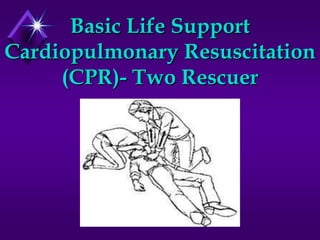
Basic Life Support
Cardiopulmonary Resuscitation
     (CPR)- Two Rescuer
Learning Objectives
At the end of this session, the students
  should b able to:-
1. Identify the acronyms of CPR.
2. Explain the acronyms DRABC.
3. Practice on two rescuer of CPR.
4. List the types of injuries in perform
   CPR.
5. List the complications of CPR.
CPR
 Combines  rescue breathing and chest
  compressions.
 Revives heart (cardio) and lung
  (pulmonary) functioning.
   Use when there is no breathing and
    no pulse.
 Provides O² to the brain until
  paramedics arrives.
How CPR Works
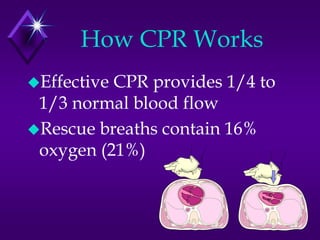
EffectiveCPR provides 1/4 to
 1/3 normal blood flow
Rescue breaths contain 16%
 oxygen (21%)
Start CPR Immediately
Betterchance of survival.
Brain damage starts in 4-6
 minutes.
Brain damage is certain after 10
 minutes without CPR.
DRABC
D – DANGER
R – RESPONSIVENESS
A- AIRWAYS
B – BREATHING
C - CIRCULATION
Two Rescuer CPR
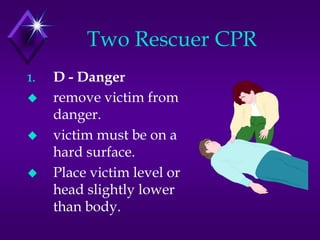
1.   D - Danger
    remove victim from
     danger.
    victim must be on a
     hard surface.
    Place victim level or
     head slightly lower
     than body.
Two Rescuer CPR
2. R - Responsiveness
 First rescuer check for
   responsiveness
 - Tap shoulder and shout “Are you
 ok?”
 - if unresponsive…….
  call 991 or 999.
Two Rescuer CPR
3. A - Airway
 First rescuer check the airway.
   Open the airway.
   Head tilt and chin lift.
Two Rescuer CPR
4. B - Breathing
 Look, listen and feel for breathing.
    No longer than 10 seconds.
    Pinch the nose.
 Seal the mouth with yours.
 First rescuer gives two breathing in 5 seconds.
    If the first two don’t go in, re-tilt and give two
      more breaths (if breaths still do not go in,
      suspect choking).
 Second rescuer bares the chest.
Two Rescuer CPR
5. C – Circulation
 First rescuer palpate the carotid pulse.
 Second rescuer properly positions his hands
  for chest compression.
  - Locate proper hand position for chest
  compressions.
  - Place heel of one hand on center of chest
  between the nipples.
Two Rescuer CPR -
           Circulation (cont…)
 Ifthe patient is pulseless, the first rescuer
  say ‘commence CPR’ and give two
  breathing.
 The second rescuer commemces fiftheen
  chest compressions.
  - Depth of compressions: 1 .5 to 2 inches
  - Count 1, 2, 3 …
Two Rescuer CPR -
         Circulation (cont…)
  The first rescuer feel the carotid pulse
  to determine adequate compressions.
 The second rescuer delivers fifthteen
  compressions at one persecond,
  counting out load.
 The first rescuer give a two ventilation
  of every fifthteen compressions.
Two Rescuer CPR
6. If patient recover, put at the recovery
  position (semiprone position).

7. Check if the patient vomitting and vital
  signs.
Injuries Related to CPR

1. Rib fractures
2. Laceration related to the tip of the
  sternum
   Liver, lung, spleen
Complications of CPR
1. Vomiting
 Aspiration..
 Place  victim on left side
 Wipe vomit from mouth with
  fingers wrapped in a cloth
 Reposition and resume CPR.
Complicatons of CPR
            (cont…)
2. Stomach distension
- Air in the stomach
   Creates pressure against the lungs.
- Prevention of Stomach Distension:-
   Don’t  blow too hard.
   Slow rescue breathing.
   Re-tilt the head to make sure the airway is
    open.
   Use mouth to nose method.
Practical Session by
          tomorrow
- 29/10/2011
- Saturday
- 1pm
- Skill lab, 4 th floor, FSK 2
Thank You…..

Cpr 3 (two rescuer)

  • 1.
    Basic Life Support CardiopulmonaryResuscitation (CPR)- Two Rescuer
  • 2.
    Learning Objectives At theend of this session, the students should b able to:- 1. Identify the acronyms of CPR. 2. Explain the acronyms DRABC. 3. Practice on two rescuer of CPR. 4. List the types of injuries in perform CPR. 5. List the complications of CPR.
  • 3.
    CPR  Combines rescue breathing and chest compressions.  Revives heart (cardio) and lung (pulmonary) functioning. Use when there is no breathing and no pulse.  Provides O² to the brain until paramedics arrives.
  • 4.
    How CPR Works EffectiveCPRprovides 1/4 to 1/3 normal blood flow Rescue breaths contain 16% oxygen (21%)
  • 5.
    Start CPR Immediately Betterchanceof survival. Brain damage starts in 4-6 minutes. Brain damage is certain after 10 minutes without CPR.
  • 6.
    DRABC D – DANGER R– RESPONSIVENESS A- AIRWAYS B – BREATHING C - CIRCULATION
  • 7.
    Two Rescuer CPR 1. D - Danger  remove victim from danger.  victim must be on a hard surface.  Place victim level or head slightly lower than body.
  • 8.
    Two Rescuer CPR 2.R - Responsiveness  First rescuer check for responsiveness - Tap shoulder and shout “Are you ok?” - if unresponsive……. call 991 or 999.
  • 9.
    Two Rescuer CPR 3.A - Airway  First rescuer check the airway. Open the airway. Head tilt and chin lift.
  • 10.
    Two Rescuer CPR 4.B - Breathing  Look, listen and feel for breathing.  No longer than 10 seconds.  Pinch the nose.  Seal the mouth with yours.  First rescuer gives two breathing in 5 seconds.  If the first two don’t go in, re-tilt and give two more breaths (if breaths still do not go in, suspect choking).  Second rescuer bares the chest.
  • 11.
    Two Rescuer CPR 5.C – Circulation  First rescuer palpate the carotid pulse.  Second rescuer properly positions his hands for chest compression. - Locate proper hand position for chest compressions. - Place heel of one hand on center of chest between the nipples.
  • 12.
    Two Rescuer CPR- Circulation (cont…)  Ifthe patient is pulseless, the first rescuer say ‘commence CPR’ and give two breathing.  The second rescuer commemces fiftheen chest compressions. - Depth of compressions: 1 .5 to 2 inches - Count 1, 2, 3 …
  • 13.
    Two Rescuer CPR- Circulation (cont…)  The first rescuer feel the carotid pulse to determine adequate compressions.  The second rescuer delivers fifthteen compressions at one persecond, counting out load.  The first rescuer give a two ventilation of every fifthteen compressions.
  • 14.
    Two Rescuer CPR 6.If patient recover, put at the recovery position (semiprone position). 7. Check if the patient vomitting and vital signs.
  • 15.
    Injuries Related toCPR 1. Rib fractures 2. Laceration related to the tip of the sternum Liver, lung, spleen
  • 16.
    Complications of CPR 1.Vomiting Aspiration.. Place victim on left side Wipe vomit from mouth with fingers wrapped in a cloth Reposition and resume CPR.
  • 17.
    Complicatons of CPR (cont…) 2. Stomach distension - Air in the stomach  Creates pressure against the lungs. - Prevention of Stomach Distension:-  Don’t blow too hard.  Slow rescue breathing.  Re-tilt the head to make sure the airway is open.  Use mouth to nose method.
  • 18.
    Practical Session by tomorrow - 29/10/2011 - Saturday - 1pm - Skill lab, 4 th floor, FSK 2
  • 19.