Course Mapping
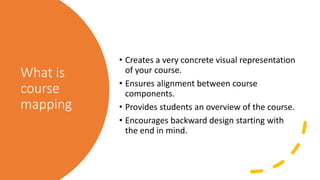
What is
course
mapping
• Creates a very concrete visual representation
of your course.
• Ensures alignment between course
components.
• Provides students an overview of the course.
• Encourages backward design starting with
the end in mind.
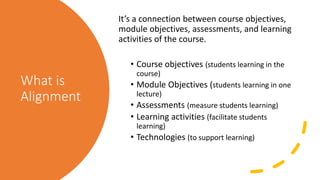
What is
Alignment
It’s a connection between course objectives,
module objectives, assessments, and learning
activities of the course.
• Course objectives (students learning in the
course)
• Module Objectives (students learning in one
lecture)
• Assessments (measure students learning)
• Learning activities (facilitate students
learning)
• Technologies (to support learning)
What is
Backward
design
• Backward design is focused primarily on
student learning and understanding.
• Once learning goals have been identified,
instructors will have easier time developing
assessments and instructions based on the
goals.
• Three stages of Backward Design are:
• Identify desired results,
• Determine acceptable evidence, and
• Plan learning experiences and instructions.
Creating
Objectives
• Are objectives measurable?
• Are objectives relevant to the course?
• Do objectives cover whole course?
• Are objectives written using language the
students will understand?
• Are objectives appropriate to the level of the
course?
Action Tips
for Course
Objectives
• Write objectives that are SMART
• Specific
• Measurable
• Action-oriented
• Realistic
• Time based
• Begin each objective with a verb.
• Match your verbs to your activities and
assessments.
List
Assessments
• Do the assessments measure state
objectives?
• Are the assessments sequenced, built on
pervious knowledge, varied and suited to
the level of the course?
• Are the assessments comprehensive and do
they provide opportunities for peer
evaluation?
• Are there multiple opportunities to track
learnings?
List learning
activities
• Do activities promote achievement of all
learning objectives?
• DO you have the list of all the required and
optional readings?
• Do activities provide opportunities for active
learning?
• Are the opportunities to interact with
material, instructor and other students
exist?
• Are there opportunities to practice?
List Course
Technologies
• Are materials up to date
• Are materials from varied sources
• Are optional materials clearly marked
• Do technologies contribute to achieving
objectives
• Do the course tools promote learner
engagement and active learning
• Are the technologies in the course readily
attainable
• Are the technologies current
Steps to
create a
course map
• Create course specific learning outcomes.
Think in terms of what will students know,
value and be able to be do by the end of the
course.
• Modularize your course for achieving these
course learning outcomes. (These are the
topics which you want to cover in the
course)
• Create modules objectives, match them with
the course learning outcomes.
Steps to
create a
course map
• Create course specific learning outcomes.
Think in terms Create assessments that will
provide evidence that students have
achieved the module objectives
• Create learning experiences for the students
by actualizing what learning experiences will
students actively engage in as they progress
towards the module objective.
• Mention the technologies and materials
needed to support students learning.
Course
Mapping
Tips
• Familiarize yourself with the course
• What components do you have?
• What will you need to develop
• Do you need a new research article for
students to read
• Is there a new technology which will help
students learn
• Course mapping is a fluid and continuous
process. You may jump to and return to the
steps as you develop your course map.

Course mapping

  • 1.
  • 2.
    What is course mapping • Createsa very concrete visual representation of your course. • Ensures alignment between course components. • Provides students an overview of the course. • Encourages backward design starting with the end in mind.
  • 3.
    What is Alignment It’s aconnection between course objectives, module objectives, assessments, and learning activities of the course. • Course objectives (students learning in the course) • Module Objectives (students learning in one lecture) • Assessments (measure students learning) • Learning activities (facilitate students learning) • Technologies (to support learning)
  • 4.
    What is Backward design • Backwarddesign is focused primarily on student learning and understanding. • Once learning goals have been identified, instructors will have easier time developing assessments and instructions based on the goals. • Three stages of Backward Design are: • Identify desired results, • Determine acceptable evidence, and • Plan learning experiences and instructions.
  • 5.
    Creating Objectives • Are objectivesmeasurable? • Are objectives relevant to the course? • Do objectives cover whole course? • Are objectives written using language the students will understand? • Are objectives appropriate to the level of the course?
  • 6.
    Action Tips for Course Objectives •Write objectives that are SMART • Specific • Measurable • Action-oriented • Realistic • Time based • Begin each objective with a verb. • Match your verbs to your activities and assessments.
  • 7.
    List Assessments • Do theassessments measure state objectives? • Are the assessments sequenced, built on pervious knowledge, varied and suited to the level of the course? • Are the assessments comprehensive and do they provide opportunities for peer evaluation? • Are there multiple opportunities to track learnings?
  • 8.
    List learning activities • Doactivities promote achievement of all learning objectives? • DO you have the list of all the required and optional readings? • Do activities provide opportunities for active learning? • Are the opportunities to interact with material, instructor and other students exist? • Are there opportunities to practice?
  • 9.
    List Course Technologies • Arematerials up to date • Are materials from varied sources • Are optional materials clearly marked • Do technologies contribute to achieving objectives • Do the course tools promote learner engagement and active learning • Are the technologies in the course readily attainable • Are the technologies current
  • 10.
    Steps to create a coursemap • Create course specific learning outcomes. Think in terms of what will students know, value and be able to be do by the end of the course. • Modularize your course for achieving these course learning outcomes. (These are the topics which you want to cover in the course) • Create modules objectives, match them with the course learning outcomes.
  • 11.
    Steps to create a coursemap • Create course specific learning outcomes. Think in terms Create assessments that will provide evidence that students have achieved the module objectives • Create learning experiences for the students by actualizing what learning experiences will students actively engage in as they progress towards the module objective. • Mention the technologies and materials needed to support students learning.
  • 12.
    Course Mapping Tips • Familiarize yourselfwith the course • What components do you have? • What will you need to develop • Do you need a new research article for students to read • Is there a new technology which will help students learn • Course mapping is a fluid and continuous process. You may jump to and return to the steps as you develop your course map.