Course Mapping
What is
Course
Mapping
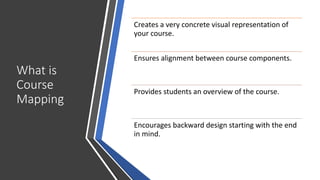
Creates a very concrete visual representation of
your course.
Ensures alignment between course components.
Provides students an overview of the course.
Encourages backward design starting with the end
in mind.
What is Course Alignment
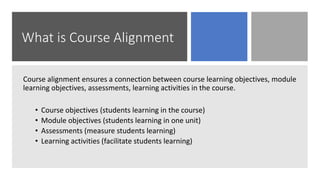
Course alignment ensures a connection between course learning objectives, module
learning objectives, assessments, learning activities in the course.
• Course objectives (students learning in the course)
• Module objectives (students learning in one unit)
• Assessments (measure students learning)
• Learning activities (facilitate students learning)
What is Backward Design
• Backward design identifies what students are expected to learn and then design
assessments to test their learning and then design the lesson to achieve the
desired results.
• Once learning objectives have been identified, instructors will have an easier time
developing assessments and instructions based on the objectives.
• Three stages of Backward Design are:
• Identify desired results,
• Determine acceptable evidence, and
• Plan instructional materials and student engagement.
Creating Objectives
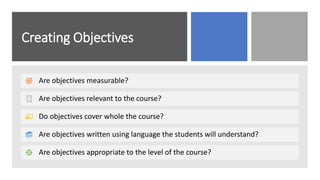
Are objectives measurable?
Are objectives relevant to the course?
Do objectives cover whole the course?
Are objectives written using language the students will understand?
Are objectives appropriate to the level of the course?
Action Tips for Course
Objectives
Write objectives that are
S.M.A.R.T.
Specific, Measurable, Attainable
Realistic & Timely
Begin each objective
with a verb.
Match your verbs to
your activities and
assessments.
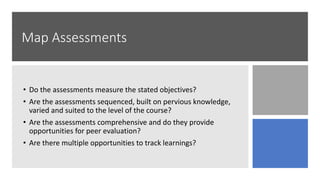
Map Assessments
• Do the assessments measure the stated objectives?
• Are the assessments sequenced, built on pervious knowledge,
varied and suited to the level of the course?
• Are the assessments comprehensive and do they provide
opportunities for peer evaluation?
• Are there multiple opportunities to track learnings?
Map Learning Activities
• Do activities promote achievement of all learning objectives?
• Do activities provide opportunities for active learning?
• Are there opportunities for students to interact with material,
the instructor and other students?
• Do these activities promote learner engagement and active
learning?
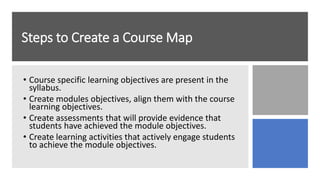
Steps to Create a Course Map
• Course specific learning objectives are present in the
syllabus.
• Create modules objectives, align them with the course
learning objectives.
• Create assessments that will provide evidence that
students have achieved the module objectives.
• Create learning activities that actively engage students
to achieve the module objectives.
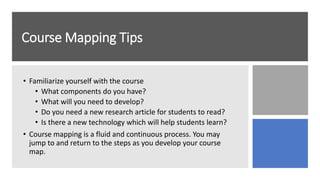
Course Mapping Tips
• Familiarize yourself with the course
• What components do you have?
• What will you need to develop?
• Do you need a new research article for students to read?
• Is there a new technology which will help students learn?
• Course mapping is a fluid and continuous process. You may
jump to and return to the steps as you develop your course
map.

Course Mapping.pptx

  • 1.
  • 2.
    What is Course Mapping Creates avery concrete visual representation of your course. Ensures alignment between course components. Provides students an overview of the course. Encourages backward design starting with the end in mind.
  • 3.
    What is CourseAlignment Course alignment ensures a connection between course learning objectives, module learning objectives, assessments, learning activities in the course. • Course objectives (students learning in the course) • Module objectives (students learning in one unit) • Assessments (measure students learning) • Learning activities (facilitate students learning)
  • 4.
    What is BackwardDesign • Backward design identifies what students are expected to learn and then design assessments to test their learning and then design the lesson to achieve the desired results. • Once learning objectives have been identified, instructors will have an easier time developing assessments and instructions based on the objectives. • Three stages of Backward Design are: • Identify desired results, • Determine acceptable evidence, and • Plan instructional materials and student engagement.
  • 5.
    Creating Objectives Are objectivesmeasurable? Are objectives relevant to the course? Do objectives cover whole the course? Are objectives written using language the students will understand? Are objectives appropriate to the level of the course?
  • 6.
    Action Tips forCourse Objectives Write objectives that are S.M.A.R.T. Specific, Measurable, Attainable Realistic & Timely Begin each objective with a verb. Match your verbs to your activities and assessments.
  • 7.
    Map Assessments • Dothe assessments measure the stated objectives? • Are the assessments sequenced, built on pervious knowledge, varied and suited to the level of the course? • Are the assessments comprehensive and do they provide opportunities for peer evaluation? • Are there multiple opportunities to track learnings?
  • 8.
    Map Learning Activities •Do activities promote achievement of all learning objectives? • Do activities provide opportunities for active learning? • Are there opportunities for students to interact with material, the instructor and other students? • Do these activities promote learner engagement and active learning?
  • 9.
    Steps to Createa Course Map • Course specific learning objectives are present in the syllabus. • Create modules objectives, align them with the course learning objectives. • Create assessments that will provide evidence that students have achieved the module objectives. • Create learning activities that actively engage students to achieve the module objectives.
  • 10.
    Course Mapping Tips •Familiarize yourself with the course • What components do you have? • What will you need to develop? • Do you need a new research article for students to read? • Is there a new technology which will help students learn? • Course mapping is a fluid and continuous process. You may jump to and return to the steps as you develop your course map.