Country Project Madeline Avallon
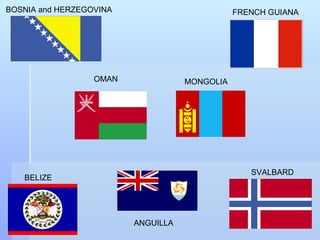
OMAN ANGUILLA FRENCH GUIANA MONGOLIA SVALBARD BELIZE BOSNIA and HERZEGOVINA
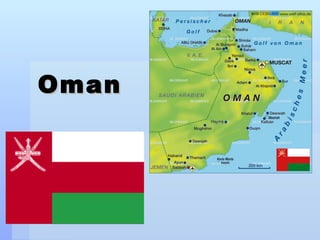
Oman
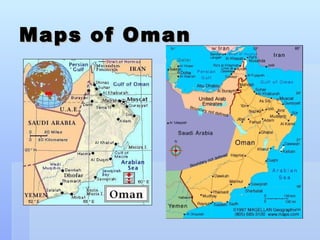
Maps of Oman
Description Total Area:  309,500 sq km 0 sq km of water Location : 21 00 N, 57 00 E  In the Middle East bordering the Arabian Sea, Gulf of Oman, and Persian Gulf. between Yemen and UAE Population:  3,027,959 Climate:  arid subtropical, the climate differs from one region to another. the interior is normally very hot, with temperatures from May to October. The coastal areas are hot and humid from April to October. The summer wind, the  Gharbi , makes the heat more oppressive. the south has a more moderate climate.
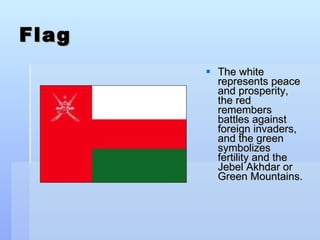
Flag The white represents peace and prosperity, the red remembers battles against foreign invaders, and the green symbolizes fertility and the Jebel Akhdar or Green Mountains.
Geography desert plains in the center rugged mountains in the north and south lowest point: Arabian Sea 0 m. highest point: Jabal Shams 2,980 m it is broken into 5 regions: Ad Dakhiliyah, Al Batinah, Al Wusta, Ash Sharqiyah and Az Zahirah, and 3 governorates: Masqat, Musandam and Zufur There are no lakes in Oman, the country has two large areas of salt flats, one in the west-central region and another off the eastern coast. Capital: Muscat
Geography (continued) Wildlife includes: leopard, Oryx, gazelle, ibex, desert foxes, wild cats, 400 species of birds, exotic marine life like turtles, tropical fish, and also 22 species of whale and dolphin in warm waters Oman offers some of the most stunning beaches with a coastline of 1700km. Khawr Najd, Kumzar Village located in the far north of Musandam peninsula, and Salalah a well known beach, the city of Muscat, its museums and mosques; the coastal sea town of Sur; the historical monuments of Nizwa - the country's ancient capital; the Musandam Peninsula with endless fishing and scuba diving are just a few interesting attractions
History Little is known about Oman's pre-Islamic past but recent discoveries say that early civilizations existed at least 5,000 years ago. The Omanis are believed to have come from Yemen or northern Arabia. The conversion to Islam occurred in the 7th century. Muscat, the capital was occupied by the Portuguese from 1508 to 1648, then the Ottoman Turks. in 1741, Ahmad Ibn Sa'id forced the Turks out, and the descendants of Sultan Ahmad rule Oman today. On July 23, 1970, the sultan, Sa'id bin Taimur, was overthrown by his son, Qabus Ibn Sa'id, who promised to establish a modern government Oman joined the Arab League and the United Nations in 1971.
History (continued) In 1997, Sultan Qabus granted women the right to be elected to the country's consultative body, the Shura Council.  In 2003, the sultan extended voting rights to everyone over 21; previously, voters were selected from among the elite, and only about a quarter of the population was allowed to vote. A long border dispute with Yemen was resolved in Oct. 1992; in 1997,
Current Day In late February 2011, protesters took to the streets of Sohar in the northeast, and demanded higher salaries, more employment opportunities, and other political reform. Police moved in and fired rubber bullets at the demonstrators, killing two people. After the violence, Sultan Qabus promised to create 50,000 jobs and offered each person seeking employment about $390 per month.
Economy Natural resources include: oil, natural gas, copper, marble, limestone, and chromium. Products   include dates, bananas, mangos, alfalfa Fisheries include kingfish, tuna, shrimp, lobster, abalone. Trade (2008): Exports -$37.72 billion.  Major markets --China, U.A.E., Japan, South Korea, Thailand.  Imports --$22.92 billion: machinery, transportation equipment, manufactured goods, food, livestock, lubricants.  Major suppliers --U.A.E., Japan, United States, China, India. Major industries include: crude oil production and refining, natural and liquefied natural gas production; construction, cement, copper, steel, chemicals, optic fiber.
Economy/Politics Oman is a middle-income economy. it is dependent on oil resources but because of declining reserves, it has actively pursued a development plan that focuses on diversification, industrialization, and privatization, to reduce the oil sector's contribution to GDP Tourism and gas-based industries are key components of the government's diversification strategy.  Government type- Monarchy Government Leader- Sultan Ahmad
People Ethnic Groups: Arab, Baluchi, South Asian (Indian, Pakistani, Sri Lankan, Bangladeshi), African Religions: Ibadhi Muslim 75%,Sunni Muslim, Shia Muslim, Hindu Arabic (official), English, Baluchi, Urdu, Indian dialects Literacy: total population:  81.4% male:  86.8% female:  73.5% 20% of Oman’s population uses internet
People (continued) Life Expectancy total population: 74.22 years male: 72.38 years female :  76.16 years Clothing Omani men wear dishdasha, simple collarless gowns to the ankle. Furakha is a tassel sewn into the neckline of this dress, dipped in perfume. A plain piece of cloth is worn below the dishdasha covering the body. they also wear different headdresses. Some men carry an ornamental stick called assa. Most men wear sandals on their feet. Omani women dress in colorful, ornate clothing to reflect regions. The main component is a sirwal and a headdress called lihaf. they wear elaborate gold and silver jewelry around the head, neck, wrists, ankles, fingers and toes. Most women wear sandals and many paint their hands and feet with henna, especially before weddings, holidays and festivals.
Culture Omani food represent a variety and are unique from other Arab counties. Kahwa is a bitter drink like coffee flavored. It is served with Lokhemat, a deep-fried ball of flour and yeast spiced with dry fruits and nuts. Rice, meat, fish and bread are the main ingredients of most Omani dishes, like maqbous and aursia. Other specials are buttermilk drinks, salads and soups.  Shuva is a popular festive meal requiring an elaborate preparation, often by the whole village community. To make this, a whole cow is roasted up for two days in a special oven placed in a pit dug in the ground. The meat becomes extremely tender and is then spiced elaborately.
Culture (continued) Oman people have a great appreciation for tradition, the country preserves the richness of Arabian culture  They make ornate silverware and detailed embroidery The music has rhythm that adds a unique touch to the tunes. Music is a big part of the peoples’ life. They use instruments like  the mizmar, rababa, and tanbura.  Dance in Oman is marked by vibrant movements and all forms share a common dependency on beats and movement.
Conclusion Oman is a country very rich in tradition and heritage. It has a variety of wildlife and resources. Although they have no water internally it is surrounded by water so fishing is very successful. The government is very dependent on oil resource and are industrializing to reduce oil use.
Svalbard
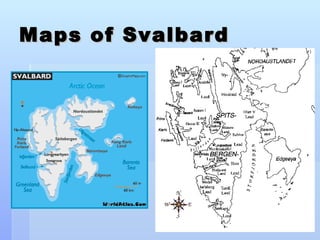
Maps of Sval bard
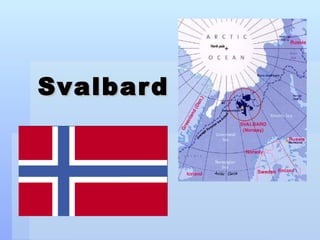
Description Total area: 62,045 sq km water :  0 sq km slightly smaller than West Virginia Climate: Arctic, cool summers, cold winters; North Atlantic Current flows along west and north coasts, keeping water open and navigable most of the year
Description Located in Northern Europe between the Arctic Ocean, Barents Sea, Greenland Sea, and Norwegian Sea north of Norway  78 00 N, 20 00 E Population : 2,019 Capital: Longyearbyen
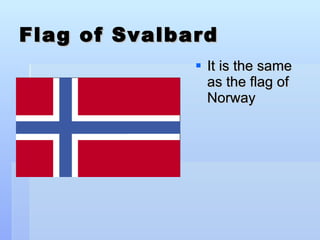
Flag of Svalbard It is the same as the flag of Norway
Geography rugged mountains much land is ice covered west coast clear of ice for about one-half of the year fjords along west and north coasts long, narrow inlet with steep sides lowest point: Arctic Ocean 0 m highest point: Newtontoppen 1,717 m northernmost part of the Kingdom of Norway; consists of nine main islands; glaciers and snowfields cover 60% of the total area
Geography The principal islands are Spitsbergen, Nordaustlandet, Barentsøya, Edgeøya, Kong Karls Land, Prins Karls Forland, and Bjørnøya (Bear Island).  there are few lakes on Svalbard. Most lakes  are small and shallow, and many bottom-freeze in winter.  The best known and studied lake on Svalbard is Linné­vatnet,.  It is more than 5 km long.
Wildlife The only indigenous land mammals in Svalbard are the Arctic fox, the Svalbard reindeer and the polar bear.  Sea mammals include the ringed and the bearded seal, walruses and various species of whales, especially minky whales and belugas.  Svalbard has a very rich bird life in summer. The ptarmigan is the only bird to remain on the island a whole year. The most common birds are auks, arctic owls and gulls.  There are no trees, but the polar willow and the dwarf birch form small bushes.  Most common plants are mosses, lichen and fungi, but there are also about 170 vascular plants.
Attractions Most tourists arrive during spring and summer. Spitsbergen is one of the few places in Norway where a snowmobile can be driven in open country without special permission. This is the only place in Europe where polar bears can be seen living in their natural habitat. With few roads outside these settlements and the main way to see more of the island is on foot, snowmobile or by boat. Expedition cruises arrive throughout the summer so tourists can explore the coast, see huge glaciers, visit the settlements and watch the wildlife. You can also join expeditions and go hiking and kayaking on the mountains and in the fjords. In winter you can do many things like snowmobiling and husky sledding.
History the Dutch voyager Willem Barents, in search of a northeast passage to China is the first visitor from the European mainland. He named the islands Spitsbergen, or ‘sharp mountains’. The Norwegian name, Svalbard, comes from the Old Norse for ‘cold coast’. In 1920 the Svalbard Treaty granted Norway sovereignty over the islands and restricted military activities. Initially signed by nine nations, it now has over 40 adherents, whose citizens enjoy the same rights on the islands as Norwegians themselves.
Politics territory of Norway administered by the Polar Department of the Ministry of Justice, through a governor residing in Longyearbyen, Spitsbergen; sovereignty was awarded to Norway  by treaty (9 February 1920) chief of state: King Harald V of Norway head of government: Governor Odd Olsen Ingero Assistant Governor Lars Fause no elections, the monarchy is hereditary;
Economy Coal mining, tourism, and international research are the major businesses There is also hunting of seals, reindeer, and foxes.  Export $197.6 million Trade partners: UK, Germany, Netherlands, France, Sweden, US
Culture Traditions: fur trapping You can dog sleigh or scooter They have colorful houses to contrast with the mountains Kayaking or hiking, many adventurous activities Food: Lapskois- traditional food, is potato simmered with diced beef, carrots and sausages.  Fish is also very important because of Svalbard’s location Protestant religion Language : English, Norwegian is spoken in Norwegian settlements, and Russian in Russian settlements.
Conclusion Svalbard is Europe’s northern most territory, it is a territory of Norway and is made up of several different islands. Coal mining and tourism are their most successful businesses. Many tourists go to see the ice and glaciers and other beautiful sites.
Bosnia and Herzegovina
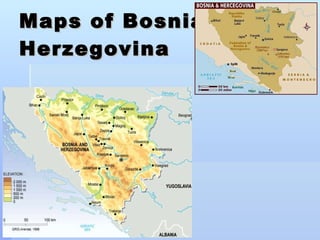
Maps of Bosnia Herzegovina
Description Capital: Sarajevo Location: Southeastern Europe bordering Croatia, Montenegro, Serbia and the Adriatic Sea 44 00 N, 18 00 E Total Area:   51,197 sq km water:   10 sq km slightly smaller than West Virginia Climate: hot summers and cold winters;  Areas of high elevation have short, cool summers and long, severe winters while the coast has mild, rainy winters Population: 4,622,163
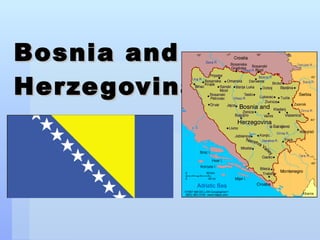
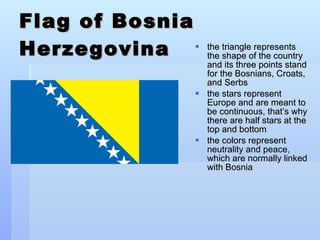
Flag of Bosnia Herzegovina  the triangle represents the shape of the country and its three points stand for the Bosnians, Croats, and Serbs  the stars represent Europe and are meant to be continuous, that’s why there are half stars at the top and bottom  the colors represent neutrality and peace, which are normally linked with Bosnia
Geography It is made up of many mountains and valleys lowest point: Adriatic Sea 0 m highest point: Maglic 2,386 m Natural resources: coal, iron ore, bauxite, copper, lead, zinc, chromite, cobalt, manganese, nickel, clay, gypsum, salt, sand, timber, hydropower Rivers and Lakes: Glina , Sava Bosna, Neretva and Bijela are a few of the many bodies of water found there. Wildlife: Eurasian lynx, bears, hundreds of species of birds, which are attracted to the many species of fish
Attractions Sarajevo is the “European Jerusalem” because of its many mosques, synagogues, and churches. Sarajevo bridges, The City Hall- the biggest building from the Austro-Hungarian period, Emperor's mosque and Cathedral of Jesus' Sacred Heart
History Bosnia-Herzegovina is annexed to Austria-Hungary. Austria-Hungary collapses at the end of world war I.  Bosnia-Herzegovina becomes part of the Kingdom of Serbs, Croats and Slovenes. It becomes a republic within the Yugoslav Socialist Federation. conflict breaks out between Muslims and Croats In 1995 Dayton peace accord creates two lands, one for Bosnian Muslims and Croats, the other for Serbs  2011- Bosnia's central government has still not yet been formed
Political It is trying to become a federal democratic republic Chairman of the Presidency Nebojsa Radmanovic Chairman of the Council of Ministers Nikola Spiric
Economy second poorest republic of the former Yugoslavia  Major industries: steel, coal, iron ore, lead, zinc, manganese, aluminum, vehicle assembly, textiles, tobacco products, wooden furniture, ammunition, domestic appliances, oil refining Agriculture: wheat, corn, fruits, vegetables; livestock Exports: metals, clothing, wood products Partners: Croatia, Slovenia, Italy, Germany, Austria Imports: machinery and equipment, chemicals, fuels, food Partners: Croatia, Germany, Slovenia, Italy, Austria, Hungary
Culture Food: The food is influenced by its Balkan neighbors. bread, soups, stews, kebabs, cevapcici-minced meat sausages, and stuffed peppers. Side dishes, such as sour cabbage, tomato and onion salad and yogurt, are often served. Sarajevski sahan: vegetables stuffed with meat and rice. Bosnian pot: thick stew-like soup made of veal and vegetables flavored spices like cardamom, cloves and cinnamon Desserts eaten are fruit, pancakes, cakes and pastries. Language: Bosnian, Croatian and Serbian Religion: about 40%  Muslim, a little over 30% Orthodox Church, about 15% Roman Catholic.  the end of Ramadan is celebrated with a large family meal and sweets and pastries
Culture (cont) Bosnia has a patriarchal tradition in which women are expected to be subservient to men Women are responsible for all domestic tasks, including cooking, cleaning, and child rearing inheritance follows a system of primogeniture It is traditional to remove one's shoes and put on a pair of slippers. Kissing is a common form of greeting for both men and women, three kisses on the cheeks
Conclusion Bosnia and Herzegovina is influenced greatly by its surrounding nations. Its economy is not doing very well, it is one of the poorest of the former Yugoslavia lands. There is also difficulty forming a central government. There are many places to visit and many species of fish and birds all around. It is a patriarchal and most women work in the homes
French Guiana
Maps of French Guiana
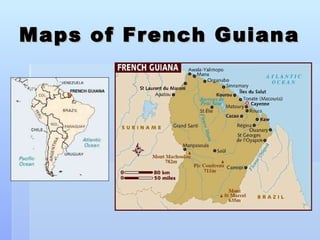
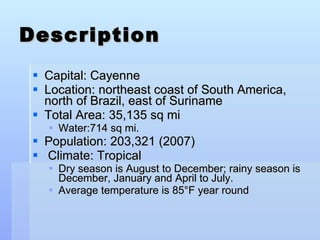
Description Capital: Cayenne Location: northeast coast of South America, north of Brazil, east of Suriname  Total Area: 35,135 sq mi  Water:714 sq mi. Population: 203,321 (2007) Climate: Tropical Dry season is August to December; rainy season is December, January and April to July.  Average temperature is 85°F year round
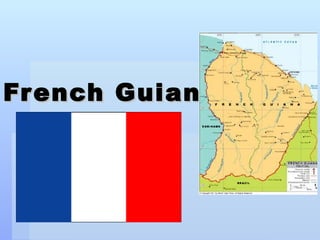
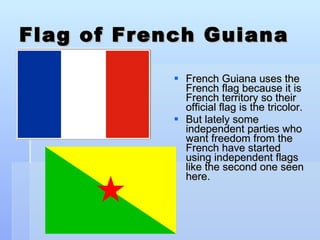
Flag of French Guiana French Guiana uses the French flag because it is French territory so their official flag is the tricolor. But lately some independent parties who want freedom from the French have started using independent flags like the second one seen here.
Geography Lowland moist forest, swamp forest, low summit forest Amazon, Negro and Orinoco rivers It has twenty-six different regions Cayenne River, Wanapi River, Inini River,  and the Mana River are a few of the rivers in French Guiana It is a French territory Opossum, armadillo, sloth, anteater, rabbit, crocodile, iguana, snake, stork, parrot, shark, ray and bat are all found here
Places of Interest Iles du Salut Devil’s Island – where political prisoners were held Kourou - The main French Space Center Emerald Jungle Village Fort Diamant Salvation Islands
History 1498 French Guiana was first visited by Christopher Columbus on his third voyage and  In 1604 France tried to settle there, but had to abandon it because of the Portuguese, who said it violated the Treaty of Tordesillas. French settlers returned, however, in 1643 and managed to establish a settlement at Cayenne French Guiana became an overseas  department  of France in 1946. The penal colonies, including Devil's Island, were phased out and then formally closed in 1951.  At first, only those freed prisoners who could raise the fare for their return passage to France were able to go home, so French Guiana was haunted after the official closing of the prisons by freed convicts
Government  chief of state: President of France: Jacques CHIRAC  It is a territory of France  President of the General Council Stephan PHINERA  General Council-19 seats, members are elected by popular vote, serve six-year terms Regional Council-31 seats, members are elected by popular vote, serve six-year terms
Economy Exports: shrimp, timber, gold, rum, rosewood essence, clothing, fish Partners: France, Switzerland, US  Imports: food machinery and transport equipment, fuels and chemicals  Partners: France, US, Trinidad and Tobago, Italy  It is dependent on importing Main industry: construction, shrimp processing, forestry products, rum, gold mining  Agriculture products: corn, rice, sugar, cocoa, vegetables, bananas; cattle, poultry
Culture languages: French (official), Creole  religion: Christianity  Life expectancy: 72 years (men), 78 years (women)  Food: a lot of fish, fruits and vegetables, many spices, hot peppers, curry Roti is a popular dish its made with meat and vegetables, cooked with curry and wrapped in bread.   83% literacy rate 20.5% internet usage (2007)
Conclusion French Guiana is a territory of France so it has many things in common with France. The people rely on importing items very much. The warm temperature is good for many animals that live there as well as for items to export
Mongolia
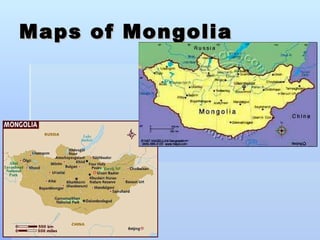
Maps of Mongolia
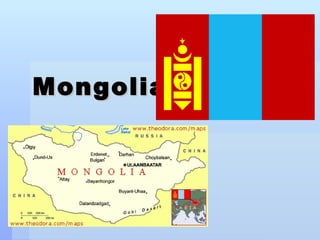
Description Capital: Ulaanbaatar Total area:1,564,116 sq km Water : 10,560 sq km  Location: Northern Asia between China and Russia 46 00 N, 105 00 E Climate: extreme continental climate with long, cold winters and short summers averages 257 cloudless days a year Precipitation in the north averages 20 to 35 centimeters a year in the south it receives 10 to 20 centimeters a year Population: 3,133,318
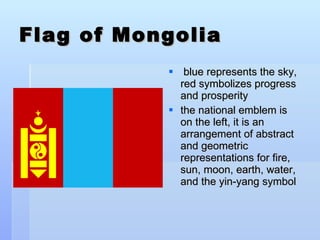
Flag of Mongolia blue represents the sky, red symbolizes progress and prosperity the national emblem is on the left, it is an arrangement of abstract and geometric representations for fire, sun, moon, earth, water, and the yin-yang symbol
Geography semi-desert and desert plains, grassy steppe, mountains in west and southwest; Gobi Desert in south-central lowest point: Hoh Nuur 560 m highest point: Nayramadlin Orgil 4,374 m Landlocked, some areas have limited fresh water Lakes and rivers: Lake Khövsgöl, many salt lakes, Beltes River, Khogorog River, Selenge River Wildlife: 136 mammal species,400 types of birds, 76 species of fish. Wolves, snow leopards, wild boar, elk, brown bears, marmot, muskrat, fox, steppe fox, wild horses and sable are just a few .
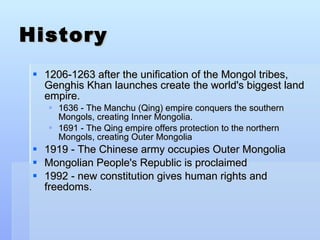
History 1206-1263 after the unification of the Mongol tribes, Genghis Khan launches create the world's biggest land empire.  1636 - The Manchu (Qing) empire conquers the southern Mongols, creating Inner Mongolia.  1691 - The Qing empire offers protection to the northern Mongols, creating Outer Mongolia 1919 - The Chinese army occupies Outer Mongolia  Mongolian People's Republic is proclaimed  1992 - new constitution gives human rights and freedoms.
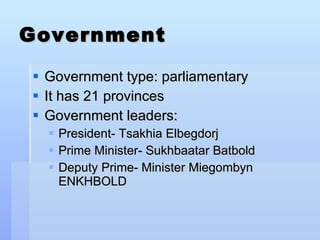
Government Government type: parliamentary It has 21 provinces Government leaders: President- Tsakhia Elbegdorj  Prime Minister- Sukhbaatar Batbold Deputy Prime- Minister Miegombyn ENKHBOLD
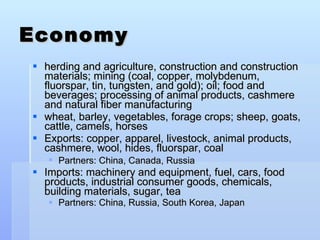
Economy herding and agriculture, construction and construction materials; mining (coal, copper, molybdenum, fluorspar, tin, tungsten, and gold); oil; food and beverages; processing of animal products, cashmere and natural fiber manufacturing wheat, barley, vegetables, forage crops; sheep, goats, cattle, camels, horses Exports: copper, apparel, livestock, animal products, cashmere, wool, hides, fluorspar, coal Partners: China, Canada, Russia   Imports: machinery and equipment, fuel, cars, food products, industrial consumer goods, chemicals, building materials, sugar, tea Partners: China, Russia, South Korea, Japan
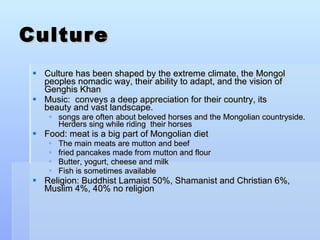
Culture Culture has been shaped by the extreme climate, the Mongol peoples nomadic way, their ability to adapt, and the vision of Genghis Khan Music:  conveys a deep appreciation for their country, its beauty and vast landscape.  songs are often about beloved horses and the Mongolian countryside. Herders sing while riding  their horses  Food: meat is a big part of Mongolian diet The main meats are mutton and beef  fried pancakes made from mutton and flour Butter, yogurt, cheese and milk  Fish is sometimes available Religion: Buddhist Lamaist 50%, Shamanist and Christian 6%, Muslim 4%, 40% no religion
Culture (cont) Language: Khalkha Mongol 90%, Turkic, Russian 12.5% of Mongolians use the internet 98.4% literacy rate Clothing: The del is the traditional clothing.  typically it is made of wool and worn by both men and women. Dels look like knee-length togas. They have a silk sash around the waist. They’re more functional than beautiful because of nomadic people living in the northern climes.
Conclusion Mongolia is a country with very important traditions. They follow traditions from the nomadic Mongols very much. They appreciate there land and country very much. They have many different animals living their even though the climate is cold most of the year.
Anguilla
Maps of Anguilla
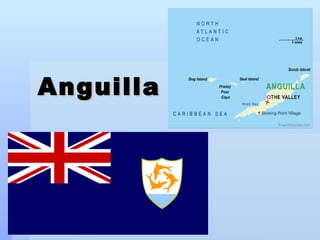
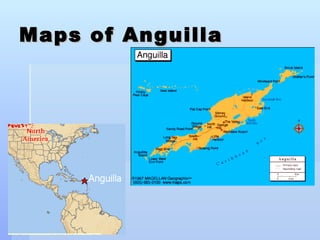
Description Location: between the Caribbean Sea and North Atlantic Ocean, east of Puerto Rico  18 15 N, 63 10 W Total area:91 sq km Water 0 sq km Climate: tropical humid; climate depends on Northeast Trade Winds.  average rainfall 900-1000 mm  June to November are hurricane months  Capital: The Valley Population: 15,094  It is a British overseas territory
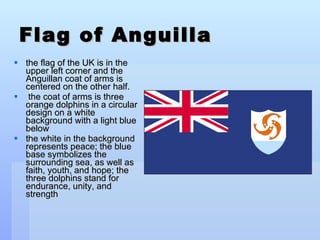
Flag of Anguilla the flag of the UK is in the upper left corner and the Anguillan coat of arms is centered on the other half. the coat of arms is three orange dolphins in a circular design on a white background with a light blue below  the white in the background represents peace; the blue base symbolizes the surrounding sea, as well as faith, youth, and hope; the three dolphins stand for endurance, unity, and strength
Geography lowest point: Caribbean Sea 0 m highest point: Crocus Hill 65 m Anguilla is a coral and limestone island It is covered with sparse vegetation,  no rivers; several salt ponds, used for the production of salt. Wildlife: flamingos, island goats, scorpion, craps, tortoises, cows, lizards and birds, these animals have adapted to Anguillas harsh climate to survive
History Anguilla is administered by the British Government through Antigua from 1667 to 1824 Placed under control of St. Kitts and suffer for years They expel St. Kitts-directed police force and demand direct links with Britain.  Britain invades Anguilla, the military force is met by a few children and journalists, not a shot was fired. world press heaps scorn on Britain(1969) 1980: Britain agrees to allows Anguilla to become a British Dependent Territory
Government Queen Elizabeth II, represented by Governor Alistair Harrison  head of government: Chief Minister Hubert Hughes overseas territory of the UK
Economy Anguilla is not industrialized  few natural resources; the economy depends tourism, offshore banking, lobster fishing, and remittances from emigrants Exports: lobster, fish, livestock, salt, concrete blocks, rum Imports: fuels, foodstuffs, manufactures, chemicals, trucks, textiles Great Britain and its neighboring islands are Anguilla's major trade partners
Culture men make up the majority of the workforce. But women own shops or work in the tourist business, in hotels, restaurants, or markets. Women are also employed in agricultural work Politeness and manners are considered important  Religion: Protestant mainly Anglican and Methodist, Roman Catholic is second-largest religious group, Obeah, which is similar to voodoo is practiced by some.  Language: English, Creole language- a mixture of English and African languages. 46.3% of Anguilla’s population uses the internet Literacy rate: 95%
Conclusion Although Anguilla is not industrialized it seems to be doing pretty well and may be in the process of industrialization. They have a 95% literacy rate. Men make up most of the work force but women can work as well. Their economy depends heavily on tourism and their tropical climate makes tourism very successful.
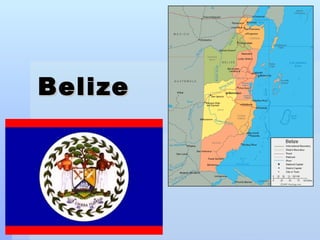
Belize
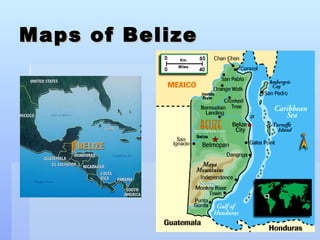
Maps of Belize
Description Capital: Belmopan  Location: Central America, between Guatemala and Mexico 17 15 N, 88 45 W Total Area: 22,966 sq km Water: 160 sq. km. slightly smaller than Massachusetts Climate: tropical; hot and humid; May to November is the rainy season; February to May is the dry season; temperature usually ranges from 50 °F  to 95 °F Population: 321,115
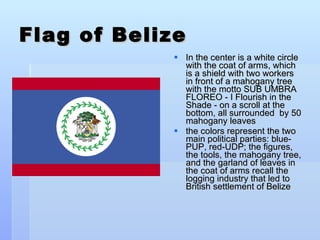
Flag of Belize In the center is a white circle with the coat of arms, which is a shield with two workers in front of a mahogany tree with the motto SUB UMBRA FLOREO - I Flourish in the Shade - on a scroll at the bottom, all surrounded  by 50 mahogany leaves the colors represent the two main political parties: blue-PUP, red-UDP; the figures, the tools, the mahogany tree, and the garland of leaves in the coat of arms recall the logging industry that led to British settlement of Belize
Geography The land is a flat, swampy coastal plain; low mountains in south, it has a lot of forests lowest point: Caribbean Sea 0 m highest point: Victoria Peak at 1120 m The Belize River is the main river. Golden Stream, Middle River, Deep River, Freshwater Creek , Mango Creek, Anacleto River, Brian Chan River and Israel Pond  are just a few more rivers and lakes. 6 districts: Belize, Cayo, Corozal, Orange Walk, Stann Creek, Toledo
Places of Interest St. John's Cathedral- the oldest building in Belize Bliss Institute for the Performing Arts, House of Culture Museum and Baron Bliss Lighthouse Monument Swing Bridge- the only functional manually operated swing bridge in the world today
History That Mayan civilization flourished here for eons; great cities were formed, massive ceremonial buildings, palaces, temples and personal dwellings were constructed, and the people farmed the land very well. The Spanish tried to take over the Mayans in Belize but could never succeed.  There was conflict between the Spanish and British over control of Belize. The British had limited power while the Spanish had sovereignty over Belize until September 10, 1798 when there was a Spanish attack on the Settlement of Belize The British won and the Spanish never tried to control Belize again Caste War of Yucatán was the war of the Mayan people against those of European descent
Current Day The Central Bank of Belize and The Belize Bank are in a court battle. The Central Bank wants the Belize Bank to stop parallel banking. This was brought up because of the dept of the Luke Espat Group which is a total of 190 million Belize dollars. 150 million is being covered by the Turks and Cairos but the rest is for the Belize Bank.  They went to court because the Belize Bank doesn't think the Central Bank has the authority to tell them to stop parallel banking. The trial will begin on March 23. The outcome can have a great effect on how Belize's largest banks operate.
Government It is a parliamentary democracy and a Commonwealth realm chief of state:   Queen Elizabeth II, represented by Governor General Sir Colville Young, Sr.  Prime Minister Dean Oliver Barrow Deputy  Prime Minister Gaspar Vega The Cabinet is appointed by the governor general with the advice of the prime minister. National Assembly: Senate -12 seats-serve five-year terms and the House of Representatives -31 seats, members are elected by direct popular vote and serve five-year terms
Economy Tourism is the best industry followed by exports of marine products, citrus, cane sugar, bananas, and garments. Exports : sugar, bananas, citrus, clothing, fish products, molasses, wood, crude oil Partners: US, UK, Nigeria, Cote d'Ivoire Imports : machinery and transport equipment, manufactured goods, fuels, chemicals, pharmaceuticals; food, beverages, tobacco Partners: US, Mexico, Cuba, Guatemala, Spain, China
Culture Belize’s culture is a unique mix of Mayans, Mennonites, Kriols, Garifuna, Mestizos, Spanish, English, Lebanese, East Indian and Chinese The official language is English, but Spanish is  used a lot too. The Mayans, Garifuna and Mennonites speak in their own languages.  Religion: Roman Catholic Rice is part of their daily diet. They eat rice and beans, with fried chicken, or sweet beef. They use red beans instead of the black bean, which are used in other Latin American countries. Some taditional foods are: relleno, tamales, escabeche, tacos, chimole and negro. Fruit and vegetable salad also are important parts of Belizean food. Corn is important for making tortillas, bollos and tamalitos .
Culture (cont) The people love festivals, like the San Pedro International Costa Maya Festival, Belize Carnival or International Film Festival Belize .  The Europeans brought instruments like polkas, schottisches, waltzes and quadrilles, while Africans brought instruments like the marimba.  The mix of Mestizo, African, Mayan and British influence give their music a unique sound brukdown music, is famous in the interior logging camps and is played using a banjo, guitar, drums, dingaling bell, accordion and an ass' jawbone, is a tradition in Belize
Daily Life Literacy rate: total population:  76.9%  male:  76.7%  female:  77.1%  Clothing:  Women wear long dresses, normally plain, bright colors with lace around the collar and sleeves Men wear Euro-American style clothing mostly 10.6% of the population uses internet
Conclusion  Belize’s tropical climate attracts many tourists. Tourism supports the economy the most. The culture is a mixture of many different cultures which makes it very unique Random Facts:  only country in Central America without a coastline on the North Pacific Ocean Belize's flag is the only national flag that shows human beings on it
Works Cited https://www.cia.gov/library/publications/the-world-factbook/index.html http://www.belizenet.com/history/chap3.html   http://www.mapsofworld.com/flags/french-guiana-flag.html   http://www.atlapedia.com/online/countries/bosnia.htm   http://www.colonialvoyage.com/america/eng/central/anguilla/climate.html   http://countrystudies.us/belize/20.htm   http://www.belizenet.com/weather/climate.html#top   http://www.infoplease.com/ipa/A0107544.html   http://www.mapsofworld.com/belize/culture/   http://worldstogethertravel.com/belize/quich-culture.htm   http://www.svalbard.com/SvalbardFAQ.html#religion   http://news.bbc.co.uk/2/hi/europe/country_profiles/1066981.stm   http://www.everyculture.com/Bo-Co/Bosnia-and-Herzegovina.html   http://www.everyculture.com/A-Bo/Anguilla.html   http://www.anguillian.com/article/articleview/84/1/11/   http://www.mongolianculture.com/about.html   http://www.rahul.net/dold/mongfood.htm   http://www.accu.or.jp/litdbase/policy/mng/index.htm   http://www.umsl.edu/services/govdocs/wofact98/88.htm

Country project-Madeline Avallon

  • 1.
  • 2.
    OMAN ANGUILLA FRENCHGUIANA MONGOLIA SVALBARD BELIZE BOSNIA and HERZEGOVINA
  • 3.
  • 4.
  • 5.
    Description Total Area: 309,500 sq km 0 sq km of water Location : 21 00 N, 57 00 E In the Middle East bordering the Arabian Sea, Gulf of Oman, and Persian Gulf. between Yemen and UAE Population: 3,027,959 Climate: arid subtropical, the climate differs from one region to another. the interior is normally very hot, with temperatures from May to October. The coastal areas are hot and humid from April to October. The summer wind, the Gharbi , makes the heat more oppressive. the south has a more moderate climate.
  • 6.
    Flag The whiterepresents peace and prosperity, the red remembers battles against foreign invaders, and the green symbolizes fertility and the Jebel Akhdar or Green Mountains.
  • 7.
    Geography desert plainsin the center rugged mountains in the north and south lowest point: Arabian Sea 0 m. highest point: Jabal Shams 2,980 m it is broken into 5 regions: Ad Dakhiliyah, Al Batinah, Al Wusta, Ash Sharqiyah and Az Zahirah, and 3 governorates: Masqat, Musandam and Zufur There are no lakes in Oman, the country has two large areas of salt flats, one in the west-central region and another off the eastern coast. Capital: Muscat
  • 8.
    Geography (continued) Wildlifeincludes: leopard, Oryx, gazelle, ibex, desert foxes, wild cats, 400 species of birds, exotic marine life like turtles, tropical fish, and also 22 species of whale and dolphin in warm waters Oman offers some of the most stunning beaches with a coastline of 1700km. Khawr Najd, Kumzar Village located in the far north of Musandam peninsula, and Salalah a well known beach, the city of Muscat, its museums and mosques; the coastal sea town of Sur; the historical monuments of Nizwa - the country's ancient capital; the Musandam Peninsula with endless fishing and scuba diving are just a few interesting attractions
  • 9.
    History Little isknown about Oman's pre-Islamic past but recent discoveries say that early civilizations existed at least 5,000 years ago. The Omanis are believed to have come from Yemen or northern Arabia. The conversion to Islam occurred in the 7th century. Muscat, the capital was occupied by the Portuguese from 1508 to 1648, then the Ottoman Turks. in 1741, Ahmad Ibn Sa'id forced the Turks out, and the descendants of Sultan Ahmad rule Oman today. On July 23, 1970, the sultan, Sa'id bin Taimur, was overthrown by his son, Qabus Ibn Sa'id, who promised to establish a modern government Oman joined the Arab League and the United Nations in 1971.
  • 10.
    History (continued) In1997, Sultan Qabus granted women the right to be elected to the country's consultative body, the Shura Council. In 2003, the sultan extended voting rights to everyone over 21; previously, voters were selected from among the elite, and only about a quarter of the population was allowed to vote. A long border dispute with Yemen was resolved in Oct. 1992; in 1997,
  • 11.
    Current Day Inlate February 2011, protesters took to the streets of Sohar in the northeast, and demanded higher salaries, more employment opportunities, and other political reform. Police moved in and fired rubber bullets at the demonstrators, killing two people. After the violence, Sultan Qabus promised to create 50,000 jobs and offered each person seeking employment about $390 per month.
  • 12.
    Economy Natural resourcesinclude: oil, natural gas, copper, marble, limestone, and chromium. Products include dates, bananas, mangos, alfalfa Fisheries include kingfish, tuna, shrimp, lobster, abalone. Trade (2008): Exports -$37.72 billion. Major markets --China, U.A.E., Japan, South Korea, Thailand. Imports --$22.92 billion: machinery, transportation equipment, manufactured goods, food, livestock, lubricants. Major suppliers --U.A.E., Japan, United States, China, India. Major industries include: crude oil production and refining, natural and liquefied natural gas production; construction, cement, copper, steel, chemicals, optic fiber.
  • 13.
    Economy/Politics Oman isa middle-income economy. it is dependent on oil resources but because of declining reserves, it has actively pursued a development plan that focuses on diversification, industrialization, and privatization, to reduce the oil sector's contribution to GDP Tourism and gas-based industries are key components of the government's diversification strategy. Government type- Monarchy Government Leader- Sultan Ahmad
  • 14.
    People Ethnic Groups:Arab, Baluchi, South Asian (Indian, Pakistani, Sri Lankan, Bangladeshi), African Religions: Ibadhi Muslim 75%,Sunni Muslim, Shia Muslim, Hindu Arabic (official), English, Baluchi, Urdu, Indian dialects Literacy: total population: 81.4% male: 86.8% female: 73.5% 20% of Oman’s population uses internet
  • 15.
    People (continued) LifeExpectancy total population: 74.22 years male: 72.38 years female : 76.16 years Clothing Omani men wear dishdasha, simple collarless gowns to the ankle. Furakha is a tassel sewn into the neckline of this dress, dipped in perfume. A plain piece of cloth is worn below the dishdasha covering the body. they also wear different headdresses. Some men carry an ornamental stick called assa. Most men wear sandals on their feet. Omani women dress in colorful, ornate clothing to reflect regions. The main component is a sirwal and a headdress called lihaf. they wear elaborate gold and silver jewelry around the head, neck, wrists, ankles, fingers and toes. Most women wear sandals and many paint their hands and feet with henna, especially before weddings, holidays and festivals.
  • 16.
    Culture Omani foodrepresent a variety and are unique from other Arab counties. Kahwa is a bitter drink like coffee flavored. It is served with Lokhemat, a deep-fried ball of flour and yeast spiced with dry fruits and nuts. Rice, meat, fish and bread are the main ingredients of most Omani dishes, like maqbous and aursia. Other specials are buttermilk drinks, salads and soups. Shuva is a popular festive meal requiring an elaborate preparation, often by the whole village community. To make this, a whole cow is roasted up for two days in a special oven placed in a pit dug in the ground. The meat becomes extremely tender and is then spiced elaborately.
  • 17.
    Culture (continued) Omanpeople have a great appreciation for tradition, the country preserves the richness of Arabian culture They make ornate silverware and detailed embroidery The music has rhythm that adds a unique touch to the tunes. Music is a big part of the peoples’ life. They use instruments like the mizmar, rababa, and tanbura. Dance in Oman is marked by vibrant movements and all forms share a common dependency on beats and movement.
  • 18.
    Conclusion Oman isa country very rich in tradition and heritage. It has a variety of wildlife and resources. Although they have no water internally it is surrounded by water so fishing is very successful. The government is very dependent on oil resource and are industrializing to reduce oil use.
  • 19.
  • 20.
  • 21.
    Description Total area:62,045 sq km water : 0 sq km slightly smaller than West Virginia Climate: Arctic, cool summers, cold winters; North Atlantic Current flows along west and north coasts, keeping water open and navigable most of the year
  • 22.
    Description Located inNorthern Europe between the Arctic Ocean, Barents Sea, Greenland Sea, and Norwegian Sea north of Norway 78 00 N, 20 00 E Population : 2,019 Capital: Longyearbyen
  • 23.
    Flag of SvalbardIt is the same as the flag of Norway
  • 24.
    Geography rugged mountainsmuch land is ice covered west coast clear of ice for about one-half of the year fjords along west and north coasts long, narrow inlet with steep sides lowest point: Arctic Ocean 0 m highest point: Newtontoppen 1,717 m northernmost part of the Kingdom of Norway; consists of nine main islands; glaciers and snowfields cover 60% of the total area
  • 25.
    Geography The principalislands are Spitsbergen, Nordaustlandet, Barentsøya, Edgeøya, Kong Karls Land, Prins Karls Forland, and Bjørnøya (Bear Island). there are few lakes on Svalbard. Most lakes are small and shallow, and many bottom-freeze in winter. The best known and studied lake on Svalbard is Linné­vatnet,. It is more than 5 km long.
  • 26.
    Wildlife The onlyindigenous land mammals in Svalbard are the Arctic fox, the Svalbard reindeer and the polar bear. Sea mammals include the ringed and the bearded seal, walruses and various species of whales, especially minky whales and belugas. Svalbard has a very rich bird life in summer. The ptarmigan is the only bird to remain on the island a whole year. The most common birds are auks, arctic owls and gulls. There are no trees, but the polar willow and the dwarf birch form small bushes. Most common plants are mosses, lichen and fungi, but there are also about 170 vascular plants.
  • 27.
    Attractions Most touristsarrive during spring and summer. Spitsbergen is one of the few places in Norway where a snowmobile can be driven in open country without special permission. This is the only place in Europe where polar bears can be seen living in their natural habitat. With few roads outside these settlements and the main way to see more of the island is on foot, snowmobile or by boat. Expedition cruises arrive throughout the summer so tourists can explore the coast, see huge glaciers, visit the settlements and watch the wildlife. You can also join expeditions and go hiking and kayaking on the mountains and in the fjords. In winter you can do many things like snowmobiling and husky sledding.
  • 28.
    History the Dutchvoyager Willem Barents, in search of a northeast passage to China is the first visitor from the European mainland. He named the islands Spitsbergen, or ‘sharp mountains’. The Norwegian name, Svalbard, comes from the Old Norse for ‘cold coast’. In 1920 the Svalbard Treaty granted Norway sovereignty over the islands and restricted military activities. Initially signed by nine nations, it now has over 40 adherents, whose citizens enjoy the same rights on the islands as Norwegians themselves.
  • 29.
    Politics territory ofNorway administered by the Polar Department of the Ministry of Justice, through a governor residing in Longyearbyen, Spitsbergen; sovereignty was awarded to Norway by treaty (9 February 1920) chief of state: King Harald V of Norway head of government: Governor Odd Olsen Ingero Assistant Governor Lars Fause no elections, the monarchy is hereditary;
  • 30.
    Economy Coal mining,tourism, and international research are the major businesses There is also hunting of seals, reindeer, and foxes. Export $197.6 million Trade partners: UK, Germany, Netherlands, France, Sweden, US
  • 31.
    Culture Traditions: furtrapping You can dog sleigh or scooter They have colorful houses to contrast with the mountains Kayaking or hiking, many adventurous activities Food: Lapskois- traditional food, is potato simmered with diced beef, carrots and sausages. Fish is also very important because of Svalbard’s location Protestant religion Language : English, Norwegian is spoken in Norwegian settlements, and Russian in Russian settlements.
  • 32.
    Conclusion Svalbard isEurope’s northern most territory, it is a territory of Norway and is made up of several different islands. Coal mining and tourism are their most successful businesses. Many tourists go to see the ice and glaciers and other beautiful sites.
  • 33.
  • 34.
    Maps of BosniaHerzegovina
  • 35.
    Description Capital: SarajevoLocation: Southeastern Europe bordering Croatia, Montenegro, Serbia and the Adriatic Sea 44 00 N, 18 00 E Total Area: 51,197 sq km water: 10 sq km slightly smaller than West Virginia Climate: hot summers and cold winters; Areas of high elevation have short, cool summers and long, severe winters while the coast has mild, rainy winters Population: 4,622,163
  • 36.
    Flag of BosniaHerzegovina the triangle represents the shape of the country and its three points stand for the Bosnians, Croats, and Serbs the stars represent Europe and are meant to be continuous, that’s why there are half stars at the top and bottom the colors represent neutrality and peace, which are normally linked with Bosnia
  • 37.
    Geography It ismade up of many mountains and valleys lowest point: Adriatic Sea 0 m highest point: Maglic 2,386 m Natural resources: coal, iron ore, bauxite, copper, lead, zinc, chromite, cobalt, manganese, nickel, clay, gypsum, salt, sand, timber, hydropower Rivers and Lakes: Glina , Sava Bosna, Neretva and Bijela are a few of the many bodies of water found there. Wildlife: Eurasian lynx, bears, hundreds of species of birds, which are attracted to the many species of fish
  • 38.
    Attractions Sarajevo isthe “European Jerusalem” because of its many mosques, synagogues, and churches. Sarajevo bridges, The City Hall- the biggest building from the Austro-Hungarian period, Emperor's mosque and Cathedral of Jesus' Sacred Heart
  • 39.
    History Bosnia-Herzegovina isannexed to Austria-Hungary. Austria-Hungary collapses at the end of world war I. Bosnia-Herzegovina becomes part of the Kingdom of Serbs, Croats and Slovenes. It becomes a republic within the Yugoslav Socialist Federation. conflict breaks out between Muslims and Croats In 1995 Dayton peace accord creates two lands, one for Bosnian Muslims and Croats, the other for Serbs 2011- Bosnia's central government has still not yet been formed
  • 40.
    Political It istrying to become a federal democratic republic Chairman of the Presidency Nebojsa Radmanovic Chairman of the Council of Ministers Nikola Spiric
  • 41.
    Economy second poorestrepublic of the former Yugoslavia Major industries: steel, coal, iron ore, lead, zinc, manganese, aluminum, vehicle assembly, textiles, tobacco products, wooden furniture, ammunition, domestic appliances, oil refining Agriculture: wheat, corn, fruits, vegetables; livestock Exports: metals, clothing, wood products Partners: Croatia, Slovenia, Italy, Germany, Austria Imports: machinery and equipment, chemicals, fuels, food Partners: Croatia, Germany, Slovenia, Italy, Austria, Hungary
  • 42.
    Culture Food: Thefood is influenced by its Balkan neighbors. bread, soups, stews, kebabs, cevapcici-minced meat sausages, and stuffed peppers. Side dishes, such as sour cabbage, tomato and onion salad and yogurt, are often served. Sarajevski sahan: vegetables stuffed with meat and rice. Bosnian pot: thick stew-like soup made of veal and vegetables flavored spices like cardamom, cloves and cinnamon Desserts eaten are fruit, pancakes, cakes and pastries. Language: Bosnian, Croatian and Serbian Religion: about 40% Muslim, a little over 30% Orthodox Church, about 15% Roman Catholic. the end of Ramadan is celebrated with a large family meal and sweets and pastries
  • 43.
    Culture (cont) Bosniahas a patriarchal tradition in which women are expected to be subservient to men Women are responsible for all domestic tasks, including cooking, cleaning, and child rearing inheritance follows a system of primogeniture It is traditional to remove one's shoes and put on a pair of slippers. Kissing is a common form of greeting for both men and women, three kisses on the cheeks
  • 44.
    Conclusion Bosnia andHerzegovina is influenced greatly by its surrounding nations. Its economy is not doing very well, it is one of the poorest of the former Yugoslavia lands. There is also difficulty forming a central government. There are many places to visit and many species of fish and birds all around. It is a patriarchal and most women work in the homes
  • 45.
  • 46.
  • 47.
    Description Capital: CayenneLocation: northeast coast of South America, north of Brazil, east of Suriname Total Area: 35,135 sq mi Water:714 sq mi. Population: 203,321 (2007) Climate: Tropical Dry season is August to December; rainy season is December, January and April to July. Average temperature is 85°F year round
  • 48.
    Flag of FrenchGuiana French Guiana uses the French flag because it is French territory so their official flag is the tricolor. But lately some independent parties who want freedom from the French have started using independent flags like the second one seen here.
  • 49.
    Geography Lowland moistforest, swamp forest, low summit forest Amazon, Negro and Orinoco rivers It has twenty-six different regions Cayenne River, Wanapi River, Inini River, and the Mana River are a few of the rivers in French Guiana It is a French territory Opossum, armadillo, sloth, anteater, rabbit, crocodile, iguana, snake, stork, parrot, shark, ray and bat are all found here
  • 50.
    Places of InterestIles du Salut Devil’s Island – where political prisoners were held Kourou - The main French Space Center Emerald Jungle Village Fort Diamant Salvation Islands
  • 51.
    History 1498 FrenchGuiana was first visited by Christopher Columbus on his third voyage and In 1604 France tried to settle there, but had to abandon it because of the Portuguese, who said it violated the Treaty of Tordesillas. French settlers returned, however, in 1643 and managed to establish a settlement at Cayenne French Guiana became an overseas department of France in 1946. The penal colonies, including Devil's Island, were phased out and then formally closed in 1951. At first, only those freed prisoners who could raise the fare for their return passage to France were able to go home, so French Guiana was haunted after the official closing of the prisons by freed convicts
  • 52.
    Government chiefof state: President of France: Jacques CHIRAC It is a territory of France President of the General Council Stephan PHINERA General Council-19 seats, members are elected by popular vote, serve six-year terms Regional Council-31 seats, members are elected by popular vote, serve six-year terms
  • 53.
    Economy Exports: shrimp,timber, gold, rum, rosewood essence, clothing, fish Partners: France, Switzerland, US Imports: food machinery and transport equipment, fuels and chemicals Partners: France, US, Trinidad and Tobago, Italy It is dependent on importing Main industry: construction, shrimp processing, forestry products, rum, gold mining Agriculture products: corn, rice, sugar, cocoa, vegetables, bananas; cattle, poultry
  • 54.
    Culture languages: French(official), Creole religion: Christianity Life expectancy: 72 years (men), 78 years (women) Food: a lot of fish, fruits and vegetables, many spices, hot peppers, curry Roti is a popular dish its made with meat and vegetables, cooked with curry and wrapped in bread. 83% literacy rate 20.5% internet usage (2007)
  • 55.
    Conclusion French Guianais a territory of France so it has many things in common with France. The people rely on importing items very much. The warm temperature is good for many animals that live there as well as for items to export
  • 56.
  • 57.
  • 58.
    Description Capital: UlaanbaatarTotal area:1,564,116 sq km Water : 10,560 sq km Location: Northern Asia between China and Russia 46 00 N, 105 00 E Climate: extreme continental climate with long, cold winters and short summers averages 257 cloudless days a year Precipitation in the north averages 20 to 35 centimeters a year in the south it receives 10 to 20 centimeters a year Population: 3,133,318
  • 59.
    Flag of Mongoliablue represents the sky, red symbolizes progress and prosperity the national emblem is on the left, it is an arrangement of abstract and geometric representations for fire, sun, moon, earth, water, and the yin-yang symbol
  • 60.
    Geography semi-desert anddesert plains, grassy steppe, mountains in west and southwest; Gobi Desert in south-central lowest point: Hoh Nuur 560 m highest point: Nayramadlin Orgil 4,374 m Landlocked, some areas have limited fresh water Lakes and rivers: Lake Khövsgöl, many salt lakes, Beltes River, Khogorog River, Selenge River Wildlife: 136 mammal species,400 types of birds, 76 species of fish. Wolves, snow leopards, wild boar, elk, brown bears, marmot, muskrat, fox, steppe fox, wild horses and sable are just a few .
  • 61.
    History 1206-1263 afterthe unification of the Mongol tribes, Genghis Khan launches create the world's biggest land empire. 1636 - The Manchu (Qing) empire conquers the southern Mongols, creating Inner Mongolia. 1691 - The Qing empire offers protection to the northern Mongols, creating Outer Mongolia 1919 - The Chinese army occupies Outer Mongolia Mongolian People's Republic is proclaimed 1992 - new constitution gives human rights and freedoms.
  • 62.
    Government Government type:parliamentary It has 21 provinces Government leaders: President- Tsakhia Elbegdorj Prime Minister- Sukhbaatar Batbold Deputy Prime- Minister Miegombyn ENKHBOLD
  • 63.
    Economy herding andagriculture, construction and construction materials; mining (coal, copper, molybdenum, fluorspar, tin, tungsten, and gold); oil; food and beverages; processing of animal products, cashmere and natural fiber manufacturing wheat, barley, vegetables, forage crops; sheep, goats, cattle, camels, horses Exports: copper, apparel, livestock, animal products, cashmere, wool, hides, fluorspar, coal Partners: China, Canada, Russia Imports: machinery and equipment, fuel, cars, food products, industrial consumer goods, chemicals, building materials, sugar, tea Partners: China, Russia, South Korea, Japan
  • 64.
    Culture Culture hasbeen shaped by the extreme climate, the Mongol peoples nomadic way, their ability to adapt, and the vision of Genghis Khan Music:  conveys a deep appreciation for their country, its beauty and vast landscape. songs are often about beloved horses and the Mongolian countryside. Herders sing while riding  their horses Food: meat is a big part of Mongolian diet The main meats are mutton and beef fried pancakes made from mutton and flour Butter, yogurt, cheese and milk Fish is sometimes available Religion: Buddhist Lamaist 50%, Shamanist and Christian 6%, Muslim 4%, 40% no religion
  • 65.
    Culture (cont) Language:Khalkha Mongol 90%, Turkic, Russian 12.5% of Mongolians use the internet 98.4% literacy rate Clothing: The del is the traditional clothing. typically it is made of wool and worn by both men and women. Dels look like knee-length togas. They have a silk sash around the waist. They’re more functional than beautiful because of nomadic people living in the northern climes.
  • 66.
    Conclusion Mongolia isa country with very important traditions. They follow traditions from the nomadic Mongols very much. They appreciate there land and country very much. They have many different animals living their even though the climate is cold most of the year.
  • 67.
  • 68.
  • 69.
    Description Location: betweenthe Caribbean Sea and North Atlantic Ocean, east of Puerto Rico 18 15 N, 63 10 W Total area:91 sq km Water 0 sq km Climate: tropical humid; climate depends on Northeast Trade Winds. average rainfall 900-1000 mm June to November are hurricane months Capital: The Valley Population: 15,094 It is a British overseas territory
  • 70.
    Flag of Anguillathe flag of the UK is in the upper left corner and the Anguillan coat of arms is centered on the other half. the coat of arms is three orange dolphins in a circular design on a white background with a light blue below the white in the background represents peace; the blue base symbolizes the surrounding sea, as well as faith, youth, and hope; the three dolphins stand for endurance, unity, and strength
  • 71.
    Geography lowest point:Caribbean Sea 0 m highest point: Crocus Hill 65 m Anguilla is a coral and limestone island It is covered with sparse vegetation, no rivers; several salt ponds, used for the production of salt. Wildlife: flamingos, island goats, scorpion, craps, tortoises, cows, lizards and birds, these animals have adapted to Anguillas harsh climate to survive
  • 72.
    History Anguilla isadministered by the British Government through Antigua from 1667 to 1824 Placed under control of St. Kitts and suffer for years They expel St. Kitts-directed police force and demand direct links with Britain. Britain invades Anguilla, the military force is met by a few children and journalists, not a shot was fired. world press heaps scorn on Britain(1969) 1980: Britain agrees to allows Anguilla to become a British Dependent Territory
  • 73.
    Government Queen ElizabethII, represented by Governor Alistair Harrison head of government: Chief Minister Hubert Hughes overseas territory of the UK
  • 74.
    Economy Anguilla isnot industrialized few natural resources; the economy depends tourism, offshore banking, lobster fishing, and remittances from emigrants Exports: lobster, fish, livestock, salt, concrete blocks, rum Imports: fuels, foodstuffs, manufactures, chemicals, trucks, textiles Great Britain and its neighboring islands are Anguilla's major trade partners
  • 75.
    Culture men makeup the majority of the workforce. But women own shops or work in the tourist business, in hotels, restaurants, or markets. Women are also employed in agricultural work Politeness and manners are considered important Religion: Protestant mainly Anglican and Methodist, Roman Catholic is second-largest religious group, Obeah, which is similar to voodoo is practiced by some. Language: English, Creole language- a mixture of English and African languages. 46.3% of Anguilla’s population uses the internet Literacy rate: 95%
  • 76.
    Conclusion Although Anguillais not industrialized it seems to be doing pretty well and may be in the process of industrialization. They have a 95% literacy rate. Men make up most of the work force but women can work as well. Their economy depends heavily on tourism and their tropical climate makes tourism very successful.
  • 77.
  • 78.
  • 79.
    Description Capital: Belmopan Location: Central America, between Guatemala and Mexico 17 15 N, 88 45 W Total Area: 22,966 sq km Water: 160 sq. km. slightly smaller than Massachusetts Climate: tropical; hot and humid; May to November is the rainy season; February to May is the dry season; temperature usually ranges from 50 °F to 95 °F Population: 321,115
  • 80.
    Flag of BelizeIn the center is a white circle with the coat of arms, which is a shield with two workers in front of a mahogany tree with the motto SUB UMBRA FLOREO - I Flourish in the Shade - on a scroll at the bottom, all surrounded by 50 mahogany leaves the colors represent the two main political parties: blue-PUP, red-UDP; the figures, the tools, the mahogany tree, and the garland of leaves in the coat of arms recall the logging industry that led to British settlement of Belize
  • 81.
    Geography The landis a flat, swampy coastal plain; low mountains in south, it has a lot of forests lowest point: Caribbean Sea 0 m highest point: Victoria Peak at 1120 m The Belize River is the main river. Golden Stream, Middle River, Deep River, Freshwater Creek , Mango Creek, Anacleto River, Brian Chan River and Israel Pond are just a few more rivers and lakes. 6 districts: Belize, Cayo, Corozal, Orange Walk, Stann Creek, Toledo
  • 82.
    Places of InterestSt. John's Cathedral- the oldest building in Belize Bliss Institute for the Performing Arts, House of Culture Museum and Baron Bliss Lighthouse Monument Swing Bridge- the only functional manually operated swing bridge in the world today
  • 83.
    History That Mayancivilization flourished here for eons; great cities were formed, massive ceremonial buildings, palaces, temples and personal dwellings were constructed, and the people farmed the land very well. The Spanish tried to take over the Mayans in Belize but could never succeed. There was conflict between the Spanish and British over control of Belize. The British had limited power while the Spanish had sovereignty over Belize until September 10, 1798 when there was a Spanish attack on the Settlement of Belize The British won and the Spanish never tried to control Belize again Caste War of Yucatán was the war of the Mayan people against those of European descent
  • 84.
    Current Day TheCentral Bank of Belize and The Belize Bank are in a court battle. The Central Bank wants the Belize Bank to stop parallel banking. This was brought up because of the dept of the Luke Espat Group which is a total of 190 million Belize dollars. 150 million is being covered by the Turks and Cairos but the rest is for the Belize Bank. They went to court because the Belize Bank doesn't think the Central Bank has the authority to tell them to stop parallel banking. The trial will begin on March 23. The outcome can have a great effect on how Belize's largest banks operate.
  • 85.
    Government It isa parliamentary democracy and a Commonwealth realm chief of state: Queen Elizabeth II, represented by Governor General Sir Colville Young, Sr. Prime Minister Dean Oliver Barrow Deputy Prime Minister Gaspar Vega The Cabinet is appointed by the governor general with the advice of the prime minister. National Assembly: Senate -12 seats-serve five-year terms and the House of Representatives -31 seats, members are elected by direct popular vote and serve five-year terms
  • 86.
    Economy Tourism isthe best industry followed by exports of marine products, citrus, cane sugar, bananas, and garments. Exports : sugar, bananas, citrus, clothing, fish products, molasses, wood, crude oil Partners: US, UK, Nigeria, Cote d'Ivoire Imports : machinery and transport equipment, manufactured goods, fuels, chemicals, pharmaceuticals; food, beverages, tobacco Partners: US, Mexico, Cuba, Guatemala, Spain, China
  • 87.
    Culture Belize’s cultureis a unique mix of Mayans, Mennonites, Kriols, Garifuna, Mestizos, Spanish, English, Lebanese, East Indian and Chinese The official language is English, but Spanish is used a lot too. The Mayans, Garifuna and Mennonites speak in their own languages. Religion: Roman Catholic Rice is part of their daily diet. They eat rice and beans, with fried chicken, or sweet beef. They use red beans instead of the black bean, which are used in other Latin American countries. Some taditional foods are: relleno, tamales, escabeche, tacos, chimole and negro. Fruit and vegetable salad also are important parts of Belizean food. Corn is important for making tortillas, bollos and tamalitos .
  • 88.
    Culture (cont) Thepeople love festivals, like the San Pedro International Costa Maya Festival, Belize Carnival or International Film Festival Belize . The Europeans brought instruments like polkas, schottisches, waltzes and quadrilles, while Africans brought instruments like the marimba. The mix of Mestizo, African, Mayan and British influence give their music a unique sound brukdown music, is famous in the interior logging camps and is played using a banjo, guitar, drums, dingaling bell, accordion and an ass' jawbone, is a tradition in Belize
  • 89.
    Daily Life Literacyrate: total population: 76.9% male: 76.7% female: 77.1% Clothing: Women wear long dresses, normally plain, bright colors with lace around the collar and sleeves Men wear Euro-American style clothing mostly 10.6% of the population uses internet
  • 90.
    Conclusion Belize’stropical climate attracts many tourists. Tourism supports the economy the most. The culture is a mixture of many different cultures which makes it very unique Random Facts: only country in Central America without a coastline on the North Pacific Ocean Belize's flag is the only national flag that shows human beings on it
  • 91.
    Works Cited https://www.cia.gov/library/publications/the-world-factbook/index.htmlhttp://www.belizenet.com/history/chap3.html http://www.mapsofworld.com/flags/french-guiana-flag.html http://www.atlapedia.com/online/countries/bosnia.htm http://www.colonialvoyage.com/america/eng/central/anguilla/climate.html http://countrystudies.us/belize/20.htm http://www.belizenet.com/weather/climate.html#top http://www.infoplease.com/ipa/A0107544.html http://www.mapsofworld.com/belize/culture/ http://worldstogethertravel.com/belize/quich-culture.htm http://www.svalbard.com/SvalbardFAQ.html#religion http://news.bbc.co.uk/2/hi/europe/country_profiles/1066981.stm http://www.everyculture.com/Bo-Co/Bosnia-and-Herzegovina.html http://www.everyculture.com/A-Bo/Anguilla.html http://www.anguillian.com/article/articleview/84/1/11/ http://www.mongolianculture.com/about.html http://www.rahul.net/dold/mongfood.htm http://www.accu.or.jp/litdbase/policy/mng/index.htm http://www.umsl.edu/services/govdocs/wofact98/88.htm

Editor's Notes

  • #5 http://www.boxist.com/travel/oman-map.html http://www2.scholastic.com/browse/article.jsp?id=6010
  • #9 http://www.omanet.om/english/tourism/wildlife/overview.asp?cat=tour&subcat=wild
  • #28 http://www.univ-orleans.fr/mapmo/membres/berglund/private/svalbard/wildlife.html
  • #47 http://www.lonelyplanet.com/maps/south-america/french-guiana/
  • #57 http://www.usefreedomtv.com/livetv_country.php?cid=77
  • #61 http://www.offroad.mn/index.php?module=menu&sub=1&cmd=content&menu_id=59&smid=15
  • #76 http://www.internetworldstats.com/car/ai.htm
  • #79 http://www.nahanni.com/winterescapeinformation/mapofbelize/ http://www.buddycom.com/belize/belizmap.html