Oman officially called the Sultanate of Oman is an Arab
state in southwest Asia on the southeast coast of the
Arabian Peninsula. It has a strategically important position
at the mouth of the Persian Gulf. It is bordered by the
United Arab Emirates (UAE) to the northwest, Saudi
Arabia to the west, and Yemen to the southwest and also
shares a marine border with Iran. The coast is formed by
the Arabian Sea on the southeast and the Gulf of Oman on
the northeast. The Madha and Musandam exclaves are
surrounded by the UAE on their land borders, with the
Strait of Hormuz and Gulf of Oman forming Musandam's
coastal boundaries.
MUSCAT
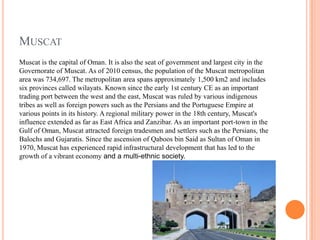
Muscat is the capital of Oman. It is also the seat of government and largest city in the
Governorate of Muscat. As of 2010 census, the population of the Muscat metropolitan
area was 734,697. The metropolitan area spans approximately 1,500 km2 and includes
six provinces called wilayats. Known since the early 1st century CE as an important
trading port between the west and the east, Muscat was ruled by various indigenous
tribes as well as foreign powers such as the Persians and the Portuguese Empire at
various points in its history. A regional military power in the 18th century, Muscat's
influence extended as far as East Africa and Zanzibar. As an important port-town in the
Gulf of Oman, Muscat attracted foreign tradesmen and settlers such as the Persians, the
Balochs and Gujaratis. Since the ascension of Qaboos bin Said as Sultan of Oman in
1970, Muscat has experienced rapid infrastructural development that has led to the
growth of a vibrant economy and a multi-ethnic society.
JABAL AKHDAR:
The Jebel Akhdar, Jabal Akhdar or Al Jabal Al Akhdar ,is part of the Al
Hajar Mountains range in Oman, which extends about 300 km (186 mi)
northwest to southeast, between 50–100 km (31-62 mi) inland from the Gulf
of Oman coast. It is one of Oman’s most spectacular areas. The highest
point, Jabal Shams (the mountain of the sun), is around 3,000 metres
(around 9,800 feet) high. It is the highest point in Oman and the whole of
eastern Arabia. It comprises the central section of the Al Hajar Mountains
range, and is located around 150 km (93 mi) from Muscat.
Terraces of Jebal Akhdar
The range is mostly desert, but at higher altitudes it
receives around 300 mm (12 in) of precipitation annually,
moist enough to allow the growth of shrubs and trees and
support agriculture. It is this that gives the mountains their
'green' name. Cool summers provide the visitor with fresh
air surrounded by breathtaking stones. The area is about 2
hours drive from Nizwa and is famous for its traditional
rose water extraction and agricultural products including
pomegranate, apricot, peach and walnut. The Jebel is
mostly inhabited by the ancient Arab tribe Bani Riyam (al
Riyamy) Pop.( approx. 14,000 ). However most
descendants of the tribe are now in nearby towns Such as
Nizwa, Izki and some inhabit Ibra.
All of us Oman forum poem
Deepen my heart
Deepen his soul
Deepen her mind
Using one voice
All of us will be
Oman
…………………
Dreaming to reach
By holding Oman peace
No fearing just feel
That all of us will be
Oman
…………………
Seeing one world
Working as one
Hoping to prove
By telling the truth
That all of us will be
Will be
Oman
……………………
Omani we born
With glorious & proud
No blue no more
Just green and red
With white up up
& all of us will be Oman
……………………
Deepen my heart
Deepen his soul
Deepen her mind
Using one voice
All of us will be
Oman

value week

  • 2.
    Oman officially calledthe Sultanate of Oman is an Arab state in southwest Asia on the southeast coast of the Arabian Peninsula. It has a strategically important position at the mouth of the Persian Gulf. It is bordered by the United Arab Emirates (UAE) to the northwest, Saudi Arabia to the west, and Yemen to the southwest and also shares a marine border with Iran. The coast is formed by the Arabian Sea on the southeast and the Gulf of Oman on the northeast. The Madha and Musandam exclaves are surrounded by the UAE on their land borders, with the Strait of Hormuz and Gulf of Oman forming Musandam's coastal boundaries.
  • 3.
    MUSCAT Muscat is thecapital of Oman. It is also the seat of government and largest city in the Governorate of Muscat. As of 2010 census, the population of the Muscat metropolitan area was 734,697. The metropolitan area spans approximately 1,500 km2 and includes six provinces called wilayats. Known since the early 1st century CE as an important trading port between the west and the east, Muscat was ruled by various indigenous tribes as well as foreign powers such as the Persians and the Portuguese Empire at various points in its history. A regional military power in the 18th century, Muscat's influence extended as far as East Africa and Zanzibar. As an important port-town in the Gulf of Oman, Muscat attracted foreign tradesmen and settlers such as the Persians, the Balochs and Gujaratis. Since the ascension of Qaboos bin Said as Sultan of Oman in 1970, Muscat has experienced rapid infrastructural development that has led to the growth of a vibrant economy and a multi-ethnic society.
  • 4.
    JABAL AKHDAR: The JebelAkhdar, Jabal Akhdar or Al Jabal Al Akhdar ,is part of the Al Hajar Mountains range in Oman, which extends about 300 km (186 mi) northwest to southeast, between 50–100 km (31-62 mi) inland from the Gulf of Oman coast. It is one of Oman’s most spectacular areas. The highest point, Jabal Shams (the mountain of the sun), is around 3,000 metres (around 9,800 feet) high. It is the highest point in Oman and the whole of eastern Arabia. It comprises the central section of the Al Hajar Mountains range, and is located around 150 km (93 mi) from Muscat.
  • 5.
    Terraces of JebalAkhdar The range is mostly desert, but at higher altitudes it receives around 300 mm (12 in) of precipitation annually, moist enough to allow the growth of shrubs and trees and support agriculture. It is this that gives the mountains their 'green' name. Cool summers provide the visitor with fresh air surrounded by breathtaking stones. The area is about 2 hours drive from Nizwa and is famous for its traditional rose water extraction and agricultural products including pomegranate, apricot, peach and walnut. The Jebel is mostly inhabited by the ancient Arab tribe Bani Riyam (al Riyamy) Pop.( approx. 14,000 ). However most descendants of the tribe are now in nearby towns Such as Nizwa, Izki and some inhabit Ibra.
  • 6.
    All of usOman forum poem Deepen my heart Deepen his soul Deepen her mind Using one voice All of us will be Oman ………………… Dreaming to reach By holding Oman peace No fearing just feel That all of us will be Oman ………………… Seeing one world Working as one Hoping to prove By telling the truth
  • 7.
    That all ofus will be Will be Oman …………………… Omani we born With glorious & proud No blue no more Just green and red With white up up & all of us will be Oman …………………… Deepen my heart Deepen his soul Deepen her mind Using one voice All of us will be Oman