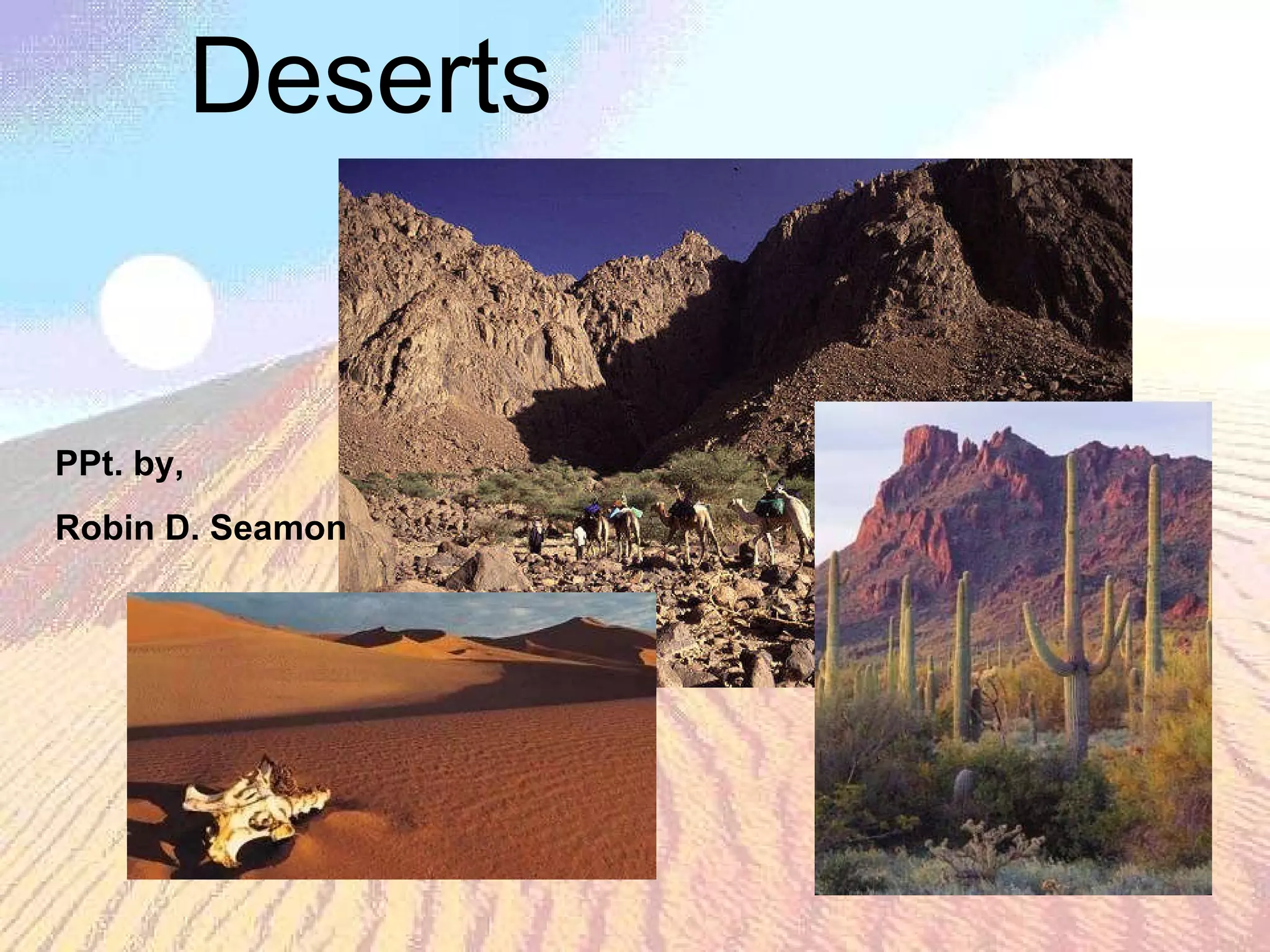
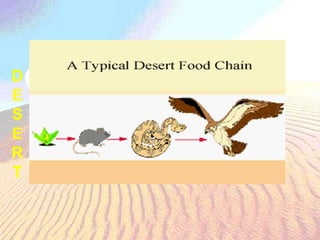
Deserts PPt. by,  Robin D. Seamon
Dry/ arid lands (no humidity) Less than 10 inches of rain a year. 1/5 Earth’s land surface Sand & gravel Supports little plant life because not enough moisture; soil is too dry A land of EXTREMES
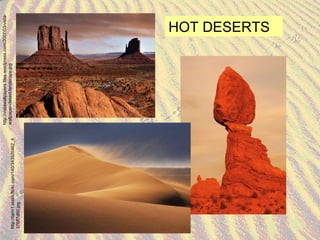
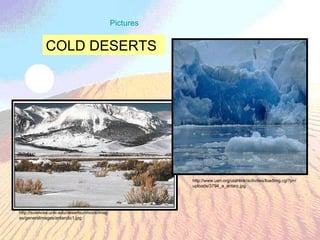
TWO KINDS OF DESERTS: Hot desert Near equator, HOT days, COLD nights (136 degrees F in day, 40 degrees F at night) Cold desert Arctic deserts where nothing can grow due to cold and dryness Near the Poles
HOT DESERTS http://vistawallpapers.files.wordpress.com/2007/03/vista-wallpaper-desert-landscape.jpg http://farm1.static.flickr.com/140/343920462_4376ff7d60.jpg
COLD DESERTS Pictures http://sciences.unlv.edu/desertsurvivors/images/generalimages/antarctic1.jpg http://www.uen.org/utahlink/activities/loadimg.cgi?p=/uploads/3794_a_antarc.jpg
 
ADAPTATIONS PEOPLE: Farming in river valleys; wells, oasis Cities: bring water in through pipelines (Las Vegas) N. American villages make adobe/mud houses Africa/Asia: herders live in tents/long robes 1 How to survive a  DESERT (Man vs. Wild)  directions 2 How to survive a  DESERT (Man vs. Wild)  hydration 3 How to survive a  DESERT (Man vs. Wild)  water (not saved)
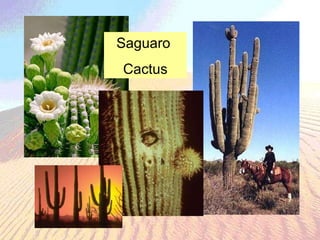
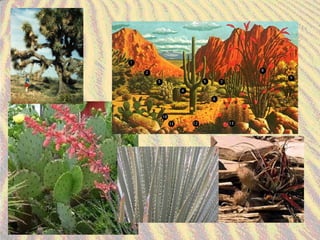
ADAPTATIONS PLANTS: After rains, desert flowers Deep roots OR long, broad roots to take in more water Store water (Saguaro) Waxy leaves & stems No leaves Spikes for protection
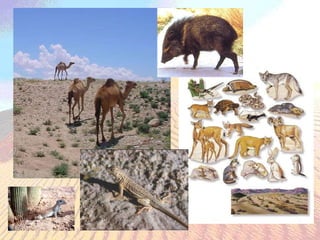
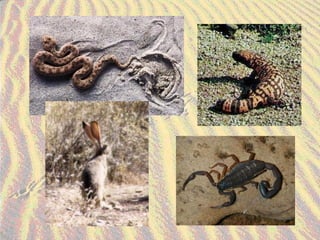
ADAPTATIONS ANIMALS: (insects, spiders, reptiles, birds, mammals) Nocturnal : out at night when cooler Burrows underground where cooler Dormant  during the day Keeping cool tricks: RABBIT keeps cool by big ears like air conditioning
WEATHER: Rain-shadow  effect:  makes deserts on one side of a mountain. warm air rises up the mountain and cools.  As it cools, it rains down.  The dry cool air sinks as the air mass moves over the other side of the mountain:
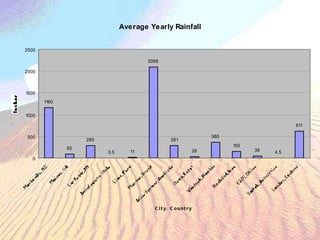
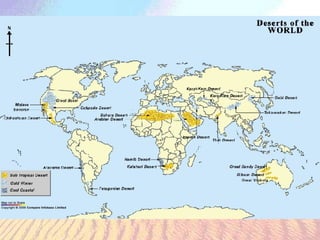
FACTS: Sahara  (AFRICA)- largest desert (3.5million square miles= the size of the US) Atacama  (S. AMERICA)- driest, no rain for over 200 years. Mojave  &  Sonora  (USA) Gobi - cold winters Sahel - (AFRICA) Kalihari -
 
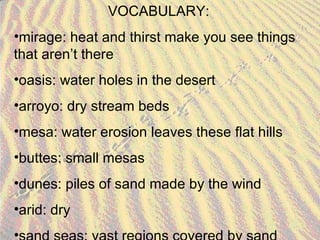
VOCABULARY: mirage: heat and thirst make you see things that aren’t there oasis: water holes in the desert arroyo: dry stream beds mesa: water erosion leaves these flat hills buttes: small mesas dunes: piles of sand made by the wind arid: dry sand seas: vast regions covered by sand
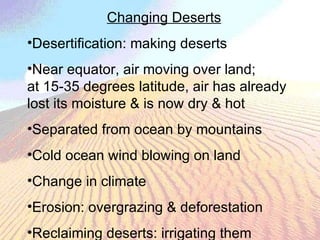
Changing Deserts Desertification: making deserts Near equator, air moving over land;  at 15-35 degrees latitude, air has already lost its moisture & is now dry & hot Separated from ocean by mountains Cold ocean wind blowing on land Change in climate Erosion: overgrazing & deforestation Reclaiming deserts: irrigating them
Desert Debate: Should deserts be reclaimed? Yes, because… No, because…
Saguaro  Cactus


DESERT

Desert notes Notes on world's deserts & organisms' adaptations to surviving them, with video links.

  • 1.
    Deserts PPt. by, Robin D. Seamon
  • 2.
    Dry/ arid lands(no humidity) Less than 10 inches of rain a year. 1/5 Earth’s land surface Sand & gravel Supports little plant life because not enough moisture; soil is too dry A land of EXTREMES
  • 3.
    TWO KINDS OFDESERTS: Hot desert Near equator, HOT days, COLD nights (136 degrees F in day, 40 degrees F at night) Cold desert Arctic deserts where nothing can grow due to cold and dryness Near the Poles
  • 4.
  • 5.
    COLD DESERTS Pictureshttp://sciences.unlv.edu/desertsurvivors/images/generalimages/antarctic1.jpg http://www.uen.org/utahlink/activities/loadimg.cgi?p=/uploads/3794_a_antarc.jpg
  • 6.
  • 7.
    ADAPTATIONS PEOPLE: Farmingin river valleys; wells, oasis Cities: bring water in through pipelines (Las Vegas) N. American villages make adobe/mud houses Africa/Asia: herders live in tents/long robes 1 How to survive a DESERT (Man vs. Wild) directions 2 How to survive a DESERT (Man vs. Wild) hydration 3 How to survive a DESERT (Man vs. Wild) water (not saved)
  • 8.
    ADAPTATIONS PLANTS: Afterrains, desert flowers Deep roots OR long, broad roots to take in more water Store water (Saguaro) Waxy leaves & stems No leaves Spikes for protection
  • 9.
    ADAPTATIONS ANIMALS: (insects,spiders, reptiles, birds, mammals) Nocturnal : out at night when cooler Burrows underground where cooler Dormant during the day Keeping cool tricks: RABBIT keeps cool by big ears like air conditioning
  • 10.
    WEATHER: Rain-shadow effect: makes deserts on one side of a mountain. warm air rises up the mountain and cools. As it cools, it rains down. The dry cool air sinks as the air mass moves over the other side of the mountain:
  • 11.
    FACTS: Sahara (AFRICA)- largest desert (3.5million square miles= the size of the US) Atacama (S. AMERICA)- driest, no rain for over 200 years. Mojave & Sonora (USA) Gobi - cold winters Sahel - (AFRICA) Kalihari -
  • 12.
  • 13.
    VOCABULARY: mirage: heatand thirst make you see things that aren’t there oasis: water holes in the desert arroyo: dry stream beds mesa: water erosion leaves these flat hills buttes: small mesas dunes: piles of sand made by the wind arid: dry sand seas: vast regions covered by sand
  • 14.
    Changing Deserts Desertification:making deserts Near equator, air moving over land; at 15-35 degrees latitude, air has already lost its moisture & is now dry & hot Separated from ocean by mountains Cold ocean wind blowing on land Change in climate Erosion: overgrazing & deforestation Reclaiming deserts: irrigating them
  • 15.
    Desert Debate: Shoulddeserts be reclaimed? Yes, because… No, because…
  • 16.
  • 17.
  • 18.
  • 19.
  • 20.