By: Maggie Cline
Bulgarian Map LEGEND Capital City Cities Mountains
Bulgaria Size- 110,879 sq km  Climate- temperate; cold, damp winters and hot, dry summers. Location- Southeastern Europe  Population- 7,093,635 people Flag-
Geographic Features Land   Regions -mostly mountains with lowlands in north and southeast Rivers, Lakes, Oceans-  Danube River; separates Romania & Bulgaria and Black Sea to the East Indigenous Fauna &Flora-  Arctic alpines, suslik, rock partridges, chamois, capercaillie, chough, accentor, & wall creeper   Special Points of interest- earthquakes;   landslides Vacation Tour- Boyana Church, Kazanluk Tomb, and Bachkovo Monastery
History Early   History- Central Asian Turkic tribes merged with the local Slavic inhabitants in the late 7th century.  Impact on world- Having fought on the losing side in both World Wars, Bulgaria fell within the Soviet sphere of influence and became a People's Republic in 1946.
Political Type of government- parliamentary democracy Government Leaders Chief of State -President Georgi Parvanov, Vice President Angel Marin.   Head of Government -Prime Minister Boyko Borlssov, Deputy Prime Ministers Simeon Djankov and Tsvetan Tsvetanov.
Economy Industry -electricity, gas, water; food, beverages, tobacco; machinery and equipment, base metals, chemical products, coke, refined petroleum, nuclear fuel. Exports-  clothing, footwear, iron and steel, machinery and equipment, fuels. Imports -machinery and equipment; metals and ores; chemicals and plastics; fuels, minerals, and raw materials Economic Status-  Bulgaria entered the EU on January 1, 2007. Major Trade Partners-  Russia, Germany, Italy, Greece, Romania, Turkey, Ukraine, Austria. Trade Association-  EUROMAT (European Gaming and Amusement Federation), Association of Apparel and Textile.  Sanctions-  None at this time.
Daily Life Standard of living- $12,800   per capita Literacy-  98.2% of population Clothing- Pants, shirts, and vests are worn by men   and dresses and aprons that are heavily embroidered for the women.  Internet Usage- 3.395 million
Cultural Traditions-  Rose Day celebrates the start of rose-picking. Customs- Sourvakars  (Boys going from house to house, wishing people a Happy New Year by slapping them ritually with an ornamented twig for health and prosperity.) , Martyr Triffon Zarezan ( first pruning of the vines.) Religions-  Bulgarian Orthodox, Muslim, other Christian.   Foods-  Traditional Bulgarian food include recipes that contain feta cheese, meat, vegetables, and yogurt.   Music & Dance -  Nestinars is a ritual dance on live coal.   Unique Facts-  Wedding bands are worn on the right hand, not the left as in the West and when Bulgarians nod their heads up and down, they mean NO. When they move their heads from side to side, they mean YES.
Conclusion I learned that Bulgaria is a unique country with its unusual traditions. I learned Bulgaria was a former communist country and is now a parliamentary democracy. Bulgaria is a mountainous region with a huge population.
Pictures of Bulgaria
Map of Czech Republic
Czech Republic Size-78,867 sq km  Climate-temperate; cool summers; cold, cloudy, humid winters Location-Central Europe  Population-10,190,213  Flag-
Geography Land Regions-  Bohemia in the west consists of rolling plains, hills, and plateaus surrounded by low mountains; Moravia in the east consists of very hilly country. Rivers, lakes, oceans-  Elbe River Indigenous fauna & flora-  Oak, beech, and spruce dominate the forest zones,while the Alpine zone supports grasses and low-growing bushes.   Points of interest-  flooding Vacation-  St. Nicholas Cathedral, National Theater, and old Jewish cemetery.
History Early history-   On 1 January 1993, the country underwent a "velvet divorce" into its two national components, the Czech Republic and Slovakia.  The Czech Republic joined NATO in 1999 and the European Union in   2004.   Impact on world-   At the end of WWI, the Czech and the Slovaks joined together to make Czechoslovakia. On the eve of WWII, the Czechs were forcibly annexed into the Third Reich.
Political Type of government -parliamentary democracy Government leaders- Chief of state-  President Vaclav Klaus Head of government-  Prime Minister Petr Necas First Deputy Prime Minister-  Karel Schwarzenberg
Economy Industry-  motor vehicles, metallurgy, machinery and equipment, glass, armaments Exports-  machinery and transport equipment, raw materials and fuel, chemicals Imports-  machinery and transport equipment, raw materials and fuels, chemicals Economic status-  The Czech Republic is a stable and prosperous market economy.   Trade partners-   Germany, China, Slovakia, Poland, France, Russia  Trade associations- OSCE and NATO   Sanctions- None at this time.
Daily Life Standard of living-   $25,600 per capita   Literacy-   99% of the population   Clothing-  The normal pants and shirt for men and women or women can wear skirts or dresses. Internet usage-   6.681 million
Cultural Traditions-the burning of witches, the day of love, and Hromnice. Customs-  Remove your shoes before dining, the eldest woman gets served first, and be on time.   Religions-  Roman Catholic, Protestant   Foods-   Their meals consist of meats and starches Music & dance- The Czech Republic is central and eastern Europe's centers for music. Unique facts- Czechs are very shy; reserved people and value family and planning ahead into the future.
Conclusion The Czech Republic is located in central Europe. Their food recipes consists of meats and starches because of their harsh winters. I learned that the Czechs are very reserved people that value family just like me.
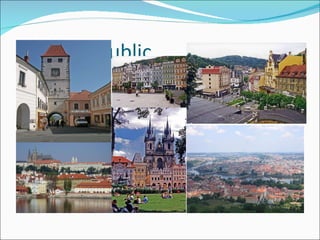
Czech Republic
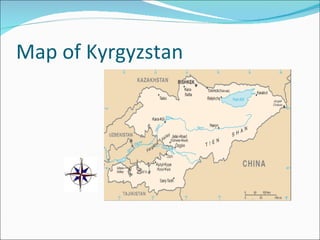
Map of Kyrgyzstan
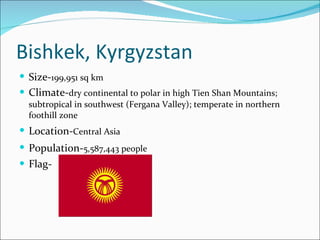
Bishkek, Kyrgyzstan Size- 199,951 sq km   Climate- dry continental to polar in high Tien Shan Mountains; subtropical in southwest (Fergana Valley); temperate in northern foothill zone Location- Central Asia   Population- 5,587,443 people   Flag-
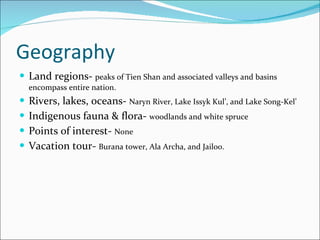
Geography Land regions-  peaks of Tien Shan and associated valleys and basins encompass entire nation. Rivers, lakes, oceans-  Naryn River, Lake Issyk Kul’, and Lake Song-Kel’ Indigenous fauna & flora-  woodlands and white spruce Points of interest-  None Vacation tour-  Burana tower, Ala Archa, and Jailoo.
History Early history-  Kyrgyzstan was annexed by Russia in 1876. During the Tsarist Empire revolt in 1916 almost 1/6 of Kyrgyz population was killed. Kyrgyz received independence in 1991 when the USSR dissolved.   Impact on world-  The Silk road went thru Kyrgyzstan from China to Europe opening a trading route for silk, teas and other fine spices.
Political Type of government- republic Government Leaders Chief of state-   President Roza Otunbaeva Head of government-   Prime Minister Almazbek Atambaev
Economy Industry- small machinery, textiles, food processing, cement, shoes, sawn logs, refrigerators, furniture, electric motors, gold, rare earth metals Exports- cotton, wool, meat, tobacco; gold, mercury, uranium, natural gas, hydropower; machinery; shoes Imports- oil and gas, machinery and equipment, chemicals, food stuffs Economic status-  Kyrgyzstan is a very poor country with much corruption.   Trade partners- China, Switzerland, Russia, Uzbekistan, Kazakhstan   Trade associations-  Organization for Security and Co-operation in Europe (OSCE)  Sanctions- None
Daily Life Standard of living-  $ 2,200 per capita Literacy-  98.7% of the population Clothing-  people in felt hats, knee-length silk tunics, (belted at the waist) and high leather boots – all very reminiscent of traditional Kyrgyz costume. More modern western traditional clothing is becoming more accepted. Internet usage- 2.195 million
Cultural Traditions- People live in a Yurta. Customs-  Jentek toi (Birth Feast)  New parents show their happiness by treating their neighbors, and a mark of respect is to treat people to sary mai (yellow butter). First it is put into the baby's mouth, followed by the oldest person in the house. The sary mai is kept in a slaughtered lamb's, sheep's or calf's stomach for the purpose of this feast.  Religions- Muslim and Russian Orthodox   Foods-  Dish is meant to be eaten with the hands, not with a knife and fork! - "Besh" means five, and "barmak", finger.   Music & dance-  Music is nomadic and rural.   Unique facts-   The people have no sewage system and get their water from mountains.
Conclusion Kyrgyzstan is a very mountainous and poor country. They have no sewage system and get their water mainly from mountains. The consequences of mountain water in water population which is dominant in this country.
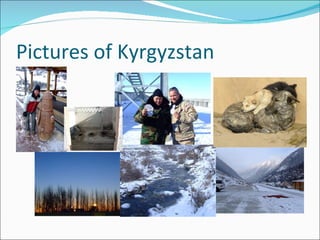
Pictures of Kyrgyzstan
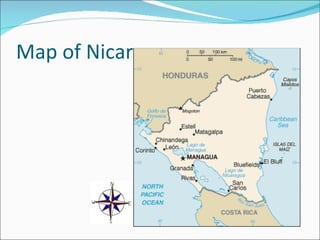
Map of Nicaragua
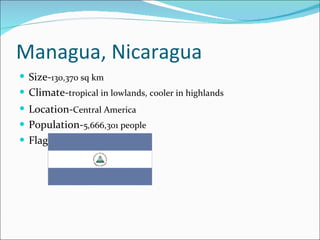
Managua, Nicaragua Size- 130,370 sq km   Climate- tropical in lowlands, cooler in highlands Location- Central America   Population- 5,666,301 people Flag-
Geography Land regions-   extensive Atlantic coastal plains rising to central interior mountains; narrow Pacific coastal plain interrupted by volcanoes. Rivers, lakes, oceans-   Lago de Nicaragua, Lago de Managua, Caribbean Sea, and North pacific Ocean Indigenous fauna & flora-  Forests contain valuable cedar, mahogany, and pine timber as well as quebracho, guaiacum, guapinol and medlar  Points of interest-  Destructive earthquakes; volcanoes; landslides; extremely susceptible to hurricanes. Vacation tour- Cathedral de la Asuncion, Volcan Masaya National Park, and Nueva Catedral.
History Early history-  Nicaragua was settled as a Spanish colony from Panama in the early 16th century. They gained their independence in 1821, from Spain.  Impact on world-  Nicaraguan aid to leftist rebels in El Salvador caused the US to sponsor anti-Sandinista contra guerrillas.
Political Type of government- Republic Government leaders Chief of state-   President Daniel Ortega Saavedra; Vice President Jaime Morales Carazo
Economy Industry-  Food processing, chemicals, machinery and metal products, knit and woven apparel, petroleum refining and distribution, beverages, footwear, wood. Exports-  Coffee, beef, shrimp and lobster, tobacco, sugar, gold, peanuts; textiles and apparel. Imports-  Consumer goods, machinery and equipment, raw materials, petroleum products. Economic Status-  The poorest country in Central America.  Trade partners-  U.S., Venezuela, Mexico, and Costa Rica   Trade association-  CACM, WTO, and WTO   Sanction-  None at this time.
Daily Life Standard of living- $2,900 per capita   Literacy- 67.5% of the population Clothing-  Very brightly colored clothing. Internet usage- 199,800 of the population
Cultural Traditions-  Toro Guaco and La Gritera.   Customs-  Catholic devotion, diverse indigenous roots, and enthusiasm for life in the face of extreme poverty. Religions-  Roman Catholic, Evangelical, Moravian, and Jehovah's Witness  Foods-  Corn is used in a lot of recipes. Music & dance- Marimba   dances.   Unique facts-  Nicaragua is the second poorest country in the Hemisphere.
Conclusion Nicaragua is the poorest country in Central America. Despite the poverty stricken country they are devout Catholics.
Pictures of Nicaragua
Map of Saudi Arabia
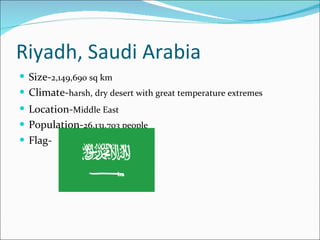
Riyadh, Saudi Arabia Size- 2,149,690 sq km   Climate- harsh, dry desert with great temperature extremes Location- Middle East   Population- 26,131,703 people Flag-
Geography Land Regions-  mostly uninhabited, sandy desert Rivers, lakes, oceans-  Red Sea and Persian Gulf Indigenous fauna & flora- Points of interest-  Frequent sand and dust storms Vacation tour-
History Early history-  The modern Saudi state was founded in 1932. it is home to the religion of Islam and has two holy cities; Mecca and Medina.  Impact on world-  After Iraq invaded Kuwait in 1990, Saudi Arabia accepted the Kuwait royal family and 400,00 refugees.
Political Type of government- Monarchy Government leaders- Chief of state-  King and Prime Minister Abdallah bin Abd al-Aziz Al Saud
Economy Industry- crude oil production, petroleum refining, basic petrochemicals, ammonia, industrial gases, sodium hydroxide (caustic soda), cement, fertilizer, plastics, metals, commercial ship repair, commercial aircraft repair, construction Exports- petroleum and petroleum products   Imports- machinery and equipment, foodstuffs, chemicals, motor vehicles, textiles Economic status-  Oil-based economy and is strongly controlled by the government. Trade partners-  Japan, United States, South Korea, China, and Germany.  Trade association-  UKOOA Sanction-  None at this time.
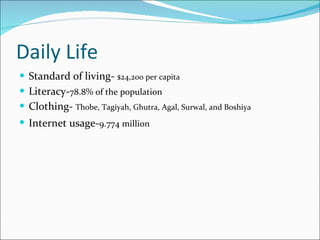
Daily Life Standard of living-  $24,200 per capita Literacy- 78.8% of the population Clothing-  Thobe, Tagiyah, Ghutra, Agal, Surwal, and Boshiya  Internet usage- 9.774 million
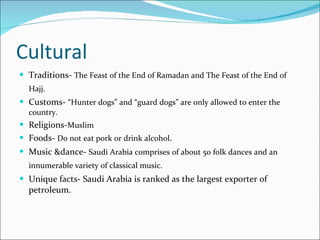
Cultural Traditions-  The Feast of the End of Ramadan and The Feast of the End of Hajj.   Customs-  “Hunter dogs” and “guard dogs” are only allowed to enter the country.  Religions- Muslim   Foods-  Do not eat pork or drink alcohol . Music &dance-  Saudi Arabia comprises of about 50 folk dances and an innumerable variety of classical music.   Unique facts- Saudi Arabia is ranked as the largest exporter of petroleum.
Conclusion Saudi Arabia is a country found in the middle east. They rely heavily on their oil for trade but have expanded into agriculture.
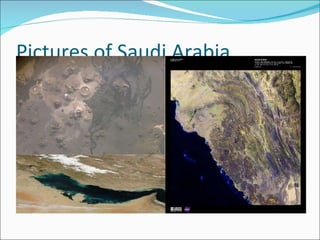
Pictures of Saudi Arabia
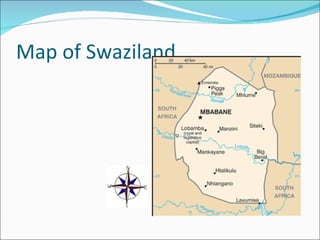
Map of Swaziland
Mbabana, Swaziland Size-  17,364 sq km Climate-  Varies from tropical to near temperate. Location-  Southern Africa   Population-  1,370,424 people Flag-
Geography Land regions-  Mostly mountains and hills; some moderately sloping plains. Rivers, lakes, oceans- Lusutfu River and Komati River. Indigenous fauna & flora-  Made up of mostly the Highveld and the windward slopes of the Lubombo escarpment; savanna, and grassland.   Points of interest-  Drought Vacation Tour- Milwane Wildlife Sanctuary, National Museum, and Havelock Mine.
History Early History-  Autonomy for the Swazis of southern Africa was guaranteed by the British in the late 19th century. They finally gained independence in 1968.   Impact on world-  Swaziland recently surpassed Botswana as the country with the world's highest known HIV/AIDS prevalence rate.
Political Type of government-  Monarchy Government Leaders Chief of state-  King Mswati III   Head of government-  Prime Minister Barnabas Sibusiso Dlamini
Economy Industry-  Coal, wood pulp, sugar, soft drink concentrates, textiles and apparel. Exports-  Soft drink concentrates, sugar, wood pulp, cotton yarn, refrigerators, citrus and canned fruit. Imports-  Motor vehicles, machinery, transport equipment, foodstuffs, petroleum products, chemicals. Economic Status- Sugar and wood pulp were major foreign exchange earners; however, the wood pulp producer closed in January 2010. Trade partners-  South Africa Trade associations-  Southern African Customs Union (SACU).  Sanctions-  Political sanctions within its own country.
Daily Life Standard of living-   $4,500 per capita Literacy-   81.6% of total population Clothing- Colorful skirt with a leather apron.  Internet Usage-  90,100
Cultural Traditions-  Commonwealth Day, Birthday of King Sobhuza II, and  Boxing Day. Customs-  They rely on oral tradition folklore .   Religions-  Zionist, Roman Catholic, and Muslim. Foods-   Corn, sorghum, beans, groundnuts and sweet potatoes are grown to eat. Music and dance-   SiBhaca  dance music . Unique Facts-   Swaziland is a very poor country with the highest number of infected by with HIV/AIDS.
Conclusion Swaziland is found in southern Africa. It is a very poor country and has the highest number of infected people with HIV/AIDS.
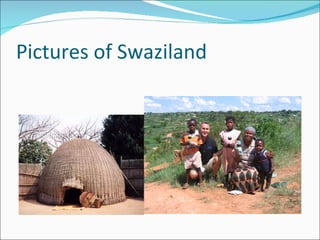
Pictures of Swaziland
Map of Yemen
Yemen Climate-  Extraordinarily hot, dry, harsh desert. Size-  527,968 sq km Location-  Middle East, bordering the Arabian Sea, Gulf of Aden, and Red Sea, between Oman and Saudi Arabia. Population-  24,133,492   Flag-
Geography Land regions-  Narrow coastal plain backed by flat-topped hills and rugged mountains; dissected upland desert plains in center slope into the desert interior of the Arabian Peninsula. Rivers, lakes, oceans-  Gulf of Aden and Red Sea Indigenous fauna & flora-  The date palm, citrus fruits, bananas, and cotton. Points of interest-  Sandstorms and dust storms in summer Vacation Tour-  City of Taiz, Makha, and Al-Qaherah Castle.
History Early History-   North Yemen became independent of the Ottoman Empire in 1918. In the 19century, the British set up a protectorate area around the southern port of Aden. Impact on   world-  In 2000, Saudi Arabia and Yemen agreed to a delimitation of their border.
Political Type of government-   Republic Government leaders Chief of state-   President Ali Abdallah Salih Head of government-  Prime Minister Ali Muhammad Mujawwar
Economy Industry-   Crude oil production and petroleum refining; small-scale production of cotton textiles and leather goods; food processing; handicrafts; small aluminum products factory; cement; commercial ship repair; natural gas production. Exports-  Crude oil, coffee, dried and salted fish, liquefied natural gas. Imports- Food and live animals, machinery and equipment, chemicals. Economic Status- Relies on declining oil resources for revenue. Trade Partners- China, Thailand, India, South Africa, Japan, UAE.  Trade Associations- WTO  Sanctions- Yemen is does not have sanctions, however the United Nations wants to sanction Al’ Qaida in the region.
Daily Life Standard of living- $2,600 per capita   Literacy-  50.2% of the population. Clothing- Thob.  Internet Usage-  2.349 million
Cultural Traditions-  Yemenite men consume Qat, a narcotic plant, every day. Customs-  Muharram (Islamic New Year). Religions-  Muslim including Shaf'i (Sunni) and Zaydi (Shia), small numbers of Jewish, Christian, and Hindu. Foods- Hot and spicy foods. Music and dance- They listen to rock and R&B. Unique facts-  Yemen has no recorded deaths of people living with   HIV/AIDS.
Conclusion  Yemen is a country in southern Africa, which is strategically located along the strait of Bab el Mandeb, which links one of the most used shipping lanes.
citations Cia.gov/worldfactbook

7 countries projectMaggie

  • 1.
  • 2.
    Bulgarian Map LEGENDCapital City Cities Mountains
  • 3.
    Bulgaria Size- 110,879sq km Climate- temperate; cold, damp winters and hot, dry summers. Location- Southeastern Europe Population- 7,093,635 people Flag-
  • 4.
    Geographic Features Land Regions -mostly mountains with lowlands in north and southeast Rivers, Lakes, Oceans- Danube River; separates Romania & Bulgaria and Black Sea to the East Indigenous Fauna &Flora- Arctic alpines, suslik, rock partridges, chamois, capercaillie, chough, accentor, & wall creeper Special Points of interest- earthquakes; landslides Vacation Tour- Boyana Church, Kazanluk Tomb, and Bachkovo Monastery
  • 5.
    History Early History- Central Asian Turkic tribes merged with the local Slavic inhabitants in the late 7th century. Impact on world- Having fought on the losing side in both World Wars, Bulgaria fell within the Soviet sphere of influence and became a People's Republic in 1946.
  • 6.
    Political Type ofgovernment- parliamentary democracy Government Leaders Chief of State -President Georgi Parvanov, Vice President Angel Marin. Head of Government -Prime Minister Boyko Borlssov, Deputy Prime Ministers Simeon Djankov and Tsvetan Tsvetanov.
  • 7.
    Economy Industry -electricity,gas, water; food, beverages, tobacco; machinery and equipment, base metals, chemical products, coke, refined petroleum, nuclear fuel. Exports- clothing, footwear, iron and steel, machinery and equipment, fuels. Imports -machinery and equipment; metals and ores; chemicals and plastics; fuels, minerals, and raw materials Economic Status- Bulgaria entered the EU on January 1, 2007. Major Trade Partners- Russia, Germany, Italy, Greece, Romania, Turkey, Ukraine, Austria. Trade Association- EUROMAT (European Gaming and Amusement Federation), Association of Apparel and Textile. Sanctions- None at this time.
  • 8.
    Daily Life Standardof living- $12,800 per capita Literacy- 98.2% of population Clothing- Pants, shirts, and vests are worn by men and dresses and aprons that are heavily embroidered for the women. Internet Usage- 3.395 million
  • 9.
    Cultural Traditions- Rose Day celebrates the start of rose-picking. Customs- Sourvakars (Boys going from house to house, wishing people a Happy New Year by slapping them ritually with an ornamented twig for health and prosperity.) , Martyr Triffon Zarezan ( first pruning of the vines.) Religions- Bulgarian Orthodox, Muslim, other Christian. Foods- Traditional Bulgarian food include recipes that contain feta cheese, meat, vegetables, and yogurt. Music & Dance - Nestinars is a ritual dance on live coal. Unique Facts- Wedding bands are worn on the right hand, not the left as in the West and when Bulgarians nod their heads up and down, they mean NO. When they move their heads from side to side, they mean YES.
  • 10.
    Conclusion I learnedthat Bulgaria is a unique country with its unusual traditions. I learned Bulgaria was a former communist country and is now a parliamentary democracy. Bulgaria is a mountainous region with a huge population.
  • 11.
  • 12.
    Map of CzechRepublic
  • 13.
    Czech Republic Size-78,867sq km Climate-temperate; cool summers; cold, cloudy, humid winters Location-Central Europe Population-10,190,213 Flag-
  • 14.
    Geography Land Regions- Bohemia in the west consists of rolling plains, hills, and plateaus surrounded by low mountains; Moravia in the east consists of very hilly country. Rivers, lakes, oceans- Elbe River Indigenous fauna & flora- Oak, beech, and spruce dominate the forest zones,while the Alpine zone supports grasses and low-growing bushes. Points of interest- flooding Vacation- St. Nicholas Cathedral, National Theater, and old Jewish cemetery.
  • 15.
    History Early history- On 1 January 1993, the country underwent a "velvet divorce" into its two national components, the Czech Republic and Slovakia. The Czech Republic joined NATO in 1999 and the European Union in 2004. Impact on world- At the end of WWI, the Czech and the Slovaks joined together to make Czechoslovakia. On the eve of WWII, the Czechs were forcibly annexed into the Third Reich.
  • 16.
    Political Type ofgovernment -parliamentary democracy Government leaders- Chief of state- President Vaclav Klaus Head of government- Prime Minister Petr Necas First Deputy Prime Minister- Karel Schwarzenberg
  • 17.
    Economy Industry- motor vehicles, metallurgy, machinery and equipment, glass, armaments Exports- machinery and transport equipment, raw materials and fuel, chemicals Imports- machinery and transport equipment, raw materials and fuels, chemicals Economic status- The Czech Republic is a stable and prosperous market economy. Trade partners- Germany, China, Slovakia, Poland, France, Russia Trade associations- OSCE and NATO Sanctions- None at this time.
  • 18.
    Daily Life Standardof living- $25,600 per capita Literacy- 99% of the population Clothing- The normal pants and shirt for men and women or women can wear skirts or dresses. Internet usage- 6.681 million
  • 19.
    Cultural Traditions-the burningof witches, the day of love, and Hromnice. Customs- Remove your shoes before dining, the eldest woman gets served first, and be on time. Religions- Roman Catholic, Protestant Foods- Their meals consist of meats and starches Music & dance- The Czech Republic is central and eastern Europe's centers for music. Unique facts- Czechs are very shy; reserved people and value family and planning ahead into the future.
  • 20.
    Conclusion The CzechRepublic is located in central Europe. Their food recipes consists of meats and starches because of their harsh winters. I learned that the Czechs are very reserved people that value family just like me.
  • 21.
  • 22.
  • 23.
    Bishkek, Kyrgyzstan Size-199,951 sq km Climate- dry continental to polar in high Tien Shan Mountains; subtropical in southwest (Fergana Valley); temperate in northern foothill zone Location- Central Asia Population- 5,587,443 people Flag-
  • 24.
    Geography Land regions- peaks of Tien Shan and associated valleys and basins encompass entire nation. Rivers, lakes, oceans- Naryn River, Lake Issyk Kul’, and Lake Song-Kel’ Indigenous fauna & flora- woodlands and white spruce Points of interest- None Vacation tour- Burana tower, Ala Archa, and Jailoo.
  • 25.
    History Early history- Kyrgyzstan was annexed by Russia in 1876. During the Tsarist Empire revolt in 1916 almost 1/6 of Kyrgyz population was killed. Kyrgyz received independence in 1991 when the USSR dissolved. Impact on world- The Silk road went thru Kyrgyzstan from China to Europe opening a trading route for silk, teas and other fine spices.
  • 26.
    Political Type ofgovernment- republic Government Leaders Chief of state- President Roza Otunbaeva Head of government- Prime Minister Almazbek Atambaev
  • 27.
    Economy Industry- smallmachinery, textiles, food processing, cement, shoes, sawn logs, refrigerators, furniture, electric motors, gold, rare earth metals Exports- cotton, wool, meat, tobacco; gold, mercury, uranium, natural gas, hydropower; machinery; shoes Imports- oil and gas, machinery and equipment, chemicals, food stuffs Economic status- Kyrgyzstan is a very poor country with much corruption. Trade partners- China, Switzerland, Russia, Uzbekistan, Kazakhstan Trade associations- Organization for Security and Co-operation in Europe (OSCE) Sanctions- None
  • 28.
    Daily Life Standardof living- $ 2,200 per capita Literacy- 98.7% of the population Clothing- people in felt hats, knee-length silk tunics, (belted at the waist) and high leather boots – all very reminiscent of traditional Kyrgyz costume. More modern western traditional clothing is becoming more accepted. Internet usage- 2.195 million
  • 29.
    Cultural Traditions- Peoplelive in a Yurta. Customs- Jentek toi (Birth Feast) New parents show their happiness by treating their neighbors, and a mark of respect is to treat people to sary mai (yellow butter). First it is put into the baby's mouth, followed by the oldest person in the house. The sary mai is kept in a slaughtered lamb's, sheep's or calf's stomach for the purpose of this feast. Religions- Muslim and Russian Orthodox Foods- Dish is meant to be eaten with the hands, not with a knife and fork! - "Besh" means five, and "barmak", finger. Music & dance- Music is nomadic and rural. Unique facts- The people have no sewage system and get their water from mountains.
  • 30.
    Conclusion Kyrgyzstan isa very mountainous and poor country. They have no sewage system and get their water mainly from mountains. The consequences of mountain water in water population which is dominant in this country.
  • 31.
  • 32.
  • 33.
    Managua, Nicaragua Size-130,370 sq km Climate- tropical in lowlands, cooler in highlands Location- Central America Population- 5,666,301 people Flag-
  • 34.
    Geography Land regions- extensive Atlantic coastal plains rising to central interior mountains; narrow Pacific coastal plain interrupted by volcanoes. Rivers, lakes, oceans- Lago de Nicaragua, Lago de Managua, Caribbean Sea, and North pacific Ocean Indigenous fauna & flora- Forests contain valuable cedar, mahogany, and pine timber as well as quebracho, guaiacum, guapinol and medlar Points of interest- Destructive earthquakes; volcanoes; landslides; extremely susceptible to hurricanes. Vacation tour- Cathedral de la Asuncion, Volcan Masaya National Park, and Nueva Catedral.
  • 35.
    History Early history- Nicaragua was settled as a Spanish colony from Panama in the early 16th century. They gained their independence in 1821, from Spain. Impact on world- Nicaraguan aid to leftist rebels in El Salvador caused the US to sponsor anti-Sandinista contra guerrillas.
  • 36.
    Political Type ofgovernment- Republic Government leaders Chief of state- President Daniel Ortega Saavedra; Vice President Jaime Morales Carazo
  • 37.
    Economy Industry- Food processing, chemicals, machinery and metal products, knit and woven apparel, petroleum refining and distribution, beverages, footwear, wood. Exports- Coffee, beef, shrimp and lobster, tobacco, sugar, gold, peanuts; textiles and apparel. Imports- Consumer goods, machinery and equipment, raw materials, petroleum products. Economic Status- The poorest country in Central America. Trade partners- U.S., Venezuela, Mexico, and Costa Rica Trade association- CACM, WTO, and WTO Sanction- None at this time.
  • 38.
    Daily Life Standardof living- $2,900 per capita Literacy- 67.5% of the population Clothing- Very brightly colored clothing. Internet usage- 199,800 of the population
  • 39.
    Cultural Traditions- Toro Guaco and La Gritera. Customs- Catholic devotion, diverse indigenous roots, and enthusiasm for life in the face of extreme poverty. Religions- Roman Catholic, Evangelical, Moravian, and Jehovah's Witness Foods- Corn is used in a lot of recipes. Music & dance- Marimba dances. Unique facts- Nicaragua is the second poorest country in the Hemisphere.
  • 40.
    Conclusion Nicaragua isthe poorest country in Central America. Despite the poverty stricken country they are devout Catholics.
  • 41.
  • 42.
  • 43.
    Riyadh, Saudi ArabiaSize- 2,149,690 sq km Climate- harsh, dry desert with great temperature extremes Location- Middle East Population- 26,131,703 people Flag-
  • 44.
    Geography Land Regions- mostly uninhabited, sandy desert Rivers, lakes, oceans- Red Sea and Persian Gulf Indigenous fauna & flora- Points of interest- Frequent sand and dust storms Vacation tour-
  • 45.
    History Early history- The modern Saudi state was founded in 1932. it is home to the religion of Islam and has two holy cities; Mecca and Medina. Impact on world- After Iraq invaded Kuwait in 1990, Saudi Arabia accepted the Kuwait royal family and 400,00 refugees.
  • 46.
    Political Type ofgovernment- Monarchy Government leaders- Chief of state- King and Prime Minister Abdallah bin Abd al-Aziz Al Saud
  • 47.
    Economy Industry- crudeoil production, petroleum refining, basic petrochemicals, ammonia, industrial gases, sodium hydroxide (caustic soda), cement, fertilizer, plastics, metals, commercial ship repair, commercial aircraft repair, construction Exports- petroleum and petroleum products Imports- machinery and equipment, foodstuffs, chemicals, motor vehicles, textiles Economic status- Oil-based economy and is strongly controlled by the government. Trade partners- Japan, United States, South Korea, China, and Germany. Trade association- UKOOA Sanction- None at this time.
  • 48.
    Daily Life Standardof living- $24,200 per capita Literacy- 78.8% of the population Clothing- Thobe, Tagiyah, Ghutra, Agal, Surwal, and Boshiya Internet usage- 9.774 million
  • 49.
    Cultural Traditions- The Feast of the End of Ramadan and The Feast of the End of Hajj. Customs- “Hunter dogs” and “guard dogs” are only allowed to enter the country. Religions- Muslim Foods- Do not eat pork or drink alcohol . Music &dance- Saudi Arabia comprises of about 50 folk dances and an innumerable variety of classical music. Unique facts- Saudi Arabia is ranked as the largest exporter of petroleum.
  • 50.
    Conclusion Saudi Arabiais a country found in the middle east. They rely heavily on their oil for trade but have expanded into agriculture.
  • 51.
  • 52.
  • 53.
    Mbabana, Swaziland Size- 17,364 sq km Climate- Varies from tropical to near temperate. Location- Southern Africa Population- 1,370,424 people Flag-
  • 54.
    Geography Land regions- Mostly mountains and hills; some moderately sloping plains. Rivers, lakes, oceans- Lusutfu River and Komati River. Indigenous fauna & flora- Made up of mostly the Highveld and the windward slopes of the Lubombo escarpment; savanna, and grassland. Points of interest- Drought Vacation Tour- Milwane Wildlife Sanctuary, National Museum, and Havelock Mine.
  • 55.
    History Early History- Autonomy for the Swazis of southern Africa was guaranteed by the British in the late 19th century. They finally gained independence in 1968. Impact on world- Swaziland recently surpassed Botswana as the country with the world's highest known HIV/AIDS prevalence rate.
  • 56.
    Political Type ofgovernment- Monarchy Government Leaders Chief of state- King Mswati III Head of government- Prime Minister Barnabas Sibusiso Dlamini
  • 57.
    Economy Industry- Coal, wood pulp, sugar, soft drink concentrates, textiles and apparel. Exports- Soft drink concentrates, sugar, wood pulp, cotton yarn, refrigerators, citrus and canned fruit. Imports- Motor vehicles, machinery, transport equipment, foodstuffs, petroleum products, chemicals. Economic Status- Sugar and wood pulp were major foreign exchange earners; however, the wood pulp producer closed in January 2010. Trade partners- South Africa Trade associations- Southern African Customs Union (SACU). Sanctions- Political sanctions within its own country.
  • 58.
    Daily Life Standardof living- $4,500 per capita Literacy- 81.6% of total population Clothing- Colorful skirt with a leather apron. Internet Usage- 90,100
  • 59.
    Cultural Traditions- Commonwealth Day, Birthday of King Sobhuza II, and Boxing Day. Customs- They rely on oral tradition folklore . Religions- Zionist, Roman Catholic, and Muslim. Foods- Corn, sorghum, beans, groundnuts and sweet potatoes are grown to eat. Music and dance- SiBhaca dance music . Unique Facts- Swaziland is a very poor country with the highest number of infected by with HIV/AIDS.
  • 60.
    Conclusion Swaziland isfound in southern Africa. It is a very poor country and has the highest number of infected people with HIV/AIDS.
  • 61.
  • 62.
  • 63.
    Yemen Climate- Extraordinarily hot, dry, harsh desert. Size- 527,968 sq km Location- Middle East, bordering the Arabian Sea, Gulf of Aden, and Red Sea, between Oman and Saudi Arabia. Population- 24,133,492 Flag-
  • 64.
    Geography Land regions- Narrow coastal plain backed by flat-topped hills and rugged mountains; dissected upland desert plains in center slope into the desert interior of the Arabian Peninsula. Rivers, lakes, oceans- Gulf of Aden and Red Sea Indigenous fauna & flora- The date palm, citrus fruits, bananas, and cotton. Points of interest- Sandstorms and dust storms in summer Vacation Tour- City of Taiz, Makha, and Al-Qaherah Castle.
  • 65.
    History Early History- North Yemen became independent of the Ottoman Empire in 1918. In the 19century, the British set up a protectorate area around the southern port of Aden. Impact on world- In 2000, Saudi Arabia and Yemen agreed to a delimitation of their border.
  • 66.
    Political Type ofgovernment- Republic Government leaders Chief of state- President Ali Abdallah Salih Head of government- Prime Minister Ali Muhammad Mujawwar
  • 67.
    Economy Industry- Crude oil production and petroleum refining; small-scale production of cotton textiles and leather goods; food processing; handicrafts; small aluminum products factory; cement; commercial ship repair; natural gas production. Exports- Crude oil, coffee, dried and salted fish, liquefied natural gas. Imports- Food and live animals, machinery and equipment, chemicals. Economic Status- Relies on declining oil resources for revenue. Trade Partners- China, Thailand, India, South Africa, Japan, UAE. Trade Associations- WTO Sanctions- Yemen is does not have sanctions, however the United Nations wants to sanction Al’ Qaida in the region.
  • 68.
    Daily Life Standardof living- $2,600 per capita Literacy- 50.2% of the population. Clothing- Thob. Internet Usage- 2.349 million
  • 69.
    Cultural Traditions- Yemenite men consume Qat, a narcotic plant, every day. Customs- Muharram (Islamic New Year). Religions- Muslim including Shaf'i (Sunni) and Zaydi (Shia), small numbers of Jewish, Christian, and Hindu. Foods- Hot and spicy foods. Music and dance- They listen to rock and R&B. Unique facts- Yemen has no recorded deaths of people living with HIV/AIDS.
  • 70.
    Conclusion Yemenis a country in southern Africa, which is strategically located along the strait of Bab el Mandeb, which links one of the most used shipping lanes.
  • 71.