GULF  REGION
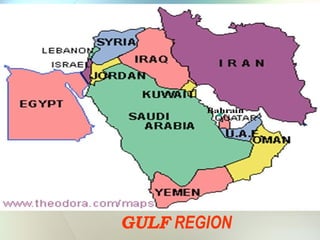
Officially Established on  26 May 1981 Aim of GCC  :To promote coordination between member states in all fields in order to achieve unity.  In 1991 it  joined with  Egypt and Syria  to create a  Regional Peacekeeping Force.  In 2003  Tariffs on trade  between member nations was eliminated and established  Common External Tariffs  . In 2008  Gulf  Common Market  was established.  By 2010 they are aiming  to establish a  Broader Economic union  ( including a single market and currency ) Map of the countries comprising GCC(in green) Map of the countries comprising GCC(in green)  Gulf Cooperation Council (GCC)
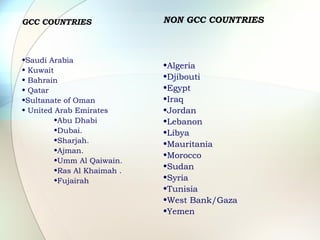
GCC COUNTRIES Saudi Arabia Kuwait Bahrain Qatar Sultanate of Oman  United Arab Emirates Abu Dhabi  Dubai. Sharjah. Ajman. Umm Al Qaiwain. Ras Al Khaimah . Fujairah  NON GCC COUNTRIES Algeria Djibouti Egypt Iraq Jordan Lebanon Libya Mauritania Morocco Sudan Syria Tunisia West Bank/Gaza Yemen
Climatic Conditions of Gulf Saudi Arabia  : one of the driest countries in the world. with rainfall averaging is less than 5 inches per year.   Bahrain  : Most of the year the climate is very hot and also very humid because  of the Arabian gulf sea surrounding  the Island  Kuwait  :Little rainfall, high temperatures and lots of sunshine.   U.A.E :  Climate is subtropical. Rain occurs in winter and amounts to 13cm a year only.  Oman:  Climate is very complicated. Hot and dry in the interior,  hot and humid along the coast .   Rainfall throughout the country is minimal, averaging only about 4 inches (100 mm) per year, although precipitation in the mountains is heavier .
Environment of Gulf Saudi Arabia:  M ost known type of animal’s are  Falcon’s Camels, different types of Lizards & Snakes.   Bahrain  :  Tubli bay in the eastern part of the island holds the vast of the mangroves  Kuwait  :Camels are likely to find in the Kuwait desert, although the camel has been domesticated it is a natural Arabian Species   Oman : Over thirteen types of whales and dolphins are found in the waters off Oman .
Customs and Traditions of Gulf Region The  traditional clothes is the  Thobe ,  on their heads they’d wear the  gahfia  ,on top of that would be the  Iga  the  shaila and abaya  for the women.  Sword dance  is famous in  Saudi Arabia . Traditional activities like  Falconry& Pearl Diving  are famous in  Kuwait
SAUDI ARABIA Population:24,573,000 Capital: Riyadh Language: Arabic Religion: Muslim Currency: Saudi riyal Life Expectancy:72 GDP : U.S. $11,400 Literacy Percent:79
Location & Geographical Features Saudi Arabia is Bordered by Jordan on the north-west. Iraq on the North and Northeast. Kuwait, Qatar, Bahrain. United Arab Emirates to East.  Oman on the Southeast. Yemen on the South. Geographical Features The southwestern region has mountains as high as 3,000 m, and is known for having the greenest and freshest atmosphere in all of Saudi Arabia.  The Red Sea lies to the West of Saudi Arabia.
Government Saudi Arabia is a monarchy country, Lead by  “King Abdullah bin Abdul Aziz”. The king was elected by the vote of the (male) citizens. The king's powers are supposedly limited within the Shari'a and other Saudi traditions.
BAHRAIN Population:731,000 Capital:Manama Language: Arabic, English, Farsi, Urdu Religion: Shiite and SunniMuslim Currency: Bahraini dinar Life Expectancy: 74 GDP per Capita U.S. $15,100 Literacy Percent:89
Location & Geographical Features Bahrain is an island so there are no countries that border it.  Places near it are  Saudi Arabia Qatar  Kuwait  U.A.E.  Geographical Features It is generally flat  made up of thirty three islands.
Government It is constitutional monarchy leaded by the King, Sheikh Hamad bin Isa Al Khalifa.  The head of government is the  Prime Minister, Sheikh Khalifa bin Salman Al Khalifa. The cabinet is made up of 23 people.  The first elections for the members of parliament took place in 2002 Although  70%  of the country are  Shia  the rulers and the government are  Sunni .
Tourism Very popular place for tourists. It gets about 8 million tourists a year mostly from surrounding Arab nations but the numbers from outside the region is growing rapidly due to the countries rich legacy and the Bahrain formula one race track. It is described as “an excellent introduction to the Persian gulf.”  The Bahrain national museum has artifacts that date to 9000 years ago.
Kuwait Population:2,589,000 Capital: Kuwait City Language: Arabic, English Religion: Sunni and Shiite Muslim, Christian, Hindu, Parsi Currency: Kuwaiti dinar Life Expectancy: 78 GDP : U.S. $17,500 Literacy Percent : 84
Location & Geographical Features Located in the Southwest Asia next to the Persian Gulf and between Iraq and Saudi Arabia. The countries that are near : Qatar Saudi Arabia UAE Bahrain Yemen Oman Geographical Features Flat to slightly undulating desert plain.
Government It is a constitutional monarchy, governed by the al-Sabah family.  The present Emir of Kuwait is his highness  Sheikh Sabah Al-Ahmed Al-Jaber Al-Sabah.
Tourism Places tourist can visit is: The Liberation Tower, it is the symbol of  Kuwaiti liberation.  There are also the Kuwaiti Towers and the National Museum.
OMAN Population: 2,436,000 Capital: Muscat Language: Arabic, English, Baluchi, Urdu, Indian dialects Religion:Ibadhi Muslim, Sunni Muslim, Shiite Muslim, Hindu Currency: Omani rial Life Expectancy: 73 GDP :U.S. $8,300 Literacy Percent:76
Location & Geographical Features Located in the Middle East, bordering  The Arabian Sea to the east. Saudi Arabia to the west.  Yemen to the south . UAE to the north . Geographical Features It is s the dessert landscape and also the highness of the topography of the land.  Because of Arabian Sea  Omani people and the Arabian peninsula in whole provided with water, fish, and fossil water which is a resource.
Government In Oman the legislative group are the people who make the laws in Oman.  Oman is governed by a monarchy (sultanate).  Sultan Qaboos bin Said  The sultan is the head of state, and, although he also acts as the prime minister, he may appoint one if he chooses.  The sultan is chosen by a method called voting, in which only the tribal leaders and intellectuals and prominent businessmen may vote.
Tourism Over 4 million people from different countries visited Oman. Oman has so many tourist attractions like wadi shab wahiba  The jabrin Fort Grand Mosque  Wadi Shab Grand Mosque   Jabrin Fort   Wahiba
United Arab Emirates Population: 4,618,000 Capital:Abu Dhabi Language: Arabic, Persian, English, Hindi, Urdu Religion: Sunni and Shiite Muslim, Christian, Hindu, Currency:Emirati dirham Life Expectancy:74 GDP :U.S. $22,100 Literacy Percent:78
Location & Geographical Features The United Arab Emirates which is also known as the U.A.E.  The countries surrounding the U.A.E are  Qatar Saudi Arabia Oman Iran  Geographical Features United Arab Emirates is almost completely a desert, except for Dubai, which is a really improved city, with great technology and beautiful sky scrapers.  Burj Dubai
Government Government is a monarchy  Consists of  Seven tiny kingdoms  each ruled by an emir and one emir plays a in charge  role of all Emir’s Khalifa bin Zayed Al Nahyan
Seven Emirates  Abu Dhabi  Dubai  Sharjah  Ajman  Umm Al Qaiwain  Ras Al Khaimah  Fujairah
Brief description on Seven Emirates Abu Dhabi , by far the largest emirate , Pearling and fishing  were the main sources of income for the people. Dubai , the second largest of the seven emirates,  Pearling and fishing  were the main sources of income for the people. Sharjah's  famous for   salt mines constituted an important part of its  export business , along with  pearls . It is the cultural and educational centre of the  UAE . Ajman  is the smallest emirate,  Fishing and date-trees  provided the local population with their primary means of sustenance . Umm Al Qaiwain  It is the second smallest emirate,  Fishing  is the primary means of income.  Date farming  also plays a significant role in the economy.  Ras Al Khaimah  has a unique abundance of flora, so it is no surprise that  Agriculture  is important to the local economy. The emirate also benefits from its  Stone quarries, and fishing , which is plentiful in the rich waters of the Gulf.  Fujairah  the only emirate without a  coastline  on the Arabian Gulf ,economy is based on  fishing and agriculture .
Economy of Gulf Region Saudi Arabia  :Petroleum sector accounts for roughly 75% of budget revenues, 45% of GDP, and 90% of export earnings. About 40% of GDP comes from theprivate sector   Bahrain  :  Petroleum production is the most important resource. It is 60% of the exports, 60% of the government revenues and 30% of the countries GDP.  Kuwait  : It owns about 10 percent of the worlds proven oil reserves. Its crude oil reserves of about 95% of export revenues, and 80-90% of government income.  Oman  has a pretty low GPD per capita of about 8,300, which is slightly lower than the world’s average  U.A.E  has been largely funded by oil revenues, the GDP of UAE economy is  the fastest growing
QATAR Population:768,000 Capital:Doha Language:Arabic, English Religion: Muslim Currency: Qatari rial Life Expectancy:72 GDP :U.S. $20,100 Literacy Percent: 83
LOCATION Qatar is neighbored by four  countries To the north Bahrain  To the west Saudi Arabia To the south the U.A.E  To the east the closest country to it is Iran.
Geographic Features Qatar has a limited space and is a small country. It does not have any rivers, lakes or ponds or huge mountains. The highest point in Qatar is jebel Dukhan( the mountain of Dukhan ), it is about 90 meters tall ,area contains Qatar's largest onshore oil fields.
Climatic Conditions Qatar does not have a big range of weathers and climates.  Qatar has a  desert climate  and it rarely  changes it’s pattern of  temperature and wind. In the  winters  of Qatar are mostly  December, January , and until the middle of  February ; this time for Qatar is very peaceful and it will usually  rain  a bit during this period of time,  The summers in Qatar are extremely humid  and hot.  The summer time is usually  June, July and August .
Government Qatar is a constitutional monarchy.  Qatar  president ( emir ) is  sheikh Hamad bin khalifa Al  Thani. The law in Qatar is based on  Islamic and  civil law codes.  Advisory council  (  majlis Al Shura  ) is appointed by the emir to help the emir in his job. The prime minister of the country is  Hamad bin Jassin Bin Jabor Al Thani. Sheikh Hamad bin khalifa AlThani Hamad bin Jassin Bin Jabor Al Thani.
International & Regional Relations International United Nations(U.N) WTO OPEC IMF Regional GCC OAPEC Arab League(AL)
ECONOMY Overall Balance of payments=$10,900 million Export goods Petroleum products(80%),fertilizers and steel Export partners Japan(52%),Singapore(9%),South Korea(8%),U.S.A and UAE. Import goods Machinery & transport equipment, food and chemicals Import partners U.K(10%),Japan(8%),Germany,Italy and U.S.A(6%)
Labour Market 90%  of the workforce are  expatriates Many locals work at the  bureaucracy  Unemployment  may become a problem as the population increases  very fast   Efforts to improve the local human capital State Budget/Public Expenditures Government revenues  are largely dependent on oil Large external debts due to large lending's from  Japanese banks Serious efforts to control the public expenditures Foreign Investment The government encourages foreign investment in  joint ventures  with Qatari partners Many  regulations and legal limits  for foreign investors Sectors of foreign Investment Electricity   water sectors   oil and natural gas development . Privatisation The laws about foreign investment are a drawback  The establishment of the  Stock exchange  is expected to facilitate privatisation
The Doha Stock-Exchange  Doha Securities Market (DSM)  Began operation in the  first quarter of 1997 Trading  is confined only to Qatari's The stock-exchange is  autonomous , but Directly overseen by the  Finance, Economic and Trade Ministry Medium Run Prospects Rapid population  growth-low level  of  human capital Development of  non-oil sectors Control  Public  expenditures Instability in the region Long run prospects Petroleum reserves  are declining fast There is a  strong need to diversify  the structure of economy Research  for   gas substitutes
Structure of  Economy The economy of Qatar has two sectors The  oil sector The  non-oil sector Agriculture Manufacturing Industries Transportation Communication Finance & real estate services etc
Banks in Qatar 1 Al Khaliji 1 Qatar Industrial Development Bank Pakistani 1 United Bank Limited 1 GrindlaysQatar Bank Iranian 1 Saderat Iran Bank 12 Qatar Islamic Bank French 1 P.N.B. Paribas 7 Qatar International Islamic Bank British 3 HSBC Bank Middle East 10 Al-AhliBankof Qatar British 1 Standard Chartered Bank 13 Commercial Bank of Qatar UAE 1 Mashreq Bank Plc 16 Doha Bank Jordanian 3 Arab Bank Limited 30 QatarNational Bank Nationality No of Branches Name No of Branches Name  Foreign Banks Domestic Banks
SAFETY AND SECURITY   Incidents of violence are rare in Qatar  The crime rate in Qatar is  generally low ,  incidents of violence are rare but frequently as Doha ’s population and economic pressures  The Qatari Police can be contacted for emergency assistance by dialing  999  from any telephone in Qatar .  Criminal offenses  are punished according to  Qatari laws , some cases are based on  Islamic law  and sometimes  more severe  than in the  United States  for similar offenses.   Penalties   for  use or trafficking in illegal drugs Homosexual activity  using or disseminating child pornography in Qatar are considered severe
Qatar Newspapers and News Sites   Al Jazeera English language site of Qatar based pan-Arabian TV broadcaster. Foreign Information Agency (FIA) Multilanguage news portal.  Gulf Times First English newspaper in Qatar.  Qatar Falcon Business oriented news site.  Qatar Ministry Of Foreign Affairs Find general country and tourism information as well as info on visa regulations.  Qatar News Agency Daily Qatar and Middle East news from official news service.  Qatar Tourism Authority Provides news and information about visiting Qatar including activities, accommodation, travel, investor relations, guide to Doha and other cities, more.  Peninsula, The Qatar's leading English daily newspaper.
GULF COMMAN MARKET --GCM
1 st  January 2008 At the end of the  28th Gulf summit  in Doha,  The wealthy  Six Gulf  states have taken a step closer together economically with the formation of a common market as  Gulf Common Market .  Aim  Gulf Common Market  :  To build on  local strengths  where all  Gulf nationals will be considered equal citizens and will enjoy the same rights in the fields : Travel Employment  Education  Economic Financial &  investment opportunities .  Main challenges for the Gulf Common Market   Monetary policies in the GCC states Inflation rates  Laws and Regulations related to investment  . problems and obstacles  : S ome member states have signed  Bilateral Economic Agreements  with non-GCC countries. Real implementation of the GCC common market  : Requires months and that this period was needed to have the  local rules and Regulations  amended to match the requirements of the  Common Market .
Procespects of  GCC Common Market Would grant the countries strong competitive tools to face the  Global Economic challenges.  The common market is the  beginning  of a new phase for the activation of  GCC Economic Integration,  will make them one big economy which can withstand competition in world markets.  Concerns  of  GCC Common Market Different  Economic Models  of the  six countries  to secure a meaningful common market looks difficult. Different  Legislative  arrangements in the six Gulf countries, such as  Ownership  Investment legislation .
THANK YOU

Gulf Region

  • 1.
  • 2.
    Officially Established on 26 May 1981 Aim of GCC :To promote coordination between member states in all fields in order to achieve unity. In 1991 it joined with Egypt and Syria to create a Regional Peacekeeping Force. In 2003 Tariffs on trade between member nations was eliminated and established Common External Tariffs . In 2008 Gulf Common Market was established. By 2010 they are aiming to establish a Broader Economic union ( including a single market and currency ) Map of the countries comprising GCC(in green) Map of the countries comprising GCC(in green) Gulf Cooperation Council (GCC)
  • 3.
    GCC COUNTRIES SaudiArabia Kuwait Bahrain Qatar Sultanate of Oman United Arab Emirates Abu Dhabi Dubai. Sharjah. Ajman. Umm Al Qaiwain. Ras Al Khaimah . Fujairah NON GCC COUNTRIES Algeria Djibouti Egypt Iraq Jordan Lebanon Libya Mauritania Morocco Sudan Syria Tunisia West Bank/Gaza Yemen
  • 4.
    Climatic Conditions ofGulf Saudi Arabia : one of the driest countries in the world. with rainfall averaging is less than 5 inches per year. Bahrain : Most of the year the climate is very hot and also very humid because of the Arabian gulf sea surrounding the Island Kuwait :Little rainfall, high temperatures and lots of sunshine. U.A.E : Climate is subtropical. Rain occurs in winter and amounts to 13cm a year only. Oman: Climate is very complicated. Hot and dry in the interior, hot and humid along the coast . Rainfall throughout the country is minimal, averaging only about 4 inches (100 mm) per year, although precipitation in the mountains is heavier .
  • 5.
    Environment of GulfSaudi Arabia: M ost known type of animal’s are Falcon’s Camels, different types of Lizards & Snakes. Bahrain : Tubli bay in the eastern part of the island holds the vast of the mangroves Kuwait :Camels are likely to find in the Kuwait desert, although the camel has been domesticated it is a natural Arabian Species Oman : Over thirteen types of whales and dolphins are found in the waters off Oman .
  • 6.
    Customs and Traditionsof Gulf Region The traditional clothes is the Thobe , on their heads they’d wear the gahfia ,on top of that would be the Iga the shaila and abaya for the women. Sword dance is famous in Saudi Arabia . Traditional activities like Falconry& Pearl Diving are famous in Kuwait
  • 7.
    SAUDI ARABIA Population:24,573,000Capital: Riyadh Language: Arabic Religion: Muslim Currency: Saudi riyal Life Expectancy:72 GDP : U.S. $11,400 Literacy Percent:79
  • 8.
    Location & GeographicalFeatures Saudi Arabia is Bordered by Jordan on the north-west. Iraq on the North and Northeast. Kuwait, Qatar, Bahrain. United Arab Emirates to East. Oman on the Southeast. Yemen on the South. Geographical Features The southwestern region has mountains as high as 3,000 m, and is known for having the greenest and freshest atmosphere in all of Saudi Arabia. The Red Sea lies to the West of Saudi Arabia.
  • 9.
    Government Saudi Arabiais a monarchy country, Lead by “King Abdullah bin Abdul Aziz”. The king was elected by the vote of the (male) citizens. The king's powers are supposedly limited within the Shari'a and other Saudi traditions.
  • 10.
    BAHRAIN Population:731,000 Capital:ManamaLanguage: Arabic, English, Farsi, Urdu Religion: Shiite and SunniMuslim Currency: Bahraini dinar Life Expectancy: 74 GDP per Capita U.S. $15,100 Literacy Percent:89
  • 11.
    Location & GeographicalFeatures Bahrain is an island so there are no countries that border it. Places near it are Saudi Arabia Qatar Kuwait U.A.E. Geographical Features It is generally flat made up of thirty three islands.
  • 12.
    Government It isconstitutional monarchy leaded by the King, Sheikh Hamad bin Isa Al Khalifa. The head of government is the Prime Minister, Sheikh Khalifa bin Salman Al Khalifa. The cabinet is made up of 23 people. The first elections for the members of parliament took place in 2002 Although 70% of the country are Shia the rulers and the government are Sunni .
  • 13.
    Tourism Very popularplace for tourists. It gets about 8 million tourists a year mostly from surrounding Arab nations but the numbers from outside the region is growing rapidly due to the countries rich legacy and the Bahrain formula one race track. It is described as “an excellent introduction to the Persian gulf.” The Bahrain national museum has artifacts that date to 9000 years ago.
  • 14.
    Kuwait Population:2,589,000 Capital:Kuwait City Language: Arabic, English Religion: Sunni and Shiite Muslim, Christian, Hindu, Parsi Currency: Kuwaiti dinar Life Expectancy: 78 GDP : U.S. $17,500 Literacy Percent : 84
  • 15.
    Location & GeographicalFeatures Located in the Southwest Asia next to the Persian Gulf and between Iraq and Saudi Arabia. The countries that are near : Qatar Saudi Arabia UAE Bahrain Yemen Oman Geographical Features Flat to slightly undulating desert plain.
  • 16.
    Government It isa constitutional monarchy, governed by the al-Sabah family. The present Emir of Kuwait is his highness Sheikh Sabah Al-Ahmed Al-Jaber Al-Sabah.
  • 17.
    Tourism Places touristcan visit is: The Liberation Tower, it is the symbol of Kuwaiti liberation. There are also the Kuwaiti Towers and the National Museum.
  • 18.
    OMAN Population: 2,436,000Capital: Muscat Language: Arabic, English, Baluchi, Urdu, Indian dialects Religion:Ibadhi Muslim, Sunni Muslim, Shiite Muslim, Hindu Currency: Omani rial Life Expectancy: 73 GDP :U.S. $8,300 Literacy Percent:76
  • 19.
    Location & GeographicalFeatures Located in the Middle East, bordering The Arabian Sea to the east. Saudi Arabia to the west. Yemen to the south . UAE to the north . Geographical Features It is s the dessert landscape and also the highness of the topography of the land. Because of Arabian Sea Omani people and the Arabian peninsula in whole provided with water, fish, and fossil water which is a resource.
  • 20.
    Government In Omanthe legislative group are the people who make the laws in Oman. Oman is governed by a monarchy (sultanate). Sultan Qaboos bin Said The sultan is the head of state, and, although he also acts as the prime minister, he may appoint one if he chooses. The sultan is chosen by a method called voting, in which only the tribal leaders and intellectuals and prominent businessmen may vote.
  • 21.
    Tourism Over 4million people from different countries visited Oman. Oman has so many tourist attractions like wadi shab wahiba The jabrin Fort Grand Mosque Wadi Shab Grand Mosque Jabrin Fort Wahiba
  • 22.
    United Arab EmiratesPopulation: 4,618,000 Capital:Abu Dhabi Language: Arabic, Persian, English, Hindi, Urdu Religion: Sunni and Shiite Muslim, Christian, Hindu, Currency:Emirati dirham Life Expectancy:74 GDP :U.S. $22,100 Literacy Percent:78
  • 23.
    Location & GeographicalFeatures The United Arab Emirates which is also known as the U.A.E. The countries surrounding the U.A.E are Qatar Saudi Arabia Oman Iran Geographical Features United Arab Emirates is almost completely a desert, except for Dubai, which is a really improved city, with great technology and beautiful sky scrapers. Burj Dubai
  • 24.
    Government Government isa monarchy Consists of Seven tiny kingdoms each ruled by an emir and one emir plays a in charge role of all Emir’s Khalifa bin Zayed Al Nahyan
  • 25.
    Seven Emirates Abu Dhabi Dubai Sharjah Ajman Umm Al Qaiwain Ras Al Khaimah Fujairah
  • 26.
    Brief description onSeven Emirates Abu Dhabi , by far the largest emirate , Pearling and fishing were the main sources of income for the people. Dubai , the second largest of the seven emirates, Pearling and fishing were the main sources of income for the people. Sharjah's famous for salt mines constituted an important part of its export business , along with pearls . It is the cultural and educational centre of the UAE . Ajman is the smallest emirate, Fishing and date-trees provided the local population with their primary means of sustenance . Umm Al Qaiwain It is the second smallest emirate, Fishing is the primary means of income. Date farming also plays a significant role in the economy. Ras Al Khaimah has a unique abundance of flora, so it is no surprise that Agriculture is important to the local economy. The emirate also benefits from its Stone quarries, and fishing , which is plentiful in the rich waters of the Gulf. Fujairah the only emirate without a coastline on the Arabian Gulf ,economy is based on fishing and agriculture .
  • 27.
    Economy of GulfRegion Saudi Arabia :Petroleum sector accounts for roughly 75% of budget revenues, 45% of GDP, and 90% of export earnings. About 40% of GDP comes from theprivate sector Bahrain : Petroleum production is the most important resource. It is 60% of the exports, 60% of the government revenues and 30% of the countries GDP. Kuwait : It owns about 10 percent of the worlds proven oil reserves. Its crude oil reserves of about 95% of export revenues, and 80-90% of government income. Oman has a pretty low GPD per capita of about 8,300, which is slightly lower than the world’s average U.A.E has been largely funded by oil revenues, the GDP of UAE economy is the fastest growing
  • 28.
    QATAR Population:768,000 Capital:DohaLanguage:Arabic, English Religion: Muslim Currency: Qatari rial Life Expectancy:72 GDP :U.S. $20,100 Literacy Percent: 83
  • 29.
    LOCATION Qatar isneighbored by four countries To the north Bahrain To the west Saudi Arabia To the south the U.A.E To the east the closest country to it is Iran.
  • 30.
    Geographic Features Qatarhas a limited space and is a small country. It does not have any rivers, lakes or ponds or huge mountains. The highest point in Qatar is jebel Dukhan( the mountain of Dukhan ), it is about 90 meters tall ,area contains Qatar's largest onshore oil fields.
  • 31.
    Climatic Conditions Qatardoes not have a big range of weathers and climates. Qatar has a desert climate and it rarely changes it’s pattern of temperature and wind. In the winters of Qatar are mostly December, January , and until the middle of February ; this time for Qatar is very peaceful and it will usually rain a bit during this period of time, The summers in Qatar are extremely humid and hot. The summer time is usually June, July and August .
  • 32.
    Government Qatar isa constitutional monarchy. Qatar president ( emir ) is sheikh Hamad bin khalifa Al Thani. The law in Qatar is based on Islamic and civil law codes. Advisory council ( majlis Al Shura ) is appointed by the emir to help the emir in his job. The prime minister of the country is Hamad bin Jassin Bin Jabor Al Thani. Sheikh Hamad bin khalifa AlThani Hamad bin Jassin Bin Jabor Al Thani.
  • 33.
    International & RegionalRelations International United Nations(U.N) WTO OPEC IMF Regional GCC OAPEC Arab League(AL)
  • 34.
    ECONOMY Overall Balanceof payments=$10,900 million Export goods Petroleum products(80%),fertilizers and steel Export partners Japan(52%),Singapore(9%),South Korea(8%),U.S.A and UAE. Import goods Machinery & transport equipment, food and chemicals Import partners U.K(10%),Japan(8%),Germany,Italy and U.S.A(6%)
  • 35.
    Labour Market 90% of the workforce are expatriates Many locals work at the bureaucracy Unemployment may become a problem as the population increases very fast Efforts to improve the local human capital State Budget/Public Expenditures Government revenues are largely dependent on oil Large external debts due to large lending's from Japanese banks Serious efforts to control the public expenditures Foreign Investment The government encourages foreign investment in joint ventures with Qatari partners Many regulations and legal limits for foreign investors Sectors of foreign Investment Electricity water sectors oil and natural gas development . Privatisation The laws about foreign investment are a drawback The establishment of the Stock exchange is expected to facilitate privatisation
  • 36.
    The Doha Stock-Exchange Doha Securities Market (DSM) Began operation in the first quarter of 1997 Trading is confined only to Qatari's The stock-exchange is autonomous , but Directly overseen by the Finance, Economic and Trade Ministry Medium Run Prospects Rapid population growth-low level of human capital Development of non-oil sectors Control Public expenditures Instability in the region Long run prospects Petroleum reserves are declining fast There is a strong need to diversify the structure of economy Research for gas substitutes
  • 37.
    Structure of Economy The economy of Qatar has two sectors The oil sector The non-oil sector Agriculture Manufacturing Industries Transportation Communication Finance & real estate services etc
  • 38.
    Banks in Qatar1 Al Khaliji 1 Qatar Industrial Development Bank Pakistani 1 United Bank Limited 1 GrindlaysQatar Bank Iranian 1 Saderat Iran Bank 12 Qatar Islamic Bank French 1 P.N.B. Paribas 7 Qatar International Islamic Bank British 3 HSBC Bank Middle East 10 Al-AhliBankof Qatar British 1 Standard Chartered Bank 13 Commercial Bank of Qatar UAE 1 Mashreq Bank Plc 16 Doha Bank Jordanian 3 Arab Bank Limited 30 QatarNational Bank Nationality No of Branches Name No of Branches Name Foreign Banks Domestic Banks
  • 39.
    SAFETY AND SECURITY Incidents of violence are rare in Qatar The crime rate in Qatar is generally low , incidents of violence are rare but frequently as Doha ’s population and economic pressures The Qatari Police can be contacted for emergency assistance by dialing 999 from any telephone in Qatar . Criminal offenses are punished according to Qatari laws , some cases are based on Islamic law and sometimes more severe than in the United States for similar offenses.  Penalties for use or trafficking in illegal drugs Homosexual activity using or disseminating child pornography in Qatar are considered severe
  • 40.
    Qatar Newspapers andNews Sites Al Jazeera English language site of Qatar based pan-Arabian TV broadcaster. Foreign Information Agency (FIA) Multilanguage news portal. Gulf Times First English newspaper in Qatar. Qatar Falcon Business oriented news site. Qatar Ministry Of Foreign Affairs Find general country and tourism information as well as info on visa regulations. Qatar News Agency Daily Qatar and Middle East news from official news service. Qatar Tourism Authority Provides news and information about visiting Qatar including activities, accommodation, travel, investor relations, guide to Doha and other cities, more. Peninsula, The Qatar's leading English daily newspaper.
  • 41.
  • 42.
    1 st January 2008 At the end of the 28th Gulf summit in Doha, The wealthy Six Gulf states have taken a step closer together economically with the formation of a common market as Gulf Common Market . Aim Gulf Common Market : To build on local strengths where all Gulf nationals will be considered equal citizens and will enjoy the same rights in the fields : Travel Employment Education Economic Financial & investment opportunities . Main challenges for the Gulf Common Market Monetary policies in the GCC states Inflation rates Laws and Regulations related to investment . problems and obstacles : S ome member states have signed Bilateral Economic Agreements with non-GCC countries. Real implementation of the GCC common market : Requires months and that this period was needed to have the local rules and Regulations amended to match the requirements of the Common Market .
  • 43.
    Procespects of GCC Common Market Would grant the countries strong competitive tools to face the Global Economic challenges. The common market is the beginning of a new phase for the activation of GCC Economic Integration, will make them one big economy which can withstand competition in world markets. Concerns of GCC Common Market Different Economic Models of the six countries to secure a meaningful common market looks difficult. Different Legislative arrangements in the six Gulf countries, such as Ownership Investment legislation .
  • 44.