Elizabeth Tong7 Countries Project
By Elizabeth TongMali Bamako
Mali
Mali Elizabeth Tong
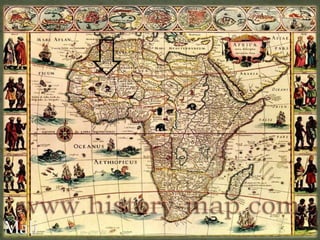
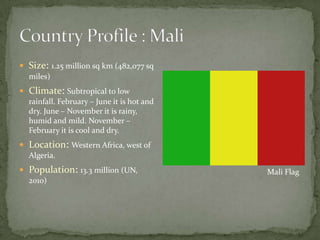
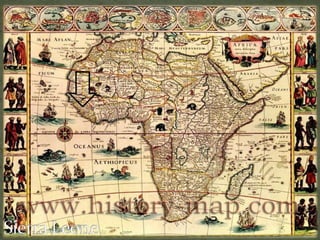
Country Profile : MaliSize:1.25 million sq km (482,077 sq miles)Climate: Subtropical to low rainfall. February – June it is hot and dry. June – November it is rainy, humid and mild. November – February it is cool and dry.Location: Western Africa, west of Algeria. Population: 13.3 million (UN, 2010)   Mali Flag
Geographical FeaturesMali is mostly made up of mostly flat to rolling northern plains covered by sand, the savanna in the south and rugged hills in the northeast. The Niger river also flows through Mali.Elevation degree:                 lowest point: Senegal River 23 m highest point: Hombori Tondo 1,155 mPeople travel to Mali, one of the largest countries in Africa, to see the beautiful landscape and to experience a cultural immersion.Special Points: Vacationers in Mali are attracted by the Sigui Dance of the Masks, performed once every 60 years. However, for the sake of the tourist, imitations dances are performed.  MaliVacation Tour
The recorded history of Mali goes back to mostly Arabic writings of about the 4th century ad. Between then and the 19th century, Mali was the center of great empires of the western Sudan: Ghana, Mali, and Songhai. Also cities of Djenné, Tombouctou, and Gao became centers of trade, learning, and culture.
The Mali Empire originated in the 11th century, but its period of greatness began under Sundiata Keita, who ruled from around 1235 to 1255.
By the 1890s, French administration was installed in Mali, they banned African political activity until after World War II. However in 1958 a vote of the population was taken, but instead of separating itself completely from France, the Sudanese Union accepted self- government within the new French Community as the Sudanese Republic. It then sought to unite several French West African states in a new political federation, and in 1959 the Federation of Mali was formed. History: Mali
According to nytimes.com, An open letter has been written to the government by the Party for National Renaissance demanded that the acres of land being leased to private investors and  foreign government be accounted for, have the financial details of the leases released, as well as the required environmental impact studies.The Party for National Renaissance speculates that the government was "giving the land away to countries including Libya, China and Brazil without ensuring that food sufficiency was the priority."Currently in MaliEvents
Djenné, Mali is an ancient city rich in history and timeless beauty, and now is an official World Heritage site. However the town’s people living here are not happy because of the strict restriction applied to the improvements available to be made to person’s home. “The guidelines established by Unesco , the cultural arm of the United Nations, which compiles the heritage list, demand that any reconstruction not substantially alter the original.” Due to this restriction the people are forced to live frozen in space and unable to revolutionize with the rest of the world. However residents recognize that the Unesco list has made their city famous, but they also believe if there is no noticeable gain what is the point of living like a frozen exhibition on display.  Currently in MaliEvents
Type of Government:  RepublicChief of State: President Amadou Toumani (since 8 June 2002)Head of Government: Prime Minister Modibo (since 28 September 2007)Cabinet: Council of Ministers appointed by the prime ministerElections: President elected by popular vote for a five-year term (eligible for a second term)Legislative Branch: 147 seats, member are elected by popular vote and serve a five-year term.Judicial Court: Supreme Court Political: Mali
Economy: MaliIndustry: Food processing; construction; phosphate and gold mining.Exports: Cotton, gold, livestock are worth $294 million (2006) in exports.Imports: Petroleum, machinery and equipment, construction materials, foodstuffs, textiles are worth $2.358 billion (2006) in imports.Major Trade Partners: China Thailand Pakistan, Morocco Burkina Faso, France, India, Cote d'Ivoire and Senegal. (2009)Economic Status: Mali’s revenue depends heavily on gold mining and agricultural exports. According to the CIA Factbook, “Mali's adherence to economic reform and the 50% devaluation of the CFA franc in January 1994 have pushed up economic growth to a 5% average in 1996-2010. ”A house constructed from mud bricks
Daily Life: MaliStandard of Living: Mali is not a hightly modernized country.Literacy: Ages 15 and over can read and write. 46.4% of the total population. (2003 est.)Internet Usage: 249,800 people use the internet in Mali. (2009)Clothing: Silk is a very common material for making clothes. Since Mali is mostly a Muslim Country, the women wear different types of turbans to match their skirts, tops or long dresses. Men prefer wearing loose pants and shirts. Mali women
Culture: MaliTraditions: Every 60 years the Sigui Dance of the Masks is performed to honor their ancestors. Religions: Muslim 90%, Christian 1%, indigenous beliefs 9%Foods:  In the cities, rice is the preferred dish, followed by cereals. The cereals can be served with sauces with fish or meat and various vegetables, or in the form of porridge.Music and Dance:  Mali’s music, combines Islamic influences of the north with the complex rhythm of the south. Because drums are very important to West African music their dances go along with the beat of the drums.
Mali is a beautiful and unique country that struggles to compete finically with the growing powerhouses of the world. It is a West African country with a rich past, present and future that will be remembered and praised by the world for its determination.In farming regions of Mali, bit men and women are both equally involved.ConclusionNeat Stuff
By Elizabeth TongSierra Leone Freetown
Sierra Leone
Sierra Leone Elizabeth Tong
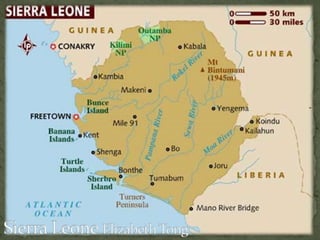
Country Profile: Sierra LeoneSize: 71,740 sq km (27,699 sq miles) Climate: Tropical climate with an annual rainfall of 2,000 mm in the interior to 3,800 mm along the coast. Most rain falls from May to October.Location: Western African between Guinea and Liberia. Also along the North Atlantic Ocean.Population: 5.7 million (UN, 2009) Sierra Leone flag
Geographical FeaturesSierra Leone is mostly made up of mangrove swamps along the coastline, a wooded hill country, an upland plateau, and mountains in east.Elevation Degrees:                lowest Point: Atlantic Ocean 0 m                                         highest point: Loma Mansa 1,948 mMany people travel to Sierra Leone for the beaches and the rich culture that can be seen in the people that live there.Special Points of Interest: People who travel to Sierra Leone  may want to see Bunce Island, an 18th century slave trading post or may just want to visit the beautiful beaches by the coast of the Atlantic Ocean.Sierra LeoneVacation Tour
Sierra Leone meaning the Lion Mountain, was named by Pedro da Cintra, who visited the coast in 1460.Freetown was first establish in 1787 by Britain as a colony for slaves. The original land where the city later developed was purchased from local chiefs.After WWII, Britain submitted to nationalist’s demand in West Africa, including Sierra Leone, and the constitution of 1951 gave control to the majority. Its Leader was Sir Milton Margai of the Sierra Leone People’s Party. Later on April 27, 1961, Sierra Leone become an independent state within Britain territory. History: Sierra Leone
On Wednesday, February 3, a passenger boat traveling from Shengay to Freetown capsized, leaving 10 passengers missing including a pregnant woman. Originally there were 20 passengers but 10 disembarked in Plantain Island. The search and rescue effort is still ongoing. On March 8, 2011, three people were trapped in a fire at Hill Station. Only a few days ago, Hill Station experienced a deadly truck accident that claimed the lives of three people. Bystanders helped rescue people, however the real help, The National Fire Force (NFF), arrived three hours  into the event.Currently in Sierre LeoneEvents
Type of Government: Constitutional MonarchyChief of State and Head of Government: President Ernest Bai(since 17 September 2007)Cabinet: Appointed by the president with the approval of the House of Representatives.Election: President elected by popular vote for a five-year term (eligible for a second term)Legislative Branch: 124 seats; 112 members elected by popular vote, 12 filled by the chiefs elected in separate elections, the members are to serve five-year terms.Judicial Branch:  Supreme CourtPolitical: Sierra Leone
Economy: Sierra LeoneIndustry: Diamond mining, small-scale manufacturing beverages, textiles, cigarettes and footwear, petroleum refining, and small commercial ship repair.Exports: Diamonds, rutile, cocoa, coffee and fish.Imports: Foods, machinery and equipment, fuels and chemicals.Major Trade Partners: South Africa ,China, US, Cote d'Ivoire, India, Malaysia, France, UK, Netherlands, Belgium and Greece. (2009)Economic Status: Sierra Leone is a poverty stricken country, who is still trying to recover from the civil war.A thatched hut in Sierra Leone
Daily Life: Sierra LeoneStandard of Living: Sierra is a very poor nation so many families do not have much resources.   Literacy: Ages 15 and over can read and write English, Mende, Temne, or Arabic. 35.1% of the total population. (2004 est.)Internet Usage:  14,900 people in Sierra Leone use the internet. (2009)Clothing: Since Sierra Leone is also mostly a Muslim Country, the women wear different types of turbans to match their skirts, tops or long dresses. Men prefer wearing loose pants and shirts.
Culture: Sierra LeoneGroup of women make garas, a traditional tie-dyed cloth.Traditions, Music and Dance: There are many cultural dances performed by secret societies or political parties to rally or Chase the devil. The music usually consist of beating drums. Religions: Muslim 60%, Christian 10%, indigenous beliefs 30%Foods: In Sierra Leone rice is eaten at every meal and can be prepared  many different ways or topped with sauces made from potato leaves, cassava leaves, hot peppers, peanuts, beans, okra, fish, beef, chicken, eggplant, onions, and tomatoes. A market in Freetown
Although Sierra Leone is a very small country, its beauty, culture and people are able to set Sierra Leone apart from other West African countries.Sierra Leone was named by Portuguese explorer Pedro da Cintra when saw the tall mountains rising up the Freetown Peninsula and called them the "Lion Mountains," or " Serra Lyoa ."ConclusionNeat Stuff
By Elizabeth TongMoldova Chinsinau
Moldova
Moldova Elizabeth Tong
Country Profile: MoldovaSize: 33,800 sq km (13,050 sq miles) Climate: Moderate Winters and warm summers.Location:  Eastern Europe and northeast of Romania.Population: 3.6 million (UN, 2010)Moldova Flag
Geographical FeaturesMoldova is land locked between Romania and Ukraine with a vast rolling plain and the Dniester River. Elevation Degrees:           lowest point: Dniester 2 m highest point: Dealul Balanesti 430 mSpecial Points of interest: Many people travel to the capital city of Moldova, Chisinau, because of its historical landmarks centered along the Stefan cel Mare Boulevard. One of the most popular cultural attraction is the Triumphal Arch, also known as the Sacred Gate or the Arch of Glory.MoldovaVacation Tour
Moldova was once a part of the Bessarabia region, the named orginated from a medieval prince, Basarab I, who once ruled part of the southern region.Russia took over the region of Bessarabia after the Russo-Turkish War of 1806-1812 leaving fractions of Moldavia to be still under Ottoman control. When Russia was defeated in Crimean War (1853-1856), Moldavia and southern Bessarabia gained independence from the Ottoman Empire and Russia, and the reunited.History: Moldova
According to allmoldova.com, Moldova's cabinet was to meet March 5, 2011 to consider and approve the 2011 Budget Bill, but it has been postponed. Prime Minister Vlad Filat stated that the postponement was due to certain issues that need to be discussed in another setting. According to unofficial statements, the Government's sitting was lead earlier this morning by a meeting of the executive committee.Currently in MoldovaEvent
Political: MoldovaGovernment Type: RepublicChief of State: Acting President Marian (since 30 December 2010)[President Marian, is only a temporary replacement for Mihai Ghimpu who was the acting president before him. He is an acting president because the elected President Vladimir resigned September 11, 2009.] Presidents are elected by Parliament to serve a four- year term.Legislative Branch: 101 seats; members elected by popular vote to serve four-year terms.Judicial Branch: Supreme Court
Economy: MoldovaIndustry: Sugar, vegetable oil, food processing, agricultural machinery, refrigerators and freezers, washing machines; hosiery, shoes and textiles.Exports: Food, textiles and machinery.Imports: Mineral products and fuel, machinery and equipment, chemicals and textiles.Major Trade Partners: Russia, Italy, Romania, Germany, Turkey Belarus, Ukraine and Romania (2009)Economic Status: Despite recent economic progress, Moldova remains as one of the poorest European country.Workers at a Ceramic factory
Daily Life: MoldovaStandard of Living: Moldova has a large foreign debt and high unemployment is heavily dependent on Russia for energy supplies. Literacy: Ages 15 and over can read and write. 99.1% of the total population.Internet Usage: 1.333 million people is Moldova use the internet. (2009)Clothing: The younger generation of Moldova wear westernized clothing. Older men wear traditional shirts and trousers and older women wear long skirts, blouses and often an apron and head scarf (like a bandana)Women at a market
Culture: MoldovaCustoms: During a meal or in a ritual it is proper to drink at least some amount of wine to honor the host and to toast the health of the people present. Occasionally in villages, toasting with the left hand may not be regarded as proper. Religions: Eastern Orthodox 98%, Jewish 1.5%, Baptist and others 0.5%. (2000) Foods:Mamaliga is a hard corn porridge that is regarded as the national dish. It is poured onto a flat surface in the shape of a big cake and is served mainly with cheese, sour cream or milk.Music: The music of Moldova is known for its sweeping tempos, rhythm, and the placement of their accent on a weak beat.
Moldova remains one of the poorest European countries despite recent progress. However their cheerful toasts, greetings and music would prove otherwise.Women are expected carry the burden of house duties and child care in addition to working outside the home. ConclusionNeat Stuff
Elizabeth TongGeorgia Tbilisi
Georgia
Georgia
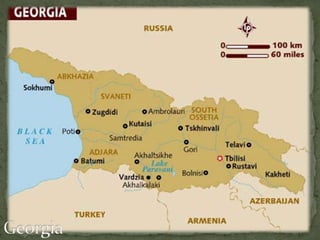
Country Profile: GeorgiaSize: 69,700 sq km (26,911 sq miles) Climate: Warm and pleasant. Mediterranean  like climate along the coast of the Black Sea.Location: Southwestern Asia, bordering the Black Sea.Population: 4.2 million (UN, 2010) Georgia flag
Geographical FeaturesGeorgia is a largely mountainous area with Great Caucasus Mountains in the north.Elevation Degrees:              lowest point: Black Sea 0 m highest point: Mount Shkhara 5,201 mSpecial Points of Interest: Georgia is has many historic cities, a relaxing countryside and a culture that combines Eastern Asia, Europe and the Middle East. In the capital of Georgia, Tbilisi, you’ll find the Church of St Nicholas in the Narikala Fortress.GeorgiaVacation Tour
Georgia once contained the ancient kingdoms of Colchis and Kartli-Iberia.Under Roman influence in the first centuries A.D, Christianity became the state religion.In the  11th-13th centuries dominations by Persians, Arabs, and Turks were discontinued by the Mongol invasion of 1236. Then in the 19th century Georgia was included into the Russian Empire.History: Georgia
According  to Armenian News the on March 25, Dimitry Shashkin and Armen Ashotyan signed an agreement in the field of education and science in Tbilisi. According to the agreement, “the higher education institutions of both countries will conduct joint researches and organize different joint projects. Both countries will promote the exchange of 10 students in accordance with state legislation.”Currently in Georgia
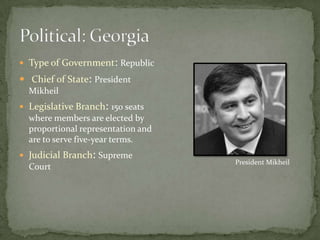
Political: GeorgiaType of Government: RepublicChief of State: President MikheilLegislative Branch: 150 seats where members are elected by proportional representation and are to serve five-year terms. Judicial Branch: Supreme CourtPresident Mikheil
Economy: GeorgiaIndustry: steel, aircraft, machine tools, electrical appliances, chemicals, wood products  and wine.Export: scrap metal, wine, mineral water, ores, vehicles, fruits and nuts.Import: fuels, vehicles, machinery and parts, grain and other foods and pharmaceuticals.Major Trade Partners:  Turkey, Azerbaijan, Bulgaria, Canada, UK, Ukraine, Spain, United States of America, Germany and Russia.Economic Status: Georgia's growth slowed in 2008 but returned in 2010.Women tending to the farm
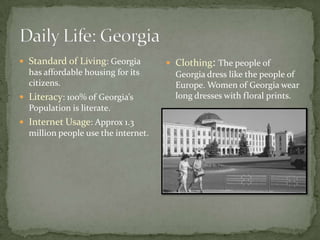
Daily Life: GeorgiaStandard of Living: Georgia has affordable housing for its citizens. Literacy: 100% of Georgia’s Population is literate. Internet Usage: Approx 1.3 million people use the internet. Clothing: The people of Georgia dress like the people of Europe. Women of Georgia wear long dresses with floral prints.
Culture: GeorgiaTraditions and Customs: Since Georgians are divided by regions, they have specific traditions  and customs, folklore, cuisine, dress and may speak a different language.Religion: The majority of the population belongs either to the Georgian Orthodox Church or Eastern (Greek) Orthodox church. Foods: In the west, there is an emphasis on vegetarian food. Herbs and spices, such as tarragon, basil, coriander and pepper make western foods hot and spicy. In the east, the food is leans on meats and pork.
Georgia is a fascinating and developing republic that is attracting more and more people to its unique culture and history.The term "Georgian" derives  from the ancient Persian word Gurgor Gorg, meaning wolf  which symbolizes a "farmer“ or "cultivator of land."ConclusionNeat Stuff
By Elizabeth TongCyprus Nicosia
Cyprus
Cyprus Elizabeth Tong
Country Profile: CyprusSize: 879,000 (combined) (UN, 2010) Climate: Hot and dry summers and cool winters.Location: Island in the Mediterranean Sea, south of Turkey.Population: 1,120,489 (July 2011 est.)Cyprus Flag
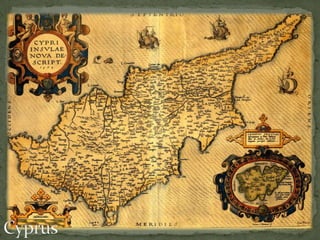
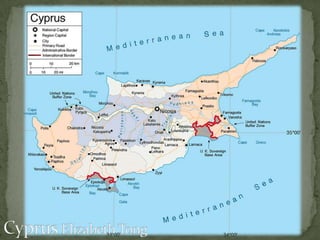
Geographical FeaturesCyprus is an island surrounded by the Mediterranean Sea. It has a central plain with mountains to the north and south.Elevation Degrees:           lowest point: Mediterranean Sea 0 m                                      highest point: Mount Olympus 1,951 mSpecial Points of Interest: Many people visit the capital of Cyprus, Nicosia because it combines the atmosphere of   business with history. Cyprus’s second largest city, Limassol is the center of the wine industry. CyprusVacation Tour
Cyprus used to house seafaring and trading people of the Mediterranean. Since 1974 Cyprus has been divided, the Northern side of Cyprus is recognized as the Turkish Republic of Northern Cyprus.In 1963 clashes between Greek and Turkish Cypriots, forced the United Nations to station a peacekeeping force on the island.  This force guards the so-called “Green Line” that separates the two sections. These two forces clashed because the southern two-thirds of the island is home to the Greek Cypriot Republic of Cyprus, while Northern Cyprus is a self-proclaimed republic recognized only by Turkey. History: Cyprus
According to bbc.co.uk, countries in southern Europe have urged the rest of the European Countries to share the burden of accepting migrants from North Africa because  more are predicted to come. Italy, Spain, France, Cyprus, Malta and Greece joined to present proposals at a meeting of EU interior ministers in Brussels on Thursday, they want a common European protection of extradition systemto be in place in 2012.Currently in CyprusEvent
Type of Government: RepublicChief of State and Head of Government: President Demetris (since February 2008)Legislative Branch: 80 seats total. 56 assigned to the Greek Cypriots  and 24 seat to Turkish Cypriots.Judicial Branch: Supreme CourtPolitical: CyprusPresident Demetris
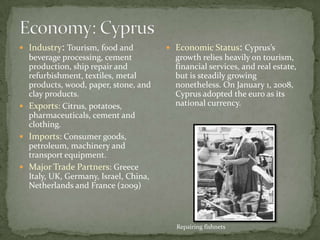
Economy: CyprusIndustry: Tourism, food and beverage processing, cement production, ship repair and refurbishment, textiles, metal products, wood, paper, stone, and clay products.Exports: Citrus, potatoes, pharmaceuticals, cement and clothing.Imports: Consumer goods, petroleum, machinery and transport equipment.Major Trade Partners: Greece Italy, UK, Germany, Israel, China, Netherlands and France (2009) Economic Status: Cyprus’s growth relies heavily on tourism, financial services, and real estate, but is steadily growing nonetheless. On January 1, 2008, Cyprus adopted the euro as its national currency.Repairing fishnets
Daily life: CyprusStandard of Living: Cyprus has a high European standard of living.Literacy: Ages 15 and over can read and write. 97.6% of the total population.Internet Usage: 433,900 people in Cyprus use the interent. (2009)Clothing: Cypriots are wear dressier and trendier styles of US and European clothes.
Culture: CyprusTradition and Custom: In Cyprus being 30-45 minutes late to a social gathering is actually expected.Among friends, a kiss on each cheek is a common greeting. However for the men a handshake will satisfy.Religions: Greek Orthodox 78%, Muslim 18% and other 4%.Foods: Meals consists of vegetables prepared various ways with a side of salad or yogurt.Dance: Musical taste in Cyprus leans toward a combination of Euro-pop, techno, American hip-hop and Greek music.A common meal in Cyprus
Cyprus being an island doesn’t stop people from coming to here. Cyprus too has a rich history and rich wine!In 1960, the new state was composed of people who considered themselves Greeks and Turks rather than Cypriots.ConclusionNeat Stuff
Elizabeth TongChile Santiago
Chile
Chile
Country Profile: ChileSize: 756,096 sq km (291,930 sq miles) Climate: Desert in north, Mediterranean in the central region, cool and damp in the south.Location: South America, bordering the South Pacific Ocean.Population: 17.1 million (UN, 2010) Chile Flag
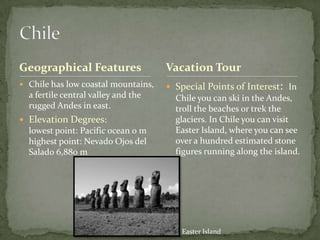
Geographical FeaturesChile has low coastal mountains, a fertile central valley and the rugged Andes in east.Elevation Degrees:              lowest point: Pacific ocean 0 m highest point: Nevado Ojos del Salado 6,880 mSpecial Points of Interest:  In Chile you can ski in the Andes, troll the beaches or trek the glaciers. In Chile you can visit Easter Island, where you can see over a hundred estimated stone figures running along the island.ChileVacation TourEaster Island
Until the arrival of the Spanish in the 16thcentury, the Inca ruled northern Chile while the indigenous Mapuche inhabited central and southern Chile. Then in 1810 Chile tried to declare its independence from Spain but it was not until 1818 that it was achieved.Chile defeated Peru and Bolivia and won its present northern regions in the War of the Pacific (1879-83). History: Chile
According the nytimes.com, Chile and the Untied States signed an accord March 18, 20011 to help Chile develop a nuclear energy program. The accord focuses on training nuclear engineers and calls for "cooperation in the areas of 'operation and utilization of nuclear research reactors,' safety, radioactive waste management and scientific exchange." However, Chile’s mining and energy minister, Laurence Golborne, said Tuesday that the government needed to study situation in Japan before committing to the nuclear program.Currently in Chile
Political: ChileType of Government: Republic Chief of State: President SebastianLegislative branch: 120 seats, members are elected by popular vote to serve four-year terms. Judicial branch: Supreme Court President Sebastian
Economy: ChileIndustry: Copper, lithium, other minerals, foods, fish processing, iron and steel, wood and wood products, transport equipment, cement and textiles.Import: petroleum and petroleum products, chemicals, electrical and telecommunications equipment, industrial machinery, vehicles and natural gas.Export: copper, fruit, fish products, paper and pulp, chemicals and wine.Major trade partners: China, United States of America, Japan, South Korea, Brazil, Mexico and Argentina.Economic  Status: “Chile has a market-oriented economy characterized by a high level of foreign trade.” CIA Factbook
Daily Life: ChileStandard of Living: Chile the most stable and developed country of Latin America. Literacy: 95.7% of total population can read and write. Internet Usage: Approx  7.009 million people use internet.Clothing: People of Chile are conservative but trendy, they follow  American trends.  People of Chile
Culture: ChileTradition and Custom: Men will usually shake hands, however women will pat each other on the right forearm or shoulder.Religion: Most Chileans are Roman Catholics.Foods: Chileans normally eat four times a day. A common salad is the ensaladachilena, itincludes sliced onions, chopped and peeled tomatoes, oil and vinegar dressing and fresh cilantro.Dance: Chile's national dance is the cueca.Music: Chile does not have a specific style or genre. They have children folk music, contemporary music and the Chilean Tonada.
Chile is one of the most developed countries of Latin America and attract many people because of it vast resources such as the beach and the mountains.Chile comes from the native Aymará word chilliwhich means “where the Earth ends. ConclusionNeat Stuff
By Elizabeth TongNorth Korea Pyongyang
North Korea
North Korea Elizabeth Tong
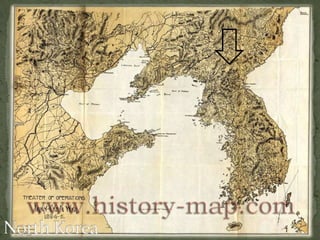
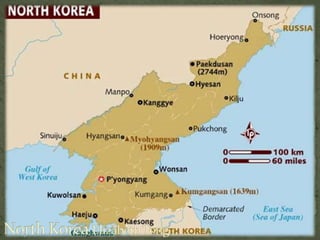
Country Profile: North KoreaSize: 122,762 sq km (47,399 sq miles) Climate: Temperate with occasional rainfall.Location: Eastern Asia, the north coast borders the East Sea. Above South Korea. ♥Population: 23.9 million (UN, 2010) North Korean Flag
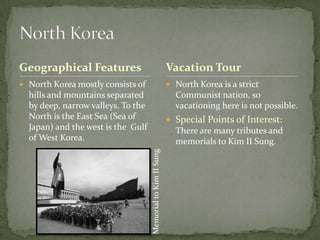
Geographical FeaturesNorth Korea mostly consists of hills and mountains separated by deep, narrow valleys. To the North is the East Sea (Sea of Japan) and the west is the  Gulf of West Korea. North Korea is a strict Communist nation, so vacationing here is not possible.Special Points of Interest: There are many tributes and memorials to Kim II Sung.North KoreaVacation TourMemorial to Kim II Sung
Kim Il Sung, born Kim Sung Chu was the leader of North Korea from 1948 until his death in 1994. At age 19 he joined the Korean Communist party in 1932. In 1980, Kim Il Sung’s son, Kim Jong Il, was in a commanding position to succeed his father. Kim Il Sung was reelected president in May 1990 for a four-year term. In 1991 both North and South Korea joined the United Nations (UN), and the two nations signed accords regarding nuclear weapons and reconciliation. From June 25, 1950 to July 27, 1953, the Korean War was fought between Communist and non-Communist rivals. By the end of WWII Korea was divided into two: The Republic of Korea (South) and the People's Democratic Republic of Korea (North).History: North Korea
According to Yahoo, on Febuary 3, 2011, North Korea has confirmed that it has been plagued with the "foot-and-mouth" disease. Due to this outbreak, thousands of  livestock has been killed, but the places most affected by this outbreak is Pyongyang and Kangwon provinces. According to a Seoul official report, North Korea has been dealing with this outbreak since last mouth but Thursday is the first time that North Korea has confirmed it. Back in 2007 North Korea also had a similar outbreak and Seoul was able to led its help but now with a sour relationship, Seoul is waiting to see how much worse the outbreak will strike then decide whether or not to aid their neighboring land.Currently in North KoreaEvent
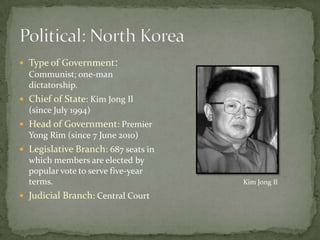
Political: North KoreaType of Government: Communist; one-man dictatorship.Chief of State: Kim Jong Il (since July 1994)Head of Government: Premier Yong Rim (since 7 June 2010)Legislative Branch: 687 seats in which members are elected by popular vote to serve five-year terms.Judicial Branch: Central CourtKim Jong Il
Economy: North KoreaIndustry: Military products, chemicals, coal, iron ore, limestone, graphite, copper, zinc, lead, and precious metals, textiles and food processing.Exports: Minerals, military weapons, textiles, agricultural and fishery products.Imports: Petroleum, coking coal, machinery and equipment, textiles and grain.Major Trade Partners: China, South Korea, Singapore, Hong Kong and India  (2009 est.)Economic Status: “North Korea, one of the world's most centrally directed and least open economies, faces chronic economic problems. Industrial capital stock is nearly beyond repair as a result of years of underinvestment, shortages of spare parts, and poor maintenance…” (CIA Factbook)
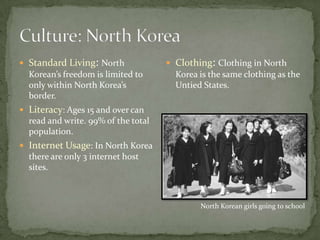
Culture: North KoreaStandard Living: North Korean’s freedom is limited to only within North Korea’s border.Literacy: Ages 15 and over can read and write. 99% of the total population.Internet Usage: In North Korea there are only 3 internet host sites.Clothing: Clothing in North Korea is the same clothing as the Untied States.North Korean girls going to school
Culture: North KoreaCultural Life: “Cultural activity is aided and encouraged by the government. Historical museums and libraries are located in many of the larger counties. The government has also formed national symphony, theater, and dance companies.” (Microsoft Encarta”Religions: Traditionally Buddhist and Confucianist, some Christian.Foods: White rice and meat soup is eaten daily.Music: North Korean music are done with a folk style. Buddhist Temple

7 countries projectong

  • 1.
  • 2.
  • 3.
  • 4.
  • 5.
    Country Profile :MaliSize:1.25 million sq km (482,077 sq miles)Climate: Subtropical to low rainfall. February – June it is hot and dry. June – November it is rainy, humid and mild. November – February it is cool and dry.Location: Western Africa, west of Algeria. Population: 13.3 million (UN, 2010) Mali Flag
  • 6.
    Geographical FeaturesMali ismostly made up of mostly flat to rolling northern plains covered by sand, the savanna in the south and rugged hills in the northeast. The Niger river also flows through Mali.Elevation degree: lowest point: Senegal River 23 m highest point: Hombori Tondo 1,155 mPeople travel to Mali, one of the largest countries in Africa, to see the beautiful landscape and to experience a cultural immersion.Special Points: Vacationers in Mali are attracted by the Sigui Dance of the Masks, performed once every 60 years. However, for the sake of the tourist, imitations dances are performed. MaliVacation Tour
  • 7.
    The recorded history of Mali goesback to mostly Arabic writings of about the 4th century ad. Between then and the 19th century, Mali was the center of great empires of the western Sudan: Ghana, Mali, and Songhai. Also cities of Djenné, Tombouctou, and Gao became centers of trade, learning, and culture.
  • 8.
    The Mali Empire originated inthe 11th century, but its period of greatness began under Sundiata Keita, who ruled from around 1235 to 1255.
  • 9.
    By the 1890s, French administrationwas installed in Mali, they banned African political activity until after World War II. However in 1958 a vote of the population was taken, but instead of separating itself completely from France, the Sudanese Union accepted self- government within the new French Community as the Sudanese Republic. It then sought to unite several French West African states in a new political federation, and in 1959 the Federation of Mali was formed. History: Mali
  • 10.
    According to nytimes.com,An open letter has been written to the government by the Party for National Renaissance demanded that the acres of land being leased to private investors and  foreign government be accounted for, have the financial details of the leases released, as well as the required environmental impact studies.The Party for National Renaissance speculates that the government was "giving the land away to countries including Libya, China and Brazil without ensuring that food sufficiency was the priority."Currently in MaliEvents
  • 11.
    Djenné, Mali isan ancient city rich in history and timeless beauty, and now is an official World Heritage site. However the town’s people living here are not happy because of the strict restriction applied to the improvements available to be made to person’s home. “The guidelines established by Unesco , the cultural arm of the United Nations, which compiles the heritage list, demand that any reconstruction not substantially alter the original.” Due to this restriction the people are forced to live frozen in space and unable to revolutionize with the rest of the world. However residents recognize that the Unesco list has made their city famous, but they also believe if there is no noticeable gain what is the point of living like a frozen exhibition on display.  Currently in MaliEvents
  • 12.
    Type of Government: RepublicChief of State: President Amadou Toumani (since 8 June 2002)Head of Government: Prime Minister Modibo (since 28 September 2007)Cabinet: Council of Ministers appointed by the prime ministerElections: President elected by popular vote for a five-year term (eligible for a second term)Legislative Branch: 147 seats, member are elected by popular vote and serve a five-year term.Judicial Court: Supreme Court Political: Mali
  • 13.
    Economy: MaliIndustry: Foodprocessing; construction; phosphate and gold mining.Exports: Cotton, gold, livestock are worth $294 million (2006) in exports.Imports: Petroleum, machinery and equipment, construction materials, foodstuffs, textiles are worth $2.358 billion (2006) in imports.Major Trade Partners: China Thailand Pakistan, Morocco Burkina Faso, France, India, Cote d'Ivoire and Senegal. (2009)Economic Status: Mali’s revenue depends heavily on gold mining and agricultural exports. According to the CIA Factbook, “Mali's adherence to economic reform and the 50% devaluation of the CFA franc in January 1994 have pushed up economic growth to a 5% average in 1996-2010. ”A house constructed from mud bricks
  • 14.
    Daily Life: MaliStandardof Living: Mali is not a hightly modernized country.Literacy: Ages 15 and over can read and write. 46.4% of the total population. (2003 est.)Internet Usage: 249,800 people use the internet in Mali. (2009)Clothing: Silk is a very common material for making clothes. Since Mali is mostly a Muslim Country, the women wear different types of turbans to match their skirts, tops or long dresses. Men prefer wearing loose pants and shirts. Mali women
  • 15.
    Culture: MaliTraditions: Every60 years the Sigui Dance of the Masks is performed to honor their ancestors. Religions: Muslim 90%, Christian 1%, indigenous beliefs 9%Foods: In the cities, rice is the preferred dish, followed by cereals. The cereals can be served with sauces with fish or meat and various vegetables, or in the form of porridge.Music and Dance: Mali’s music, combines Islamic influences of the north with the complex rhythm of the south. Because drums are very important to West African music their dances go along with the beat of the drums.
  • 16.
    Mali is abeautiful and unique country that struggles to compete finically with the growing powerhouses of the world. It is a West African country with a rich past, present and future that will be remembered and praised by the world for its determination.In farming regions of Mali, bit men and women are both equally involved.ConclusionNeat Stuff
  • 17.
  • 18.
  • 19.
  • 20.
    Country Profile: SierraLeoneSize: 71,740 sq km (27,699 sq miles) Climate: Tropical climate with an annual rainfall of 2,000 mm in the interior to 3,800 mm along the coast. Most rain falls from May to October.Location: Western African between Guinea and Liberia. Also along the North Atlantic Ocean.Population: 5.7 million (UN, 2009) Sierra Leone flag
  • 21.
    Geographical FeaturesSierra Leoneis mostly made up of mangrove swamps along the coastline, a wooded hill country, an upland plateau, and mountains in east.Elevation Degrees: lowest Point: Atlantic Ocean 0 m highest point: Loma Mansa 1,948 mMany people travel to Sierra Leone for the beaches and the rich culture that can be seen in the people that live there.Special Points of Interest: People who travel to Sierra Leone may want to see Bunce Island, an 18th century slave trading post or may just want to visit the beautiful beaches by the coast of the Atlantic Ocean.Sierra LeoneVacation Tour
  • 22.
    Sierra Leone meaningthe Lion Mountain, was named by Pedro da Cintra, who visited the coast in 1460.Freetown was first establish in 1787 by Britain as a colony for slaves. The original land where the city later developed was purchased from local chiefs.After WWII, Britain submitted to nationalist’s demand in West Africa, including Sierra Leone, and the constitution of 1951 gave control to the majority. Its Leader was Sir Milton Margai of the Sierra Leone People’s Party. Later on April 27, 1961, Sierra Leone become an independent state within Britain territory. History: Sierra Leone
  • 23.
    On Wednesday, February3, a passenger boat traveling from Shengay to Freetown capsized, leaving 10 passengers missing including a pregnant woman. Originally there were 20 passengers but 10 disembarked in Plantain Island. The search and rescue effort is still ongoing. On March 8, 2011, three people were trapped in a fire at Hill Station. Only a few days ago, Hill Station experienced a deadly truck accident that claimed the lives of three people. Bystanders helped rescue people, however the real help, The National Fire Force (NFF), arrived three hours into the event.Currently in Sierre LeoneEvents
  • 24.
    Type of Government:Constitutional MonarchyChief of State and Head of Government: President Ernest Bai(since 17 September 2007)Cabinet: Appointed by the president with the approval of the House of Representatives.Election: President elected by popular vote for a five-year term (eligible for a second term)Legislative Branch: 124 seats; 112 members elected by popular vote, 12 filled by the chiefs elected in separate elections, the members are to serve five-year terms.Judicial Branch: Supreme CourtPolitical: Sierra Leone
  • 25.
    Economy: Sierra LeoneIndustry:Diamond mining, small-scale manufacturing beverages, textiles, cigarettes and footwear, petroleum refining, and small commercial ship repair.Exports: Diamonds, rutile, cocoa, coffee and fish.Imports: Foods, machinery and equipment, fuels and chemicals.Major Trade Partners: South Africa ,China, US, Cote d'Ivoire, India, Malaysia, France, UK, Netherlands, Belgium and Greece. (2009)Economic Status: Sierra Leone is a poverty stricken country, who is still trying to recover from the civil war.A thatched hut in Sierra Leone
  • 26.
    Daily Life: SierraLeoneStandard of Living: Sierra is a very poor nation so many families do not have much resources. Literacy: Ages 15 and over can read and write English, Mende, Temne, or Arabic. 35.1% of the total population. (2004 est.)Internet Usage: 14,900 people in Sierra Leone use the internet. (2009)Clothing: Since Sierra Leone is also mostly a Muslim Country, the women wear different types of turbans to match their skirts, tops or long dresses. Men prefer wearing loose pants and shirts.
  • 27.
    Culture: Sierra LeoneGroupof women make garas, a traditional tie-dyed cloth.Traditions, Music and Dance: There are many cultural dances performed by secret societies or political parties to rally or Chase the devil. The music usually consist of beating drums. Religions: Muslim 60%, Christian 10%, indigenous beliefs 30%Foods: In Sierra Leone rice is eaten at every meal and can be prepared many different ways or topped with sauces made from potato leaves, cassava leaves, hot peppers, peanuts, beans, okra, fish, beef, chicken, eggplant, onions, and tomatoes. A market in Freetown
  • 28.
    Although Sierra Leoneis a very small country, its beauty, culture and people are able to set Sierra Leone apart from other West African countries.Sierra Leone was named by Portuguese explorer Pedro da Cintra when saw the tall mountains rising up the Freetown Peninsula and called them the "Lion Mountains," or " Serra Lyoa ."ConclusionNeat Stuff
  • 29.
  • 30.
  • 31.
  • 32.
    Country Profile: MoldovaSize:33,800 sq km (13,050 sq miles) Climate: Moderate Winters and warm summers.Location: Eastern Europe and northeast of Romania.Population: 3.6 million (UN, 2010)Moldova Flag
  • 33.
    Geographical FeaturesMoldova island locked between Romania and Ukraine with a vast rolling plain and the Dniester River. Elevation Degrees: lowest point: Dniester 2 m highest point: Dealul Balanesti 430 mSpecial Points of interest: Many people travel to the capital city of Moldova, Chisinau, because of its historical landmarks centered along the Stefan cel Mare Boulevard. One of the most popular cultural attraction is the Triumphal Arch, also known as the Sacred Gate or the Arch of Glory.MoldovaVacation Tour
  • 34.
    Moldova was oncea part of the Bessarabia region, the named orginated from a medieval prince, Basarab I, who once ruled part of the southern region.Russia took over the region of Bessarabia after the Russo-Turkish War of 1806-1812 leaving fractions of Moldavia to be still under Ottoman control. When Russia was defeated in Crimean War (1853-1856), Moldavia and southern Bessarabia gained independence from the Ottoman Empire and Russia, and the reunited.History: Moldova
  • 35.
    According to allmoldova.com,Moldova's cabinet was to meet March 5, 2011 to consider and approve the 2011 Budget Bill, but it has been postponed. Prime Minister Vlad Filat stated that the postponement was due to certain issues that need to be discussed in another setting. According to unofficial statements, the Government's sitting was lead earlier this morning by a meeting of the executive committee.Currently in MoldovaEvent
  • 36.
    Political: MoldovaGovernment Type:RepublicChief of State: Acting President Marian (since 30 December 2010)[President Marian, is only a temporary replacement for Mihai Ghimpu who was the acting president before him. He is an acting president because the elected President Vladimir resigned September 11, 2009.] Presidents are elected by Parliament to serve a four- year term.Legislative Branch: 101 seats; members elected by popular vote to serve four-year terms.Judicial Branch: Supreme Court
  • 37.
    Economy: MoldovaIndustry: Sugar,vegetable oil, food processing, agricultural machinery, refrigerators and freezers, washing machines; hosiery, shoes and textiles.Exports: Food, textiles and machinery.Imports: Mineral products and fuel, machinery and equipment, chemicals and textiles.Major Trade Partners: Russia, Italy, Romania, Germany, Turkey Belarus, Ukraine and Romania (2009)Economic Status: Despite recent economic progress, Moldova remains as one of the poorest European country.Workers at a Ceramic factory
  • 38.
    Daily Life: MoldovaStandardof Living: Moldova has a large foreign debt and high unemployment is heavily dependent on Russia for energy supplies. Literacy: Ages 15 and over can read and write. 99.1% of the total population.Internet Usage: 1.333 million people is Moldova use the internet. (2009)Clothing: The younger generation of Moldova wear westernized clothing. Older men wear traditional shirts and trousers and older women wear long skirts, blouses and often an apron and head scarf (like a bandana)Women at a market
  • 39.
    Culture: MoldovaCustoms: Duringa meal or in a ritual it is proper to drink at least some amount of wine to honor the host and to toast the health of the people present. Occasionally in villages, toasting with the left hand may not be regarded as proper. Religions: Eastern Orthodox 98%, Jewish 1.5%, Baptist and others 0.5%. (2000) Foods:Mamaliga is a hard corn porridge that is regarded as the national dish. It is poured onto a flat surface in the shape of a big cake and is served mainly with cheese, sour cream or milk.Music: The music of Moldova is known for its sweeping tempos, rhythm, and the placement of their accent on a weak beat.
  • 40.
    Moldova remains oneof the poorest European countries despite recent progress. However their cheerful toasts, greetings and music would prove otherwise.Women are expected carry the burden of house duties and child care in addition to working outside the home. ConclusionNeat Stuff
  • 41.
  • 42.
  • 43.
  • 44.
    Country Profile: GeorgiaSize:69,700 sq km (26,911 sq miles) Climate: Warm and pleasant. Mediterranean like climate along the coast of the Black Sea.Location: Southwestern Asia, bordering the Black Sea.Population: 4.2 million (UN, 2010) Georgia flag
  • 45.
    Geographical FeaturesGeorgia isa largely mountainous area with Great Caucasus Mountains in the north.Elevation Degrees: lowest point: Black Sea 0 m highest point: Mount Shkhara 5,201 mSpecial Points of Interest: Georgia is has many historic cities, a relaxing countryside and a culture that combines Eastern Asia, Europe and the Middle East. In the capital of Georgia, Tbilisi, you’ll find the Church of St Nicholas in the Narikala Fortress.GeorgiaVacation Tour
  • 46.
    Georgia once containedthe ancient kingdoms of Colchis and Kartli-Iberia.Under Roman influence in the first centuries A.D, Christianity became the state religion.In the 11th-13th centuries dominations by Persians, Arabs, and Turks were discontinued by the Mongol invasion of 1236. Then in the 19th century Georgia was included into the Russian Empire.History: Georgia
  • 47.
    According toArmenian News the on March 25, Dimitry Shashkin and Armen Ashotyan signed an agreement in the field of education and science in Tbilisi. According to the agreement, “the higher education institutions of both countries will conduct joint researches and organize different joint projects. Both countries will promote the exchange of 10 students in accordance with state legislation.”Currently in Georgia
  • 48.
    Political: GeorgiaType ofGovernment: RepublicChief of State: President MikheilLegislative Branch: 150 seats where members are elected by proportional representation and are to serve five-year terms. Judicial Branch: Supreme CourtPresident Mikheil
  • 49.
    Economy: GeorgiaIndustry: steel,aircraft, machine tools, electrical appliances, chemicals, wood products and wine.Export: scrap metal, wine, mineral water, ores, vehicles, fruits and nuts.Import: fuels, vehicles, machinery and parts, grain and other foods and pharmaceuticals.Major Trade Partners:  Turkey, Azerbaijan, Bulgaria, Canada, UK, Ukraine, Spain, United States of America, Germany and Russia.Economic Status: Georgia's growth slowed in 2008 but returned in 2010.Women tending to the farm
  • 50.
    Daily Life: GeorgiaStandardof Living: Georgia has affordable housing for its citizens. Literacy: 100% of Georgia’s Population is literate. Internet Usage: Approx 1.3 million people use the internet. Clothing: The people of Georgia dress like the people of Europe. Women of Georgia wear long dresses with floral prints.
  • 51.
    Culture: GeorgiaTraditions andCustoms: Since Georgians are divided by regions, they have specific traditions and customs, folklore, cuisine, dress and may speak a different language.Religion: The majority of the population belongs either to the Georgian Orthodox Church or Eastern (Greek) Orthodox church. Foods: In the west, there is an emphasis on vegetarian food. Herbs and spices, such as tarragon, basil, coriander and pepper make western foods hot and spicy. In the east, the food is leans on meats and pork.
  • 52.
    Georgia is afascinating and developing republic that is attracting more and more people to its unique culture and history.The term "Georgian" derives from the ancient Persian word Gurgor Gorg, meaning wolf which symbolizes a "farmer“ or "cultivator of land."ConclusionNeat Stuff
  • 53.
  • 54.
  • 55.
  • 56.
    Country Profile: CyprusSize:879,000 (combined) (UN, 2010) Climate: Hot and dry summers and cool winters.Location: Island in the Mediterranean Sea, south of Turkey.Population: 1,120,489 (July 2011 est.)Cyprus Flag
  • 57.
    Geographical FeaturesCyprus isan island surrounded by the Mediterranean Sea. It has a central plain with mountains to the north and south.Elevation Degrees: lowest point: Mediterranean Sea 0 m highest point: Mount Olympus 1,951 mSpecial Points of Interest: Many people visit the capital of Cyprus, Nicosia because it combines the atmosphere of business with history. Cyprus’s second largest city, Limassol is the center of the wine industry. CyprusVacation Tour
  • 58.
    Cyprus used tohouse seafaring and trading people of the Mediterranean. Since 1974 Cyprus has been divided, the Northern side of Cyprus is recognized as the Turkish Republic of Northern Cyprus.In 1963 clashes between Greek and Turkish Cypriots, forced the United Nations to station a peacekeeping force on the island. This force guards the so-called “Green Line” that separates the two sections. These two forces clashed because the southern two-thirds of the island is home to the Greek Cypriot Republic of Cyprus, while Northern Cyprus is a self-proclaimed republic recognized only by Turkey. History: Cyprus
  • 59.
    According to bbc.co.uk,countries in southern Europe have urged the rest of the European Countries to share the burden of accepting migrants from North Africa because  more are predicted to come. Italy, Spain, France, Cyprus, Malta and Greece joined to present proposals at a meeting of EU interior ministers in Brussels on Thursday, they want a common European protection of extradition systemto be in place in 2012.Currently in CyprusEvent
  • 60.
    Type of Government:RepublicChief of State and Head of Government: President Demetris (since February 2008)Legislative Branch: 80 seats total. 56 assigned to the Greek Cypriots and 24 seat to Turkish Cypriots.Judicial Branch: Supreme CourtPolitical: CyprusPresident Demetris
  • 61.
    Economy: CyprusIndustry: Tourism,food and beverage processing, cement production, ship repair and refurbishment, textiles, metal products, wood, paper, stone, and clay products.Exports: Citrus, potatoes, pharmaceuticals, cement and clothing.Imports: Consumer goods, petroleum, machinery and transport equipment.Major Trade Partners: Greece Italy, UK, Germany, Israel, China, Netherlands and France (2009) Economic Status: Cyprus’s growth relies heavily on tourism, financial services, and real estate, but is steadily growing nonetheless. On January 1, 2008, Cyprus adopted the euro as its national currency.Repairing fishnets
  • 62.
    Daily life: CyprusStandardof Living: Cyprus has a high European standard of living.Literacy: Ages 15 and over can read and write. 97.6% of the total population.Internet Usage: 433,900 people in Cyprus use the interent. (2009)Clothing: Cypriots are wear dressier and trendier styles of US and European clothes.
  • 63.
    Culture: CyprusTradition andCustom: In Cyprus being 30-45 minutes late to a social gathering is actually expected.Among friends, a kiss on each cheek is a common greeting. However for the men a handshake will satisfy.Religions: Greek Orthodox 78%, Muslim 18% and other 4%.Foods: Meals consists of vegetables prepared various ways with a side of salad or yogurt.Dance: Musical taste in Cyprus leans toward a combination of Euro-pop, techno, American hip-hop and Greek music.A common meal in Cyprus
  • 64.
    Cyprus being anisland doesn’t stop people from coming to here. Cyprus too has a rich history and rich wine!In 1960, the new state was composed of people who considered themselves Greeks and Turks rather than Cypriots.ConclusionNeat Stuff
  • 65.
  • 66.
  • 67.
  • 68.
    Country Profile: ChileSize:756,096 sq km (291,930 sq miles) Climate: Desert in north, Mediterranean in the central region, cool and damp in the south.Location: South America, bordering the South Pacific Ocean.Population: 17.1 million (UN, 2010) Chile Flag
  • 69.
    Geographical FeaturesChile haslow coastal mountains, a fertile central valley and the rugged Andes in east.Elevation Degrees: lowest point: Pacific ocean 0 m highest point: Nevado Ojos del Salado 6,880 mSpecial Points of Interest: In Chile you can ski in the Andes, troll the beaches or trek the glaciers. In Chile you can visit Easter Island, where you can see over a hundred estimated stone figures running along the island.ChileVacation TourEaster Island
  • 70.
    Until the arrivalof the Spanish in the 16thcentury, the Inca ruled northern Chile while the indigenous Mapuche inhabited central and southern Chile. Then in 1810 Chile tried to declare its independence from Spain but it was not until 1818 that it was achieved.Chile defeated Peru and Bolivia and won its present northern regions in the War of the Pacific (1879-83). History: Chile
  • 71.
    According the nytimes.com,Chile and the Untied States signed an accord March 18, 20011 to help Chile develop a nuclear energy program. The accord focuses on training nuclear engineers and calls for "cooperation in the areas of 'operation and utilization of nuclear research reactors,' safety, radioactive waste management and scientific exchange." However, Chile’s mining and energy minister, Laurence Golborne, said Tuesday that the government needed to study situation in Japan before committing to the nuclear program.Currently in Chile
  • 72.
    Political: ChileType ofGovernment: Republic Chief of State: President SebastianLegislative branch: 120 seats, members are elected by popular vote to serve four-year terms. Judicial branch: Supreme Court President Sebastian
  • 73.
    Economy: ChileIndustry: Copper,lithium, other minerals, foods, fish processing, iron and steel, wood and wood products, transport equipment, cement and textiles.Import: petroleum and petroleum products, chemicals, electrical and telecommunications equipment, industrial machinery, vehicles and natural gas.Export: copper, fruit, fish products, paper and pulp, chemicals and wine.Major trade partners: China, United States of America, Japan, South Korea, Brazil, Mexico and Argentina.Economic Status: “Chile has a market-oriented economy characterized by a high level of foreign trade.” CIA Factbook
  • 74.
    Daily Life: ChileStandardof Living: Chile the most stable and developed country of Latin America. Literacy: 95.7% of total population can read and write. Internet Usage: Approx 7.009 million people use internet.Clothing: People of Chile are conservative but trendy, they follow American trends. People of Chile
  • 75.
    Culture: ChileTradition andCustom: Men will usually shake hands, however women will pat each other on the right forearm or shoulder.Religion: Most Chileans are Roman Catholics.Foods: Chileans normally eat four times a day. A common salad is the ensaladachilena, itincludes sliced onions, chopped and peeled tomatoes, oil and vinegar dressing and fresh cilantro.Dance: Chile's national dance is the cueca.Music: Chile does not have a specific style or genre. They have children folk music, contemporary music and the Chilean Tonada.
  • 76.
    Chile is oneof the most developed countries of Latin America and attract many people because of it vast resources such as the beach and the mountains.Chile comes from the native Aymará word chilliwhich means “where the Earth ends. ConclusionNeat Stuff
  • 77.
    By Elizabeth TongNorthKorea Pyongyang
  • 78.
  • 79.
  • 80.
    Country Profile: NorthKoreaSize: 122,762 sq km (47,399 sq miles) Climate: Temperate with occasional rainfall.Location: Eastern Asia, the north coast borders the East Sea. Above South Korea. ♥Population: 23.9 million (UN, 2010) North Korean Flag
  • 81.
    Geographical FeaturesNorth Koreamostly consists of hills and mountains separated by deep, narrow valleys. To the North is the East Sea (Sea of Japan) and the west is the Gulf of West Korea. North Korea is a strict Communist nation, so vacationing here is not possible.Special Points of Interest: There are many tributes and memorials to Kim II Sung.North KoreaVacation TourMemorial to Kim II Sung
  • 82.
    Kim Il Sung,born Kim Sung Chu was the leader of North Korea from 1948 until his death in 1994. At age 19 he joined the Korean Communist party in 1932. In 1980, Kim Il Sung’s son, Kim Jong Il, was in a commanding position to succeed his father. Kim Il Sung was reelected president in May 1990 for a four-year term. In 1991 both North and South Korea joined the United Nations (UN), and the two nations signed accords regarding nuclear weapons and reconciliation. From June 25, 1950 to July 27, 1953, the Korean War was fought between Communist and non-Communist rivals. By the end of WWII Korea was divided into two: The Republic of Korea (South) and the People's Democratic Republic of Korea (North).History: North Korea
  • 83.
    According to Yahoo,on Febuary 3, 2011, North Korea has confirmed that it has been plagued with the "foot-and-mouth" disease. Due to this outbreak, thousands of  livestock has been killed, but the places most affected by this outbreak is Pyongyang and Kangwon provinces. According to a Seoul official report, North Korea has been dealing with this outbreak since last mouth but Thursday is the first time that North Korea has confirmed it. Back in 2007 North Korea also had a similar outbreak and Seoul was able to led its help but now with a sour relationship, Seoul is waiting to see how much worse the outbreak will strike then decide whether or not to aid their neighboring land.Currently in North KoreaEvent
  • 84.
    Political: North KoreaTypeof Government: Communist; one-man dictatorship.Chief of State: Kim Jong Il (since July 1994)Head of Government: Premier Yong Rim (since 7 June 2010)Legislative Branch: 687 seats in which members are elected by popular vote to serve five-year terms.Judicial Branch: Central CourtKim Jong Il
  • 85.
    Economy: North KoreaIndustry:Military products, chemicals, coal, iron ore, limestone, graphite, copper, zinc, lead, and precious metals, textiles and food processing.Exports: Minerals, military weapons, textiles, agricultural and fishery products.Imports: Petroleum, coking coal, machinery and equipment, textiles and grain.Major Trade Partners: China, South Korea, Singapore, Hong Kong and India (2009 est.)Economic Status: “North Korea, one of the world's most centrally directed and least open economies, faces chronic economic problems. Industrial capital stock is nearly beyond repair as a result of years of underinvestment, shortages of spare parts, and poor maintenance…” (CIA Factbook)
  • 86.
    Culture: North KoreaStandardLiving: North Korean’s freedom is limited to only within North Korea’s border.Literacy: Ages 15 and over can read and write. 99% of the total population.Internet Usage: In North Korea there are only 3 internet host sites.Clothing: Clothing in North Korea is the same clothing as the Untied States.North Korean girls going to school
  • 87.
    Culture: North KoreaCulturalLife: “Cultural activity is aided and encouraged by the government. Historical museums and libraries are located in many of the larger counties. The government has also formed national symphony, theater, and dance companies.” (Microsoft Encarta”Religions: Traditionally Buddhist and Confucianist, some Christian.Foods: White rice and meat soup is eaten daily.Music: North Korean music are done with a folk style. Buddhist Temple