Dr M Ushashree
1st yr pg
Gandhi Medical College
 Introduction
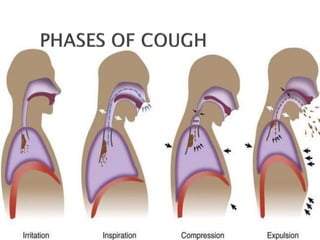
 Phases of cough
 Cough reflex
 Types of cough
 Evaluation
 Investigations
 Treatment
 complications
 COUGH – it is a sudden and variable expiratory
thrust of air from the lungs through the air
passages associated with phonation, which
momentarily interrupts the physiological pattern
of breathing
 Without an effective cough reflex, there is a risk
of retaining airway secretions and aspirated
material predisposing to infection, atelectasis,
and respiratory compromise
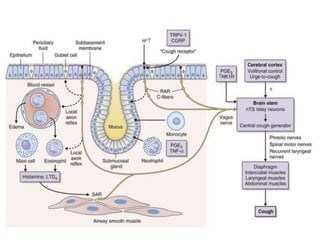
 http://clinicalgate.com/wp-
content/uploads/2015/06/B9780323082037
000403_f040-001-9780323082037.jpg
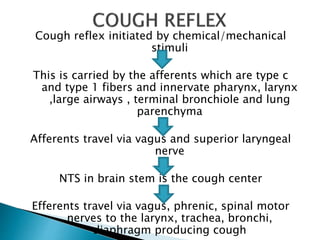
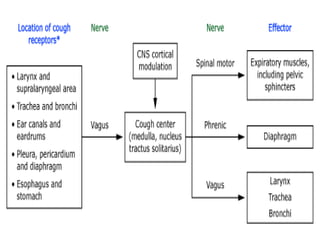
Cough reflex initiated by chemical/mechanical
stimuli
This is carried by the afferents which are type c
and type 1 fibers and innervate pharynx, larynx
,large airways , terminal bronchiole and lung
parenchyma
Afferents travel via vagus and superior laryngeal
nerve
NTS in brain stem is the cough center
Efferents travel via vagus, phrenic, spinal motor
nerves to the larynx, trachea, bronchi,
diaphragm producing cough
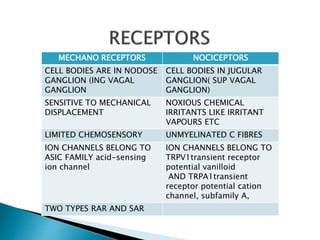
MECHANO RECEPTORS NOCICEPTORS
CELL BODIES ARE IN NODOSE
GANGLION (ING VAGAL
GANGLION
CELL BODIES IN JUGULAR
GANGLION( SUP VAGAL
GANGLION)
SENSITIVE TO MECHANICAL
DISPLACEMENT
NOXIOUS CHEMICAL
IRRITANTS LIKE IRRITANT
VAPOURS ETC
LIMITED CHEMOSENSORY UNMYELINATED C FIBRES
ION CHANNELS BELONG TO
ASIC FAMILY acid-sensing
ion channel
ION CHANNELS BELONG TO
TRPV1transient receptor
potential vanilloid
AND TRPA1transient
receptor potential cation
channel, subfamily A,
TWO TYPES RAR AND SAR
 Voluntarily a person is capable of
suppressing the reflex cough for some time
 Cough can also be voluntarily induces (motor
and pre motor areas of brain)
 Neuro transmitters involved in voluntary
control of cough are seratonin, gaba,
dopamine, nmda(N-methyl-D-aspartate ) etc
 The central nervous pathways for cough show
interactions and plasticity
 ACUTE (<3 WKS)
 Tracheobronchitis
 Bronchopneumonia
 Viral pneumonia
 Acute-on-chronic bronchitis
 Pertussis
 Pulmonary embolism
 Foreign body aspiration
 Sudden onset – bronchial asthma ,asthmatic
bronchitis , whooping cough, foreign body
,LVF with PE
 SUB ACUTE (3-8 wks )
 trachiobronchitis ,
 pertussis ,
 post viral tussive syndrome
 CHRONIC > 8 wks
• Upper airway cough syndrome
• Asthma
• Gastro oesophageal reflux disorder
• Post viral cough
• Chronic bronchitis
• Bronchiectasis, cystic fibrosis
• Ace inhibitor induced Cough
• Environmental irritants.
• Infections – Mycoplasma Chlamydia
Bordetella
• Granulomatous disease – TB ,
Sarcoidosis.
• Neoplasms – Bronchogenic
carcinoma,Carcinoid tumor
• ILD
 Micro aspirations
 Zenker’s diverticulum
 CVS – Disorders of pericardium, CCF,
Vasculitis
 Tourette syndrome
 Habitual or psychogenic cough.
 Asymptomatic enlarged tonsils
 Based on expectoration
• Dry cough: pleural disorders , diseases of
interstitium, mediastinal lesions
• Productive cough: suppurative lung disease,
airway diseases
 Brassy/Gander cough –metallic sound d/t
compression of trachea by intra thoracic
space occupying lesions or aortic aneurysms
also known as leopards growl
 Bovine cough –loss of expulsive nature as in a
tumour pressing on the recurrent laryngeal
nerve
 Paroxysmal cough – whooping cough ,
chronic bronchitis, foreign body , bronchial
asthma
 Barking cough – involvement of epiglottis ,
croup( laryngo trachiobronchitis) , hysteria
 Whooping cough – pertussis
 Spluttering cough- s/I T-E fistula , cough
while swallowing
 Hacking – heavy smokers, chronic pharyngitis
or laryngitis
IMPAIRED COUGH
 Decreased expiratory-muscle strength
 Decreased inspiratory-muscle strength
 chest wall deformity
 Impaired glottic closure or tracheostomy
 Tracheomalacia
 Central respiratory depression (e.g.,
anesthesia, sedation)
 Efforts should be made to identify the cause
of cough
 A cough lasting than more than 3 wks
require a detailed evaluation
 Cough associated with or without sputum is
more important than the amount of sputum
and the presence or absence of sputum
should not be taken as a strict criterion for
diagnosis
 Considerations at 1st visit
 Determine the severity
 Assess the cause
 Plan investigation and treatment
 Cough: onset, duration, character,
triggers
 Sputum-volume & character
 Postural variations
 Diurnal variations
 Smoking, occupation
 Drug history(ACE inhibitors)
 Asthma: wheeze, nocturnal symptoms, atopy
 GE Reflux ass. Symptoms
 Rhinitis: PND, sinusitis, throat clearing, nasal
congestion
 chest pains, incontinence,
 syncope, anxiety, disturbed sleep
 Lobar pneumonia – the cough is initially dry
a/w chest pain later becomes productive
 Chronic bronchitis – productive cough for
most days of 3 months for 2 consecutive yrs
 Bronchiectasis – copious amt of foul smelling
sputum more on lying down
 Gastro esophageal reflux disorder -
Nonproductive cough often following meals
with or without symptoms of GERD
 Left ventricular failure - Cough intensifies
while supine, along with aggravation of
dyspnea
 Angiotensin-converting enzyme (ACE)
inhibitors Nonproductive cough, more
common in women, may occur at any time ,
neurokinin 1 receptor polymorphism
 Routine investigations
 Absolute eosinophil count
 Pulmonary function tests
 Sputum gram stain , culture sensitivity , zn
stain
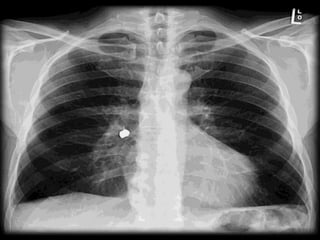
 Chest x ray
 Ct chest
 Sinus x ray/CT sinus
 Quality of life questionnaires
 Leicester cough questionnaire used to assess
cough intensity and frequency
 Measurement of cough reflex- by inhalation
of tussive agent like capsaicin
 Visual analogue scales
 Cough lasting less than 3 wks
 Usually it is due to viral and bacterial
infections of upper respiratory tract
 Usually the cough resolves within 2 wks
 Other symptoms that can be associated
with cough are post nasal discharge ,
nasal obstruction, nasal discharge
 Rhinitis associated with common cold
may have mucopurulent discharge but it
is not an indication of antibiotics unless it
persists for more than 10 to 14 days
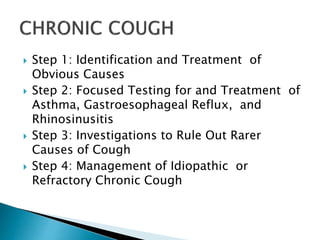
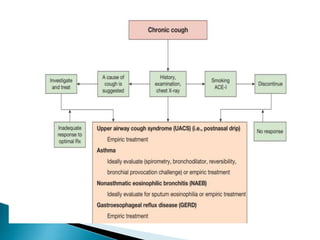
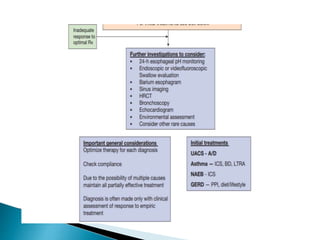
 Step 1: Identification and Treatment of
Obvious Causes
 Step 2: Focused Testing for and Treatment of
Asthma, Gastroesophageal Reflux, and
Rhinosinusitis
 Step 3: Investigations to Rule Out Rarer
Causes of Cough
 Step 4: Management of Idiopathic or
Refractory Chronic Cough
 Cough variant Asthma
 Upper airway cough syndrome
 Aspiration
 Habitual cough
 Foreign body
 Drugs Angiotensin converting enzyme inhibitors
 Chronic bronchitis
 Chronic idiopathic cough,
 narcotic cough suppressants, such as
codeine or hydrocodone
 Dexomethorphan can also be used
 Benzonatate
 Case series have reported benefit from off-
label use of gabapentin or amitryptyline for
chronic idiopathic cough.
 In paediatric age group cough more than 4
wks is considered chronic
 Most common cause of chronic cough in
infants is aspiration and congenital heart
defects
 2-5 yrs – foreign body inhalation , hyper
reactive airways
 Adolescents – hyper reactive airways,
infections
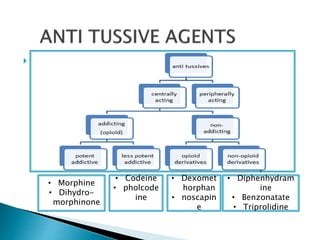
 ANTITUSSIVE AGENT
• Morphine
• Dihydro-
morphinone
• Codeine
• pholcode
ine
• Dexomet
horphan
• noscapin
e
,
• Diphenhydram
ine
• Benzonatate
• Triprolidine
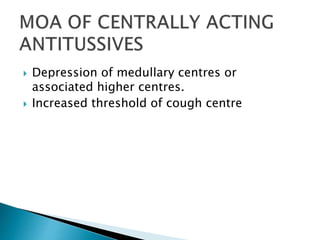
 Depression of medullary centres or
associated higher centres.
 Increased threshold of cough centre
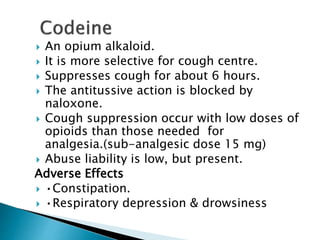
 An opium alkaloid.
 It is more selective for cough centre.
 Suppresses cough for about 6 hours.
 The antitussive action is blocked by
naloxone.
 Cough suppression occur with low doses of
opioids than those needed for
analgesia.(sub-analgesic dose 15 mg)
 Abuse liability is low, but present.
Adverse Effects
 •Constipation.
 •Respiratory depression & drowsiness
 Little/ no analgesic or addicting
property.
 Similar efficacy as antitussive to
codeine
 Is longer acting—–acts for 12 hours
or more.
 Given once or twice daily.
Adverse Effects
 Nausea
 Drowsiness
 •Depresses cough but has no
narcotic, analgesic or dependence
inducing properties.
 •Efficacy same as codeine, specially
useful in spasmodic cough.
Adverse Effects
 •Headache & nausea can occur
 raises threshold for cough & depresses
cough centre in medulla.
 It has been found to enhance the
analgesic action of morphine & other μ
receptors agonists
 As effective as codeine, does not depress
mucociliary function of the airway
mucosa.
 Devoid of addicting actions.
 Produces less constipation than codeine
 Antitussive action for 6 hours.
 it does not act through opioids
receptors.
Side effects:
 Dizziness, nausea, drowsiness & ataxia.
 It acts at the CNS level by inhibiting the
medullary cough centre
 In addition to this peripheral effects are
related to its antihistamine,
antiserotonergic and muscle-relaxant
properties
 it is used in the treatment of cough,
bronchospasm and related symptoms
 It has antihistamine with anticholinergic
properties
 Centrally acting with no addicting
properties
 the most common side effect is
drowsiness
 quick acting drug that can clear
congestion and stop runny noses in 15–
30 minutes
 Useful in cough in allergic conditions
 Diphenhydramine is an antihistamine
used to relieve symptoms of allergy,
hay fever, and the common cold.
 Commonly present in many cough
syrups
 Drowsiness, dizziness, constipation,
stomach upset, blurred vision
 Demulcents. promotes salivation & inhibit
impulses from inflamed mucosa
 Linctus Thick liquid preparation
containing sucrose and medicinal
substance
 Throat lozenges:They have lubricating
and soothing effect on irritated tissue of
throat may contain benzocaine or
dextromethorphan.
 selective NOP1 (nociceptin opioid 1) receptor
agonist
 TRPV1 antagonists
 TRPA1 antagonists
 Memantine, the non competitive NMDA
channel blocker
 The neurokinin-1 (NK1) receptor has been
implicated in the sensitization of synapses in
the nTS, and its antagonist (aprepitant) was
recently found to reduce cough in patients
with lung cancer
Drugs which render sputum less visous
Inhalational:
 •Acetylcysteine,
Oral :
 •Acetylcysteine,
 •Bromohexine,
 •Carbocysteine,
 •Methylcysteine.
Clinical Uses
 Acute & chronic bronchitis.
 Bronchial asthma
Drugs which ↑ bronchial secretions or
reduces its viscosity facilitating its removal
by coughing
 Ipecacuanha
 Ammonium chloride
 Ammonium bicarbonate.
 Terepin hydrate
 Potassium Iodide
 Guaiphenesin
 Sodium or Potassium citrate
RESPIRATORY
 Pneumothorax
 Subcutaneous emphysema
 Pneumomediastinum
 Pneumoperitoneum
 Laryngeal damage
CARDIOVASCULAR
 Cardiac dysrhythmias
 Loss of consciousness or cough syncope
 Subconjunctival hemorrhage
CENTRAL NERVOUS SYSTEM
 Syncope Headaches
 Cerebral air embolism
MUSCULOSKELETAL
 Intercostal muscle pain
 Rupture of rectus abdominis muscle
 Increase in serum creatine phosphokinase
 Cervical disc prolapse
CENTRAL NERVOUS SYSTEM
 Syncope Headaches
 Cerebral air embolism
MUSCULOSKELETAL
 Intercostal muscle pain
 Rupture of rectus abdominis muscle
 Increase in serum creatine phosphokinase
 Cervical disc prolapse
GASTROINTESTINAL
 Esophageal perforation
OTHER
 Social embarrassment
 Depression Urinary incontinence
 Disruption of surgical wounds
 Petechiae Purpura
cough-161117122251 (1).pdf

cough-161117122251 (1).pdf

  • 1.
    Dr M Ushashree 1styr pg Gandhi Medical College
  • 2.
     Introduction  Phasesof cough  Cough reflex  Types of cough  Evaluation  Investigations  Treatment  complications
  • 3.
     COUGH –it is a sudden and variable expiratory thrust of air from the lungs through the air passages associated with phonation, which momentarily interrupts the physiological pattern of breathing  Without an effective cough reflex, there is a risk of retaining airway secretions and aspirated material predisposing to infection, atelectasis, and respiratory compromise
  • 4.
  • 6.
    Cough reflex initiatedby chemical/mechanical stimuli This is carried by the afferents which are type c and type 1 fibers and innervate pharynx, larynx ,large airways , terminal bronchiole and lung parenchyma Afferents travel via vagus and superior laryngeal nerve NTS in brain stem is the cough center Efferents travel via vagus, phrenic, spinal motor nerves to the larynx, trachea, bronchi, diaphragm producing cough
  • 8.
    MECHANO RECEPTORS NOCICEPTORS CELLBODIES ARE IN NODOSE GANGLION (ING VAGAL GANGLION CELL BODIES IN JUGULAR GANGLION( SUP VAGAL GANGLION) SENSITIVE TO MECHANICAL DISPLACEMENT NOXIOUS CHEMICAL IRRITANTS LIKE IRRITANT VAPOURS ETC LIMITED CHEMOSENSORY UNMYELINATED C FIBRES ION CHANNELS BELONG TO ASIC FAMILY acid-sensing ion channel ION CHANNELS BELONG TO TRPV1transient receptor potential vanilloid AND TRPA1transient receptor potential cation channel, subfamily A, TWO TYPES RAR AND SAR
  • 10.
     Voluntarily aperson is capable of suppressing the reflex cough for some time  Cough can also be voluntarily induces (motor and pre motor areas of brain)  Neuro transmitters involved in voluntary control of cough are seratonin, gaba, dopamine, nmda(N-methyl-D-aspartate ) etc  The central nervous pathways for cough show interactions and plasticity
  • 11.
     ACUTE (<3WKS)  Tracheobronchitis  Bronchopneumonia  Viral pneumonia  Acute-on-chronic bronchitis  Pertussis  Pulmonary embolism  Foreign body aspiration  Sudden onset – bronchial asthma ,asthmatic bronchitis , whooping cough, foreign body ,LVF with PE
  • 12.
     SUB ACUTE(3-8 wks )  trachiobronchitis ,  pertussis ,  post viral tussive syndrome
  • 13.
     CHRONIC >8 wks • Upper airway cough syndrome • Asthma • Gastro oesophageal reflux disorder • Post viral cough • Chronic bronchitis • Bronchiectasis, cystic fibrosis • Ace inhibitor induced Cough • Environmental irritants.
  • 14.
    • Infections –Mycoplasma Chlamydia Bordetella • Granulomatous disease – TB , Sarcoidosis. • Neoplasms – Bronchogenic carcinoma,Carcinoid tumor • ILD
  • 15.
     Micro aspirations Zenker’s diverticulum  CVS – Disorders of pericardium, CCF, Vasculitis  Tourette syndrome  Habitual or psychogenic cough.  Asymptomatic enlarged tonsils
  • 16.
     Based onexpectoration • Dry cough: pleural disorders , diseases of interstitium, mediastinal lesions • Productive cough: suppurative lung disease, airway diseases
  • 17.
     Brassy/Gander cough–metallic sound d/t compression of trachea by intra thoracic space occupying lesions or aortic aneurysms also known as leopards growl  Bovine cough –loss of expulsive nature as in a tumour pressing on the recurrent laryngeal nerve  Paroxysmal cough – whooping cough , chronic bronchitis, foreign body , bronchial asthma
  • 18.
     Barking cough– involvement of epiglottis , croup( laryngo trachiobronchitis) , hysteria  Whooping cough – pertussis  Spluttering cough- s/I T-E fistula , cough while swallowing  Hacking – heavy smokers, chronic pharyngitis or laryngitis
  • 22.
    IMPAIRED COUGH  Decreasedexpiratory-muscle strength  Decreased inspiratory-muscle strength  chest wall deformity  Impaired glottic closure or tracheostomy  Tracheomalacia  Central respiratory depression (e.g., anesthesia, sedation)
  • 23.
     Efforts shouldbe made to identify the cause of cough  A cough lasting than more than 3 wks require a detailed evaluation  Cough associated with or without sputum is more important than the amount of sputum and the presence or absence of sputum should not be taken as a strict criterion for diagnosis
  • 24.
     Considerations at1st visit  Determine the severity  Assess the cause  Plan investigation and treatment
  • 25.
     Cough: onset,duration, character, triggers  Sputum-volume & character  Postural variations  Diurnal variations  Smoking, occupation  Drug history(ACE inhibitors)
  • 26.
     Asthma: wheeze,nocturnal symptoms, atopy  GE Reflux ass. Symptoms  Rhinitis: PND, sinusitis, throat clearing, nasal congestion  chest pains, incontinence,  syncope, anxiety, disturbed sleep
  • 27.
     Lobar pneumonia– the cough is initially dry a/w chest pain later becomes productive  Chronic bronchitis – productive cough for most days of 3 months for 2 consecutive yrs  Bronchiectasis – copious amt of foul smelling sputum more on lying down  Gastro esophageal reflux disorder - Nonproductive cough often following meals with or without symptoms of GERD
  • 28.
     Left ventricularfailure - Cough intensifies while supine, along with aggravation of dyspnea  Angiotensin-converting enzyme (ACE) inhibitors Nonproductive cough, more common in women, may occur at any time , neurokinin 1 receptor polymorphism
  • 29.
     Routine investigations Absolute eosinophil count  Pulmonary function tests  Sputum gram stain , culture sensitivity , zn stain  Chest x ray  Ct chest  Sinus x ray/CT sinus
  • 30.
     Quality oflife questionnaires  Leicester cough questionnaire used to assess cough intensity and frequency  Measurement of cough reflex- by inhalation of tussive agent like capsaicin  Visual analogue scales
  • 31.
     Cough lastingless than 3 wks  Usually it is due to viral and bacterial infections of upper respiratory tract  Usually the cough resolves within 2 wks  Other symptoms that can be associated with cough are post nasal discharge , nasal obstruction, nasal discharge
  • 32.
     Rhinitis associatedwith common cold may have mucopurulent discharge but it is not an indication of antibiotics unless it persists for more than 10 to 14 days
  • 33.
     Step 1:Identification and Treatment of Obvious Causes  Step 2: Focused Testing for and Treatment of Asthma, Gastroesophageal Reflux, and Rhinosinusitis  Step 3: Investigations to Rule Out Rarer Causes of Cough  Step 4: Management of Idiopathic or Refractory Chronic Cough
  • 36.
     Cough variantAsthma  Upper airway cough syndrome  Aspiration  Habitual cough  Foreign body  Drugs Angiotensin converting enzyme inhibitors  Chronic bronchitis
  • 37.
     Chronic idiopathiccough,  narcotic cough suppressants, such as codeine or hydrocodone  Dexomethorphan can also be used  Benzonatate  Case series have reported benefit from off- label use of gabapentin or amitryptyline for chronic idiopathic cough.
  • 38.
     In paediatricage group cough more than 4 wks is considered chronic  Most common cause of chronic cough in infants is aspiration and congenital heart defects  2-5 yrs – foreign body inhalation , hyper reactive airways  Adolescents – hyper reactive airways, infections
  • 40.
     ANTITUSSIVE AGENT •Morphine • Dihydro- morphinone • Codeine • pholcode ine • Dexomet horphan • noscapin e , • Diphenhydram ine • Benzonatate • Triprolidine
  • 41.
     Depression ofmedullary centres or associated higher centres.  Increased threshold of cough centre
  • 42.
     An opiumalkaloid.  It is more selective for cough centre.  Suppresses cough for about 6 hours.  The antitussive action is blocked by naloxone.  Cough suppression occur with low doses of opioids than those needed for analgesia.(sub-analgesic dose 15 mg)  Abuse liability is low, but present. Adverse Effects  •Constipation.  •Respiratory depression & drowsiness
  • 43.
     Little/ noanalgesic or addicting property.  Similar efficacy as antitussive to codeine  Is longer acting—–acts for 12 hours or more.  Given once or twice daily. Adverse Effects  Nausea  Drowsiness
  • 44.
     •Depresses coughbut has no narcotic, analgesic or dependence inducing properties.  •Efficacy same as codeine, specially useful in spasmodic cough. Adverse Effects  •Headache & nausea can occur
  • 45.
     raises thresholdfor cough & depresses cough centre in medulla.  It has been found to enhance the analgesic action of morphine & other μ receptors agonists  As effective as codeine, does not depress mucociliary function of the airway mucosa.
  • 46.
     Devoid ofaddicting actions.  Produces less constipation than codeine  Antitussive action for 6 hours.  it does not act through opioids receptors. Side effects:  Dizziness, nausea, drowsiness & ataxia.
  • 47.
     It actsat the CNS level by inhibiting the medullary cough centre  In addition to this peripheral effects are related to its antihistamine, antiserotonergic and muscle-relaxant properties  it is used in the treatment of cough, bronchospasm and related symptoms
  • 48.
     It hasantihistamine with anticholinergic properties  Centrally acting with no addicting properties  the most common side effect is drowsiness  quick acting drug that can clear congestion and stop runny noses in 15– 30 minutes  Useful in cough in allergic conditions
  • 49.
     Diphenhydramine isan antihistamine used to relieve symptoms of allergy, hay fever, and the common cold.  Commonly present in many cough syrups  Drowsiness, dizziness, constipation, stomach upset, blurred vision
  • 50.
     Demulcents. promotessalivation & inhibit impulses from inflamed mucosa  Linctus Thick liquid preparation containing sucrose and medicinal substance  Throat lozenges:They have lubricating and soothing effect on irritated tissue of throat may contain benzocaine or dextromethorphan.
  • 51.
     selective NOP1(nociceptin opioid 1) receptor agonist  TRPV1 antagonists  TRPA1 antagonists  Memantine, the non competitive NMDA channel blocker  The neurokinin-1 (NK1) receptor has been implicated in the sensitization of synapses in the nTS, and its antagonist (aprepitant) was recently found to reduce cough in patients with lung cancer
  • 52.
    Drugs which rendersputum less visous Inhalational:  •Acetylcysteine, Oral :  •Acetylcysteine,  •Bromohexine,  •Carbocysteine,  •Methylcysteine. Clinical Uses  Acute & chronic bronchitis.  Bronchial asthma
  • 53.
    Drugs which ↑bronchial secretions or reduces its viscosity facilitating its removal by coughing  Ipecacuanha  Ammonium chloride  Ammonium bicarbonate.  Terepin hydrate  Potassium Iodide  Guaiphenesin  Sodium or Potassium citrate
  • 54.
    RESPIRATORY  Pneumothorax  Subcutaneousemphysema  Pneumomediastinum  Pneumoperitoneum  Laryngeal damage CARDIOVASCULAR  Cardiac dysrhythmias  Loss of consciousness or cough syncope  Subconjunctival hemorrhage
  • 55.
    CENTRAL NERVOUS SYSTEM Syncope Headaches  Cerebral air embolism MUSCULOSKELETAL  Intercostal muscle pain  Rupture of rectus abdominis muscle  Increase in serum creatine phosphokinase  Cervical disc prolapse
  • 56.
    CENTRAL NERVOUS SYSTEM Syncope Headaches  Cerebral air embolism MUSCULOSKELETAL  Intercostal muscle pain  Rupture of rectus abdominis muscle  Increase in serum creatine phosphokinase  Cervical disc prolapse
  • 57.
    GASTROINTESTINAL  Esophageal perforation OTHER Social embarrassment  Depression Urinary incontinence  Disruption of surgical wounds  Petechiae Purpura