BREAK – EVEN
ANALYSIS
Dr.M.MADHAVAN
INTRODUCTION
• Break-even analysis is a study of costs,
revenues and sales of a firm and finding
out the volume of sales where the
firm’s costs and revenues will be equal.
The Break-even point is the zone of
no-profit and no-loss as the costs equal
revenues.
Determination of Break-Even
Point
• The BEP of a firm can be found out in
two ways. It may be approached in
terms of
• Physical units, i.e., volume of output or
• Money value, i.e., the value of sales.
(i) BEP in terms of Physical
Units
• This method is useful for the firm producing a single product.
• The BEP is the number of units of the commodity that should
be sold to earn enough revenue just to cover all the expenses of
production. The revenue just to cover all the expenses of
production.
• The revenue realized covers all costs, variable as well as fixed.
The firm does not earn any profit, nor does it incur any loss.
• It is the meeting point of total revenue and total cost of the
firm.
• The BEP can be illustrated by means of a schedule and a graph
as in the following.
BEP in terms of Physical Units
(Contd … … … )
OUTPUT IN
UNITS
TOTAL REVENUE
PRICE RS.4/- PER UNIT
TOTAL FIXED
COST
TOTAL
VARIABLE COST
TOTAL COST
0 0 300 0 300
100 400 300 300 600
200 800 300 300 600
300 1200 300 900 1200
400 1600 300 1200 1500
500 2000 300 1500 1800
600 2400 300 1800 2100
Table
BEP in terms of Physical Units
(Contd … … … )
• Some assumptions are made in illustrating the BEP.
• The price of the commodity is kept constant at Rs.4/- per
unit. i.e., perfect competition is assumed.
• Therefore, the total revenue is increasing proportionately
to output.
• All the units of output are sold out. The total fixed cost is
kept constant at Rs.300/- at all levels of output.
• Then total variable cost is assumed to be increasing by a
given amount throughout.
BEP in terms of Physical Units
(Contd … … … )
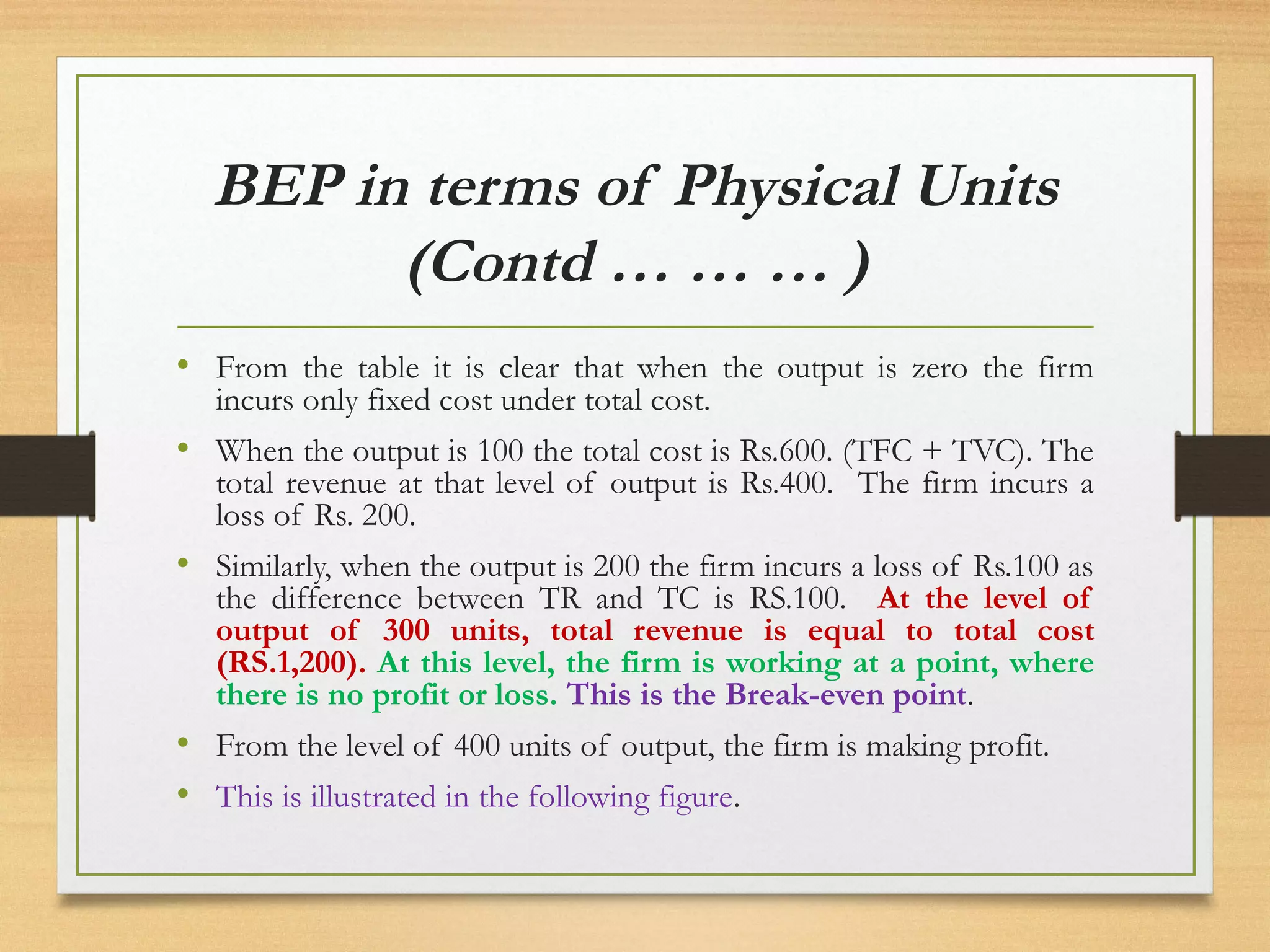
• From the table it is clear that when the output is zero the firm
incurs only fixed cost under total cost.
• When the output is 100 the total cost is Rs.600. (TFC + TVC). The
total revenue at that level of output is Rs.400. The firm incurs a
loss of Rs. 200.
• Similarly, when the output is 200 the firm incurs a loss of Rs.100 as
the difference between TR and TC is RS.100. At the level of
output of 300 units, total revenue is equal to total cost
(RS.1,200). At this level, the firm is working at a point, where
there is no profit or loss. This is the Break-even point.
• From the level of 400 units of output, the firm is making profit.
• This is illustrated in the following figure.
BEP in terms of Physical Units (Contd … … … )
In the Break-even chart,
TFC = total fixed cost
TR = total revenue and
TC = total cost
BEP in terms of Physical Units
(Contd … … … )
• Since TFC is constant al all levels of output, it is parallel
to X-axis.
• From the figure, we can see that Break-even point lies at
300 units of output.
• Up to 300 units of output the firm will be incurring loss
in all units of output as TC is at a higher level than TR.
This called Loss Zone.
• Beyond 300 units of output the firm is neither incurring
loss nor5 realizing any profit. It is the Break-even point
(BEP) or no-profit, no-loss point of production.
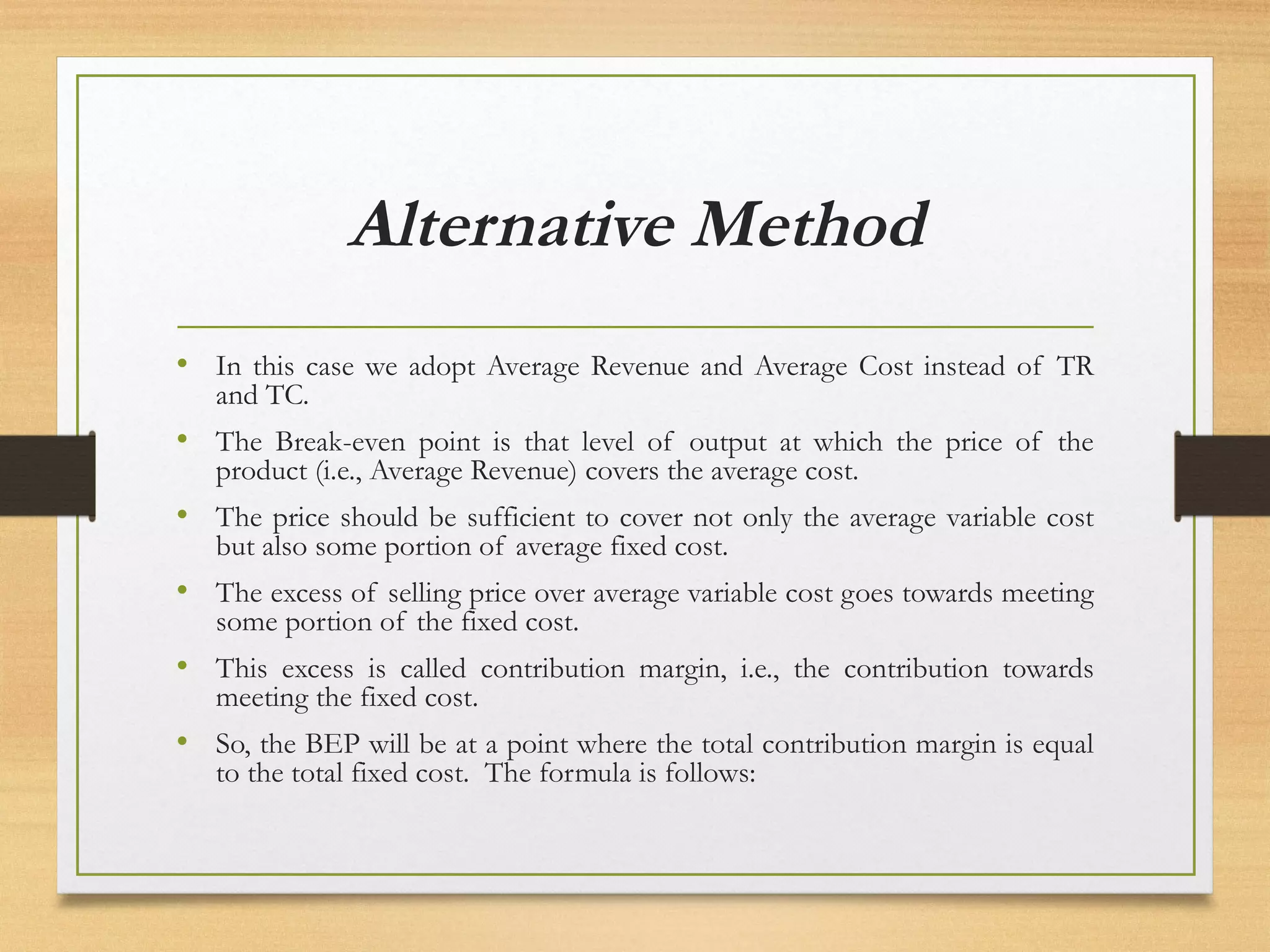
Alternative Method
• In this case we adopt Average Revenue and Average Cost instead of TR
and TC.
• The Break-even point is that level of output at which the price of the
product (i.e., Average Revenue) covers the average cost.
• The price should be sufficient to cover not only the average variable cost
but also some portion of average fixed cost.
• The excess of selling price over average variable cost goes towards meeting
some portion of the fixed cost.
• This excess is called contribution margin, i.e., the contribution towards
meeting the fixed cost.
• So, the BEP will be at a point where the total contribution margin is equal
to the total fixed cost. The formula is follows:
Alternative Method (Contd … … …)
Total Fixed Cost
BEP = -------------------------
Contribution Margin
Contribution Margin = Selling Price – AVC
Total Fixed Cost
BEP = -------------------------
Selling Price - AVC
Alternative Method (Contd … … …)
• Taking the numerical example on the basis of the above
schedule the TFC is Rs. 300, the selling price is Rs. 4 and the
Average variable cost is Rs.3. so,
300
BEP = ----------- = 300
4-3
The Break-even point on the basis of formula comes to
300 units of output.
(ii) BEP in Terms of Sales Value
• The BEP in terms of physical output is suitable only
in the case of single product firm.
• If the firm is producing many products, the BEP can
be approached only in terms of money value or total
sale value or total revenue.
• Here also the principle of total contribution margin
is made equal total fixed cost; but the contribution
margin is expressed as a ratio to sales.
BEP in Terms of Sales Value (Contd … … …)
CM = Contribution Margin
TR = Total Revenue
TVC = Total Variable Cost
TR - TVC
CM = -----------------
TR
On the basis of the previous schedule and the
numerical example, the contribution ratio is 0.25. This
is arrived at on the basis of the above formula.
BEP in Terms of Sales Value (Contd … … …)
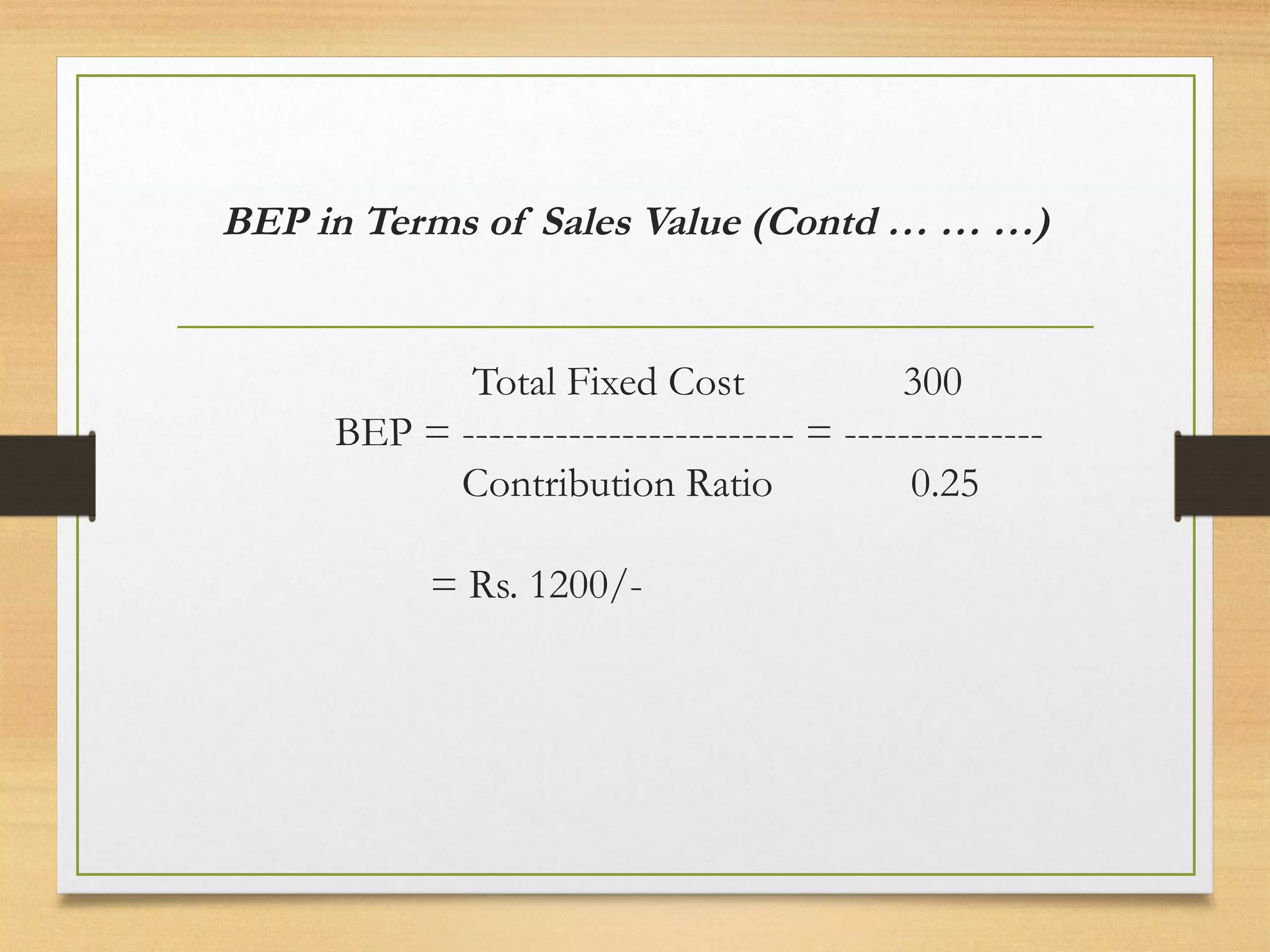
Total Fixed Cost 300
BEP = ------------------------- = ---------------
Contribution Ratio 0.25
= Rs. 1200/-
BEP in Terms of Sales Value (Contd … … …)
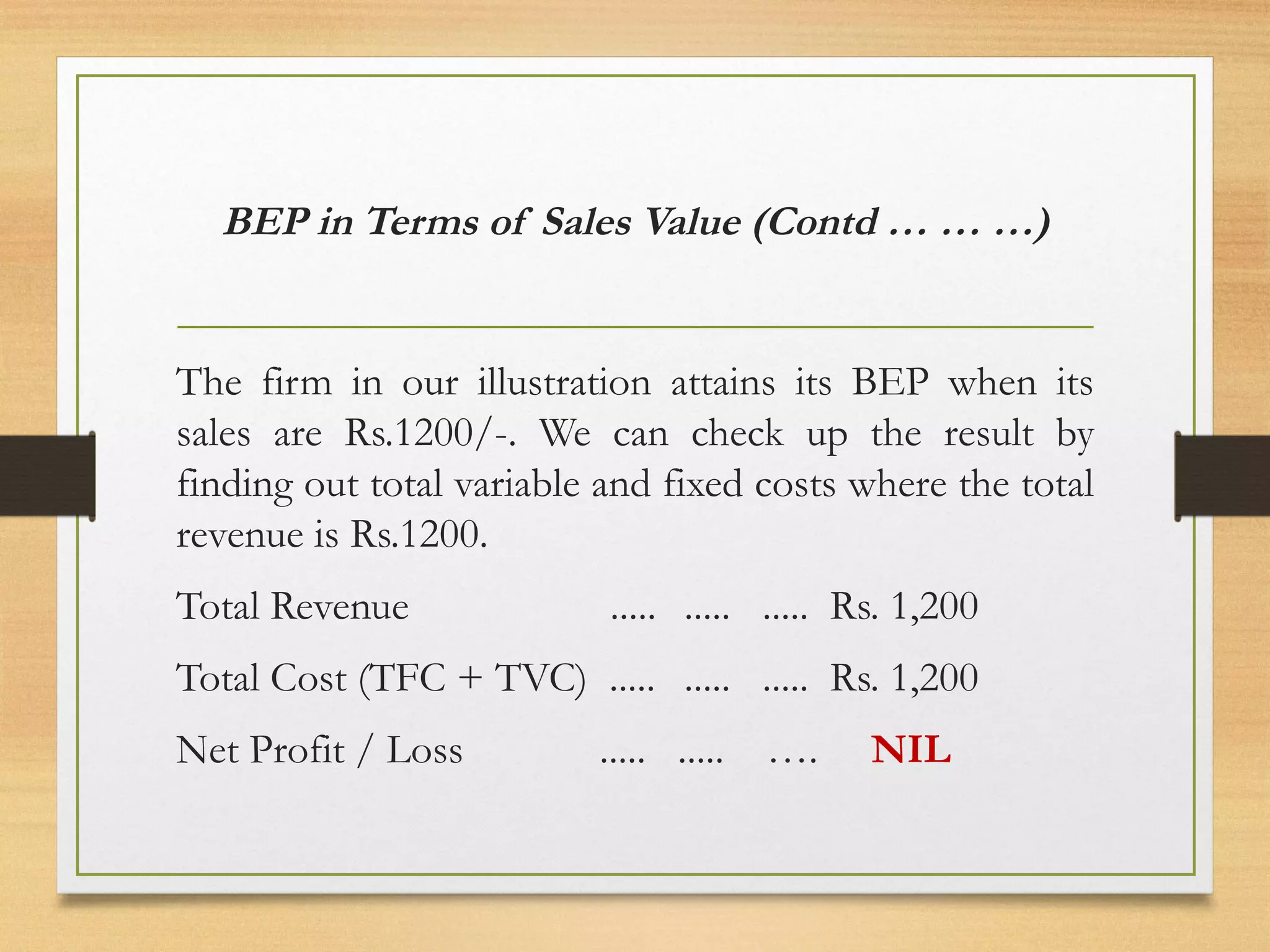
The firm in our illustration attains its BEP when its
sales are Rs.1200/-. We can check up the result by
finding out total variable and fixed costs where the total
revenue is Rs.1200.
Total Revenue ..... ..... ..... Rs. 1,200
Total Cost (TFC + TVC) ..... ..... ..... Rs. 1,200
Net Profit / Loss ..... ..... …. NIL

Break even analysis

  • 1.
  • 2.
    INTRODUCTION • Break-even analysisis a study of costs, revenues and sales of a firm and finding out the volume of sales where the firm’s costs and revenues will be equal. The Break-even point is the zone of no-profit and no-loss as the costs equal revenues.
  • 3.
    Determination of Break-Even Point •The BEP of a firm can be found out in two ways. It may be approached in terms of • Physical units, i.e., volume of output or • Money value, i.e., the value of sales.
  • 4.
    (i) BEP interms of Physical Units • This method is useful for the firm producing a single product. • The BEP is the number of units of the commodity that should be sold to earn enough revenue just to cover all the expenses of production. The revenue just to cover all the expenses of production. • The revenue realized covers all costs, variable as well as fixed. The firm does not earn any profit, nor does it incur any loss. • It is the meeting point of total revenue and total cost of the firm. • The BEP can be illustrated by means of a schedule and a graph as in the following.
  • 5.
    BEP in termsof Physical Units (Contd … … … ) OUTPUT IN UNITS TOTAL REVENUE PRICE RS.4/- PER UNIT TOTAL FIXED COST TOTAL VARIABLE COST TOTAL COST 0 0 300 0 300 100 400 300 300 600 200 800 300 300 600 300 1200 300 900 1200 400 1600 300 1200 1500 500 2000 300 1500 1800 600 2400 300 1800 2100 Table
  • 6.
    BEP in termsof Physical Units (Contd … … … ) • Some assumptions are made in illustrating the BEP. • The price of the commodity is kept constant at Rs.4/- per unit. i.e., perfect competition is assumed. • Therefore, the total revenue is increasing proportionately to output. • All the units of output are sold out. The total fixed cost is kept constant at Rs.300/- at all levels of output. • Then total variable cost is assumed to be increasing by a given amount throughout.
  • 7.
    BEP in termsof Physical Units (Contd … … … ) • From the table it is clear that when the output is zero the firm incurs only fixed cost under total cost. • When the output is 100 the total cost is Rs.600. (TFC + TVC). The total revenue at that level of output is Rs.400. The firm incurs a loss of Rs. 200. • Similarly, when the output is 200 the firm incurs a loss of Rs.100 as the difference between TR and TC is RS.100. At the level of output of 300 units, total revenue is equal to total cost (RS.1,200). At this level, the firm is working at a point, where there is no profit or loss. This is the Break-even point. • From the level of 400 units of output, the firm is making profit. • This is illustrated in the following figure.
  • 8.
    BEP in termsof Physical Units (Contd … … … ) In the Break-even chart, TFC = total fixed cost TR = total revenue and TC = total cost
  • 9.
    BEP in termsof Physical Units (Contd … … … ) • Since TFC is constant al all levels of output, it is parallel to X-axis. • From the figure, we can see that Break-even point lies at 300 units of output. • Up to 300 units of output the firm will be incurring loss in all units of output as TC is at a higher level than TR. This called Loss Zone. • Beyond 300 units of output the firm is neither incurring loss nor5 realizing any profit. It is the Break-even point (BEP) or no-profit, no-loss point of production.
  • 10.
    Alternative Method • Inthis case we adopt Average Revenue and Average Cost instead of TR and TC. • The Break-even point is that level of output at which the price of the product (i.e., Average Revenue) covers the average cost. • The price should be sufficient to cover not only the average variable cost but also some portion of average fixed cost. • The excess of selling price over average variable cost goes towards meeting some portion of the fixed cost. • This excess is called contribution margin, i.e., the contribution towards meeting the fixed cost. • So, the BEP will be at a point where the total contribution margin is equal to the total fixed cost. The formula is follows:
  • 11.
    Alternative Method (Contd… … …) Total Fixed Cost BEP = ------------------------- Contribution Margin Contribution Margin = Selling Price – AVC Total Fixed Cost BEP = ------------------------- Selling Price - AVC
  • 12.
    Alternative Method (Contd… … …) • Taking the numerical example on the basis of the above schedule the TFC is Rs. 300, the selling price is Rs. 4 and the Average variable cost is Rs.3. so, 300 BEP = ----------- = 300 4-3 The Break-even point on the basis of formula comes to 300 units of output.
  • 13.
    (ii) BEP inTerms of Sales Value • The BEP in terms of physical output is suitable only in the case of single product firm. • If the firm is producing many products, the BEP can be approached only in terms of money value or total sale value or total revenue. • Here also the principle of total contribution margin is made equal total fixed cost; but the contribution margin is expressed as a ratio to sales.
  • 14.
    BEP in Termsof Sales Value (Contd … … …) CM = Contribution Margin TR = Total Revenue TVC = Total Variable Cost TR - TVC CM = ----------------- TR On the basis of the previous schedule and the numerical example, the contribution ratio is 0.25. This is arrived at on the basis of the above formula.
  • 15.
    BEP in Termsof Sales Value (Contd … … …) Total Fixed Cost 300 BEP = ------------------------- = --------------- Contribution Ratio 0.25 = Rs. 1200/-
  • 16.
    BEP in Termsof Sales Value (Contd … … …) The firm in our illustration attains its BEP when its sales are Rs.1200/-. We can check up the result by finding out total variable and fixed costs where the total revenue is Rs.1200. Total Revenue ..... ..... ..... Rs. 1,200 Total Cost (TFC + TVC) ..... ..... ..... Rs. 1,200 Net Profit / Loss ..... ..... …. NIL