PRESENTATION ON
COST
SUBMITTED BY:-
AASHISH CHANDEL
ROLL NO 75134005
CONTENTS
 INTRODUCTION
 TYPES
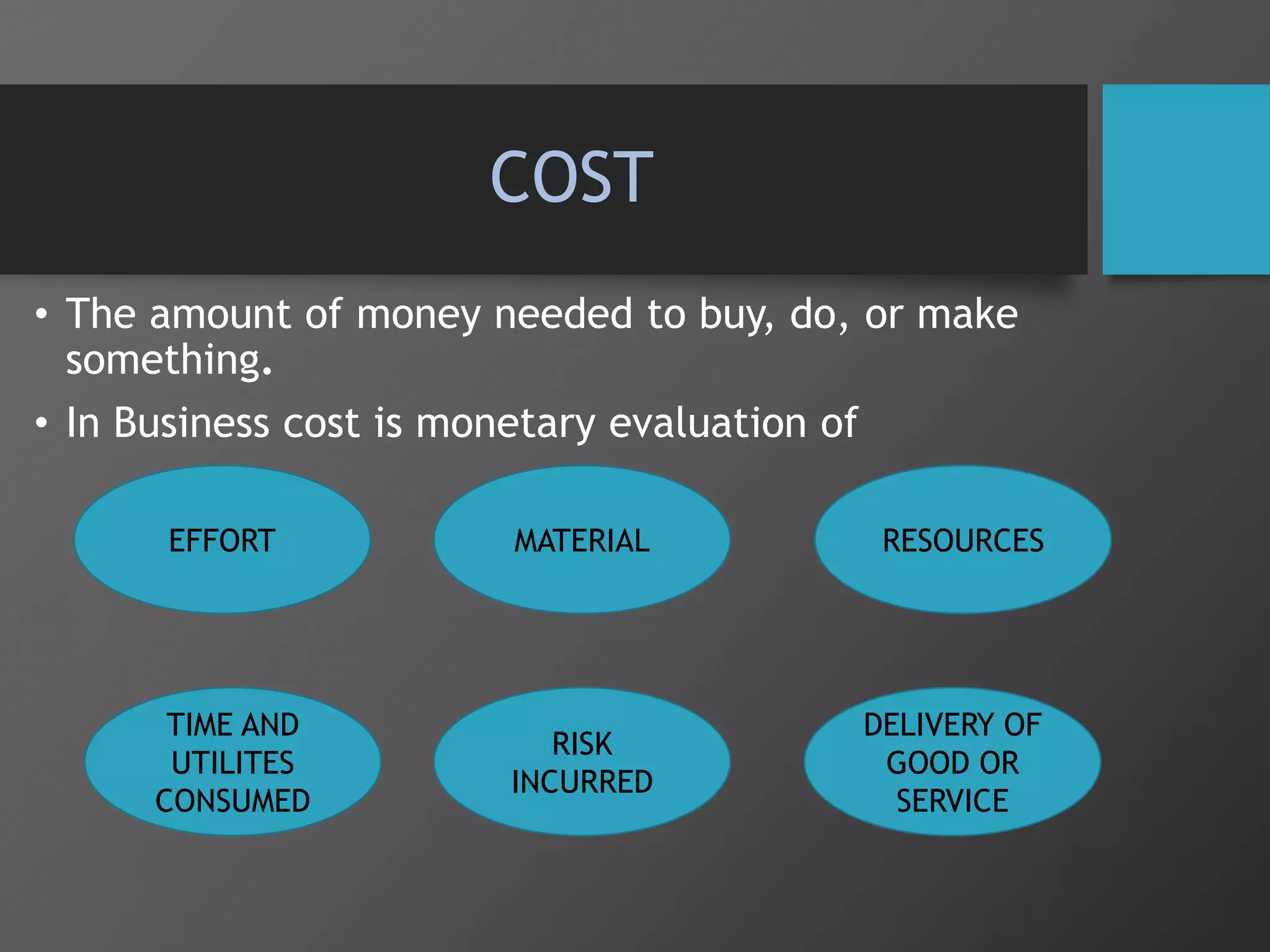
COST
• The amount of money needed to buy, do, or make
something.
• In Business cost is monetary evaluation of
EFFORT MATERIAL RESOURCES
TIME AND
UTILITES
CONSUMED
RISK
INCURRED
DELIVERY OF
GOOD OR
SERVICE
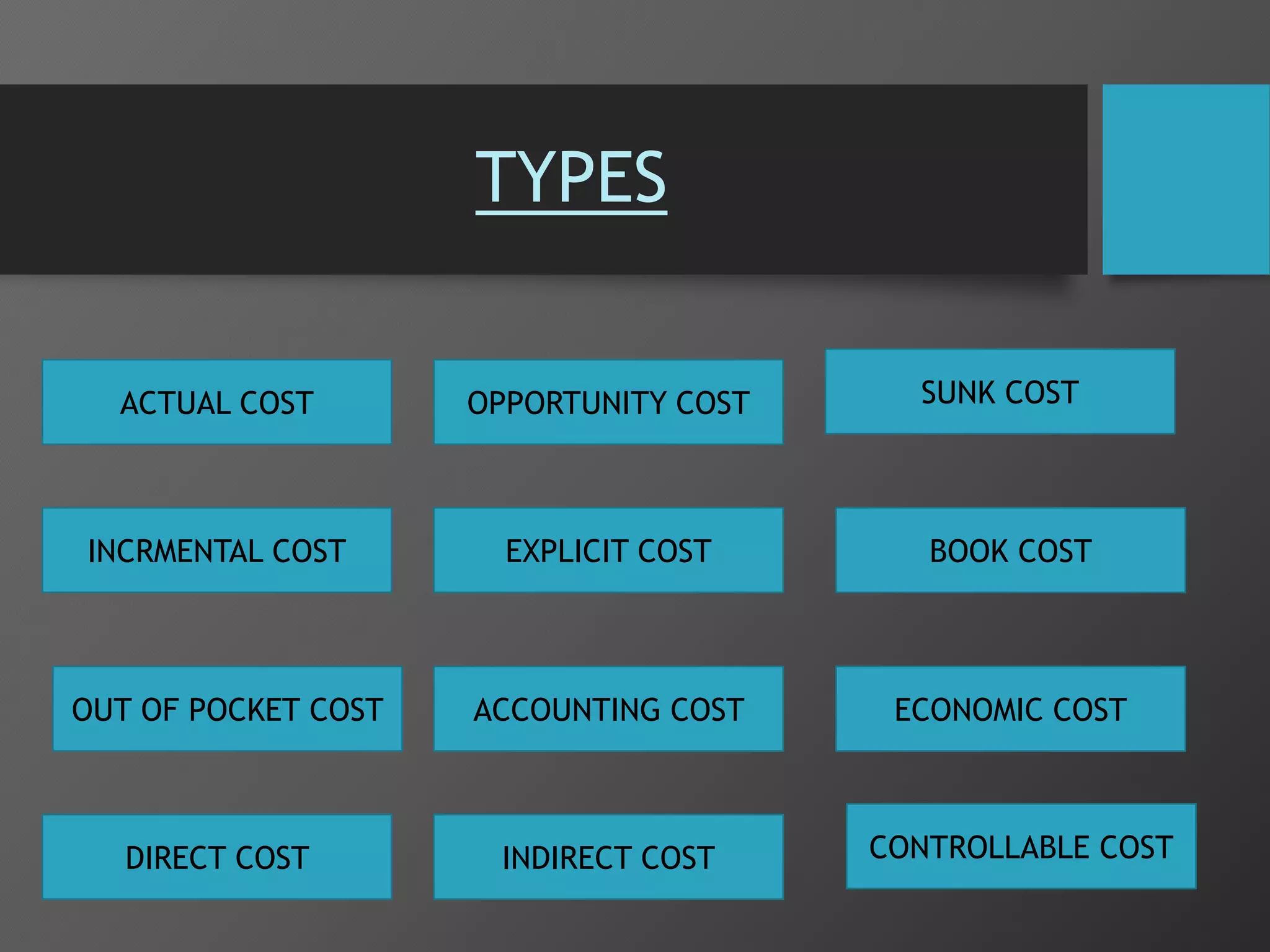
TYPES
ACTUAL COST
INCRMENTAL COST
OPPORTUNITY COST SUNK COST
BOOK COSTEXPLICIT COST
ECONOMIC COSTOUT OF POCKET COST
INDIRECT COST
ACCOUNTING COST
DIRECT COST CONTROLLABLE COST
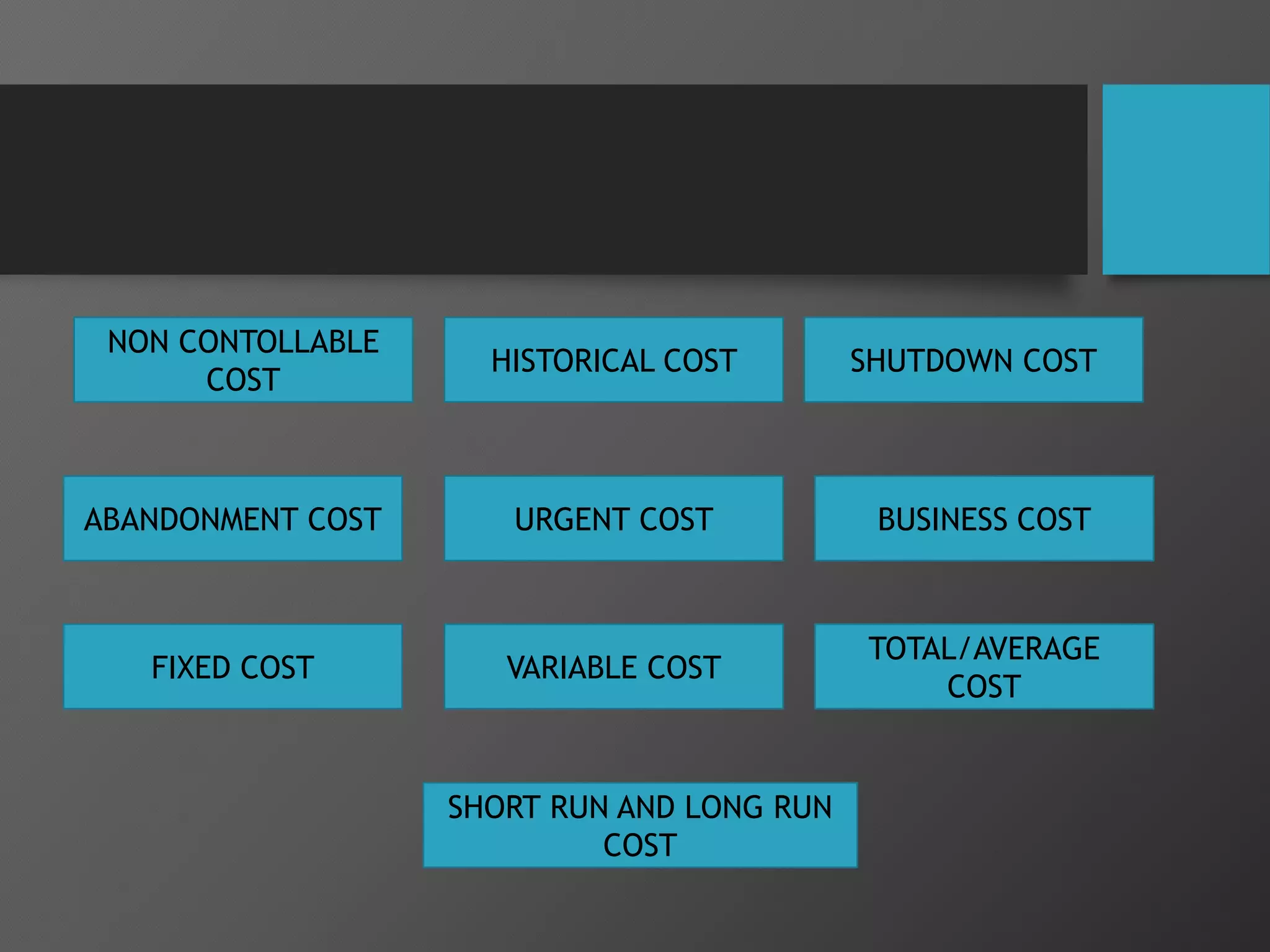
NON CONTOLLABLE
COST
ABANDONMENT COST
HISTORICAL COST
URGENT COST
VARIABLE COST
TOTAL/AVERAGE
COST
BUSINESS COST
SHUTDOWN COST
FIXED COST
SHORT RUN AND LONG RUN
COST
Actual Cost
• Actual cost is defined as the cost or expenditure
which a firm incurs for producing or acquiring a
good or service.
• Examples: Cost of raw materials, Wage Bill
Opportunity Cost
• It is the return from the second best use of the
firms resources which the firms forgoes in order
to avail of the return from the best use of the
resources.
• Examples: If a firm owns a land, there is no cost
of using the land (ie., the rent) in the firms
account. But the firm has an opportunity cost of
using the land, which is equal to the rent
forgone by not letting the land out on rent.
Sunk Cost
• Sunk costs are those do not alter by varying the
nature or level of business activity.
• Examples: All the past costs are considered as
sunk costs. The best example is amortization of
past expenses, like depreciation.
Incremental Cost
• Incremental costs are addition to costs resulting
from a change in the nature of level of business
activity.
• Example: Change in distribution channels adding
or deleting a product in the product line
Explicit Cost
• Explicit costs are those expenses/expenditures
that are actually paid by the firm.
• Explicit costs are important for calculating the
profit and loss.
• Example: Interest payment on borrowed funds,
rent payment, wages, utility expenses etc.
Implicit Cost
• Implicit costs are a part of opportunity cost.
They are the theoretical costs ie., they are not
recognised by the accounting system and are not
recorded in the books of accounts but are very
important in certain decisions.
• Examples: Rent on idle land, depreciation on
dully depreciated property still in use, interest
on equity capital etc.
Book Cost
• Book costs are those business costs which don't
involve any cash payments but a provision is
made in the books of accounts in order to
include them in the profit and loss account and
take tax advantages
Out Of Pocket Costs
• Out of pocket costs are those costs are expenses
which are current payments to the outsiders of
the firm.
• All the explicit costs fall into the category of out
of pocket costs.
• Examples: Rent Payed, wages, salaries, interest
etc
Accounting Costs
• Accounting costs are the actual or outlay costs
that point out the amount of expenditure that
has already been incurred on a particular process
or on production.
• Examples: All Sunk costs are accounting costs
Economic Costs
• Economic costs are related to future. They play
a vital role in business decisions as the costs
considered in decision - making are usually
future costs
Direct Cost
• Direct costs are those which have direct
relationship with a unit of operation like
manufacturing a product, organizing a process or
an activity.
• Examples: In operating railway services, the
costs of wagons, coaches and engines are direct
costs.
Indirect Costs
• Indirect costs are those which cannot be easily
and definitely identifiable in relation to a plant,
a product, a process or a department.
• Indirect costs are both the fixed and the
variable type.
• Example: The cost of factory building, the track
of a railway system etc., are fixed indirect costs
and the costs of machinery, labor etc.
Controllable Costs
• Controllable costs are those which can be
controlled or regulated through observation by
an executive and therefore they can be used for
assessing the efficiency of the executive.
• Example: Inventory costs can be controlled at
the shop level etc.
Non Controllable Costs
• The costs which cannot be subjected to
administrative control and supervision are called
non controllable costs.
• Example: Costs due obsolesce and depreciation,
capital costs etc.
Historical Costs and
Replacement Costs
• Historical cost or original costs of an asset refers
to the original price paid by the management to
purchase it in the past.
• Replacement costs refers to the cost that a firm
incurs to replace or acquire the same asset now.
• Example: If a firm acquires a machine for
$20,000 in the year 1990 and the same machine
costs $40,000 now. The amount $20,000 is the
historical cost and the amount $40,000 is the
replacement cost.
Shutdown Costs
• The costs which a firm incurs when it
temporarily stops its operations are called
shutdown costs.
• These costs can be saved when the firm again
start its operations. Shutdown costs include
fixed costs, maintenance cost, layoff expenses
etc.
Abandonment Costs
• Abandonment costs are those costs which are
incurred for the complete removal of the fixed
asset from use.
• These may occur due to obsolesce or due to
improvisation of the firm. Abandonment costs
thus involve problem of disposal of the asset
Urgent Costs
• Urgent costs are those costs which have to be
incurred compulsorily by the management in
order to continue its operations.
• If urgent costs are not incurred in time the
operational efficiency of the firm falls.
• Example: Cost of material, labour, fuel etc
Business Cost and Full Cost
• Business costs include all the expenses incurred
by the firm to carry out business activities.
• Costs Include all the payments and contractual
obligations made by the firm together with the
book cost of depreciation on plant and
equipment.
• Full costs include business costs, opportunity
costs, and normal profits.
Fixed Costs
• Fixed costs are the costs that do not vary with
the changes in output. In other words, fixed
costs are those which are fixed in volume though
there are variations in the output level.
• Examples: Expenditures on depreciation costs of
administrative, staff, rent, land and buildings,
taxes etc.
Variable Costs
• Variable Costs are those that are directly
dependent on the output i.e.., they vary with
the variation in the volume/level of output.
• Example: Cost of raw materials, expenditure on
labour, running cost or maintenance costs of
fixed assets such as fuel, repairs, routine
maintenance expenditure.
Total Cost, Average Cost
and Marginal Cost
• Total cost (TC) refers to the money value of the total
resources/inputs required for the production of goods
and services by the firm.
• TC = VC + FC
• Average Cost (AC) , refers to the cost per unit of
output assuming that production of each unit incurs
the same cost.
• AC= TC/O
• Marginal costs(MC), refers to the additional costs that
are incurred when there is an addition to the existing
output level of goods and services
Short Run Cost
• These costs are which vary with the variation in
the output with size of the firm as same.
• Short run costs are same as variable costs.
Long Run Cost
• These costs are which incurred on the fixed
assets like land and building, plant and
machinery etc.
• Long run costs are same as fixed costs. Usually,
long run costs are associated with variations in
size and kind of plant.
Presentation on cost

Presentation on cost

  • 1.
  • 2.
  • 3.
    COST • The amountof money needed to buy, do, or make something. • In Business cost is monetary evaluation of EFFORT MATERIAL RESOURCES TIME AND UTILITES CONSUMED RISK INCURRED DELIVERY OF GOOD OR SERVICE
  • 4.
    TYPES ACTUAL COST INCRMENTAL COST OPPORTUNITYCOST SUNK COST BOOK COSTEXPLICIT COST ECONOMIC COSTOUT OF POCKET COST INDIRECT COST ACCOUNTING COST DIRECT COST CONTROLLABLE COST
  • 5.
    NON CONTOLLABLE COST ABANDONMENT COST HISTORICALCOST URGENT COST VARIABLE COST TOTAL/AVERAGE COST BUSINESS COST SHUTDOWN COST FIXED COST SHORT RUN AND LONG RUN COST
  • 6.
    Actual Cost • Actualcost is defined as the cost or expenditure which a firm incurs for producing or acquiring a good or service. • Examples: Cost of raw materials, Wage Bill
  • 7.
    Opportunity Cost • Itis the return from the second best use of the firms resources which the firms forgoes in order to avail of the return from the best use of the resources. • Examples: If a firm owns a land, there is no cost of using the land (ie., the rent) in the firms account. But the firm has an opportunity cost of using the land, which is equal to the rent forgone by not letting the land out on rent.
  • 8.
    Sunk Cost • Sunkcosts are those do not alter by varying the nature or level of business activity. • Examples: All the past costs are considered as sunk costs. The best example is amortization of past expenses, like depreciation.
  • 9.
    Incremental Cost • Incrementalcosts are addition to costs resulting from a change in the nature of level of business activity. • Example: Change in distribution channels adding or deleting a product in the product line
  • 10.
    Explicit Cost • Explicitcosts are those expenses/expenditures that are actually paid by the firm. • Explicit costs are important for calculating the profit and loss. • Example: Interest payment on borrowed funds, rent payment, wages, utility expenses etc.
  • 11.
    Implicit Cost • Implicitcosts are a part of opportunity cost. They are the theoretical costs ie., they are not recognised by the accounting system and are not recorded in the books of accounts but are very important in certain decisions. • Examples: Rent on idle land, depreciation on dully depreciated property still in use, interest on equity capital etc.
  • 12.
    Book Cost • Bookcosts are those business costs which don't involve any cash payments but a provision is made in the books of accounts in order to include them in the profit and loss account and take tax advantages
  • 13.
    Out Of PocketCosts • Out of pocket costs are those costs are expenses which are current payments to the outsiders of the firm. • All the explicit costs fall into the category of out of pocket costs. • Examples: Rent Payed, wages, salaries, interest etc
  • 14.
    Accounting Costs • Accountingcosts are the actual or outlay costs that point out the amount of expenditure that has already been incurred on a particular process or on production. • Examples: All Sunk costs are accounting costs
  • 15.
    Economic Costs • Economiccosts are related to future. They play a vital role in business decisions as the costs considered in decision - making are usually future costs
  • 16.
    Direct Cost • Directcosts are those which have direct relationship with a unit of operation like manufacturing a product, organizing a process or an activity. • Examples: In operating railway services, the costs of wagons, coaches and engines are direct costs.
  • 17.
    Indirect Costs • Indirectcosts are those which cannot be easily and definitely identifiable in relation to a plant, a product, a process or a department. • Indirect costs are both the fixed and the variable type. • Example: The cost of factory building, the track of a railway system etc., are fixed indirect costs and the costs of machinery, labor etc.
  • 18.
    Controllable Costs • Controllablecosts are those which can be controlled or regulated through observation by an executive and therefore they can be used for assessing the efficiency of the executive. • Example: Inventory costs can be controlled at the shop level etc.
  • 19.
    Non Controllable Costs •The costs which cannot be subjected to administrative control and supervision are called non controllable costs. • Example: Costs due obsolesce and depreciation, capital costs etc.
  • 20.
    Historical Costs and ReplacementCosts • Historical cost or original costs of an asset refers to the original price paid by the management to purchase it in the past. • Replacement costs refers to the cost that a firm incurs to replace or acquire the same asset now. • Example: If a firm acquires a machine for $20,000 in the year 1990 and the same machine costs $40,000 now. The amount $20,000 is the historical cost and the amount $40,000 is the replacement cost.
  • 21.
    Shutdown Costs • Thecosts which a firm incurs when it temporarily stops its operations are called shutdown costs. • These costs can be saved when the firm again start its operations. Shutdown costs include fixed costs, maintenance cost, layoff expenses etc.
  • 22.
    Abandonment Costs • Abandonmentcosts are those costs which are incurred for the complete removal of the fixed asset from use. • These may occur due to obsolesce or due to improvisation of the firm. Abandonment costs thus involve problem of disposal of the asset
  • 23.
    Urgent Costs • Urgentcosts are those costs which have to be incurred compulsorily by the management in order to continue its operations. • If urgent costs are not incurred in time the operational efficiency of the firm falls. • Example: Cost of material, labour, fuel etc
  • 24.
    Business Cost andFull Cost • Business costs include all the expenses incurred by the firm to carry out business activities. • Costs Include all the payments and contractual obligations made by the firm together with the book cost of depreciation on plant and equipment. • Full costs include business costs, opportunity costs, and normal profits.
  • 25.
    Fixed Costs • Fixedcosts are the costs that do not vary with the changes in output. In other words, fixed costs are those which are fixed in volume though there are variations in the output level. • Examples: Expenditures on depreciation costs of administrative, staff, rent, land and buildings, taxes etc.
  • 26.
    Variable Costs • VariableCosts are those that are directly dependent on the output i.e.., they vary with the variation in the volume/level of output. • Example: Cost of raw materials, expenditure on labour, running cost or maintenance costs of fixed assets such as fuel, repairs, routine maintenance expenditure.
  • 27.
    Total Cost, AverageCost and Marginal Cost • Total cost (TC) refers to the money value of the total resources/inputs required for the production of goods and services by the firm. • TC = VC + FC • Average Cost (AC) , refers to the cost per unit of output assuming that production of each unit incurs the same cost. • AC= TC/O • Marginal costs(MC), refers to the additional costs that are incurred when there is an addition to the existing output level of goods and services
  • 28.
    Short Run Cost •These costs are which vary with the variation in the output with size of the firm as same. • Short run costs are same as variable costs.
  • 29.
    Long Run Cost •These costs are which incurred on the fixed assets like land and building, plant and machinery etc. • Long run costs are same as fixed costs. Usually, long run costs are associated with variations in size and kind of plant.