
Lecturer:
Dr. Kamilah Ahmad
25 February 2014
Topic 2: Type of Costs in
Production
Chapter Learning Outcomes
 Acknowledge the basic types of production cost in
production environment
 Differentiate costs behavior
Introduction
 All types of organizations incur costs.
 The kind of costs incurred and the way in which these
costs are classified depend on the type of organization.
 Will focus the cost characteristics of manufacturing
firms since their basic activities include most activities
found in other types of organizations.
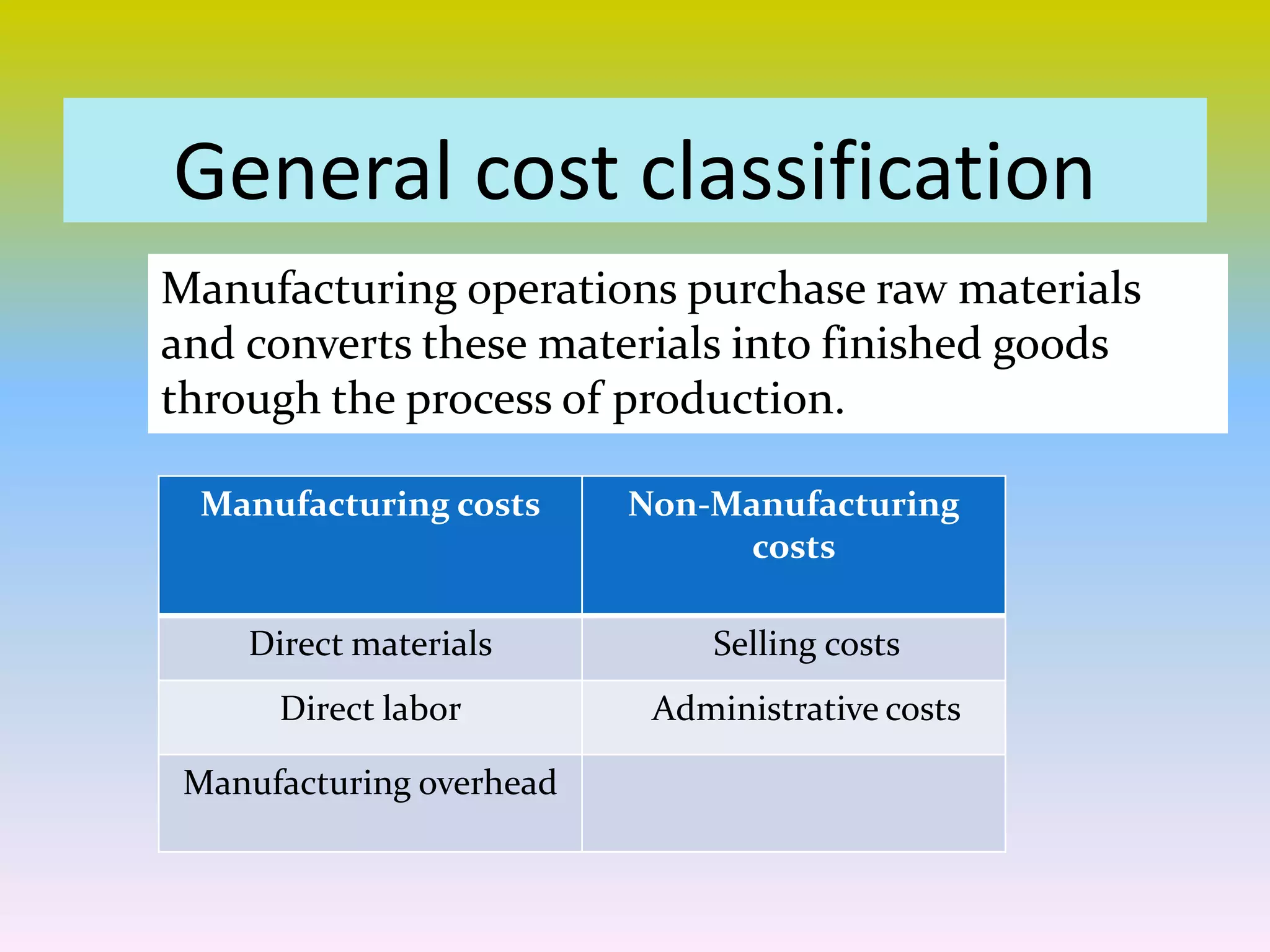
General cost classification
Manufacturing costs Non-Manufacturing
costs
Direct materials Selling costs
Direct labor Administrative costs
Manufacturing overhead
Manufacturing operations purchase raw materials
and converts these materials into finished goods
through the process of production.
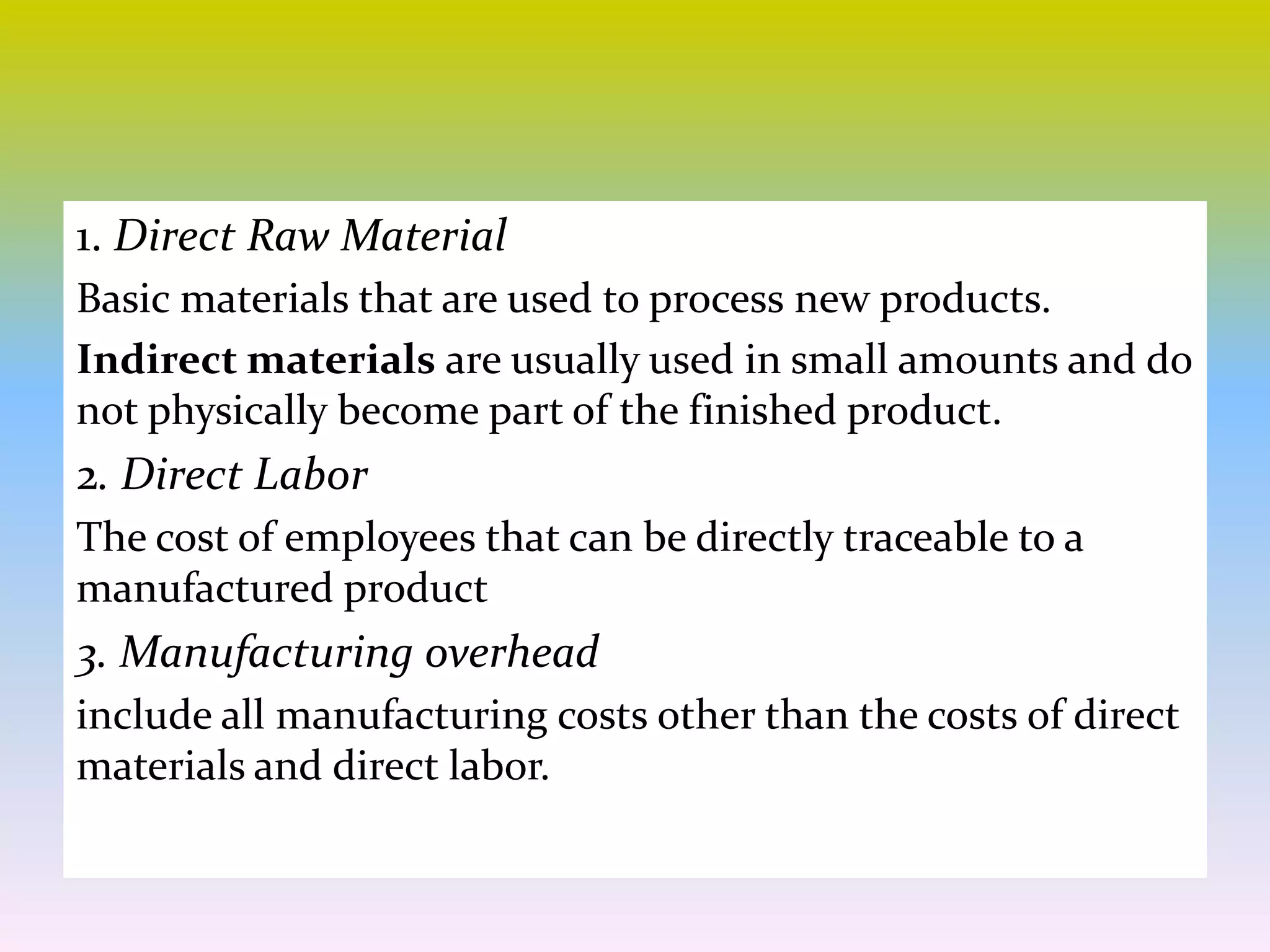
1. Direct Raw Material
Basic materials that are used to process new products.
Indirect materials are usually used in small amounts and do
not physically become part of the finished product.
2. Direct Labor
The cost of employees that can be directly traceable to a
manufactured product
3. Manufacturing overhead
include all manufacturing costs other than the costs of direct
materials and direct labor.
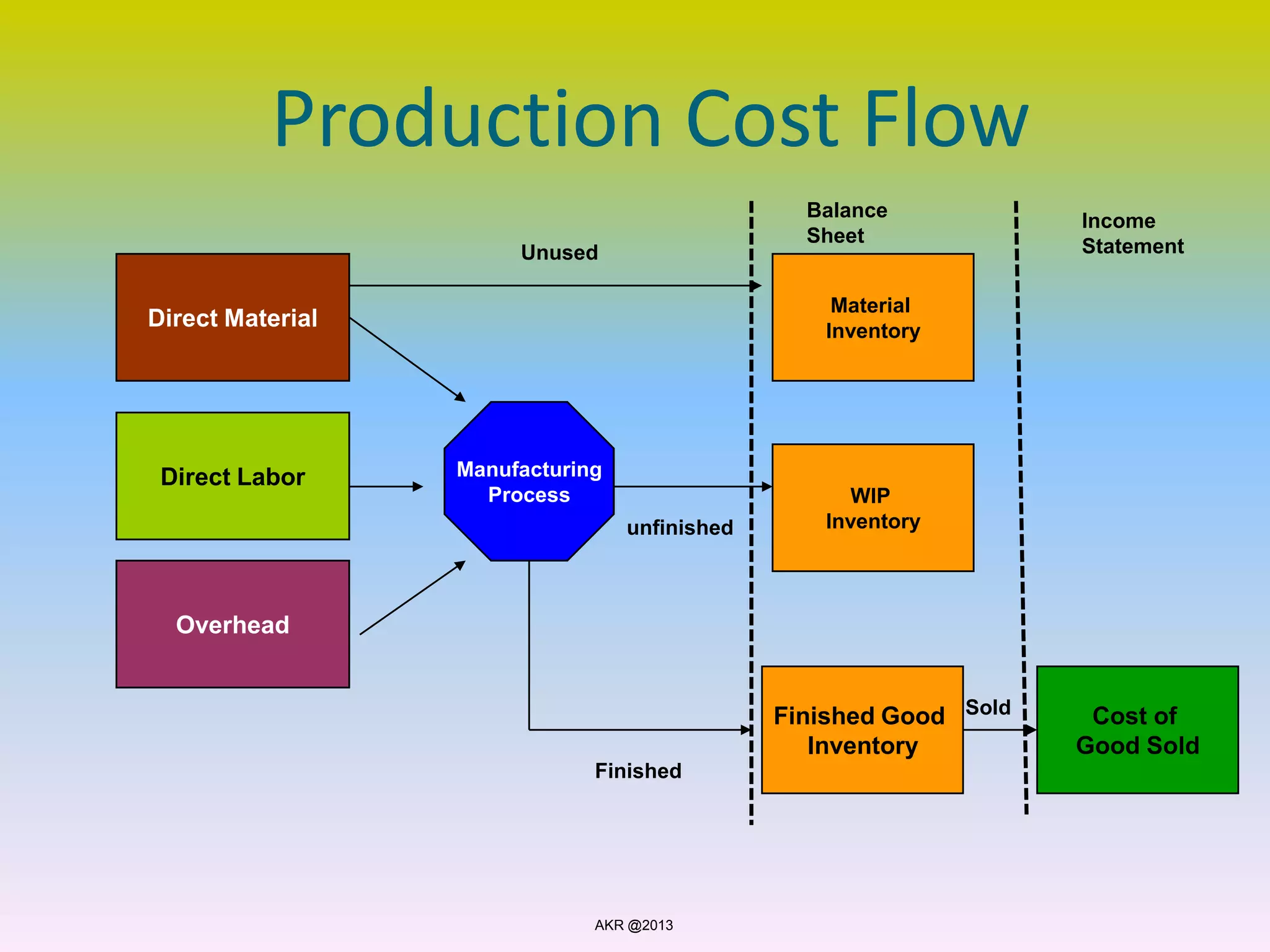
Production Cost Flow
Direct Material
Overhead
Direct Labor Manufacturing
Process
Material
Inventory
Finished Good
Inventory
WIP
Inventory
Cost of
Good Sold
Sold
Finished
unfinished
Unused
Balance
Sheet
Income
Statement
AKR @2013
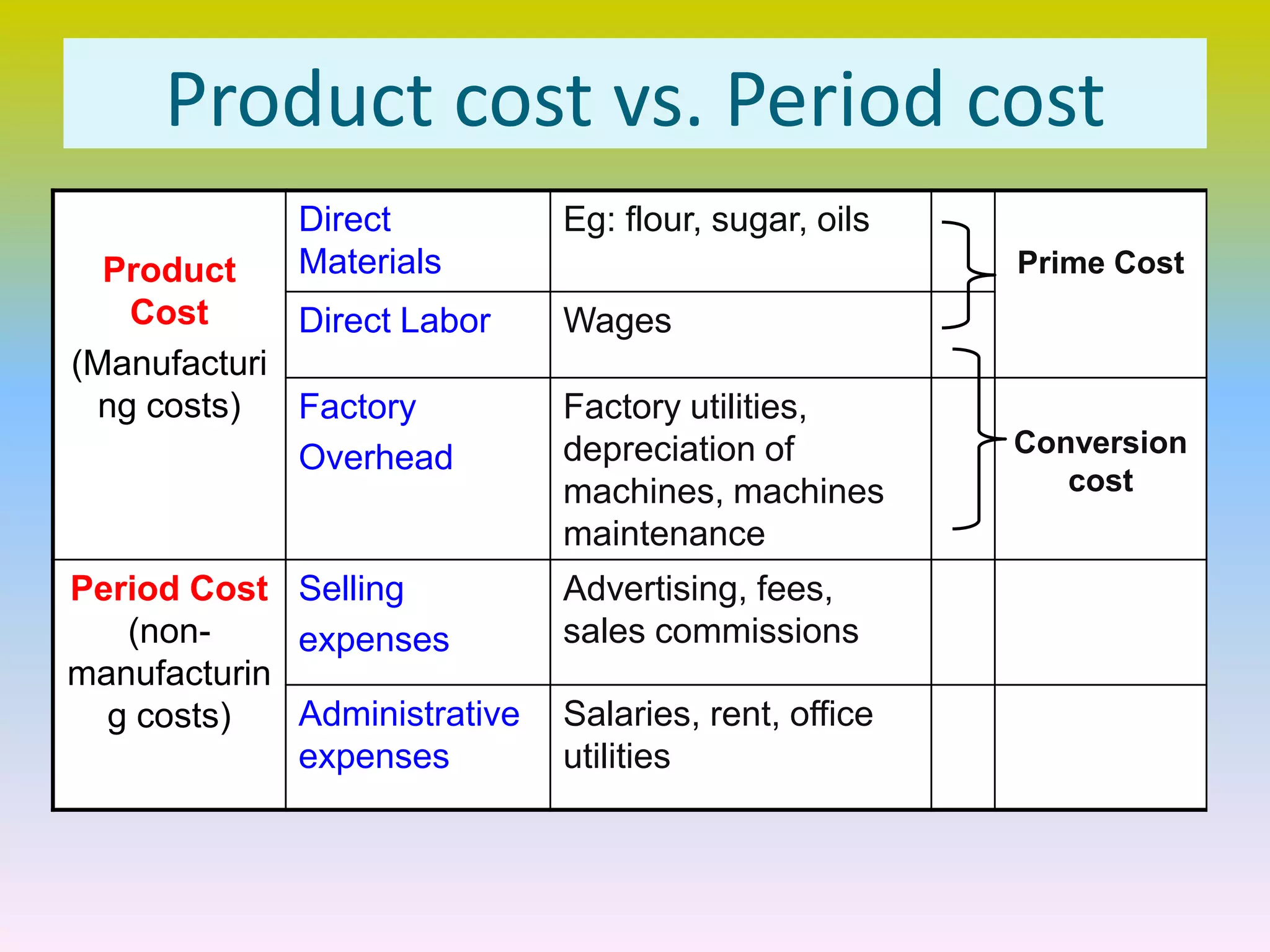
Product cost vs. Period cost
Product
Cost
(Manufacturi
ng costs)
Direct
Materials
Eg: flour, sugar, oils
Prime Cost
Direct Labor Wages
Factory
Overhead
Factory utilities,
depreciation of
machines, machines
maintenance
Conversion
cost
Period Cost
(non-
manufacturin
g costs)
Selling
expenses
Advertising, fees,
sales commissions
Administrative
expenses
Salaries, rent, office
utilities
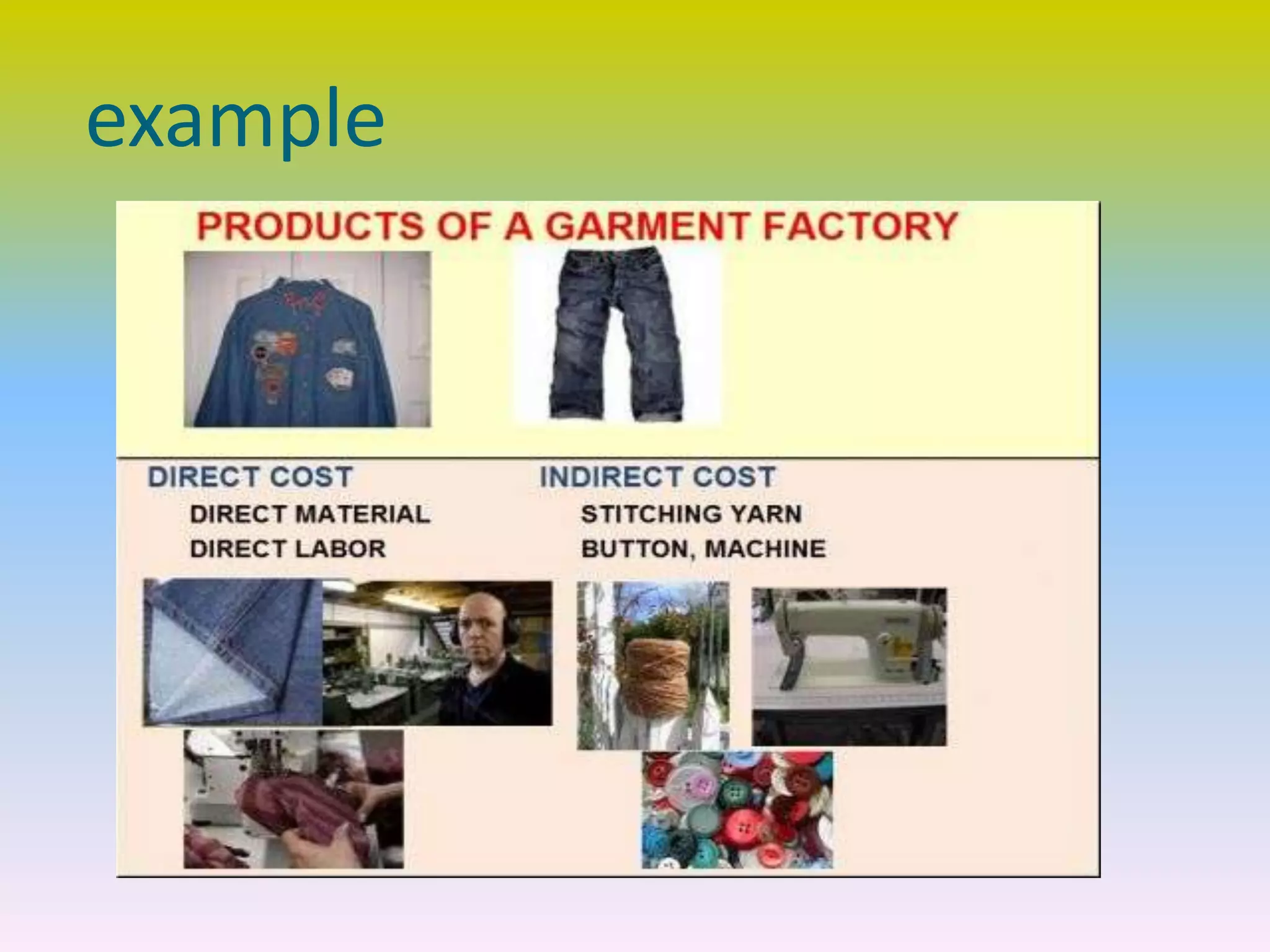
example
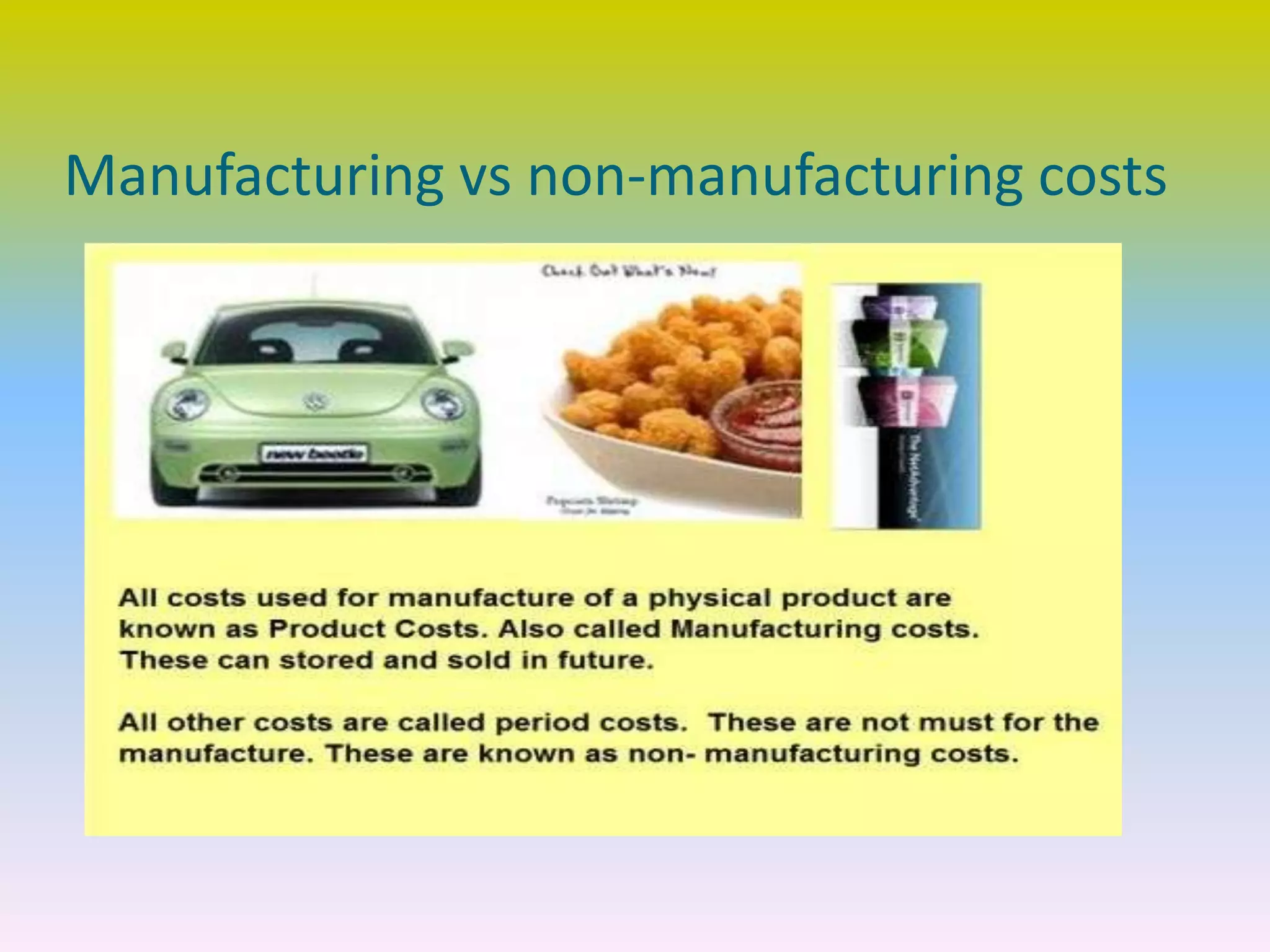
Manufacturing vs non-manufacturing costs
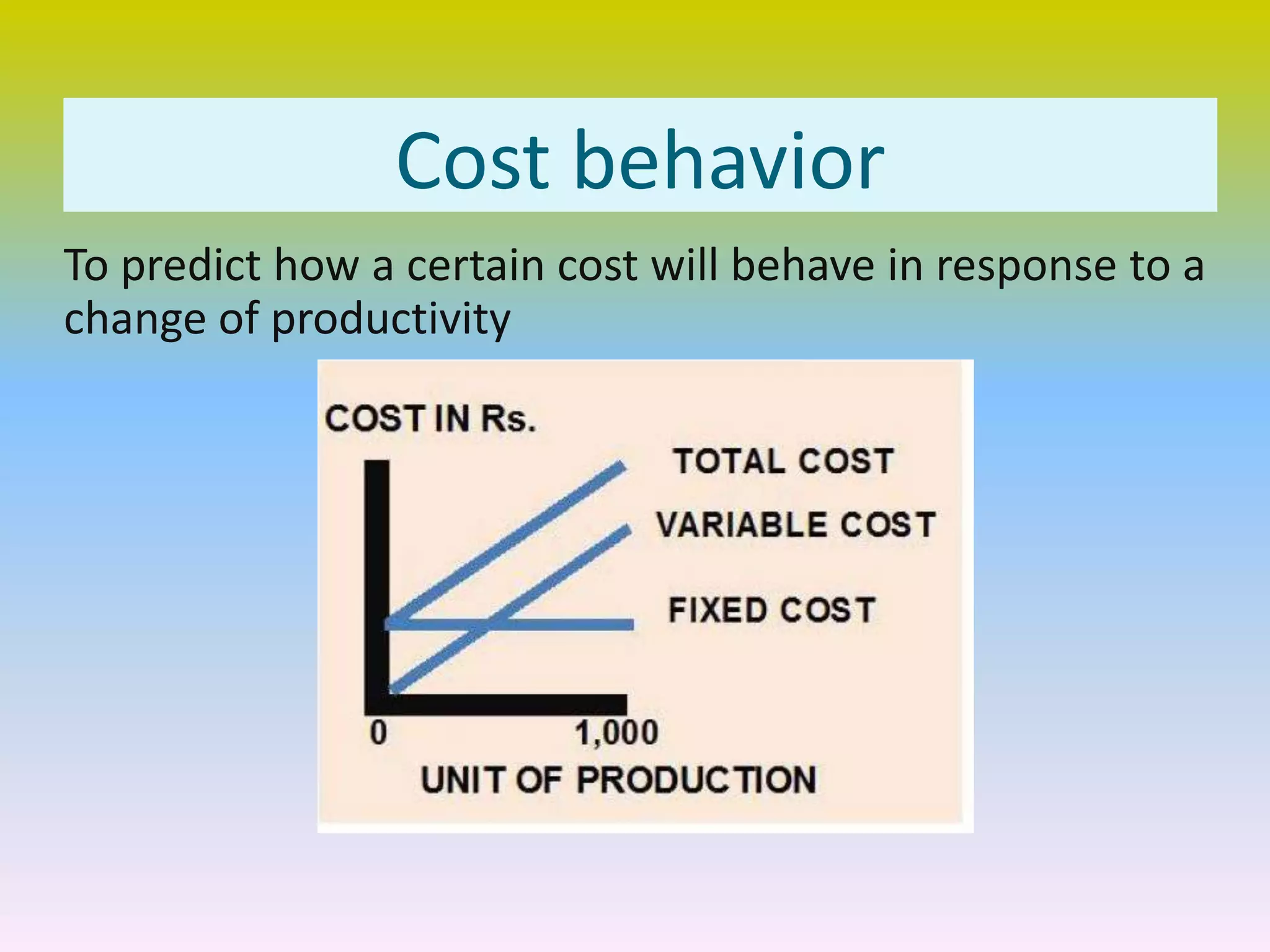
Cost behavior
To predict how a certain cost will behave in response to a
change of productivity
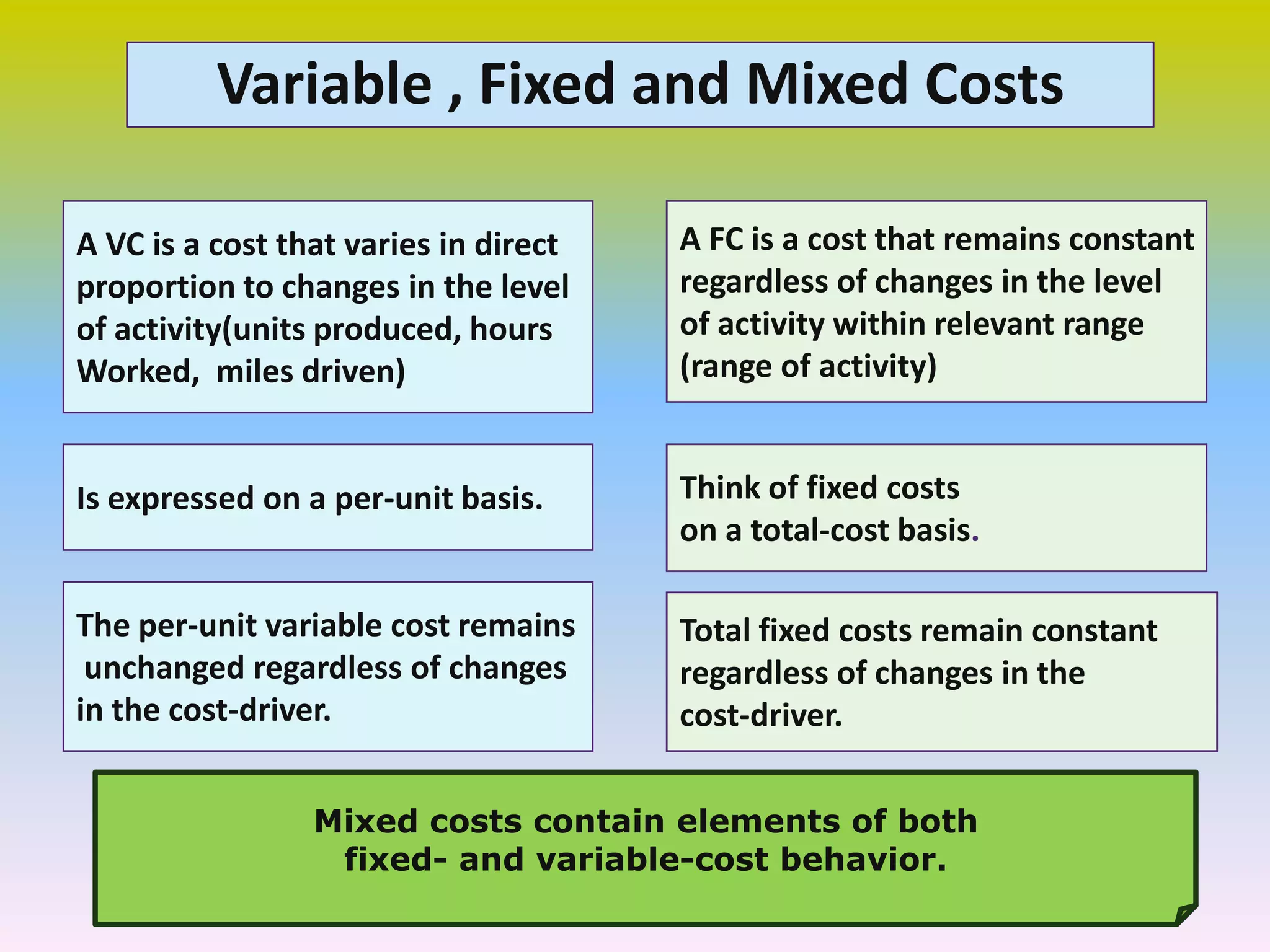
Variable , Fixed and Mixed Costs
A VC is a cost that varies in direct
proportion to changes in the level
of activity(units produced, hours
Worked, miles driven)
A FC is a cost that remains constant
regardless of changes in the level
of activity within relevant range
(range of activity)
Is expressed on a per-unit basis.
The per-unit variable cost remains
unchanged regardless of changes
in the cost-driver.
Think of fixed costs
on a total-cost basis.
Total fixed costs remain constant
regardless of changes in the
cost-driver.
Mixed costs contain elements of both
fixed- and variable-cost behavior.
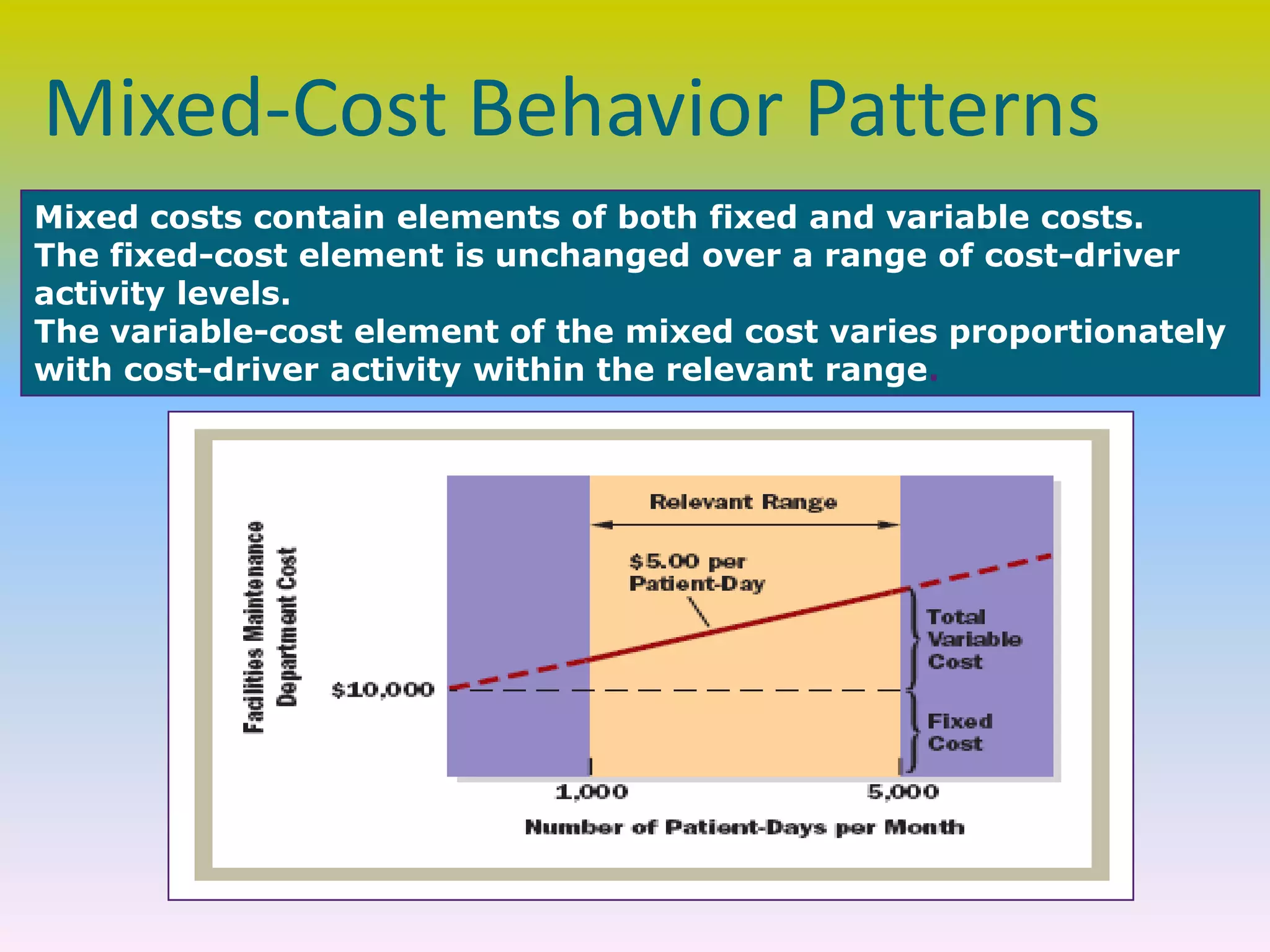
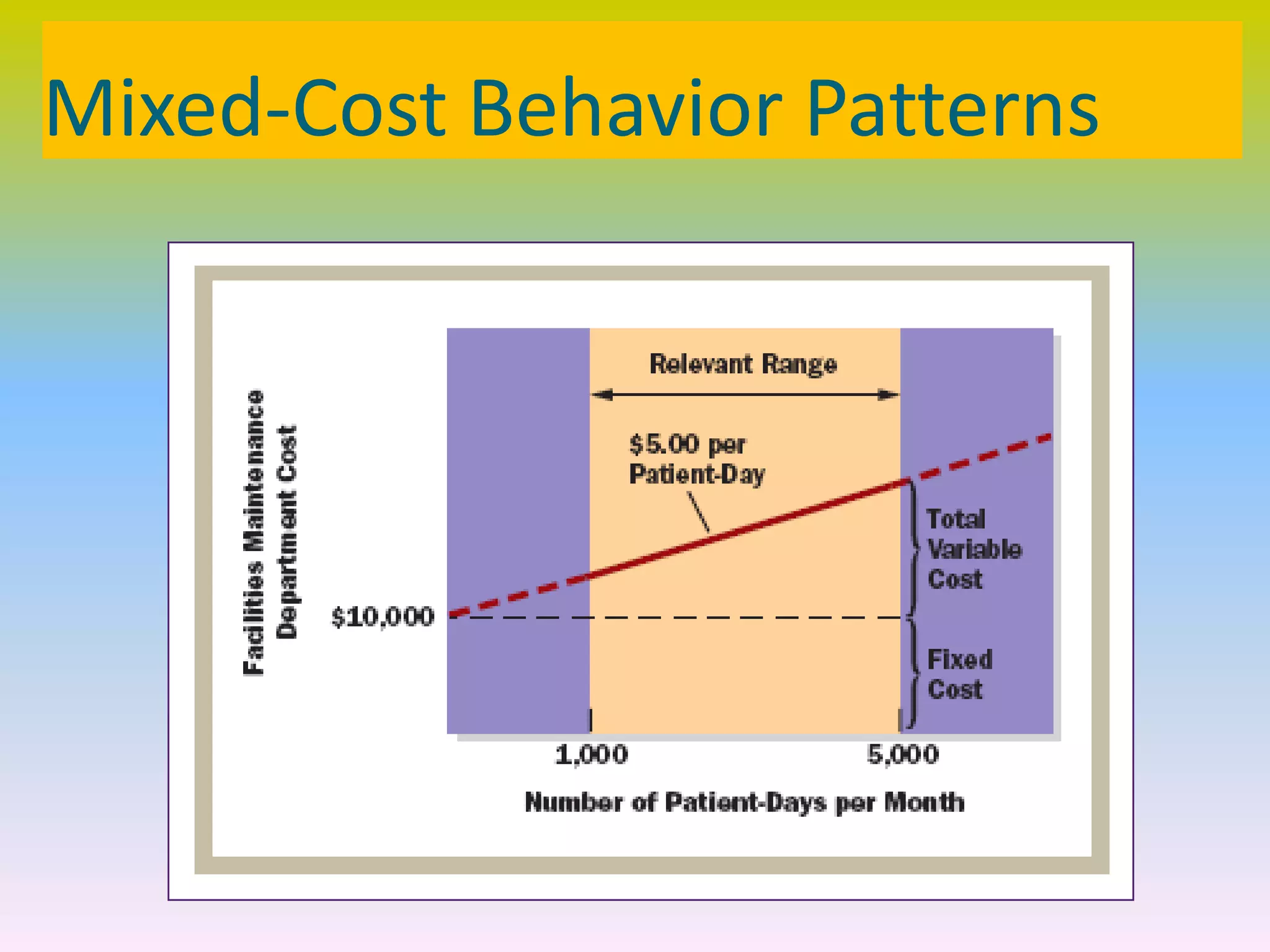
Mixed-Cost Behavior Patterns
Mixed costs contain elements of both fixed and variable costs.
The fixed-cost element is unchanged over a range of cost-driver
activity levels.
The variable-cost element of the mixed cost varies proportionately
with cost-driver activity within the relevant range.
Cost Drivers
Cost drivers are measures of activities that require
the use of resources and thereby cause costs.
Measurement of Cost Behavior
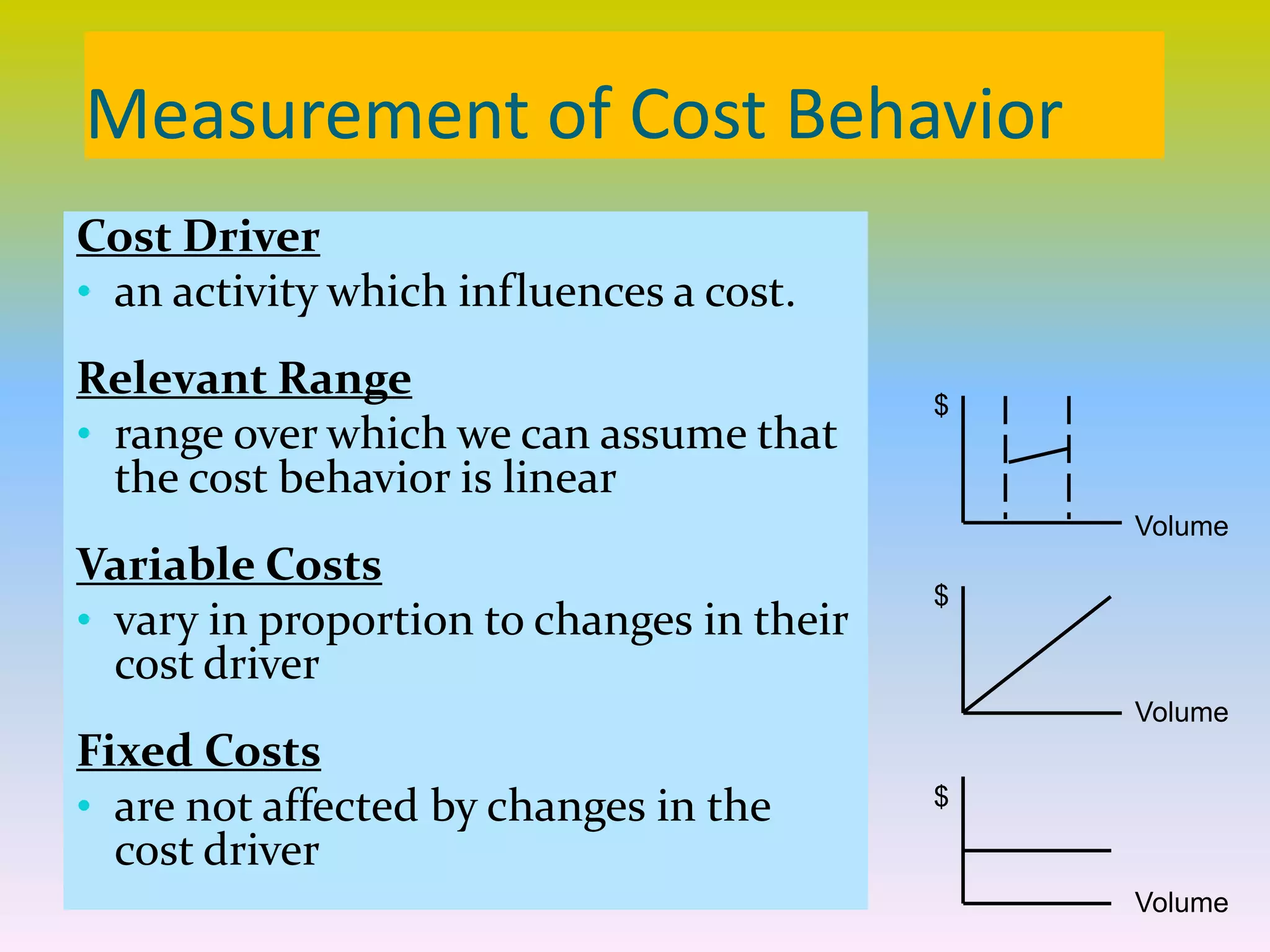
Cost Driver
• an activity which influences a cost.
Relevant Range
• range over which we can assume that
the cost behavior is linear
Variable Costs
• vary in proportion to changes in their
cost driver
Fixed Costs
• are not affected by changes in the
cost driver
$
Volume
$
Volume
$
Volume
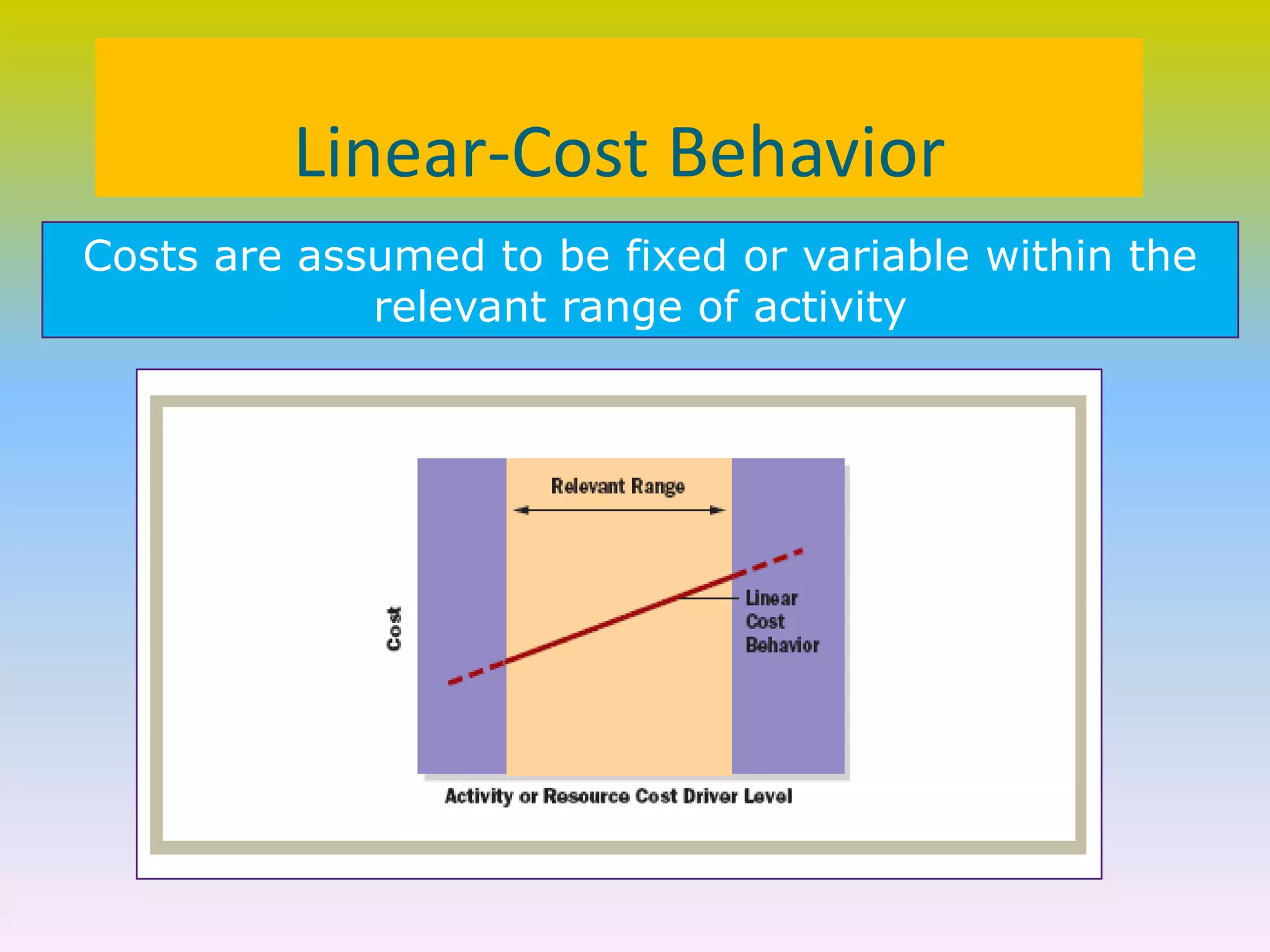
Linear-Cost Behavior
Costs are assumed to be fixed or variable within the
relevant range of activity
Variations in Cost Behaviour
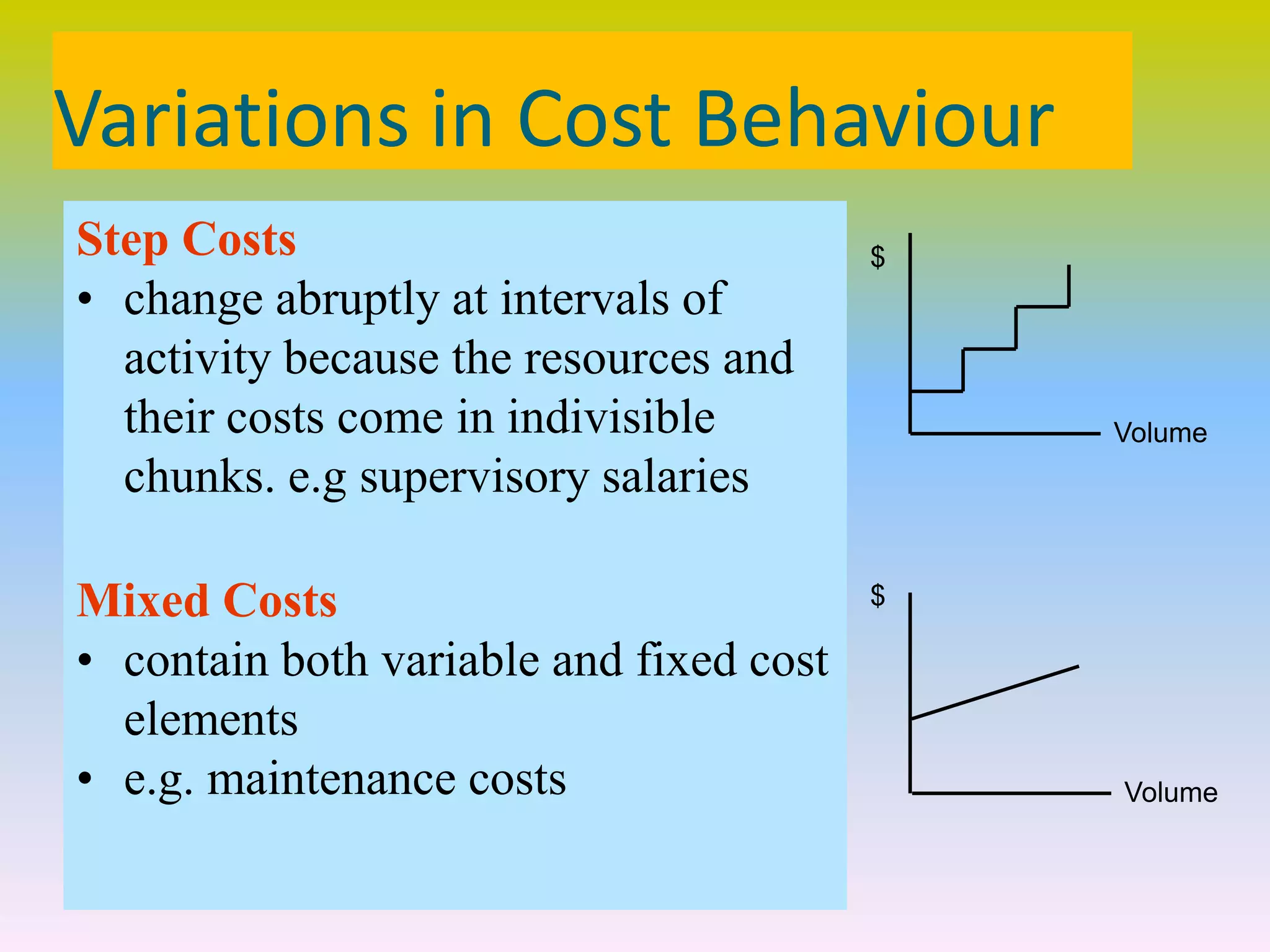
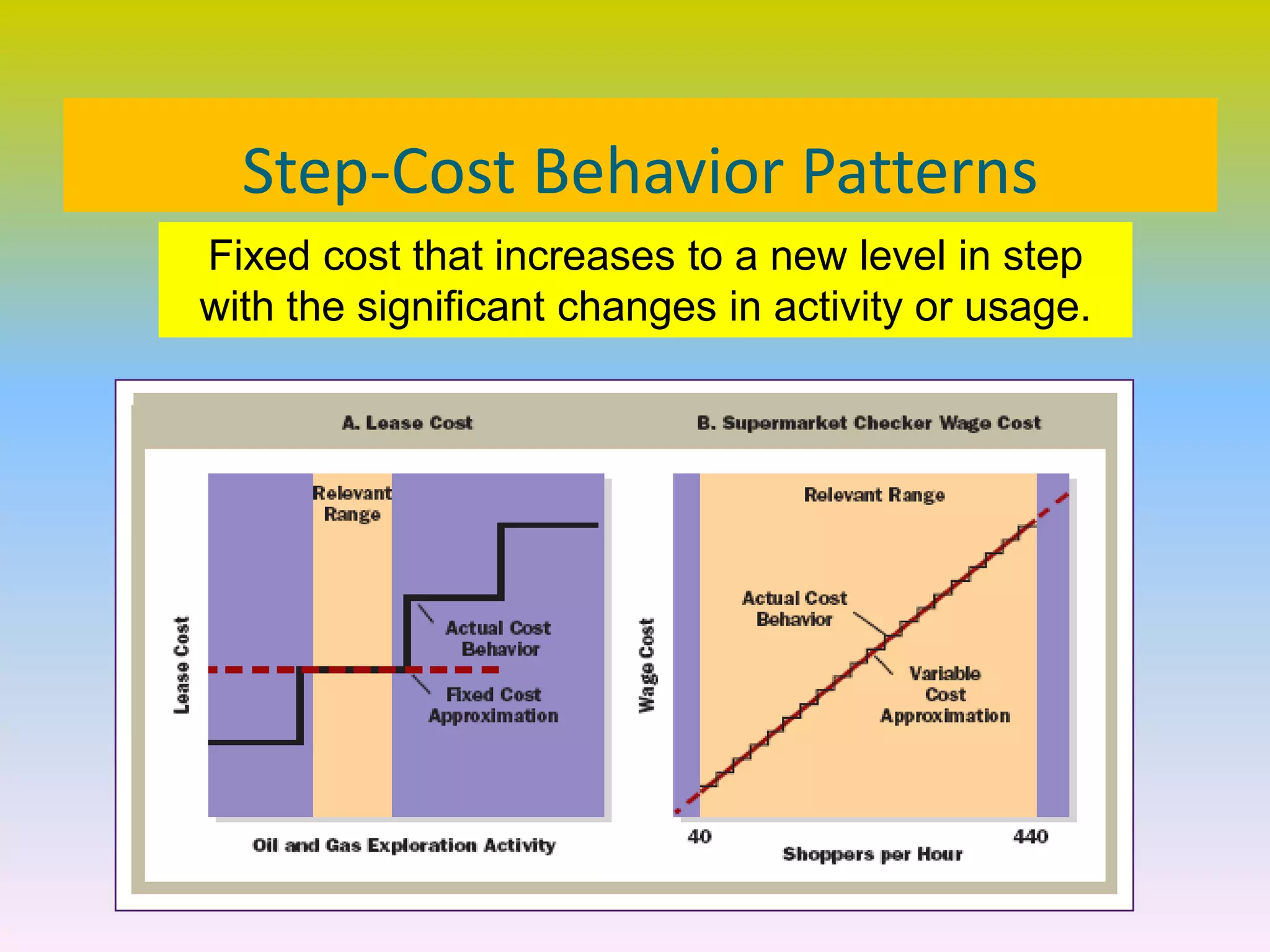
Step Costs
• change abruptly at intervals of
activity because the resources and
their costs come in indivisible
chunks. e.g supervisory salaries
Mixed Costs
• contain both variable and fixed cost
elements
• e.g. maintenance costs
Volume
$
Volume
$
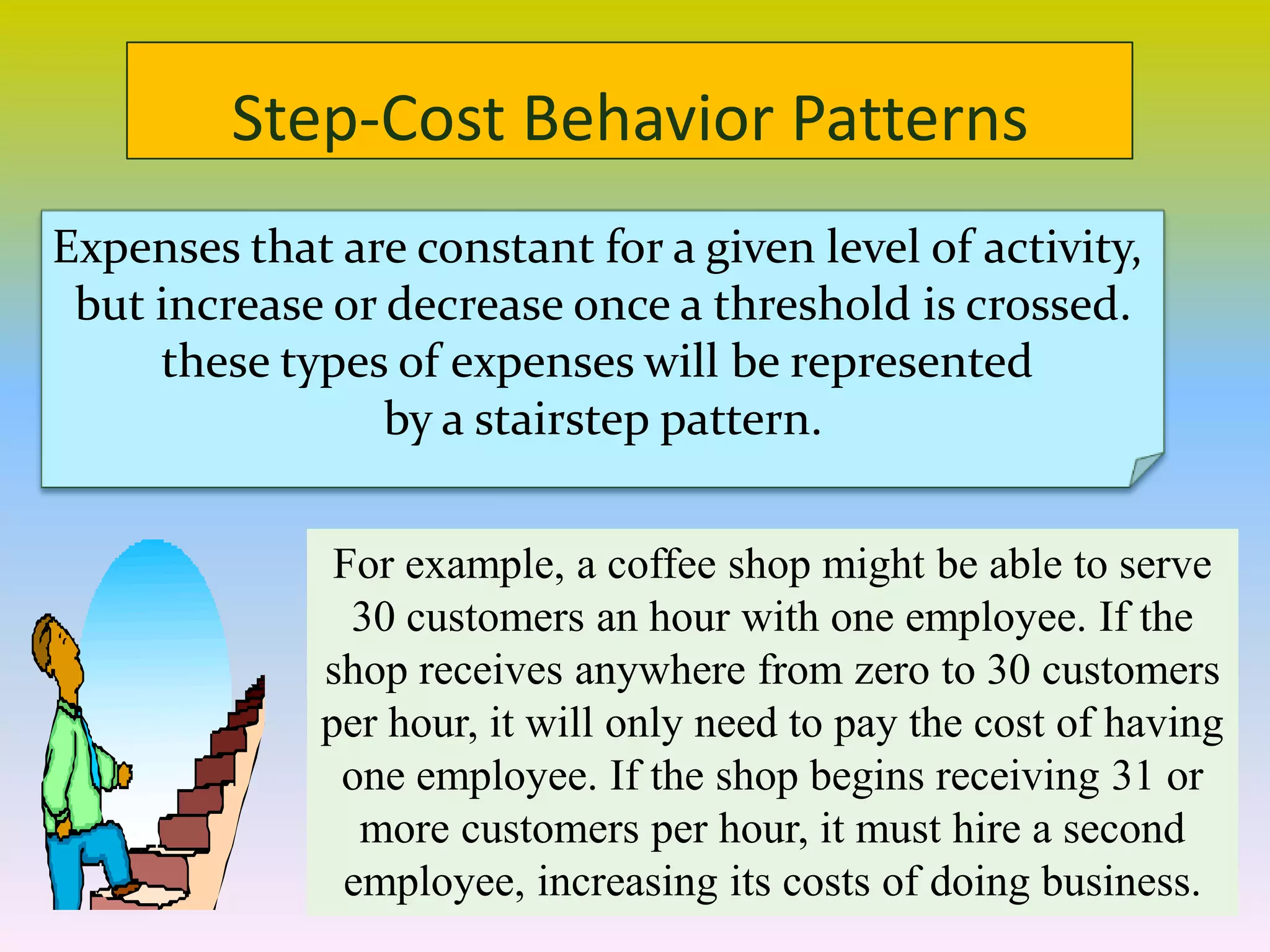
Step-Cost Behavior Patterns
Expenses that are constant for a given level of activity,
but increase or decrease once a threshold is crossed.
these types of expenses will be represented
by a stairstep pattern.
For example, a coffee shop might be able to serve
30 customers an hour with one employee. If the
shop receives anywhere from zero to 30 customers
per hour, it will only need to pay the cost of having
one employee. If the shop begins receiving 31 or
more customers per hour, it must hire a second
employee, increasing its costs of doing business.
Step-Cost Behavior Patterns
Fixed cost that increases to a new level in step
with the significant changes in activity or usage.
Mixed-Cost Behavior Patterns
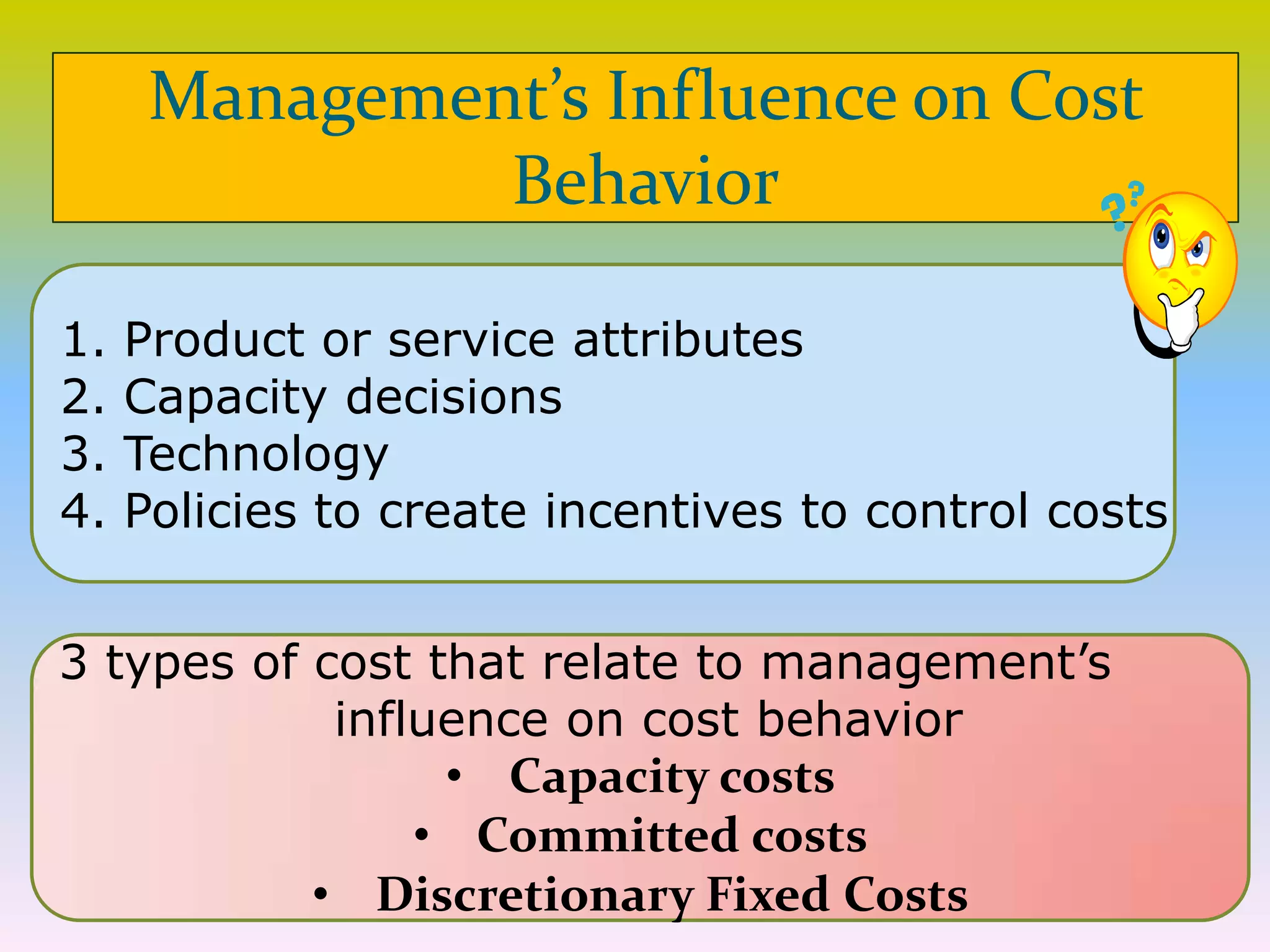
1. Product or service attributes
2. Capacity decisions
3. Technology
4. Policies to create incentives to control costs
Management’s Influence on Cost
Behavior
3 types of cost that relate to management’s
influence on cost behavior
• Capacity costs
• Committed costs
• Discretionary Fixed Costs
Capacity Decisions
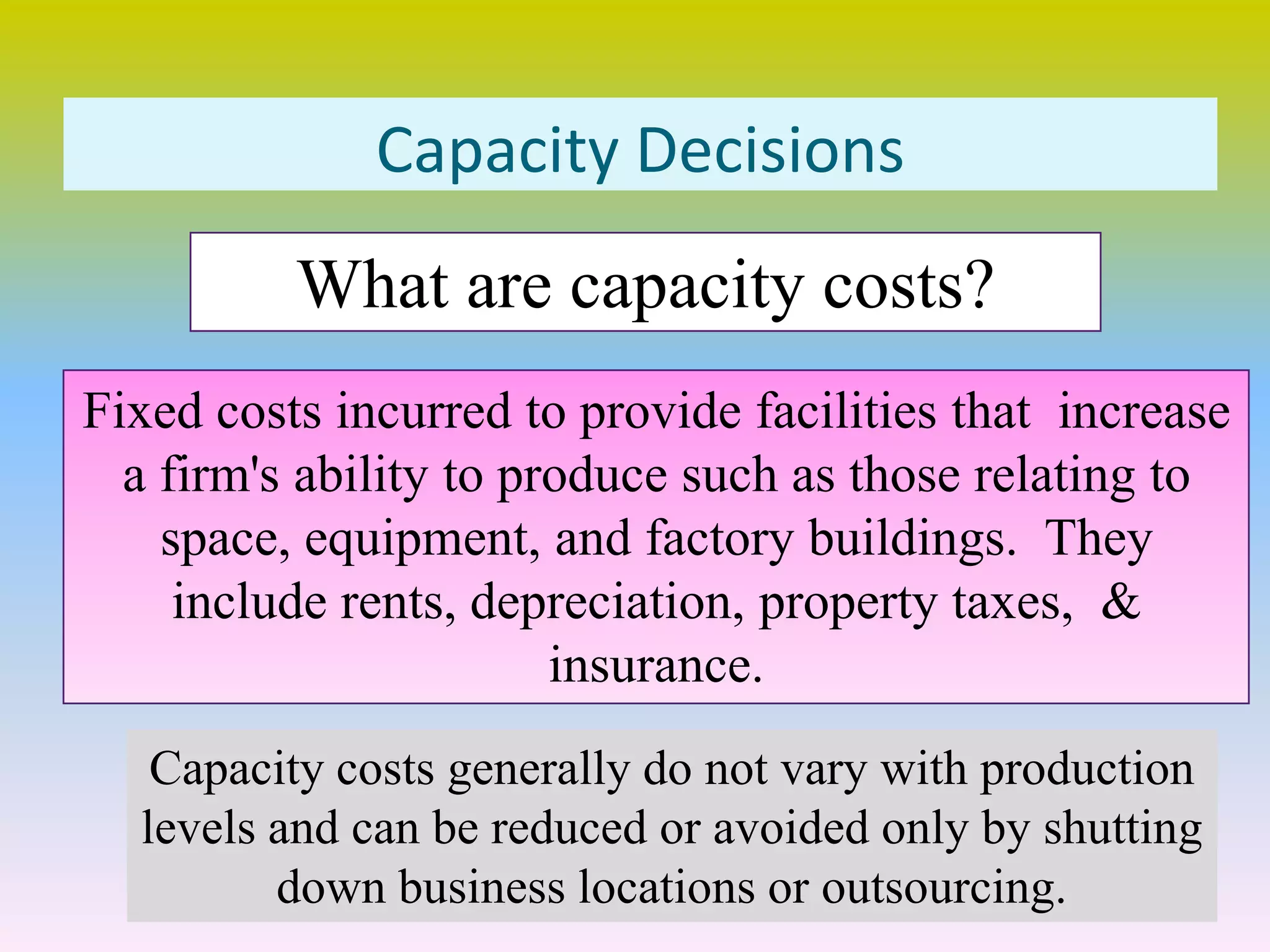
Fixed costs incurred to provide facilities that increase
a firm's ability to produce such as those relating to
space, equipment, and factory buildings. They
include rents, depreciation, property taxes, &
insurance.
What are capacity costs?
Capacity costs generally do not vary with production
levels and can be reduced or avoided only by shutting
down business locations or outsourcing.
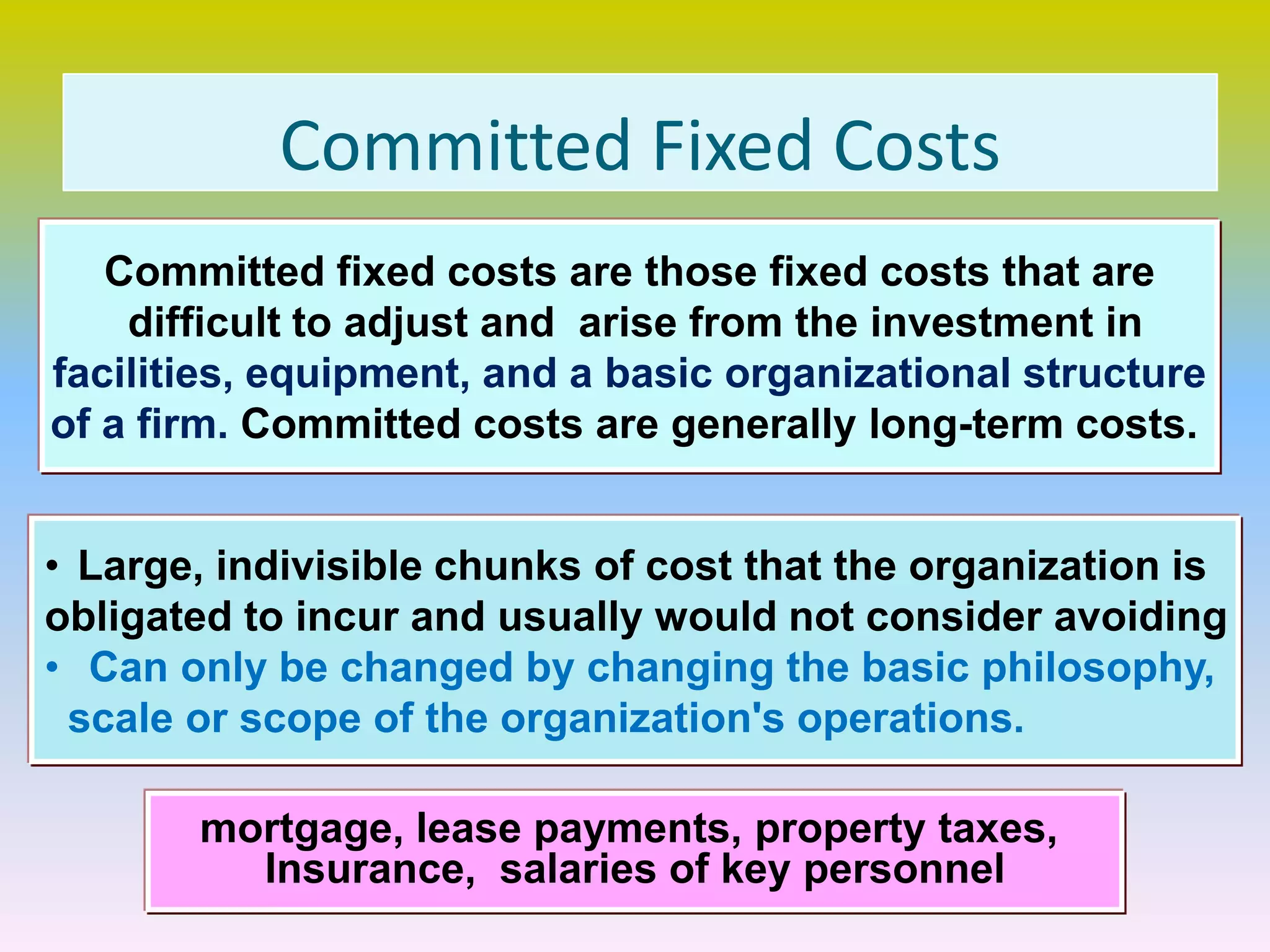
Committed Fixed Costs
Committed fixed costs are those fixed costs that are
difficult to adjust and arise from the investment in
facilities, equipment, and a basic organizational structure
of a firm. Committed costs are generally long-term costs.
• Large, indivisible chunks of cost that the organization is
obligated to incur and usually would not consider avoiding
• Can only be changed by changing the basic philosophy,
scale or scope of the organization's operations.
mortgage, lease payments, property taxes,
Insurance, salaries of key personnel
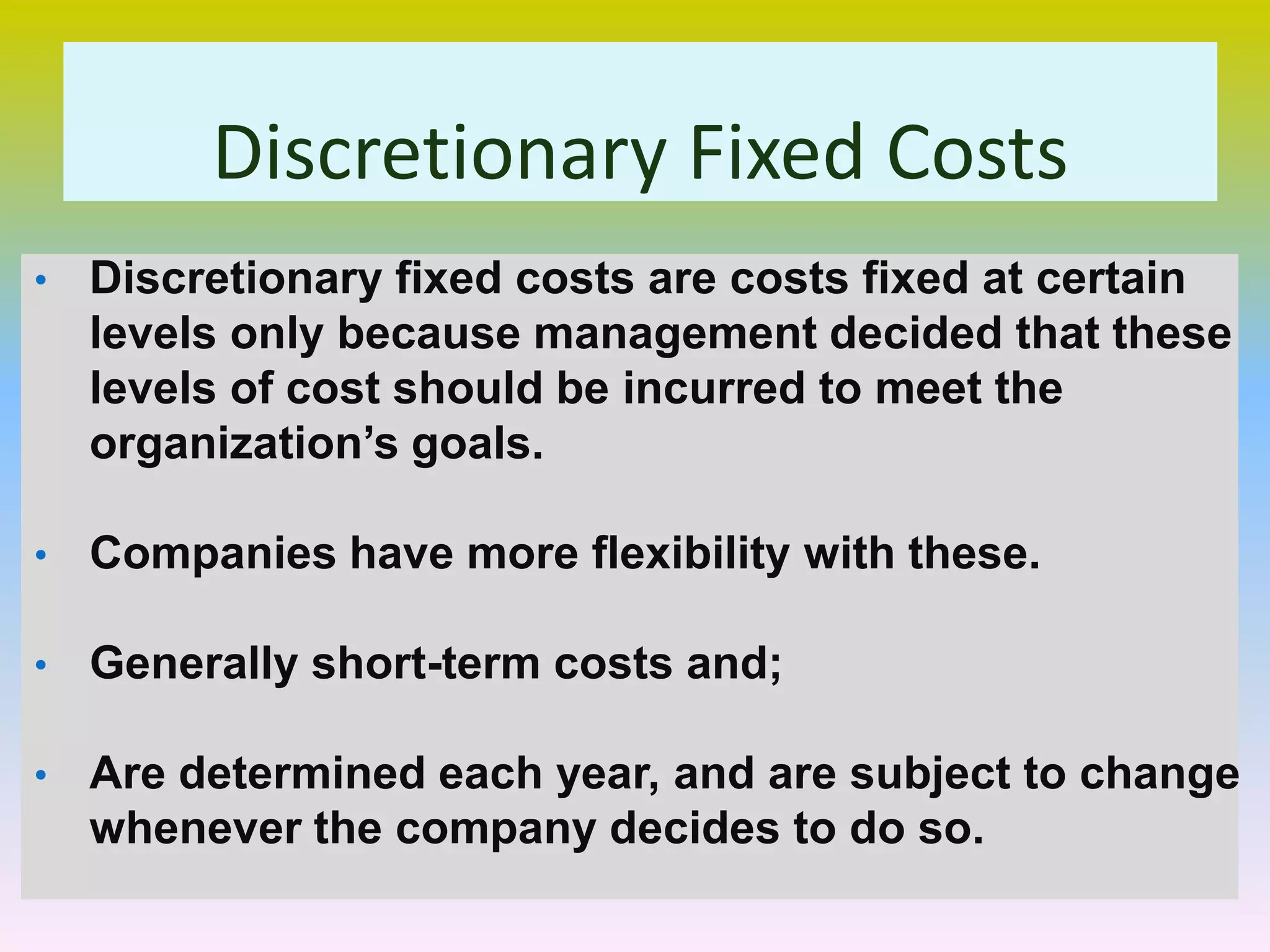
Discretionary Fixed Costs
• Discretionary fixed costs are costs fixed at certain
levels only because management decided that these
levels of cost should be incurred to meet the
organization’s goals.
• Companies have more flexibility with these.
• Generally short-term costs and;
• Are determined each year, and are subject to change
whenever the company decides to do so.
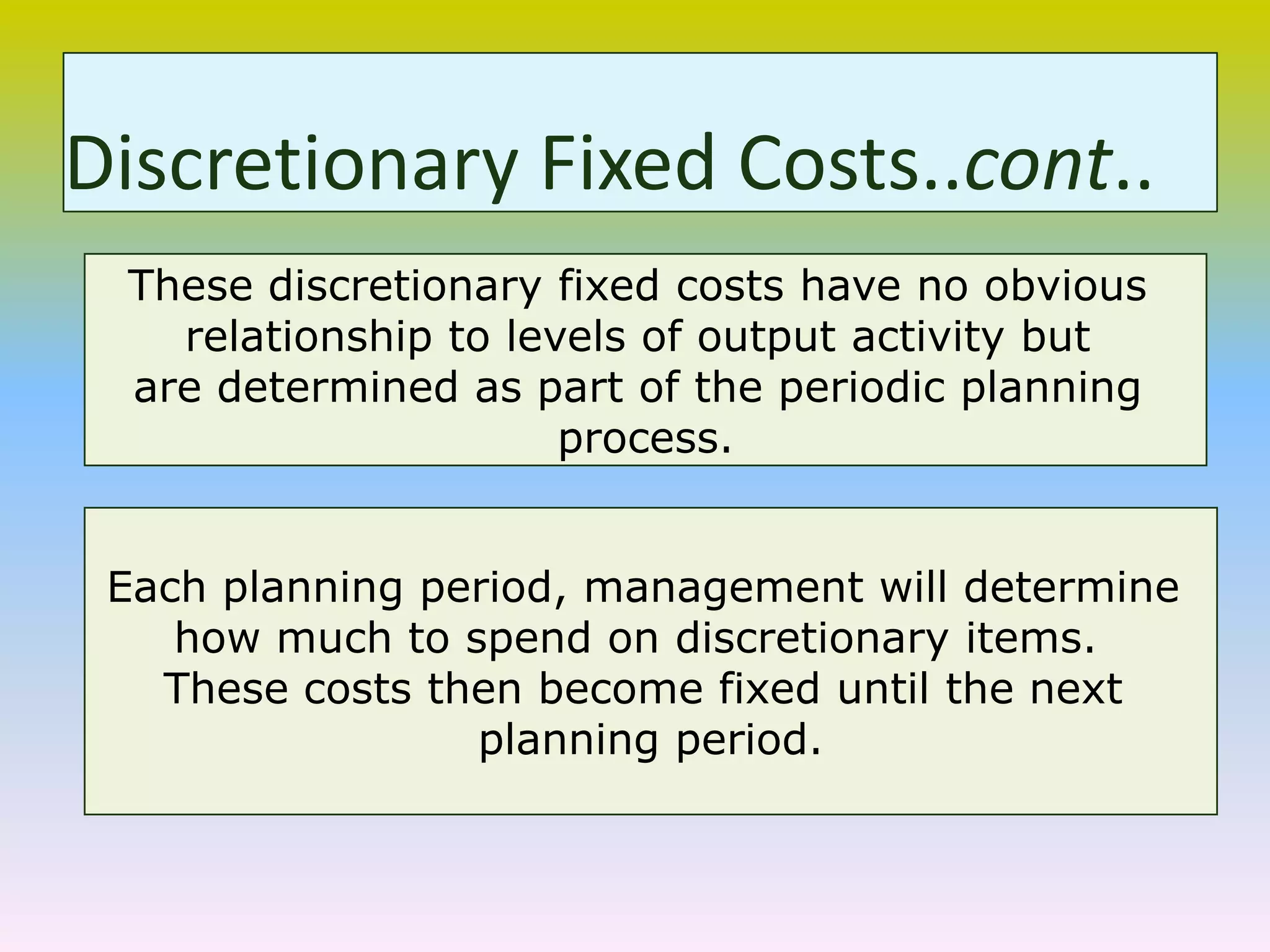
These discretionary fixed costs have no obvious
relationship to levels of output activity but
are determined as part of the periodic planning
process.
Each planning period, management will determine
how much to spend on discretionary items.
These costs then become fixed until the next
planning period.
Discretionary Fixed Costs..cont..
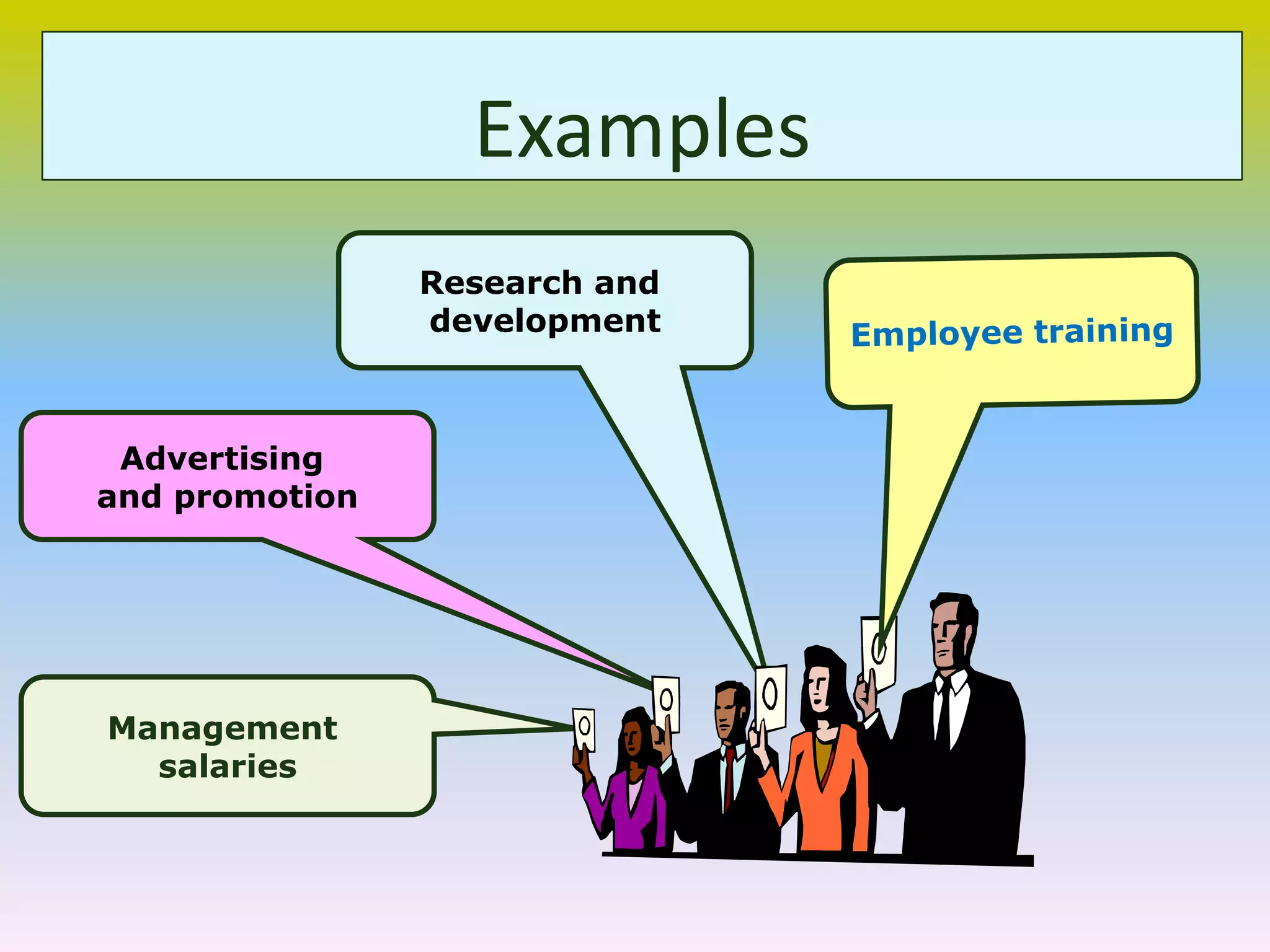
Examples
Advertising
and promotion
Research and
development
Management
salaries
Technology Decisions
Choice of technology (e-commerce versus
in-store or mail-order sales) positions the
organization to meet its current goals and
to respond to changes in the environment.
Cost-Control Incentives
Managers use their
knowledge of cost
behavior to set
cost expectations.
Employees may
receive rewards that
are tied to meeting
these expectations.
Cost Functions
Planning and controlling the activities
of an organization require accurate
and useful estimates of future
fixed and variable costs.
Cost Functions
Understanding relationships between costs
And their cost drivers allows managers to:
Make better operating, marketing,
and production decisions
Plan and evaluate actions
Determine appropriate costs for
short-run and long-run decisions.
Cost Functions
The first step in estimating or predicting
costs is measuring cost behavior as a
function of appropriate cost drivers.
The second step is to use these cost
measures to estimate future costs at
expected levels of cost-driver activity.
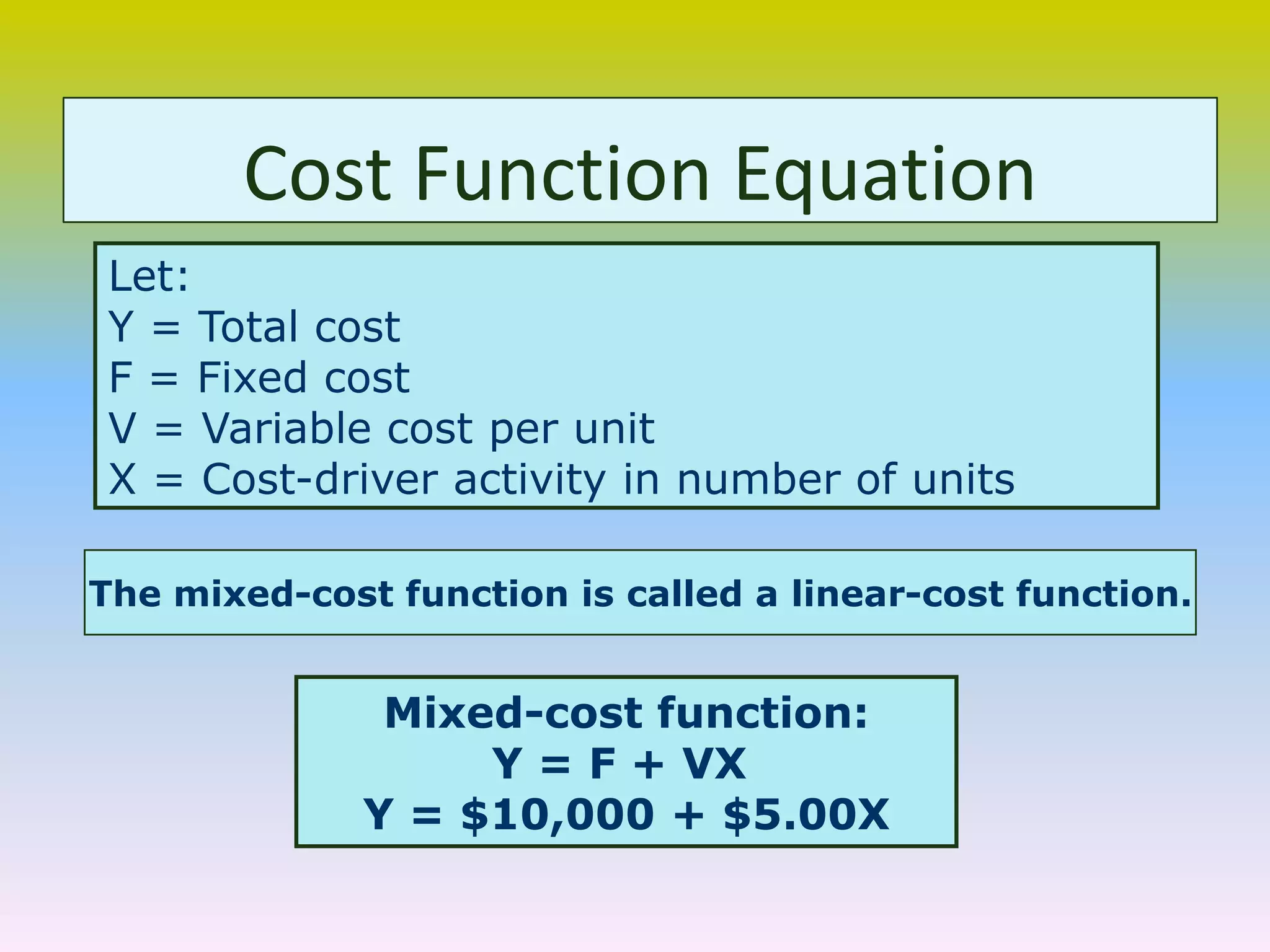
Cost Function Equation
Let:
Y = Total cost
F = Fixed cost
V = Variable cost per unit
X = Cost-driver activity in number of units
Mixed-cost function:
Y = F + VX
Y = $10,000 + $5.00X
The mixed-cost function is called a linear-cost function.
Developing Cost Functions
A cost function’s estimates of costs
at actual levels of activity must reliably
conform with actually observed costs.
The cost function must be believable.
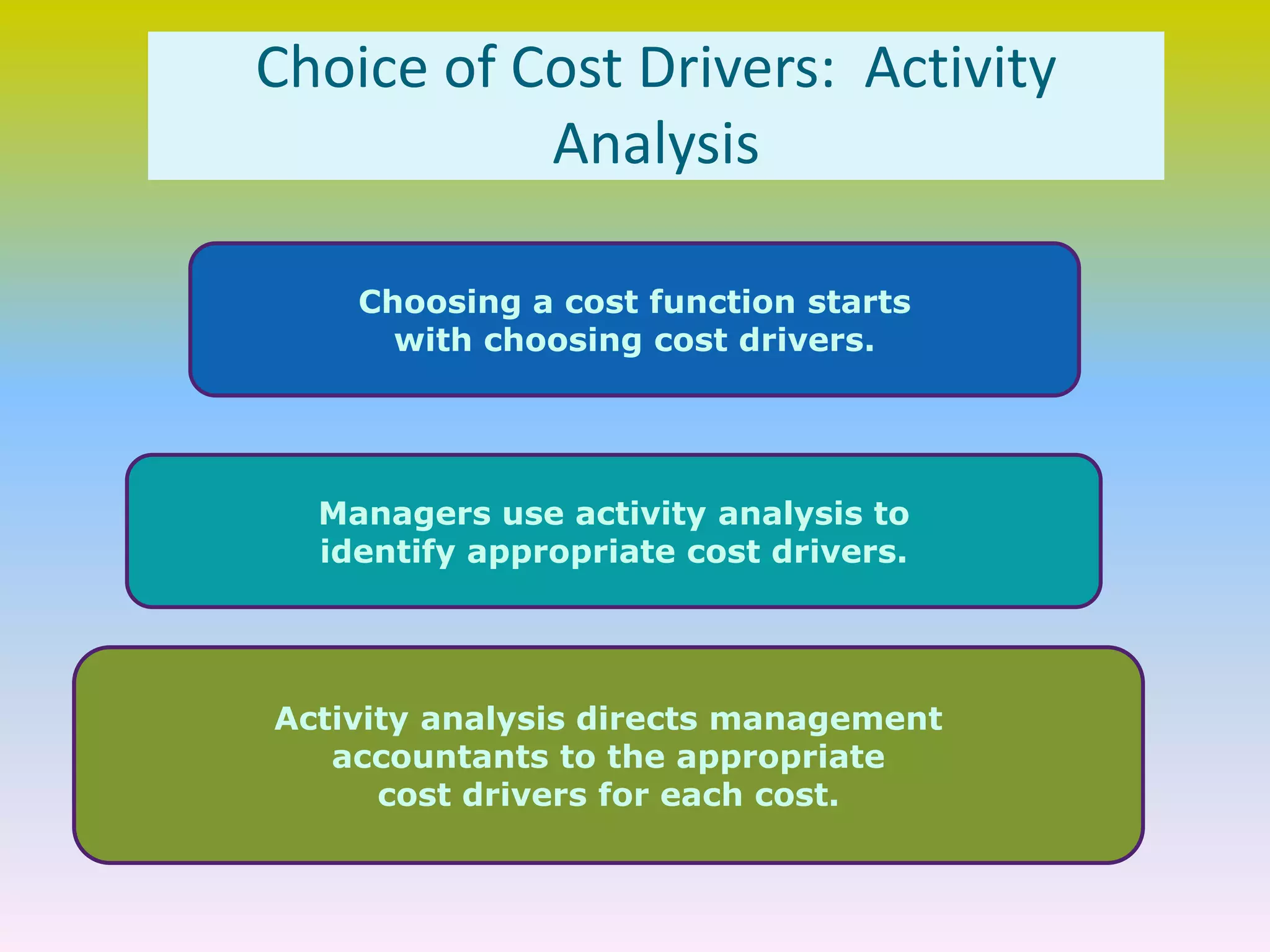
Choice of Cost Drivers: Activity
Analysis
Choosing a cost function starts
with choosing cost drivers.
Managers use activity analysis to
identify appropriate cost drivers.
Activity analysis directs management
accountants to the appropriate
cost drivers for each cost.
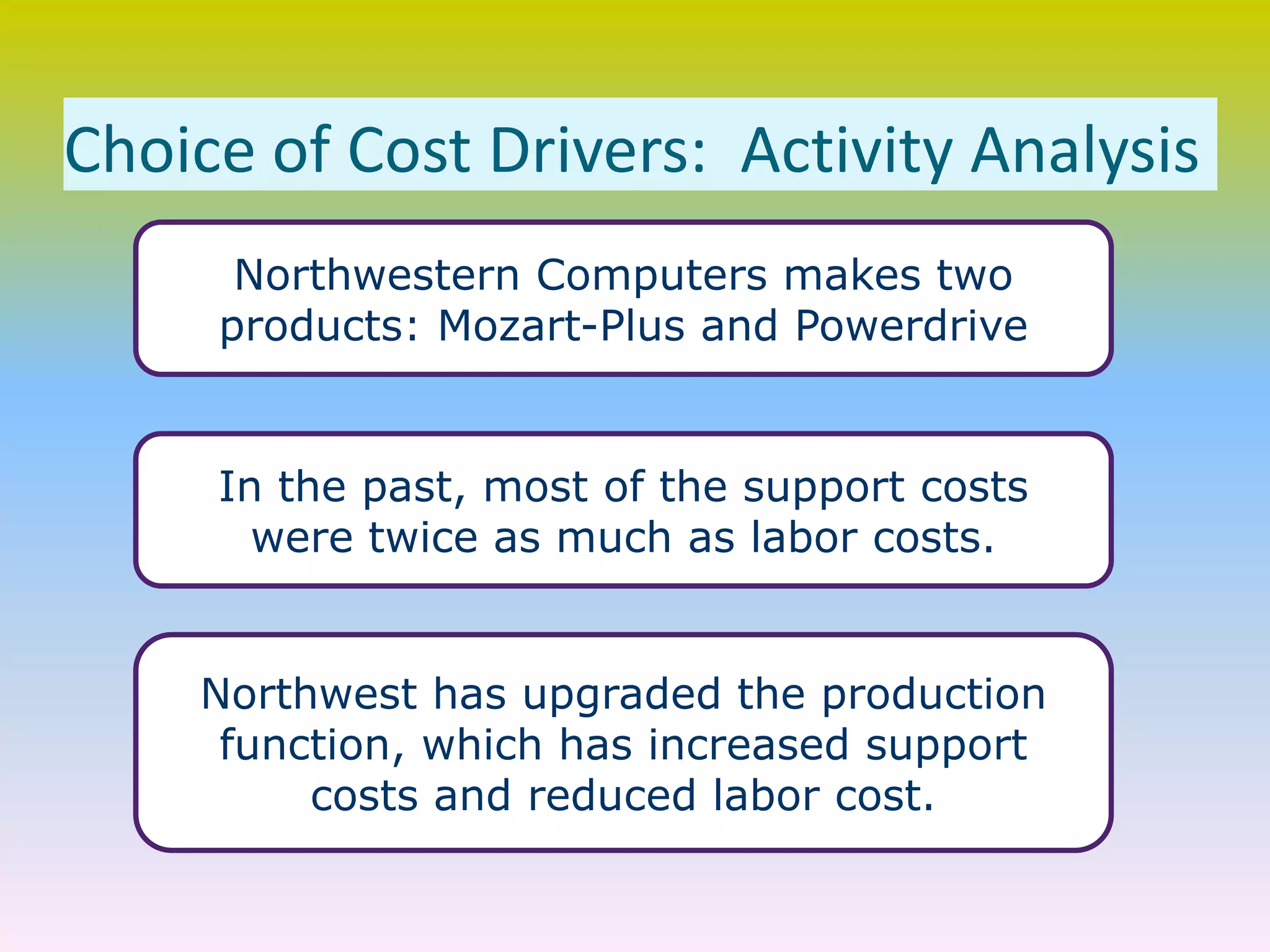
Choice of Cost Drivers: Activity Analysis
Northwestern Computers makes two
products: Mozart-Plus and Powerdrive
In the past, most of the support costs
were twice as much as labor costs.
Northwest has upgraded the production
function, which has increased support
costs and reduced labor cost.
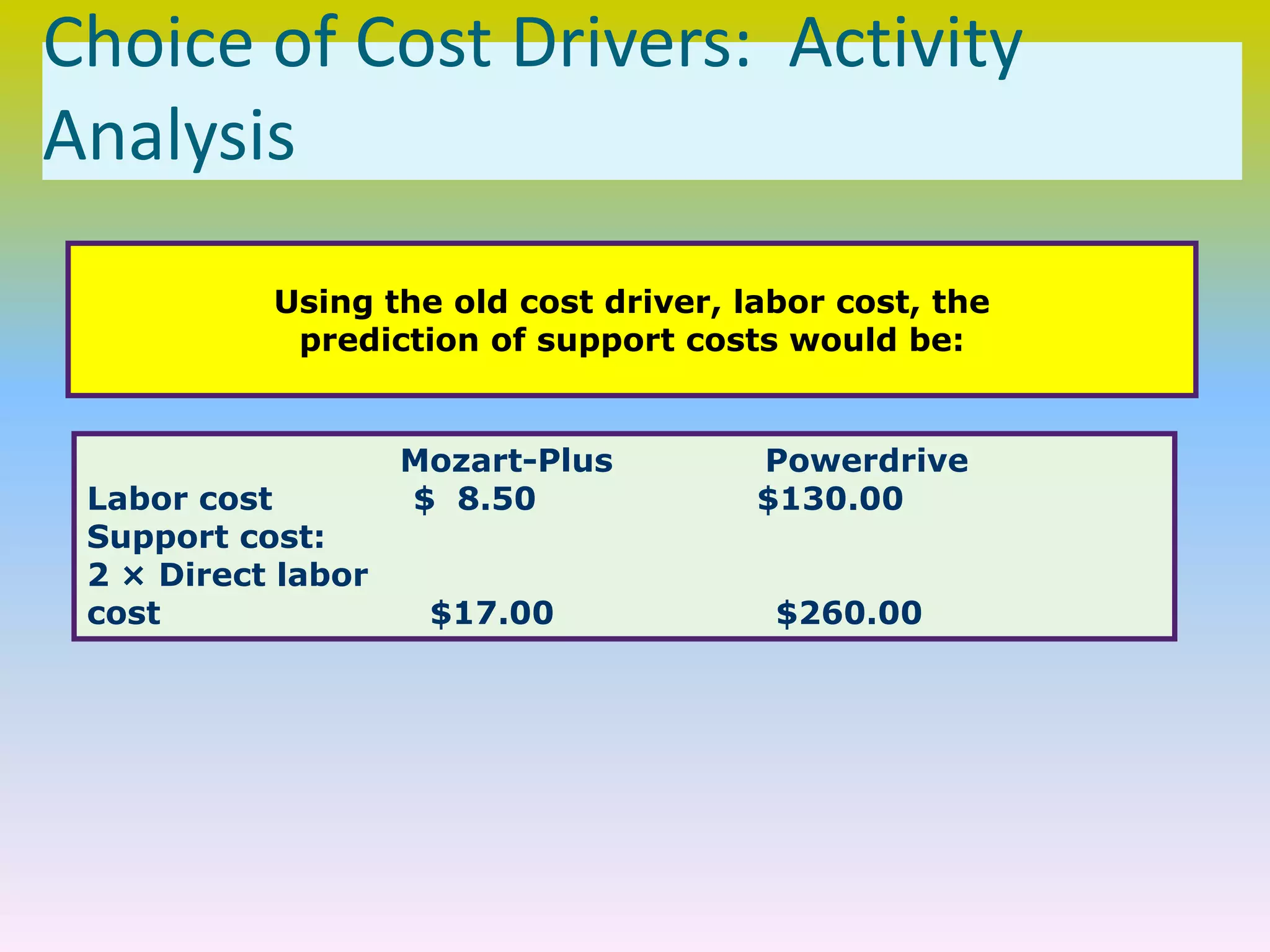
Choice of Cost Drivers: Activity
Analysis
Using the old cost driver, labor cost, the
prediction of support costs would be:
Mozart-Plus Powerdrive
Labor cost $ 8.50 $130.00
Support cost:
2 × Direct labor
cost $17.00 $260.00
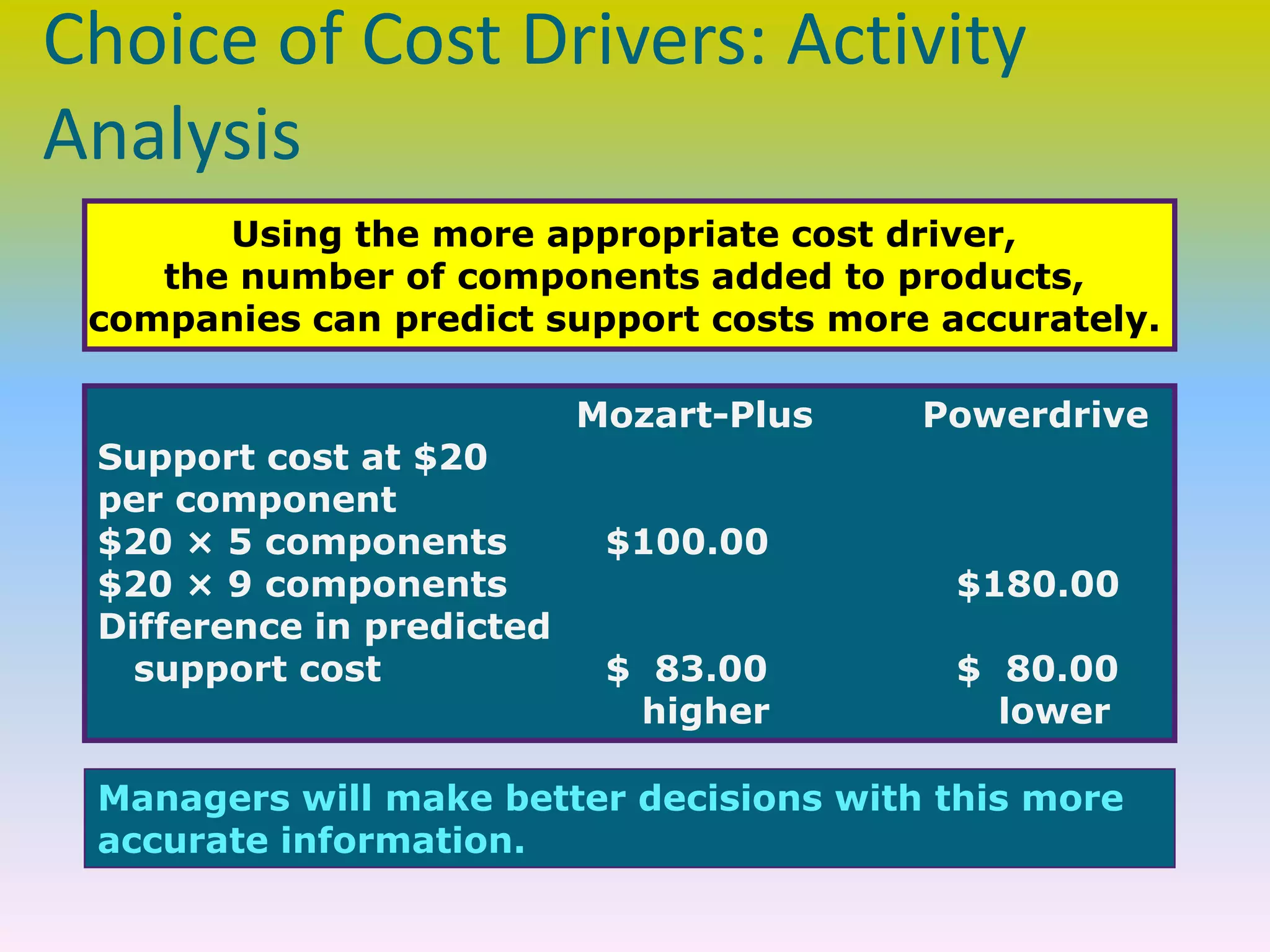
Choice of Cost Drivers: Activity
Analysis
Using the more appropriate cost driver,
the number of components added to products,
companies can predict support costs more accurately.
Mozart-Plus Powerdrive
Support cost at $20
per component
$20 × 5 components $100.00
$20 × 9 components $180.00
Difference in predicted
support cost $ 83.00 $ 80.00
higher lower
Managers will make better decisions with this more
accurate information.
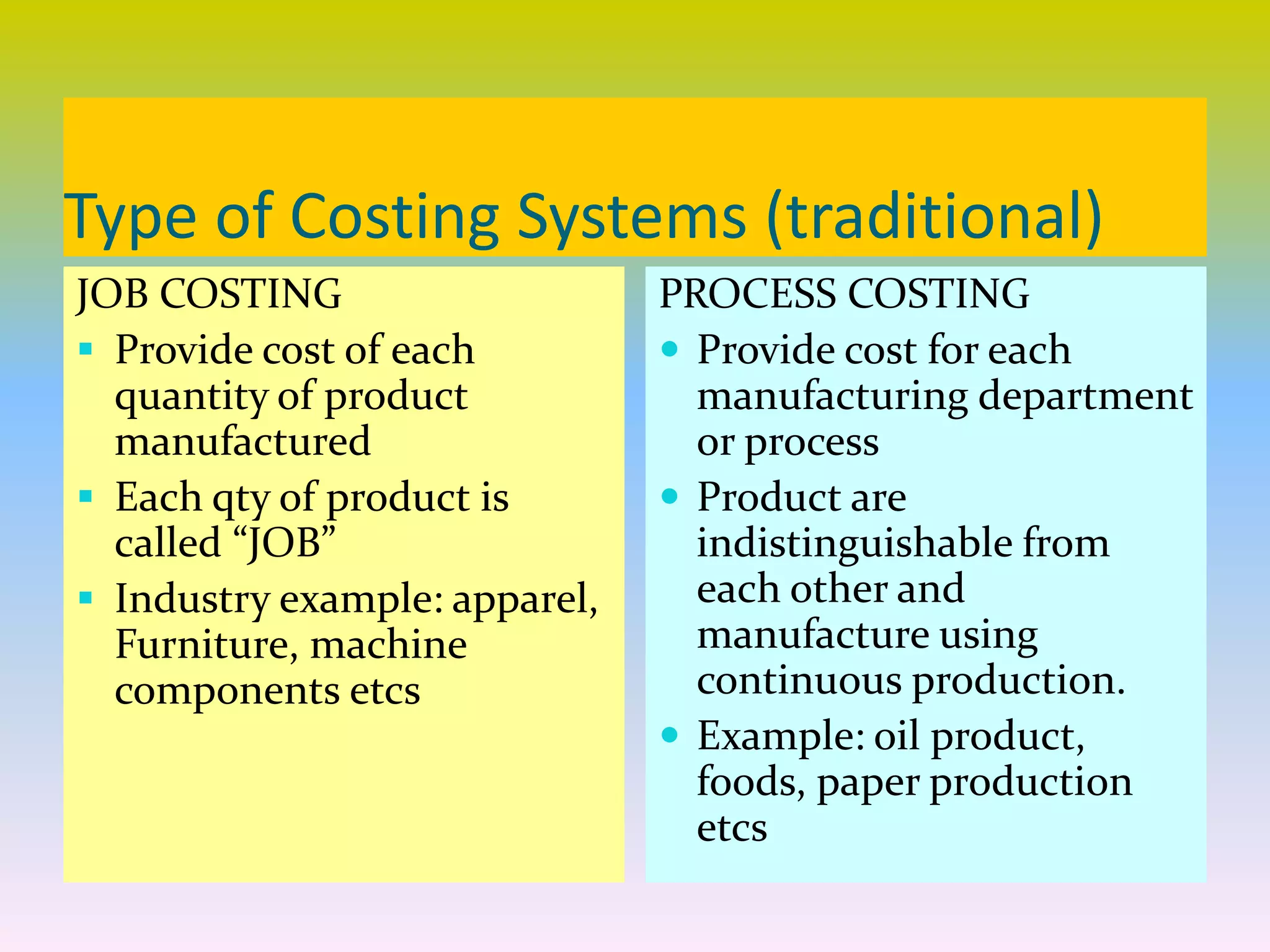
Type of Costing Systems (traditional)
JOB COSTING
 Provide cost of each
quantity of product
manufactured
 Each qty of product is
called “JOB”
 Industry example: apparel,
Furniture, machine
components etcs
PROCESS COSTING
 Provide cost for each
manufacturing department
or process
 Product are
indistinguishable from
each other and
manufacture using
continuous production.
 Example: oil product,
foods, paper production
etcs
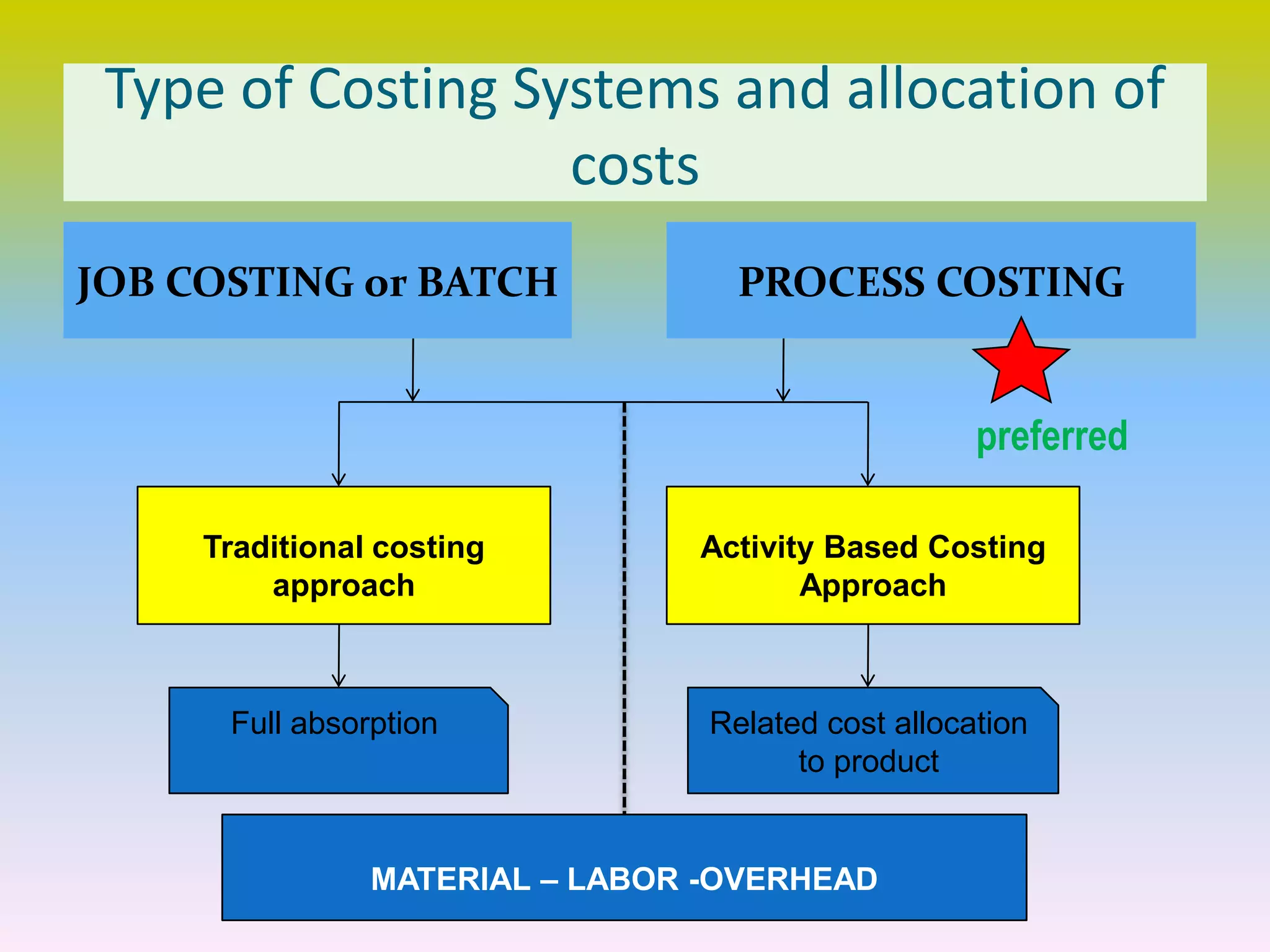
Type of Costing Systems and allocation of
costs
JOB COSTING or BATCH PROCESS COSTING
Traditional costing
approach
Activity Based Costing
Approach
preferred
Full absorption Related cost allocation
to product
MATERIAL – LABOR -OVERHEAD
Topic 2

PENGEKOSAN PRODUCTION OPERATION topic2 types of cost

  • 1.
    Lecturer: Dr. Kamilah Ahmad 25February 2014 Topic 2: Type of Costs in Production
  • 2.
    Chapter Learning Outcomes Acknowledge the basic types of production cost in production environment  Differentiate costs behavior
  • 3.
    Introduction  All typesof organizations incur costs.  The kind of costs incurred and the way in which these costs are classified depend on the type of organization.  Will focus the cost characteristics of manufacturing firms since their basic activities include most activities found in other types of organizations.
  • 4.
    General cost classification Manufacturingcosts Non-Manufacturing costs Direct materials Selling costs Direct labor Administrative costs Manufacturing overhead Manufacturing operations purchase raw materials and converts these materials into finished goods through the process of production.
  • 5.
    1. Direct RawMaterial Basic materials that are used to process new products. Indirect materials are usually used in small amounts and do not physically become part of the finished product. 2. Direct Labor The cost of employees that can be directly traceable to a manufactured product 3. Manufacturing overhead include all manufacturing costs other than the costs of direct materials and direct labor.
  • 6.
    Production Cost Flow DirectMaterial Overhead Direct Labor Manufacturing Process Material Inventory Finished Good Inventory WIP Inventory Cost of Good Sold Sold Finished unfinished Unused Balance Sheet Income Statement AKR @2013
  • 7.
    Product cost vs.Period cost Product Cost (Manufacturi ng costs) Direct Materials Eg: flour, sugar, oils Prime Cost Direct Labor Wages Factory Overhead Factory utilities, depreciation of machines, machines maintenance Conversion cost Period Cost (non- manufacturin g costs) Selling expenses Advertising, fees, sales commissions Administrative expenses Salaries, rent, office utilities
  • 8.
  • 9.
  • 10.
    Cost behavior To predicthow a certain cost will behave in response to a change of productivity
  • 11.
    Variable , Fixedand Mixed Costs A VC is a cost that varies in direct proportion to changes in the level of activity(units produced, hours Worked, miles driven) A FC is a cost that remains constant regardless of changes in the level of activity within relevant range (range of activity) Is expressed on a per-unit basis. The per-unit variable cost remains unchanged regardless of changes in the cost-driver. Think of fixed costs on a total-cost basis. Total fixed costs remain constant regardless of changes in the cost-driver. Mixed costs contain elements of both fixed- and variable-cost behavior.
  • 12.
    Mixed-Cost Behavior Patterns Mixedcosts contain elements of both fixed and variable costs. The fixed-cost element is unchanged over a range of cost-driver activity levels. The variable-cost element of the mixed cost varies proportionately with cost-driver activity within the relevant range.
  • 13.
    Cost Drivers Cost driversare measures of activities that require the use of resources and thereby cause costs.
  • 14.
    Measurement of CostBehavior Cost Driver • an activity which influences a cost. Relevant Range • range over which we can assume that the cost behavior is linear Variable Costs • vary in proportion to changes in their cost driver Fixed Costs • are not affected by changes in the cost driver $ Volume $ Volume $ Volume
  • 15.
    Linear-Cost Behavior Costs areassumed to be fixed or variable within the relevant range of activity
  • 16.
    Variations in CostBehaviour Step Costs • change abruptly at intervals of activity because the resources and their costs come in indivisible chunks. e.g supervisory salaries Mixed Costs • contain both variable and fixed cost elements • e.g. maintenance costs Volume $ Volume $
  • 17.
    Step-Cost Behavior Patterns Expensesthat are constant for a given level of activity, but increase or decrease once a threshold is crossed. these types of expenses will be represented by a stairstep pattern. For example, a coffee shop might be able to serve 30 customers an hour with one employee. If the shop receives anywhere from zero to 30 customers per hour, it will only need to pay the cost of having one employee. If the shop begins receiving 31 or more customers per hour, it must hire a second employee, increasing its costs of doing business.
  • 18.
    Step-Cost Behavior Patterns Fixedcost that increases to a new level in step with the significant changes in activity or usage.
  • 19.
  • 20.
    1. Product orservice attributes 2. Capacity decisions 3. Technology 4. Policies to create incentives to control costs Management’s Influence on Cost Behavior 3 types of cost that relate to management’s influence on cost behavior • Capacity costs • Committed costs • Discretionary Fixed Costs
  • 21.
    Capacity Decisions Fixed costsincurred to provide facilities that increase a firm's ability to produce such as those relating to space, equipment, and factory buildings. They include rents, depreciation, property taxes, & insurance. What are capacity costs? Capacity costs generally do not vary with production levels and can be reduced or avoided only by shutting down business locations or outsourcing.
  • 22.
    Committed Fixed Costs Committedfixed costs are those fixed costs that are difficult to adjust and arise from the investment in facilities, equipment, and a basic organizational structure of a firm. Committed costs are generally long-term costs. • Large, indivisible chunks of cost that the organization is obligated to incur and usually would not consider avoiding • Can only be changed by changing the basic philosophy, scale or scope of the organization's operations. mortgage, lease payments, property taxes, Insurance, salaries of key personnel
  • 23.
    Discretionary Fixed Costs •Discretionary fixed costs are costs fixed at certain levels only because management decided that these levels of cost should be incurred to meet the organization’s goals. • Companies have more flexibility with these. • Generally short-term costs and; • Are determined each year, and are subject to change whenever the company decides to do so.
  • 24.
    These discretionary fixedcosts have no obvious relationship to levels of output activity but are determined as part of the periodic planning process. Each planning period, management will determine how much to spend on discretionary items. These costs then become fixed until the next planning period. Discretionary Fixed Costs..cont..
  • 25.
  • 26.
    Technology Decisions Choice oftechnology (e-commerce versus in-store or mail-order sales) positions the organization to meet its current goals and to respond to changes in the environment.
  • 27.
    Cost-Control Incentives Managers usetheir knowledge of cost behavior to set cost expectations. Employees may receive rewards that are tied to meeting these expectations.
  • 28.
    Cost Functions Planning andcontrolling the activities of an organization require accurate and useful estimates of future fixed and variable costs.
  • 29.
    Cost Functions Understanding relationshipsbetween costs And their cost drivers allows managers to: Make better operating, marketing, and production decisions Plan and evaluate actions Determine appropriate costs for short-run and long-run decisions.
  • 30.
    Cost Functions The firststep in estimating or predicting costs is measuring cost behavior as a function of appropriate cost drivers. The second step is to use these cost measures to estimate future costs at expected levels of cost-driver activity.
  • 31.
    Cost Function Equation Let: Y= Total cost F = Fixed cost V = Variable cost per unit X = Cost-driver activity in number of units Mixed-cost function: Y = F + VX Y = $10,000 + $5.00X The mixed-cost function is called a linear-cost function.
  • 32.
    Developing Cost Functions Acost function’s estimates of costs at actual levels of activity must reliably conform with actually observed costs. The cost function must be believable.
  • 33.
    Choice of CostDrivers: Activity Analysis Choosing a cost function starts with choosing cost drivers. Managers use activity analysis to identify appropriate cost drivers. Activity analysis directs management accountants to the appropriate cost drivers for each cost.
  • 34.
    Choice of CostDrivers: Activity Analysis Northwestern Computers makes two products: Mozart-Plus and Powerdrive In the past, most of the support costs were twice as much as labor costs. Northwest has upgraded the production function, which has increased support costs and reduced labor cost.
  • 35.
    Choice of CostDrivers: Activity Analysis Using the old cost driver, labor cost, the prediction of support costs would be: Mozart-Plus Powerdrive Labor cost $ 8.50 $130.00 Support cost: 2 × Direct labor cost $17.00 $260.00
  • 36.
    Choice of CostDrivers: Activity Analysis Using the more appropriate cost driver, the number of components added to products, companies can predict support costs more accurately. Mozart-Plus Powerdrive Support cost at $20 per component $20 × 5 components $100.00 $20 × 9 components $180.00 Difference in predicted support cost $ 83.00 $ 80.00 higher lower Managers will make better decisions with this more accurate information.
  • 37.
    Type of CostingSystems (traditional) JOB COSTING  Provide cost of each quantity of product manufactured  Each qty of product is called “JOB”  Industry example: apparel, Furniture, machine components etcs PROCESS COSTING  Provide cost for each manufacturing department or process  Product are indistinguishable from each other and manufacture using continuous production.  Example: oil product, foods, paper production etcs
  • 38.
    Type of CostingSystems and allocation of costs JOB COSTING or BATCH PROCESS COSTING Traditional costing approach Activity Based Costing Approach preferred Full absorption Related cost allocation to product MATERIAL – LABOR -OVERHEAD
  • 39.

Editor's Notes

  • #7 Production Cost Flow is to show the value change of inputs into conversion processes and it final journey as final products / services. It shows the various type of cost associate to the different phase of conversion (operation). Most of the costs is directly associated to products /services whilst some portion of costs to be treated as period costs