What is Low Cost?
 Deals with effective budgeting
 Following of techniques which help in reducing the cost
construction
 Use of locally available materials which suits and
blends with the local environment along with improved
skills and technology without sacrificing the strength,
performance and life of the structure
 Low-cost housing by no means implies the usage of
inferior quality or materials
 The building construction cost can be divided into :
Building material cost : 65 to 70 %
Labor cost : 30 to 35 %
THE NEED FOR AFFORDABLE
HOUSING
 Reduction in the supply of affordable housing
nationally since 1980
 Fast population growth leading to demands for
additional housing
 The dwindling supply and high cost of
developable land
 Rising costs of materials and labor
 Incomes in most areas have not increased
sufficiently to overcome the effects of inflation
and escalating home prices
1) Reducing plinth area by using thinner wall concept
2) Using locally available material in an innovative form
3) Use energy efficiency materials like concrete block in place of
burnt brick
4) Using environmentally friendly materials which are substitute
for conventional building components like use R.C.C. door
and window frames in place of wooden frames
5) Preplan every component of a house and rationalize the
design procedure for reducing the size of the component in
the building
6) Unnecessary components should not be used
How to reduce the cost
Cost Reduction : Adhoc Methods
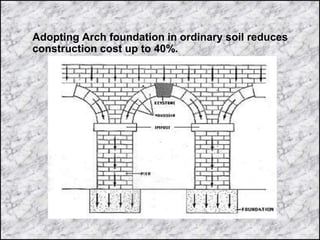
Adopting Arch foundation in ordinary soil reduces
construction cost up to 40%.
Using pile foundation in black and other soft soils is
up to 25% economical.
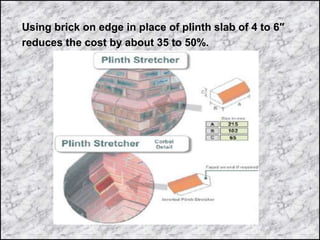
Using brick on edge in place of plinth slab of 4 to 6″
reduces the cost by about 35 to 50%.
Using concrete block masonry reduces wall
thickness to15 Cms saving mortar, avoiding
plaster, speedy construction saving of 10 to 25%.
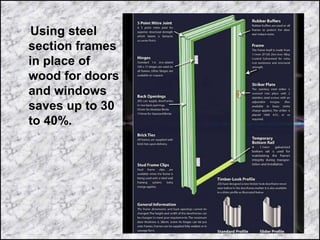
Using steel
section frames
in place of
wood for doors
and windows
saves up to 30
to 40%.
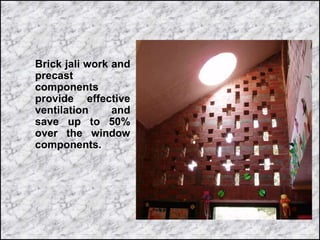
Brick jali work and
precast
components
provide effective
ventilation and
save up to 50%
over the window
components.
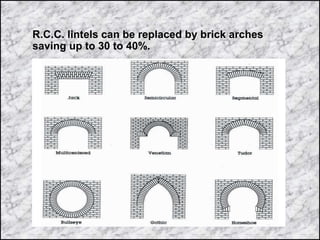
R.C.C. lintels can be replaced by brick arches
saving up to 30 to 40%.
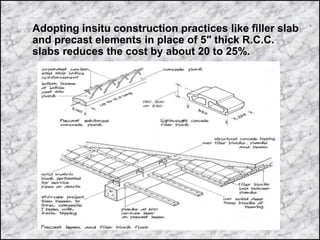
Adopting insitu construction practices like filler slab
and precast elements in place of 5″ thick R.C.C.
slabs reduces the cost by about 20 to 25%.
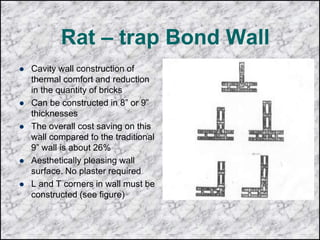
Rat – trap Bond Wall
 Cavity wall construction of
thermal comfort and reduction
in the quantity of bricks
 Can be constructed in 8” or 9”
thicknesses
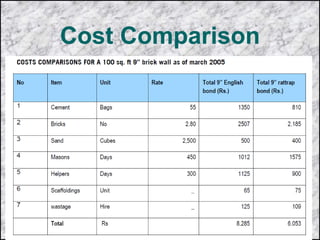
 The overall cost saving on this
wall compared to the traditional
9” wall is about 26%
 Aesthetically pleasing wall
surface. No plaster required
 L and T corners in wall must be
constructed (see figure)
The Technology
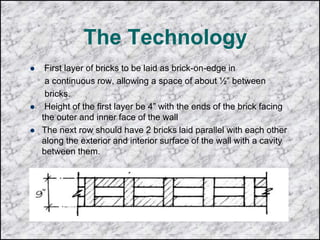
 First layer of bricks to be laid as brick-on-edge in
a continuous row, allowing a space of about ½” between
bricks.
 Height of the first layer be 4” with the ends of the brick facing
the outer and inner face of the wall
 The next row should have 2 bricks laid parallel with each other
along the exterior and interior surface of the wall with a cavity
between them.
The Technology
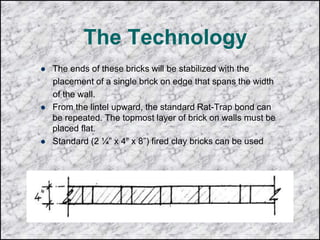
 The ends of these bricks will be stabilized with the
placement of a single brick on edge that spans the width
of the wall.
 From the lintel upward, the standard Rat-Trap bond can
be repeated. The topmost layer of brick on walls must be
placed flat.
 Standard (2 ¼” x 4” x 8”) fired clay bricks can be used
Cost Comparison
COMPRESSED EARTH BLOCKS
 Applications of Compressed Earth Block:
Foundation, load bearing walls, arches, vaults and domes, etc.
Hot or cold climate
Dry or humid areas
 A Local Material for Reducing Imports:
CEB production is ideally made on the construction site itself
 Limiting Deforestation, no Need of Firing:
CEB are often stabilized with cement or lime. curing necessary
 Cost Saving:
CEB are most of the time cheaper than conventional materials
 More Eco-Friendly than Fired Bricks:
5-15 times energy savings
8 times less polluting
PRODUCTION
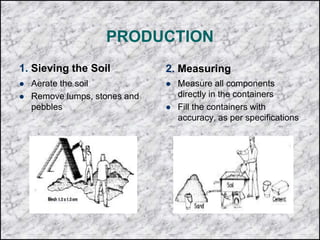
1. Sieving the Soil
 Aerate the soil
 Remove lumps, stones and
pebbles
2. Measuring
 Measure all components
directly in the containers
 Fill the containers with
accuracy, as per specifications
PRODUCTION
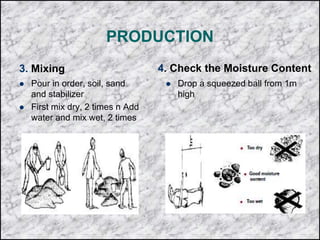
3. Mixing
 Pour in order, soil, sand
and stabilizer
 First mix dry, 2 times n Add
water and mix wet, 2 times
4. Check the Moisture Content
 Drop a squeezed ball from 1m
high
PRODUCTION
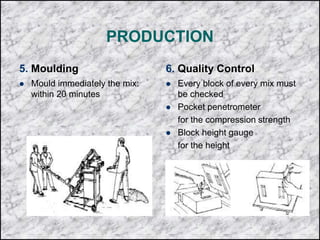
5. Moulding
 Mould immediately the mix:
within 20 minutes
6. Quality Control
 Every block of every mix must
be checked
 Pocket penetrometer
for the compression strength
 Block height gauge
for the height
PRODUCTION
7. Humid Curing and
Stacking
 The pile must remain covered
2 days with a plastic sheet
 Stacking the fresh block
 Cover immediately every row
with a plastic sheet
8. Final Curing and
Stacking
 Water the pile daily (on top and
on the 4 sides),
as many times as needed, for
1 month
 Never let the pile dry for a full
month
FERROCEMENT CHANNELS
 Thin wall of reinforced cement, where layers of
continuous mesh are covered on both sides with mortar
 Durable, Versatile, Light and Waterproof
 Precast Longitudinal element of a curved
section (often semi-cylindrical). It is using moulds
 Uses less cement and steel having same strength RCC
 Used for floors or roofs, but are bad thermal insulators
 A major cost reduction is achieved compared to RCC
 Simple and cheap manufacturing set up needed but areas
for prefabricating and curing are large
 Easy to acquire the skill and easy to manufacture
 Lifted into place and can immediately be joined together in order
to provide a shelter
MANUFACTURING THE MOULD
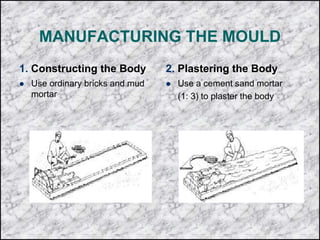
1. Constructing the Body
 Use ordinary bricks and mud
mortar
2. Plastering the Body
 Use a cement sand mortar
(1: 3) to plaster the body
MANUFACTURING THE MOULD
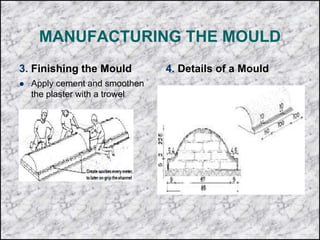
3. Finishing the Mould
 Apply cement and smoothen
the plaster with a trowel
4. Details of a Mould
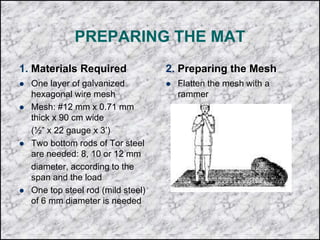
PREPARING THE MAT
1. Materials Required
 One layer of galvanized
hexagonal wire mesh
 Mesh: #12 mm x 0.71 mm
thick x 90 cm wide
(½” x 22 gauge x 3’)
 Two bottom rods of Tor steel
are needed: 8, 10 or 12 mm
diameter, according to the
span and the load
 One top steel rod (mild steel)
of 6 mm diameter is needed
2. Preparing the Mesh
 Flatten the mesh with a
rammer
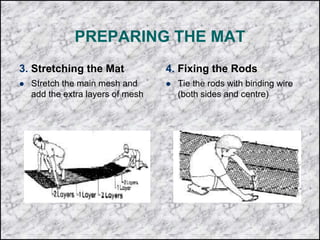
PREPARING THE MAT
3. Stretching the Mat
 Stretch the main mesh and
add the extra layers of mesh
4. Fixing the Rods
 Tie the rods with binding wire
(both sides and centre)
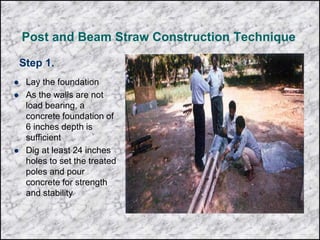
Post and Beam Straw Construction Technique
Step 1.
 Lay the foundation
 As the walls are not
load bearing, a
concrete foundation of
6 inches depth is
sufficient
 Dig at least 24 inches
holes to set the treated
poles and pour
concrete for strength
and stability
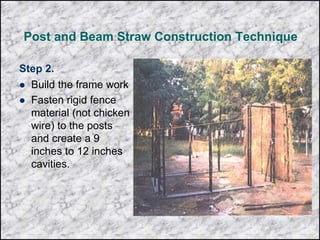
Post and Beam Straw Construction Technique
Step 2.
 Build the frame work
 Fasten rigid fence
material (not chicken
wire) to the posts
and create a 9
inches to 12 inches
cavities.
Post and Beam Straw Construction Technique
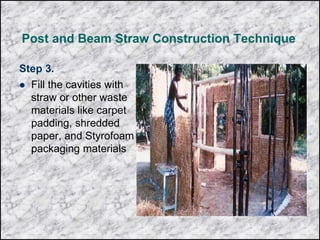
Step 3.
 Fill the cavities with
straw or other waste
materials like carpet
padding, shredded
paper, and Styrofoam
packaging materials
Post and Beam Straw Construction Technique
Step 4.
 Plaster the inside
and outside of the
walls with mud
dug from the
foundation
 Let it dry for a
couple of days
Pre-fabricated Wall Panels
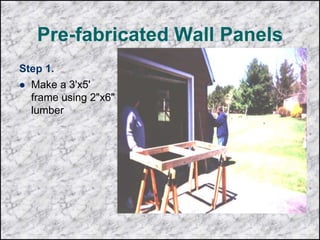
Step 1.
 Make a 3'x5'
frame using 2"x6"
lumber
Pre-fabricated Wall Panels
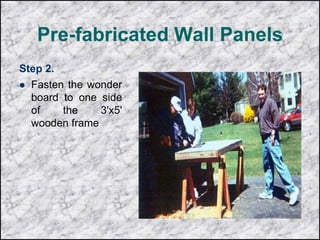
Step 2.
 Fasten the wonder
board to one side
of the 3'x5'
wooden frame
Pre-fabricated Wall Panels
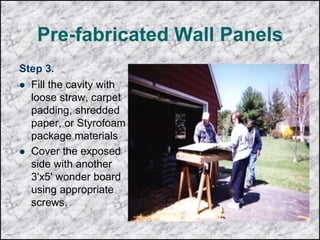
Step 3.
 Fill the cavity with
loose straw, carpet
padding, shredded
paper, or Styrofoam
package materials
 Cover the exposed
side with another
3'x5' wonder board
using appropriate
screws.
Pre-fabricated Wall Panels
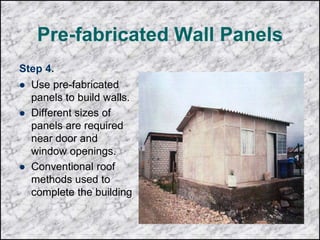
Step 4.
 Use pre-fabricated
panels to build walls.
 Different sizes of
panels are required
near door and
window openings.
 Conventional roof
methods used to
complete the building
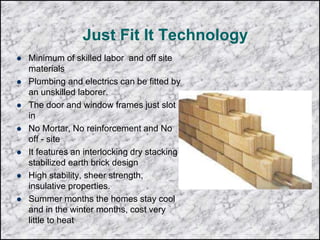
Just Fit It Technology
 Minimum of skilled labor and off site
materials
 Plumbing and electrics can be fitted by
an unskilled laborer.
 The door and window frames just slot
in
 No Mortar, No reinforcement and No
off - site
 It features an interlocking dry stacking
stabilized earth brick design
 High stability, sheer strength,
insulative properties.
 Summer months the homes stay cool
and in the winter months, cost very
little to heat
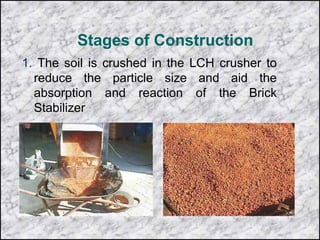
Stages of Construction
1. The soil is crushed in the LCH crusher to
reduce the particle size and aid the
absorption and reaction of the Brick
Stabilizer
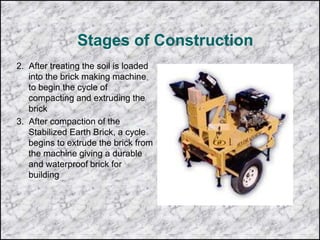
Stages of Construction
2. After treating the soil is loaded
into the brick making machine
to begin the cycle of
compacting and extruding the
brick
3. After compaction of the
Stabilized Earth Brick, a cycle
begins to extrude the brick from
the machine giving a durable
and waterproof brick for
building
Stages of Construction
4. Finished bricks stacked for curing
for a short period of time then building
commences
5. Foundations are made using the
same bricks building then
commences above floor level by
dry stacking the bricks one on top
of the other
Stages of Construction
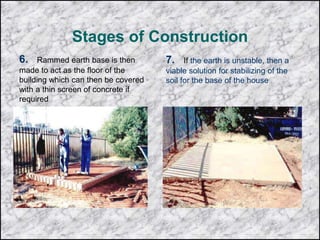
6. Rammed earth base is then
made to act as the floor of the
building which can then be covered
with a thin screen of concrete if
required
7. If the earth is unstable, then a
viable solution for stabilizing of the
soil for the base of the house
Stages of Construction
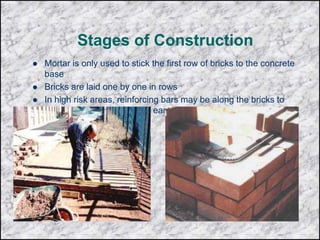
 Mortar is only used to stick the first row of bricks to the concrete
base
 Bricks are laid one by one in rows
 In high risk areas, reinforcing bars may be along the bricks to
increase stability in case of earthquakes, typhoons or hurricanes
Stages of Construction
 Interconnecting walls are made by a pair of reinforcing bars at
right angles
 At this point the electrical conduits and outlets may be installed
 The Just Fit It Technology allows the conduits to flow deep inside
the walls and provide flush fitted outlets inside the house
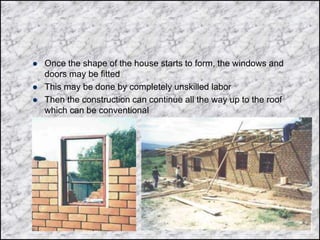
 Once the shape of the house starts to form, the windows and
doors may be fitted
 This may be done by completely unskilled labor
 Then the construction can continue all the way up to the roof
which can be conventional
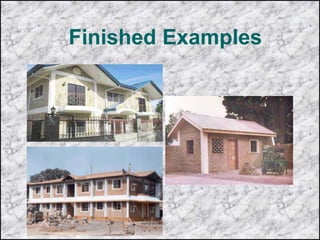
Finished Examples
ENVIRONMENT FRIENDLY LOW COST
DEMONSTRATION MODEL HOUSES BY
CWHR, KARACHI (1980-2006)
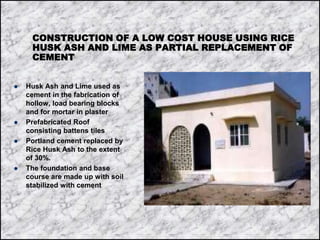
CONSTRUCTION OF A LOW COST HOUSE USING RICE
HUSK ASH AND LIME AS PARTIAL REPLACEMENT OF
CEMENT
 Husk Ash and Lime used as
cement in the fabrication of
hollow, load bearing blocks
and for mortar in plaster
 Prefabricated Roof
consisting battens tiles
 Portland cement replaced by
Rice Husk Ash to the extent
of 30%.
 The foundation and base
course are made up with soil
stabilized with cement
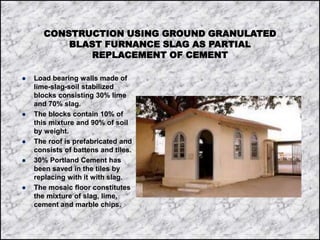
CONSTRUCTION USING GROUND GRANULATED
BLAST FURNANCE SLAG AS PARTIAL
REPLACEMENT OF CEMENT
 Load bearing walls made of
lime-slag-soil stabilized
blocks consisting 30% lime
and 70% slag.
 The blocks contain 10% of
this mixture and 90% of soil
by weight.
 The roof is prefabricated and
consists of battens and tiles.
 30% Portland Cement has
been saved in the tiles by
replacing with it with slag.
 The mosaic floor constitutes
the mixture of slag, lime,
cement and marble chips.
CONCLUSION
 The above list of suggestion for reducing construction
cost is of general nature
 Varies depending upon the nature of the building,
budget, geographical location, availability of the
building material, good construction management
practices etc.
 Good planning necessary and design methods shall
be adopted by utilizing the services of an experienced
engineer or an architect for supervising the work
 It may be cost effective to an extent of 25% in actual
practice.

Low-Cost-Housing.ppt

  • 2.
    What is LowCost?  Deals with effective budgeting  Following of techniques which help in reducing the cost construction  Use of locally available materials which suits and blends with the local environment along with improved skills and technology without sacrificing the strength, performance and life of the structure  Low-cost housing by no means implies the usage of inferior quality or materials  The building construction cost can be divided into : Building material cost : 65 to 70 % Labor cost : 30 to 35 %
  • 3.
    THE NEED FORAFFORDABLE HOUSING  Reduction in the supply of affordable housing nationally since 1980  Fast population growth leading to demands for additional housing  The dwindling supply and high cost of developable land  Rising costs of materials and labor  Incomes in most areas have not increased sufficiently to overcome the effects of inflation and escalating home prices
  • 4.
    1) Reducing plintharea by using thinner wall concept 2) Using locally available material in an innovative form 3) Use energy efficiency materials like concrete block in place of burnt brick 4) Using environmentally friendly materials which are substitute for conventional building components like use R.C.C. door and window frames in place of wooden frames 5) Preplan every component of a house and rationalize the design procedure for reducing the size of the component in the building 6) Unnecessary components should not be used How to reduce the cost
  • 5.
    Cost Reduction :Adhoc Methods
  • 6.
    Adopting Arch foundationin ordinary soil reduces construction cost up to 40%.
  • 7.
    Using pile foundationin black and other soft soils is up to 25% economical.
  • 8.
    Using brick onedge in place of plinth slab of 4 to 6″ reduces the cost by about 35 to 50%.
  • 9.
    Using concrete blockmasonry reduces wall thickness to15 Cms saving mortar, avoiding plaster, speedy construction saving of 10 to 25%.
  • 10.
    Using steel section frames inplace of wood for doors and windows saves up to 30 to 40%.
  • 11.
    Brick jali workand precast components provide effective ventilation and save up to 50% over the window components.
  • 12.
    R.C.C. lintels canbe replaced by brick arches saving up to 30 to 40%.
  • 13.
    Adopting insitu constructionpractices like filler slab and precast elements in place of 5″ thick R.C.C. slabs reduces the cost by about 20 to 25%.
  • 14.
    Rat – trapBond Wall  Cavity wall construction of thermal comfort and reduction in the quantity of bricks  Can be constructed in 8” or 9” thicknesses  The overall cost saving on this wall compared to the traditional 9” wall is about 26%  Aesthetically pleasing wall surface. No plaster required  L and T corners in wall must be constructed (see figure)
  • 15.
    The Technology  Firstlayer of bricks to be laid as brick-on-edge in a continuous row, allowing a space of about ½” between bricks.  Height of the first layer be 4” with the ends of the brick facing the outer and inner face of the wall  The next row should have 2 bricks laid parallel with each other along the exterior and interior surface of the wall with a cavity between them.
  • 16.
    The Technology  Theends of these bricks will be stabilized with the placement of a single brick on edge that spans the width of the wall.  From the lintel upward, the standard Rat-Trap bond can be repeated. The topmost layer of brick on walls must be placed flat.  Standard (2 ¼” x 4” x 8”) fired clay bricks can be used
  • 17.
  • 18.
    COMPRESSED EARTH BLOCKS Applications of Compressed Earth Block: Foundation, load bearing walls, arches, vaults and domes, etc. Hot or cold climate Dry or humid areas  A Local Material for Reducing Imports: CEB production is ideally made on the construction site itself  Limiting Deforestation, no Need of Firing: CEB are often stabilized with cement or lime. curing necessary  Cost Saving: CEB are most of the time cheaper than conventional materials  More Eco-Friendly than Fired Bricks: 5-15 times energy savings 8 times less polluting
  • 19.
    PRODUCTION 1. Sieving theSoil  Aerate the soil  Remove lumps, stones and pebbles 2. Measuring  Measure all components directly in the containers  Fill the containers with accuracy, as per specifications
  • 20.
    PRODUCTION 3. Mixing  Pourin order, soil, sand and stabilizer  First mix dry, 2 times n Add water and mix wet, 2 times 4. Check the Moisture Content  Drop a squeezed ball from 1m high
  • 21.
    PRODUCTION 5. Moulding  Mouldimmediately the mix: within 20 minutes 6. Quality Control  Every block of every mix must be checked  Pocket penetrometer for the compression strength  Block height gauge for the height
  • 22.
    PRODUCTION 7. Humid Curingand Stacking  The pile must remain covered 2 days with a plastic sheet  Stacking the fresh block  Cover immediately every row with a plastic sheet 8. Final Curing and Stacking  Water the pile daily (on top and on the 4 sides), as many times as needed, for 1 month  Never let the pile dry for a full month
  • 23.
    FERROCEMENT CHANNELS  Thinwall of reinforced cement, where layers of continuous mesh are covered on both sides with mortar  Durable, Versatile, Light and Waterproof  Precast Longitudinal element of a curved section (often semi-cylindrical). It is using moulds  Uses less cement and steel having same strength RCC  Used for floors or roofs, but are bad thermal insulators  A major cost reduction is achieved compared to RCC  Simple and cheap manufacturing set up needed but areas for prefabricating and curing are large  Easy to acquire the skill and easy to manufacture  Lifted into place and can immediately be joined together in order to provide a shelter
  • 24.
    MANUFACTURING THE MOULD 1.Constructing the Body  Use ordinary bricks and mud mortar 2. Plastering the Body  Use a cement sand mortar (1: 3) to plaster the body
  • 25.
    MANUFACTURING THE MOULD 3.Finishing the Mould  Apply cement and smoothen the plaster with a trowel 4. Details of a Mould
  • 26.
    PREPARING THE MAT 1.Materials Required  One layer of galvanized hexagonal wire mesh  Mesh: #12 mm x 0.71 mm thick x 90 cm wide (½” x 22 gauge x 3’)  Two bottom rods of Tor steel are needed: 8, 10 or 12 mm diameter, according to the span and the load  One top steel rod (mild steel) of 6 mm diameter is needed 2. Preparing the Mesh  Flatten the mesh with a rammer
  • 27.
    PREPARING THE MAT 3.Stretching the Mat  Stretch the main mesh and add the extra layers of mesh 4. Fixing the Rods  Tie the rods with binding wire (both sides and centre)
  • 28.
    Post and BeamStraw Construction Technique Step 1.  Lay the foundation  As the walls are not load bearing, a concrete foundation of 6 inches depth is sufficient  Dig at least 24 inches holes to set the treated poles and pour concrete for strength and stability
  • 29.
    Post and BeamStraw Construction Technique Step 2.  Build the frame work  Fasten rigid fence material (not chicken wire) to the posts and create a 9 inches to 12 inches cavities.
  • 30.
    Post and BeamStraw Construction Technique Step 3.  Fill the cavities with straw or other waste materials like carpet padding, shredded paper, and Styrofoam packaging materials
  • 31.
    Post and BeamStraw Construction Technique Step 4.  Plaster the inside and outside of the walls with mud dug from the foundation  Let it dry for a couple of days
  • 32.
    Pre-fabricated Wall Panels Step1.  Make a 3'x5' frame using 2"x6" lumber
  • 33.
    Pre-fabricated Wall Panels Step2.  Fasten the wonder board to one side of the 3'x5' wooden frame
  • 34.
    Pre-fabricated Wall Panels Step3.  Fill the cavity with loose straw, carpet padding, shredded paper, or Styrofoam package materials  Cover the exposed side with another 3'x5' wonder board using appropriate screws.
  • 35.
    Pre-fabricated Wall Panels Step4.  Use pre-fabricated panels to build walls.  Different sizes of panels are required near door and window openings.  Conventional roof methods used to complete the building
  • 36.
    Just Fit ItTechnology  Minimum of skilled labor and off site materials  Plumbing and electrics can be fitted by an unskilled laborer.  The door and window frames just slot in  No Mortar, No reinforcement and No off - site  It features an interlocking dry stacking stabilized earth brick design  High stability, sheer strength, insulative properties.  Summer months the homes stay cool and in the winter months, cost very little to heat
  • 37.
    Stages of Construction 1.The soil is crushed in the LCH crusher to reduce the particle size and aid the absorption and reaction of the Brick Stabilizer
  • 38.
    Stages of Construction 2.After treating the soil is loaded into the brick making machine to begin the cycle of compacting and extruding the brick 3. After compaction of the Stabilized Earth Brick, a cycle begins to extrude the brick from the machine giving a durable and waterproof brick for building
  • 39.
    Stages of Construction 4.Finished bricks stacked for curing for a short period of time then building commences 5. Foundations are made using the same bricks building then commences above floor level by dry stacking the bricks one on top of the other
  • 40.
    Stages of Construction 6.Rammed earth base is then made to act as the floor of the building which can then be covered with a thin screen of concrete if required 7. If the earth is unstable, then a viable solution for stabilizing of the soil for the base of the house
  • 41.
    Stages of Construction Mortar is only used to stick the first row of bricks to the concrete base  Bricks are laid one by one in rows  In high risk areas, reinforcing bars may be along the bricks to increase stability in case of earthquakes, typhoons or hurricanes
  • 42.
    Stages of Construction Interconnecting walls are made by a pair of reinforcing bars at right angles  At this point the electrical conduits and outlets may be installed  The Just Fit It Technology allows the conduits to flow deep inside the walls and provide flush fitted outlets inside the house
  • 43.
     Once theshape of the house starts to form, the windows and doors may be fitted  This may be done by completely unskilled labor  Then the construction can continue all the way up to the roof which can be conventional
  • 44.
  • 45.
    ENVIRONMENT FRIENDLY LOWCOST DEMONSTRATION MODEL HOUSES BY CWHR, KARACHI (1980-2006)
  • 46.
    CONSTRUCTION OF ALOW COST HOUSE USING RICE HUSK ASH AND LIME AS PARTIAL REPLACEMENT OF CEMENT  Husk Ash and Lime used as cement in the fabrication of hollow, load bearing blocks and for mortar in plaster  Prefabricated Roof consisting battens tiles  Portland cement replaced by Rice Husk Ash to the extent of 30%.  The foundation and base course are made up with soil stabilized with cement
  • 47.
    CONSTRUCTION USING GROUNDGRANULATED BLAST FURNANCE SLAG AS PARTIAL REPLACEMENT OF CEMENT  Load bearing walls made of lime-slag-soil stabilized blocks consisting 30% lime and 70% slag.  The blocks contain 10% of this mixture and 90% of soil by weight.  The roof is prefabricated and consists of battens and tiles.  30% Portland Cement has been saved in the tiles by replacing with it with slag.  The mosaic floor constitutes the mixture of slag, lime, cement and marble chips.
  • 48.
    CONCLUSION  The abovelist of suggestion for reducing construction cost is of general nature  Varies depending upon the nature of the building, budget, geographical location, availability of the building material, good construction management practices etc.  Good planning necessary and design methods shall be adopted by utilizing the services of an experienced engineer or an architect for supervising the work  It may be cost effective to an extent of 25% in actual practice.