Outline
• What is Green Building?
• Why is Green Building Important?
• Three aspects of new project planning
• Obstacles
• Benefits of Green Building
• Advantages of Green Building
• Disadvantages of Green Building
• Case Study
• References
What is Green Building?
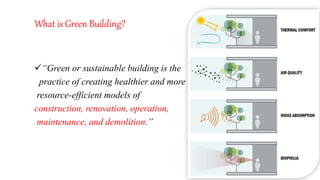
“Green or sustainable building is the
practice of creating healthier and more
resource-efficient models of
construction, renovation, operation,
maintenance, and demolition.”
Why is Green Building Important?
• 4000 kgs of waste are typically thrown into a landfill during the construction of a
2000sqft home.
• The buildings consume more than twice as much energy as all the cars.
• Buildings account for 68% of total electricity consumption.
• Buildings use 80% of total drinking water consumption.
• Indoor levels of pollution are commonly 2 to 5 times higher than outdoor pollution levels
New Project Planning
• Construction – Reduce the amount of waste generated at a
construction site
• Design – Building design details will help to reduce construction
materials, and energy/water requirements when completed
• Material Selection – Careful selection of construction materials will
leave less of an environmental impact
Construction
• Construction waste accounts for 10 to as much as 30% of
municipal waste stream
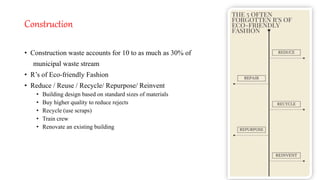
• R’s of Eco-friendly Fashion
• Reduce / Reuse / Recycle/ Repurpose/ Reinvent
• Building design based on standard sizes of materials
• Buy higher quality to reduce rejects
• Recycle (use scraps)
• Train crew
• Renovate an existing building
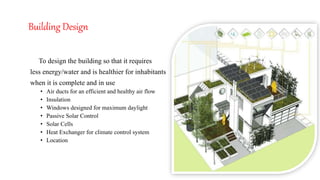
Building Design
To design the building so that it requires
less energy/water and is healthier for inhabitants
when it is complete and in use
• Air ducts for an efficient and healthy air flow
• Insulation
• Windows designed for maximum daylight
• Passive Solar Control
• Solar Cells
• Heat Exchanger for climate control system
• Location
Materials
Choose materials that have low environmental costs and do not contribute to indoor air
pollution
• Engineered Wood (recycled and reclaimed material)
• Doors and Windows (energy and placement)
• Floor Coverings (recycled with no off-gassing)
• Roof Materials (Reflective and light)
• Energy Efficient Appliances
Obstacles
• 93% of consumers worry about their home’s environmental
performance. However, only 18% are willing to pay more to reduce
the impact.
• There are higher initial costs for Green Building
• Customers are concerned they would be sacrificing comfort
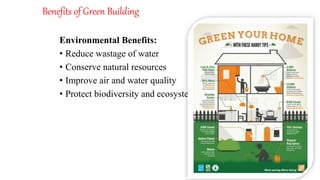
Benefits of Green Building
Environmental Benefits:
• Reduce wastage of water
• Conserve natural resources
• Improve air and water quality
• Protect biodiversity and ecosystems
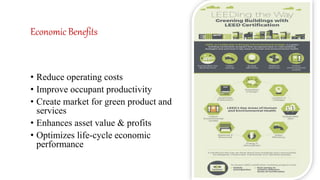
Economic Benefits
• Reduce operating costs
• Improve occupant productivity
• Create market for green product and
services
• Enhances asset value & profits
• Optimizes life-cycle economic
performance
Social Benefits
• Improve quality of life
• Minimize strain on local infrastructure
• Improve occupant health and comfort
Advantages of Green Building
1. Cost
2. Efficiency
3. Preserving infrastructure
4. High ROI (Return on Investment) rates
Disadvantages of Green Building
1. Location
2. Availability
3. No air cooling features
Case Study
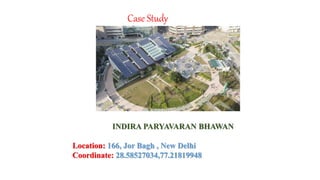
INDIRA PARYAVARAN BHAWAN
Location: 166, Jor Bagh , New Delhi
Coordinate: 28.58527034,77.21819948
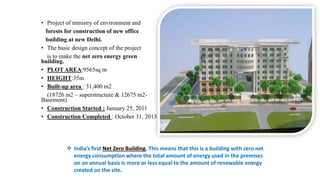
• Project of ministry of environment and
forests for construction of new office
building at new Delhi.
• The basic design concept of the project
is to make the net zero energy green
building.
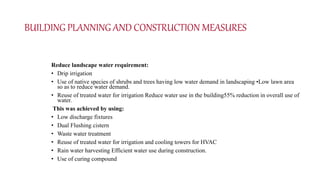
• PLOT AREA:9565sq m
• HEIGHT:35m
• Built-up area : 31,400 m2
(18726 m2 – superstructure & 12675 m2-
Basement)
• Construction Started : January 25, 2011
• Construction Completed : October 31, 2013
 India’s first Net Zero Building, This means that this is a building with zero net
energy consumption where the total amount of energy used in the premises
on an annual basis is more or less equal to the amount of renewable energy
created on the site.
Achievements
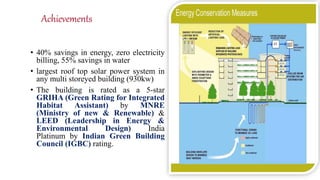
• 40% savings in energy, zero electricity
billing, 55% savings in water
• largest roof top solar power system in
any multi storeyed building (930kw)
• The building is rated as a 5-star
GRIHA (Green Rating for Integrated
Habitat Assistant) by MNRE
(Ministry of new & Renewable) &
LEED (Leadership in Energy &
Environmental Design) India
Platinum by Indian Green Building
Council (IGBC) rating.
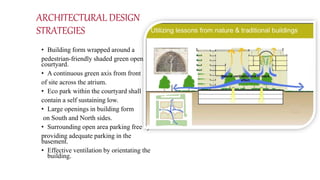
ARCHITECTURAL DESIGN
STRATEGIES
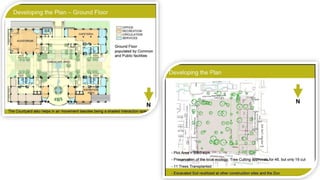
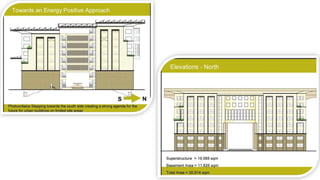
• Building form wrapped around a
pedestrian-friendly shaded green open
courtyard.
• A continuous green axis from front
of site across the atrium.
• Eco park within the courtyard shall
contain a self sustaining low.
• Large openings in building form
on South and North sides.
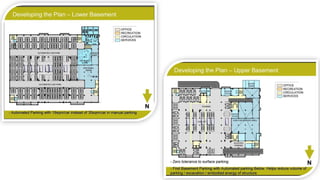
• Surrounding open area parking free by
providing adequate parking in the
basement.
• Effective ventilation by orientating the
building.
BUILDING PLANNING AND CONSTRUCTION MEASURES
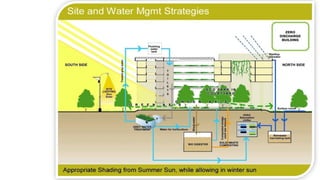
Reduce landscape water requirement:
• Drip irrigation
• Use of native species of shrubs and trees having low water demand in landscaping •Low lawn area
so as to reduce water demand.
• Reuse of treated water for irrigation Reduce water use in the building55% reduction in overall use of
water.
This was achieved by using:
• Low discharge fixtures
• Dual Flushing cistern
• Waste water treatment
• Reuse of treated water for irrigation and cooling towers for HVAC
• Rain water harvesting Efficient water use during construction.
• Use of curing compound
Energy Conservation Measures
MATERIALS
• Stone available in nearby area for flooring
• Terrazzo flooring with locally available stone materials.
• Jute bamboo composite for door frames & shutters.
• UPVC windows with hermetically sealed double using low heat transmittance
index glass.
• Use of high reflectance terrace tiles for low heat ingress
• Avoided aluminum as it has high embedded energy
• Sandstone Jalis.
• Stone and Ferrocement Jalis
• FALG (Fly Ash Lime Gypsum) bricks and AAC blocks are used in the
construction instead of clay bricks.
• High Efficiency Glass
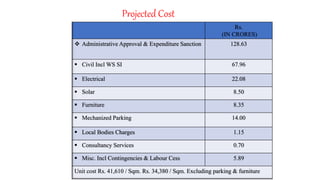
Projected Cost
Rs.
(IN CRORES)
 Administrative Approval & Expenditure Sanction 128.63
 Civil Incl WS SI 67.96
 Electrical 22.08
 Solar 8.50
 Furniture 8.35
 Mechanized Parking 14.00
 Local Bodies Charges 1.15
 Consultancy Services 0.70
 Misc. Incl Contingencies & Labour Cess 5.89
Unit cost Rs. 41,610 / Sqm. Rs. 34,380 / Sqm. Excluding parking & furniture
References
• U.S. Environmental Protection Agency.(October 28,2009)
http://www.epa.gov/greenbuilding/
• WBDG Sustainable Committee.(August 18,2009)
http://www.wbdg.org/designsustainable.php
• Hopkins, R.2002. A Natural Way Of Building
Transition Culture. Retrieved: 2007-03-30
Reference for case study
• Archdaily website –
http://www.archdaily.com/466958/suzlonone-earth-global-corporate-
headquarters-christopherbenninger
• Modern Green Architecture website –
http://www.mgsarchitecture.in/projects/460-suzlon-one-earthpune.html

Green Building in India with Case Study

  • 1.
    Outline • What isGreen Building? • Why is Green Building Important? • Three aspects of new project planning • Obstacles • Benefits of Green Building • Advantages of Green Building • Disadvantages of Green Building • Case Study • References
  • 2.
    What is GreenBuilding? “Green or sustainable building is the practice of creating healthier and more resource-efficient models of construction, renovation, operation, maintenance, and demolition.”
  • 3.
    Why is GreenBuilding Important? • 4000 kgs of waste are typically thrown into a landfill during the construction of a 2000sqft home. • The buildings consume more than twice as much energy as all the cars. • Buildings account for 68% of total electricity consumption. • Buildings use 80% of total drinking water consumption. • Indoor levels of pollution are commonly 2 to 5 times higher than outdoor pollution levels
  • 4.
    New Project Planning •Construction – Reduce the amount of waste generated at a construction site • Design – Building design details will help to reduce construction materials, and energy/water requirements when completed • Material Selection – Careful selection of construction materials will leave less of an environmental impact
  • 5.
    Construction • Construction wasteaccounts for 10 to as much as 30% of municipal waste stream • R’s of Eco-friendly Fashion • Reduce / Reuse / Recycle/ Repurpose/ Reinvent • Building design based on standard sizes of materials • Buy higher quality to reduce rejects • Recycle (use scraps) • Train crew • Renovate an existing building
  • 6.
    Building Design To designthe building so that it requires less energy/water and is healthier for inhabitants when it is complete and in use • Air ducts for an efficient and healthy air flow • Insulation • Windows designed for maximum daylight • Passive Solar Control • Solar Cells • Heat Exchanger for climate control system • Location
  • 7.
    Materials Choose materials thathave low environmental costs and do not contribute to indoor air pollution • Engineered Wood (recycled and reclaimed material) • Doors and Windows (energy and placement) • Floor Coverings (recycled with no off-gassing) • Roof Materials (Reflective and light) • Energy Efficient Appliances
  • 8.
    Obstacles • 93% ofconsumers worry about their home’s environmental performance. However, only 18% are willing to pay more to reduce the impact. • There are higher initial costs for Green Building • Customers are concerned they would be sacrificing comfort
  • 9.
    Benefits of GreenBuilding Environmental Benefits: • Reduce wastage of water • Conserve natural resources • Improve air and water quality • Protect biodiversity and ecosystems
  • 10.
    Economic Benefits • Reduceoperating costs • Improve occupant productivity • Create market for green product and services • Enhances asset value & profits • Optimizes life-cycle economic performance
  • 11.
    Social Benefits • Improvequality of life • Minimize strain on local infrastructure • Improve occupant health and comfort
  • 12.
    Advantages of GreenBuilding 1. Cost 2. Efficiency 3. Preserving infrastructure 4. High ROI (Return on Investment) rates
  • 13.
    Disadvantages of GreenBuilding 1. Location 2. Availability 3. No air cooling features
  • 14.
    Case Study INDIRA PARYAVARANBHAWAN Location: 166, Jor Bagh , New Delhi Coordinate: 28.58527034,77.21819948
  • 15.
    • Project ofministry of environment and forests for construction of new office building at new Delhi. • The basic design concept of the project is to make the net zero energy green building. • PLOT AREA:9565sq m • HEIGHT:35m • Built-up area : 31,400 m2 (18726 m2 – superstructure & 12675 m2- Basement) • Construction Started : January 25, 2011 • Construction Completed : October 31, 2013  India’s first Net Zero Building, This means that this is a building with zero net energy consumption where the total amount of energy used in the premises on an annual basis is more or less equal to the amount of renewable energy created on the site.
  • 16.
    Achievements • 40% savingsin energy, zero electricity billing, 55% savings in water • largest roof top solar power system in any multi storeyed building (930kw) • The building is rated as a 5-star GRIHA (Green Rating for Integrated Habitat Assistant) by MNRE (Ministry of new & Renewable) & LEED (Leadership in Energy & Environmental Design) India Platinum by Indian Green Building Council (IGBC) rating.
  • 17.
    ARCHITECTURAL DESIGN STRATEGIES • Buildingform wrapped around a pedestrian-friendly shaded green open courtyard. • A continuous green axis from front of site across the atrium. • Eco park within the courtyard shall contain a self sustaining low. • Large openings in building form on South and North sides. • Surrounding open area parking free by providing adequate parking in the basement. • Effective ventilation by orientating the building.
  • 23.
    BUILDING PLANNING ANDCONSTRUCTION MEASURES Reduce landscape water requirement: • Drip irrigation • Use of native species of shrubs and trees having low water demand in landscaping •Low lawn area so as to reduce water demand. • Reuse of treated water for irrigation Reduce water use in the building55% reduction in overall use of water. This was achieved by using: • Low discharge fixtures • Dual Flushing cistern • Waste water treatment • Reuse of treated water for irrigation and cooling towers for HVAC • Rain water harvesting Efficient water use during construction. • Use of curing compound
  • 25.
  • 26.
    MATERIALS • Stone availablein nearby area for flooring • Terrazzo flooring with locally available stone materials. • Jute bamboo composite for door frames & shutters. • UPVC windows with hermetically sealed double using low heat transmittance index glass. • Use of high reflectance terrace tiles for low heat ingress • Avoided aluminum as it has high embedded energy • Sandstone Jalis. • Stone and Ferrocement Jalis • FALG (Fly Ash Lime Gypsum) bricks and AAC blocks are used in the construction instead of clay bricks. • High Efficiency Glass
  • 27.
    Projected Cost Rs. (IN CRORES) Administrative Approval & Expenditure Sanction 128.63  Civil Incl WS SI 67.96  Electrical 22.08  Solar 8.50  Furniture 8.35  Mechanized Parking 14.00  Local Bodies Charges 1.15  Consultancy Services 0.70  Misc. Incl Contingencies & Labour Cess 5.89 Unit cost Rs. 41,610 / Sqm. Rs. 34,380 / Sqm. Excluding parking & furniture
  • 28.
    References • U.S. EnvironmentalProtection Agency.(October 28,2009) http://www.epa.gov/greenbuilding/ • WBDG Sustainable Committee.(August 18,2009) http://www.wbdg.org/designsustainable.php • Hopkins, R.2002. A Natural Way Of Building Transition Culture. Retrieved: 2007-03-30 Reference for case study • Archdaily website – http://www.archdaily.com/466958/suzlonone-earth-global-corporate- headquarters-christopherbenninger • Modern Green Architecture website – http://www.mgsarchitecture.in/projects/460-suzlon-one-earthpune.html