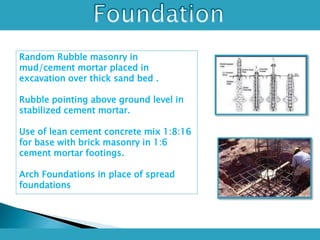
Random Rubble masonry in
mud/cement mortar placed in
excavation over thick sand bed .
Rubble pointing above ground level in
stabilized cement mortar.
Use of lean cement concrete mix 1:8:16
for base with brick masonry in 1:6
cement mortar footings.
Arch Foundations in place of spread
foundations
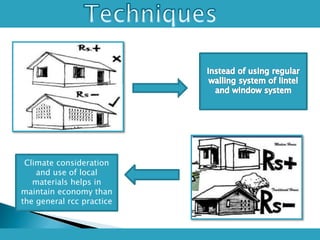
Climate consideration
and use of local
materials helps in
maintain economy than
the general rcc practice
Soil Cement Block Technology
This method of construction of wall is by soil cement blocks in
place of burnt bricks masonry. It is an energy efficient method of
construction where soil mixed with 5% and above cement and
pressed in hand operated machine and cured well and then used
in the masonry.
The overall economy that could be achieved with the soil cement
technology is about 15 to 20% Compared to conventional
method of construction.
Concrete Block Walling
In View of high energy consumption by burnt brick it is suggested
to use concrete block which consumes about only 1/3 of the
energy of the burnt bricks in its production. Concrete block
masonry saves mortar consumption, speedy construction of wall
resulting in higher output of labour
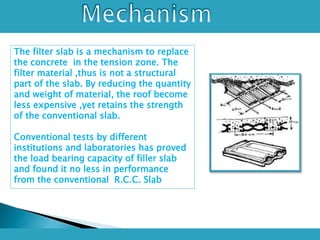
The filter slab is a mechanism to replace
the concrete in the tension zone. The
filter material ,thus is not a structural
part of the slab. By reducing the quantity
and weight of material, the roof become
less expensive ,yet retains the strength
of the conventional slab.
Conventional tests by different
institutions and laboratories has proved
the load bearing capacity of filler slab
and found it no less in performance
from the conventional R.C.C. Slab
Saving on Cost
The savings on cost can be from 15
percent to 25 percent.
Thermal Insulation
The air pocket formed by the
contours of the tiles makes an
excellent thermal insulation layer.
The design integrity of a filler slab
involves careful planning taking
into account the negative zones
and reinforcement areas.
 Use energy free resources
 Use local plentifully available inexpensive
material. Avoid importing much as possible
 Insist on accurate mixes & mixing of
plasters, mortars and concrete
 Don’t forget to apply common sense to all
designs
 Avoid currently fashionable gimmicks
That’s All Folks!!

Cost Effective Construction Techniques By Okey Fabian Eze

  • 2.
    Random Rubble masonryin mud/cement mortar placed in excavation over thick sand bed . Rubble pointing above ground level in stabilized cement mortar. Use of lean cement concrete mix 1:8:16 for base with brick masonry in 1:6 cement mortar footings. Arch Foundations in place of spread foundations
  • 3.
    Climate consideration and useof local materials helps in maintain economy than the general rcc practice
  • 4.
    Soil Cement BlockTechnology This method of construction of wall is by soil cement blocks in place of burnt bricks masonry. It is an energy efficient method of construction where soil mixed with 5% and above cement and pressed in hand operated machine and cured well and then used in the masonry. The overall economy that could be achieved with the soil cement technology is about 15 to 20% Compared to conventional method of construction. Concrete Block Walling In View of high energy consumption by burnt brick it is suggested to use concrete block which consumes about only 1/3 of the energy of the burnt bricks in its production. Concrete block masonry saves mortar consumption, speedy construction of wall resulting in higher output of labour
  • 5.
    The filter slabis a mechanism to replace the concrete in the tension zone. The filter material ,thus is not a structural part of the slab. By reducing the quantity and weight of material, the roof become less expensive ,yet retains the strength of the conventional slab. Conventional tests by different institutions and laboratories has proved the load bearing capacity of filler slab and found it no less in performance from the conventional R.C.C. Slab
  • 6.
    Saving on Cost Thesavings on cost can be from 15 percent to 25 percent. Thermal Insulation The air pocket formed by the contours of the tiles makes an excellent thermal insulation layer. The design integrity of a filler slab involves careful planning taking into account the negative zones and reinforcement areas.
  • 7.
     Use energyfree resources  Use local plentifully available inexpensive material. Avoid importing much as possible  Insist on accurate mixes & mixing of plasters, mortars and concrete  Don’t forget to apply common sense to all designs  Avoid currently fashionable gimmicks
  • 8.