BROILER PROJECT
Sachith Sri Mihiraj
BSc (Special), M.Agri
Introduction
■ Broilers are chicken reared for meat purpose.
■ Normally it takes about 42 days
■ Earlier broilers were reared in backyard , now as
intensive or semi intensive.
■ Broiler farming is one of the profitable agro industry.
■ It ensures the continues flow of income
What is cost analysis?
■ It is a procedure for estimating all costs involve and
profits
■ It accounts both quantitative and qualitative factors for
the analysis of value of money for our project
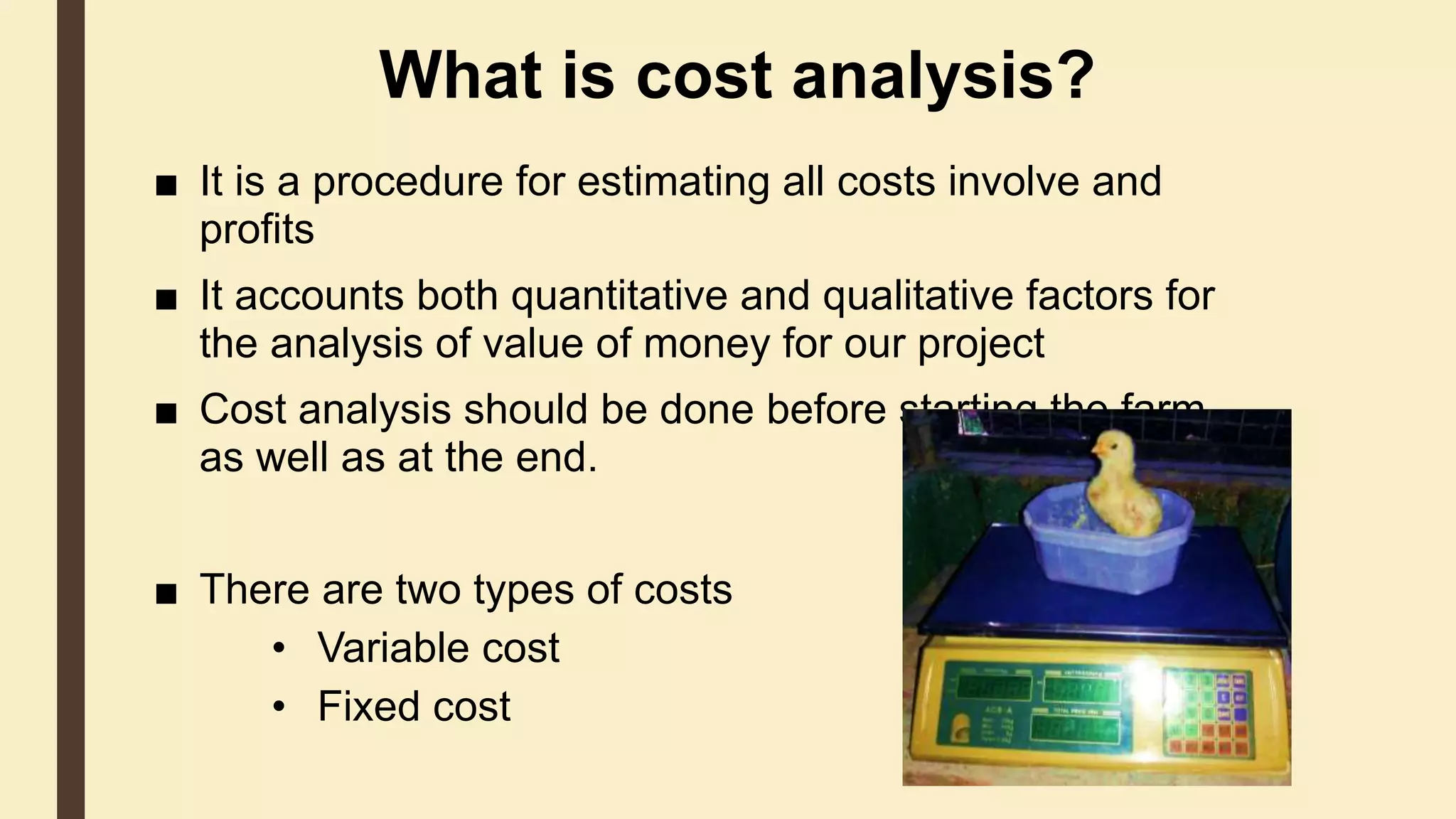
■ Cost analysis should be done before starting the farm
as well as at the end.
■ There are two types of costs
• Variable cost
• Fixed cost
Fixed cost
• Fixed cost is a cost that does not
change over the short term
• Ex: land, poultry house, feeders,
waters, brooders.
Variable cost
• Variable cost is a cost that change
over short term.
• Ex: feeds, water, vaccines, litter,
medicines.
Importance of cost analysis
■ To establish goals
■ Reduce risk of doing unprofitable farming
■ Reduce wasting of time and money
■ To prepare the budget
■ To cut off unnecessary costs
■ To evaluate the profit
■ For decision making
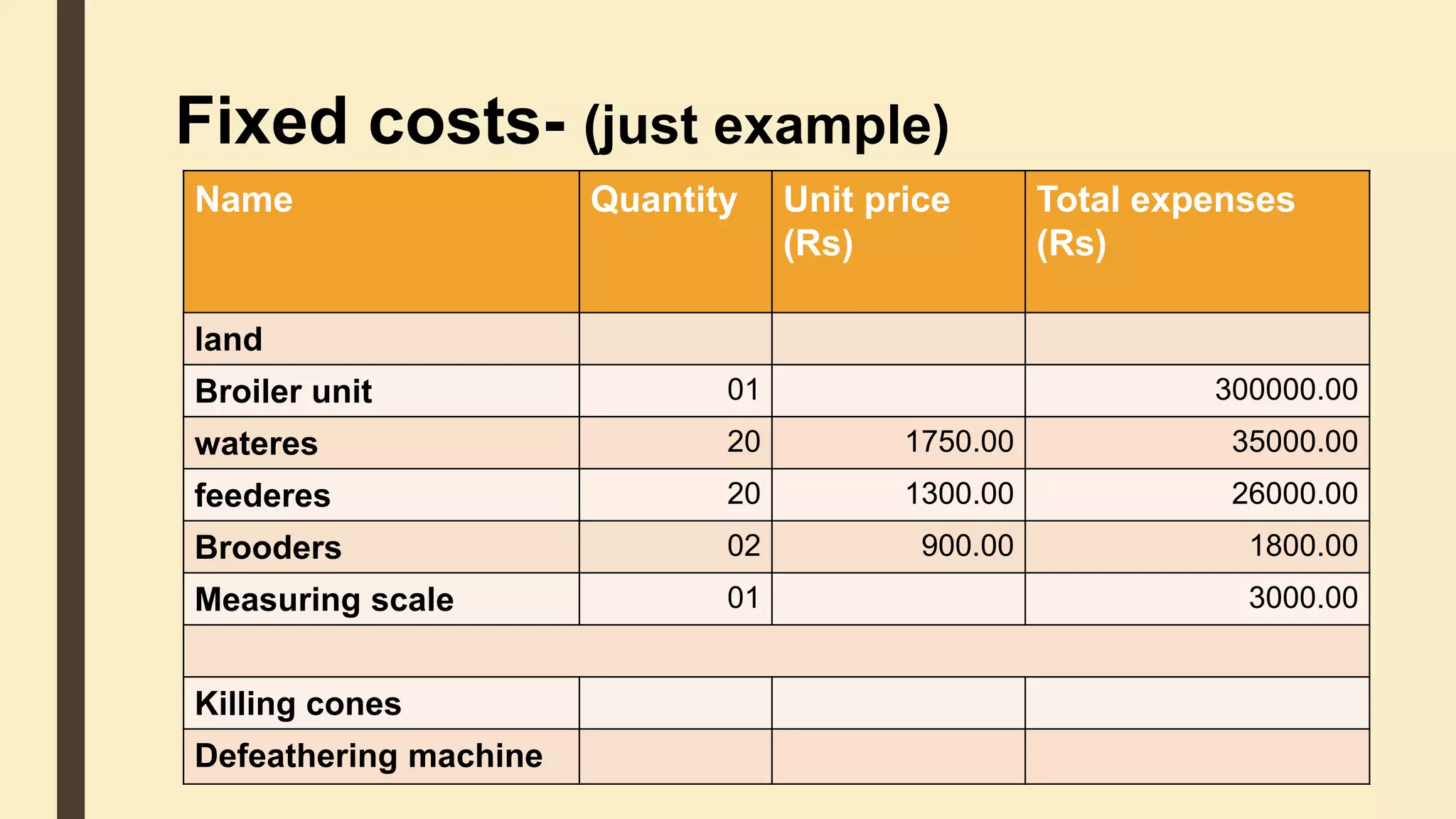
Fixed costs- (just example)
Name Quantity Unit price
(Rs)
Total expenses
(Rs)
land
Broiler unit 01 300000.00
wateres 20 1750.00 35000.00
feederes 20 1300.00 26000.00
Brooders 02 900.00 1800.00
Measuring scale 01 3000.00
Killing cones
Defeathering machine
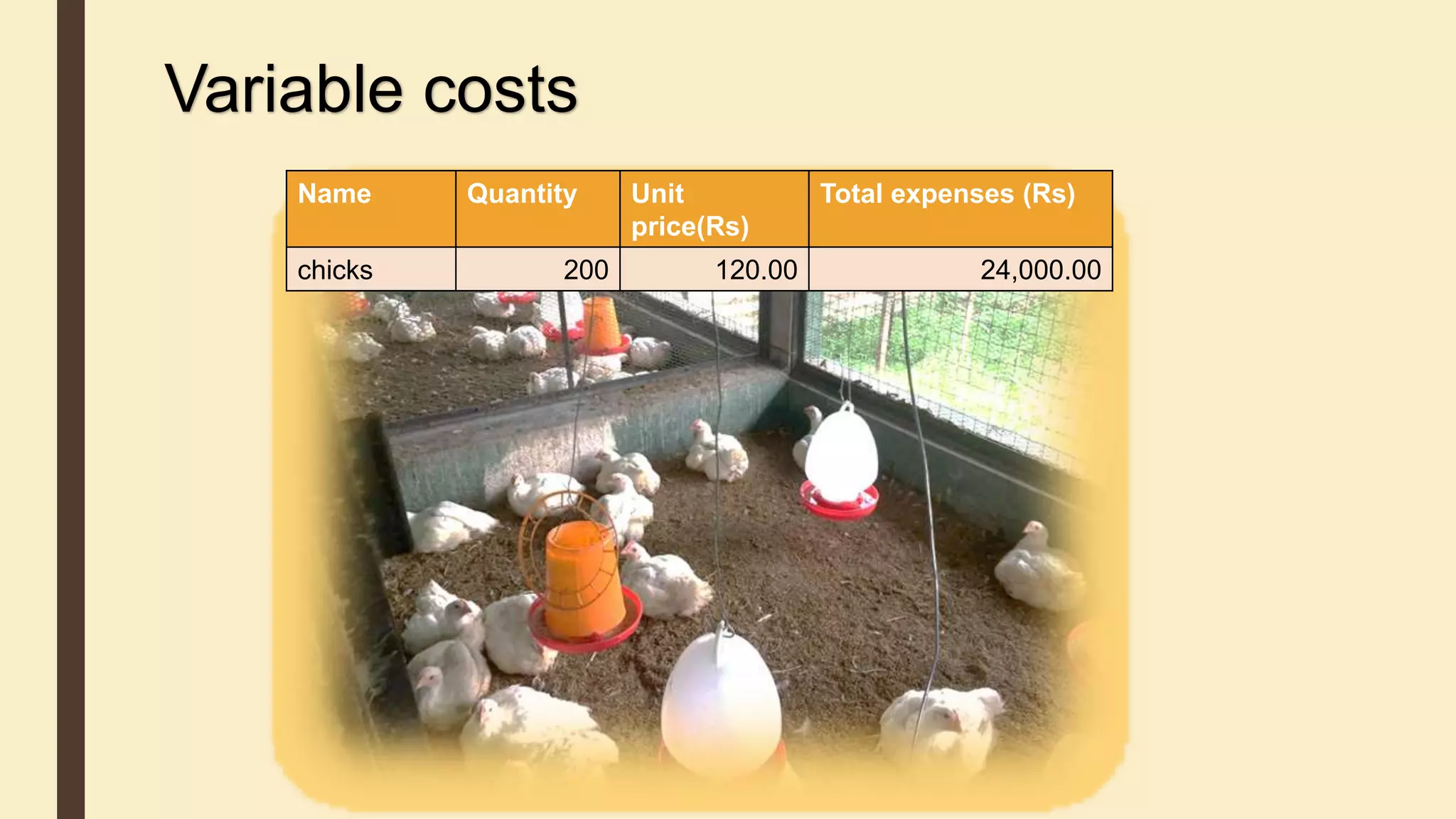
Variable costs
Name Quantity Unit
price(Rs)
Total expenses (Rs)
chicks 200 120.00 24,000.00
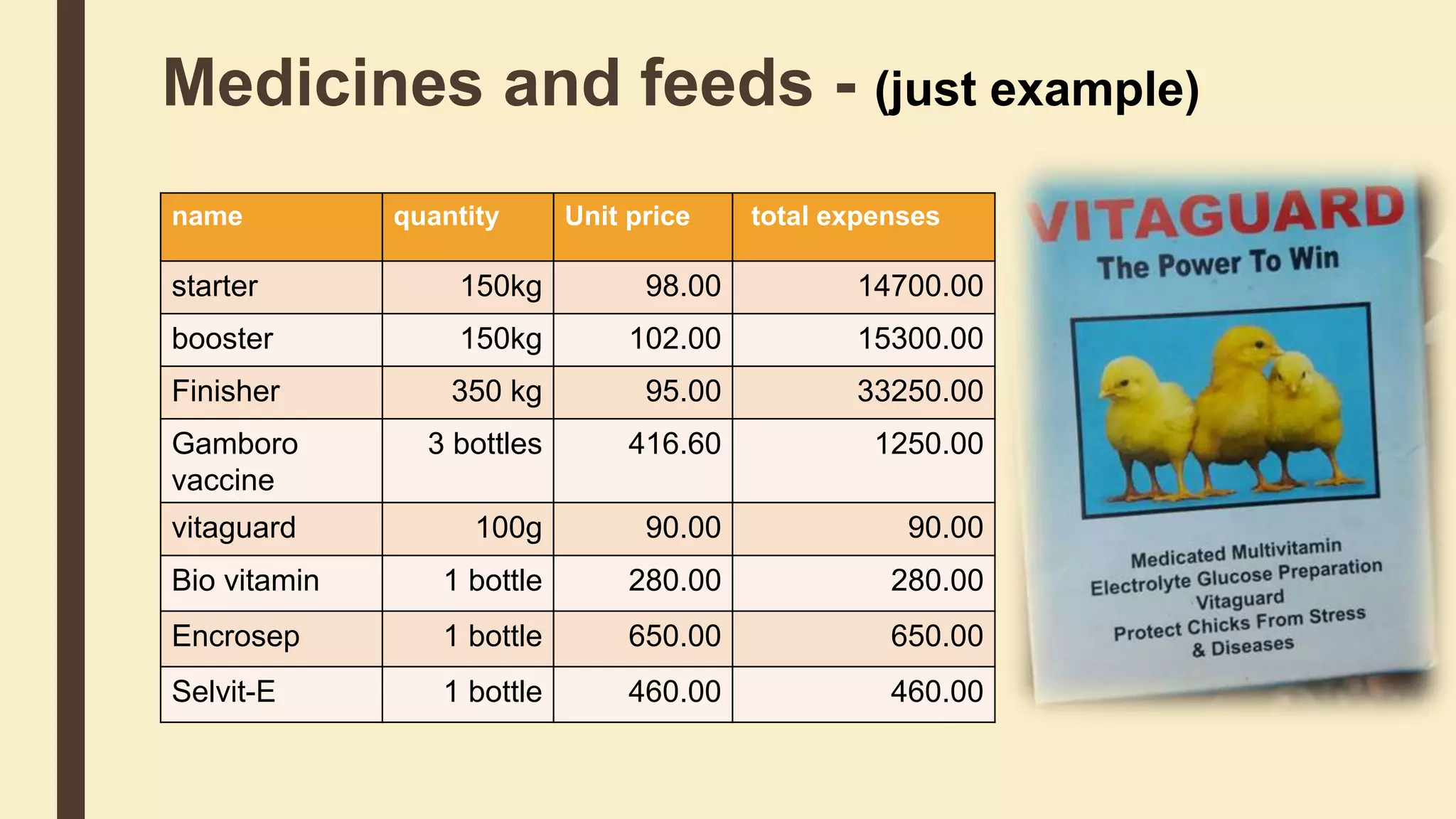
Medicines and feeds - (just example)
name quantity Unit price total expenses
starter 150kg 98.00 14700.00
booster 150kg 102.00 15300.00
Finisher 350 kg 95.00 33250.00
Gamboro
vaccine
3 bottles 416.60 1250.00
vitaguard 100g 90.00 90.00
Bio vitamin 1 bottle 280.00 280.00
Encrosep 1 bottle 650.00 650.00
Selvit-E 1 bottle 460.00 460.00
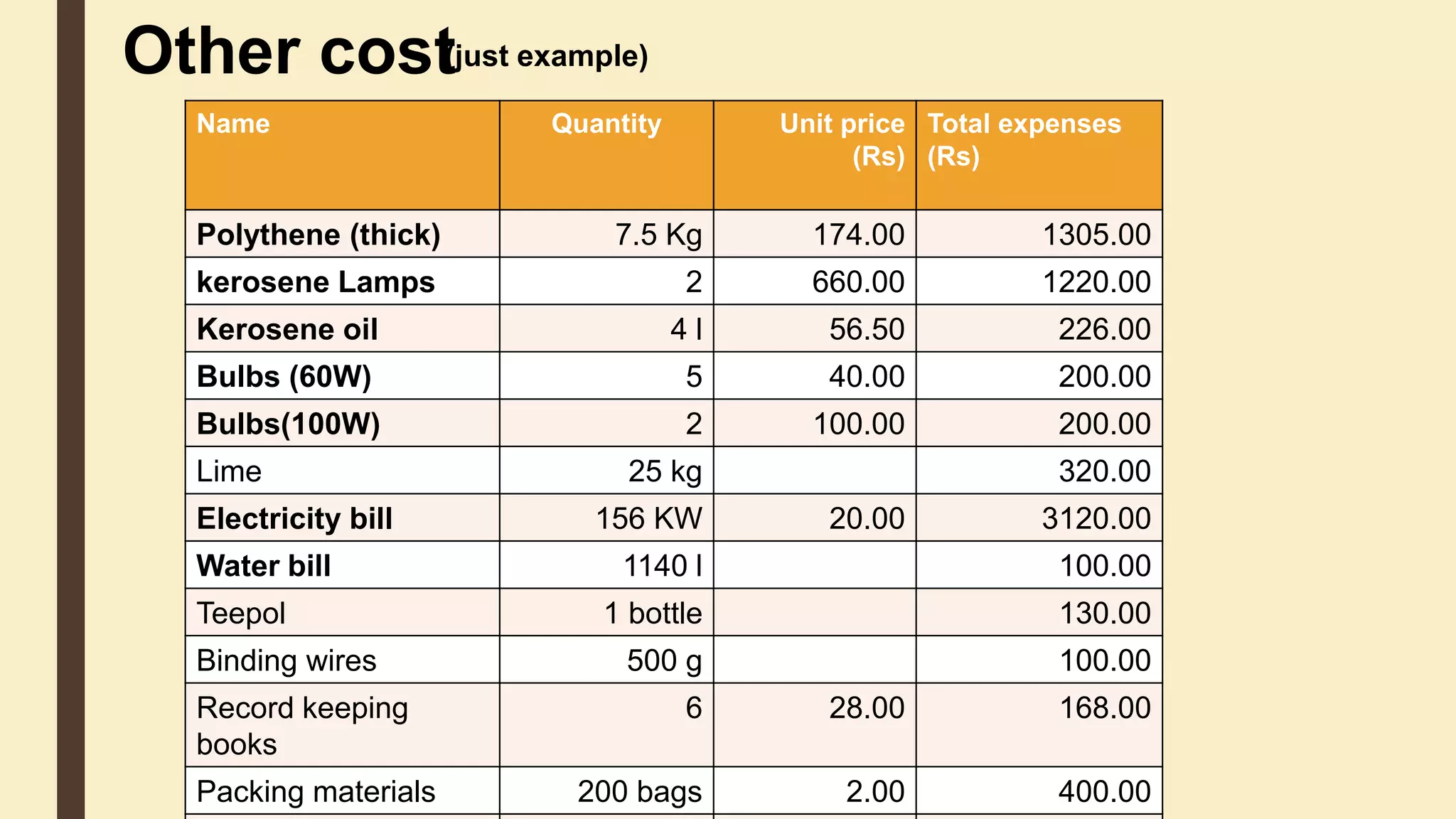
Other cost
Name Quantity Unit price
(Rs)
Total expenses
(Rs)
Polythene (thick) 7.5 Kg 174.00 1305.00
kerosene Lamps 2 660.00 1220.00
Kerosene oil 4 l 56.50 226.00
Bulbs (60W) 5 40.00 200.00
Bulbs(100W) 2 100.00 200.00
Lime 25 kg 320.00
Electricity bill 156 KW 20.00 3120.00
Water bill 1140 l 100.00
Teepol 1 bottle 130.00
Binding wires 500 g 100.00
Record keeping
books
6 28.00 168.00
Packing materials 200 bags 2.00 400.00
(just example)
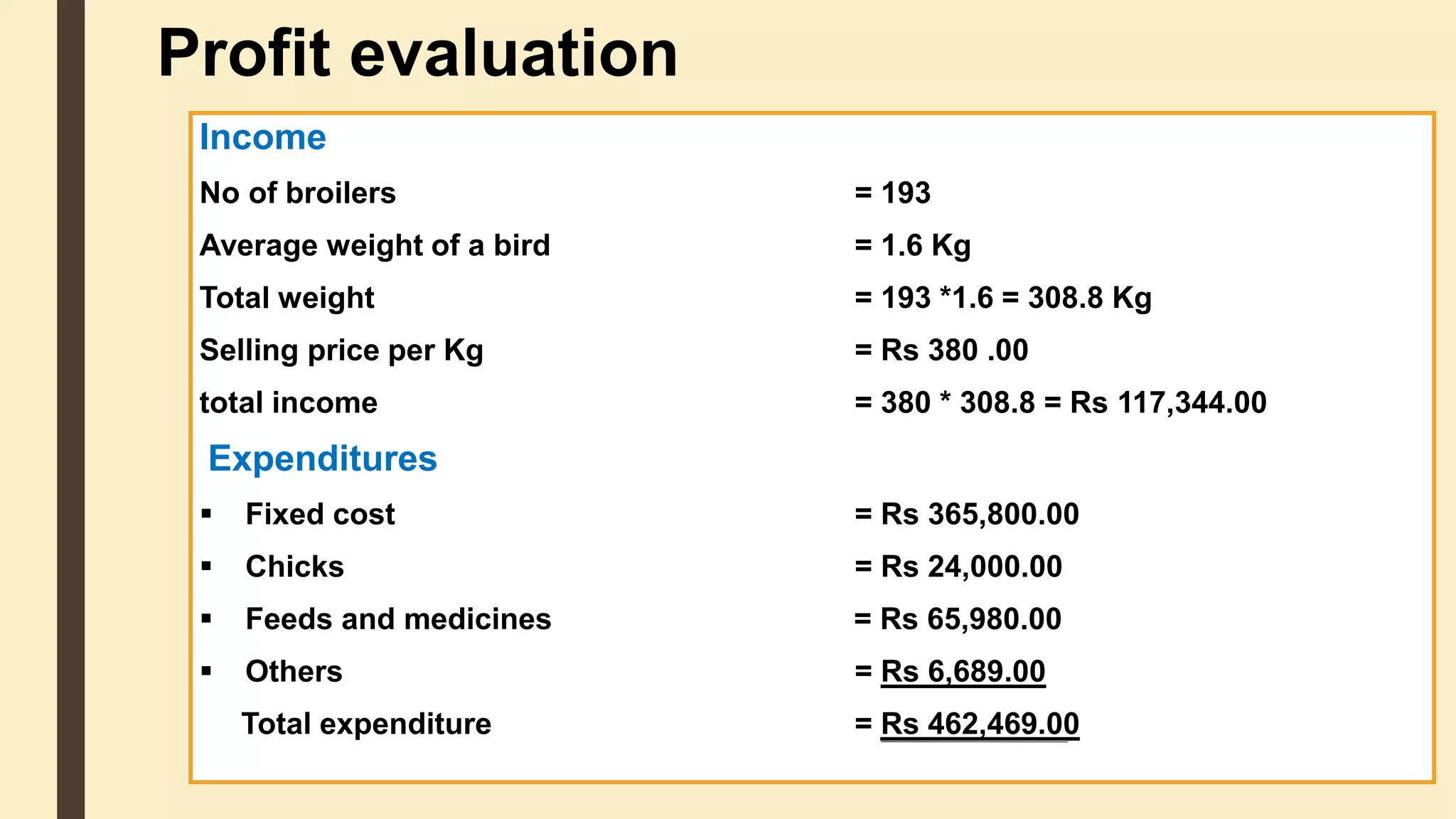
Profit evaluation
Income
No of broilers = 193
Average weight of a bird = 1.6 Kg
Total weight = 193 *1.6 = 308.8 Kg
Selling price per Kg = Rs 380 .00
total income = 380 * 308.8 = Rs 117,344.00
Expenditures
 Fixed cost = Rs 365,800.00
 Chicks = Rs 24,000.00
 Feeds and medicines = Rs 65,980.00
 Others = Rs 6,689.00
Total expenditure = Rs 462,469.00
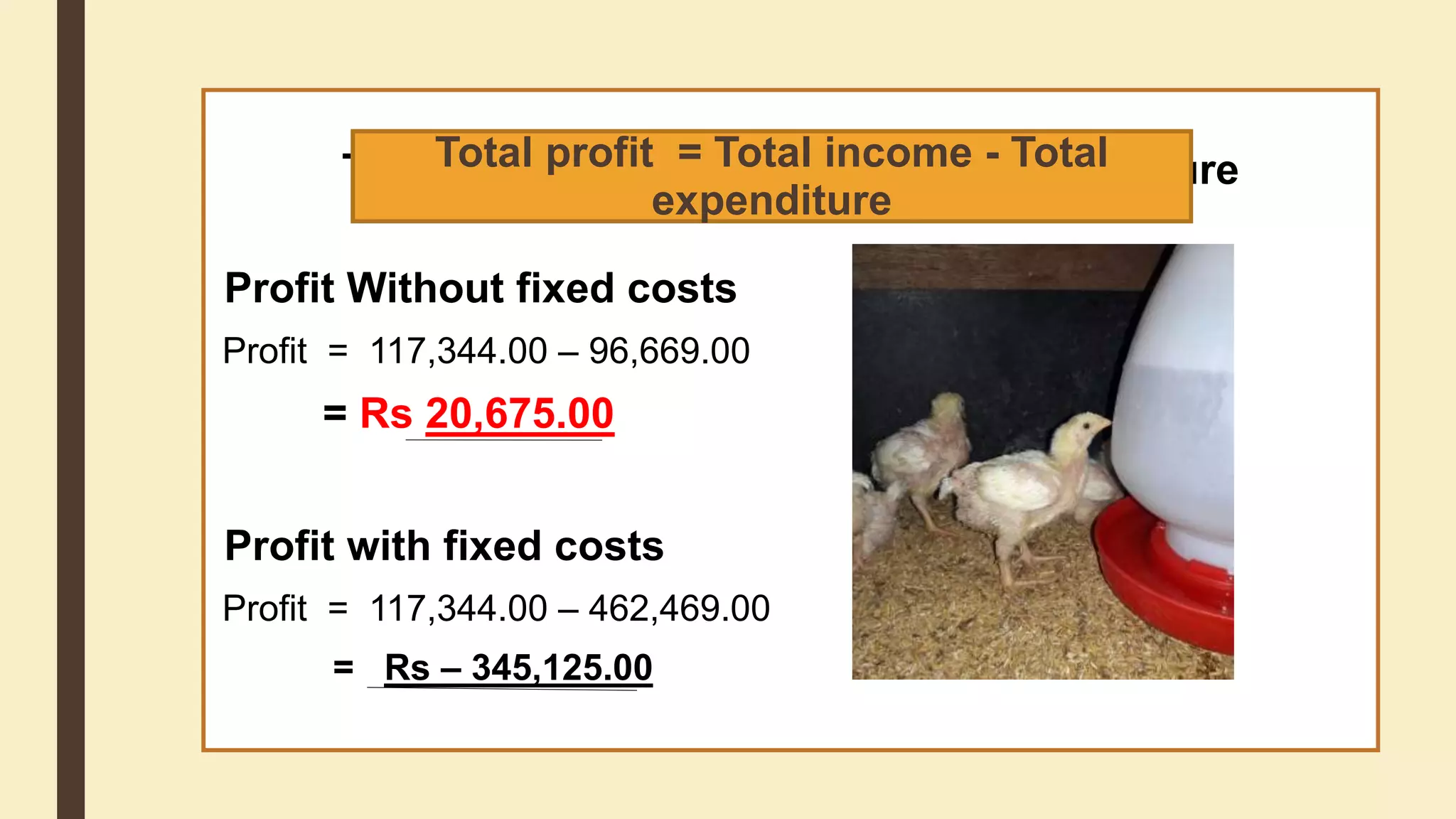
Total profit = total income- total expenditure
Profit Without fixed costs
Profit = 117,344.00 – 96,669.00
= Rs 20,675.00
Profit with fixed costs
Profit = 117,344.00 – 462,469.00
= Rs – 345,125.00
Total profit = Total income - Total
expenditure
Methods to reduce cost
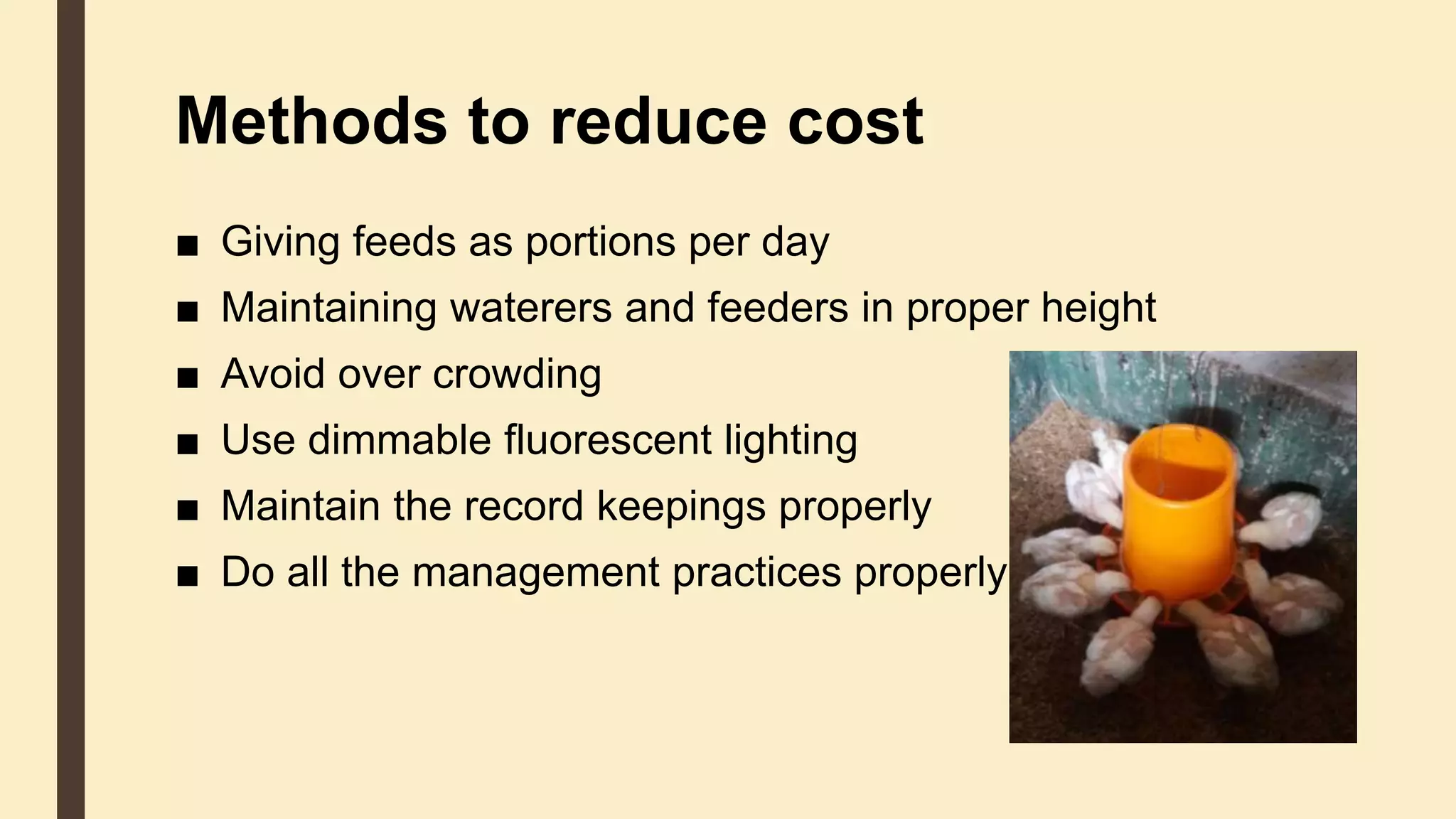
■ Giving feeds as portions per day
■ Maintaining waterers and feeders in proper height
■ Avoid over crowding
■ Use dimmable fluorescent lighting
■ Maintain the record keepings properly
■ Do all the management practices properly
Cost analysis of broiler farming

Cost analysis of broiler farming

  • 1.
    BROILER PROJECT Sachith SriMihiraj BSc (Special), M.Agri
  • 2.
    Introduction ■ Broilers arechicken reared for meat purpose. ■ Normally it takes about 42 days ■ Earlier broilers were reared in backyard , now as intensive or semi intensive. ■ Broiler farming is one of the profitable agro industry. ■ It ensures the continues flow of income
  • 3.
    What is costanalysis? ■ It is a procedure for estimating all costs involve and profits ■ It accounts both quantitative and qualitative factors for the analysis of value of money for our project ■ Cost analysis should be done before starting the farm as well as at the end. ■ There are two types of costs • Variable cost • Fixed cost
  • 4.
    Fixed cost • Fixedcost is a cost that does not change over the short term • Ex: land, poultry house, feeders, waters, brooders. Variable cost • Variable cost is a cost that change over short term. • Ex: feeds, water, vaccines, litter, medicines.
  • 5.
    Importance of costanalysis ■ To establish goals ■ Reduce risk of doing unprofitable farming ■ Reduce wasting of time and money ■ To prepare the budget ■ To cut off unnecessary costs ■ To evaluate the profit ■ For decision making
  • 6.
    Fixed costs- (justexample) Name Quantity Unit price (Rs) Total expenses (Rs) land Broiler unit 01 300000.00 wateres 20 1750.00 35000.00 feederes 20 1300.00 26000.00 Brooders 02 900.00 1800.00 Measuring scale 01 3000.00 Killing cones Defeathering machine
  • 7.
    Variable costs Name QuantityUnit price(Rs) Total expenses (Rs) chicks 200 120.00 24,000.00
  • 8.
    Medicines and feeds- (just example) name quantity Unit price total expenses starter 150kg 98.00 14700.00 booster 150kg 102.00 15300.00 Finisher 350 kg 95.00 33250.00 Gamboro vaccine 3 bottles 416.60 1250.00 vitaguard 100g 90.00 90.00 Bio vitamin 1 bottle 280.00 280.00 Encrosep 1 bottle 650.00 650.00 Selvit-E 1 bottle 460.00 460.00
  • 9.
    Other cost Name QuantityUnit price (Rs) Total expenses (Rs) Polythene (thick) 7.5 Kg 174.00 1305.00 kerosene Lamps 2 660.00 1220.00 Kerosene oil 4 l 56.50 226.00 Bulbs (60W) 5 40.00 200.00 Bulbs(100W) 2 100.00 200.00 Lime 25 kg 320.00 Electricity bill 156 KW 20.00 3120.00 Water bill 1140 l 100.00 Teepol 1 bottle 130.00 Binding wires 500 g 100.00 Record keeping books 6 28.00 168.00 Packing materials 200 bags 2.00 400.00 (just example)
  • 10.
    Profit evaluation Income No ofbroilers = 193 Average weight of a bird = 1.6 Kg Total weight = 193 *1.6 = 308.8 Kg Selling price per Kg = Rs 380 .00 total income = 380 * 308.8 = Rs 117,344.00 Expenditures  Fixed cost = Rs 365,800.00  Chicks = Rs 24,000.00  Feeds and medicines = Rs 65,980.00  Others = Rs 6,689.00 Total expenditure = Rs 462,469.00
  • 11.
    Total profit =total income- total expenditure Profit Without fixed costs Profit = 117,344.00 – 96,669.00 = Rs 20,675.00 Profit with fixed costs Profit = 117,344.00 – 462,469.00 = Rs – 345,125.00 Total profit = Total income - Total expenditure
  • 12.
    Methods to reducecost ■ Giving feeds as portions per day ■ Maintaining waterers and feeders in proper height ■ Avoid over crowding ■ Use dimmable fluorescent lighting ■ Maintain the record keepings properly ■ Do all the management practices properly