BSc (Special), M.Agri
Sachith Sri Mihiraj
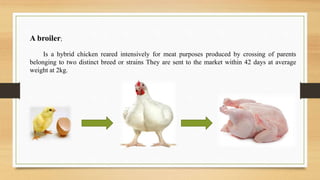
A broiler;
Is a hybrid chicken reared intensively for meat purposes produced by crossing of parents
belonging to two distinct breed or strains They are sent to the market within 42 days at average
weight at 2kg.
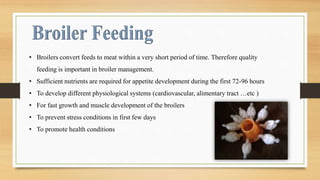
• Broilers convert feeds to meat within a very short period of time. Therefore quality
feeding is important in broiler management.
• Sufficient nutrients are required for appetite development during the first 72-96 hours
• To develop different physiological systems (cardiovascular, alimentary tract …etc )
• For fast growth and muscle development of the broilers
• To prevent stress conditions in first few days
• To promote health conditions
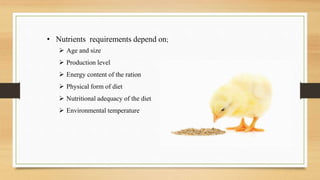
• Nutrients requirements depend on;
 Age and size
 Production level
 Energy content of the ration
 Physical form of diet
 Nutritional adequacy of the diet
 Environmental temperature
• Energy concentrates – corn, milling by-products, sorghum…
• Protein concentrates
 plant protein sources - soybean meals and other oil seed meals
 animal protein sources –meat and bone meal, fish meal
• Water
Feed additives :
 Nutrient feed additives : vitamin and mineral supplements,
Essential Amino Acids
 Non nutrient feed additives : antibiotics, coccidiostats,
anti oxidants, enzymes, prebiotics and probiotics
 Proteins : adequate amount of protein is very much important due to their fast growth and weight gain.
 Carbohydrates & fats : Provide metabolisable energy (ME), fuel for body function
 Minerals : important for proper body functions
 Vitamins : important role in metabolism, require in small quantities
 water :
 For heat removal
 Digestion and formation of body tissues
Mainly there are two rations in broiler feeding.
1. Broiler starter (Day 1 to 21)
2. Broiler finisher (Day 22 to slaughter )
Broiler starter
 Highest quality feed
 Important in establishing good appetite and maximum early growth
 Contain more protein : 21-23% (SL 20-21%)
 Metabolisable Energy – 3200 kcal/kg of diet
 Crumble form
 Ad libitum feeding
 Should contain;
 Coccidiostats
 Feed additives (growth promoters)
Broiler finisher
 Lesser protein than starter
 Protein content : 20% (SL18%)
 Metabolisable Energy – 3200kcal/kg of diet
 Pellets form
 Ad libitum feeding
 Contain feed additives
 Feeding process should be stopped at 12-18 hours before slaughtering.
Reasons :
 Ease of handling and transportation
 Empty the digestive tract – lower the chance of spoilage
 Reduce feed cost
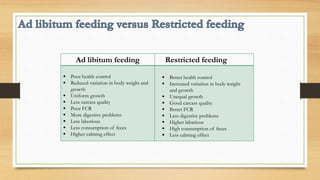
Ad libitum feeding Restricted feeding
 Poor health control
 Reduced variation in body weight and
growth
 Uniform growth
 Less carcass quality
 Poor FCR
 More digestive problems
 Less laborious
 Less consumption of feces
 Higher calming effect
 Better health control
 Increased variation in body weight
and growth
 Unequal growth
 Good carcass quality
 Better FCR
 Less digestive problems
 Higher labarious
 High consumption of feces
 Less calming effect
• Other than those feeds;
 Vitaguard solution (multivitamin- Bio vitamin oral solution 1ml per 1l)
 Selvit E (vitamin E oral solution)
 Enrocip oral solution (10% wv) were provided.
• Provide water and feeds twice a day.
• For feeding of broilers; following types of feeders can be used.
 Automatic
 Linear
 Circular
• For watering; following types of drinkers can be used.
 Bell
 Nipple
 Linear
 Conventional
• Feeders and drinkers should be in hygiene condition.
• Sufficient feeding space has to be provided, depending on their age
• 0-2 weeks - 3 cm
• 3-4 weeks - 5 cm
• > 4 weeks - 8 cm
• Height of the feeder should adjusted
Sufficient drinker space has to be provided, depending on their age
• 0-2 weeks – 1.3cm
• 3-5 weeks – 2.5 cm
• > 5 weeks - 5 cm
• Height of the feeder should be adjusted
High cost for feeds
High feed wastage
Disturbing birds during watering and feeding
Broiler feeding

Broiler feeding

  • 1.
  • 2.
    A broiler; Is ahybrid chicken reared intensively for meat purposes produced by crossing of parents belonging to two distinct breed or strains They are sent to the market within 42 days at average weight at 2kg.
  • 3.
    • Broilers convertfeeds to meat within a very short period of time. Therefore quality feeding is important in broiler management. • Sufficient nutrients are required for appetite development during the first 72-96 hours • To develop different physiological systems (cardiovascular, alimentary tract …etc ) • For fast growth and muscle development of the broilers • To prevent stress conditions in first few days • To promote health conditions
  • 4.
    • Nutrients requirementsdepend on;  Age and size  Production level  Energy content of the ration  Physical form of diet  Nutritional adequacy of the diet  Environmental temperature
  • 5.
    • Energy concentrates– corn, milling by-products, sorghum… • Protein concentrates  plant protein sources - soybean meals and other oil seed meals  animal protein sources –meat and bone meal, fish meal • Water Feed additives :  Nutrient feed additives : vitamin and mineral supplements, Essential Amino Acids  Non nutrient feed additives : antibiotics, coccidiostats, anti oxidants, enzymes, prebiotics and probiotics
  • 6.
     Proteins :adequate amount of protein is very much important due to their fast growth and weight gain.  Carbohydrates & fats : Provide metabolisable energy (ME), fuel for body function  Minerals : important for proper body functions  Vitamins : important role in metabolism, require in small quantities  water :  For heat removal  Digestion and formation of body tissues
  • 7.
    Mainly there aretwo rations in broiler feeding. 1. Broiler starter (Day 1 to 21) 2. Broiler finisher (Day 22 to slaughter ) Broiler starter  Highest quality feed  Important in establishing good appetite and maximum early growth  Contain more protein : 21-23% (SL 20-21%)  Metabolisable Energy – 3200 kcal/kg of diet  Crumble form  Ad libitum feeding  Should contain;  Coccidiostats  Feed additives (growth promoters)
  • 8.
    Broiler finisher  Lesserprotein than starter  Protein content : 20% (SL18%)  Metabolisable Energy – 3200kcal/kg of diet  Pellets form  Ad libitum feeding  Contain feed additives  Feeding process should be stopped at 12-18 hours before slaughtering. Reasons :  Ease of handling and transportation  Empty the digestive tract – lower the chance of spoilage  Reduce feed cost
  • 9.
    Ad libitum feedingRestricted feeding  Poor health control  Reduced variation in body weight and growth  Uniform growth  Less carcass quality  Poor FCR  More digestive problems  Less laborious  Less consumption of feces  Higher calming effect  Better health control  Increased variation in body weight and growth  Unequal growth  Good carcass quality  Better FCR  Less digestive problems  Higher labarious  High consumption of feces  Less calming effect
  • 10.
    • Other thanthose feeds;  Vitaguard solution (multivitamin- Bio vitamin oral solution 1ml per 1l)  Selvit E (vitamin E oral solution)  Enrocip oral solution (10% wv) were provided. • Provide water and feeds twice a day.
  • 11.
    • For feedingof broilers; following types of feeders can be used.  Automatic  Linear  Circular • For watering; following types of drinkers can be used.  Bell  Nipple  Linear  Conventional • Feeders and drinkers should be in hygiene condition.
  • 12.
    • Sufficient feedingspace has to be provided, depending on their age • 0-2 weeks - 3 cm • 3-4 weeks - 5 cm • > 4 weeks - 8 cm • Height of the feeder should adjusted
  • 13.
    Sufficient drinker spacehas to be provided, depending on their age • 0-2 weeks – 1.3cm • 3-5 weeks – 2.5 cm • > 5 weeks - 5 cm • Height of the feeder should be adjusted
  • 14.
    High cost forfeeds High feed wastage Disturbing birds during watering and feeding