
Animal Breeding Goals
By
Numan Sharif
This Presentation will include
The challenges for animal breeding
Defining the breeding goal
Measurement of breeding goal traits
Weighing the different traits of the breeding goal
Challenges for Animal Breeding
• The major challenge in world is an increase in human population
• More food is required for increasing population of human
• Animals contributes major portion in Agriculture in the form of food
(Meat, Milk, eggs)
• In developing countries productivity and fitness traits are the
major challenge for animal breeding to facilitate production of food
by animals and for food supply
• In developed countries with intensive animal production systems,
health and welfare traits create a new challenge for animal
breeders
Cont…
• Breeding challenges are influenced by a wide range of factors
• They are determined by the needs and priorities of the owners of the
animals, the consumers of animal products, the food industry, and
increasingly the general public
• In small population at least all female individuals are allowed to breed to
get next generation
• Then, there is no opportunity to select for traits related to food production
Selection for breeding goal traits is hardly possible in the small populations
Breeding goals depend on the production
system
• The use of the animals and the wishes of the users determine to a great extend the
breeding goal and the breeding programs
• In the breeding programs for animal functions other than food production several
traits play an important role in addition to selective breeding for the obvious
breeding goal traits
• health and welfare of the animals, and adaptation to feed of
lower quality and extreme climates to be capable to produce and reproduce
Before defining the Breeding goals we have to answer few questions:
For what reason the animals are kept?
In which way the products and animals are
marketed?
What are important aspects of feeding and
management?
Is there already a breeding program in place?
What traits can be recorded?
Is artificial reproduction applicable?
The choice of the appropriate breed
• It is a 1st step in initiating a breeding programme
• More attention should be given on the adoptive performance of breed
• High producing animals (Holstein Friesian) are imported in tropical
areas but not succeeded due to adoptive performances
• In all food production systems adaptation of the animals to the
conditions within the system is important.
• Adaptive fitness is characterized by survival, health and reproduction
related traits
The breeding goal
A breeding goal is the specification of the
traits to be improved including the
emphasis given to each trait. It gives the
direction in which we want to improve the
population
Breeding Program
A Breeding program is a program aiming at defined breeding
objectives for the production of a next generation of animals.
It is the combination of recording selected traits, the estimation of
breeding values, the selection of potential parents and a mating
programme for the selected parents including appropriate (artificial)
reproduction methods
Breeding goals are directed towards
the future and require tenacity
• Breeding goal consists of a single criterion that facilitates the
ranking of animals in line with this goal
• The breeding goal aims at the future
• The breeding goal usually involves the improvement of multiple
traits
• The breeding goal should be formulated carefully and should hold
consequently for many generations to become successful as a
breeder
• A trait should be included in the breeding goal based on its
economic value and its heritability
Breeding goals consists of several traits
The breeding goal for food production aims
 improving gross efficiency (amount of product divided by the
amount of feed consumed) reducing cost price by:
improving productivity (higher yield and financial returns
improving feed conversion(less feed per kg of product and less
costs)
improving reproduction, health and survival
(less replacement animals needed and less costs)
Measurement of breeding goal traits
Recording breeding goal traits raises a lot of questions:
• What can be measured?
• How often can or should the trait be measured?
• Who or what is measuring the trait?
• What animals can or should be involved?
• At what age?
• How detailed?
• What is the accuracy of the measurement?
• Do systematic effects play a role on the outcome of the
measurement?
The breeding goal determines which
traits should be recorded
• Breeding goal traits might be Quantitative Traits
• The traits which are measured in units (Kg, or simply in numbers)
• Kg of milk
• Grams of growth
• No. of Eggs
Qualitative Traits:
Traits are measured in classes Product traits, scores for body
traits, disease incidences or performance impressions
Good, Moderate or Bad meat quality
Cont…
• Some breeding goals traits cannot be measured at the time when it is
relevant. E.g. in meat production, meat quality is an important
breeding goal trait
• It can be measured only after slaughter and then breeding with that
animal is impossible
• Indicator traits, obtained by scanning live animals for body
composition before you take breeding decisions may help to predict
carcass composition
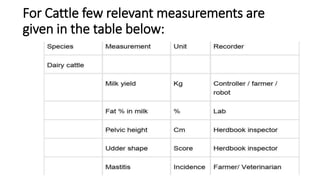
For Cattle few relevant measurements are
given in the table below:
Weighing the different traits of the
breeding goal
• In case of commercial breeding programs many traits are recorded and
have an influence on the profit of animals produced by these
commercial breeding programs
• In order to rank the individual selection candidates for the breeding
goal traits it is necessary to comprise the values for the respective
traits into one single selection criterion
• The value of this criterion can be obtained by summing up the
breeding value for each trait multiplied by a weighing factor based on
the relevance of that trait in the breeding goal
Animal breeding goals

Animal breeding goals

  • 1.
  • 2.
    This Presentation willinclude The challenges for animal breeding Defining the breeding goal Measurement of breeding goal traits Weighing the different traits of the breeding goal
  • 3.
    Challenges for AnimalBreeding • The major challenge in world is an increase in human population • More food is required for increasing population of human • Animals contributes major portion in Agriculture in the form of food (Meat, Milk, eggs) • In developing countries productivity and fitness traits are the major challenge for animal breeding to facilitate production of food by animals and for food supply • In developed countries with intensive animal production systems, health and welfare traits create a new challenge for animal breeders
  • 4.
    Cont… • Breeding challengesare influenced by a wide range of factors • They are determined by the needs and priorities of the owners of the animals, the consumers of animal products, the food industry, and increasingly the general public • In small population at least all female individuals are allowed to breed to get next generation • Then, there is no opportunity to select for traits related to food production Selection for breeding goal traits is hardly possible in the small populations
  • 5.
    Breeding goals dependon the production system • The use of the animals and the wishes of the users determine to a great extend the breeding goal and the breeding programs • In the breeding programs for animal functions other than food production several traits play an important role in addition to selective breeding for the obvious breeding goal traits • health and welfare of the animals, and adaptation to feed of lower quality and extreme climates to be capable to produce and reproduce
  • 6.
    Before defining theBreeding goals we have to answer few questions: For what reason the animals are kept? In which way the products and animals are marketed? What are important aspects of feeding and management? Is there already a breeding program in place? What traits can be recorded? Is artificial reproduction applicable?
  • 7.
    The choice ofthe appropriate breed • It is a 1st step in initiating a breeding programme • More attention should be given on the adoptive performance of breed • High producing animals (Holstein Friesian) are imported in tropical areas but not succeeded due to adoptive performances • In all food production systems adaptation of the animals to the conditions within the system is important. • Adaptive fitness is characterized by survival, health and reproduction related traits
  • 8.
    The breeding goal Abreeding goal is the specification of the traits to be improved including the emphasis given to each trait. It gives the direction in which we want to improve the population
  • 9.
    Breeding Program A Breedingprogram is a program aiming at defined breeding objectives for the production of a next generation of animals. It is the combination of recording selected traits, the estimation of breeding values, the selection of potential parents and a mating programme for the selected parents including appropriate (artificial) reproduction methods
  • 10.
    Breeding goals aredirected towards the future and require tenacity • Breeding goal consists of a single criterion that facilitates the ranking of animals in line with this goal • The breeding goal aims at the future • The breeding goal usually involves the improvement of multiple traits • The breeding goal should be formulated carefully and should hold consequently for many generations to become successful as a breeder • A trait should be included in the breeding goal based on its economic value and its heritability
  • 11.
    Breeding goals consistsof several traits The breeding goal for food production aims  improving gross efficiency (amount of product divided by the amount of feed consumed) reducing cost price by: improving productivity (higher yield and financial returns improving feed conversion(less feed per kg of product and less costs) improving reproduction, health and survival (less replacement animals needed and less costs)
  • 12.
    Measurement of breedinggoal traits Recording breeding goal traits raises a lot of questions: • What can be measured? • How often can or should the trait be measured? • Who or what is measuring the trait? • What animals can or should be involved? • At what age? • How detailed? • What is the accuracy of the measurement? • Do systematic effects play a role on the outcome of the measurement?
  • 13.
    The breeding goaldetermines which traits should be recorded • Breeding goal traits might be Quantitative Traits • The traits which are measured in units (Kg, or simply in numbers) • Kg of milk • Grams of growth • No. of Eggs Qualitative Traits: Traits are measured in classes Product traits, scores for body traits, disease incidences or performance impressions Good, Moderate or Bad meat quality
  • 14.
    Cont… • Some breedinggoals traits cannot be measured at the time when it is relevant. E.g. in meat production, meat quality is an important breeding goal trait • It can be measured only after slaughter and then breeding with that animal is impossible • Indicator traits, obtained by scanning live animals for body composition before you take breeding decisions may help to predict carcass composition
  • 15.
    For Cattle fewrelevant measurements are given in the table below:
  • 16.
    Weighing the differenttraits of the breeding goal • In case of commercial breeding programs many traits are recorded and have an influence on the profit of animals produced by these commercial breeding programs • In order to rank the individual selection candidates for the breeding goal traits it is necessary to comprise the values for the respective traits into one single selection criterion • The value of this criterion can be obtained by summing up the breeding value for each trait multiplied by a weighing factor based on the relevance of that trait in the breeding goal