Sachith Sri Mihiraj
BSc (Special), M.Agri
What is record keeping?
Record keeping is the process of making
and maintaining of complete, accurate
and reliable evidence of information.
Types of record keeping
Manual method
Most of the small scale broiler farms are
adopting this method.
No any equipment are used.
All the records are written on record books.
Accuracy is somewhat lower.
Takes more time to prepare and analyze.
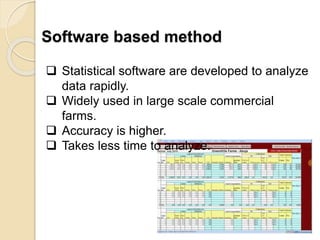
Software based method
 Statistical software are developed to analyze
data rapidly.
 Widely used in large scale commercial
farms.
 Accuracy is higher.
 Takes less time to analyze.
Importance of record keeping
Financial decisions
To make budget and for cost analysis.
Feeding decisions
To decide types of feed rations given, the
quantity of feed rations, and the effectiveness
of a specific feed ration.
Productivity of birds
To evaluate the productivity of batches.
.
Compare performance of batches
Reference to previous success
Avoid previous mistakes
Reference for visitors, auditors, bankers etc.
Reference to drug efficiency to certain
disease outbreaks
Mortality pattern for certain encountered
outbreaks recorded for future reference
Drug type and administration schedule
Characteristics of good
records
 Simple, easy to understand, with all the needed
information
 Reliable and relevant.
 Should be made available at any time.
 Should provide a clear picture of all mistakes to
be avoided in the future.
 Should provide information for future planning,
changes and expansions.
 Enable study of the production performance,
and check whether it meets the prescribed
standards.
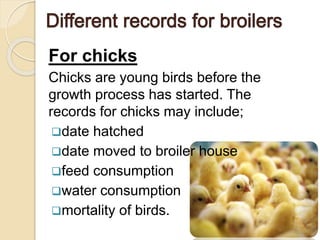
For chicks
Chicks are young birds before the
growth process has started. The
records for chicks may include;
date hatched
date moved to broiler house
feed consumption
water consumption
mortality of birds.
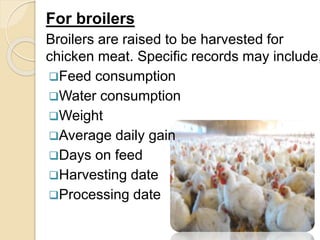
For broilers
Broilers are raised to be harvested for
chicken meat. Specific records may include,
Feed consumption
Water consumption
Weight
Average daily gain
Days on feed
Harvesting date
Processing date
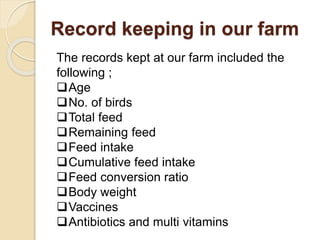
Record keeping in our farm
The records kept at our farm included the
following ;
Age
No. of birds
Total feed
Remaining feed
Feed intake
Cumulative feed intake
Feed conversion ratio
Body weight
Vaccines
Antibiotics and multi vitamins
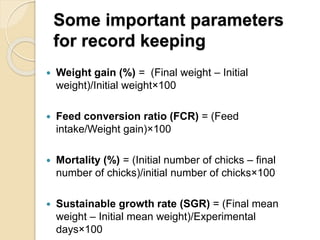
Some important parameters
for record keeping
 Weight gain (%) = (Final weight – Initial
weight)/Initial weight×100
 Feed conversion ratio (FCR) = (Feed
intake/Weight gain)×100
 Mortality (%) = (Initial number of chicks – final
number of chicks)/initial number of chicks×100
 Sustainable growth rate (SGR) = (Final mean
weight – Initial mean weight)/Experimental
days×100
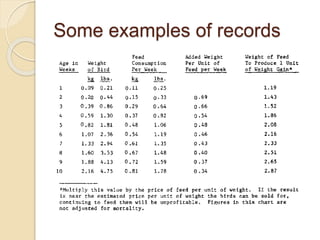
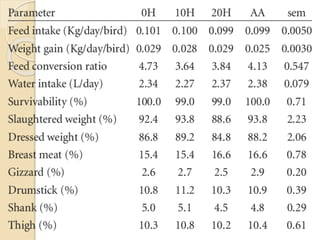
Some examples of records
Record keeping in broiler production

Record keeping in broiler production

  • 1.
    Sachith Sri Mihiraj BSc(Special), M.Agri
  • 2.
    What is recordkeeping? Record keeping is the process of making and maintaining of complete, accurate and reliable evidence of information.
  • 3.
    Types of recordkeeping Manual method Most of the small scale broiler farms are adopting this method. No any equipment are used. All the records are written on record books. Accuracy is somewhat lower. Takes more time to prepare and analyze.
  • 4.
    Software based method Statistical software are developed to analyze data rapidly.  Widely used in large scale commercial farms.  Accuracy is higher.  Takes less time to analyze.
  • 5.
    Importance of recordkeeping Financial decisions To make budget and for cost analysis. Feeding decisions To decide types of feed rations given, the quantity of feed rations, and the effectiveness of a specific feed ration. Productivity of birds To evaluate the productivity of batches.
  • 6.
    . Compare performance ofbatches Reference to previous success Avoid previous mistakes Reference for visitors, auditors, bankers etc. Reference to drug efficiency to certain disease outbreaks Mortality pattern for certain encountered outbreaks recorded for future reference Drug type and administration schedule
  • 7.
    Characteristics of good records Simple, easy to understand, with all the needed information  Reliable and relevant.  Should be made available at any time.  Should provide a clear picture of all mistakes to be avoided in the future.  Should provide information for future planning, changes and expansions.  Enable study of the production performance, and check whether it meets the prescribed standards.
  • 8.
    For chicks Chicks areyoung birds before the growth process has started. The records for chicks may include; date hatched date moved to broiler house feed consumption water consumption mortality of birds.
  • 9.
    For broilers Broilers areraised to be harvested for chicken meat. Specific records may include, Feed consumption Water consumption Weight Average daily gain Days on feed Harvesting date Processing date
  • 10.
    Record keeping inour farm The records kept at our farm included the following ; Age No. of birds Total feed Remaining feed Feed intake Cumulative feed intake Feed conversion ratio Body weight Vaccines Antibiotics and multi vitamins
  • 11.
    Some important parameters forrecord keeping  Weight gain (%) = (Final weight – Initial weight)/Initial weight×100  Feed conversion ratio (FCR) = (Feed intake/Weight gain)×100  Mortality (%) = (Initial number of chicks – final number of chicks)/initial number of chicks×100  Sustainable growth rate (SGR) = (Final mean weight – Initial mean weight)/Experimental days×100
  • 12.