Presented by
Suresh A.Gautam
(Department of pharmaceutics)
Skbcop , kamptee
Computerized marketing facilitates the
collection and dissemination of current market
information.
Most information used in the produce industry today
is acquired through telephone conversatitins with
other traders.
Computer aided marketing facilitates more
efficient dissemination of current, accurate
market information.
Operational efficiency relates to the cost
of getting produce from the farm to the consumer.
Van Sickle, Adrian and Epperson estimated
that 90 percent of the cost of negotiating
the sale could be eliminated with computerized
marketing.
In addition to negotiating
costs, other costs should also be lowered
by allowing traders to make more informed
marketing decisions with respect to location,
time and quality preferences.
Implementation of computerized marketing
should also result in increased competition.
Because most produce is traded over the telephone,
competition is limited by the number
of conversations traders can effectively carry
with each other.
Computerized marketing may not (probably will not)
result in more traders, but it should result in more
quantity and quality communication between traders.
The most consistent benefit measured in previous computerized
marketing systems has been higher grower prices, Higher grower
prices result from at least two factors, increased competition and
improved operational efficiency.
The impact of increased competition will result in higher grower
prices if growers gain bargaining power as a result of more
buyers bidding for their product.
The impact of increased competition in the produce industry
should be positive for growers, but the impact will probably be
less noticeable than in previous systems since the produce
industry is not generally considered to be a “thin” market.
Because of improved operational efficiency, grower prices should
increase because it costs less to get produce to market. At least
part of this cost savings should be passed to growers in the form
of higher grower prices.
Computerized marketing should also ease
the problems of accessing major produce
markets.
Because market access is limited by
communication of information, improvements
in communications should make market access
easier.
The potential trader acceptance of computer aided marketing
of produce was determined from a survey of the industry.
The survey was administered with personal interviews
in a “mirror image” approach.
The mirror image survey technique asks related questions
from the unique perspective of each individual surveyed so
that similarities and contrasts in the operations of the different
participant groups could be identified.
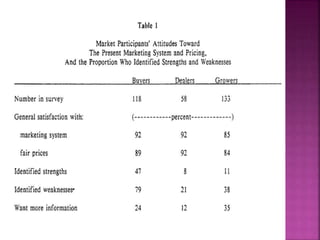
The market channel participants were divided into three broad
categories for survey purposes:buyers, dealers and sellers.
The survey was designed to collect demographic
information about the individual surveyed,
the present and expected use of computers
by the market participants, and the
attitude of the participants about the concept
of computer aided marketing.
The results of this analysis were used with other
information collected in the survey to draw important
conclusions about the potential to develop a computer
aided marketing program for produce.
The Advisory Committee concluded that a computer
aided marketing system should be developed for the
produce industry.
Because of the high level of general satisfaction with the
present market system, the committee determined that the
computer aided marketing system should be developed as
a tool to complement the present marketing system.
The approach used to conceptualize a computer
aided marketing system was to learn as much as
possible about the present marketing practices
with emphasis on the methods used to obtain
information.
The case study method was used to learn about
present marketing practices.
The case study involved choosing several traders
that would allow us to study every facet of their
marketing operation.
computer in market analysis

computer in market analysis

  • 1.
    Presented by Suresh A.Gautam (Departmentof pharmaceutics) Skbcop , kamptee
  • 2.
    Computerized marketing facilitatesthe collection and dissemination of current market information. Most information used in the produce industry today is acquired through telephone conversatitins with other traders. Computer aided marketing facilitates more efficient dissemination of current, accurate market information.
  • 3.
    Operational efficiency relatesto the cost of getting produce from the farm to the consumer. Van Sickle, Adrian and Epperson estimated that 90 percent of the cost of negotiating the sale could be eliminated with computerized marketing. In addition to negotiating costs, other costs should also be lowered by allowing traders to make more informed marketing decisions with respect to location, time and quality preferences.
  • 4.
    Implementation of computerizedmarketing should also result in increased competition. Because most produce is traded over the telephone, competition is limited by the number of conversations traders can effectively carry with each other. Computerized marketing may not (probably will not) result in more traders, but it should result in more quantity and quality communication between traders.
  • 5.
    The most consistentbenefit measured in previous computerized marketing systems has been higher grower prices, Higher grower prices result from at least two factors, increased competition and improved operational efficiency. The impact of increased competition will result in higher grower prices if growers gain bargaining power as a result of more buyers bidding for their product. The impact of increased competition in the produce industry should be positive for growers, but the impact will probably be less noticeable than in previous systems since the produce industry is not generally considered to be a “thin” market. Because of improved operational efficiency, grower prices should increase because it costs less to get produce to market. At least part of this cost savings should be passed to growers in the form of higher grower prices.
  • 6.
    Computerized marketing shouldalso ease the problems of accessing major produce markets. Because market access is limited by communication of information, improvements in communications should make market access easier.
  • 7.
    The potential traderacceptance of computer aided marketing of produce was determined from a survey of the industry. The survey was administered with personal interviews in a “mirror image” approach. The mirror image survey technique asks related questions from the unique perspective of each individual surveyed so that similarities and contrasts in the operations of the different participant groups could be identified. The market channel participants were divided into three broad categories for survey purposes:buyers, dealers and sellers.
  • 8.
    The survey wasdesigned to collect demographic information about the individual surveyed, the present and expected use of computers by the market participants, and the attitude of the participants about the concept of computer aided marketing.
  • 9.
    The results ofthis analysis were used with other information collected in the survey to draw important conclusions about the potential to develop a computer aided marketing program for produce. The Advisory Committee concluded that a computer aided marketing system should be developed for the produce industry. Because of the high level of general satisfaction with the present market system, the committee determined that the computer aided marketing system should be developed as a tool to complement the present marketing system.
  • 10.
    The approach usedto conceptualize a computer aided marketing system was to learn as much as possible about the present marketing practices with emphasis on the methods used to obtain information. The case study method was used to learn about present marketing practices. The case study involved choosing several traders that would allow us to study every facet of their marketing operation.