NUCLEIC ACID BASED THERAPEUTIC
DELIVERY SYSTEM
SUBMITTED BY: RAHUL PAL, PRACHI PANDEY SUBMITTED TO: MR. ARSH CHANANA
M. PHARM (PHARMACEUTICS), IIND SEM.
DEPARTMENT OF PHARMACEUTICS, NIMS INSTITUTE OF PHARMACY, NIMS UNIVERSITY, JAIPUR,
RAJASTHAN, 303121, INDIA.
INTRODUCTION
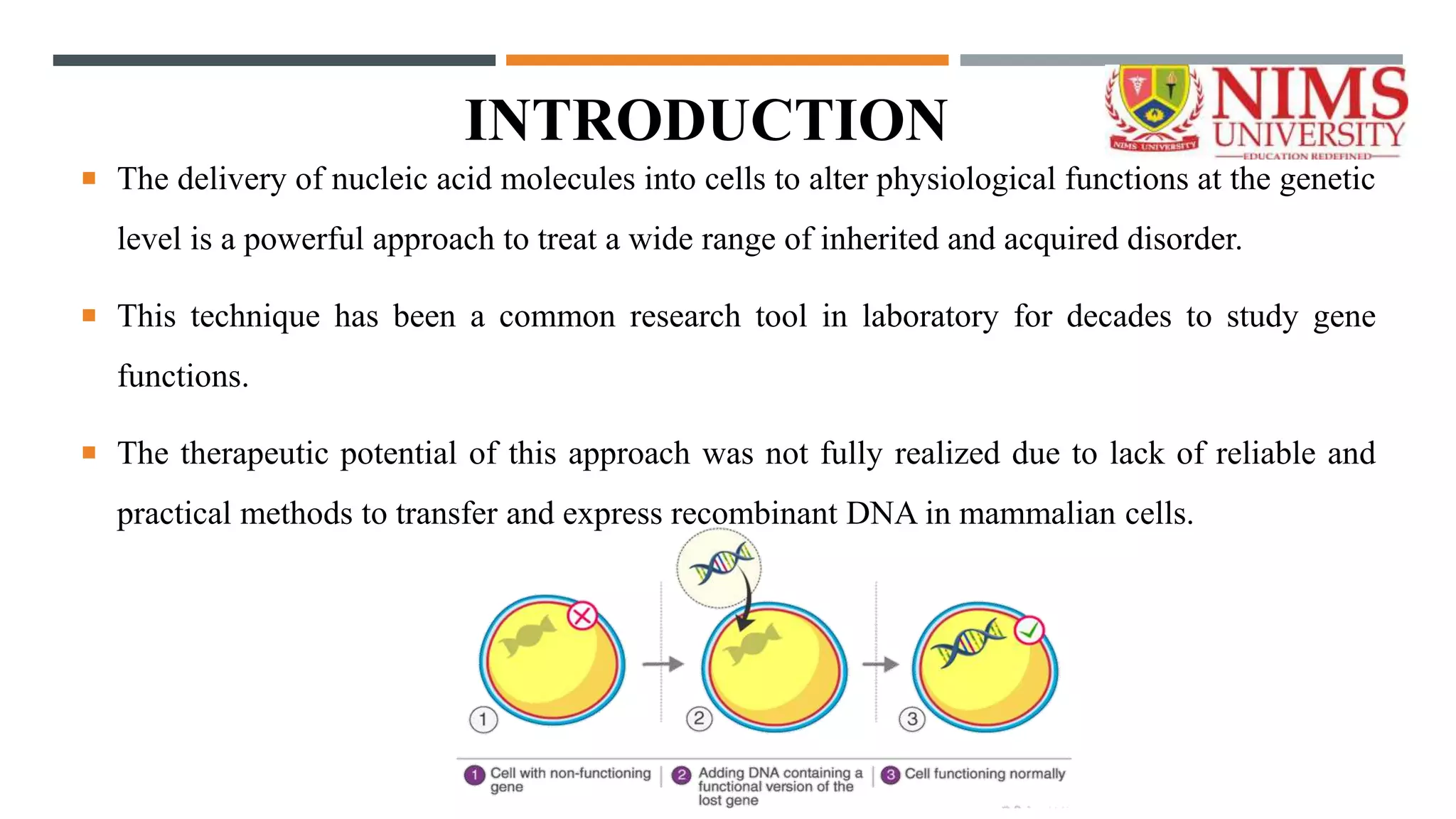
๏‚ก The delivery of nucleic acid molecules into cells to alter physiological functions at the genetic
level is a powerful approach to treat a wide range of inherited and acquired disorder.
๏‚ก This technique has been a common research tool in laboratory for decades to study gene
functions.
๏‚ก The therapeutic potential of this approach was not fully realized due to lack of reliable and
practical methods to transfer and express recombinant DNA in mammalian cells.
GENE THERAPY
๏‚ก Insertion of new genetic material into the cells of an individual with the intention of producing a
therapeutic benefits for the patient is human gene therapy.
๏‚ก The power of gene therapy is derived from the ability to manipulate cell physiology at genetic
and epigenetic levels.
๏‚ก Gene therapy quickly an intensely investigated field with the promising potential to devise
treatment not only for genetic diseases.
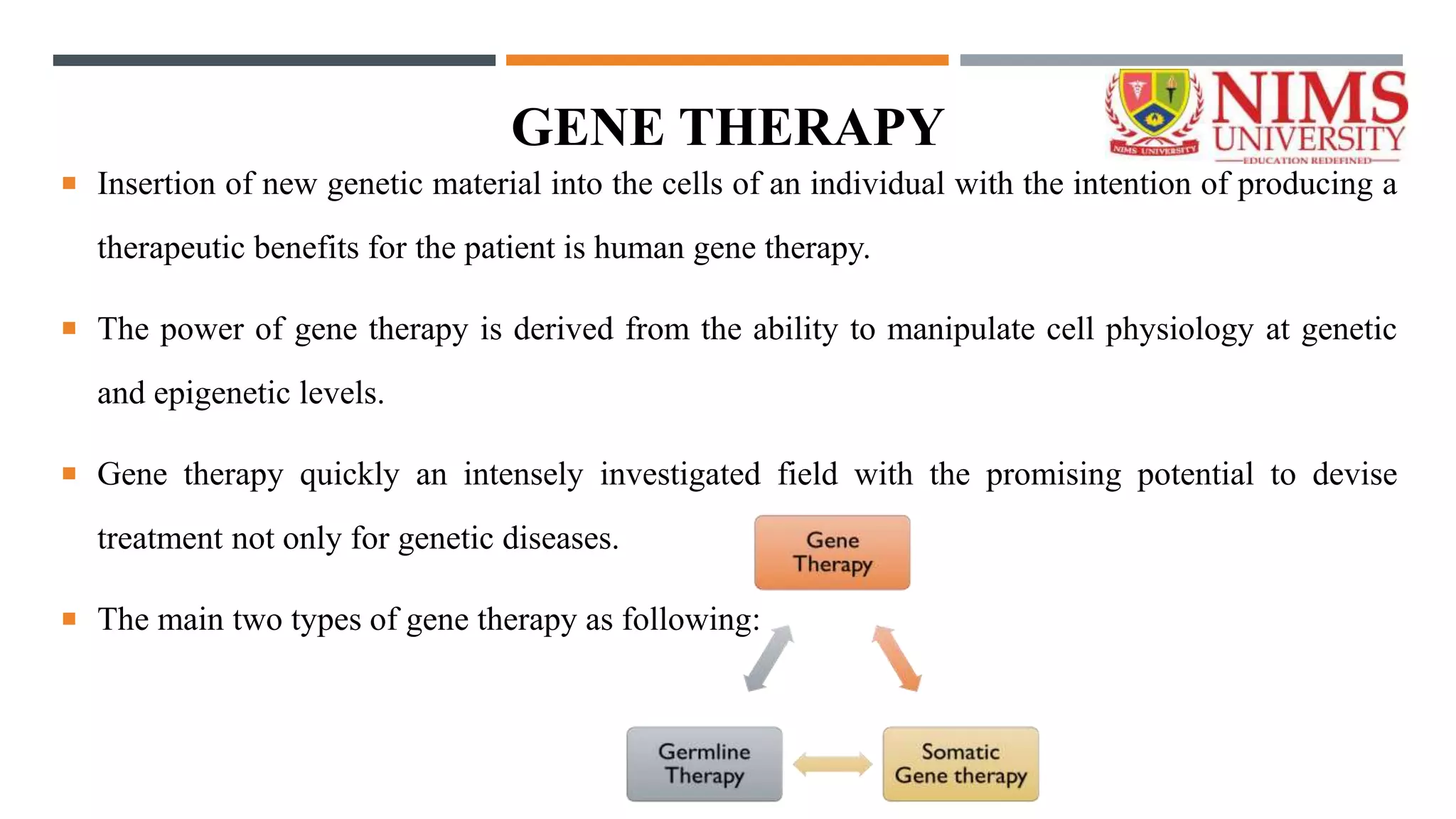
๏‚ก The main two types of gene therapy as following:
DIFFERENTIATION OF TYPES OF GENE THERAPY
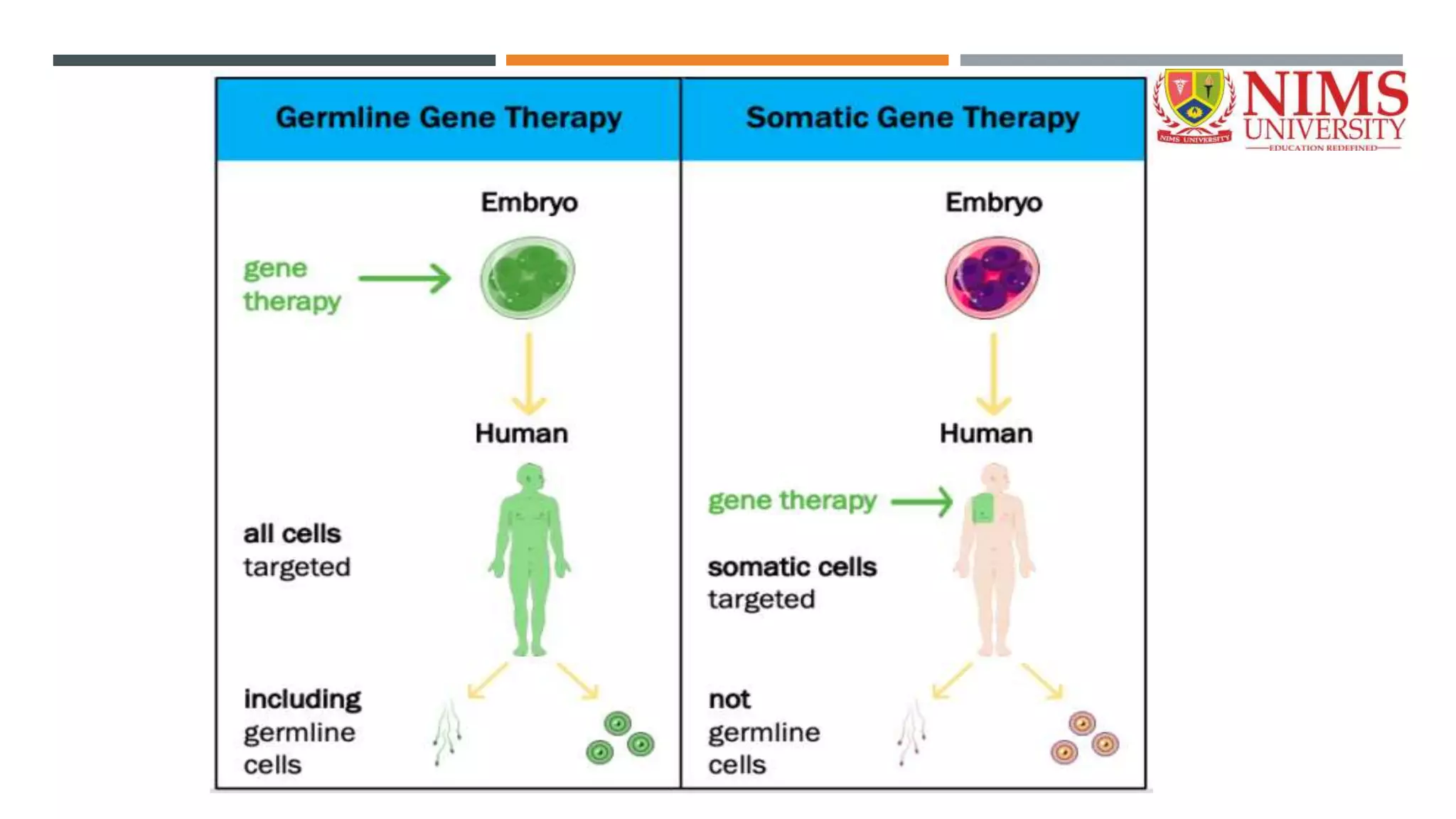
Germline Gene Therapy
๏‚ก In Germline Gene Therapy (GGT) germs cells are
modified by introduction of therapeutic genes.
๏‚ก Modifying a germ cell causes all the organism cells
to contains the modified gene.
๏‚ก The change is therefore, heritable and passed on to
later generation.
๏‚ก For safety, ethical and technical reasons it is not
being attempted at present.
Somatic Gene Therapy
๏‚ก In somatic cell gene therapy (SCGT) the therapeutics
genes are transferred into any cell other than a germ
cell.
๏‚ก Introduction of genes into bone marrow cells, blood
cells and skin cells.
๏‚ก It will not be inherited to later generation.
๏‚ก Most focus on severe genetic disorder including
immuno-deficiencies hemophilia, thalassemia and
cystic fibrosis.
TYPES OF SOMATIC CELL GENE THERAPY
DESCRIPTION ON EX-VIVO AND IN-VIVO
Ex-Vivo
๏‚ก Isolate cells with defect from a patient.
๏‚ก Grow the cells in culture.
๏‚ก Introduction the therapeutic genes.
๏‚ก Select genetically corrected cells and grow.
๏‚ก Transplant the modified cells to the patients.
In-vivo
๏‚ก Direct delivery of therapeutic gene into target cells into
patients body.
๏‚ก Carried out by viral or non-viral vector systems.
๏‚ก It can be the only possible option in patients where
individual cells cannot be cultured in-vitro in sufficient
numbers (eg. Brain cells).
๏‚ก In-vivo gene transfer is necessary when cultured cells
cannot be re-implanted in patients effectively.
Representation of In-Vivo and Ex-Vivo gene therapy
BASIC PROCESS OF GENE THERAPY: PROCESS
OF GENE THERAPY
๏‚ก A gene that is inserted directly into a cell usually does not functions, instead, a carrier called a vector is
genetically engineered to deliver the gene.
๏‚ก Viruses are often used as vectors because they can deliver the new gene by infecting the cell.
๏‚ก Delivery of gene into cells can also be accomplished by some other method like DNA complex's etc.
VIRAL VECTORS AND TYPES
Viruses have evolved a way of encapsulating and delivering their genes to huma cells in a pathogenic way by
manipulating the viral genome to remove disease causing gene and inserting therapeutic one. Viruses bind to their
hosts and introduce their genetic material into the host cell. Viruses used are altered to make them safe, although some
risks still exist with this type of gene therapy.
1. Retrovirus vector system: Recombinant retrovirus have the ability to integrate into the host genome in a stable
fashion.
2. Adeno Virus vector system: Adeno virus with DNA genome is a good carrier. Useful in treating common cold.
3. Adeno Associated virus vector: It is a single stranded, non pathologic small DNA Virus. It can integrate into
Chromosome 19.
4. Herpes simplex virus vector: They persist into nervous cell. These viruses have natural tendency to infect
particular type of cell.
NON-VIRAL VECTOR
๏‚ก The non-viral vectors are naked DNA, particle based and chemical based.
๏‚ก They are administered by direct administration (plasmid DNA/naked DNA)/
chemical/physical.
๏‚ก Most of cardiovascular clinical trials use non-viral vectors as a mode of gene transfer.
๏‚ก Non-viral vectors are generally used to transfer following type of nucleic acids:
Small
DNA
Large
DNA
RNA
Physical Methods (Carrier Free Gene Delivery)
โ€ขNeedle injection: The genetic material is
administered through a needle carrying
syringe into tissue/ synthetic injection from a
vessel.
โ€ขElectroporation
โ€ขGene Gun: Employs a high pressure
delivery system to shoot tissue with gold or
tungsten particle that are coated with DNA.
โ€ขHydroporation
Chemical Methods (Synthetic
vector based delivery)
Inorganic particles: Ca. Phosphate, Silica
and Gold.
Synthetic/natural biodegradable polymer:
Polyethyleneimine, Polymethacrylate,
Chitosan and Dendrimers.
Lipid Based: Lipid nano-emulsions, solid
lipid nano-particles and peptide.
POTENTIAL TARGET DISEASES FOR GENE THERAPY
(INHERITED DISORDER AND CANCER)
GENE THERAPY FOR TRAETMENT OF GENETIC DIAORDER:
Genetic disorder are illnesses steaming from errors in a person gene.
Any mistake in gene can alter how a specific protein is produced.
Without proper protein, the body will not functions properly and will take on a chronic and
possibly life threatening conditions.
Genetic disorder can be congenital meaning they occur from birth or they may develop over
time.
GENE THERAPY FOR CANCER TREATMENT
๏‚ก ONCOGENE ACTIVATION:
Done by using antisense therapy
Reduces the expression of antigenic protein responsible for malignancies.
๏‚ก VIRUS MEDIATED ONCOLYSIS:
Adeno virus and herpes virus can infect and causes lysis of cancer cells.
๏‚ก AUGMENTATIONOF TUMOR SUPRESSOR GENE:
It is done by repair of tumor suppressor gene in malignant cells.
GENE THERPAY IN SOME OTHER DISEASES
The gene therapy can also used in other disease like:
๏‚ก Diabetes
๏‚ก Cystic fibrosis
๏‚ก Parkinsonโ€™s diseases
๏‚ก X-SCID (X-linked combine immunodeficiency)
๏‚ก Adenosine deaminase deficiency
๏‚ก Muscular dystrophy
Diabetes Parkinsonโ€™s diseases
Muscular dystrophy
Cystic fibrosis
LIMINATIONS OF GENE THERAPY:
๏‚ก Immune hyper responsiveness directed against viral vector components may leads to
deactivation of gene.
๏‚ก Virus that used as vectors may also causes diseases inside the body.
๏‚ก Once we does not have control over the site of insertion of genome.
CONCLUSION:
๏‚ก Nucleic acid based therapeutic delivery is a technique that will e very useful for the treatment
of many diseases.
๏‚ก Gene therapy can be helpful in many genetic disease which can prevent those diseases for
future generations.
RECENT AND FUTURE ASPECTS
1. The director of the centre for gene therapy at Nationwide Children's Hospital talked about the challenges
and opportunities of gene therapies for neuromuscular diseases at the 2023 MDA conference.
2. New Castle, USA, May 25, 2023 (GLOBE NEWSWIRE) Growth Plus Reports studied and calculated the
size of the global market for gene therapy in CNS disorders in 2022 and is expected to increase at a
revenue CAGR of 29.3% during the forecast period 2023-2031.
3. The U.S. Food and Drug Administration (FDA) have voted that at their formal meeting at the end of
May, approval moves forward for a gene therapy for Duchenne muscular dystrophy-a disabling genetic
disease.
4. This year marks the first time multiple gene therapies for the same non-oncology rare disease may be
market authorized in the United States. They include treatments for beta-thalassemia, haemophilia B, and
potential treatments for sickle cell disease.
5. U.S. Food and Drug Administration. โ€œFDA Approves First Cell-Based Gene Therapy to Treat Adult and
Pediatric Patients with Beta-thalassemia Who Require Regular Blood Transfusions.โ€ 17 Aug 2022.
REFERENCES
1) S.P. Vyas and Khar; โ€œControlled and target drug delivery systemโ€, 2nd edition; page no.
520-560.
2) Charlie Yu Ming Hsu and Hasan Iludag: โ€œNucleic Acid gene therapeutic: Delivery
challenges and molecular design of non-viral gene carriers and expression cassettes to
overcome intracellular barriers for sustained targeted expressionโ€; Journal of Drug
Targeting: Page no. 301-319; 2012; 20 (4).

Nucleic Acid Based Therapeutic Delivery System.pptx

  • 1.
    NUCLEIC ACID BASEDTHERAPEUTIC DELIVERY SYSTEM SUBMITTED BY: RAHUL PAL, PRACHI PANDEY SUBMITTED TO: MR. ARSH CHANANA M. PHARM (PHARMACEUTICS), IIND SEM. DEPARTMENT OF PHARMACEUTICS, NIMS INSTITUTE OF PHARMACY, NIMS UNIVERSITY, JAIPUR, RAJASTHAN, 303121, INDIA.
  • 2.
    INTRODUCTION ๏‚ก The deliveryof nucleic acid molecules into cells to alter physiological functions at the genetic level is a powerful approach to treat a wide range of inherited and acquired disorder. ๏‚ก This technique has been a common research tool in laboratory for decades to study gene functions. ๏‚ก The therapeutic potential of this approach was not fully realized due to lack of reliable and practical methods to transfer and express recombinant DNA in mammalian cells.
  • 3.
    GENE THERAPY ๏‚ก Insertionof new genetic material into the cells of an individual with the intention of producing a therapeutic benefits for the patient is human gene therapy. ๏‚ก The power of gene therapy is derived from the ability to manipulate cell physiology at genetic and epigenetic levels. ๏‚ก Gene therapy quickly an intensely investigated field with the promising potential to devise treatment not only for genetic diseases. ๏‚ก The main two types of gene therapy as following:
  • 4.
    DIFFERENTIATION OF TYPESOF GENE THERAPY Germline Gene Therapy ๏‚ก In Germline Gene Therapy (GGT) germs cells are modified by introduction of therapeutic genes. ๏‚ก Modifying a germ cell causes all the organism cells to contains the modified gene. ๏‚ก The change is therefore, heritable and passed on to later generation. ๏‚ก For safety, ethical and technical reasons it is not being attempted at present. Somatic Gene Therapy ๏‚ก In somatic cell gene therapy (SCGT) the therapeutics genes are transferred into any cell other than a germ cell. ๏‚ก Introduction of genes into bone marrow cells, blood cells and skin cells. ๏‚ก It will not be inherited to later generation. ๏‚ก Most focus on severe genetic disorder including immuno-deficiencies hemophilia, thalassemia and cystic fibrosis.
  • 6.
    TYPES OF SOMATICCELL GENE THERAPY
  • 7.
    DESCRIPTION ON EX-VIVOAND IN-VIVO Ex-Vivo ๏‚ก Isolate cells with defect from a patient. ๏‚ก Grow the cells in culture. ๏‚ก Introduction the therapeutic genes. ๏‚ก Select genetically corrected cells and grow. ๏‚ก Transplant the modified cells to the patients. In-vivo ๏‚ก Direct delivery of therapeutic gene into target cells into patients body. ๏‚ก Carried out by viral or non-viral vector systems. ๏‚ก It can be the only possible option in patients where individual cells cannot be cultured in-vitro in sufficient numbers (eg. Brain cells). ๏‚ก In-vivo gene transfer is necessary when cultured cells cannot be re-implanted in patients effectively.
  • 8.
    Representation of In-Vivoand Ex-Vivo gene therapy
  • 9.
    BASIC PROCESS OFGENE THERAPY: PROCESS OF GENE THERAPY ๏‚ก A gene that is inserted directly into a cell usually does not functions, instead, a carrier called a vector is genetically engineered to deliver the gene. ๏‚ก Viruses are often used as vectors because they can deliver the new gene by infecting the cell. ๏‚ก Delivery of gene into cells can also be accomplished by some other method like DNA complex's etc.
  • 10.
    VIRAL VECTORS ANDTYPES Viruses have evolved a way of encapsulating and delivering their genes to huma cells in a pathogenic way by manipulating the viral genome to remove disease causing gene and inserting therapeutic one. Viruses bind to their hosts and introduce their genetic material into the host cell. Viruses used are altered to make them safe, although some risks still exist with this type of gene therapy. 1. Retrovirus vector system: Recombinant retrovirus have the ability to integrate into the host genome in a stable fashion. 2. Adeno Virus vector system: Adeno virus with DNA genome is a good carrier. Useful in treating common cold. 3. Adeno Associated virus vector: It is a single stranded, non pathologic small DNA Virus. It can integrate into Chromosome 19. 4. Herpes simplex virus vector: They persist into nervous cell. These viruses have natural tendency to infect particular type of cell.
  • 11.
    NON-VIRAL VECTOR ๏‚ก Thenon-viral vectors are naked DNA, particle based and chemical based. ๏‚ก They are administered by direct administration (plasmid DNA/naked DNA)/ chemical/physical. ๏‚ก Most of cardiovascular clinical trials use non-viral vectors as a mode of gene transfer. ๏‚ก Non-viral vectors are generally used to transfer following type of nucleic acids: Small DNA Large DNA RNA
  • 12.
    Physical Methods (CarrierFree Gene Delivery) โ€ขNeedle injection: The genetic material is administered through a needle carrying syringe into tissue/ synthetic injection from a vessel. โ€ขElectroporation โ€ขGene Gun: Employs a high pressure delivery system to shoot tissue with gold or tungsten particle that are coated with DNA. โ€ขHydroporation Chemical Methods (Synthetic vector based delivery) Inorganic particles: Ca. Phosphate, Silica and Gold. Synthetic/natural biodegradable polymer: Polyethyleneimine, Polymethacrylate, Chitosan and Dendrimers. Lipid Based: Lipid nano-emulsions, solid lipid nano-particles and peptide.
  • 13.
    POTENTIAL TARGET DISEASESFOR GENE THERAPY (INHERITED DISORDER AND CANCER) GENE THERAPY FOR TRAETMENT OF GENETIC DIAORDER: Genetic disorder are illnesses steaming from errors in a person gene. Any mistake in gene can alter how a specific protein is produced. Without proper protein, the body will not functions properly and will take on a chronic and possibly life threatening conditions. Genetic disorder can be congenital meaning they occur from birth or they may develop over time.
  • 14.
    GENE THERAPY FORCANCER TREATMENT ๏‚ก ONCOGENE ACTIVATION: Done by using antisense therapy Reduces the expression of antigenic protein responsible for malignancies. ๏‚ก VIRUS MEDIATED ONCOLYSIS: Adeno virus and herpes virus can infect and causes lysis of cancer cells. ๏‚ก AUGMENTATIONOF TUMOR SUPRESSOR GENE: It is done by repair of tumor suppressor gene in malignant cells.
  • 15.
    GENE THERPAY INSOME OTHER DISEASES The gene therapy can also used in other disease like: ๏‚ก Diabetes ๏‚ก Cystic fibrosis ๏‚ก Parkinsonโ€™s diseases ๏‚ก X-SCID (X-linked combine immunodeficiency) ๏‚ก Adenosine deaminase deficiency ๏‚ก Muscular dystrophy
  • 16.
  • 17.
    LIMINATIONS OF GENETHERAPY: ๏‚ก Immune hyper responsiveness directed against viral vector components may leads to deactivation of gene. ๏‚ก Virus that used as vectors may also causes diseases inside the body. ๏‚ก Once we does not have control over the site of insertion of genome. CONCLUSION: ๏‚ก Nucleic acid based therapeutic delivery is a technique that will e very useful for the treatment of many diseases. ๏‚ก Gene therapy can be helpful in many genetic disease which can prevent those diseases for future generations.
  • 18.
    RECENT AND FUTUREASPECTS 1. The director of the centre for gene therapy at Nationwide Children's Hospital talked about the challenges and opportunities of gene therapies for neuromuscular diseases at the 2023 MDA conference. 2. New Castle, USA, May 25, 2023 (GLOBE NEWSWIRE) Growth Plus Reports studied and calculated the size of the global market for gene therapy in CNS disorders in 2022 and is expected to increase at a revenue CAGR of 29.3% during the forecast period 2023-2031. 3. The U.S. Food and Drug Administration (FDA) have voted that at their formal meeting at the end of May, approval moves forward for a gene therapy for Duchenne muscular dystrophy-a disabling genetic disease. 4. This year marks the first time multiple gene therapies for the same non-oncology rare disease may be market authorized in the United States. They include treatments for beta-thalassemia, haemophilia B, and potential treatments for sickle cell disease. 5. U.S. Food and Drug Administration. โ€œFDA Approves First Cell-Based Gene Therapy to Treat Adult and Pediatric Patients with Beta-thalassemia Who Require Regular Blood Transfusions.โ€ 17 Aug 2022.
  • 19.
    REFERENCES 1) S.P. Vyasand Khar; โ€œControlled and target drug delivery systemโ€, 2nd edition; page no. 520-560. 2) Charlie Yu Ming Hsu and Hasan Iludag: โ€œNucleic Acid gene therapeutic: Delivery challenges and molecular design of non-viral gene carriers and expression cassettes to overcome intracellular barriers for sustained targeted expressionโ€; Journal of Drug Targeting: Page no. 301-319; 2012; 20 (4).