- Ankit Kumar
Introduction
:-
• Family:- SARS( Severe Acute Respiratory Disorder)
According to Who,
• Corona viruses are a large family of viruses which may cause illness in animals or
humans.
• In Humans, Several corona viruses are known to cause respiratory infections
ranging from the common cold to more severe diseases .such as Middle East
Respiratory Syndrome(MERS) and SARS
* Real name- COVID-19/ Noval corona virus
COVID-19
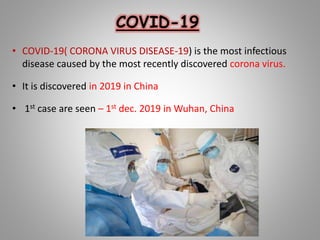
• COVID-19( CORONA VIRUS DISEASE-19) is the most infectious
disease caused by the most recently discovered corona virus.
• It is discovered in 2019 in China
• 1st case are seen – 1st dec. 2019 in Wuhan, China
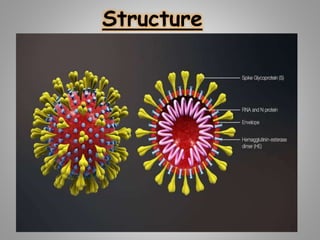
Structure
Transmission
• Direct transmission- Animals( Snake, Bat, Camel)
• Indirect transmission- By person to person
Droplet infection- From the nose or mouth which
are spread when a person with COVID-19 Coughs or exhales.
• These droplet land to objects and surfaces around the person.
• other people infected through COVID-19 by touching these objects or surfaces ,
then touching their eyes, nose or mouth.
• People also spread from COVID-19 if they breathe in droplets from a person with
COVID -19 who coughs or exhales droplets. This is why it is important to stay more
than 1meter(3 feet) away from a person who is seek.
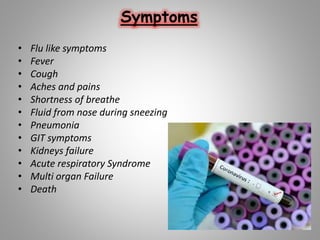
Symptoms
• Flu like symptoms
• Fever
• Cough
• Aches and pains
• Shortness of breathe
• Fluid from nose during sneezing
• Pneumonia
• GIT symptoms
• Kidneys failure
• Acute respiratory Syndrome
• Multi organ Failure
• Death
• Some people become infected but don’t develop any
symptoms and don’t feel unwell.
• About 80% recover from disease without needing special
treatment.
• Around 1 out of every 6 people who gets COVID-19 become
seriously ill and develops difficulty breathing.
• Older people, Children’s and immunocompromised people
and those with underlying medical problems like high BP ,
heart problems or diabetes are more likely to develop serious
illness.
Treatment
- No specific treatment
- No any vaccine till now
• People with serious illness should be
hospitalized.
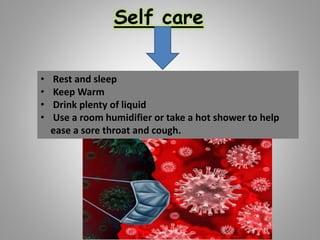
Self care
• Rest and sleep
• Keep Warm
• Drink plenty of liquid
• Use a room humidifier or take a hot shower to help
ease a sore throat and cough.
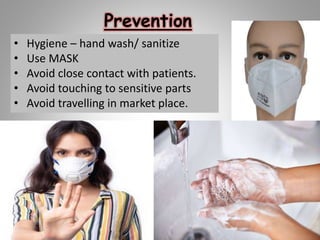
Prevention
• Hygiene – hand wash/ sanitize
• Use MASK
• Avoid close contact with patients.
• Avoid touching to sensitive parts
• Avoid travelling in market place.
Stay Home
Stay Safe
Thank you..

Corona virus

  • 1.
  • 2.
    Introduction :- • Family:- SARS(Severe Acute Respiratory Disorder) According to Who, • Corona viruses are a large family of viruses which may cause illness in animals or humans. • In Humans, Several corona viruses are known to cause respiratory infections ranging from the common cold to more severe diseases .such as Middle East Respiratory Syndrome(MERS) and SARS * Real name- COVID-19/ Noval corona virus
  • 3.
    COVID-19 • COVID-19( CORONAVIRUS DISEASE-19) is the most infectious disease caused by the most recently discovered corona virus. • It is discovered in 2019 in China • 1st case are seen – 1st dec. 2019 in Wuhan, China
  • 4.
  • 5.
    Transmission • Direct transmission-Animals( Snake, Bat, Camel) • Indirect transmission- By person to person Droplet infection- From the nose or mouth which are spread when a person with COVID-19 Coughs or exhales. • These droplet land to objects and surfaces around the person. • other people infected through COVID-19 by touching these objects or surfaces , then touching their eyes, nose or mouth. • People also spread from COVID-19 if they breathe in droplets from a person with COVID -19 who coughs or exhales droplets. This is why it is important to stay more than 1meter(3 feet) away from a person who is seek.
  • 6.
    Symptoms • Flu likesymptoms • Fever • Cough • Aches and pains • Shortness of breathe • Fluid from nose during sneezing • Pneumonia • GIT symptoms • Kidneys failure • Acute respiratory Syndrome • Multi organ Failure • Death
  • 7.
    • Some peoplebecome infected but don’t develop any symptoms and don’t feel unwell. • About 80% recover from disease without needing special treatment. • Around 1 out of every 6 people who gets COVID-19 become seriously ill and develops difficulty breathing. • Older people, Children’s and immunocompromised people and those with underlying medical problems like high BP , heart problems or diabetes are more likely to develop serious illness.
  • 8.
    Treatment - No specifictreatment - No any vaccine till now • People with serious illness should be hospitalized.
  • 9.
    Self care • Restand sleep • Keep Warm • Drink plenty of liquid • Use a room humidifier or take a hot shower to help ease a sore throat and cough.
  • 10.
    Prevention • Hygiene –hand wash/ sanitize • Use MASK • Avoid close contact with patients. • Avoid touching to sensitive parts • Avoid travelling in market place.
  • 11.