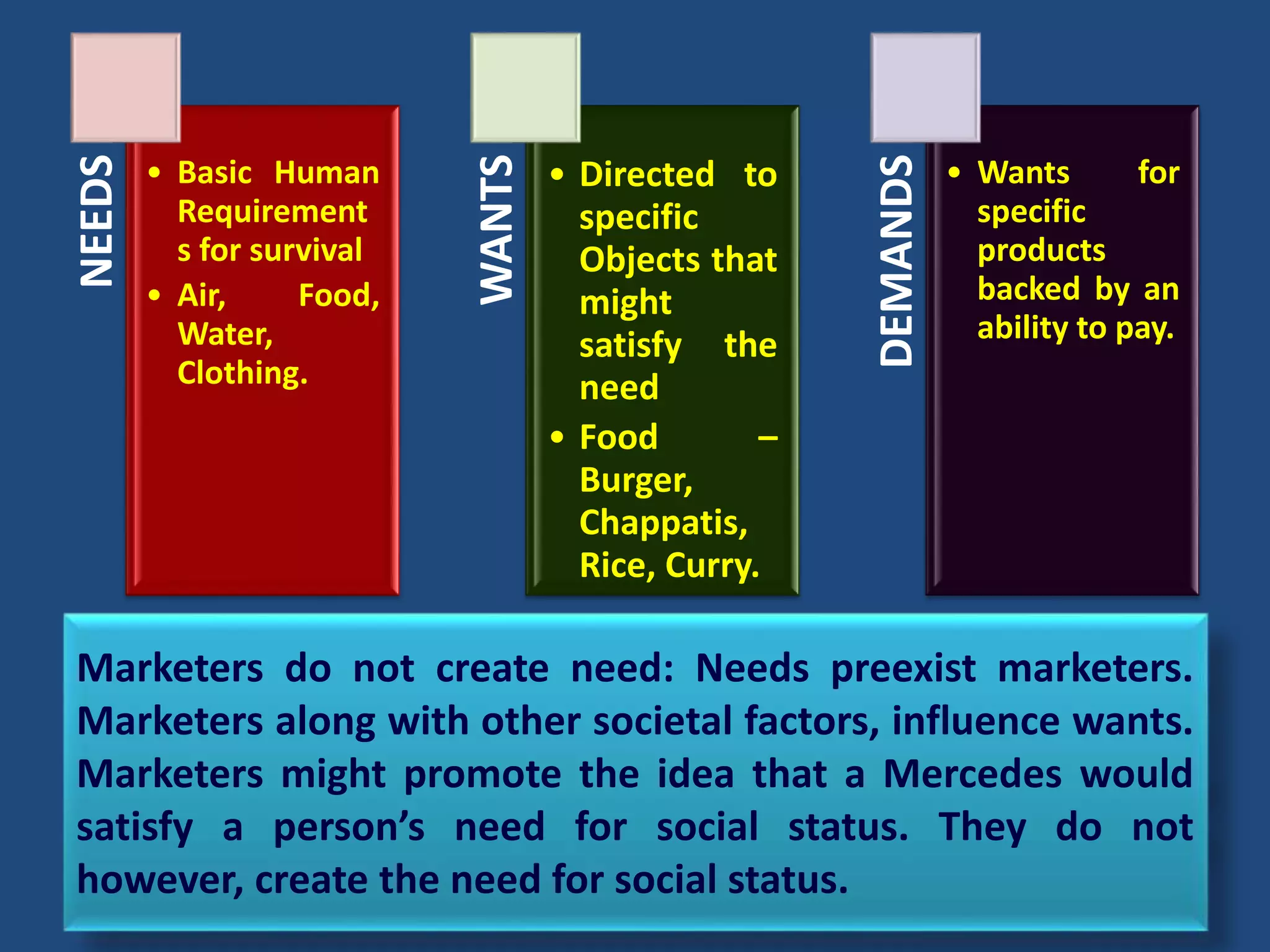
NEEDS
• Basic Human
Requirement
s for survival
• Air, Food,
Water,
Clothing.
WANTS
• Directed to
specific
Objects that
might
satisfy the
need
• Food –
Burger,
Chappatis,
Rice, Curry.
DEMANDS
• Wants for
specific
products
backed by an
ability to pay.
Marketers do not create need: Needs preexist marketers.
Marketers along with other societal factors, influence wants.
Marketers might promote the idea that a Mercedes would
satisfy a person’s need for social status. They do not
however, create the need for social status.
PRODUCTION
CONCEPT
•Maximum out
put.
•Lower unit
cost.
•Lower selling
price.
•Production
dominates the
thinking and
marketing is a
mere
appendage to
it.
•The
production
Concept fails
to serve the
right business
philosophy for
an enterprise.
•QUANTITATIVE
PRODUCT CONCEPT
•Excessive
stress on
quality of
products and
features.
•Winning the
market via
product
excellence –
improved
products, new
products,
ideally
designed and
engineered
products.
•QUALITATIVE
•MARKETING
MYOPIA
SELLING CONCEPT
•Customers, if
left alone,
won’t buy
enough of the
organisation’s
product.
•The
organisation
must
undertake
excessive
selling and
promotion
effort to sell
the product.
•Unsought
goods.
•Over pdn.
Capacity.
MARKETING
CONCEPT
•The concept
emerged in mid
1950s, Instead
of a product-
centered,
“make-and-
sell”
philosophy,
business shifted
to a customer-
centered,
“sense-and-
respond”
philosophy.
•The job is not
to find the
right customers
for your
products, but to
find the right
products for
your customers.
HOLISTIC
MARKETING
CONCEPT
• It is based on
the
development,
design, and
implementation
of marketing
programmes.
•Holistic
marketing
recognises that
everything
matters and
that a broad
integrated
perspective is
often needed.
1. Production Orientation Philosophy
(Till 1940s)
Good Products Good Sales
• Production Philosophy
• Product Philosophy
2. Sales Oriented Philosophy
(1940s to 1950s)
Products Promotions Sales
3. Customer Oriented Philosophy
(1950s to 1970s)
Customer
Marketing
Research
Production
Sales
Promotion
Sales
Marketing Concept
4. Societal/Social Oriented Philosophy
(1970s Onwards)
Customer
Marketing
Research
R & D Production
Sales
Promotion
Sales
Holistic Marketing Concept
Core marketing concepts

Core marketing concepts

  • 2.
    NEEDS • Basic Human Requirement sfor survival • Air, Food, Water, Clothing. WANTS • Directed to specific Objects that might satisfy the need • Food – Burger, Chappatis, Rice, Curry. DEMANDS • Wants for specific products backed by an ability to pay. Marketers do not create need: Needs preexist marketers. Marketers along with other societal factors, influence wants. Marketers might promote the idea that a Mercedes would satisfy a person’s need for social status. They do not however, create the need for social status.
  • 3.
    PRODUCTION CONCEPT •Maximum out put. •Lower unit cost. •Lowerselling price. •Production dominates the thinking and marketing is a mere appendage to it. •The production Concept fails to serve the right business philosophy for an enterprise. •QUANTITATIVE PRODUCT CONCEPT •Excessive stress on quality of products and features. •Winning the market via product excellence – improved products, new products, ideally designed and engineered products. •QUALITATIVE •MARKETING MYOPIA SELLING CONCEPT •Customers, if left alone, won’t buy enough of the organisation’s product. •The organisation must undertake excessive selling and promotion effort to sell the product. •Unsought goods. •Over pdn. Capacity. MARKETING CONCEPT •The concept emerged in mid 1950s, Instead of a product- centered, “make-and- sell” philosophy, business shifted to a customer- centered, “sense-and- respond” philosophy. •The job is not to find the right customers for your products, but to find the right products for your customers. HOLISTIC MARKETING CONCEPT • It is based on the development, design, and implementation of marketing programmes. •Holistic marketing recognises that everything matters and that a broad integrated perspective is often needed.
  • 4.
    1. Production OrientationPhilosophy (Till 1940s) Good Products Good Sales • Production Philosophy • Product Philosophy
  • 5.
    2. Sales OrientedPhilosophy (1940s to 1950s) Products Promotions Sales
  • 6.
    3. Customer OrientedPhilosophy (1950s to 1970s) Customer Marketing Research Production Sales Promotion Sales Marketing Concept
  • 7.
    4. Societal/Social OrientedPhilosophy (1970s Onwards) Customer Marketing Research R & D Production Sales Promotion Sales Holistic Marketing Concept