




SDM-Ch.1 1
Chanderprabhu Jain College of Higher Studies & School of Law
Plot No. OCF, Sector A-8, Narela, New Delhi – 110040
(Affiliated to Guru Gobind Singh Indraprastha University and Approved by Govt of NCT of Delhi & Bar Council of India)
Semester: Fifth Semester
Name of the Subject:
Sales & Distribution Management
Unit:1-Unit:4
SDM-Ch.1 2
SALES MANAGEMENT
• Sales management means planning, direction and control of personal
selling, including recruiting, selecting, equipping, assigning, routing,
supervising, paying and motivating as these tasks apply to the personal
Sales force.
• “The management of Sales force” by American Marketing Association.
SDM-Ch.1 3
WHAT IS SALES MANAGEMENT?
Sales management is the attainment of sales
force goals in an effective and efficient
manner through:
• Planning
• Staffing
• Training
• Leading
• Controlling organizational resources
3
SDM-Ch.1 4
EVOLUTION OF SALES MANAGEMENT
• Before industrial revolution small scale manufacturers who use to supply to
nearby customers.
• After industrial revolution i.e. around 1760 AD large scale manufacturers
came into the market.
• Selling to nearby area not adequate to meet existing supply.
• Need of expansion through wholesalers and retailers.
• Sales become a different function altogether (Revenue generating function)
SDM-Ch.1 5
• Primitive family economy
• The barter system
• The rise of money
• Small scale manufacturing
• Industrial revolution
EVOLUTION OF SALES MANAGEMENT
SDM-Ch.1 6
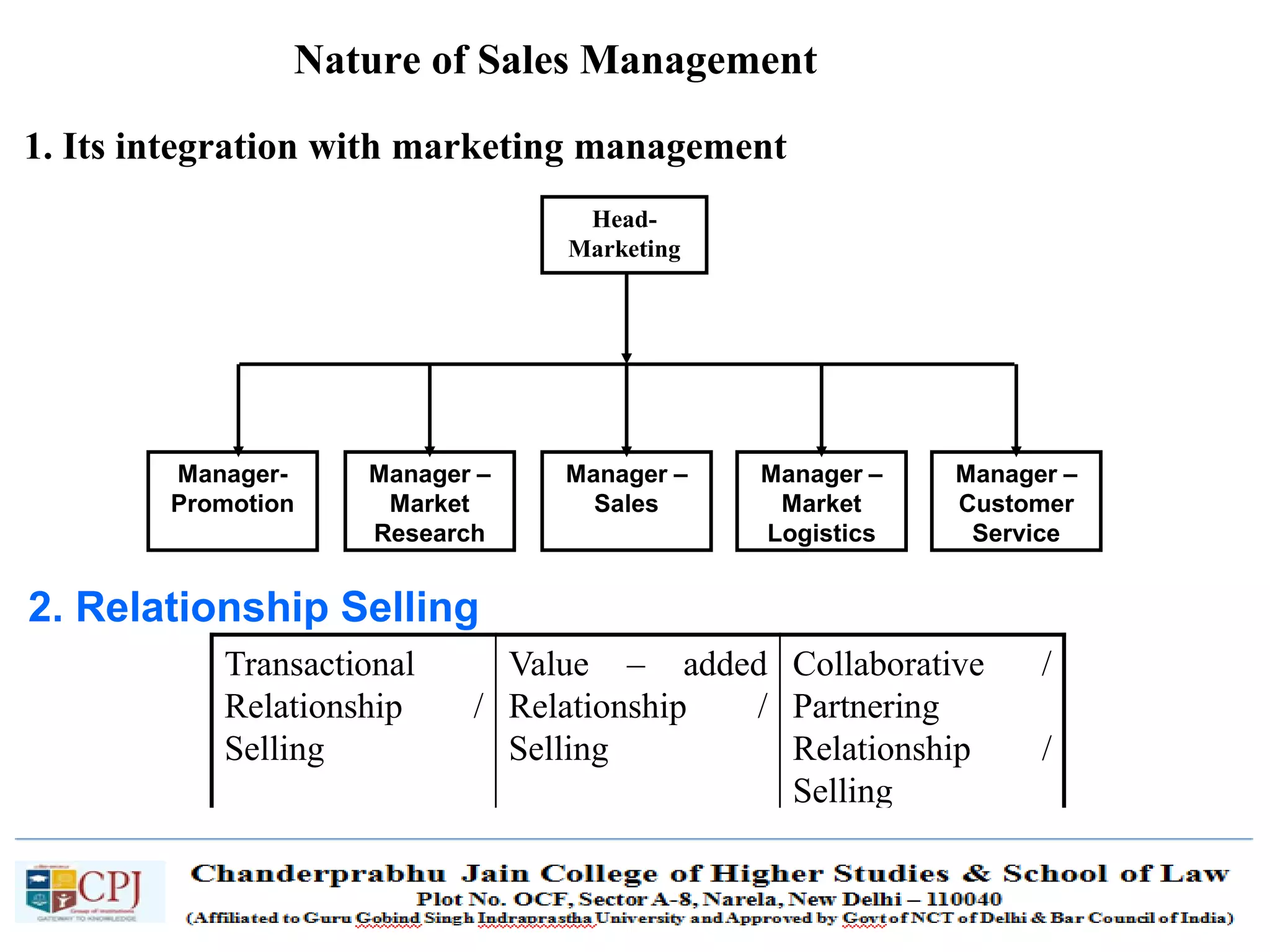
Nature of Sales Management
1. Its integration with marketing management
2. Relationship Selling
Transactional
Relationship /
Selling
Value – added
Relationship /
Selling
Collaborative /
Partnering
Relationship /
Selling
Head-
Marketing
Manager –
Customer
Service
Manager –
Market
Logistics
Manager –
Sales
Manager –
Market
Research
Manager-
Promotion
SDM-Ch.1 7
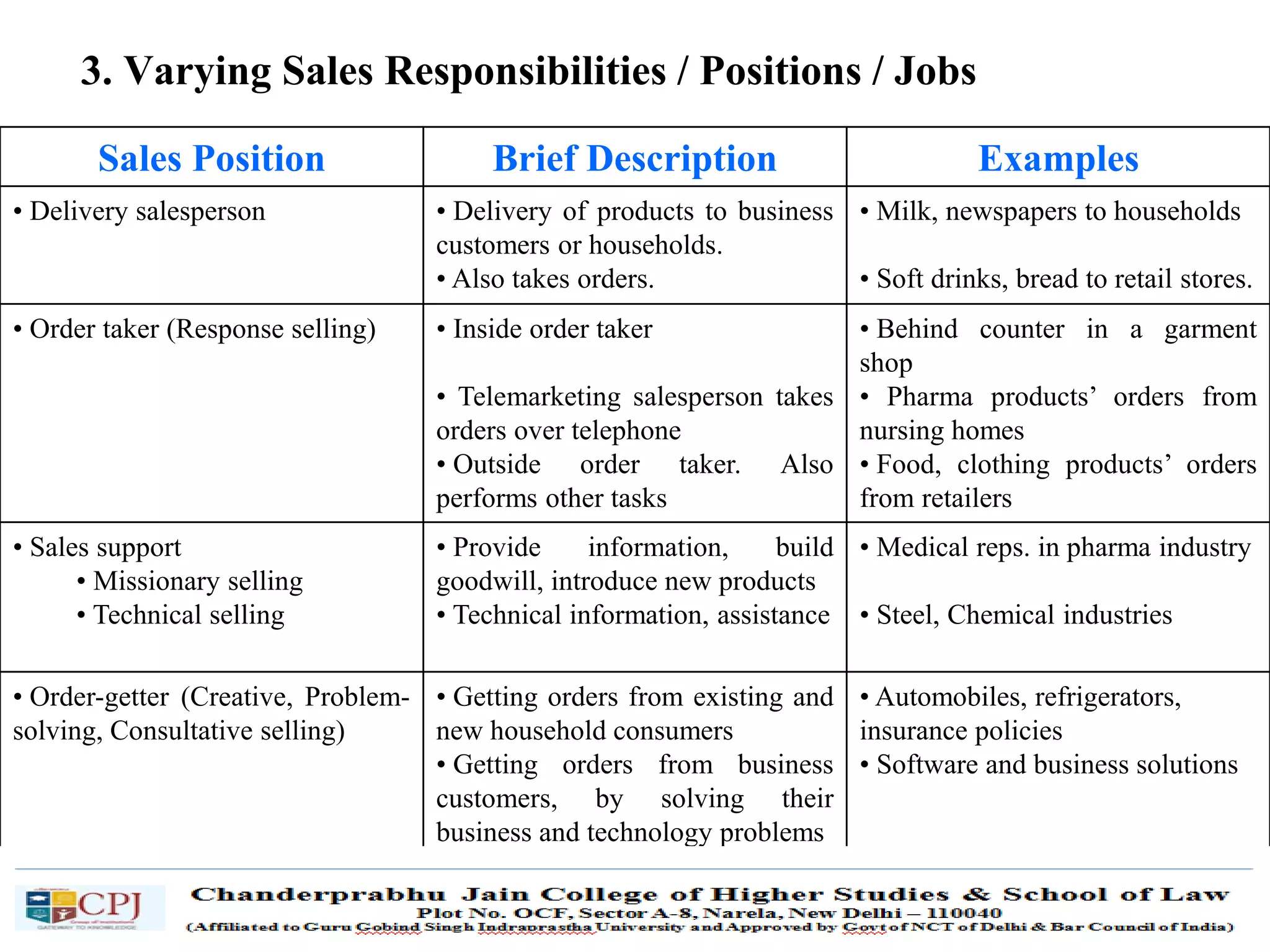
3. Varying Sales Responsibilities / Positions / Jobs
Sales Position Brief Description Examples
• Delivery salesperson • Delivery of products to business
customers or households.
• Also takes orders.
• Milk, newspapers to households
• Soft drinks, bread to retail stores.
• Order taker (Response selling) • Inside order taker
• Telemarketing salesperson takes
orders over telephone
• Outside order taker. Also
performs other tasks
• Behind counter in a garment
shop
• Pharma products’ orders from
nursing homes
• Food, clothing products’ orders
from retailers
• Sales support
• Missionary selling
• Technical selling
• Provide information, build
goodwill, introduce new products
• Technical information, assistance
• Medical reps. in pharma industry
• Steel, Chemical industries
• Order-getter (Creative, Problem-
solving, Consultative selling)
• Getting orders from existing and
new household consumers
• Getting orders from business
customers, by solving their
business and technology problems
• Automobiles, refrigerators,
insurance policies
• Software and business solutions
SDM-Ch.1 8
4. It is pervasive function: present in micro, small, medium and large
enterprises.
5. It is a continuous function.
SDM-Ch.1 9
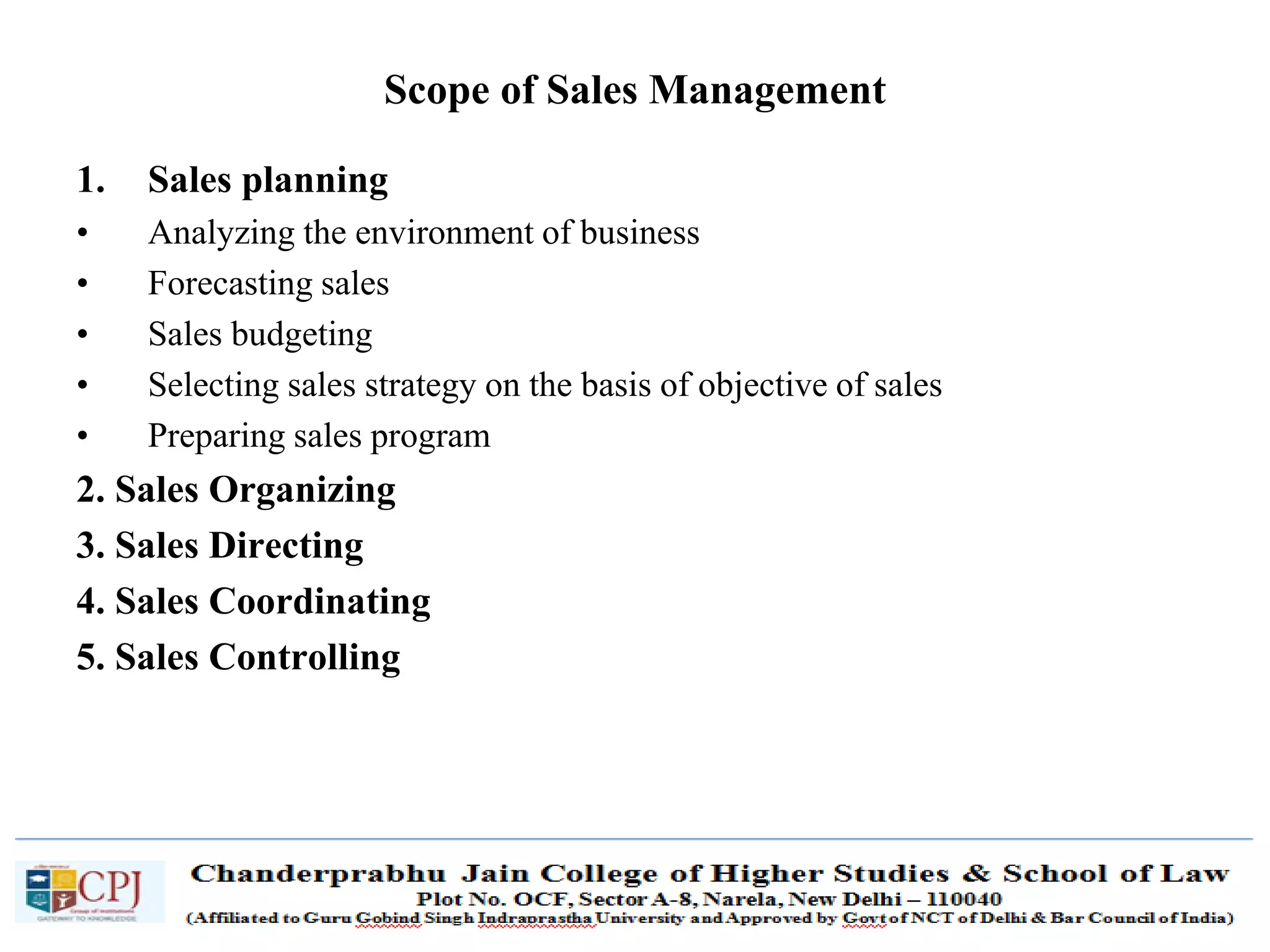
Scope of Sales Management
1. Sales planning
• Analyzing the environment of business
• Forecasting sales
• Sales budgeting
• Selecting sales strategy on the basis of objective of sales
• Preparing sales program
2. Sales Organizing
3. Sales Directing
4. Sales Coordinating
5. Sales Controlling
SDM-Ch.1 10
IMPORTANCE OF SALES MANAGEMENT
• Revenue generation
• Employment generation
• Rewarding career: fastest route to top management
• Higher standard of living of people because of sales people
• Intelligence agency (eyes and ears): all round knowledge of company’s
products, customers, competition
SDM-Ch.1 11
OBJECTIVES OF SALES MANAGEMENT
• Sales maximization
• Profit maximization
• Continuous growth
SDM-Ch.1 12
Quantitative objectives
• To retain & capture market share.
• To determine sales volume in ways that contributes to profitability.
• To obtain new accounts of given types
• To keep personal expenses within specified limits.
• To secure targeted percentage of certain accounts of business.
SDM-Ch.1 13
Qualitative objectives
• To do the entire selling job.
• To service existing accounts (customers)
• To search & maintain customer cooperation.
• To assist the dealer in selling the product line.
• To provide technical advice wherever necessary.
• To assist in training of middleman’s sales personnel.
• To provide advice & assist the middlemen.
• To collect & report market information of interest & use to the company
management.
SDM-Ch.1 14
EXCHANGE PROCESS
• “Customer is the boss- yesterday, today & tomorrow.”
• “Customer is profit- everyone else is overhead.”
• Exchange is the core aspect of marketing & sales and distribution
management facilities.
• Sales management is defined as the management of the firm’s personal
selling functions while distribution management is the indirect selling
effort.
SDM-Ch.1 15
Ways by which exchange can take place
• Directly (through its own sales force)
• Indirectly (through middlemen, retailers, wholesalers)
• Jointly.
PROCESS
Contacting
Prospecting
Negotiating & transaction
Promotion’
Physical distribution & collection
SDM-Ch.1 16
Key decision areas in sales management
• The type & quality of sales personnel
• The size of sales force: work load, incremental & sales potential methods.
• Organization & design of sales dept.
Functional org, mgmt org., territorial org.
• The territory design: circular, clover leaf, hop scotch method
• The recruitment & training procedure
• The task allocation
SDM-Ch.1 17
• The compensation of sales force.
• The performance appraisal & control system
• The feedback mechanism to be adopted.
• Managing channel relationship
• Coordinating with other marketing departments
SDM-Ch.1 18
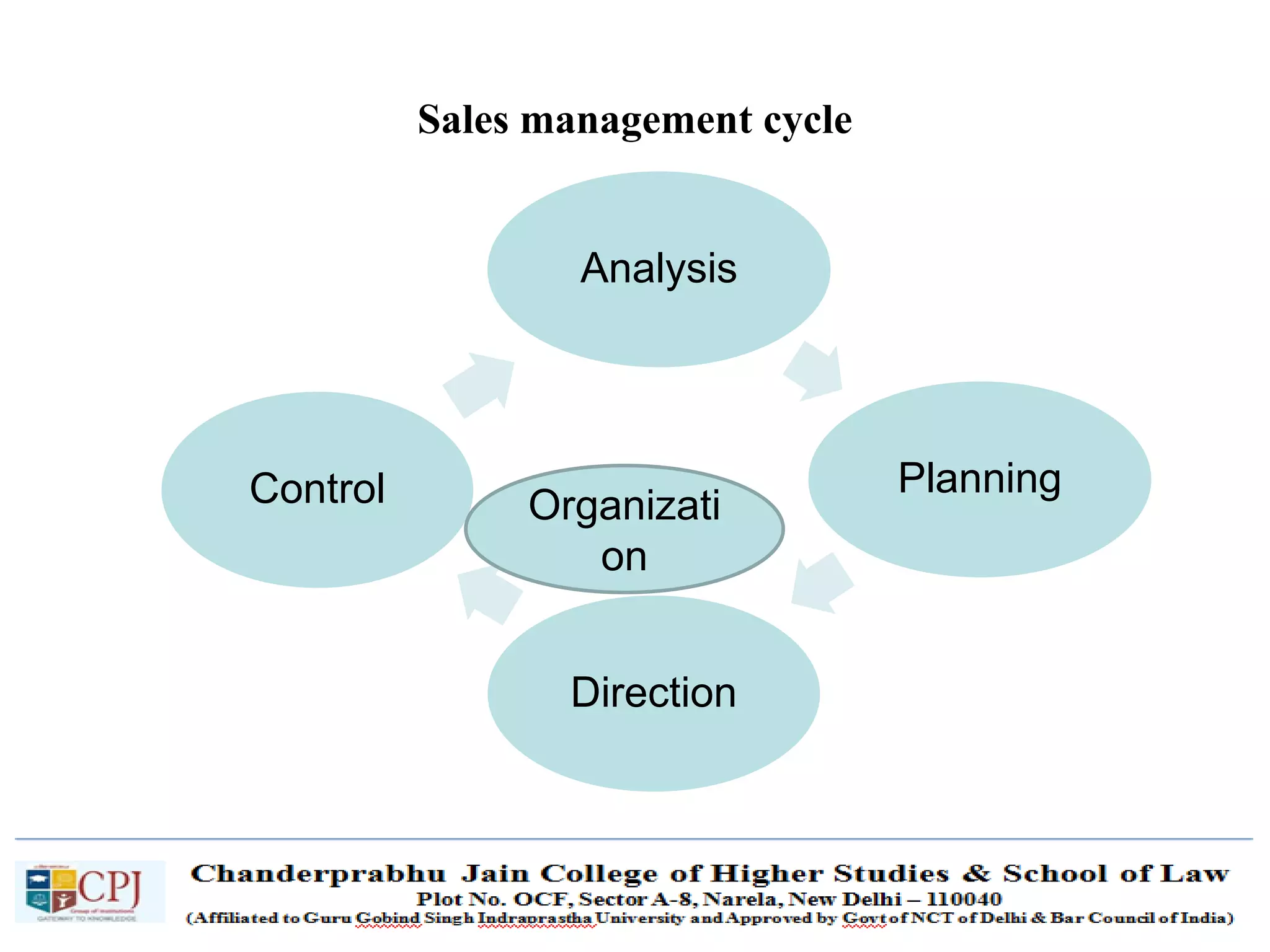
Sales management cycle
Analysis
Planning
Direction
Control Organizati
on
SDM-Ch.1 19
Difference between Sales Management & Marketing
Management
Marketing Management
• A Comparatively new concept.
• It includes sales management
• Objective is to maximize long
term profit through customer
satisfaction.
• Wide scope
• A higher level function
Sales Management
• A comparatively old concept.
• It is a part of marketing
management
• Objective is to maximize sales
and profits
• Narrow scope
• A lower level function
SDM-Ch.1 20
Roles and Skills of a Modern Sales Manager
• Strategic role
• Team member
• A team leader, working with salespeople
• Managing multiple sales / marketing channels
• Relationship building Using latest technologies (like CRM) to build superior
buyer-seller relationships
• Monitoring and controlling: Continually updating information on changes in
marketing environment.
SDM-Ch.1 21
Skills of a Successful Sales Manager
• People/ Human skills include abilities to motivate, lead, communicate,
coordinate, team-oriented relationship, and mentoring
• Managing skills consist of planning, organizing, controlling and decision
making
• Technical skills include training, selling, negotiating, problem-solving,
and use of computers
SDM-Ch.1 22
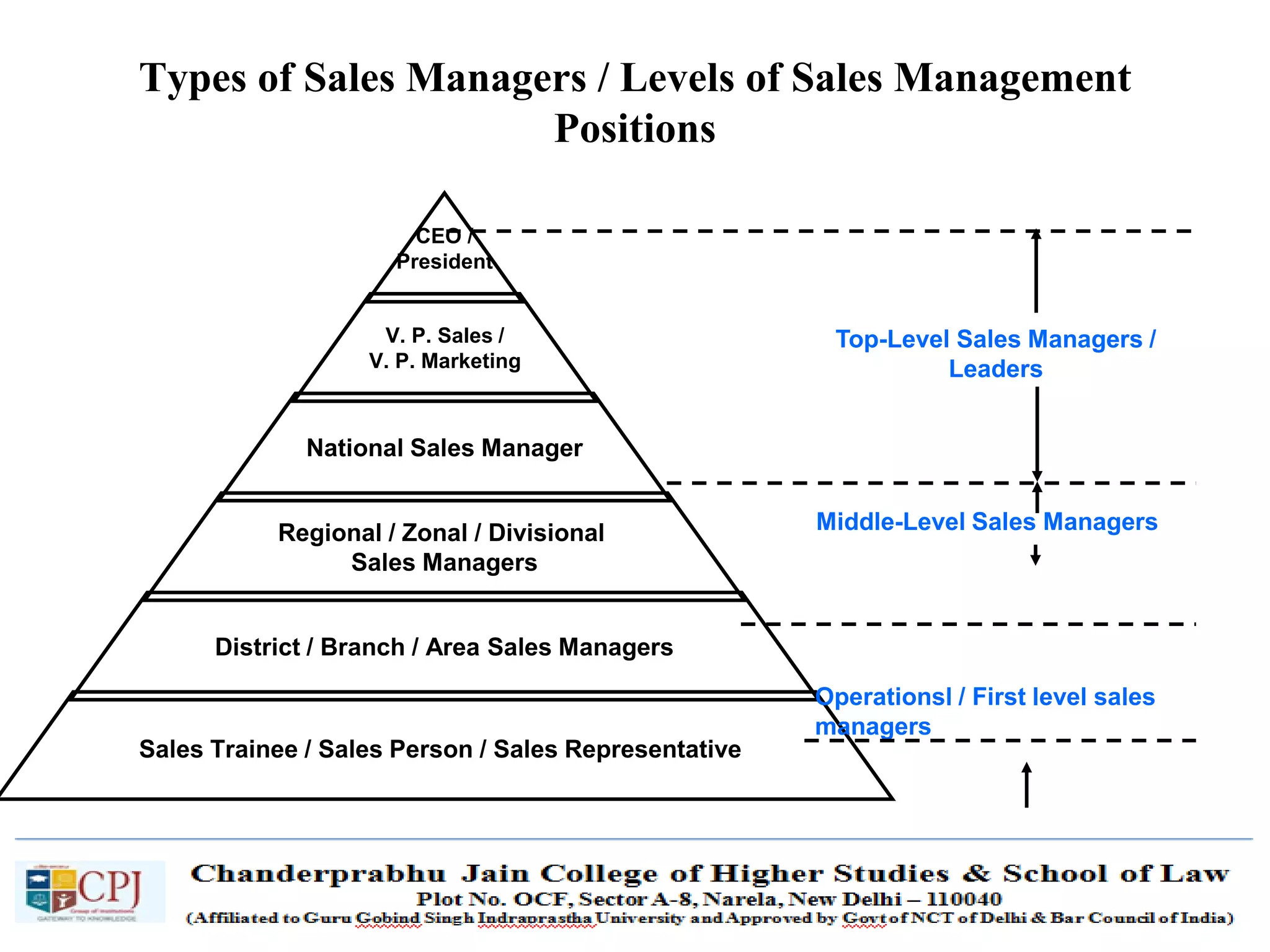
Types of Sales Managers / Levels of Sales Management
Positions
CEO /
President
V. P. Sales /
V. P. Marketing
National Sales Manager
Regional / Zonal / Divisional
Sales Managers
District / Branch / Area Sales Managers
Sales Trainee / Sales Person / Sales Representative
Operationsl / First level sales
managers
Middle-Level Sales Managers
Top-Level Sales Managers /
Leaders
SDM-Ch.1 23
• Selling is not just for sales people
• Personal selling -personal communication of information to unselfishly
persuade a prospective customer to buy something a good or a service or an
idea
SDM-Ch.1 24
Sales planning
• Sales planning is the process of determining the sales objectives & deciding
the strategies & tactics for achievement of these objectives
• Sales planning begins with sales forecasting
• Sales forecast is the prediction of what a company expects to sell during a
future period of time eg: one year.
• On the basis of sales forecast company decides its sales budget
SDM-Ch.1 25
Sales Objectives, Strategies and Tactics
The main components of planning in a company are objectives, strategies and
tactics. Their relationship is shown below
Decide / Set
Objectives
Develop Strategies
Evolve Tactics /
Action Plans
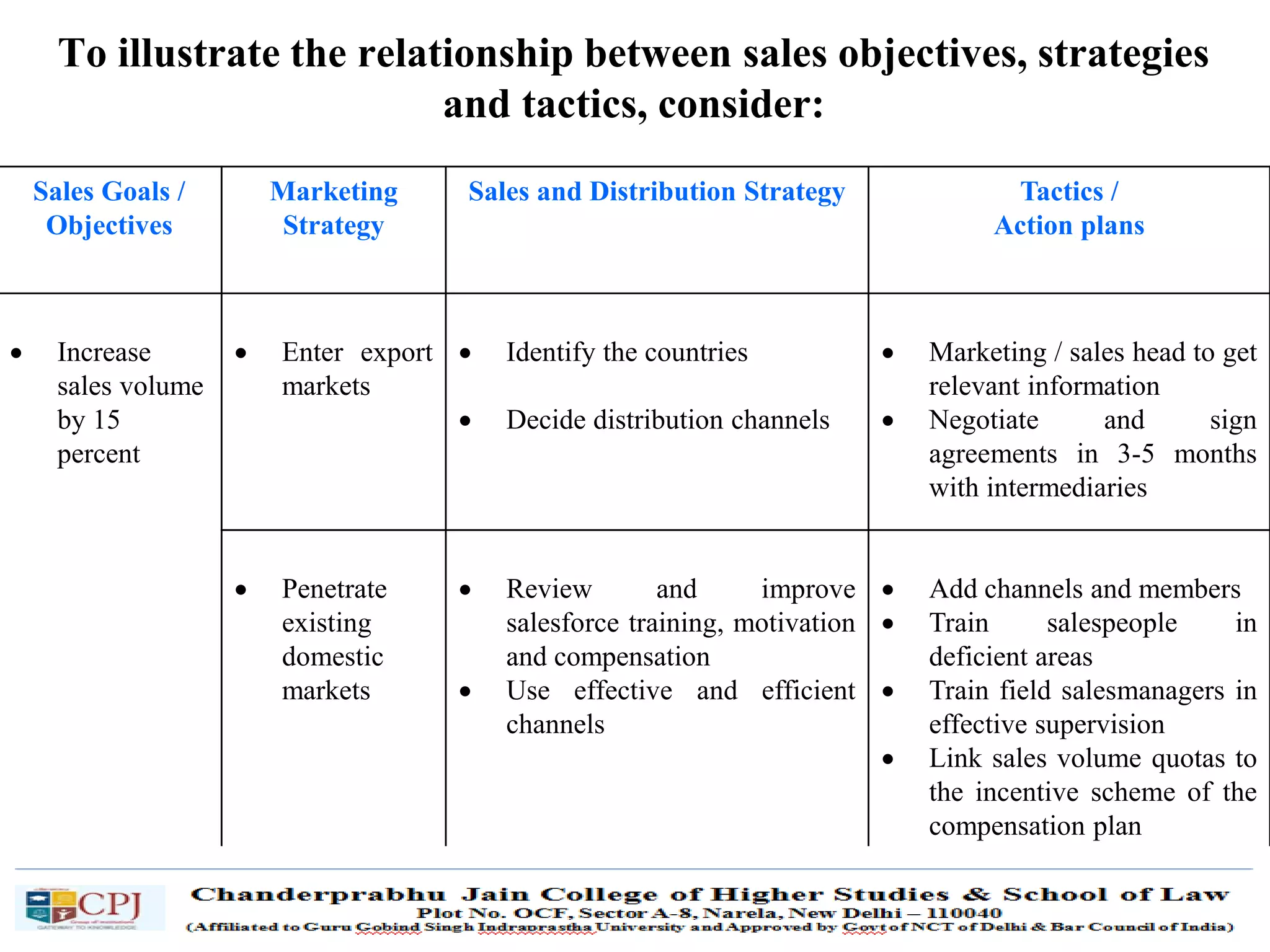
E.G. A company wants to increase sales of electric motors by 15 percent, as one
of the sales objectives. (see next slide)
Review & revision
SDM-Ch.1 26
To illustrate the relationship between sales objectives, strategies
and tactics, consider:
Sales Goals /
Objectives
Marketing
Strategy
Sales and Distribution Strategy Tactics /
Action plans
• Increase
sales volume
by 15
percent
• Enter export
markets
• Identify the countries
• Decide distribution channels
• Marketing / sales head to get
relevant information
• Negotiate and sign
agreements in 3-5 months
with intermediaries
• Penetrate
existing
domestic
markets
• Review and improve
salesforce training, motivation
and compensation
• Use effective and efficient
channels
• Add channels and members
• Train salespeople in
deficient areas
• Train field salesmanagers in
effective supervision
• Link sales volume quotas to
the incentive scheme of the
compensation plan
SDM-Ch.1 27
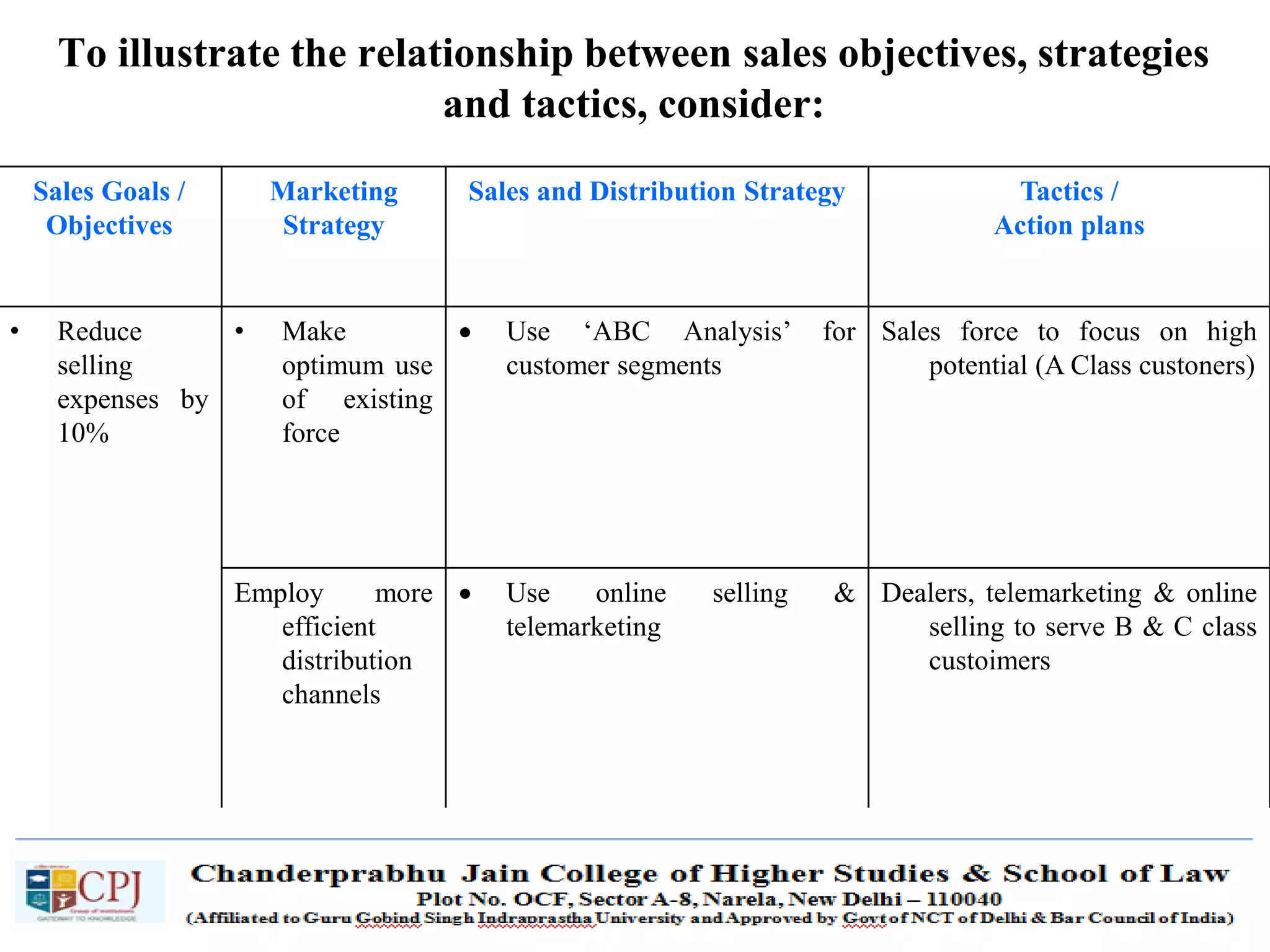
To illustrate the relationship between sales objectives, strategies
and tactics, consider:
Sales Goals /
Objectives
Marketing
Strategy
Sales and Distribution Strategy Tactics /
Action plans
• Reduce
selling
expenses by
10%
• Make
optimum use
of existing
force
• Use ‘ABC Analysis’ for
customer segments
Sales force to focus on high
potential (A Class custoners)
Employ more
efficient
distribution
channels
• Use online selling &
telemarketing
Dealers, telemarketing & online
selling to serve B & C class
custoimers
SDM-Ch.1 28
Emerging Trends in Sales Management
• Global perspective
• Revolution in technology
• Customer relationship management (CRM)
• Sales force diversity
• Team selling approach
• Managing multi-channels
• Ethical and social issues
• Sales professionalism
SDM-Ch.1 29
THEORIES OF SELLING UNIT-2
SDM-Ch.1 30
THEORIES OF SELLING
➢Selling is considered as an art by some and a science by others.
➢This has produced two contrasting approaches to the theory of selling.
SDM-Ch.1 31
Four Theories of Selling
➢ AIDAS
➢ “Right set of circumstances”
➢ “Buying Formula”
➢ “Behavioral Equation”
SDM-Ch.1 32
• AIDAS and “Right Set Of Circumstances” are seller oriented theories.
• “Buying Formula” theory of selling is Buyer oriented.
• The “Behavioral Equation” theory emphasizes the buyer’s decision process but also
takes the salesperson’s influence process into account.
SDM-Ch.1 33
AIDAS theory of selling
• A-Securing attention.
• I-Gaining Interest.
• D-Kindling desire.
• A-Inducing Action.
• S-Building Satisfaction.
SDM-Ch.1 34
“Right Set of Circumstances” Theory Of Selling
• Summed up as “Everything Was Right for The Sale.”
• Situation Response Theory
• This Theory holds that the particular circumstances prevailing in a given selling
situation cause the prospect in a predictable way.
• The more skilled the salesperson is in handling the set of circumstances, the more
predictable is the response.
SDM-Ch.1 35
“Right Set of Circumstances” Theory Of Selling
• The set of circumstances includes factors external & internal to the prospect.
• The salesperson and the remark are external factors.
• Proponents of these theory tends to stress external factors and the expense of
internal factors.
• This is a seller oriented theory: it stresses the importance of the salesperson
controlling the situation.
SDM-Ch.1 36
The ‘’Buying Formula’’ Theory
• The name ‘’buying formula’’ has been given by E.K. Strong.
• It emphasizes the buyer’s side of the buyer-seller dyad.
SDM-Ch.1 37
Reduced to its simplest form, the mental processes
involved in a purchase are
Need(or problem) Solution Purchase
SDM-Ch.1 38
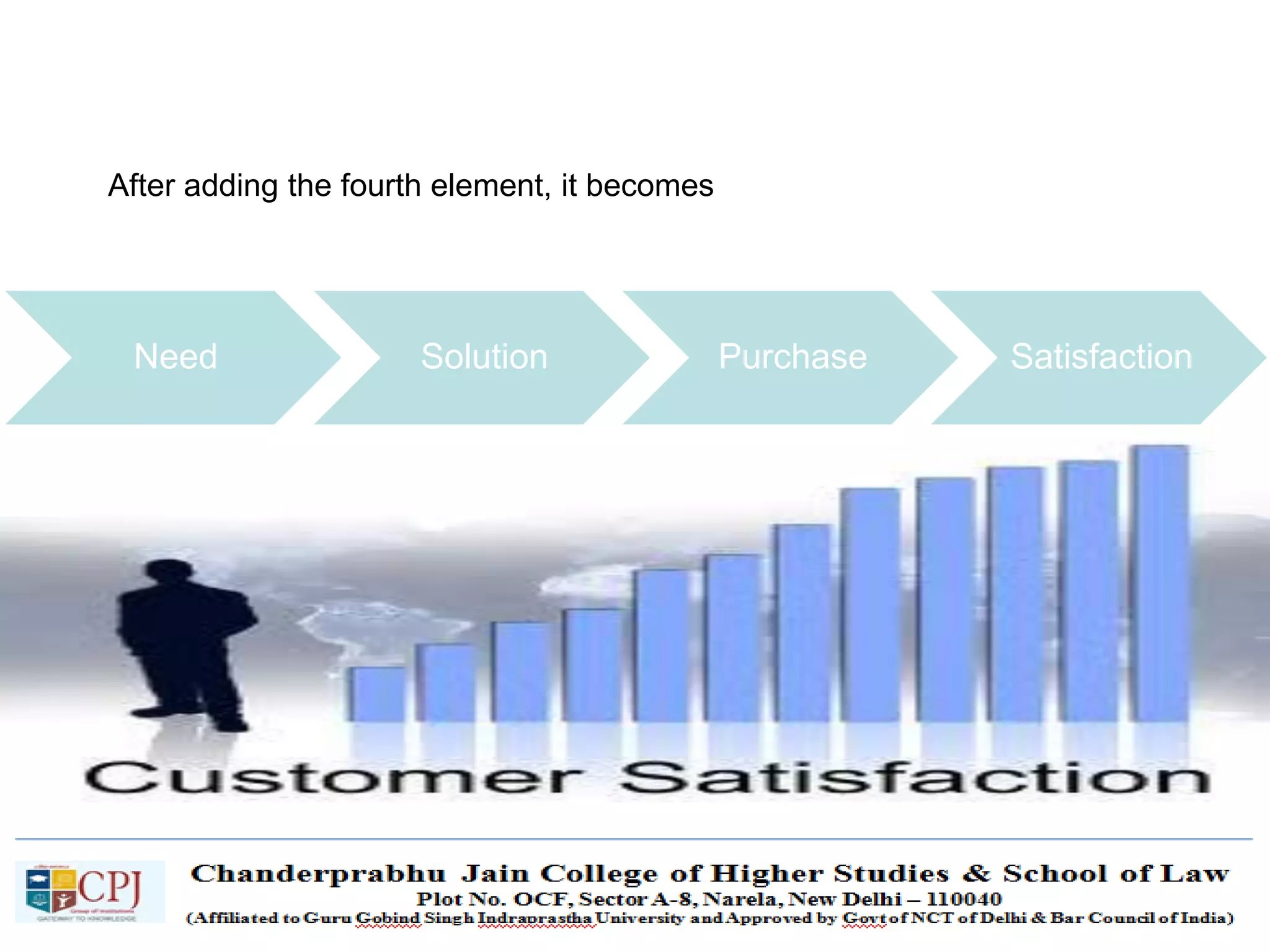
After adding the fourth element, it becomes
Need Solution Purchase Satisfaction
SDM-Ch.1 39
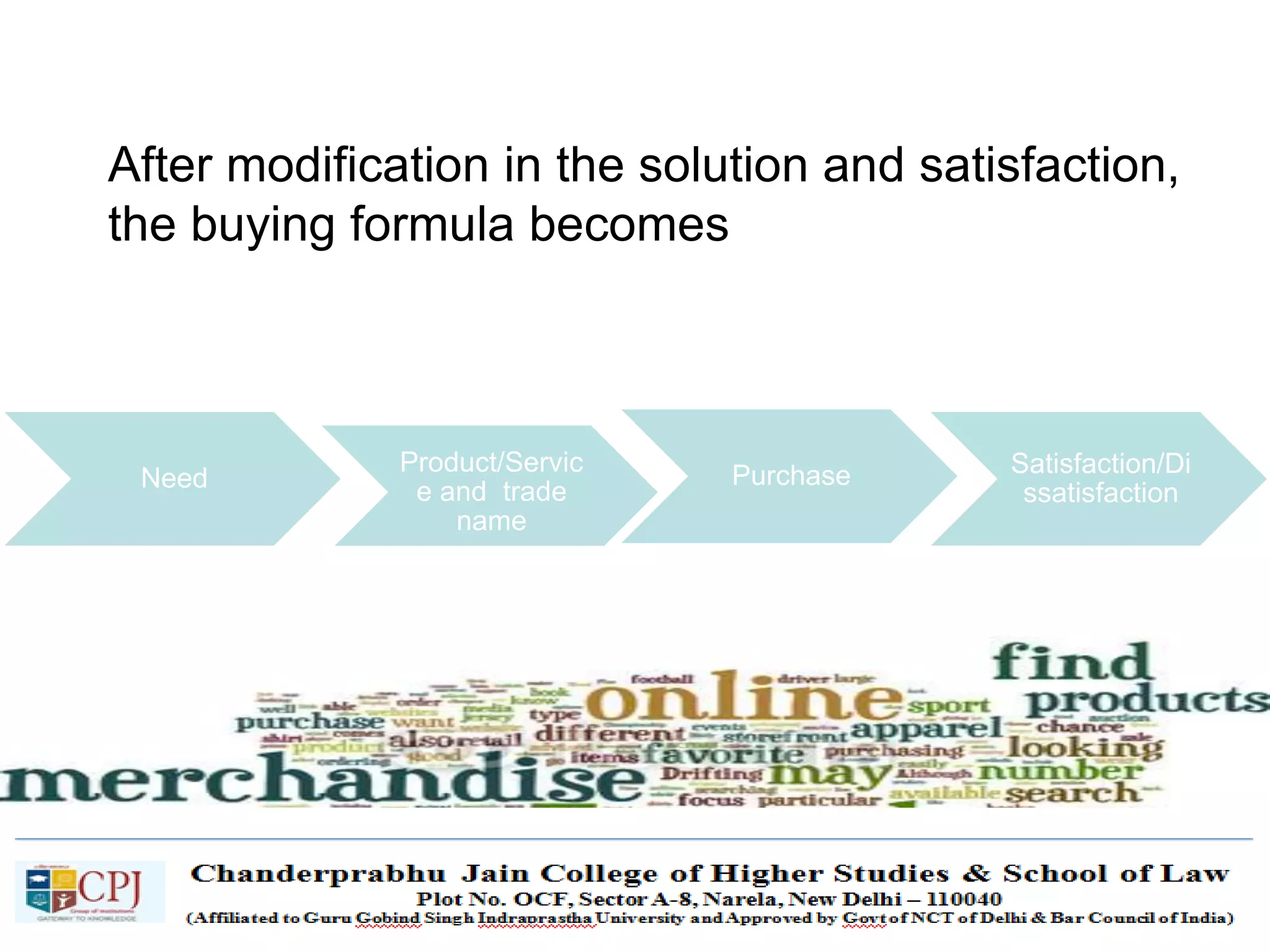
After modification in the solution and satisfaction,
the buying formula becomes
Need
Product/Servic
e and trade
name
Purchase Satisfaction/Di
ssatisfaction
SDM-Ch.1 40
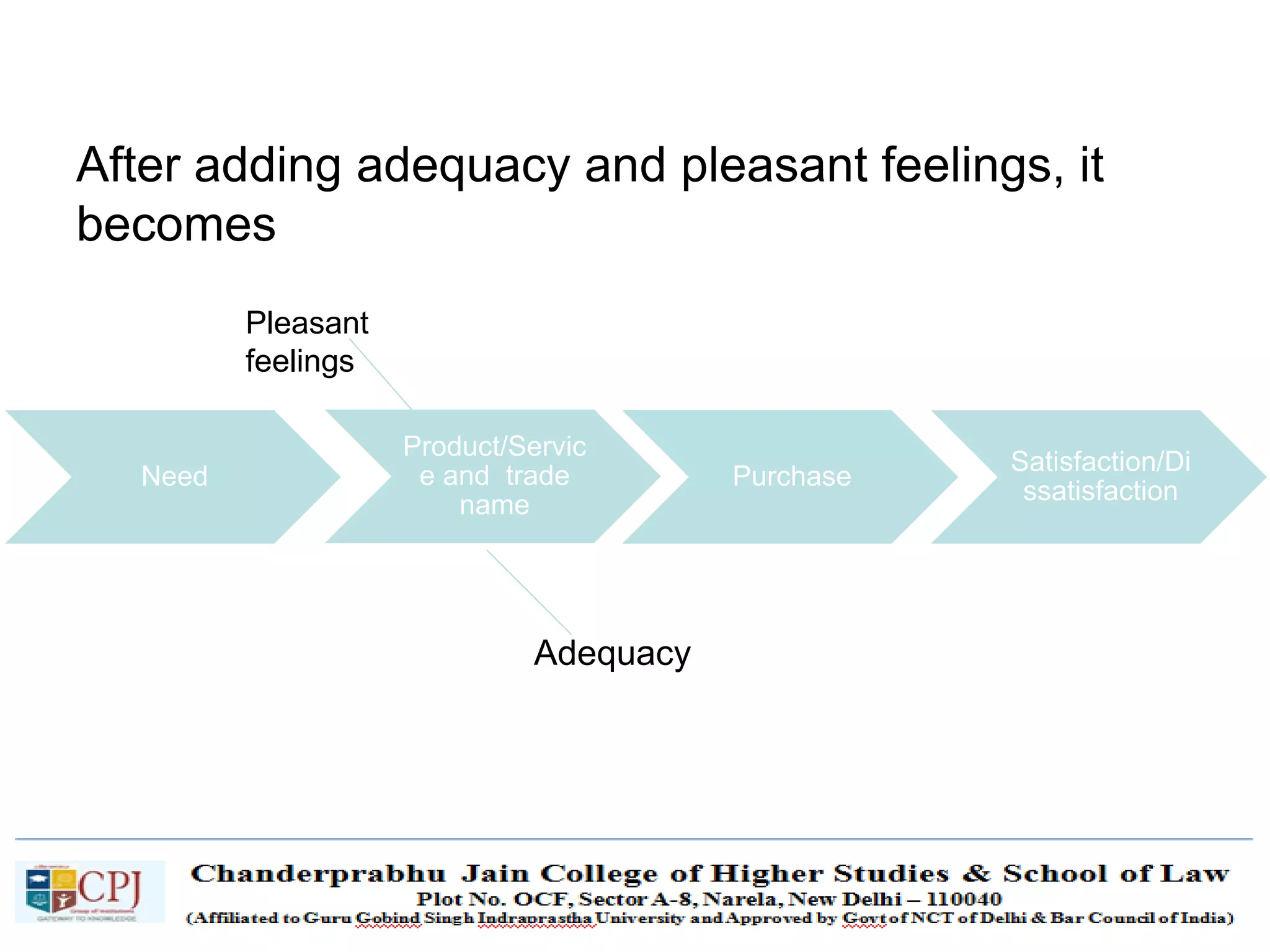
After adding adequacy and pleasant feelings, it
becomes
Need
Product/Servic
e and trade
name
Purchase
Satisfaction/Di
ssatisfaction
Adequacy
Pleasant
feelings
SDM-Ch.1 41
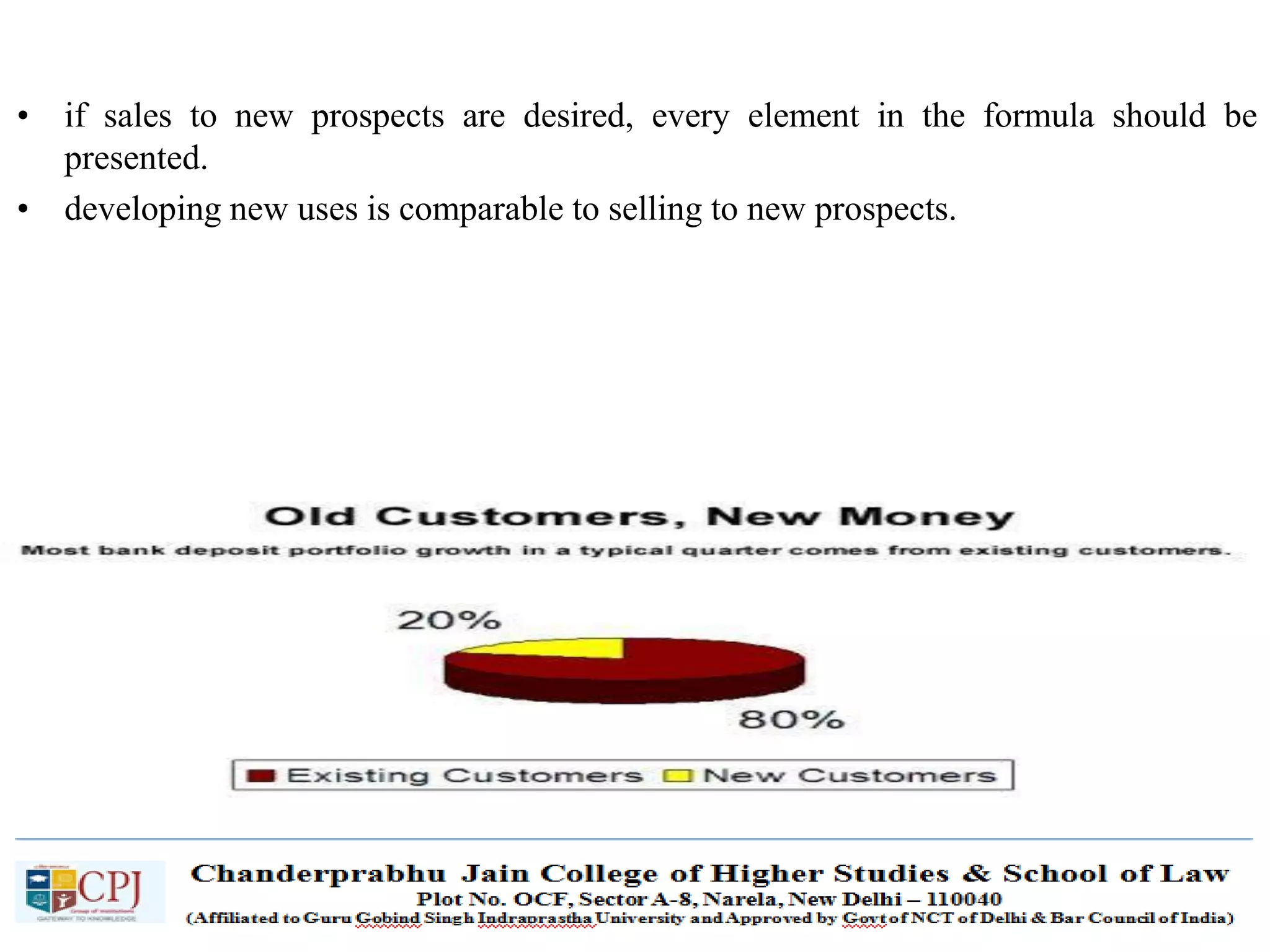
• if sales to new prospects are desired, every element in the formula should be
presented.
• developing new uses is comparable to selling to new prospects.
SDM-Ch.1 42
4: BEHAVIORAL EQUATION THEORY
SDM-Ch.1 43
• Developed using stimuli-response model.
• Sophisticated and advanced version of the “Right set of circumstances”
theory.
SDM-Ch.1 44
Requires 4 essential elements-
1: Drive-A strong internal stimulus.
a) INNATE DRIVES
b) LEARNED DRIVES
2: Cues-Weak stimuli when the buyers respond.
o Triggering
o Non-Triggering (specific product-eg. special discounts)
SDM-Ch.1 45
3: Response- What does the buyer do?
4: Reinforcement- Event that strengthens the buyer’s response tendency.
SDM-Ch.1 46
• When a product’s potential satisfaction to the buyer (K) yields rewards,
reinforcement occurs.
• When P is positive, K is automatically active.
• When P and K are positive, customers are more loyal to the product.
SDM-Ch.1 47
SALES STRATEGY FORMULATION
SDM-Ch.1 48
INTRODUCTION
• Sales strategies are adopted to achieve desired objectives in sales.
• The objective may be in many in number and these require elaborate and
careful consideration of the strategies and game plan of competitive
organizations
SDM-Ch.1 49
SALES STRATEGY
It basically involves three steps
1. Market analysis
2. Setting objectives
3. Designing sales strategy
SDM-Ch.1 50
1. MARKET ANALYSIS
• It means macro environmental analysis.
• Social , political, cultural, economic and technological factors
• SWOT Analysis
• Mission or goals setting which directly affects objectives
• Market analysis is a pre requisite for setting objectives
SDM-Ch.1 51
Through market analysis company would need to know
• The current size and growth rate of the market
• Consumer needs, attitudes and trends in purchasing behavior
• Competitor analysis: current strategy adopted by other firms , current
performance including market share analysis and their strengths and
weaknesses
• Expectation of their future actions
SDM-Ch.1 52
2. SETTING SALES OBJECTIVES
• Objectives are standards against which performance is measured.
• Qualitative and quantitative objective
• Qualitative objectives are long term and derived from marketing and sales
policies of the company
• whereas quantitative are short term
SDM-Ch.1 53
GOALS
• Goals are set in terms of
a. Sales volume
b. Sales cost
c. Accounts receivable
d. Inventory levels
e. Dealer support
f. Feedback input
SDM-Ch.1 54
3. SETTING SALES STRATEGY
• Sales strategy is set considering
a. The type of sales force required.
b. The size of sales force required
c. Territory design
d. Channel support and coordination
SDM-Ch.1 55
a. TYPE OF SALES FORCE NEEDED
• It depends on the role the sales force has to play.
• The quality of sales force is defined as the quality of contribution required
from the sales force and the work load on them.
• If pre - selling has been done by ads, then selling becomes easy.
• Some companies expect their salesman to do entire job
• Product specialist: highly technical products like banking services,
insurance, computers
• Market specialists: know the different market and can adopt different sales
approaches for different markets
SDM-Ch.1 56
b. DETERMINATION OF THE SIZE OF SALES FORCE
• Incremental method
• Work load method
• Sales potential method
SDM-Ch.1 57
Incremental method
• It says we can increase the size of sales force till the incremental revenue
exceeds incremental costs.
• Assumptions: profits will increase when additional sales person are
employed.
SDM-Ch.1 58
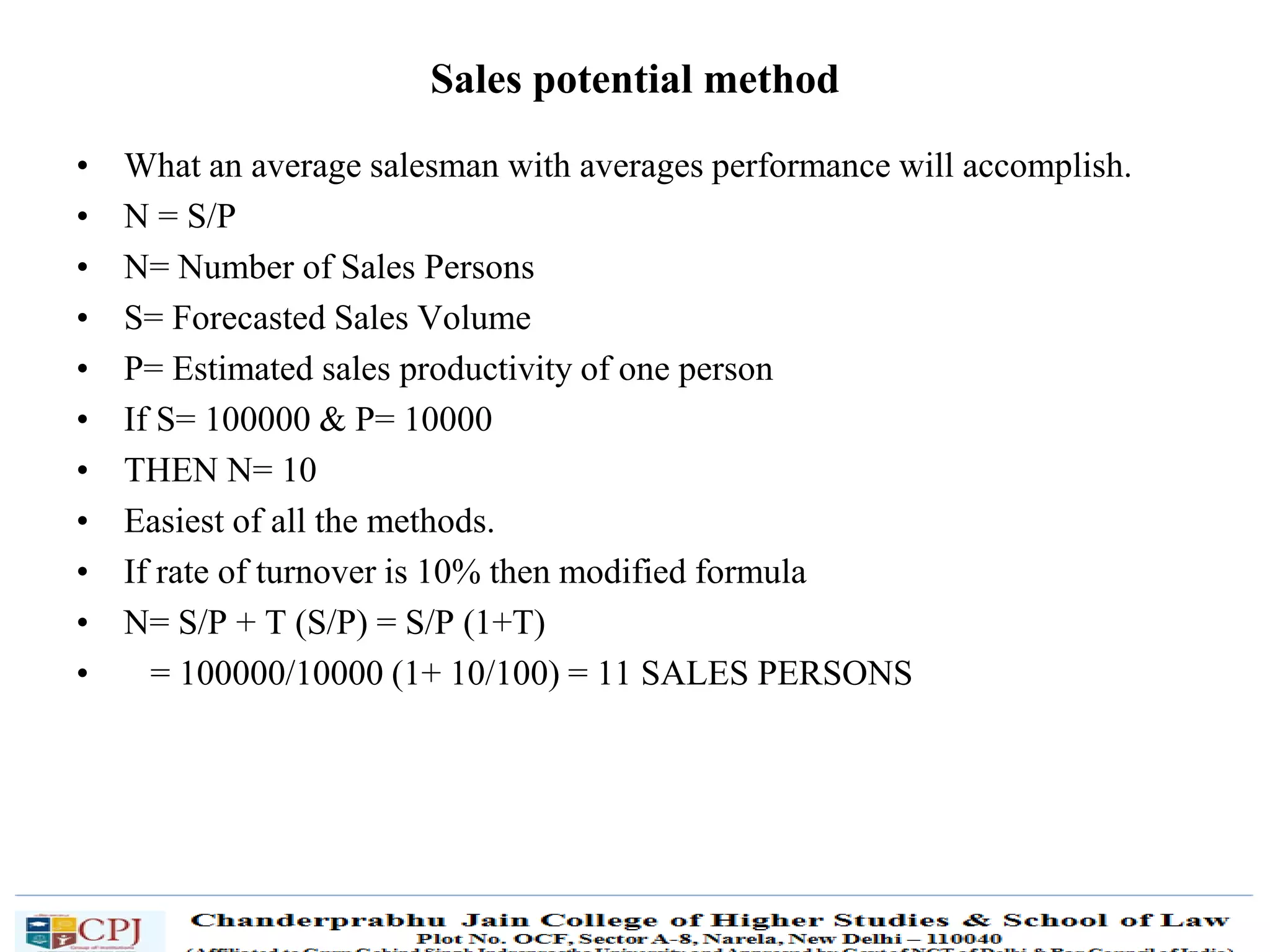
Sales potential method
• What an average salesman with averages performance will accomplish.
• N = S/P
• N= Number of Sales Persons
• S= Forecasted Sales Volume
• P= Estimated sales productivity of one person
• If S= 100000 & P= 10000
• THEN N= 10
• Easiest of all the methods.
• If rate of turnover is 10% then modified formula
• N= S/P + T (S/P) = S/P (1+T)
• = 100000/10000 (1+ 10/100) = 11 SALES PERSONS
SDM-Ch.1 59
WORK LOAD METHOD
• Most complex method
• Assumption: all sales person will shoulder equal responsibilities.
• Total work load is estimated and the it is divided equally among all the
sales people.
• Adv: easy to understand & apply, attractive to practising managers
• Disadv: does not take profit into consideration; assumes sales personnel
have same work load & same efficiency; time given to each call is as
important as quality of time given per call
SDM-Ch.1 60
c. BASIS FOR TERRITORY DESIGN
• Geographical basis: grouping according to existing geographical
boundaries.
• Sales potential basis: splitting according to dispersion of its sales potential.
• Servicing requirement basis: splitting according to servicing requirements
(maintaining & developing of account)
• Work load basis: considers both account potential and servicing
requirements.
SDM-Ch.1 61
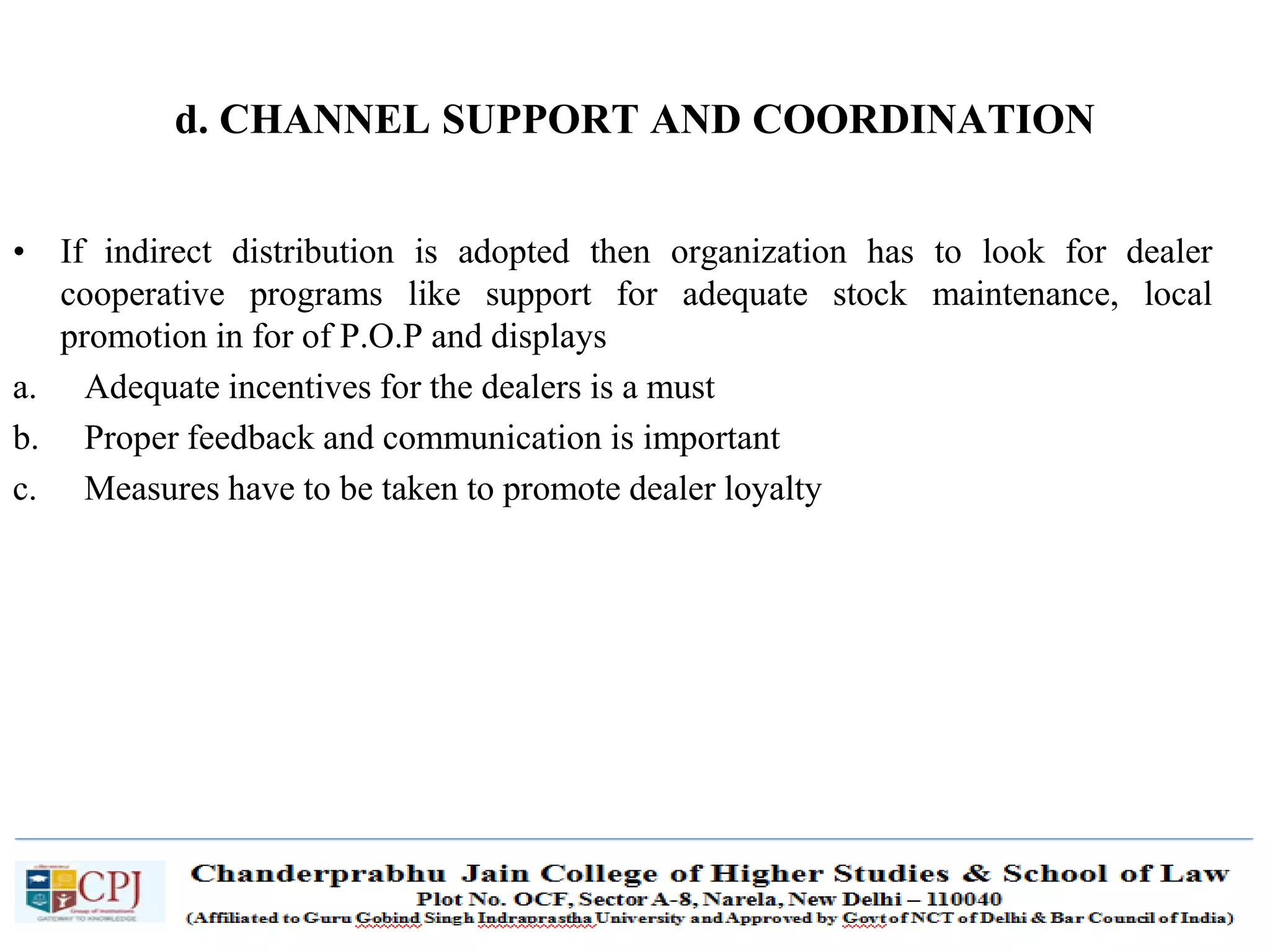
d. CHANNEL SUPPORT AND COORDINATION
• If indirect distribution is adopted then organization has to look for dealer
cooperative programs like support for adequate stock maintenance, local
promotion in for of P.O.P and displays
a. Adequate incentives for the dealers is a must
b. Proper feedback and communication is important
c. Measures have to be taken to promote dealer loyalty
SDM-Ch.1 62
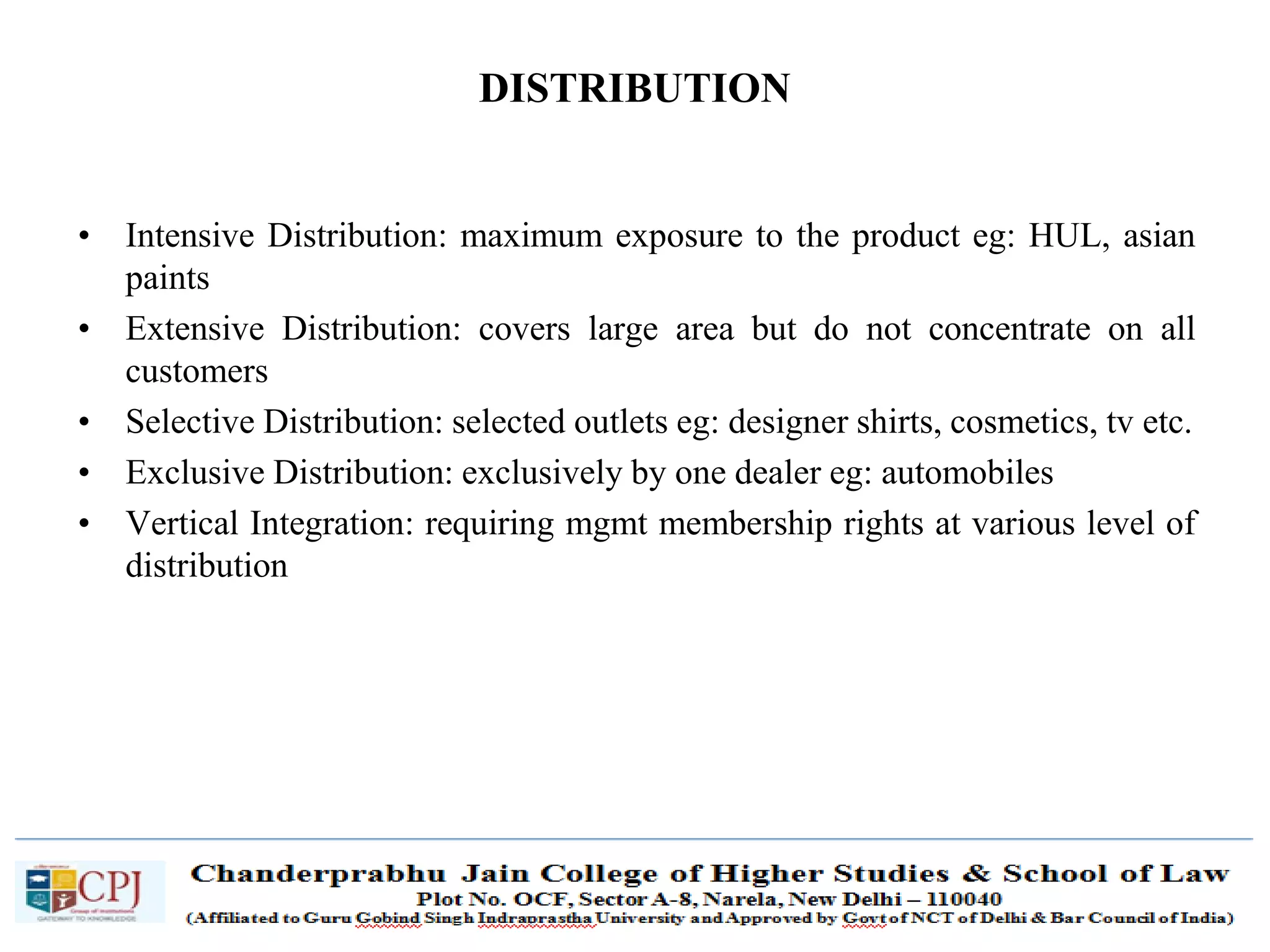
DISTRIBUTION
• Intensive Distribution: maximum exposure to the product eg: HUL, asian
paints
• Extensive Distribution: covers large area but do not concentrate on all
customers
• Selective Distribution: selected outlets eg: designer shirts, cosmetics, tv etc.
• Exclusive Distribution: exclusively by one dealer eg: automobiles
• Vertical Integration: requiring mgmt membership rights at various level of
distribution
SDM-Ch.1 63
Emerging trends in Sales Management
• Global perspective.
• Revolution in technology
• Customer relationship management
• Sales force diversity
• Team selling approach
• Managing multi channels
• Ethical and social issues
• E selling
SDM-Ch.1 64
Sales budget-Unit-3
SDM-Ch.1 65
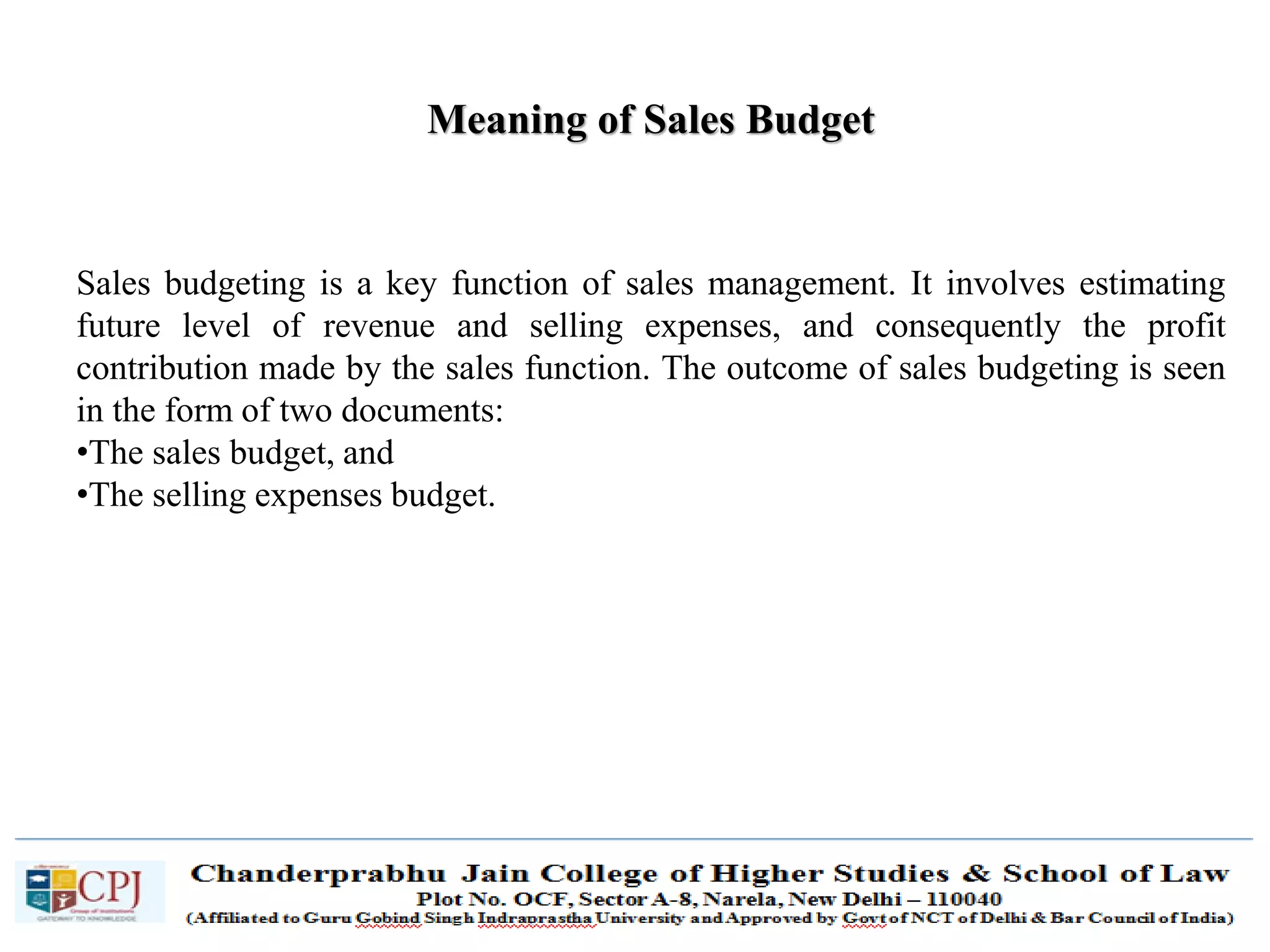
Meaning of Sales Budget
Sales budgeting is a key function of sales management. It involves estimating
future level of revenue and selling expenses, and consequently the profit
contribution made by the sales function. The outcome of sales budgeting is seen
in the form of two documents:
•The sales budget, and
•The selling expenses budget.
SDM-Ch.1 66
•Sales Budget reflects the targeted sales revenue.
• Sales Expense budget shows the expenses necessary to reach the targeted
sales revenue.
Through these two statements sales management can reconcile these
revenues & expenses with the firm’s objectives. Thus, sales budgeting is
concerned with improving selling efficiency & reducing the selling costs.
More specifically, Sales Budget is a detailed programme developed for a
specified period that indicates the anticipated sales & selling expenses.
SDM-Ch.1 67
• The sales budget is prepared by multiplying the expected unit sales volume for
each product by its anticipated unit selling price.
• Each of the other budgets such as production budget, direct material budget,
direct labor budget, manufacturing overhead budget & Selling and administration
budget depends on the sales budget.
• It is derived from the sales forecast. It represents management’s best estimate
of sales revenue for the budget period.
SDM-Ch.1 68
1.Planning
The company formulates marketing and sales objectives; the budget determines how
these objectives will be met through a detailed breakdown of the sales budget among
products, territories and customers.
2. Co-ordination:-
The budget establishes what the cost of various heads be thereby maintaining a
desired relationship between expenditure and revenues.
The budget enables sales executives to coordinate expenses with sales.
It also restricts the sales executives form spending more that their share of the funds
helping to prevent expenses from getting out of control.
Objectives of Sales Budget:-
SDM-Ch.1 69
3. Control:-
The sales budget enables sales executives for evaluating sales
performance . A sales manager can improve his success by meeting sales
and cost goals set forth in the sales budget.
4. Evaluation:-
Sales department budgets become tools to evaluate the department’s
performance. By meeting the sales & cost goals set forth in the budget, a
sales manager may prove himself to be a successful executive.
Sales budget can be determined on the basis of following categories
Objectives of Sales Budget:-
SDM-Ch.1 70
1. The sales budget is the first component of the master operating budget.
This is because sales affect all other parts of the master budget.
2. It includes the total sales valued in quantity.
3. It consists of three parts; break even, target and projected sales.
4. The budget also includes sales by product, location, customer density and
seasonal sales patterns.
5. It provides a plan for both cash and credit sales.
6. The basis of a sales budget is the sale price per unit of goods to be sold
multiplied by the quantity of goods to be sold.
7. A sales budget is planned around the competition, the material
available, cost of distribution, government controls and the political
climate.
Features
SDM-Ch.1 71
•A good sales budget should serve as a guide to company with regard to its sales
target. It should be flexible and resilient to the volatile changes in the market.
•The budget should not put too many restraints on the sales functions of the
company.
• A sales budget is a financial plan for the sales of goods and services of a
company. It is the basis on which all the financial decisions of a company with
regard to sales are taken.
•The budget also controls the general sales prospects of a company.
• Online and off line marketing, marketing in the media and other advertising
expenditures are planned around a sales budget.
Importance
SDM-Ch.1 72
Among the major factors considered when forecasting sales are:
Sales forecasting is the process of predicting sales of goods and
services.
Sales Forecasting
1. Past sales levels and trends
2. General economic trends
3. Economic trends in the company’s
industry
4. Other factors expected to affect
sales in the industry
5. Political and legal events
6. The intended pricing policy of the
company
7. Planned advertising and product
promotion
8. Expected action of competitors
9. New products contemplated by
the company or other firms
10. Market research studies
SDM-Ch.1 73
ADVANTAGES OF A SALES BUDGET
A sales budget offers the following benefits:
• It is helpful in framing sales programming so as to achieve the sales
targets of the firm.
• It is useful in allocation of resources to different products, sales
territories,etc.for realising the forecast sales.
• It is helpful in keeping expenses under control so that the objectives of net
profits are achieved.
• It serves as a yard stick for evaluating progress and sales performance of
the company.
• It can reveal the areas/products in which the company needs to strengthen
its position.
SDM-Ch.1 74
A sales budget comes with inherent limitations and a good sales budget is
made by overcoming these limitations.
1. A sales budget cannot effectively forecast the future trends of events.
2. It may not be easily accepted by all people in the organization.
3. Preparing a sales budget takes up too much managerial time.
4. Usually sales budgets shy away from expenditure that will give returns in
the long run.
Limitations:
SDM-Ch.1 75
1) Situation analysis
2) Identification of problems and opportunities
3) Development of sales forecast
4) Formulation of objectives
5) Determination of sales task
PROCEDURE OF SALES BUDGETING
SDM-Ch.1 76
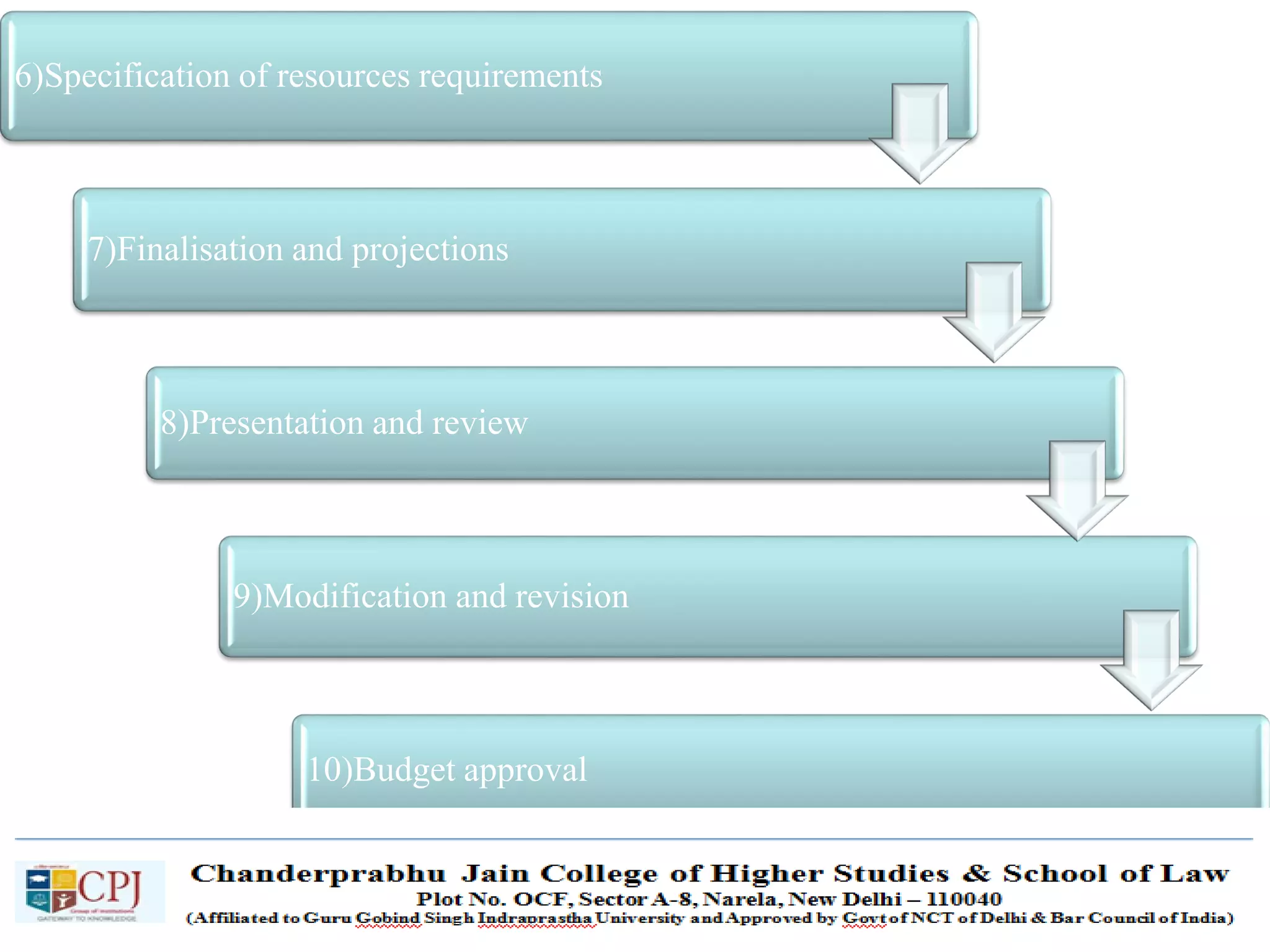
6)Specification of resources requirements
7)Finalisation and projections
8)Presentation and review
9)Modification and revision
10)Budget approval
SDM-Ch.1 77
There are various external as well as internal factors involved that influence the
sales budget of any firm. Preparing a sales budget is much tougher than an expense
budget. This is because everything in the expense budget are within company
control.
However in the case of a sales budget, the company can only control part of factors
affecting the budgeted numbers and these are called INTERENAL FACTORS.
The other part is influenced by the EXTERNAL FACTORS, such as economy,
competition, season and government to a certain extent. Those factors that are not
within the company’s control are budgeted based on assumptions.
Factors influencing Sales budget
SDM-Ch.1 78
INTERNAL FACTORS
1. Volume of sales of the enterprise.
2. Profitability of different products of the enterprise.
3. Advertising and sales promotion strategies.
4. Price policy.
5. Ability and efficiency of the salesman.
These factors fall within the reach of any organization or enterprise, and hence if
any improvement or changes are required, it could be easily incorporated, without
any wastage of time and money.
SDM-Ch.1 79
EXTERNAL FACTORS
1. Purchasing power of the general public.
2. Industrial and taxation policy of the govt.
3. Changes in needs, habits & preference of the consumers.
4. Situation of competition in the market.
5. Distribution of wealth in the country.
These factors greatly influence the sales budget of any organization in fact the sales
budget of the firms are prepared in keeping the external factors in mind for the
smooth running of the business.
SDM-Ch.1 80
• Affordable Method
• Rule of thumb (percentage of sales method)
• Competitors parity method
• Objective & task method
• Zero base budgeting
METHODS OF SALES BUDGETING
SDM-Ch.1 81
A business manager should always go through the above mentioned factors before
framing the final sales budget.
The efficiency of any sales budget is dependent on how accurately these external and
internal factors are considered and kept in mind by the sales manager.
However external factors play a more important role in preparation of any sales
budget as compared to internal factors as the former is not under the control of the
organization , and also these external factors keep fluctuating from time to time. But
to ignore internal factors simply means one is preparing an incomplete sales budget ,
thus both the factors should be kept in mind in order to make an efficient sales
budget.
SDM-Ch.1 82
Sales Management
Social, Ethical, and Legal Responsibilities of Sales Personnel-Unit-4
SDM-Ch.1 83
Sales Management
Management’s Social Responsibilities
Organizational Stakeholders
• Customers
• Community
• Creditors
• Government
• Owners
• Managers
• Employees
• Suppliers
SDM-Ch.1 84
Sales Management
Management’s Social Responsibilities
Economic Responsibilities
• Produce Goods and Services
• Maximize Profits
Legal Responsibilities
• Fulfill their Economic Goals Within a Legal Framework
SDM-Ch.1 85
Sales Management
Management’s Social Responsibilities
Ethical Responsibilities
• Act with Equity, Fairness & Impartiality
• Respect the Rights of Individuals
Discretionary Responsibilities
• Voluntary & Guided by Company’s
• Desire to Make Social Contributions
SDM-Ch.1 86
Sales Management
Management’s Ethical Responsibilities
“Ethics”
– A set of moral principles and values that governs the
behavior of a person or a group with respect to what is right
and wrong.
SDM-Ch.1 87
Some guidelines
• Use an honest approach
• Put your customer’s interest first
• Avoid misleading sale claims
• Avoid attacking competitors
• Avoid misuse of company resources
• Practice honesty after sales
SDM-Ch.1 88
Legal issues in sales management
• Price fixing
• Price discrimination
• Bribes
• Consumer protection

Sales and Distribution Management

  • 1.
    SDM-Ch.1 1 Chanderprabhu JainCollege of Higher Studies & School of Law Plot No. OCF, Sector A-8, Narela, New Delhi – 110040 (Affiliated to Guru Gobind Singh Indraprastha University and Approved by Govt of NCT of Delhi & Bar Council of India) Semester: Fifth Semester Name of the Subject: Sales & Distribution Management Unit:1-Unit:4
  • 2.
    SDM-Ch.1 2 SALES MANAGEMENT •Sales management means planning, direction and control of personal selling, including recruiting, selecting, equipping, assigning, routing, supervising, paying and motivating as these tasks apply to the personal Sales force. • “The management of Sales force” by American Marketing Association.
  • 3.
    SDM-Ch.1 3 WHAT ISSALES MANAGEMENT? Sales management is the attainment of sales force goals in an effective and efficient manner through: • Planning • Staffing • Training • Leading • Controlling organizational resources 3
  • 4.
    SDM-Ch.1 4 EVOLUTION OFSALES MANAGEMENT • Before industrial revolution small scale manufacturers who use to supply to nearby customers. • After industrial revolution i.e. around 1760 AD large scale manufacturers came into the market. • Selling to nearby area not adequate to meet existing supply. • Need of expansion through wholesalers and retailers. • Sales become a different function altogether (Revenue generating function)
  • 5.
    SDM-Ch.1 5 • Primitivefamily economy • The barter system • The rise of money • Small scale manufacturing • Industrial revolution EVOLUTION OF SALES MANAGEMENT
  • 6.
    SDM-Ch.1 6 Nature ofSales Management 1. Its integration with marketing management 2. Relationship Selling Transactional Relationship / Selling Value – added Relationship / Selling Collaborative / Partnering Relationship / Selling Head- Marketing Manager – Customer Service Manager – Market Logistics Manager – Sales Manager – Market Research Manager- Promotion
  • 7.
    SDM-Ch.1 7 3. VaryingSales Responsibilities / Positions / Jobs Sales Position Brief Description Examples • Delivery salesperson • Delivery of products to business customers or households. • Also takes orders. • Milk, newspapers to households • Soft drinks, bread to retail stores. • Order taker (Response selling) • Inside order taker • Telemarketing salesperson takes orders over telephone • Outside order taker. Also performs other tasks • Behind counter in a garment shop • Pharma products’ orders from nursing homes • Food, clothing products’ orders from retailers • Sales support • Missionary selling • Technical selling • Provide information, build goodwill, introduce new products • Technical information, assistance • Medical reps. in pharma industry • Steel, Chemical industries • Order-getter (Creative, Problem- solving, Consultative selling) • Getting orders from existing and new household consumers • Getting orders from business customers, by solving their business and technology problems • Automobiles, refrigerators, insurance policies • Software and business solutions
  • 8.
    SDM-Ch.1 8 4. Itis pervasive function: present in micro, small, medium and large enterprises. 5. It is a continuous function.
  • 9.
    SDM-Ch.1 9 Scope ofSales Management 1. Sales planning • Analyzing the environment of business • Forecasting sales • Sales budgeting • Selecting sales strategy on the basis of objective of sales • Preparing sales program 2. Sales Organizing 3. Sales Directing 4. Sales Coordinating 5. Sales Controlling
  • 10.
    SDM-Ch.1 10 IMPORTANCE OFSALES MANAGEMENT • Revenue generation • Employment generation • Rewarding career: fastest route to top management • Higher standard of living of people because of sales people • Intelligence agency (eyes and ears): all round knowledge of company’s products, customers, competition
  • 11.
    SDM-Ch.1 11 OBJECTIVES OFSALES MANAGEMENT • Sales maximization • Profit maximization • Continuous growth
  • 12.
    SDM-Ch.1 12 Quantitative objectives •To retain & capture market share. • To determine sales volume in ways that contributes to profitability. • To obtain new accounts of given types • To keep personal expenses within specified limits. • To secure targeted percentage of certain accounts of business.
  • 13.
    SDM-Ch.1 13 Qualitative objectives •To do the entire selling job. • To service existing accounts (customers) • To search & maintain customer cooperation. • To assist the dealer in selling the product line. • To provide technical advice wherever necessary. • To assist in training of middleman’s sales personnel. • To provide advice & assist the middlemen. • To collect & report market information of interest & use to the company management.
  • 14.
    SDM-Ch.1 14 EXCHANGE PROCESS •“Customer is the boss- yesterday, today & tomorrow.” • “Customer is profit- everyone else is overhead.” • Exchange is the core aspect of marketing & sales and distribution management facilities. • Sales management is defined as the management of the firm’s personal selling functions while distribution management is the indirect selling effort.
  • 15.
    SDM-Ch.1 15 Ways bywhich exchange can take place • Directly (through its own sales force) • Indirectly (through middlemen, retailers, wholesalers) • Jointly. PROCESS Contacting Prospecting Negotiating & transaction Promotion’ Physical distribution & collection
  • 16.
    SDM-Ch.1 16 Key decisionareas in sales management • The type & quality of sales personnel • The size of sales force: work load, incremental & sales potential methods. • Organization & design of sales dept. Functional org, mgmt org., territorial org. • The territory design: circular, clover leaf, hop scotch method • The recruitment & training procedure • The task allocation
  • 17.
    SDM-Ch.1 17 • Thecompensation of sales force. • The performance appraisal & control system • The feedback mechanism to be adopted. • Managing channel relationship • Coordinating with other marketing departments
  • 18.
    SDM-Ch.1 18 Sales managementcycle Analysis Planning Direction Control Organizati on
  • 19.
    SDM-Ch.1 19 Difference betweenSales Management & Marketing Management Marketing Management • A Comparatively new concept. • It includes sales management • Objective is to maximize long term profit through customer satisfaction. • Wide scope • A higher level function Sales Management • A comparatively old concept. • It is a part of marketing management • Objective is to maximize sales and profits • Narrow scope • A lower level function
  • 20.
    SDM-Ch.1 20 Roles andSkills of a Modern Sales Manager • Strategic role • Team member • A team leader, working with salespeople • Managing multiple sales / marketing channels • Relationship building Using latest technologies (like CRM) to build superior buyer-seller relationships • Monitoring and controlling: Continually updating information on changes in marketing environment.
  • 21.
    SDM-Ch.1 21 Skills ofa Successful Sales Manager • People/ Human skills include abilities to motivate, lead, communicate, coordinate, team-oriented relationship, and mentoring • Managing skills consist of planning, organizing, controlling and decision making • Technical skills include training, selling, negotiating, problem-solving, and use of computers
  • 22.
    SDM-Ch.1 22 Types ofSales Managers / Levels of Sales Management Positions CEO / President V. P. Sales / V. P. Marketing National Sales Manager Regional / Zonal / Divisional Sales Managers District / Branch / Area Sales Managers Sales Trainee / Sales Person / Sales Representative Operationsl / First level sales managers Middle-Level Sales Managers Top-Level Sales Managers / Leaders
  • 23.
    SDM-Ch.1 23 • Sellingis not just for sales people • Personal selling -personal communication of information to unselfishly persuade a prospective customer to buy something a good or a service or an idea
  • 24.
    SDM-Ch.1 24 Sales planning •Sales planning is the process of determining the sales objectives & deciding the strategies & tactics for achievement of these objectives • Sales planning begins with sales forecasting • Sales forecast is the prediction of what a company expects to sell during a future period of time eg: one year. • On the basis of sales forecast company decides its sales budget
  • 25.
    SDM-Ch.1 25 Sales Objectives,Strategies and Tactics The main components of planning in a company are objectives, strategies and tactics. Their relationship is shown below Decide / Set Objectives Develop Strategies Evolve Tactics / Action Plans E.G. A company wants to increase sales of electric motors by 15 percent, as one of the sales objectives. (see next slide) Review & revision
  • 26.
    SDM-Ch.1 26 To illustratethe relationship between sales objectives, strategies and tactics, consider: Sales Goals / Objectives Marketing Strategy Sales and Distribution Strategy Tactics / Action plans • Increase sales volume by 15 percent • Enter export markets • Identify the countries • Decide distribution channels • Marketing / sales head to get relevant information • Negotiate and sign agreements in 3-5 months with intermediaries • Penetrate existing domestic markets • Review and improve salesforce training, motivation and compensation • Use effective and efficient channels • Add channels and members • Train salespeople in deficient areas • Train field salesmanagers in effective supervision • Link sales volume quotas to the incentive scheme of the compensation plan
  • 27.
    SDM-Ch.1 27 To illustratethe relationship between sales objectives, strategies and tactics, consider: Sales Goals / Objectives Marketing Strategy Sales and Distribution Strategy Tactics / Action plans • Reduce selling expenses by 10% • Make optimum use of existing force • Use ‘ABC Analysis’ for customer segments Sales force to focus on high potential (A Class custoners) Employ more efficient distribution channels • Use online selling & telemarketing Dealers, telemarketing & online selling to serve B & C class custoimers
  • 28.
    SDM-Ch.1 28 Emerging Trendsin Sales Management • Global perspective • Revolution in technology • Customer relationship management (CRM) • Sales force diversity • Team selling approach • Managing multi-channels • Ethical and social issues • Sales professionalism
  • 29.
  • 30.
    SDM-Ch.1 30 THEORIES OFSELLING ➢Selling is considered as an art by some and a science by others. ➢This has produced two contrasting approaches to the theory of selling.
  • 31.
    SDM-Ch.1 31 Four Theoriesof Selling ➢ AIDAS ➢ “Right set of circumstances” ➢ “Buying Formula” ➢ “Behavioral Equation”
  • 32.
    SDM-Ch.1 32 • AIDASand “Right Set Of Circumstances” are seller oriented theories. • “Buying Formula” theory of selling is Buyer oriented. • The “Behavioral Equation” theory emphasizes the buyer’s decision process but also takes the salesperson’s influence process into account.
  • 33.
    SDM-Ch.1 33 AIDAS theoryof selling • A-Securing attention. • I-Gaining Interest. • D-Kindling desire. • A-Inducing Action. • S-Building Satisfaction.
  • 34.
    SDM-Ch.1 34 “Right Setof Circumstances” Theory Of Selling • Summed up as “Everything Was Right for The Sale.” • Situation Response Theory • This Theory holds that the particular circumstances prevailing in a given selling situation cause the prospect in a predictable way. • The more skilled the salesperson is in handling the set of circumstances, the more predictable is the response.
  • 35.
    SDM-Ch.1 35 “Right Setof Circumstances” Theory Of Selling • The set of circumstances includes factors external & internal to the prospect. • The salesperson and the remark are external factors. • Proponents of these theory tends to stress external factors and the expense of internal factors. • This is a seller oriented theory: it stresses the importance of the salesperson controlling the situation.
  • 36.
    SDM-Ch.1 36 The ‘’BuyingFormula’’ Theory • The name ‘’buying formula’’ has been given by E.K. Strong. • It emphasizes the buyer’s side of the buyer-seller dyad.
  • 37.
    SDM-Ch.1 37 Reduced toits simplest form, the mental processes involved in a purchase are Need(or problem) Solution Purchase
  • 38.
    SDM-Ch.1 38 After addingthe fourth element, it becomes Need Solution Purchase Satisfaction
  • 39.
    SDM-Ch.1 39 After modificationin the solution and satisfaction, the buying formula becomes Need Product/Servic e and trade name Purchase Satisfaction/Di ssatisfaction
  • 40.
    SDM-Ch.1 40 After addingadequacy and pleasant feelings, it becomes Need Product/Servic e and trade name Purchase Satisfaction/Di ssatisfaction Adequacy Pleasant feelings
  • 41.
    SDM-Ch.1 41 • ifsales to new prospects are desired, every element in the formula should be presented. • developing new uses is comparable to selling to new prospects.
  • 42.
  • 43.
    SDM-Ch.1 43 • Developedusing stimuli-response model. • Sophisticated and advanced version of the “Right set of circumstances” theory.
  • 44.
    SDM-Ch.1 44 Requires 4essential elements- 1: Drive-A strong internal stimulus. a) INNATE DRIVES b) LEARNED DRIVES 2: Cues-Weak stimuli when the buyers respond. o Triggering o Non-Triggering (specific product-eg. special discounts)
  • 45.
    SDM-Ch.1 45 3: Response-What does the buyer do? 4: Reinforcement- Event that strengthens the buyer’s response tendency.
  • 46.
    SDM-Ch.1 46 • Whena product’s potential satisfaction to the buyer (K) yields rewards, reinforcement occurs. • When P is positive, K is automatically active. • When P and K are positive, customers are more loyal to the product.
  • 47.
  • 48.
    SDM-Ch.1 48 INTRODUCTION • Salesstrategies are adopted to achieve desired objectives in sales. • The objective may be in many in number and these require elaborate and careful consideration of the strategies and game plan of competitive organizations
  • 49.
    SDM-Ch.1 49 SALES STRATEGY Itbasically involves three steps 1. Market analysis 2. Setting objectives 3. Designing sales strategy
  • 50.
    SDM-Ch.1 50 1. MARKETANALYSIS • It means macro environmental analysis. • Social , political, cultural, economic and technological factors • SWOT Analysis • Mission or goals setting which directly affects objectives • Market analysis is a pre requisite for setting objectives
  • 51.
    SDM-Ch.1 51 Through marketanalysis company would need to know • The current size and growth rate of the market • Consumer needs, attitudes and trends in purchasing behavior • Competitor analysis: current strategy adopted by other firms , current performance including market share analysis and their strengths and weaknesses • Expectation of their future actions
  • 52.
    SDM-Ch.1 52 2. SETTINGSALES OBJECTIVES • Objectives are standards against which performance is measured. • Qualitative and quantitative objective • Qualitative objectives are long term and derived from marketing and sales policies of the company • whereas quantitative are short term
  • 53.
    SDM-Ch.1 53 GOALS • Goalsare set in terms of a. Sales volume b. Sales cost c. Accounts receivable d. Inventory levels e. Dealer support f. Feedback input
  • 54.
    SDM-Ch.1 54 3. SETTINGSALES STRATEGY • Sales strategy is set considering a. The type of sales force required. b. The size of sales force required c. Territory design d. Channel support and coordination
  • 55.
    SDM-Ch.1 55 a. TYPEOF SALES FORCE NEEDED • It depends on the role the sales force has to play. • The quality of sales force is defined as the quality of contribution required from the sales force and the work load on them. • If pre - selling has been done by ads, then selling becomes easy. • Some companies expect their salesman to do entire job • Product specialist: highly technical products like banking services, insurance, computers • Market specialists: know the different market and can adopt different sales approaches for different markets
  • 56.
    SDM-Ch.1 56 b. DETERMINATIONOF THE SIZE OF SALES FORCE • Incremental method • Work load method • Sales potential method
  • 57.
    SDM-Ch.1 57 Incremental method •It says we can increase the size of sales force till the incremental revenue exceeds incremental costs. • Assumptions: profits will increase when additional sales person are employed.
  • 58.
    SDM-Ch.1 58 Sales potentialmethod • What an average salesman with averages performance will accomplish. • N = S/P • N= Number of Sales Persons • S= Forecasted Sales Volume • P= Estimated sales productivity of one person • If S= 100000 & P= 10000 • THEN N= 10 • Easiest of all the methods. • If rate of turnover is 10% then modified formula • N= S/P + T (S/P) = S/P (1+T) • = 100000/10000 (1+ 10/100) = 11 SALES PERSONS
  • 59.
    SDM-Ch.1 59 WORK LOADMETHOD • Most complex method • Assumption: all sales person will shoulder equal responsibilities. • Total work load is estimated and the it is divided equally among all the sales people. • Adv: easy to understand & apply, attractive to practising managers • Disadv: does not take profit into consideration; assumes sales personnel have same work load & same efficiency; time given to each call is as important as quality of time given per call
  • 60.
    SDM-Ch.1 60 c. BASISFOR TERRITORY DESIGN • Geographical basis: grouping according to existing geographical boundaries. • Sales potential basis: splitting according to dispersion of its sales potential. • Servicing requirement basis: splitting according to servicing requirements (maintaining & developing of account) • Work load basis: considers both account potential and servicing requirements.
  • 61.
    SDM-Ch.1 61 d. CHANNELSUPPORT AND COORDINATION • If indirect distribution is adopted then organization has to look for dealer cooperative programs like support for adequate stock maintenance, local promotion in for of P.O.P and displays a. Adequate incentives for the dealers is a must b. Proper feedback and communication is important c. Measures have to be taken to promote dealer loyalty
  • 62.
    SDM-Ch.1 62 DISTRIBUTION • IntensiveDistribution: maximum exposure to the product eg: HUL, asian paints • Extensive Distribution: covers large area but do not concentrate on all customers • Selective Distribution: selected outlets eg: designer shirts, cosmetics, tv etc. • Exclusive Distribution: exclusively by one dealer eg: automobiles • Vertical Integration: requiring mgmt membership rights at various level of distribution
  • 63.
    SDM-Ch.1 63 Emerging trendsin Sales Management • Global perspective. • Revolution in technology • Customer relationship management • Sales force diversity • Team selling approach • Managing multi channels • Ethical and social issues • E selling
  • 64.
  • 65.
    SDM-Ch.1 65 Meaning ofSales Budget Sales budgeting is a key function of sales management. It involves estimating future level of revenue and selling expenses, and consequently the profit contribution made by the sales function. The outcome of sales budgeting is seen in the form of two documents: •The sales budget, and •The selling expenses budget.
  • 66.
    SDM-Ch.1 66 •Sales Budgetreflects the targeted sales revenue. • Sales Expense budget shows the expenses necessary to reach the targeted sales revenue. Through these two statements sales management can reconcile these revenues & expenses with the firm’s objectives. Thus, sales budgeting is concerned with improving selling efficiency & reducing the selling costs. More specifically, Sales Budget is a detailed programme developed for a specified period that indicates the anticipated sales & selling expenses.
  • 67.
    SDM-Ch.1 67 • Thesales budget is prepared by multiplying the expected unit sales volume for each product by its anticipated unit selling price. • Each of the other budgets such as production budget, direct material budget, direct labor budget, manufacturing overhead budget & Selling and administration budget depends on the sales budget. • It is derived from the sales forecast. It represents management’s best estimate of sales revenue for the budget period.
  • 68.
    SDM-Ch.1 68 1.Planning The companyformulates marketing and sales objectives; the budget determines how these objectives will be met through a detailed breakdown of the sales budget among products, territories and customers. 2. Co-ordination:- The budget establishes what the cost of various heads be thereby maintaining a desired relationship between expenditure and revenues. The budget enables sales executives to coordinate expenses with sales. It also restricts the sales executives form spending more that their share of the funds helping to prevent expenses from getting out of control. Objectives of Sales Budget:-
  • 69.
    SDM-Ch.1 69 3. Control:- Thesales budget enables sales executives for evaluating sales performance . A sales manager can improve his success by meeting sales and cost goals set forth in the sales budget. 4. Evaluation:- Sales department budgets become tools to evaluate the department’s performance. By meeting the sales & cost goals set forth in the budget, a sales manager may prove himself to be a successful executive. Sales budget can be determined on the basis of following categories Objectives of Sales Budget:-
  • 70.
    SDM-Ch.1 70 1. Thesales budget is the first component of the master operating budget. This is because sales affect all other parts of the master budget. 2. It includes the total sales valued in quantity. 3. It consists of three parts; break even, target and projected sales. 4. The budget also includes sales by product, location, customer density and seasonal sales patterns. 5. It provides a plan for both cash and credit sales. 6. The basis of a sales budget is the sale price per unit of goods to be sold multiplied by the quantity of goods to be sold. 7. A sales budget is planned around the competition, the material available, cost of distribution, government controls and the political climate. Features
  • 71.
    SDM-Ch.1 71 •A goodsales budget should serve as a guide to company with regard to its sales target. It should be flexible and resilient to the volatile changes in the market. •The budget should not put too many restraints on the sales functions of the company. • A sales budget is a financial plan for the sales of goods and services of a company. It is the basis on which all the financial decisions of a company with regard to sales are taken. •The budget also controls the general sales prospects of a company. • Online and off line marketing, marketing in the media and other advertising expenditures are planned around a sales budget. Importance
  • 72.
    SDM-Ch.1 72 Among themajor factors considered when forecasting sales are: Sales forecasting is the process of predicting sales of goods and services. Sales Forecasting 1. Past sales levels and trends 2. General economic trends 3. Economic trends in the company’s industry 4. Other factors expected to affect sales in the industry 5. Political and legal events 6. The intended pricing policy of the company 7. Planned advertising and product promotion 8. Expected action of competitors 9. New products contemplated by the company or other firms 10. Market research studies
  • 73.
    SDM-Ch.1 73 ADVANTAGES OFA SALES BUDGET A sales budget offers the following benefits: • It is helpful in framing sales programming so as to achieve the sales targets of the firm. • It is useful in allocation of resources to different products, sales territories,etc.for realising the forecast sales. • It is helpful in keeping expenses under control so that the objectives of net profits are achieved. • It serves as a yard stick for evaluating progress and sales performance of the company. • It can reveal the areas/products in which the company needs to strengthen its position.
  • 74.
    SDM-Ch.1 74 A salesbudget comes with inherent limitations and a good sales budget is made by overcoming these limitations. 1. A sales budget cannot effectively forecast the future trends of events. 2. It may not be easily accepted by all people in the organization. 3. Preparing a sales budget takes up too much managerial time. 4. Usually sales budgets shy away from expenditure that will give returns in the long run. Limitations:
  • 75.
    SDM-Ch.1 75 1) Situationanalysis 2) Identification of problems and opportunities 3) Development of sales forecast 4) Formulation of objectives 5) Determination of sales task PROCEDURE OF SALES BUDGETING
  • 76.
    SDM-Ch.1 76 6)Specification ofresources requirements 7)Finalisation and projections 8)Presentation and review 9)Modification and revision 10)Budget approval
  • 77.
    SDM-Ch.1 77 There arevarious external as well as internal factors involved that influence the sales budget of any firm. Preparing a sales budget is much tougher than an expense budget. This is because everything in the expense budget are within company control. However in the case of a sales budget, the company can only control part of factors affecting the budgeted numbers and these are called INTERENAL FACTORS. The other part is influenced by the EXTERNAL FACTORS, such as economy, competition, season and government to a certain extent. Those factors that are not within the company’s control are budgeted based on assumptions. Factors influencing Sales budget
  • 78.
    SDM-Ch.1 78 INTERNAL FACTORS 1.Volume of sales of the enterprise. 2. Profitability of different products of the enterprise. 3. Advertising and sales promotion strategies. 4. Price policy. 5. Ability and efficiency of the salesman. These factors fall within the reach of any organization or enterprise, and hence if any improvement or changes are required, it could be easily incorporated, without any wastage of time and money.
  • 79.
    SDM-Ch.1 79 EXTERNAL FACTORS 1.Purchasing power of the general public. 2. Industrial and taxation policy of the govt. 3. Changes in needs, habits & preference of the consumers. 4. Situation of competition in the market. 5. Distribution of wealth in the country. These factors greatly influence the sales budget of any organization in fact the sales budget of the firms are prepared in keeping the external factors in mind for the smooth running of the business.
  • 80.
    SDM-Ch.1 80 • AffordableMethod • Rule of thumb (percentage of sales method) • Competitors parity method • Objective & task method • Zero base budgeting METHODS OF SALES BUDGETING
  • 81.
    SDM-Ch.1 81 A businessmanager should always go through the above mentioned factors before framing the final sales budget. The efficiency of any sales budget is dependent on how accurately these external and internal factors are considered and kept in mind by the sales manager. However external factors play a more important role in preparation of any sales budget as compared to internal factors as the former is not under the control of the organization , and also these external factors keep fluctuating from time to time. But to ignore internal factors simply means one is preparing an incomplete sales budget , thus both the factors should be kept in mind in order to make an efficient sales budget.
  • 82.
    SDM-Ch.1 82 Sales Management Social,Ethical, and Legal Responsibilities of Sales Personnel-Unit-4
  • 83.
    SDM-Ch.1 83 Sales Management Management’sSocial Responsibilities Organizational Stakeholders • Customers • Community • Creditors • Government • Owners • Managers • Employees • Suppliers
  • 84.
    SDM-Ch.1 84 Sales Management Management’sSocial Responsibilities Economic Responsibilities • Produce Goods and Services • Maximize Profits Legal Responsibilities • Fulfill their Economic Goals Within a Legal Framework
  • 85.
    SDM-Ch.1 85 Sales Management Management’sSocial Responsibilities Ethical Responsibilities • Act with Equity, Fairness & Impartiality • Respect the Rights of Individuals Discretionary Responsibilities • Voluntary & Guided by Company’s • Desire to Make Social Contributions
  • 86.
    SDM-Ch.1 86 Sales Management Management’sEthical Responsibilities “Ethics” – A set of moral principles and values that governs the behavior of a person or a group with respect to what is right and wrong.
  • 87.
    SDM-Ch.1 87 Some guidelines •Use an honest approach • Put your customer’s interest first • Avoid misleading sale claims • Avoid attacking competitors • Avoid misuse of company resources • Practice honesty after sales
  • 88.
    SDM-Ch.1 88 Legal issuesin sales management • Price fixing • Price discrimination • Bribes • Consumer protection