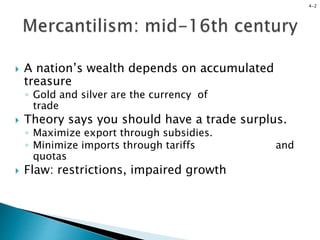
 A nation’s wealth depends on accumulated
treasure
◦ Gold and silver are the currency of
trade
 Theory says you should have a trade surplus.
◦ Maximize export through subsidies.
◦ Minimize imports through tariffs and
quotas
 Flaw: restrictions, impaired growth
4-2
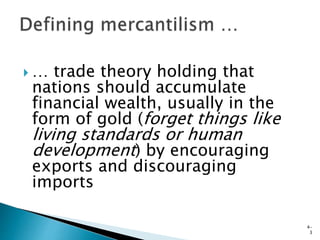
 … trade theory holding that
nations should accumulate
financial wealth, usually in the
form of gold (forget things like
living standards or human
development) by encouraging
exports and discouraging
imports
4-
3
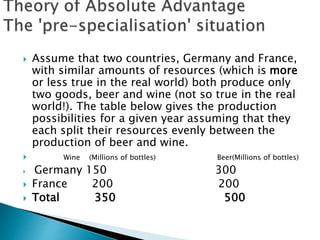
 Assume that two countries, Germany and France,
with similar amounts of resources (which is more
or less true in the real world) both produce only
two goods, beer and wine (not so true in the real
world!). The table below gives the production
possibilities for a given year assuming that they
each split their resources evenly between the
production of beer and wine.
 Wine (Millions of bottles) Beer(Millions of bottles)
 Germany 150 300
 France 200 200
 Total 350 500
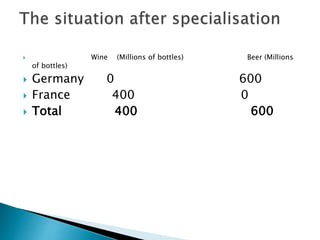
 Wine (Millions of bottles) Beer (Millions
of bottles)
 Germany 0 600
 France 400 0
 Total 400 600
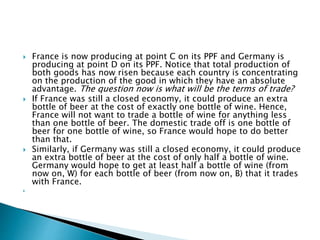
 France is now producing at point C on its PPF and Germany is
producing at point D on its PPF. Notice that total production of
both goods has now risen because each country is concentrating
on the production of the good in which they have an absolute
advantage. The question now is what will be the terms of trade?
 If France was still a closed economy, it could produce an extra
bottle of beer at the cost of exactly one bottle of wine. Hence,
France will not want to trade a bottle of wine for anything less
than one bottle of beer. The domestic trade off is one bottle of
beer for one bottle of wine, so France would hope to do better
than that.
 Similarly, if Germany was still a closed economy, it could produce
an extra bottle of beer at the cost of only half a bottle of wine.
Germany would hope to get at least half a bottle of wine (from
now on, W) for each bottle of beer (from now on, B) that it trades
with France.

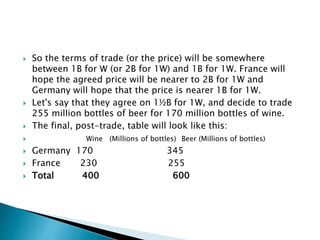
 So the terms of trade (or the price) will be somewhere
between 1B for W (or 2B for 1W) and 1B for 1W. France will
hope the agreed price will be nearer to 2B for 1W and
Germany will hope that the price is nearer 1B for 1W.
 Let's say that they agree on 1½B for 1W, and decide to trade
255 million bottles of beer for 170 million bottles of wine.
 The final, post-trade, table will look like this:
 Wine (Millions of bottles) Beer (Millions of bottles)
 Germany 170 345
 France 230 255
 Total 400 600
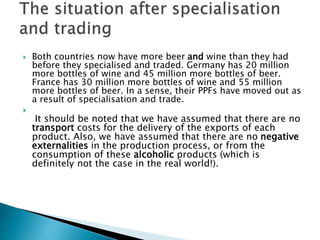
 Both countries now have more beer and wine than they had
before they specialised and traded. Germany has 20 million
more bottles of wine and 45 million more bottles of beer.
France has 30 million more bottles of wine and 55 million
more bottles of beer. In a sense, their PPFs have moved out as
a result of specialisation and trade.

It should be noted that we have assumed that there are no
transport costs for the delivery of the exports of each
product. Also, we have assumed that there are no negative
externalities in the production process, or from the
consumption of these alcoholic products (which is
definitely not the case in the real world!).
 The Pre-specialisation' situation
 Assume that two countries, Germany and
France, with similar amounts of resources
(which is more or less true in the real world)
both produce only two goods, wine and
cheese (not so true in the real world!). The
table below gives the production possibilities
for a given year assuming that they each split
their resources evenly between the
production of wine and cheese.

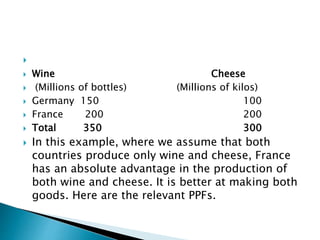
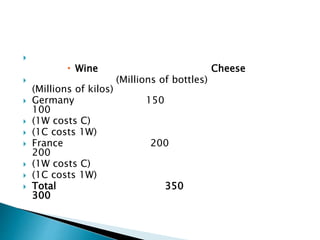
 Wine Cheese
 (Millions of bottles) (Millions of kilos)
 Germany 150 100
 France 200 200
 Total 350 300
 In this example, where we assume that both
countries produce only wine and cheese, France
has an absolute advantage in the production of
both wine and cheese. It is better at making both
goods. Here are the relevant PPFs.
 This is where the theory of comparative
advantage comes in. This theory states that in
the situation above, both countries can still
benefit from specialisation and trade.
Germany must specialise in the good at which
it is 'least bad' at making, and France should
specialise in the product at which it is best (or
'most good') at making. We find out who
should specialise in what by finding, for each
country, the opportunity cost of making each
good in terms of the other good.
 Let's look at France first. France is initially at
point A on its PPF, producing 200 million bottles
of wine (from now on, W) and 200 million
kilograms of cheese (from now on, C). If France
was to make one more kilogram of cheese, you
can see from the diagram that a bottle of wine
would have to be sacrificed. So the opportunity
cost of making 1C is 1W. If France were to make
one more bottle of wine, it would have to
sacrifice a kilogram of cheese. The opportunity
cost of making 1W is 1C.
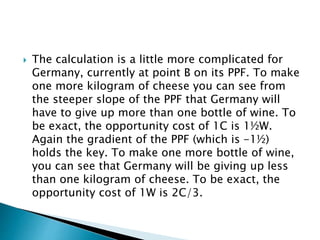
 The calculation is a little more complicated for
Germany, currently at point B on its PPF. To make
one more kilogram of cheese you can see from
the steeper slope of the PPF that Germany will
have to give up more than one bottle of wine. To
be exact, the opportunity cost of 1C is 1½W.
Again the gradient of the PPF (which is -1½)
holds the key. To make one more bottle of wine,
you can see that Germany will be giving up less
than one kilogram of cheese. To be exact, the
opportunity cost of 1W is 2C/3.

 Wine Cheese
 (Millions of bottles)
(Millions of kilos)
 Germany 150
100
 (1W costs C)
 (1C costs 1W)
 France 200
200
 (1W costs C)
 (1C costs 1W)
 Total 350
300
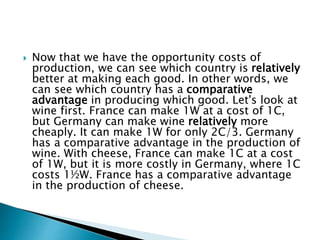
 Now that we have the opportunity costs of
production, we can see which country is relatively
better at making each good. In other words, we
can see which country has a comparative
advantage in producing which good. Let's look at
wine first. France can make 1W at a cost of 1C,
but Germany can make wine relatively more
cheaply. It can make 1W for only 2C/3. Germany
has a comparative advantage in the production of
wine. With cheese, France can make 1C at a cost
of 1W, but it is more costly in Germany, where 1C
costs 1½W. France has a comparative advantage
in the production of cheese.
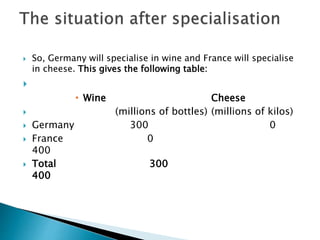
 So, Germany will specialise in wine and France will specialise
in cheese. This gives the following table:

 Wine Cheese
 (millions of bottles) (millions of kilos)
 Germany 300 0
 France 0
400
 Total 300
400
 Notice that, although overall production has
risen (700 units is bigger than 650 units), the
extra 100 million kilograms of cheese have
been produced with a loss of 50 million
bottles of wine. This may seem like a bad
deal if you particularly like wine! It is for this
reason that the two countries in this situation
are unlikely to specialise 100% in the product
for which they have a comparative advantage.
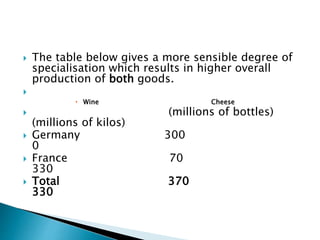
 The table below gives a more sensible degree of
specialisation which results in higher overall
production of both goods.

 Wine Cheese
 (millions of bottles)
(millions of kilos)
 Germany 300
0
 France 70
330
 Total 370
330
 If France was still a closed economy, it could produce an extra
kilogram of cheese at the cost of exactly one bottle of wine.
Hence, France will not want to trade a kilogram of cheese for
anything less than one bottle of wine. The domestic trade off is
one kilogram of cheese for one bottle of wine, so France would
hope to do better than that.
 Similarly, if Germany was still a closed economy, it could produce
an extra bottle of wine at the cost of only two-thirds of a
kilogram of cheese. Germany would hope to get at least two-
thirds of a kilogram of cheese for each bottle of wine that it
trades with France. 1W for 2C/3 is the same as 1C for 1½W.
 So the 'price' will be somewhere between 1C for 1W and 1C for
1½W. France would rather the price was as close as possible to
1C for 1½W and Germany will hope that the price is as close as
possible to 1C for 1W.
 Let's say that the two countries agree on a price of 1C for 1¼W,
and decide to trade 112 million kilograms of cheese for 140
million bottles of wine.
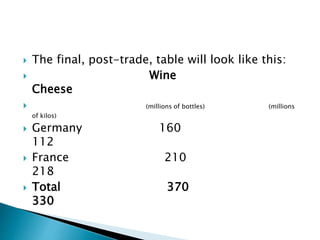
 The final, post-trade, table will look like this:
 Wine
Cheese
 (millions of bottles) (millions
of kilos)
 Germany 160
112
 France 210
218
 Total 370
330
 Both countries now have more cheese and
wine than they had before they specialised
and traded. Germany has 10 million more
bottles of wine and 12 million more
kilograms of cheese. France has 10 million
more bottles of wine and 18 million more
kilograms of cheese. In a sense, their PPFs
have moved out as a result of specialisation
and trade.
 It states that a country will export goods that
use its abundant factors intensively, and
import goods that use its scarce factors
intensively. In the two-factor case, it states:
"A capital-abundant country will export the
capital-intensive good, while the labor-
abundant country will export the labor-
intensive good."
 The critical assumption of the Heckscher–
Ohlin model is that the two countries are
identical, except for the difference in
resource endowments. This also implies that
the aggregate preferences are the same. The
relative abundance in capital will cause the
capital-abundant country to produce the
capital-intensive good cheaper than
the labor-abundant country and vice versa.
 Initially, when the countries are not trading:
 the price of the capital-intensive good in the
capital-abundant country will be bid down
relative to the price of the good in the other
country,
 the price of the labor-intensive good in the
labor-abundant country will be bid down
relative to the price of the good in the other
country.
 Once trade is allowed, profit-seeking firms
will move their products to the markets that
have higher price. As a result:
 the capital-abundant country will export the
capital-intensive good,
 the labor-abundant country will export the
labor-intensive good
 under specific economic assumptions
(constant returns, perfect competition,
equality of the number of factors to the
number of products)—a rise in therelative
price of a good will lead to a rise in the return
to that factor which is used most intensively
in the production of the good, and
conversely, to a fall in the return to the other
factor.
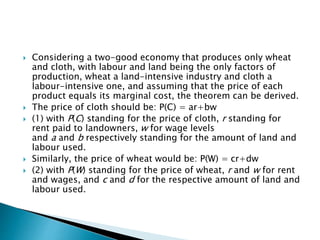
 Considering a two-good economy that produces only wheat
and cloth, with labour and land being the only factors of
production, wheat a land-intensive industry and cloth a
labour-intensive one, and assuming that the price of each
product equals its marginal cost, the theorem can be derived.
 The price of cloth should be: P(C) = ar+bw
 (1) with P(C) standing for the price of cloth, r standing for
rent paid to landowners, w for wage levels
and a and b respectively standing for the amount of land and
labour used.
 Similarly, the price of wheat would be: P(W) = cr+dw
 (2) with P(W) standing for the price of wheat, r and w for rent
and wages, and c and d for the respective amount of land and
labour used.
 If, then, cloth experiences a rise in its price, at least one of
its factors must also become more expensive, for
equation 1 to hold true, since the relative amounts of
labour and land are not affected by changing prices. It can
be assumed that it would be labour—the factor that is
intensively used in the production of cloth—that would
rise.
 When wages rise, rent must fall, in order for equation 2 to
hold true. But a fall in rent also affects equation 1. For it to
still hold true, then, the rise in wages must be more than
proportional to the rise in cloth prices.
 A rise in the price of a product, then, will more than
proportionally raise the return to the most intensively used
factor, and a fall on the return to the less intensively used
factor.
 The four primary elements of the
international product life cycle theory are: the
structure of the demand for the product,
manufacturing, international competition
and marketing strategy, and the marketing
strategy of the company that invented or
innovated the product. These elements are
categorized depending on the product’s
stage in the traditional product life cycle.
Introduction, growth, maturity, and decline
are the stages of the basic product life cycle.
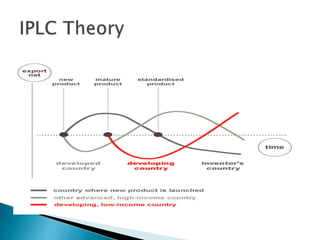
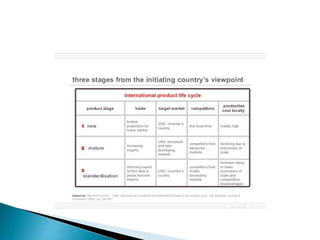
 During the introduction stage, the product is
new and not completely understood by most
consumers. Customers that do understand
the product may be willing to pay a higher
price for a cutting-edge good or service.
Production is dependent on skilled laborers
producing in short runs with rapidly changing
manufacturing methods. The innovator
markets mostly domestically, occasionally
branching out to sell the product to
consumers in other developed countries.
 International competition is usually nonexistent
during the introduction stage of the international
product life cycle, but during the growth stage
competitors in developed markets begin to copy
the product and sell domestically. These
competitors may also branch out and begin
exporting, often starting with the county that
initially innovated the product. The growth stage
is also marked by an emerging product standard
based on mass production. Price wars often
begin as the innovator breaks into an increasing
amount of developed countries, introducing the
product to new and untapped markets.
 At some point, the product enters the maturity
stage of the international product life cycle and
even the global marketplace becomes saturated,
meaning that almost everyone who would buy
the product has bought it, either from the
innovating company or one of its competitors.
Businesses compete for the remaining consumers
through lowered prices and advanced product
features. Production is stable, with a focus on
cost-cutting manufacturing methods, so that
lowered prices may be passed on to value-
conscious consumers.
 Product innovators must guard both foreign and
domestic markets from international
competition, while finally breaking into riskier
developing markets in search of new customers.
When the product reaches the decline stage, the
innovators may move production into these
developing countries in an effort to boost sales
and keep costs low. During decline, the product
may become obsolete in most developed
countries, or the price is driven so low that the
market becomes close to 100% saturated.
 a market failure is a situation wherein the
allocation of production or use of goods and
services by the free market is not efficient.
Market failures can be viewed as scenarios
where individuals' pursuit of pure self-
interest leads to results that can be improved
upon from the societal point of view.
 Market imperfection can be defined as anything
that interferes with trade. This includes two
dimensions of imperfections. First, imperfections
cause a rational market participant to deviate
from holding the market portfolio. Second,
imperfections cause a rational market participant
to deviate from his preferred risk level. Market
imperfections generate costs which interfere with
trades that rational individuals make (or would
make in the absence of the imperfection)
 The idea that multinational
corporations (MNEs) owe their existence to
market imperfections was first put forward
by Stephen Hymer, Charles P.
Kindleberger and Caves. The market
imperfections they had in mind were,
however, structural imperfections in markets
for final products .
 market imperfections are structural, arising
from structural deviations from perfect
competition in the final product market due
to exclusive and permanent control of
proprietary technology, privileged access to
inputs, scale economies, control of
distribution systems, and product
differentiation, but in their absence markets
are perfectly efficient.
 Location theory is concerned with the geographic
location of economic activity; it has become an
integral part of economic geography, regional
science, and spatial economics. Location theory
addresses questions of what economic activities
are located where and why. Location theory
rests—like microeconomic theory generally—on
the assumption that agents act in their own self-
interest. Firms thus choose locations that
maximize their profits and individuals choose
locations that maximize their utility.
 The eclectic paradigm is a theory in
economics and is also known as the OLI-
Model. It is a further development of the
theory of internalization and published
by John H. Dunning in 1980. The theory of
internalization itself is based on
the transaction cost theory.This theory says
that transactions are made within an
institution if the transaction costs on the free
market are higher than the internal costs.
This process is called internalization.
 Internalization theory itself is based on
the transaction cost theory. This theory says
that transactions are made within an
institution if the transaction costs on the free
market are higher than the internal costs.
This process is called internalization.
 For Dunning, not only the structure of
organization is important. He added 3 more
factors to the theory:
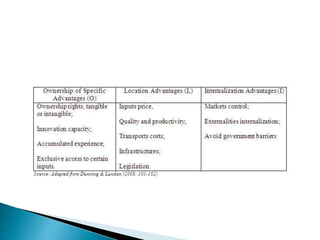
 Ownership advantages(trademark, production
technique, entrepreneurial skills, returns to
scale) Ownership specific advantages refer to
the competitive advantages of the enterprises
seeking to engage in Foreign direct
investment (FDI). The greater the competitive
advantages of the investing firms, the more
they are likely to engage in their foreign
production.
 Location advantages (existence of raw materials,
low wages, special taxes or tariffs) Locational
attractions refer to the alternative countries or
regions, for undertaking the value adding
activities of MNEs. The more the immobile,
natural or created resources, which firms need to
use jointly with their own competitive
advantages, favor a presence in a foreign
location, the more firms will choose to augment
or exploit their O specific advantages by
engaging in FDI.
 Internalization advantages (advantages by
own production rather than producing
through a partnership arrangement such as
licensing or a joint venture) Firms may
organize the creation and exploitation of
their core competencies. The greater the net
benefits of internalizing cross-border
intermediate product markets, the more likely
a firm will prefer to engage in foreign
production itself rather than license the right
to do so .
 The idea behind the Eclectic Paradigm is to merge
several isolated theories of international economics in
one approach. Three basic forms of international
activities of companies can be distinguished: Export,
FDI and Licensing. The so-called OLI-factors are
three categories of advantages, namely the ownership
advantages, locational advantages andinternalization
advantages. A precondition for international activities
of a company are the availability of net ownership
advantages. These advantages can both be material
and immaterial. The term net ownership
advantages is used to express the advantages that a
company has in foreign and unknown markets
 Two different types of FDI can be
distinguished. While resource seeking
investments are made in order to establish
access to basic material like raw materials or
other input factors, market seeking
investments are made to enter an existing
market or establish a new market. A closer
distinction is made by Dunning with the
terms efficiency seeking
investments, strategic seeking
investments and support investments
 A tariff is (1) a tax on imports or exports (an
international trade tariff). The meaning in (1)
developed from a tabular list of tax rates for
different import goods. A customs duty or due is
the indirect tax levied on the import or export of
goods in international trade. In economic sense,
a duty is also a kind of consumption tax. A duty
levied on goods being imported is referred to as
an import duty. Similarly, a duty levied on
exports is called an export duty. A tariff, which is
actually a list of commodities along with the
leviable rate (amount) of customs duty, is
popularly referred to as a customs duty.
 A subsidy is a form of financial or in kind support
extended to an economic sector (or institution,
business, or individual) generally with the aim of
promoting economic and social policy .
Furthermore, they can be broad or narrow, legal
or illegal, ethical or unethical. The most common
forms of subsidies are those to the producer or
the consumer. Producer/Production subsidies
ensure producers are better off by either
supplying market price support, direct support,
or payments to factors of production
 Types of subsidies
 Production subsidy
 Consumer/consumption subsidy
 Export subsidy
 Employment subsidy
 Tax subsidy
 An import quota is a limit on the quantity of a
good that can be produced abroad and sold
domestically.[1] It is a type of protectionist trade
restriction that sets a physical limit on the
quantity of a good that can be imported into a
country in a given period of time. If a quota is
put on a good, less of it is imported. [2] Quotas,
like other trade restrictions, are used to benefit
the producers of a good in a domestic economy
at the expense of all consumers of the good in
that economy.
 A trade restriction on the quantity of a good that
an exporting country is allowed to export to
another country. This limit is self-imposed by the
exporting country. Typically, VERs are a result of
requests made by the importing country to
provide a measure of protection for its domestic
businesses that produce substitute goods. VERs
are often created because the exporting
countries would prefer to impose their own
restrictions than risk sustaining worse terms
from tariffs and/or quotas.
 The most notable example of VERs is when Japan
imposed a VER on its auto exports into the U.S.
as a result of American pressure in the 1980s.
The VER subsequently gave the U.S. auto industry
some protection against a flood of foreign
competition.
However, there are ways in which a company can
avoid a VER. For example, the exporting
country's company can always build a
manufacturing plant in the country to which
exports would be directed. By doing so, the
company will no longer need to export goods,
and should not be bound by its country's VER.
 A protectionist tariff that a domestic government
imposes on foreign imports that it believes are
priced below fair market value. In the United
States, anti-dumping duties are imposed by the
Department of Commerce and often exceed
100%. They come into play when a foreign
company is selling an item significantly below the
price at which it is being produced. The logic
behind anti-dumping duties is to save domestic
jobs, although critics argue that this leads to
higher prices for domestic consumers and
reduces the competitiveness of domestic
companies producing similar goods.
 A foreign company will even lower the price of the
product it is "dumping" below its own cost to manufacture
the good in order to drive domestic competitors out of
business and later raise prices. Even when a foreign
company sells its exports at the same or a higher price
than they sell for in the company's home country, the
importing country can decide that the exporter is guilty of
"dumping" and impose an anti-dumping duty.
Anti-dumping duties are believed to distort the market
because the government cannot determine what
constitutes a fair market price for any good or service.
This is because fair market value is whatever price the
market will bear as determined by supply and demand.
Compa adva1
Compa adva1
Compa adva1
Compa adva1

Compa adva1

  • 2.
     A nation’swealth depends on accumulated treasure ◦ Gold and silver are the currency of trade  Theory says you should have a trade surplus. ◦ Maximize export through subsidies. ◦ Minimize imports through tariffs and quotas  Flaw: restrictions, impaired growth 4-2
  • 3.
     … tradetheory holding that nations should accumulate financial wealth, usually in the form of gold (forget things like living standards or human development) by encouraging exports and discouraging imports 4- 3
  • 4.
     Assume thattwo countries, Germany and France, with similar amounts of resources (which is more or less true in the real world) both produce only two goods, beer and wine (not so true in the real world!). The table below gives the production possibilities for a given year assuming that they each split their resources evenly between the production of beer and wine.  Wine (Millions of bottles) Beer(Millions of bottles)  Germany 150 300  France 200 200  Total 350 500
  • 5.
     Wine (Millionsof bottles) Beer (Millions of bottles)  Germany 0 600  France 400 0  Total 400 600
  • 6.
     France isnow producing at point C on its PPF and Germany is producing at point D on its PPF. Notice that total production of both goods has now risen because each country is concentrating on the production of the good in which they have an absolute advantage. The question now is what will be the terms of trade?  If France was still a closed economy, it could produce an extra bottle of beer at the cost of exactly one bottle of wine. Hence, France will not want to trade a bottle of wine for anything less than one bottle of beer. The domestic trade off is one bottle of beer for one bottle of wine, so France would hope to do better than that.  Similarly, if Germany was still a closed economy, it could produce an extra bottle of beer at the cost of only half a bottle of wine. Germany would hope to get at least half a bottle of wine (from now on, W) for each bottle of beer (from now on, B) that it trades with France. 
  • 7.
     So theterms of trade (or the price) will be somewhere between 1B for W (or 2B for 1W) and 1B for 1W. France will hope the agreed price will be nearer to 2B for 1W and Germany will hope that the price is nearer 1B for 1W.  Let's say that they agree on 1½B for 1W, and decide to trade 255 million bottles of beer for 170 million bottles of wine.  The final, post-trade, table will look like this:  Wine (Millions of bottles) Beer (Millions of bottles)  Germany 170 345  France 230 255  Total 400 600
  • 8.
     Both countriesnow have more beer and wine than they had before they specialised and traded. Germany has 20 million more bottles of wine and 45 million more bottles of beer. France has 30 million more bottles of wine and 55 million more bottles of beer. In a sense, their PPFs have moved out as a result of specialisation and trade.  It should be noted that we have assumed that there are no transport costs for the delivery of the exports of each product. Also, we have assumed that there are no negative externalities in the production process, or from the consumption of these alcoholic products (which is definitely not the case in the real world!).
  • 9.
     The Pre-specialisation'situation  Assume that two countries, Germany and France, with similar amounts of resources (which is more or less true in the real world) both produce only two goods, wine and cheese (not so true in the real world!). The table below gives the production possibilities for a given year assuming that they each split their resources evenly between the production of wine and cheese.
  • 10.
      Wine Cheese (Millions of bottles) (Millions of kilos)  Germany 150 100  France 200 200  Total 350 300  In this example, where we assume that both countries produce only wine and cheese, France has an absolute advantage in the production of both wine and cheese. It is better at making both goods. Here are the relevant PPFs.
  • 11.
     This iswhere the theory of comparative advantage comes in. This theory states that in the situation above, both countries can still benefit from specialisation and trade. Germany must specialise in the good at which it is 'least bad' at making, and France should specialise in the product at which it is best (or 'most good') at making. We find out who should specialise in what by finding, for each country, the opportunity cost of making each good in terms of the other good.
  • 12.
     Let's lookat France first. France is initially at point A on its PPF, producing 200 million bottles of wine (from now on, W) and 200 million kilograms of cheese (from now on, C). If France was to make one more kilogram of cheese, you can see from the diagram that a bottle of wine would have to be sacrificed. So the opportunity cost of making 1C is 1W. If France were to make one more bottle of wine, it would have to sacrifice a kilogram of cheese. The opportunity cost of making 1W is 1C.
  • 13.
     The calculationis a little more complicated for Germany, currently at point B on its PPF. To make one more kilogram of cheese you can see from the steeper slope of the PPF that Germany will have to give up more than one bottle of wine. To be exact, the opportunity cost of 1C is 1½W. Again the gradient of the PPF (which is -1½) holds the key. To make one more bottle of wine, you can see that Germany will be giving up less than one kilogram of cheese. To be exact, the opportunity cost of 1W is 2C/3.
  • 14.
      Wine Cheese (Millions of bottles) (Millions of kilos)  Germany 150 100  (1W costs C)  (1C costs 1W)  France 200 200  (1W costs C)  (1C costs 1W)  Total 350 300
  • 15.
     Now thatwe have the opportunity costs of production, we can see which country is relatively better at making each good. In other words, we can see which country has a comparative advantage in producing which good. Let's look at wine first. France can make 1W at a cost of 1C, but Germany can make wine relatively more cheaply. It can make 1W for only 2C/3. Germany has a comparative advantage in the production of wine. With cheese, France can make 1C at a cost of 1W, but it is more costly in Germany, where 1C costs 1½W. France has a comparative advantage in the production of cheese.
  • 16.
     So, Germanywill specialise in wine and France will specialise in cheese. This gives the following table:   Wine Cheese  (millions of bottles) (millions of kilos)  Germany 300 0  France 0 400  Total 300 400
  • 17.
     Notice that,although overall production has risen (700 units is bigger than 650 units), the extra 100 million kilograms of cheese have been produced with a loss of 50 million bottles of wine. This may seem like a bad deal if you particularly like wine! It is for this reason that the two countries in this situation are unlikely to specialise 100% in the product for which they have a comparative advantage.
  • 18.
     The tablebelow gives a more sensible degree of specialisation which results in higher overall production of both goods.   Wine Cheese  (millions of bottles) (millions of kilos)  Germany 300 0  France 70 330  Total 370 330
  • 19.
     If Francewas still a closed economy, it could produce an extra kilogram of cheese at the cost of exactly one bottle of wine. Hence, France will not want to trade a kilogram of cheese for anything less than one bottle of wine. The domestic trade off is one kilogram of cheese for one bottle of wine, so France would hope to do better than that.  Similarly, if Germany was still a closed economy, it could produce an extra bottle of wine at the cost of only two-thirds of a kilogram of cheese. Germany would hope to get at least two- thirds of a kilogram of cheese for each bottle of wine that it trades with France. 1W for 2C/3 is the same as 1C for 1½W.  So the 'price' will be somewhere between 1C for 1W and 1C for 1½W. France would rather the price was as close as possible to 1C for 1½W and Germany will hope that the price is as close as possible to 1C for 1W.  Let's say that the two countries agree on a price of 1C for 1¼W, and decide to trade 112 million kilograms of cheese for 140 million bottles of wine.
  • 20.
     The final,post-trade, table will look like this:  Wine Cheese  (millions of bottles) (millions of kilos)  Germany 160 112  France 210 218  Total 370 330
  • 21.
     Both countriesnow have more cheese and wine than they had before they specialised and traded. Germany has 10 million more bottles of wine and 12 million more kilograms of cheese. France has 10 million more bottles of wine and 18 million more kilograms of cheese. In a sense, their PPFs have moved out as a result of specialisation and trade.
  • 22.
     It statesthat a country will export goods that use its abundant factors intensively, and import goods that use its scarce factors intensively. In the two-factor case, it states: "A capital-abundant country will export the capital-intensive good, while the labor- abundant country will export the labor- intensive good."
  • 23.
     The criticalassumption of the Heckscher– Ohlin model is that the two countries are identical, except for the difference in resource endowments. This also implies that the aggregate preferences are the same. The relative abundance in capital will cause the capital-abundant country to produce the capital-intensive good cheaper than the labor-abundant country and vice versa.
  • 24.
     Initially, whenthe countries are not trading:  the price of the capital-intensive good in the capital-abundant country will be bid down relative to the price of the good in the other country,  the price of the labor-intensive good in the labor-abundant country will be bid down relative to the price of the good in the other country.
  • 25.
     Once tradeis allowed, profit-seeking firms will move their products to the markets that have higher price. As a result:  the capital-abundant country will export the capital-intensive good,  the labor-abundant country will export the labor-intensive good
  • 26.
     under specificeconomic assumptions (constant returns, perfect competition, equality of the number of factors to the number of products)—a rise in therelative price of a good will lead to a rise in the return to that factor which is used most intensively in the production of the good, and conversely, to a fall in the return to the other factor.
  • 27.
     Considering atwo-good economy that produces only wheat and cloth, with labour and land being the only factors of production, wheat a land-intensive industry and cloth a labour-intensive one, and assuming that the price of each product equals its marginal cost, the theorem can be derived.  The price of cloth should be: P(C) = ar+bw  (1) with P(C) standing for the price of cloth, r standing for rent paid to landowners, w for wage levels and a and b respectively standing for the amount of land and labour used.  Similarly, the price of wheat would be: P(W) = cr+dw  (2) with P(W) standing for the price of wheat, r and w for rent and wages, and c and d for the respective amount of land and labour used.
  • 28.
     If, then,cloth experiences a rise in its price, at least one of its factors must also become more expensive, for equation 1 to hold true, since the relative amounts of labour and land are not affected by changing prices. It can be assumed that it would be labour—the factor that is intensively used in the production of cloth—that would rise.  When wages rise, rent must fall, in order for equation 2 to hold true. But a fall in rent also affects equation 1. For it to still hold true, then, the rise in wages must be more than proportional to the rise in cloth prices.  A rise in the price of a product, then, will more than proportionally raise the return to the most intensively used factor, and a fall on the return to the less intensively used factor.
  • 31.
     The fourprimary elements of the international product life cycle theory are: the structure of the demand for the product, manufacturing, international competition and marketing strategy, and the marketing strategy of the company that invented or innovated the product. These elements are categorized depending on the product’s stage in the traditional product life cycle. Introduction, growth, maturity, and decline are the stages of the basic product life cycle.
  • 32.
     During theintroduction stage, the product is new and not completely understood by most consumers. Customers that do understand the product may be willing to pay a higher price for a cutting-edge good or service. Production is dependent on skilled laborers producing in short runs with rapidly changing manufacturing methods. The innovator markets mostly domestically, occasionally branching out to sell the product to consumers in other developed countries.
  • 33.
     International competitionis usually nonexistent during the introduction stage of the international product life cycle, but during the growth stage competitors in developed markets begin to copy the product and sell domestically. These competitors may also branch out and begin exporting, often starting with the county that initially innovated the product. The growth stage is also marked by an emerging product standard based on mass production. Price wars often begin as the innovator breaks into an increasing amount of developed countries, introducing the product to new and untapped markets.
  • 34.
     At somepoint, the product enters the maturity stage of the international product life cycle and even the global marketplace becomes saturated, meaning that almost everyone who would buy the product has bought it, either from the innovating company or one of its competitors. Businesses compete for the remaining consumers through lowered prices and advanced product features. Production is stable, with a focus on cost-cutting manufacturing methods, so that lowered prices may be passed on to value- conscious consumers.
  • 35.
     Product innovatorsmust guard both foreign and domestic markets from international competition, while finally breaking into riskier developing markets in search of new customers. When the product reaches the decline stage, the innovators may move production into these developing countries in an effort to boost sales and keep costs low. During decline, the product may become obsolete in most developed countries, or the price is driven so low that the market becomes close to 100% saturated.
  • 36.
     a marketfailure is a situation wherein the allocation of production or use of goods and services by the free market is not efficient. Market failures can be viewed as scenarios where individuals' pursuit of pure self- interest leads to results that can be improved upon from the societal point of view.
  • 37.
     Market imperfectioncan be defined as anything that interferes with trade. This includes two dimensions of imperfections. First, imperfections cause a rational market participant to deviate from holding the market portfolio. Second, imperfections cause a rational market participant to deviate from his preferred risk level. Market imperfections generate costs which interfere with trades that rational individuals make (or would make in the absence of the imperfection)
  • 38.
     The ideathat multinational corporations (MNEs) owe their existence to market imperfections was first put forward by Stephen Hymer, Charles P. Kindleberger and Caves. The market imperfections they had in mind were, however, structural imperfections in markets for final products .
  • 39.
     market imperfectionsare structural, arising from structural deviations from perfect competition in the final product market due to exclusive and permanent control of proprietary technology, privileged access to inputs, scale economies, control of distribution systems, and product differentiation, but in their absence markets are perfectly efficient.
  • 40.
     Location theoryis concerned with the geographic location of economic activity; it has become an integral part of economic geography, regional science, and spatial economics. Location theory addresses questions of what economic activities are located where and why. Location theory rests—like microeconomic theory generally—on the assumption that agents act in their own self- interest. Firms thus choose locations that maximize their profits and individuals choose locations that maximize their utility.
  • 41.
     The eclecticparadigm is a theory in economics and is also known as the OLI- Model. It is a further development of the theory of internalization and published by John H. Dunning in 1980. The theory of internalization itself is based on the transaction cost theory.This theory says that transactions are made within an institution if the transaction costs on the free market are higher than the internal costs. This process is called internalization.
  • 42.
     Internalization theoryitself is based on the transaction cost theory. This theory says that transactions are made within an institution if the transaction costs on the free market are higher than the internal costs. This process is called internalization.  For Dunning, not only the structure of organization is important. He added 3 more factors to the theory:
  • 43.
     Ownership advantages(trademark,production technique, entrepreneurial skills, returns to scale) Ownership specific advantages refer to the competitive advantages of the enterprises seeking to engage in Foreign direct investment (FDI). The greater the competitive advantages of the investing firms, the more they are likely to engage in their foreign production.
  • 44.
     Location advantages(existence of raw materials, low wages, special taxes or tariffs) Locational attractions refer to the alternative countries or regions, for undertaking the value adding activities of MNEs. The more the immobile, natural or created resources, which firms need to use jointly with their own competitive advantages, favor a presence in a foreign location, the more firms will choose to augment or exploit their O specific advantages by engaging in FDI.
  • 45.
     Internalization advantages(advantages by own production rather than producing through a partnership arrangement such as licensing or a joint venture) Firms may organize the creation and exploitation of their core competencies. The greater the net benefits of internalizing cross-border intermediate product markets, the more likely a firm will prefer to engage in foreign production itself rather than license the right to do so .
  • 46.
     The ideabehind the Eclectic Paradigm is to merge several isolated theories of international economics in one approach. Three basic forms of international activities of companies can be distinguished: Export, FDI and Licensing. The so-called OLI-factors are three categories of advantages, namely the ownership advantages, locational advantages andinternalization advantages. A precondition for international activities of a company are the availability of net ownership advantages. These advantages can both be material and immaterial. The term net ownership advantages is used to express the advantages that a company has in foreign and unknown markets
  • 47.
     Two differenttypes of FDI can be distinguished. While resource seeking investments are made in order to establish access to basic material like raw materials or other input factors, market seeking investments are made to enter an existing market or establish a new market. A closer distinction is made by Dunning with the terms efficiency seeking investments, strategic seeking investments and support investments
  • 49.
     A tariffis (1) a tax on imports or exports (an international trade tariff). The meaning in (1) developed from a tabular list of tax rates for different import goods. A customs duty or due is the indirect tax levied on the import or export of goods in international trade. In economic sense, a duty is also a kind of consumption tax. A duty levied on goods being imported is referred to as an import duty. Similarly, a duty levied on exports is called an export duty. A tariff, which is actually a list of commodities along with the leviable rate (amount) of customs duty, is popularly referred to as a customs duty.
  • 50.
     A subsidyis a form of financial or in kind support extended to an economic sector (or institution, business, or individual) generally with the aim of promoting economic and social policy . Furthermore, they can be broad or narrow, legal or illegal, ethical or unethical. The most common forms of subsidies are those to the producer or the consumer. Producer/Production subsidies ensure producers are better off by either supplying market price support, direct support, or payments to factors of production
  • 51.
     Types ofsubsidies  Production subsidy  Consumer/consumption subsidy  Export subsidy  Employment subsidy  Tax subsidy
  • 52.
     An importquota is a limit on the quantity of a good that can be produced abroad and sold domestically.[1] It is a type of protectionist trade restriction that sets a physical limit on the quantity of a good that can be imported into a country in a given period of time. If a quota is put on a good, less of it is imported. [2] Quotas, like other trade restrictions, are used to benefit the producers of a good in a domestic economy at the expense of all consumers of the good in that economy.
  • 53.
     A traderestriction on the quantity of a good that an exporting country is allowed to export to another country. This limit is self-imposed by the exporting country. Typically, VERs are a result of requests made by the importing country to provide a measure of protection for its domestic businesses that produce substitute goods. VERs are often created because the exporting countries would prefer to impose their own restrictions than risk sustaining worse terms from tariffs and/or quotas.
  • 54.
     The mostnotable example of VERs is when Japan imposed a VER on its auto exports into the U.S. as a result of American pressure in the 1980s. The VER subsequently gave the U.S. auto industry some protection against a flood of foreign competition. However, there are ways in which a company can avoid a VER. For example, the exporting country's company can always build a manufacturing plant in the country to which exports would be directed. By doing so, the company will no longer need to export goods, and should not be bound by its country's VER.
  • 55.
     A protectionisttariff that a domestic government imposes on foreign imports that it believes are priced below fair market value. In the United States, anti-dumping duties are imposed by the Department of Commerce and often exceed 100%. They come into play when a foreign company is selling an item significantly below the price at which it is being produced. The logic behind anti-dumping duties is to save domestic jobs, although critics argue that this leads to higher prices for domestic consumers and reduces the competitiveness of domestic companies producing similar goods.
  • 56.
     A foreigncompany will even lower the price of the product it is "dumping" below its own cost to manufacture the good in order to drive domestic competitors out of business and later raise prices. Even when a foreign company sells its exports at the same or a higher price than they sell for in the company's home country, the importing country can decide that the exporter is guilty of "dumping" and impose an anti-dumping duty. Anti-dumping duties are believed to distort the market because the government cannot determine what constitutes a fair market price for any good or service. This is because fair market value is whatever price the market will bear as determined by supply and demand.