Inferential Statistics
Applications & Usefulness
Definitions
• Statistics is the science which deals with the methods
of collecting, classifying, presenting, comparing and
interpreting numerical data collected to have some
inference regarding the real aspects.
Highlights:
(i) Aggregates of facts.
(ii) Effected to a marked extent by multiplicity of causes.
(iii) Numerically Expressed.
(iv) Estimated as per reasonable standards of accuracy.
(v) Collected in as systematic manner for a pre-
determined purpose.
Reasons for Learning Statistics
It enables the decision-maker to understand how to :
(i) present and describe information (data) so as to
improve decisions.
(ii) draw conclusions about the large population
based upon information obtained from samples.
(iii) seek out relationship between pair of variables to
improve processes.
(iv) obtain reliable forecasts of statistical variables of
interest.
Statistical Thinking and Analysis
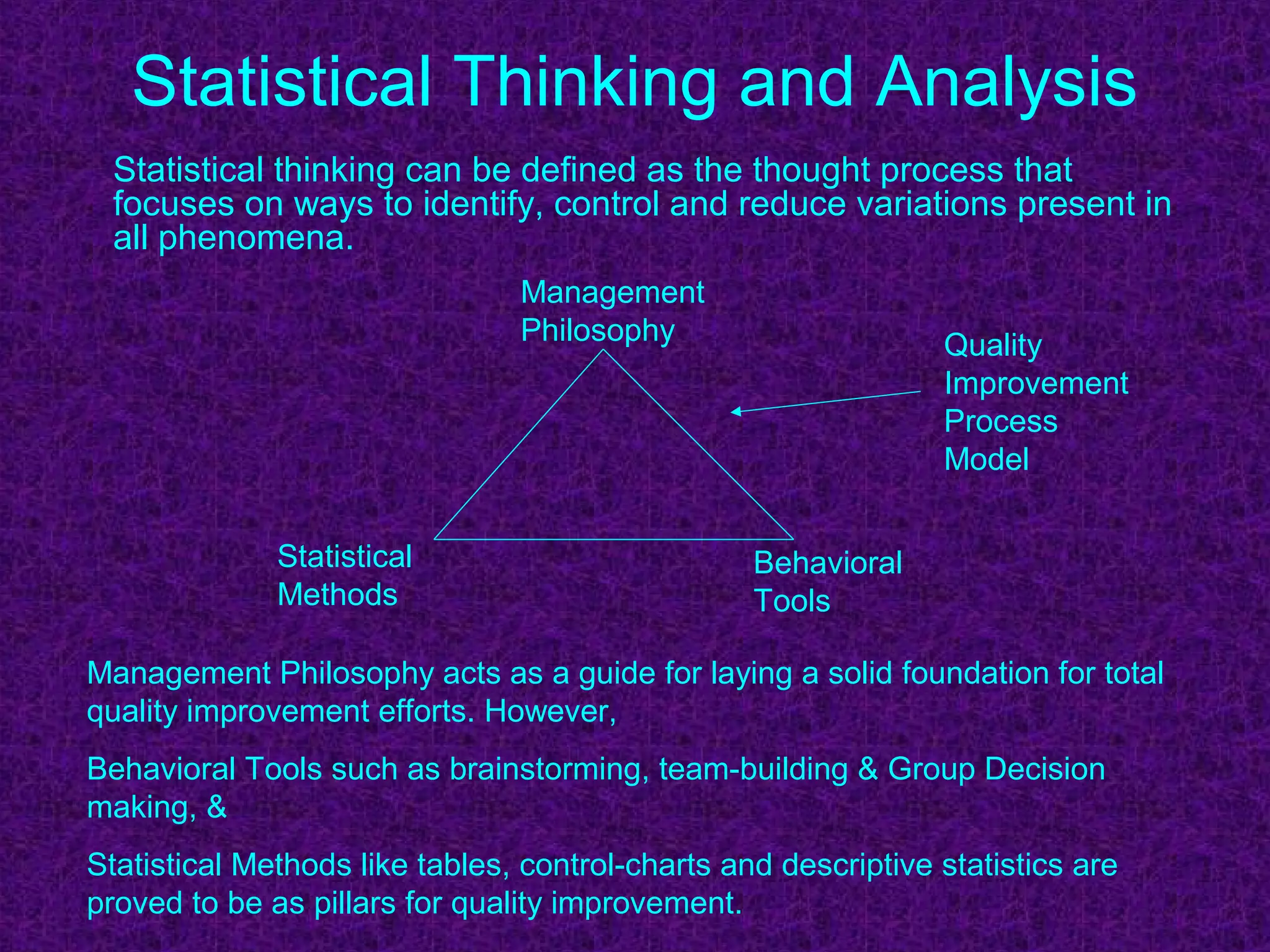
Statistical thinking can be defined as the thought process that
focuses on ways to identify, control and reduce variations present in
all phenomena.
Management
Philosophy
Statistical
Methods
Behavioral
Tools
Quality
Improvement
Process
Model
Management Philosophy acts as a guide for laying a solid foundation for total
quality improvement efforts. However,
Behavioral Tools such as brainstorming, team-building & Group Decision
making, &
Statistical Methods like tables, control-charts and descriptive statistics are
proved to be as pillars for quality improvement.
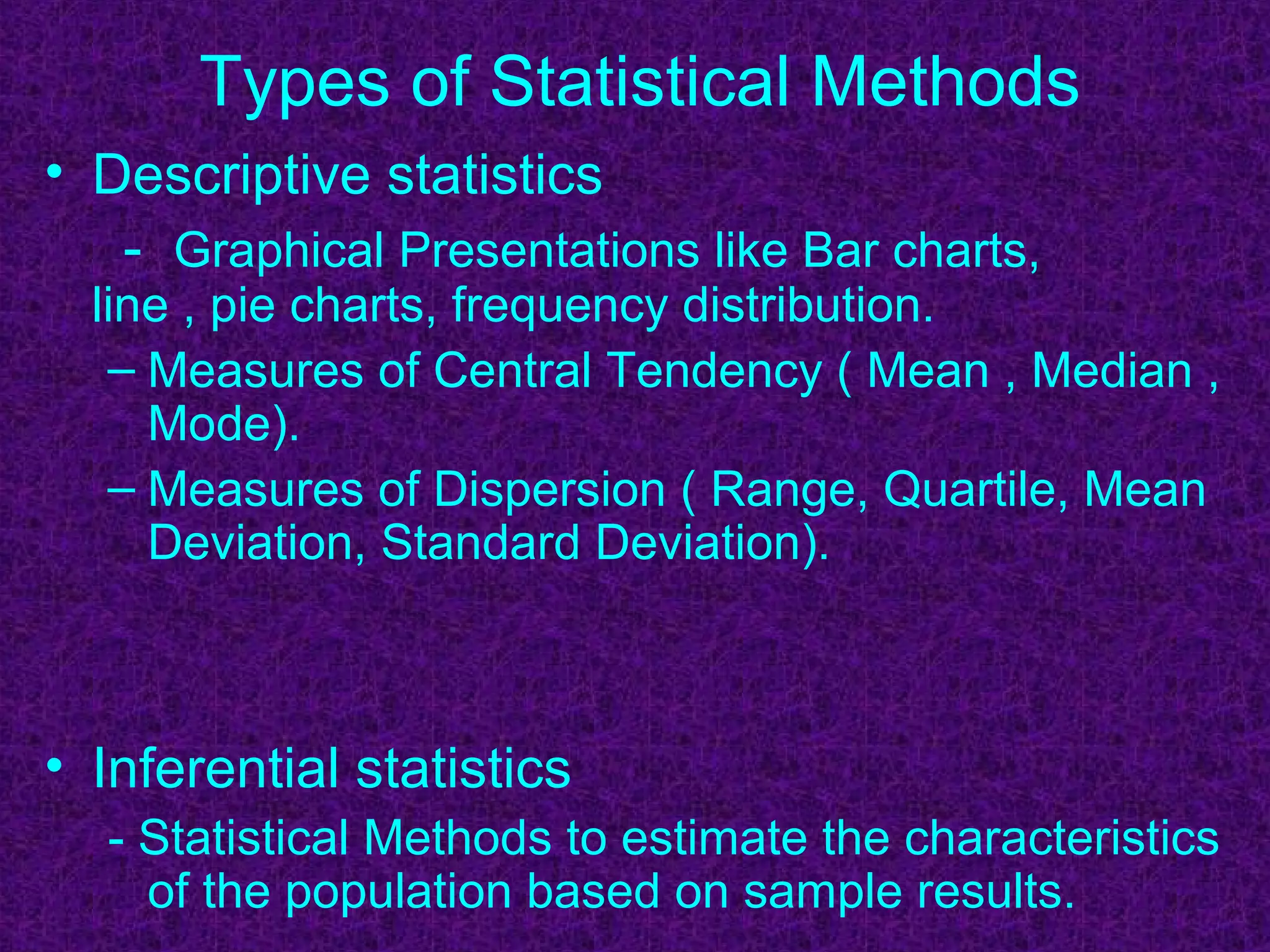
Types of Statistical Methods
• Descriptive statistics
- Graphical Presentations like Bar charts,
line , pie charts, frequency distribution.
– Measures of Central Tendency ( Mean , Median ,
Mode).
– Measures of Dispersion ( Range, Quartile, Mean
Deviation, Standard Deviation).
• Inferential statistics
- Statistical Methods to estimate the characteristics
of the population based on sample results.
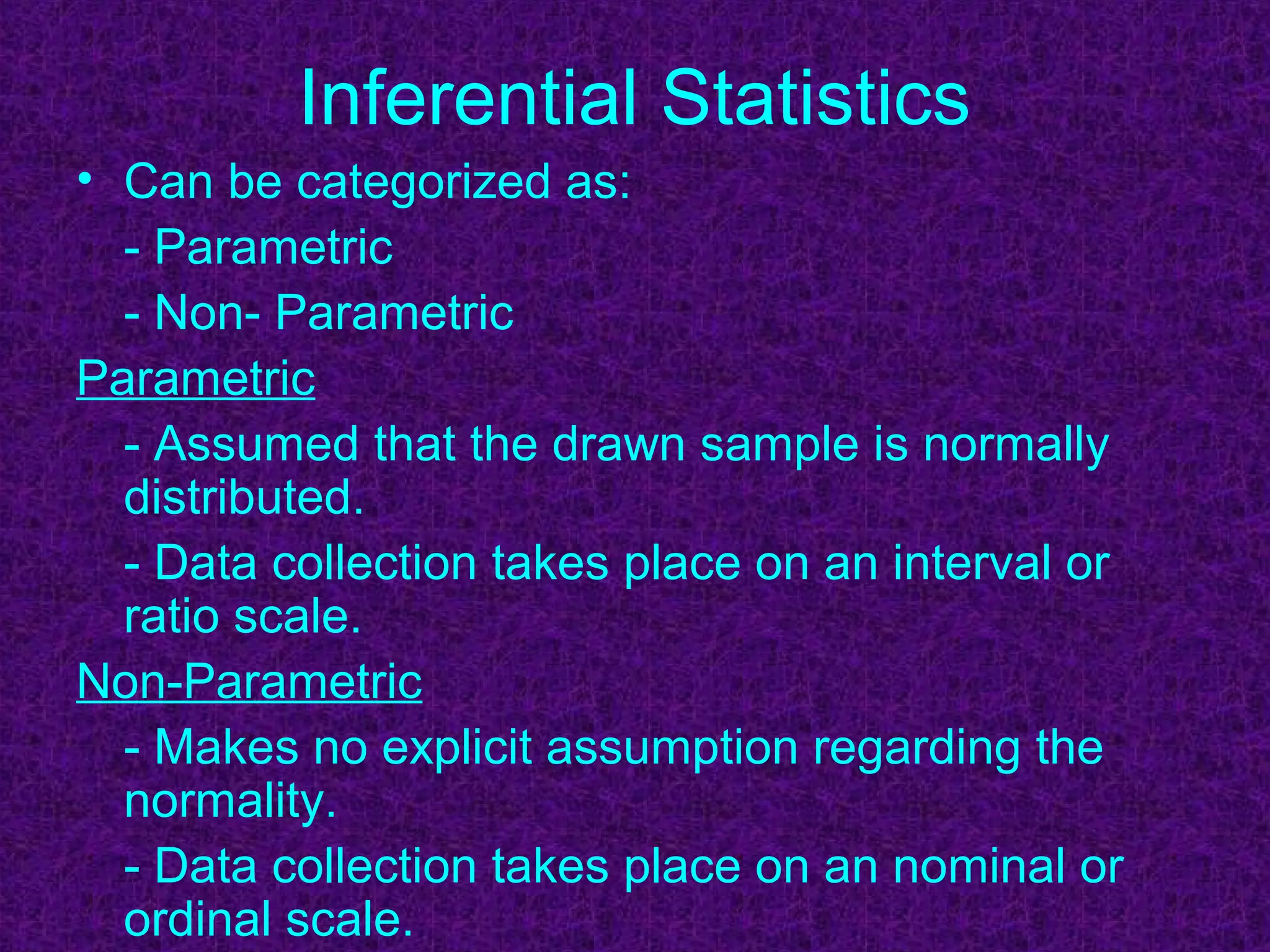
Inferential Statistics
• Can be categorized as:
- Parametric
- Non- Parametric
Parametric
- Assumed that the drawn sample is normally
distributed.
- Data collection takes place on an interval or
ratio scale.
Non-Parametric
- Makes no explicit assumption regarding the
normality.
- Data collection takes place on an nominal or
ordinal scale.
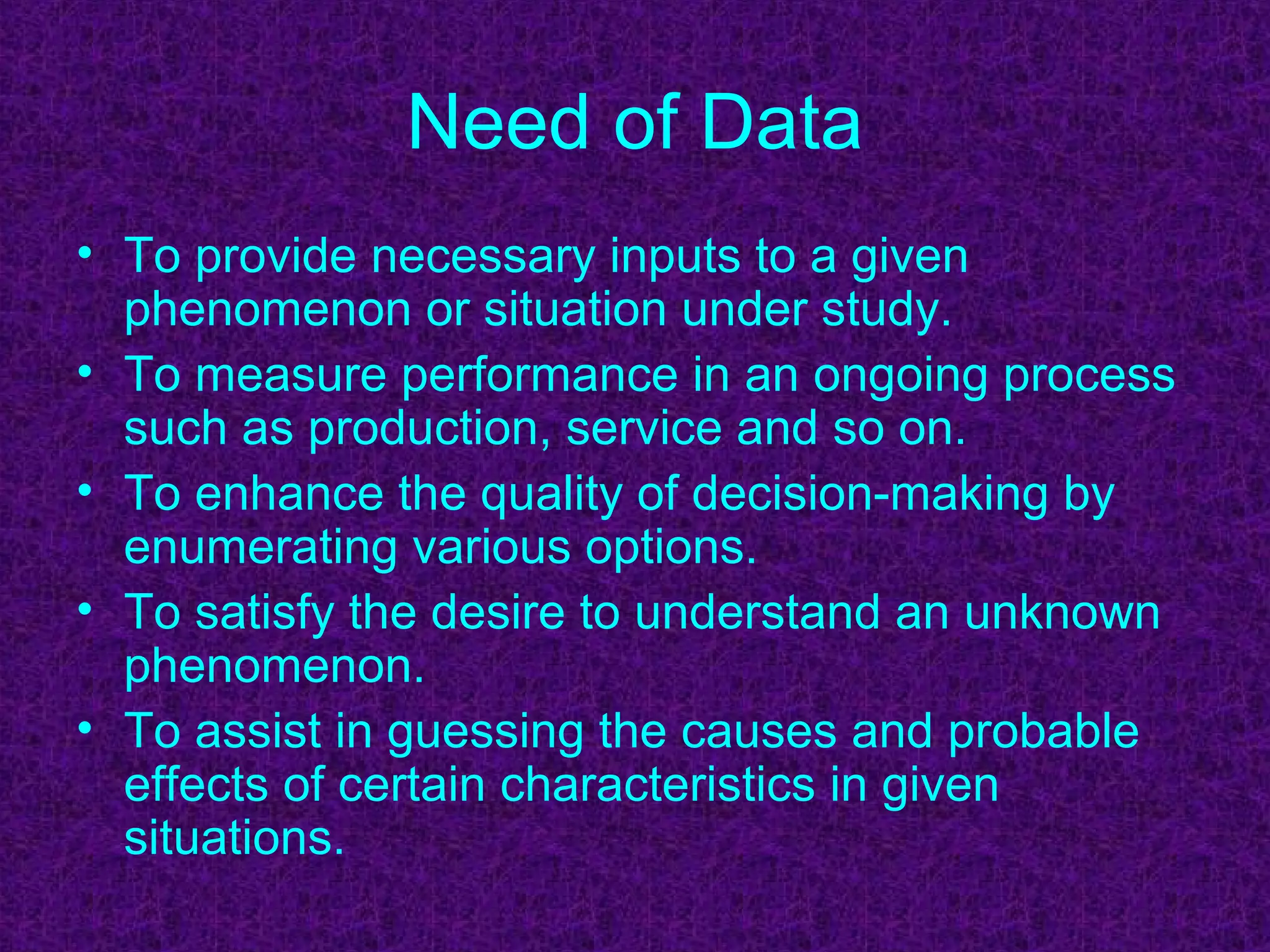
Need of Data
• To provide necessary inputs to a given
phenomenon or situation under study.
• To measure performance in an ongoing process
such as production, service and so on.
• To enhance the quality of decision-making by
enumerating various options.
• To satisfy the desire to understand an unknown
phenomenon.
• To assist in guessing the causes and probable
effects of certain characteristics in given
situations.
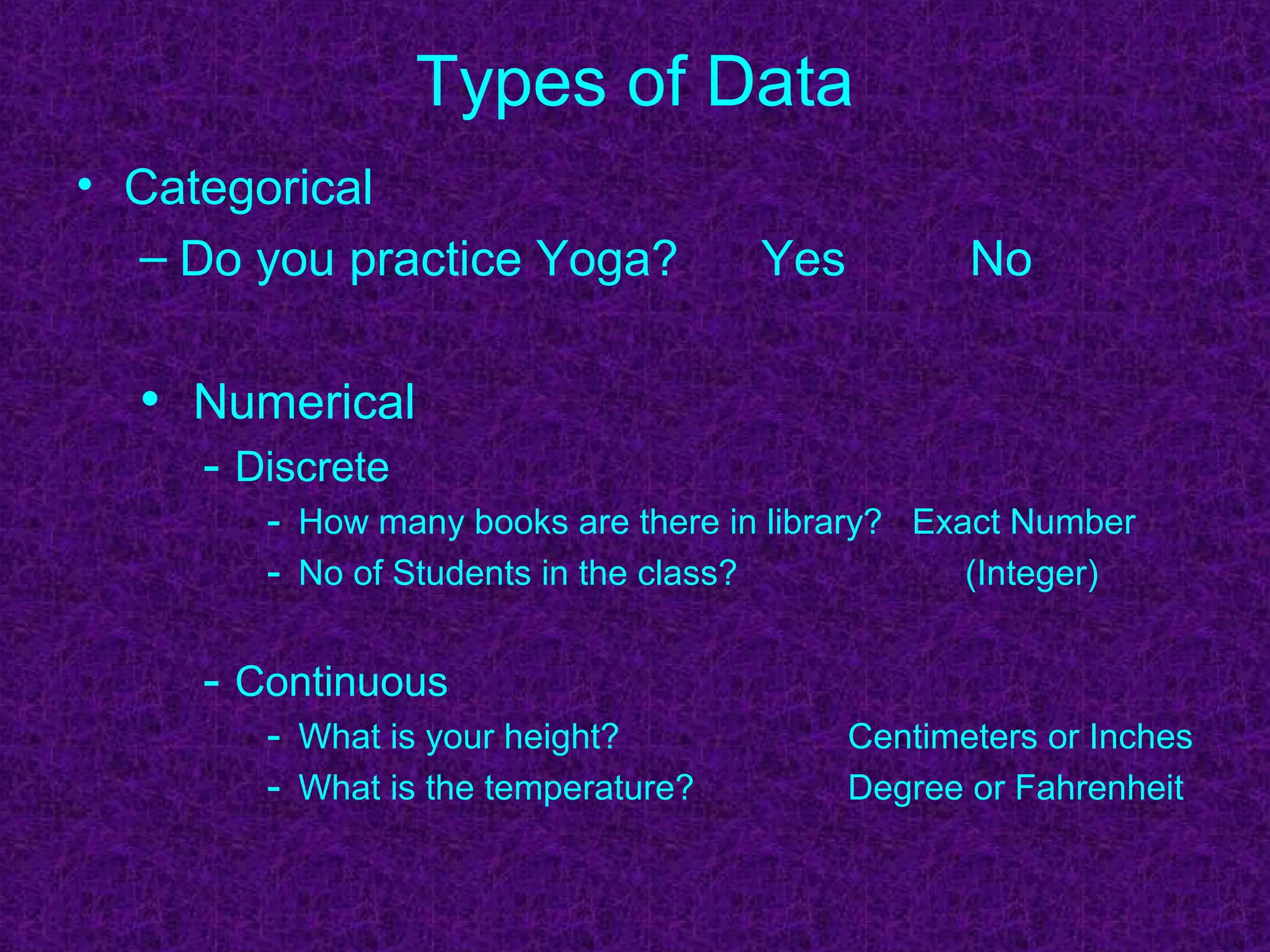
Types of Data
• Categorical
– Do you practice Yoga? Yes No
• Numerical
- Discrete
- How many books are there in library? Exact Number
- No of Students in the class? (Integer)
- Continuous
- What is your height? Centimeters or Inches
- What is the temperature? Degree or Fahrenheit
Types of Scales
• Nominal Scale
• Ordinal Scale
• Interval Scale
• Ratio Scale
Nominal Scale
• A scale of measurement for a variable that uses
a label (or name) to identify an attribute of an
element of the data set.
e.g. Each of the respondent has to fit into following
category:
- Indian - Sri Lankan - Nepalese
- Bhootanis - Pakistanis - Others
Other Examples:
Grouping of Individuals or objects.
Your gender : Male Female
Your place of work : Production Finance Sales
Ordinal Scale
• A scale of measurement for a variable that is
used to rank (or order) observations in the data
set.
e.g. Ranking of the items, say from 10 to 1,
depending of their usage.
Specifically, if particular system is not used at all
in your office, put a less figure against it.
IBM/AT Compaq IBM/XT
AT&T Apple II Tandy 2000
Macintosh Zenith HCL
Interval Scale
• A scale of measurement for a variable in
which the interval between observations is
expressed in terms of a fixed standard unit
of measurement.
e.g. when we measure temperature, the
distance from 30-40 is same as distance
from 70-80.
Ratio Scale
• A scale of measurement for a variable that
has interval which is measurable in
standard unit of measurement and a
meaningful zero, i.e. the ratio of two
values is meaningful.

Inferential statistics

  • 1.
  • 2.
    Definitions • Statistics isthe science which deals with the methods of collecting, classifying, presenting, comparing and interpreting numerical data collected to have some inference regarding the real aspects. Highlights: (i) Aggregates of facts. (ii) Effected to a marked extent by multiplicity of causes. (iii) Numerically Expressed. (iv) Estimated as per reasonable standards of accuracy. (v) Collected in as systematic manner for a pre- determined purpose.
  • 3.
    Reasons for LearningStatistics It enables the decision-maker to understand how to : (i) present and describe information (data) so as to improve decisions. (ii) draw conclusions about the large population based upon information obtained from samples. (iii) seek out relationship between pair of variables to improve processes. (iv) obtain reliable forecasts of statistical variables of interest.
  • 4.
    Statistical Thinking andAnalysis Statistical thinking can be defined as the thought process that focuses on ways to identify, control and reduce variations present in all phenomena. Management Philosophy Statistical Methods Behavioral Tools Quality Improvement Process Model Management Philosophy acts as a guide for laying a solid foundation for total quality improvement efforts. However, Behavioral Tools such as brainstorming, team-building & Group Decision making, & Statistical Methods like tables, control-charts and descriptive statistics are proved to be as pillars for quality improvement.
  • 5.
    Types of StatisticalMethods • Descriptive statistics - Graphical Presentations like Bar charts, line , pie charts, frequency distribution. – Measures of Central Tendency ( Mean , Median , Mode). – Measures of Dispersion ( Range, Quartile, Mean Deviation, Standard Deviation). • Inferential statistics - Statistical Methods to estimate the characteristics of the population based on sample results.
  • 6.
    Inferential Statistics • Canbe categorized as: - Parametric - Non- Parametric Parametric - Assumed that the drawn sample is normally distributed. - Data collection takes place on an interval or ratio scale. Non-Parametric - Makes no explicit assumption regarding the normality. - Data collection takes place on an nominal or ordinal scale.
  • 7.
    Need of Data •To provide necessary inputs to a given phenomenon or situation under study. • To measure performance in an ongoing process such as production, service and so on. • To enhance the quality of decision-making by enumerating various options. • To satisfy the desire to understand an unknown phenomenon. • To assist in guessing the causes and probable effects of certain characteristics in given situations.
  • 8.
    Types of Data •Categorical – Do you practice Yoga? Yes No • Numerical - Discrete - How many books are there in library? Exact Number - No of Students in the class? (Integer) - Continuous - What is your height? Centimeters or Inches - What is the temperature? Degree or Fahrenheit
  • 9.
    Types of Scales •Nominal Scale • Ordinal Scale • Interval Scale • Ratio Scale
  • 10.
    Nominal Scale • Ascale of measurement for a variable that uses a label (or name) to identify an attribute of an element of the data set. e.g. Each of the respondent has to fit into following category: - Indian - Sri Lankan - Nepalese - Bhootanis - Pakistanis - Others Other Examples: Grouping of Individuals or objects. Your gender : Male Female Your place of work : Production Finance Sales
  • 11.
    Ordinal Scale • Ascale of measurement for a variable that is used to rank (or order) observations in the data set. e.g. Ranking of the items, say from 10 to 1, depending of their usage. Specifically, if particular system is not used at all in your office, put a less figure against it. IBM/AT Compaq IBM/XT AT&T Apple II Tandy 2000 Macintosh Zenith HCL
  • 12.
    Interval Scale • Ascale of measurement for a variable in which the interval between observations is expressed in terms of a fixed standard unit of measurement. e.g. when we measure temperature, the distance from 30-40 is same as distance from 70-80.
  • 13.
    Ratio Scale • Ascale of measurement for a variable that has interval which is measurable in standard unit of measurement and a meaningful zero, i.e. the ratio of two values is meaningful.