CORE 2 Summary Notes
1 Indices
· Rules of Indices
x
a
´ x
b
= x
a + b
x
a
¸ x
b
= x
a – b
(x
a
)
b
= x
ab
Solve 3
2x + 1
– 10 ´ 3
x
+ 3 = 0
3 ´ (3x)
2
– 10 ´ 3
x
+ 3 = 0
Let y = 3
x
3y
2
– 10y + 3 = 0
(3y – 1)(y – 3) = 0
y =
1
gives 3
x
=
1
3 3
x = – 1
y = 3 gives 3
x
= 3 x = 1
Solve 9
x
=
1
27
3
2x
= 3
– 3
2x = – 3
x = –
3
2
· x
0
= 1
·
x
– a
=
1
a
x
· xn
= n
1
x
· x n n m n m
m
x)x( ==
2 Graphs and Transformations
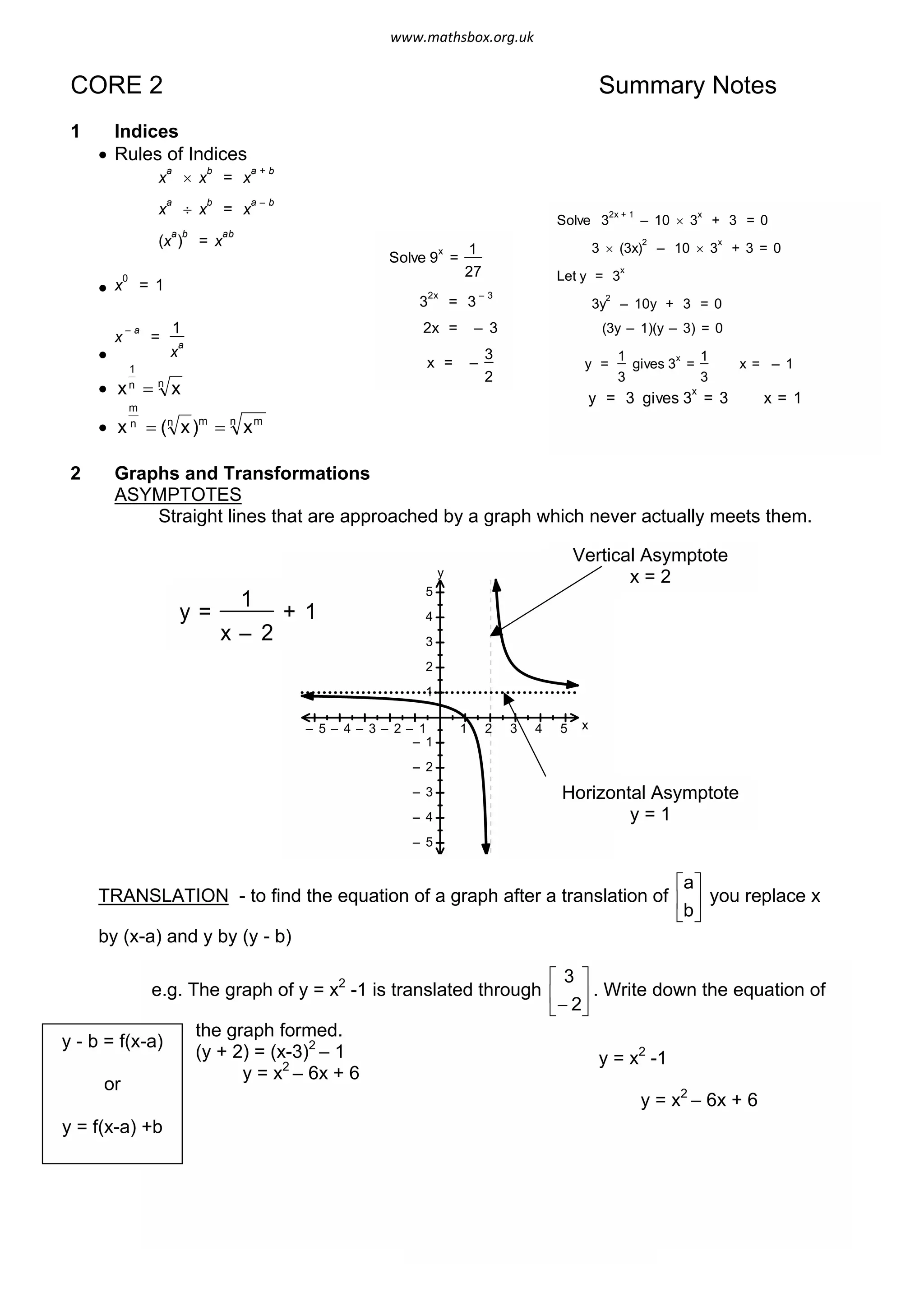
ASYMPTOTES
Straight lines that are approached by a graph which never actually meets them.
y
x1 2 3 4 5– 1– 2– 3– 4– 5
1
2
3
4
5
– 1
– 2
– 3
– 4
– 5
Horizontal Asymptote
y = 1
Vertical Asymptote
x = 2
y =
1
x – 2
+ 1
TRANSLATION - to find the equation of a graph after a translation of ú you replace x
by (x-a) and y by (y - b)
û
ù
ê
ë
éa
b
1
y
x1 2 3 4 5– 1– 2– 3– 4– 5
1
2
3
4
5
– 1
– 2
– 3
– 4
– 5
e.g. The graph of y = x2
-1 is translated through ê ú . Write down the equation of
û
ù
ë
é 3
- 2
the graph formed.
(y + 2) = (x-3)2
– 1
y = x2
– 6x + 6
y - b = f(x-a)
or
y = f(x-a) +b
y = x2
– 6x + 6
y = x2
-1
www.mathsbox.org.uk
y = -f(x)REFLECTING
Reflection in the x-axis, replace y with –y
Reflection in the y-axis, replace x with – x
STRETCHING
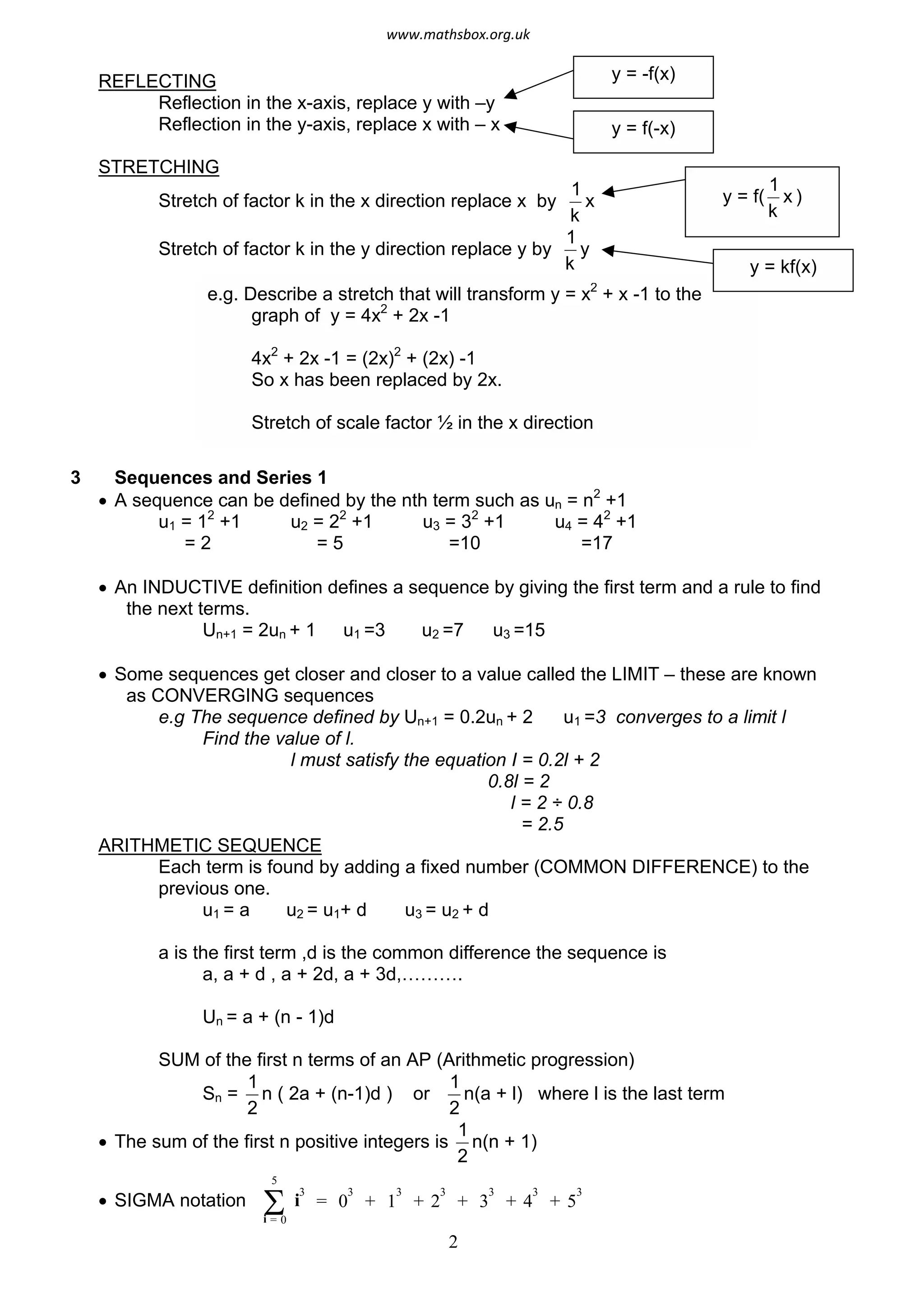
Stretch of factor k in the x direction replace x by
1
x
k
Stretch of factor k in the y direction replace y by
1
y
k
y = f(-x)
y = f(
1
x
k
)
e.g. Describe a stretch that will transform y = x2
+ x -1 to the
graph of y = 4x2
+ 2x -1
4x2
+ 2x -1 = (2x)2
+ (2x) -1
So x has been replaced by 2x.
Stretch of scale factor ½ in the x direction
y = kf(x)
3 Sequences and Series 1
· A sequence can be defined by the nth term such as un = n2
+1
u1 = 12
+1 u2 = 22
+1 u3 = 32
+1 u4 = 42
+1
= 2 = 5 =10 =17
· An INDUCTIVE definition defines a sequence by giving the first term and a rule to find
the next terms.
Un+1 = 2un + 1 u1 =3 u2 =7 u3 =15
· Some sequences get closer and closer to a value called the LIMIT – these are known
as CONVERGING sequences
e.g The sequence defined by Un+1 = 0.2un + 2 u1 =3 converges to a limit l
Find the value of l.
l must satisfy the equation I = 0.2l + 2
0.8l = 2
l = 2 ÷ 0.8
= 2.5
ARITHMETIC SEQUENCE
Each term is found by adding a fixed number (COMMON DIFFERENCE) to the
previous one.
u1 = a u2 = u1+ d u3 = u2 + d
a is the first term ,d is the common difference the sequence is
a, a + d , a + 2d, a + 3d,……….
Un = a + (n - 1)d
SUM of the first n terms of an AP (Arithmetic progression)
Sn =
2
1
n ( 2a + (n-1)d ) or
2
1
n(a + l) where l is the last term
· The sum of the first n positive integers is
1
2
n(n + 1)
· SIGMA notation Si = 0
5
i
3
= 0
3
+ 1
3
+ 2
3
+ 3
3
+ 4
3
+ 5
3
2
www.mathsbox.org.uk
Show that Sr = 1
20
(3n – 1) = 610
= 2 + 5 + 8 + .········59
a = 2 d = 3
S20 =
20
2
(2 ´ 2 + (20 – 1) ´ 3)
= 10 ´ 61
= 610
4 Geometric Sequences
· A geometric sequence is one where each term is found by MULTIPLYING the
previous term by a fixed number (COMMON RATIO)
· The nth term of a geometric sequence a, ar, ar2
, ar3
, …is arn-1
a is the first term r is the common ratio
· The sum of a geometric sequence a + ar + ar2
+ ar3
….+ arn-1
is a geometric
series
r 1
1)
=
a(rn
-
Sn
-
· If -1 < r < 1 then the sum to infinity is
1 r
a
-
Find the sum to inifinty of the series 1 +
2
3
+
4
9
+
8
27
Geometric Series first term = 1 common ratio =
2
3
Sum to infinity =
1
= 3
3
1-
2
5 Binomial Expansion
· The number of ways of arranging n objects of which r are one type and (n-r) are
another is given by
r!(n r)!
n!
r
n
=
-÷÷
ø
ö
çç
è
æ
where n! = n(n-1)(n-2)….x 3 x 2 x 1
·
(1 + x)
n
= 1 +
æ
è
ç
n ö
1 ø
÷ x +
è
æ
ç
n ö
2 ø
÷ x
2
+
æ
è
ç
n ö
3 ø
÷ x
3
+ .········.x
n
(a + b)
n
= a
n
+
è
æ
ç
n ö
1 ø
÷ a
n – 1
b
1
+
æ
è
ç
n ö
2 ø
÷ a
n – 2
b
2
+ .··········.
æ
è
ç
n
n – 1 ø
ö 1
÷ a b
n – 1
+ b
n
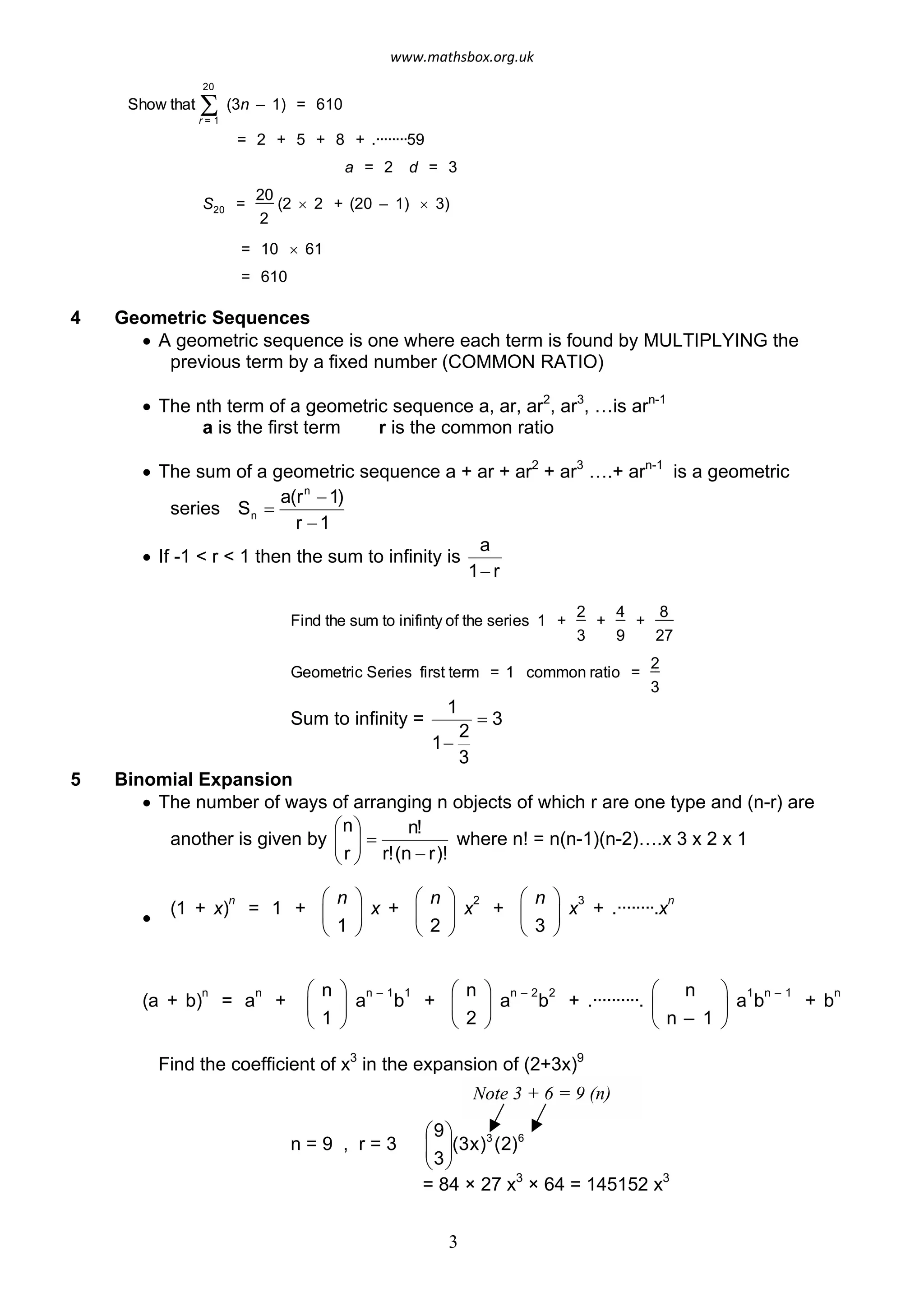
Find the coefficient of x3
in the expansion of (2+3x)9
n = 9 , r = 3 çç
æ9
(3x)3
(2)6
3÷÷
ø
ö
è
Note 3 + 6 = 9 (n)
= 84 × 27 x3
× 64 = 145152 x3
3
www.mathsbox.org.uk
6 Trigonometry
· Exact Values – LEARN
45 30 60
sin 45 =
1
2
cos 45 =
1
2
tan 45 = 1
1
1
√2
45
sin 30 =
1
2
cos 30 =
3
2
tan 30 =
1
3
1 1
2 2
sin 60 =
3
2
cos 60 =
1
2
tan 60 = 3
30
60
√3
COSINE RULE
a b
c
A
B
C
b
a
2
= b
2
+ c
2
– 2bc cos A
2
= a
2
+ c
2
– 2ac cos B
c
2
= a
2
+ b
2
– 2ab cos A
SINE RULE
a
sinA
=
b
sinB
=
c
sinC
AREA of a TRIANGLE
1
ab sinC =
1
2 2
bc sinA =
1
2
ac sinB
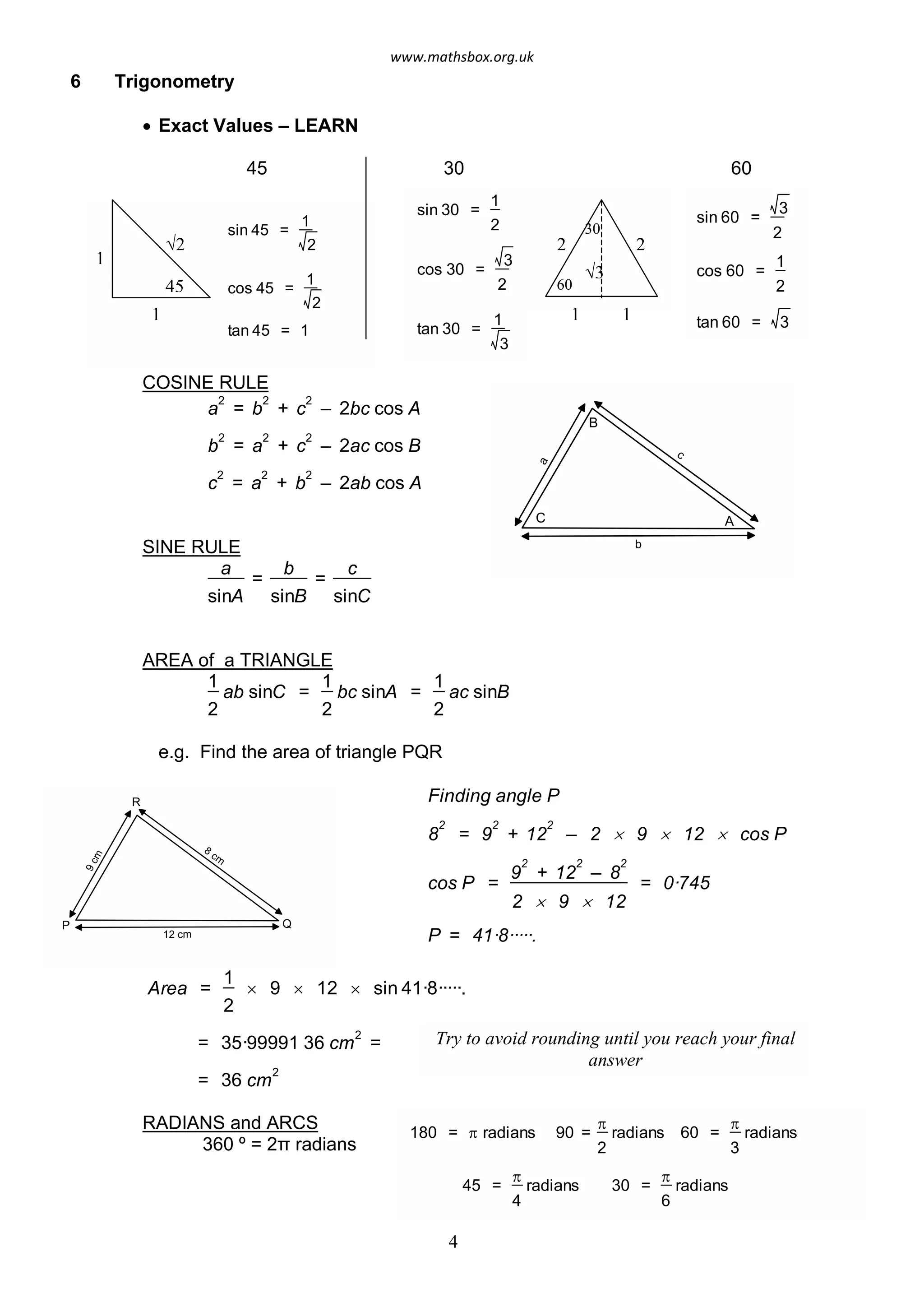
e.g. Find the area of triangle PQR
Finding angle P
8
2
= 9
2
+ 12
2
– 2 ´ 9 ´ 12 ´ cos P
cos P =
9
2
+ 12
2
– 8
2
2 ´ 9 ´ 12
= 0·745
P = 41·8·····.
Area =
1
2
´ 9 ´ 12 ´ sin 41·8·····.
= 35·99991 36 cm
2
=
= 36 cm
2
9cm
12 cm
8
cm
R
P Q
Try to avoid rounding until you reach your final
answer
180 = p radians 90 =
p
2
radians 60 =
p
3
radians
45 =
p
4
radians 30 =
p
6
radians
RADIANS and ARCS
360 º = 2π radians
4
www.mathsbox.org.uk
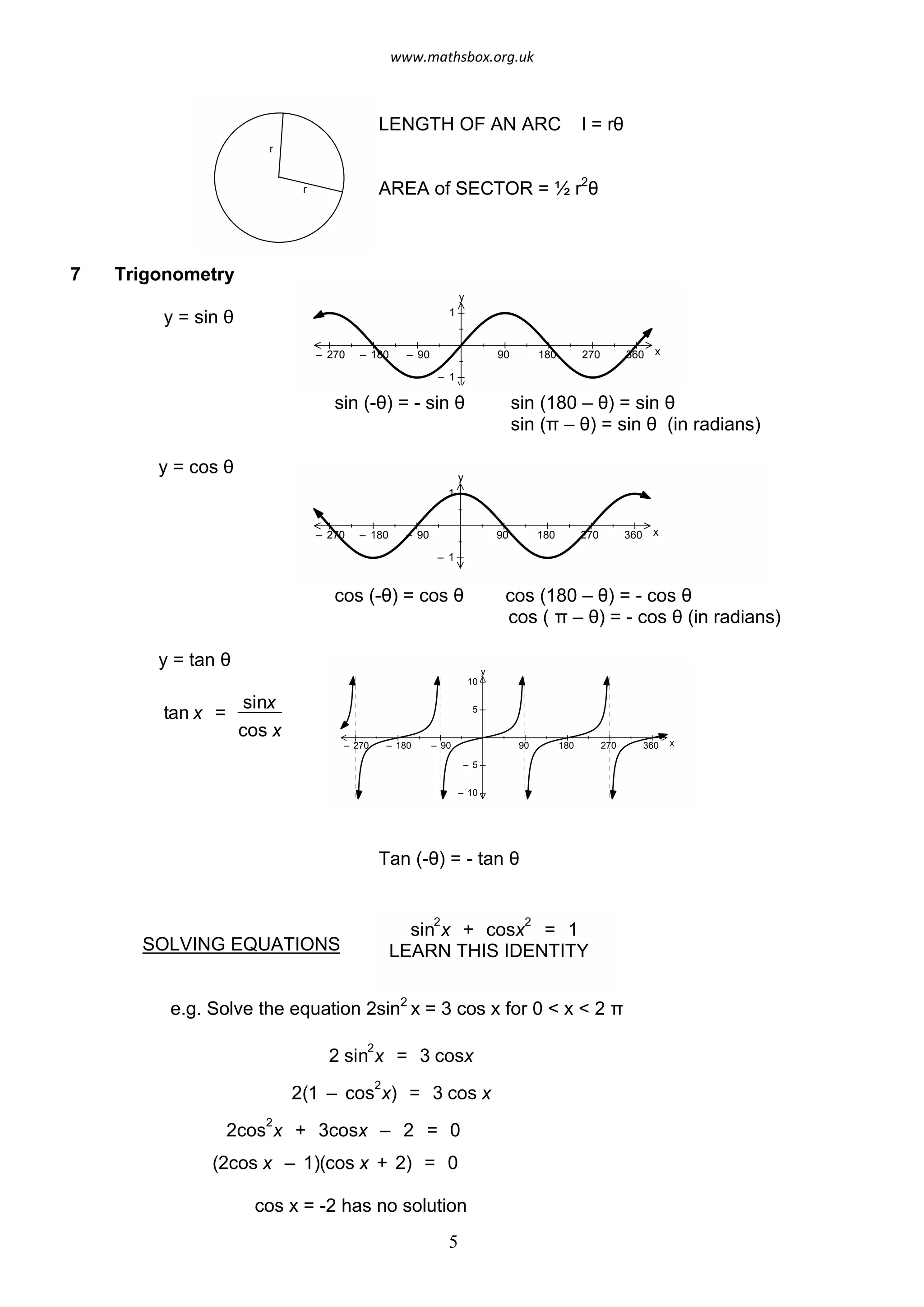
LENGTH OF AN ARC  l = rθl
AREA of SECTOR = ½ r2
θ
r
r
7 Trigonometry
y = sin θ
sin (­θ) = ­ sin θ  sin (180 – θ) = sin θ
y
x90 180 270 360– 90– 180– 270
1
– 1
sin (π – θ) = sin θ  (in radians)
y = cos θ
cos (­θ) = cos θ  cos (180 – θ) = ­ cos θ
y
x90 180 270 360– 90– 180– 270
1
– 1
cos ( π – θ) = ­ cos θ (in radians)
y = tan θ y
x90 180 270 360– 90– 180– 270
5
10
– 5
– 10
tan x =
sinx
cos x
Tan (­θ) = ­ tan θ
sin
2
x + cosx
2
= 1
LEARN THIS IDENTITYSOLVING EQUATIONS
e.g. Solve the equation 2sin2
x = 3 cos x for 0 < x < 2 π
2
2 sin
2
x = 3 cosx
2(1 – cos
2
x) = 3 cos x
cos
2
x + 3cosx – 2 = 0
(2cos x – 1)(cos x + 2) = 0
cos x = -2 has no solution
5
www.mathsbox.org.uk
cos x = -½ x =
p
3
or 2p -
3
p
=
5p
3
PROVING IDENTITIES
Show that (sin x + cos x )
2
= 1 + 2sinx cos x
LHS: (sin x + cos x)
2
= (sin
2
x + 2 sinx cos x + cos
2
x)
= sin
2
x + cos
2
x + 2 sinx cos x
= 1 + 2 sin x cos x
LHS = RHS
TRANSFORMATIONS
Stretch in the y direction scale factor a  y = a sin θ
6
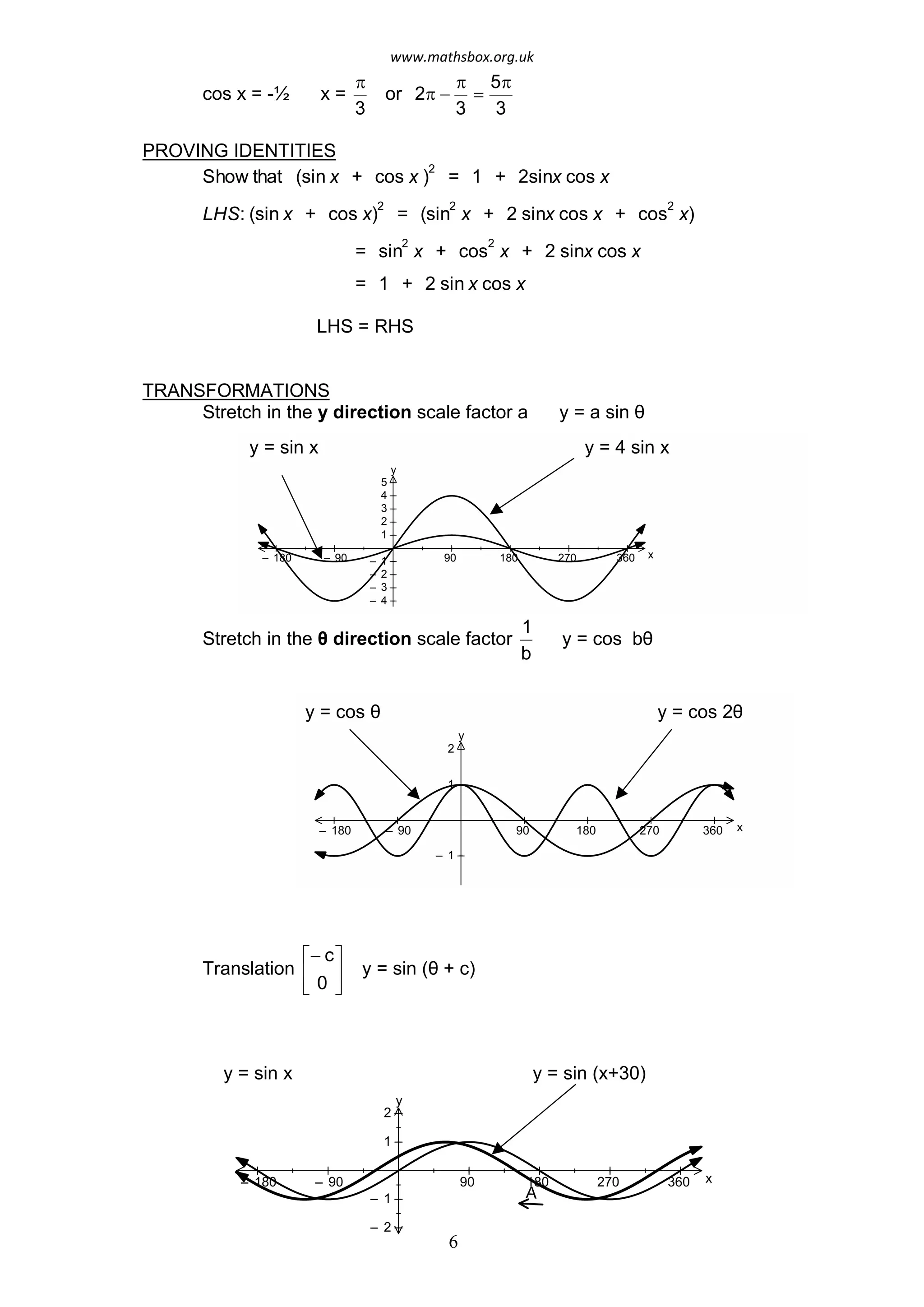
y = sin x y = sin (x+30)
y
x90 180 270 360– 90– 180
1
2
– 1
– 2
A
Stretch in the θ direction scale factor
1
b
y = cos  bθ
y = sin x y = 4 sin x
y
x90 180 270 360– 9080– 1
1
2
3
4
5
– 1
– 2
– 3
– 4
y = cos θ  y = cos 2θ
y
x90 180 270 360– 90– 180
1
2
– 1
Translation ê
é
y = sin (θ + c)ú
û
- cù
ë 0
www.mathsbox.org.uk
Translation ê
é
ú  y = cosθ + d
û
0ù
ëd
y = cos θ  y = cosθ +2
y
x90 180 270 360– 90– 180
1
2
3
4
5
– 1
A
8 Exponentials and Logarithms
· A function of the form y = ax
is an exponential function
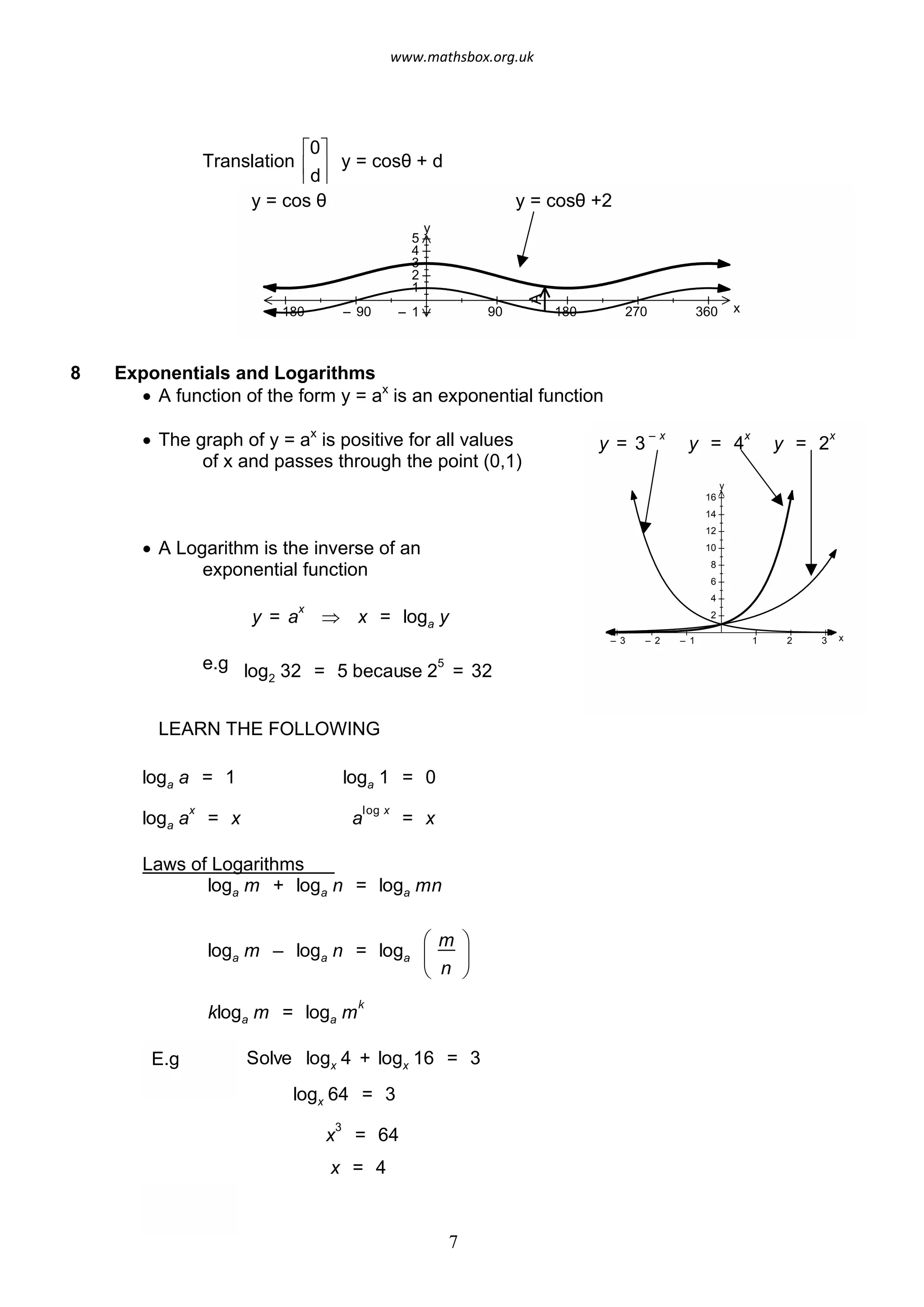
· The graph of y = ax
is positive for all values
of x and passes through the point (0,1)
· A Logarithm is the inverse of an
exponential function
y = a
x
Þ x = loga y
e.g log2 32 = 5 because 2
5
= 32
LEARN THE FOLLOWING
loga a = 1 loga 1 = 0
loga a
x
= x a
log x
= x
Laws of Logarithms
loga m + loga n = loga mn
loga m – loga n = loga
æ m
è
ç
n ø
ö
÷
kloga m = loga m
k
Solve logx 4 + logx 16 = 3
logx 64 = 3
x
3
= 64
x = 4
y = 3
– x
y = 4
x
y = 2
x
y
x1 2 3– 1– 2– 3
2
4
6
8
10
12
14
16
E.g
7
www.mathsbox.org.uk
· An equation of the form ax
=b can be solved by taking logs of both sides
9 Differentiation and Integration
· If y = x
n
then
dy
= nx
dx
n – 1
·
ò x
n
dx =
x
n + 1
n + 1
+ c for all values of n except n = – 1
e.g
ò
1 + x
2
x
=
ò x
–
1
2 + x
3
2 = 2x
1
2 +
2
5
x
5
2 + c
TRAPEZIUM RULE
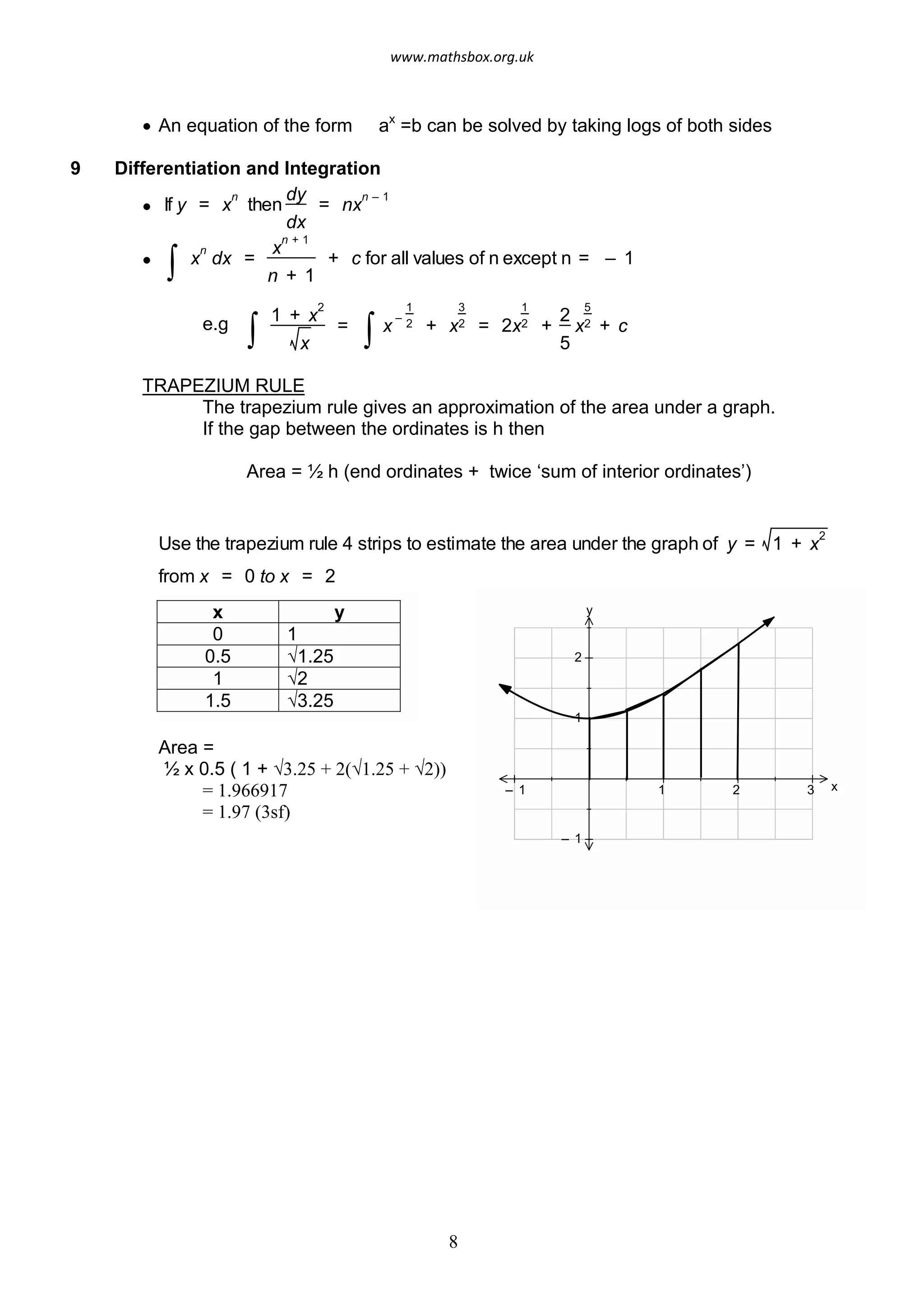
The trapezium rule gives an approximation of the area under a graph.
If the gap between the ordinates is h then
Area = ½ h (end ordinates + twice ‘sum of interior ordinates’)
Use the trapezium rule 4 strips to estimate the area under the graph of y = 1 + x
2
from x = 0 to x = 2
x y
0 1
0.5  √1.25
1  √2
1.5  √3.25
y
x1 2 3– 1
1
2
– 1
Area =
½ x 0.5 ( 1 + √3.25 + 2(√1.25 + √2))
= 1.966917
= 1.97 (3sf)
8
www.mathsbox.org.uk

Core 2 revision notes

  • 1.
    CORE 2 SummaryNotes 1 Indices · Rules of Indices x a ´ x b = x a + b x a ¸ x b = x a – b (x a ) b = x ab Solve 3 2x + 1 – 10 ´ 3 x + 3 = 0 3 ´ (3x) 2 – 10 ´ 3 x + 3 = 0 Let y = 3 x 3y 2 – 10y + 3 = 0 (3y – 1)(y – 3) = 0 y = 1 gives 3 x = 1 3 3 x = – 1 y = 3 gives 3 x = 3 x = 1 Solve 9 x = 1 27 3 2x = 3 – 3 2x = – 3 x = – 3 2 · x 0 = 1 · x – a = 1 a x · xn = n 1 x · x n n m n m m x)x( == 2 Graphs and Transformations ASYMPTOTES Straight lines that are approached by a graph which never actually meets them. y x1 2 3 4 5– 1– 2– 3– 4– 5 1 2 3 4 5 – 1 – 2 – 3 – 4 – 5 Horizontal Asymptote y = 1 Vertical Asymptote x = 2 y = 1 x – 2 + 1 TRANSLATION - to find the equation of a graph after a translation of ú you replace x by (x-a) and y by (y - b) û ù ê ë éa b 1 y x1 2 3 4 5– 1– 2– 3– 4– 5 1 2 3 4 5 – 1 – 2 – 3 – 4 – 5 e.g. The graph of y = x2 -1 is translated through ê ú . Write down the equation of û ù ë é 3 - 2 the graph formed. (y + 2) = (x-3)2 – 1 y = x2 – 6x + 6 y - b = f(x-a) or y = f(x-a) +b y = x2 – 6x + 6 y = x2 -1 www.mathsbox.org.uk
  • 2.
    y = -f(x)REFLECTING Reflectionin the x-axis, replace y with –y Reflection in the y-axis, replace x with – x STRETCHING Stretch of factor k in the x direction replace x by 1 x k Stretch of factor k in the y direction replace y by 1 y k y = f(-x) y = f( 1 x k ) e.g. Describe a stretch that will transform y = x2 + x -1 to the graph of y = 4x2 + 2x -1 4x2 + 2x -1 = (2x)2 + (2x) -1 So x has been replaced by 2x. Stretch of scale factor ½ in the x direction y = kf(x) 3 Sequences and Series 1 · A sequence can be defined by the nth term such as un = n2 +1 u1 = 12 +1 u2 = 22 +1 u3 = 32 +1 u4 = 42 +1 = 2 = 5 =10 =17 · An INDUCTIVE definition defines a sequence by giving the first term and a rule to find the next terms. Un+1 = 2un + 1 u1 =3 u2 =7 u3 =15 · Some sequences get closer and closer to a value called the LIMIT – these are known as CONVERGING sequences e.g The sequence defined by Un+1 = 0.2un + 2 u1 =3 converges to a limit l Find the value of l. l must satisfy the equation I = 0.2l + 2 0.8l = 2 l = 2 ÷ 0.8 = 2.5 ARITHMETIC SEQUENCE Each term is found by adding a fixed number (COMMON DIFFERENCE) to the previous one. u1 = a u2 = u1+ d u3 = u2 + d a is the first term ,d is the common difference the sequence is a, a + d , a + 2d, a + 3d,………. Un = a + (n - 1)d SUM of the first n terms of an AP (Arithmetic progression) Sn = 2 1 n ( 2a + (n-1)d ) or 2 1 n(a + l) where l is the last term · The sum of the first n positive integers is 1 2 n(n + 1) · SIGMA notation Si = 0 5 i 3 = 0 3 + 1 3 + 2 3 + 3 3 + 4 3 + 5 3 2 www.mathsbox.org.uk
  • 3.
    Show that Sr= 1 20 (3n – 1) = 610 = 2 + 5 + 8 + .········59 a = 2 d = 3 S20 = 20 2 (2 ´ 2 + (20 – 1) ´ 3) = 10 ´ 61 = 610 4 Geometric Sequences · A geometric sequence is one where each term is found by MULTIPLYING the previous term by a fixed number (COMMON RATIO) · The nth term of a geometric sequence a, ar, ar2 , ar3 , …is arn-1 a is the first term r is the common ratio · The sum of a geometric sequence a + ar + ar2 + ar3 ….+ arn-1 is a geometric series r 1 1) = a(rn - Sn - · If -1 < r < 1 then the sum to infinity is 1 r a - Find the sum to inifinty of the series 1 + 2 3 + 4 9 + 8 27 Geometric Series first term = 1 common ratio = 2 3 Sum to infinity = 1 = 3 3 1- 2 5 Binomial Expansion · The number of ways of arranging n objects of which r are one type and (n-r) are another is given by r!(n r)! n! r n = -÷÷ ø ö çç è æ where n! = n(n-1)(n-2)….x 3 x 2 x 1 · (1 + x) n = 1 + æ è ç n ö 1 ø ÷ x + è æ ç n ö 2 ø ÷ x 2 + æ è ç n ö 3 ø ÷ x 3 + .········.x n (a + b) n = a n + è æ ç n ö 1 ø ÷ a n – 1 b 1 + æ è ç n ö 2 ø ÷ a n – 2 b 2 + .··········. æ è ç n n – 1 ø ö 1 ÷ a b n – 1 + b n Find the coefficient of x3 in the expansion of (2+3x)9 n = 9 , r = 3 çç æ9 (3x)3 (2)6 3÷÷ ø ö è Note 3 + 6 = 9 (n) = 84 × 27 x3 × 64 = 145152 x3 3 www.mathsbox.org.uk
  • 4.
    6 Trigonometry · ExactValues – LEARN 45 30 60 sin 45 = 1 2 cos 45 = 1 2 tan 45 = 1 1 1 √2 45 sin 30 = 1 2 cos 30 = 3 2 tan 30 = 1 3 1 1 2 2 sin 60 = 3 2 cos 60 = 1 2 tan 60 = 3 30 60 √3 COSINE RULE a b c A B C b a 2 = b 2 + c 2 – 2bc cos A 2 = a 2 + c 2 – 2ac cos B c 2 = a 2 + b 2 – 2ab cos A SINE RULE a sinA = b sinB = c sinC AREA of a TRIANGLE 1 ab sinC = 1 2 2 bc sinA = 1 2 ac sinB e.g. Find the area of triangle PQR Finding angle P 8 2 = 9 2 + 12 2 – 2 ´ 9 ´ 12 ´ cos P cos P = 9 2 + 12 2 – 8 2 2 ´ 9 ´ 12 = 0·745 P = 41·8·····. Area = 1 2 ´ 9 ´ 12 ´ sin 41·8·····. = 35·99991 36 cm 2 = = 36 cm 2 9cm 12 cm 8 cm R P Q Try to avoid rounding until you reach your final answer 180 = p radians 90 = p 2 radians 60 = p 3 radians 45 = p 4 radians 30 = p 6 radians RADIANS and ARCS 360 º = 2π radians 4 www.mathsbox.org.uk
  • 5.
    LENGTH OF AN ARC  l = rθl AREA ofSECTOR = ½ r2 θ r r 7 Trigonometry y = sin θ sin (­θ) = ­ sin θ  sin (180 – θ) = sin θ y x90 180 270 360– 90– 180– 270 1 – 1 sin (π – θ) = sin θ  (in radians) y = cos θ cos (­θ) = cos θ  cos (180 – θ) = ­ cos θ y x90 180 270 360– 90– 180– 270 1 – 1 cos ( π – θ) = ­ cos θ (in radians) y = tan θ y x90 180 270 360– 90– 180– 270 5 10 – 5 – 10 tan x = sinx cos x Tan (­θ) = ­ tan θ sin 2 x + cosx 2 = 1 LEARN THIS IDENTITYSOLVING EQUATIONS e.g. Solve the equation 2sin2 x = 3 cos x for 0 < x < 2 π 2 2 sin 2 x = 3 cosx 2(1 – cos 2 x) = 3 cos x cos 2 x + 3cosx – 2 = 0 (2cos x – 1)(cos x + 2) = 0 cos x = -2 has no solution 5 www.mathsbox.org.uk
  • 6.
    cos x =-½ x = p 3 or 2p - 3 p = 5p 3 PROVING IDENTITIES Show that (sin x + cos x ) 2 = 1 + 2sinx cos x LHS: (sin x + cos x) 2 = (sin 2 x + 2 sinx cos x + cos 2 x) = sin 2 x + cos 2 x + 2 sinx cos x = 1 + 2 sin x cos x LHS = RHS TRANSFORMATIONS Stretch in the y direction scale factor a  y = a sin θ 6 y = sin x y = sin (x+30) y x90 180 270 360– 90– 180 1 2 – 1 – 2 A Stretch in the θ direction scale factor 1 b y = cos  bθ y = sin x y = 4 sin x y x90 180 270 360– 9080– 1 1 2 3 4 5 – 1 – 2 – 3 – 4 y = cos θ  y = cos 2θ y x90 180 270 360– 90– 180 1 2 – 1 Translation ê é y = sin (θ + c)ú û - cù ë 0 www.mathsbox.org.uk
  • 7.
    Translation ê é ú  y = cosθ + d û 0ù ëd y = cos θ y = cosθ +2 y x90 180 270 360– 90– 180 1 2 3 4 5 – 1 A 8 Exponentials and Logarithms · A function of the form y = ax is an exponential function · The graph of y = ax is positive for all values of x and passes through the point (0,1) · A Logarithm is the inverse of an exponential function y = a x Þ x = loga y e.g log2 32 = 5 because 2 5 = 32 LEARN THE FOLLOWING loga a = 1 loga 1 = 0 loga a x = x a log x = x Laws of Logarithms loga m + loga n = loga mn loga m – loga n = loga æ m è ç n ø ö ÷ kloga m = loga m k Solve logx 4 + logx 16 = 3 logx 64 = 3 x 3 = 64 x = 4 y = 3 – x y = 4 x y = 2 x y x1 2 3– 1– 2– 3 2 4 6 8 10 12 14 16 E.g 7 www.mathsbox.org.uk
  • 8.
    · An equationof the form ax =b can be solved by taking logs of both sides 9 Differentiation and Integration · If y = x n then dy = nx dx n – 1 · ò x n dx = x n + 1 n + 1 + c for all values of n except n = – 1 e.g ò 1 + x 2 x = ò x – 1 2 + x 3 2 = 2x 1 2 + 2 5 x 5 2 + c TRAPEZIUM RULE The trapezium rule gives an approximation of the area under a graph. If the gap between the ordinates is h then Area = ½ h (end ordinates + twice ‘sum of interior ordinates’) Use the trapezium rule 4 strips to estimate the area under the graph of y = 1 + x 2 from x = 0 to x = 2 x y 0 1 0.5  √1.25 1  √2 1.5  √3.25 y x1 2 3– 1 1 2 – 1 Area = ½ x 0.5 ( 1 + √3.25 + 2(√1.25 + √2)) = 1.966917 = 1.97 (3sf) 8 www.mathsbox.org.uk