Write your name here
                                Surname                                           Other names


                                                                  Centre Number                 Candidate Number

                               Edexcel GCSE
                                Mathematics A
                                Paper 1 (Non-Calculator)
                                                                                                  Higher Tier
                                Monday 11 June 2012 – Afternoon                                 Paper Reference

                                Time: 1 hour 45 minutes                                         1MA0/1H
                                You must have: Ruler graduated in centimetres and millimetres,              Total Marks
                                protractor, pair of compasses, pen, HB pencil, eraser. Tracing
                                paper may be used.


                        Instructions
                                Use black ink or ball-point pen.
                                Fill in the boxes at the top of this page with your name,
                                centre number and candidate number.
                                Answer all questions.
                                Answer the questions in the spaces provided
                                – there may be more space than you need.
                                Calculators must not be used.

                        Information
                                The total mark for this paper is 100
                                The marks for each question are shown in brackets
                                – use this as a guide as to how much time to spend on each question.
                                Questions labelled with an asterisk (*) are ones where the quality of your
                                written communication will be assessed.

                        Advice
                                Read each question carefully before you start to answer it.
                                Keep an eye on the time.
                                Try to answer every question.
                                Check your answers if you have time at the end.


                                                                                                                  Turn over


P40645A
©2012 Pearson Education Ltd.
                                              *P40645A0128*
6/6/7/3/
GCSE Mathematics 1MA0

                                                  Formulae: Higher Tier

                                   You must not write on this formulae page.
                          Anything you write on this formulae page will gain NO credit.


                                                                                                        1
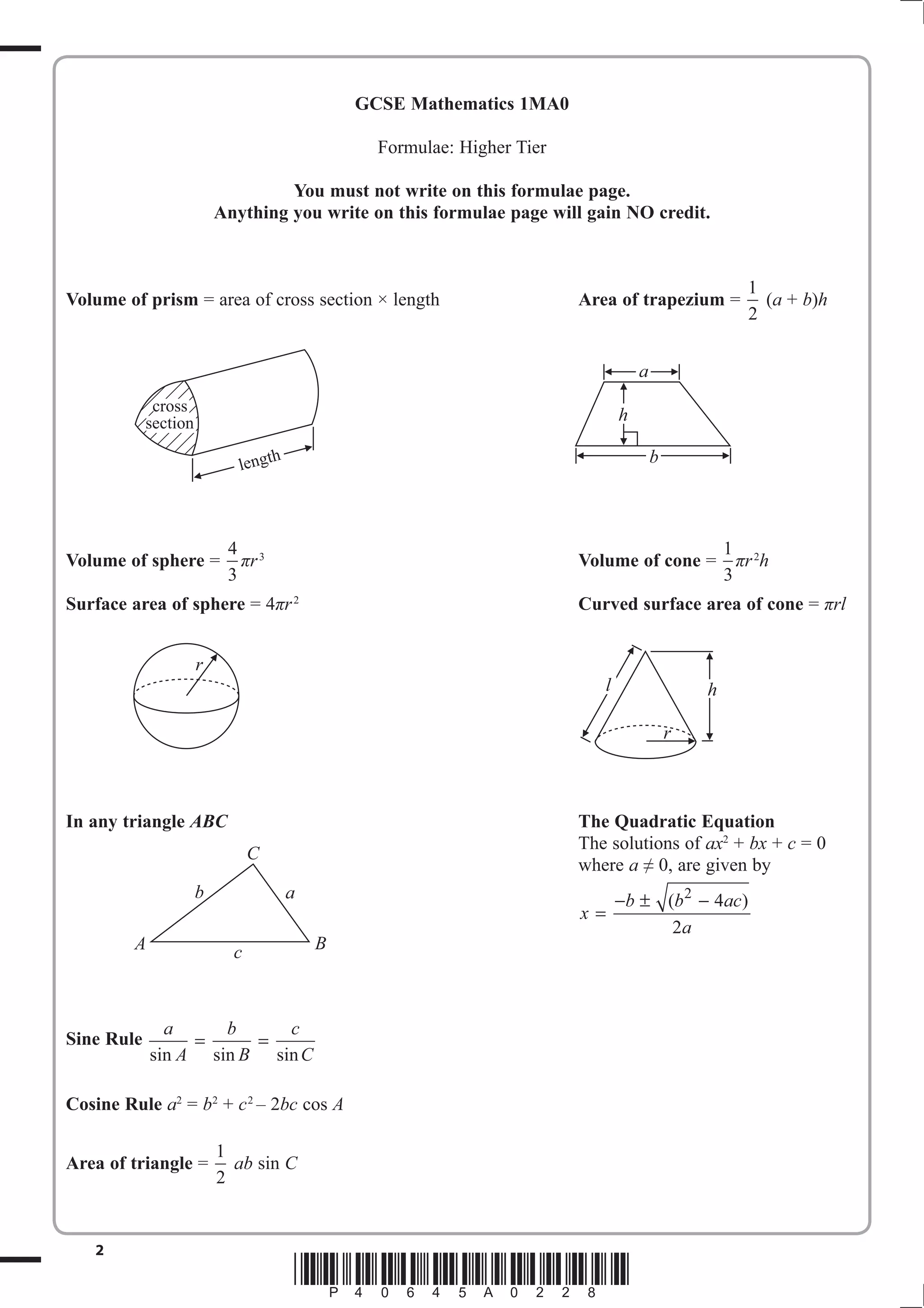
Volume of prism = area of cross section × length                          Area of trapezium =             (a + b)h
                                                                                                        2


                                                                                     a
             cross
            section                                                              h

                             lengt
                                    h                                                    b


                           4 3                                                                       1 2
Volume of sphere =           ʌU                                           Volume of cone =             ʌU h
                           3                                                                         3
Surface area of sphere = 4ʌU 2                                            Curved surface area of cone = ʌUO


                      r
                                                                             l                   h

                                                                                             r


In any triangle ABC                                                       The Quadratic Equation
                                                                          The solutions of ax2 + bx + c = 0
                                C
                                                                          where D  0, are given by
                      b                 a                                        −b ± (b 2 − 4ac)
                                                                          x=
                                                                                       2a
         A                  c               B


               a     b     c
Sine Rule         =     =
             sin A sin B sin C

Cosine Rule a2 = b2 + c 2 – 2bc cos A

                          1
Area of triangle =          ab sin C
                          2


   2
                                        *P40645A0228*
Answer ALL questions.

                                                                                                              Write your answers in the spaces provided.

                                                                                                    You must write down all stages in your working.

                                                                                                                                     You must NOT use a calculator.


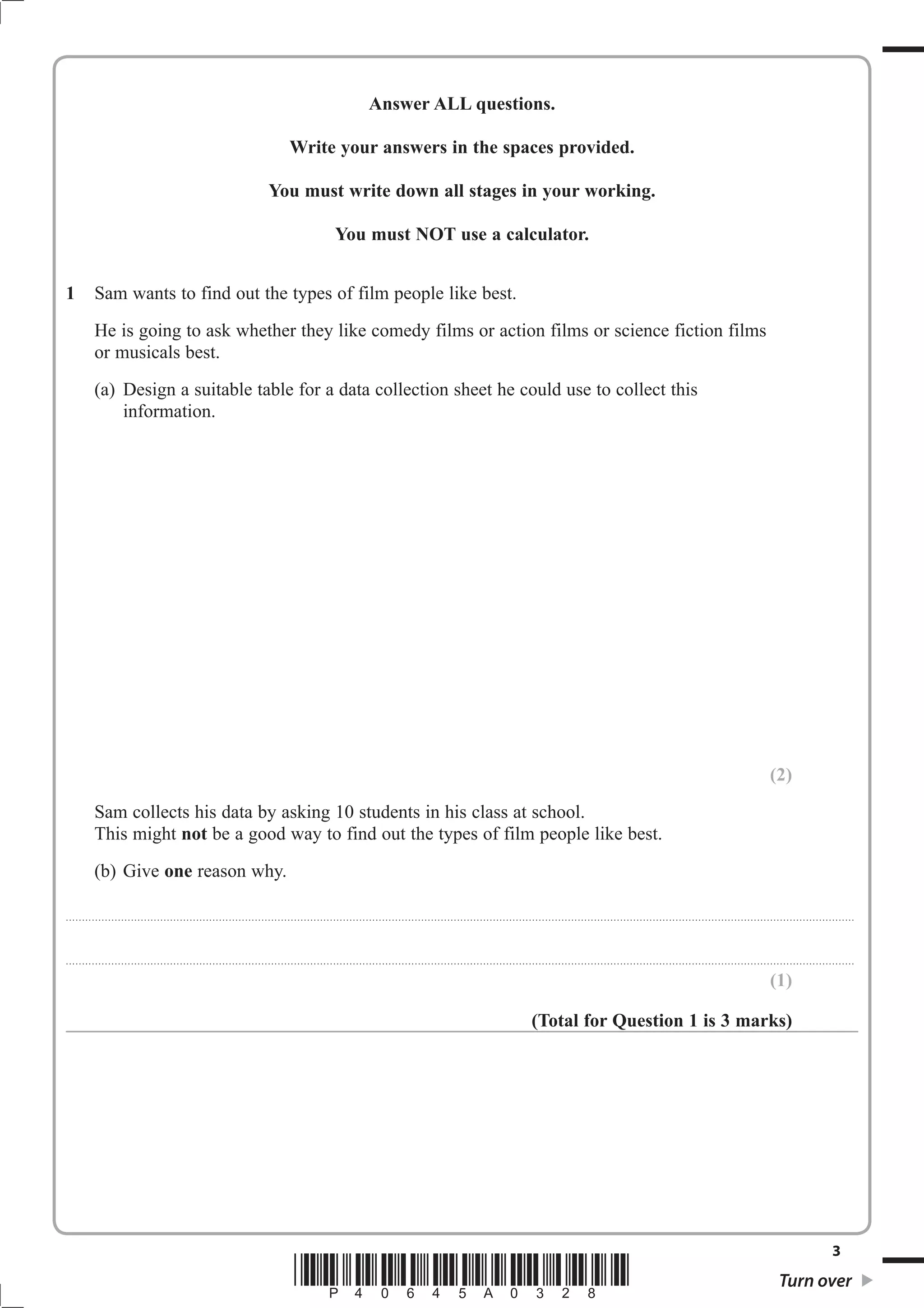
1             Sam wants to find out the types of film people like best.
              He is going to ask whether they like comedy films or action films or science fiction films
              or musicals best.
              (a) Design a suitable table for a data collection sheet he could use to collect this
                  information.


                                                                                                                                                                                                                                                                                                                                                            (2)
              Sam collects his data by asking 10 students in his class at school.
              This might not be a good way to find out the types of film people like best.
              (b) Give one reason why.

. . . . . . . . . . ............................................................................................. . . . . . . . . . . . . . . . . . . . . . . . .. . . . . . . . . . . . . . . . . . . . . . . . . . . . . . . . . . . . . . . . . . . . . . . . . . . . . . . . . . . . . . . . . . . . . . . . . . . . . . . . . . . . . . . . . . . . . . . . . . . . . . . . . . . . . . . . . . .


. . . . . . . . . . ............................................................................................. . . . . . . . . . . . . . . . . . . . . . . . .. . . . . . . . . . . . . . . . . . . . . . . . . . . . . . . . . . . . . . . . . . . . . . . . . . . . . . . . . . . . . . . . . . . . . . . . . . . . . . . . . . . . . . . . . . . . . . . . . . . . . . . . . . . . . . . . . . .

                                                                                                                                                                                                                                                                                                                                                            (1)

                                                                                                                                                                                                                                      (Total for Question 1 is 3 marks)


                                                                                                                                                                                                                                                                                                                                                                                           3
                                                                                                                 *P40645A0328*                                                                                                                                                                                                                                  Turn over
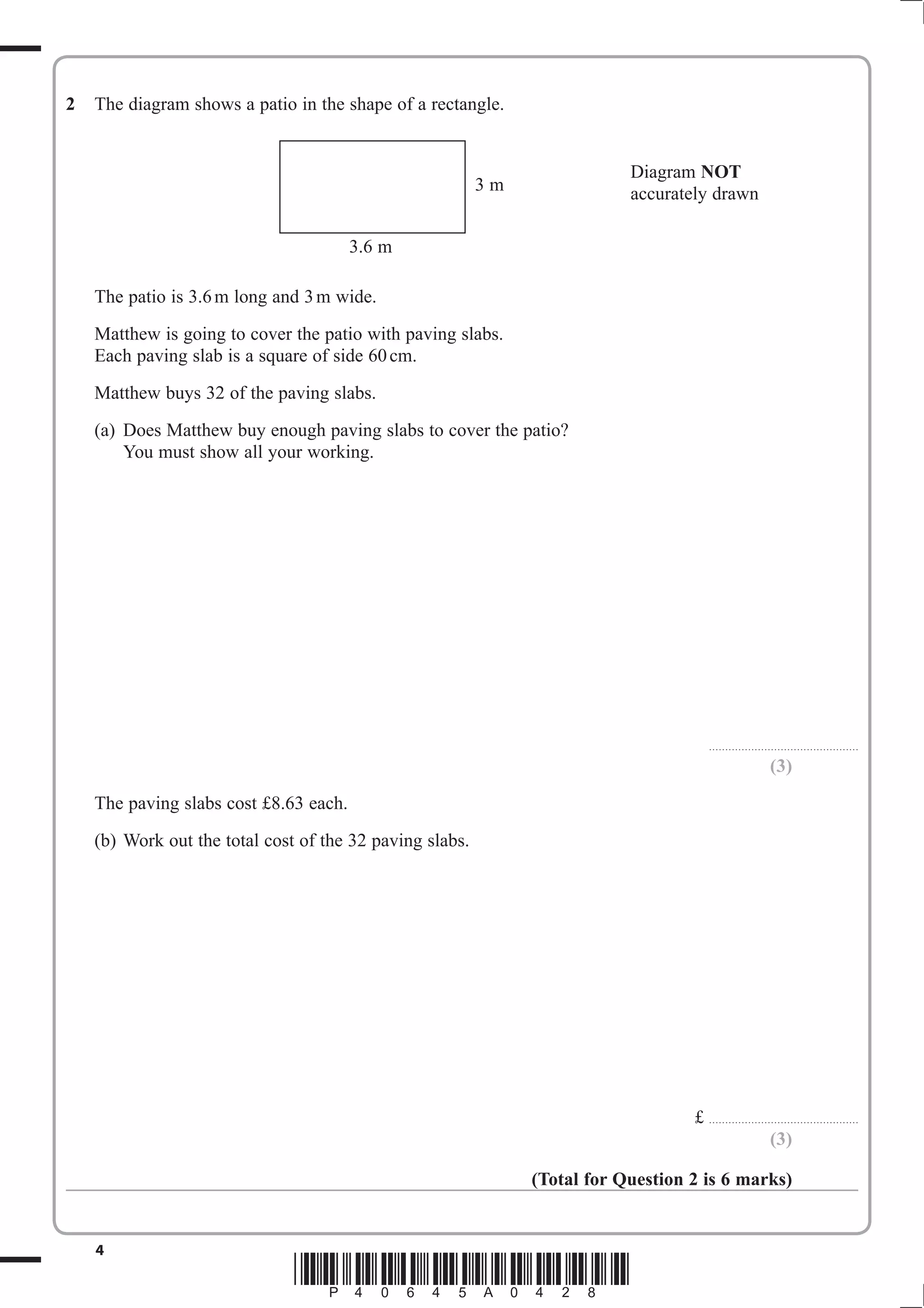
2   The diagram shows a patio in the shape of a rectangle.


                                                                           Diagram NOT
                                                          3m               accurately drawn

                                        3.6 m

    The patio is 3.6 m long and 3 m wide.
    Matthew is going to cover the patio with paving slabs.
    Each paving slab is a square of side 60 cm.
    Matthew buys 32 of the paving slabs.
    (a) Does Matthew buy enough paving slabs to cover the patio?
        You must show all your working.


                                                                                           . . . . . . . . . . . . . . . . . . . . . . . . . . .. . . . . . . . . . . . . . . . . . .

                                                                                                                               (3)
    The paving slabs cost £8.63 each.
    (b) Work out the total cost of the 32 paving slabs.


                                                                                   £ . . . . . . . . . . . . . . . . . . . . . . . . . . .. . . . . . . . . . . . . . . . . . .
                                                                                                                          (3)

                                                               (Total for Question 2 is 6 marks)


    4
                               *P40645A0428*
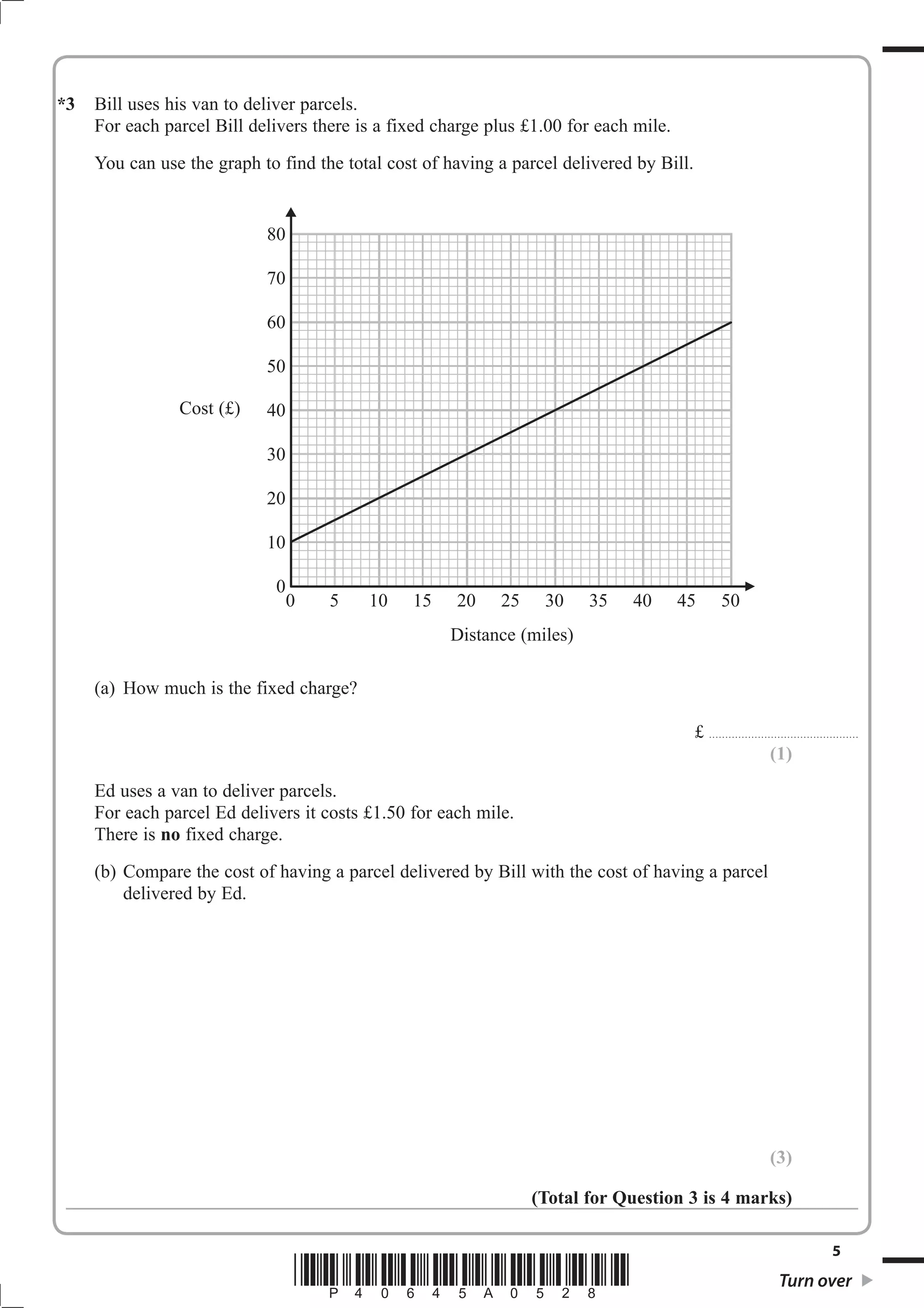
*3   Bill uses his van to deliver parcels.
     For each parcel Bill delivers there is a fixed charge plus £1.00 for each mile.
     You can use the graph to find the total cost of having a parcel delivered by Bill.


                            80

                            70

                            60

                            50

                Cost (£)    40

                            30

                            20

                            10

                             0
                                 0   5    10    15    20    25    30    35    40       45               50
                                                     Distance (miles)

     (a) How much is the fixed charge?

                                                                                          £ . . . . . . . . . . . . . . . . . . . . . . . . . . .. . . . . . . . . . . . . . . . . . .
                                                                                                                                 (1)
     Ed uses a van to deliver parcels.
     For each parcel Ed delivers it costs £1.50 for each mile.
     There is no fixed charge.
     (b) Compare the cost of having a parcel delivered by Bill with the cost of having a parcel
         delivered by Ed.


                                                                                                                                    (3)

                                                                 (Total for Question 3 is 4 marks)

                                                                                                                                                                       5
                                 *P40645A0528*                                                                                           Turn over
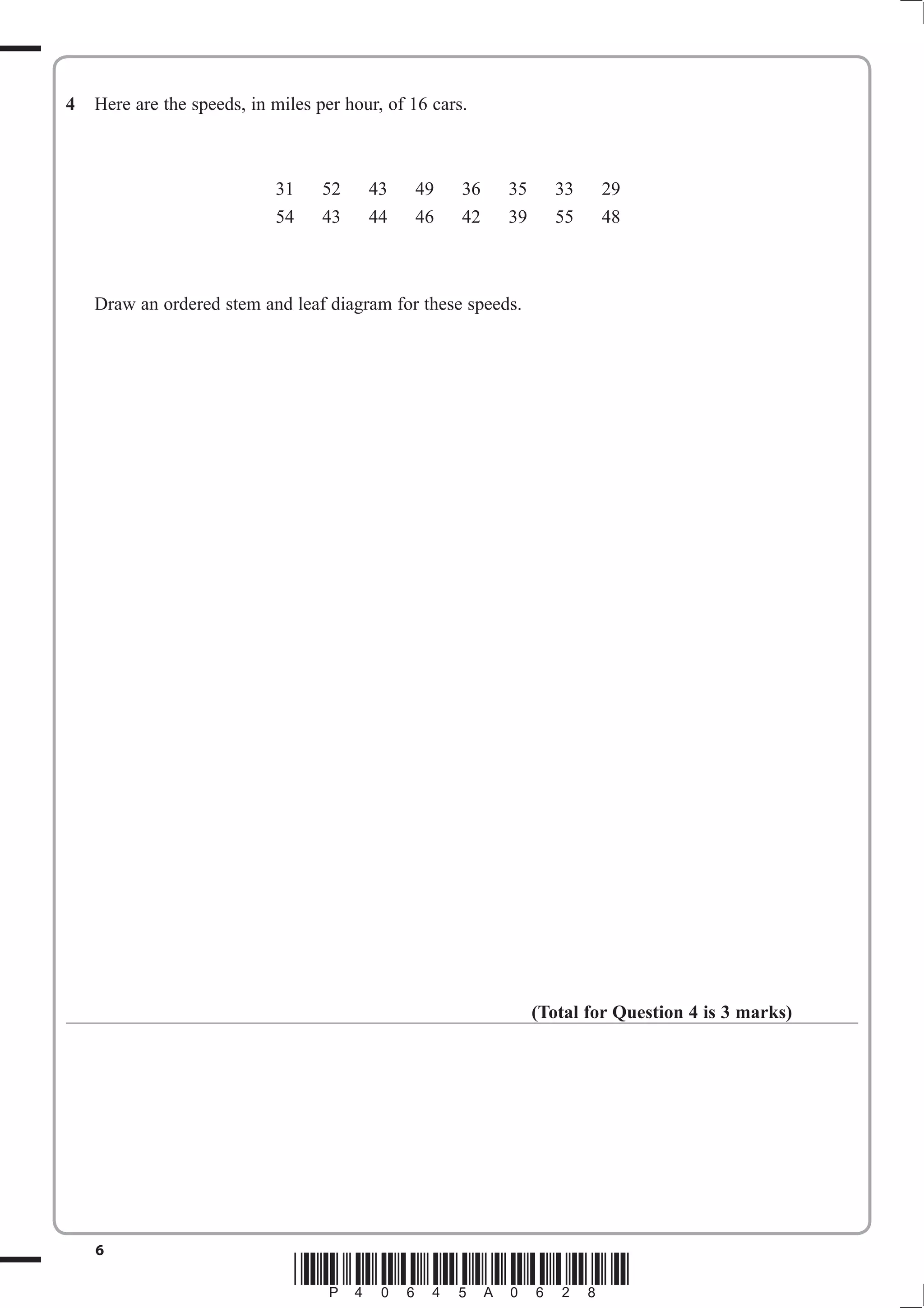
4   Here are the speeds, in miles per hour, of 16 cars.


                            31     52    43    49     36   35     33    29
                            54     43    44    46     42   39     55    48


    Draw an ordered stem and leaf diagram for these speeds.


                                                                (Total for Question 4 is 3 marks)


    6
                                 *P40645A0628*
5


             Medicine


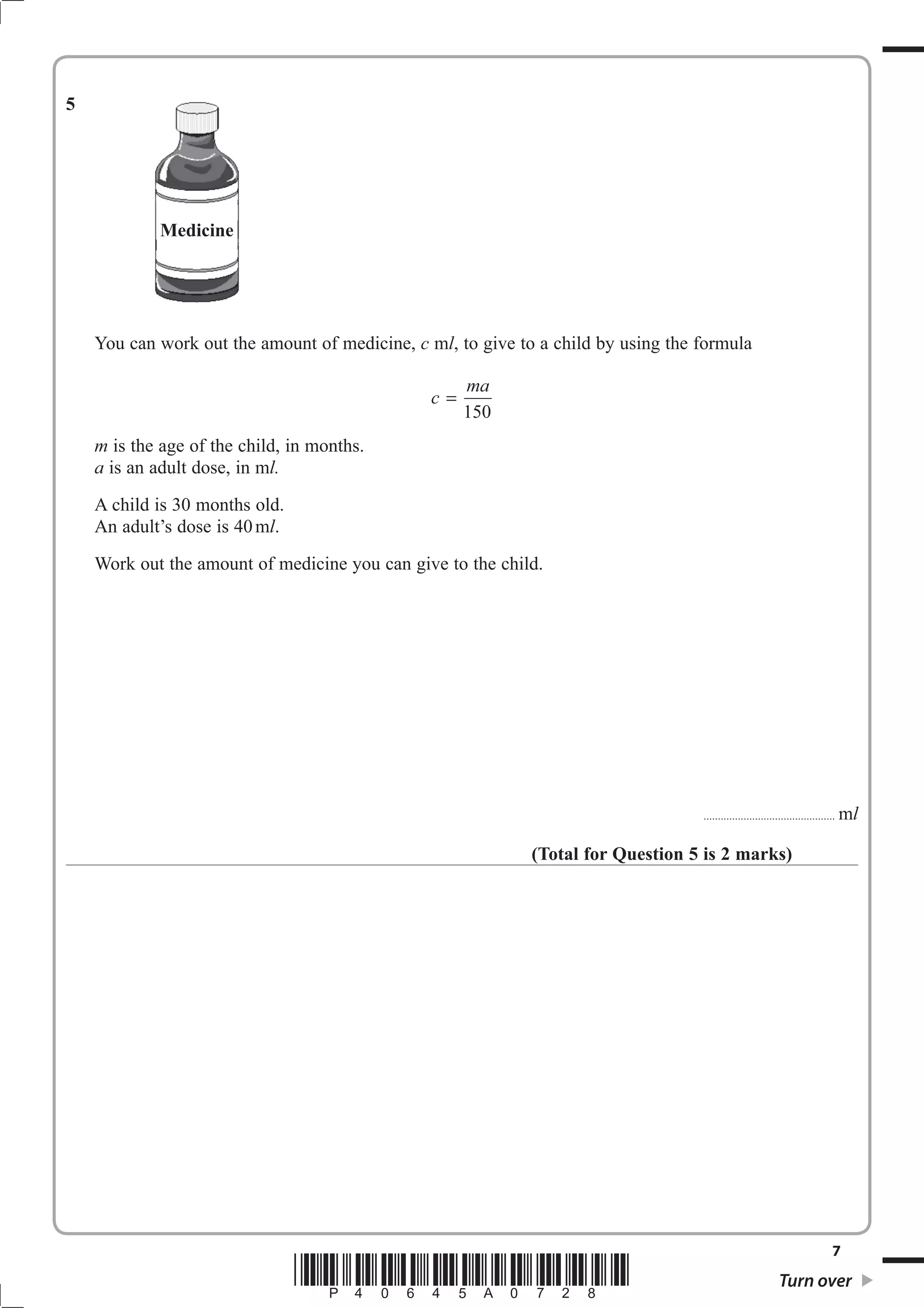
    You can work out the amount of medicine, c mO, to give to a child by using the formula

                                                     ma
                                                c=
                                                     150
    m is the age of the child, in months.
    a is an adult dose, in mO
    A child is 30 months old.
    An adult’s dose is 40 mO.
    Work out the amount of medicine you can give to the child.


                                                                                   ................................. . . . . . . . . . . . . .   mO

                                                             (Total for Question 5 is 2 marks)


                                                                                                                                            7
                                *P40645A0728*                                                                       Turn over
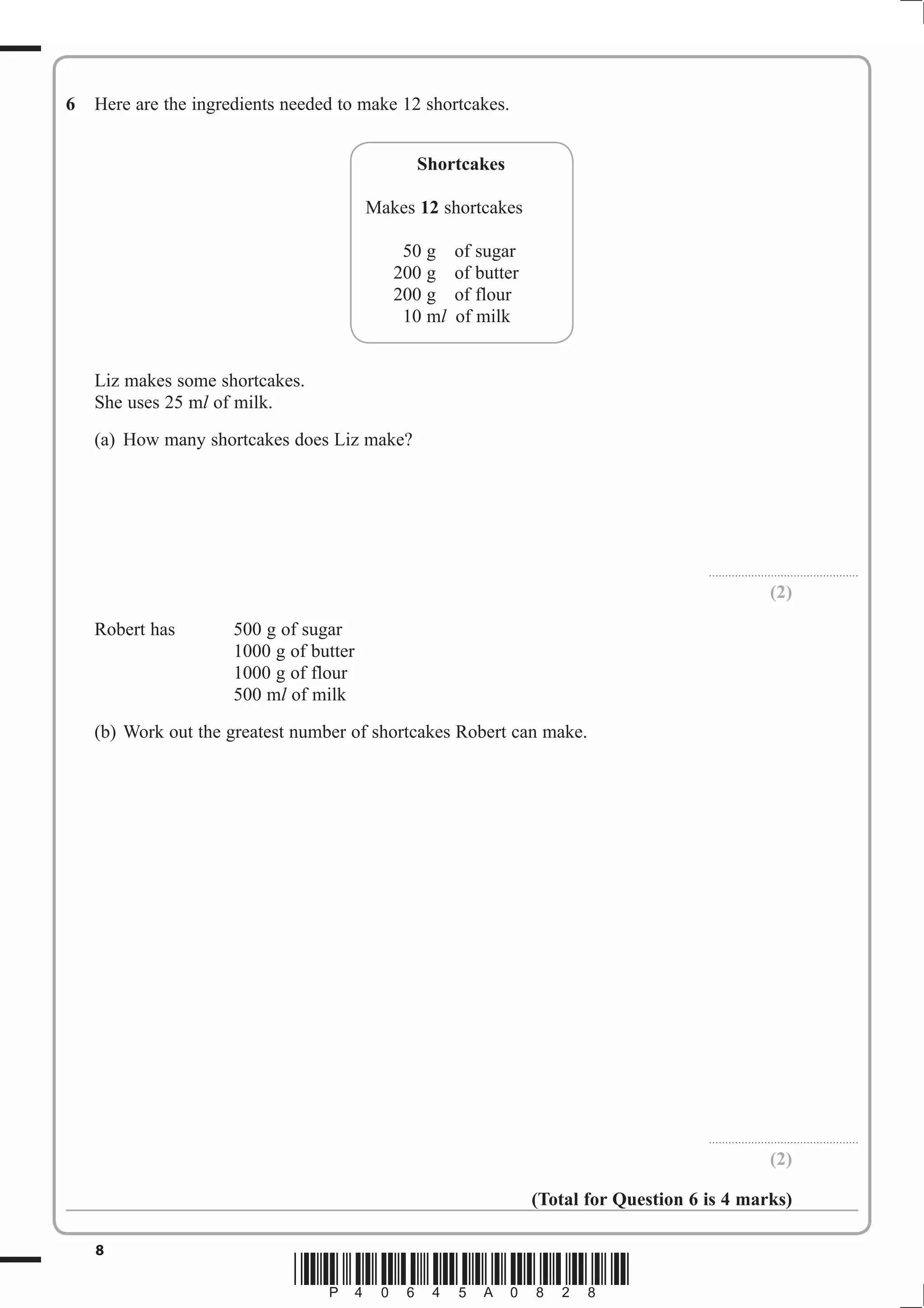
6   Here are the ingredients needed to make 12 shortcakes.


                                               Shortcakes

                                         Makes 12 shortcakes

                                             50 g    of sugar
                                            200 g    of butter
                                            200 g    of flour
                                             10 mO   of milk


    Liz makes some shortcakes.
    She uses 25 mO of milk.
    (a) How many shortcakes does Liz make?


                                                                                       . . . . . . . . . . . . . . . . . . . . . . . . . . .. . . . . . . . . . . . . . . . . . .

                                                                                                                           (2)
    Robert has        500 g of sugar
                      1000 g of butter
                      1000 g of flour
                      500 mO of milk
    (b) Work out the greatest number of shortcakes Robert can make.


                                                                                       . . . . . . . . . . . . . . . . . . . . . . . . . . .. . . . . . . . . . . . . . . . . . .

                                                                                                                           (2)

                                                                 (Total for Question 6 is 4 marks)

    8
                              *P40645A0828*
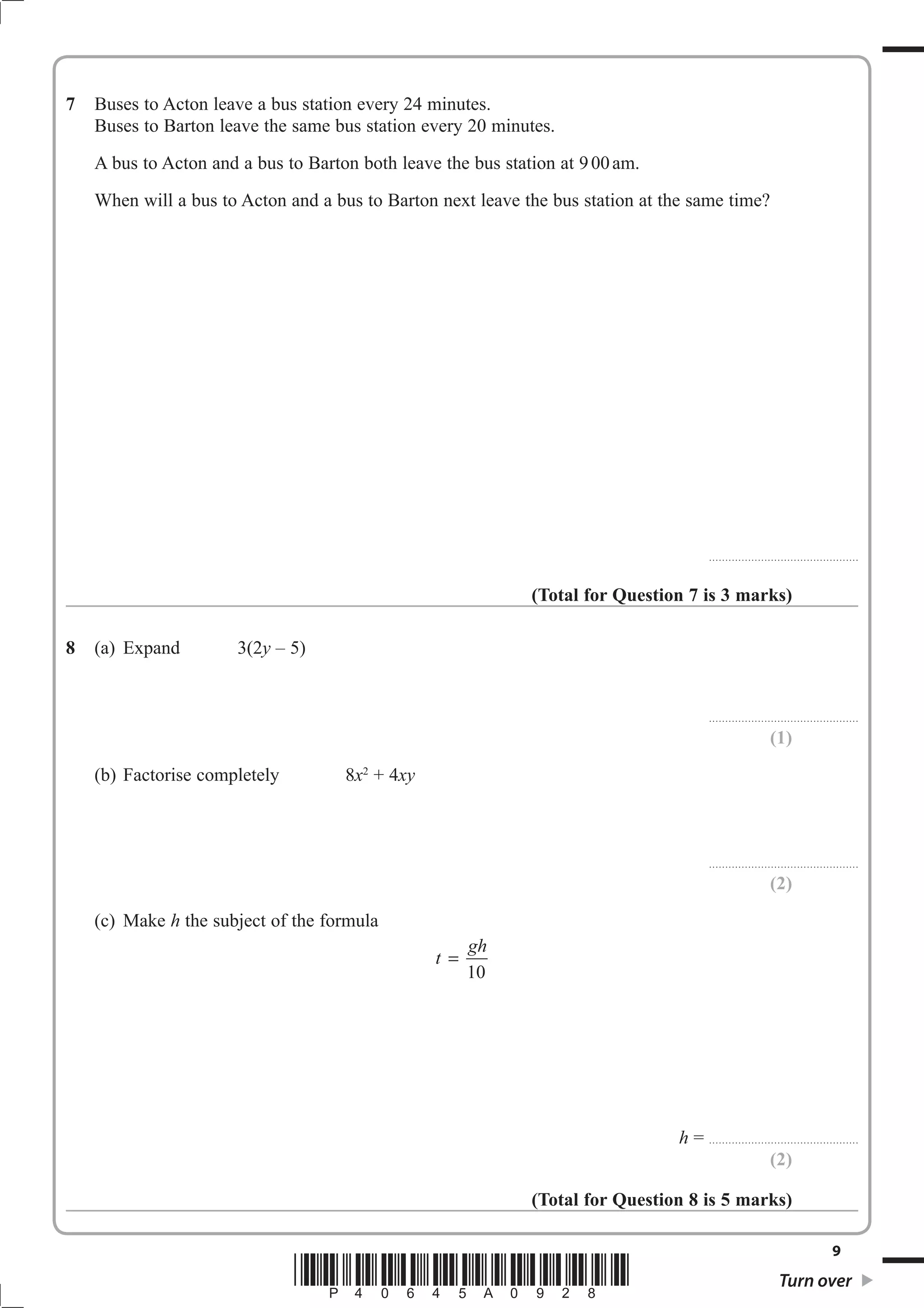
7   Buses to Acton leave a bus station every 24 minutes.
    Buses to Barton leave the same bus station every 20 minutes.
    A bus to Acton and a bus to Barton both leave the bus station at 9 00 am.
    When will a bus to Acton and a bus to Barton next leave the bus station at the same time?


                                                                                                . . . . . . . . . . . . . . . . . . . . . . . . . . .. . . . . . . . . . . . . . . . . . .


                                                              (Total for Question 7 is 3 marks)

8   (a) Expand         3(2y – 5)


                                                                                                . . . . . . . . . . . . . . . . . . . . . . . . . . .. . . . . . . . . . . . . . . . . . .

                                                                                                                                    (1)
    (b) Factorise completely         8x2 + 4xy


                                                                                                . . . . . . . . . . . . . . . . . . . . . . . . . . .. . . . . . . . . . . . . . . . . . .

                                                                                                                                    (2)
    (c) Make h the subject of the formula
                                                       gh
                                                 t =
                                                       10


                                                                                 h = . . . . . . . . . . . . . . . . . . . . . . . . . . .. . . . . . . . . . . . . . . . . . .
                                                                                                                          (2)

                                                              (Total for Question 8 is 5 marks)

                                                                                                                                                                          9
                               *P40645A0928*                                                                                              Turn over
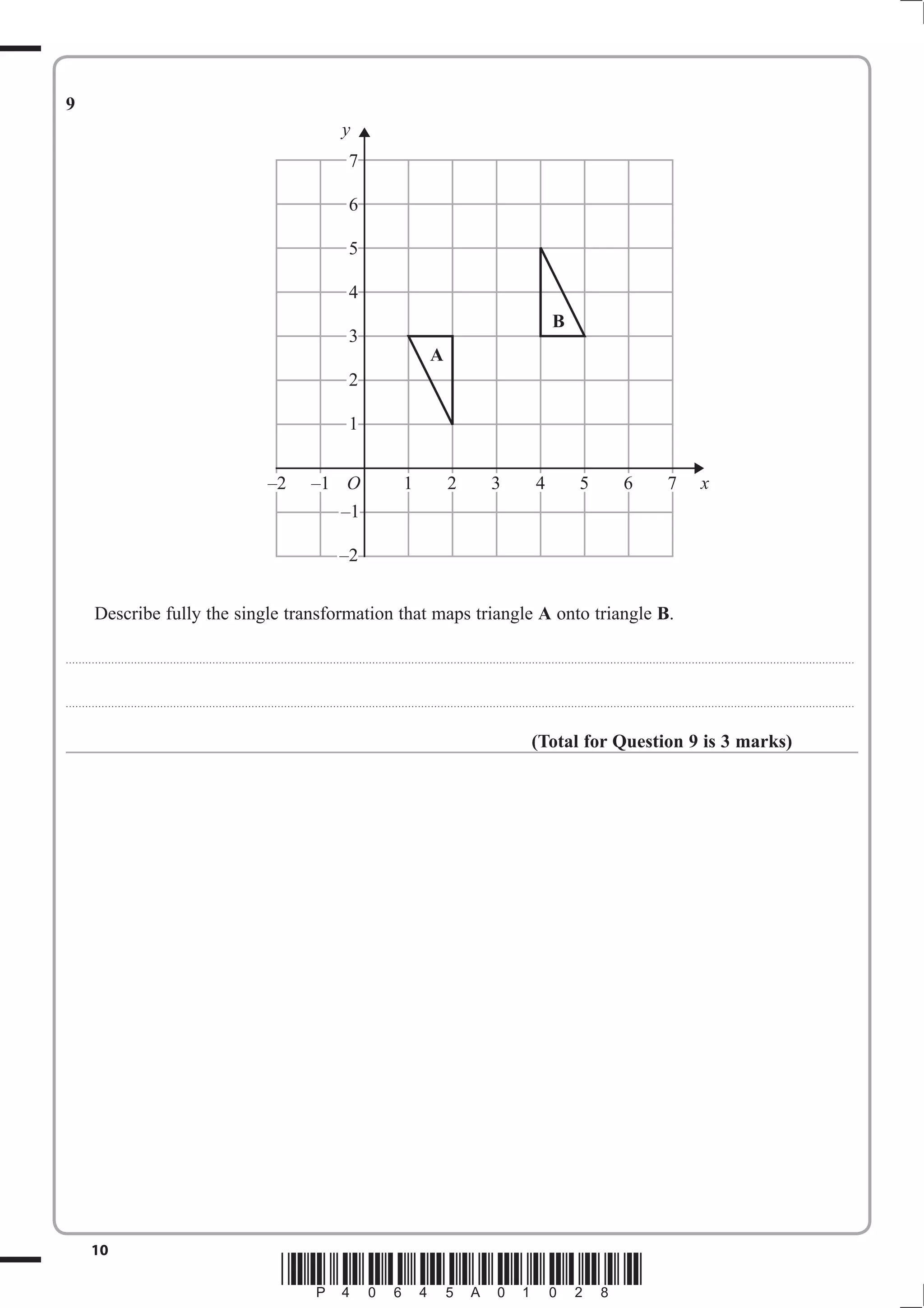
9
                                                                                                                                        y
                                                                                                                                            7

                                                                                                                                            6

                                                                                                                                            5

                                                                                                                                            4
                                                                                                                                                                                                                                                B
                                                                                                                                            3
                                                                                                                                                                                    A
                                                                                                                                            2

                                                                                                                                            1


                                                                                                   –2                    –1 O                                          1                    2                     3                     4                     5                    6                     7                x
                                                                                                                                        –1

                                                                                                                                       –2


              Describe fully the single transformation that maps triangle A onto triangle B.

. . . . . . . . . . ............................................................................................. . . . . . . . . . . . . . . . . . . . . . . . .. . . . . . . . . . . . . . . . . . . . . . . . . . . . . . . . . . . . . . . . . . . . . . . . . . . . . . . . . . . . . . . . . . . . . . . . . . . . . . . . . . . . . . . . . . . . . . . . . . . . . . . . . . . . . . . . . . .


. . . . . . . . . . ............................................................................................. . . . . . . . . . . . . . . . . . . . . . . . .. . . . . . . . . . . . . . . . . . . . . . . . . . . . . . . . . . . . . . . . . . . . . . . . . . . . . . . . . . . . . . . . . . . . . . . . . . . . . . . . . . . . . . . . . . . . . . . . . . . . . . . . . . . . . . . . . . .


                                                                                                                                                                                                                                      (Total for Question 9 is 3 marks)


            10
                                                                                                          *P40645A01028*
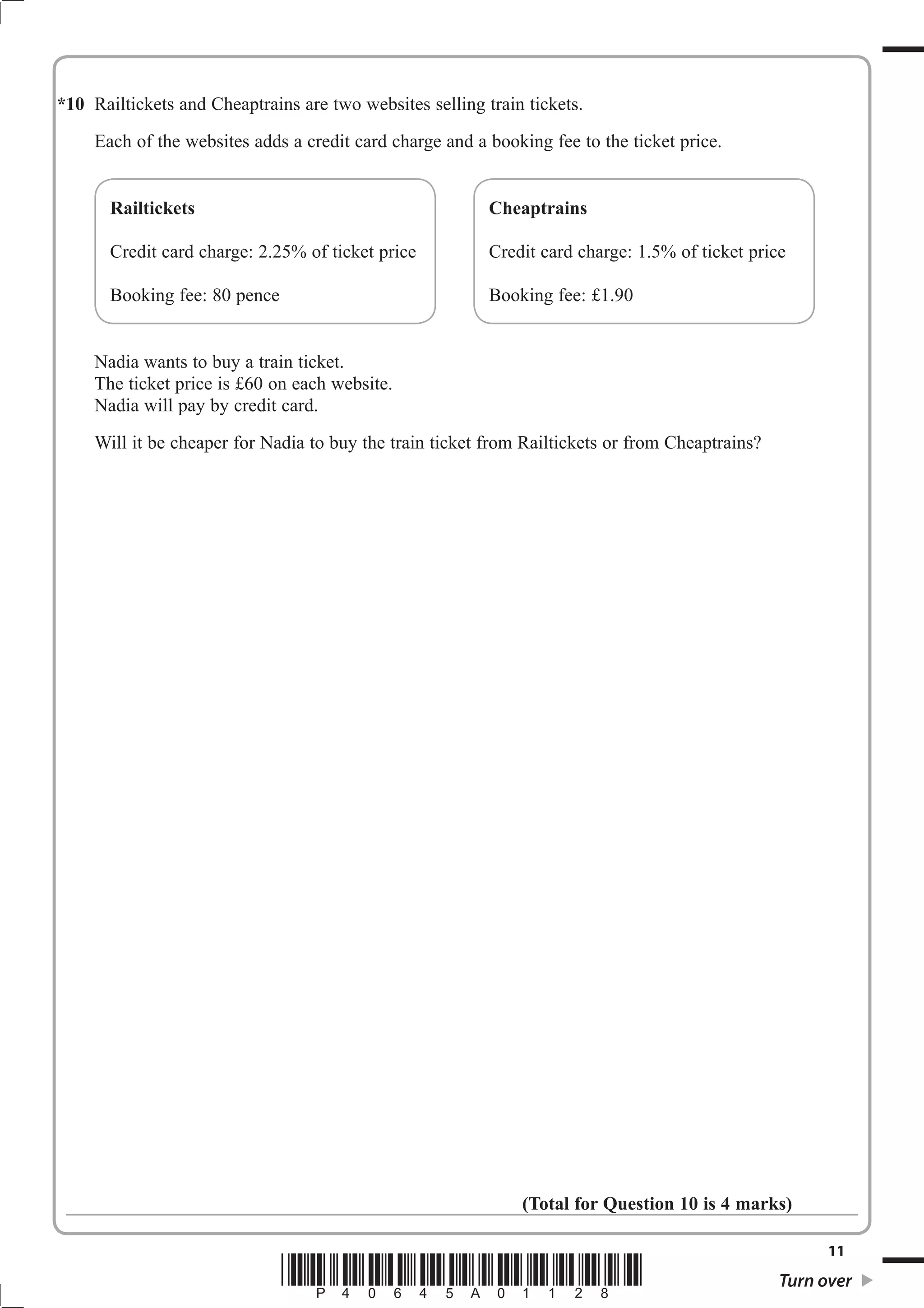
*10 Railtickets and Cheaptrains are two websites selling train tickets.
     Each of the websites adds a credit card charge and a booking fee to the ticket price.


       Railtickets                                        Cheaptrains

       Credit card charge: 2.25% of ticket price          Credit card charge: 1.5% of ticket price

       Booking fee: 80 pence                              Booking fee: £1.90


     Nadia wants to buy a train ticket.
     The ticket price is £60 on each website.
     Nadia will pay by credit card.
     Will it be cheaper for Nadia to buy the train ticket from Railtickets or from Cheaptrains?


                                                              (Total for Question 10 is 4 marks)

                                                                                                        11
                               *P40645A01128*                                                     Turn over
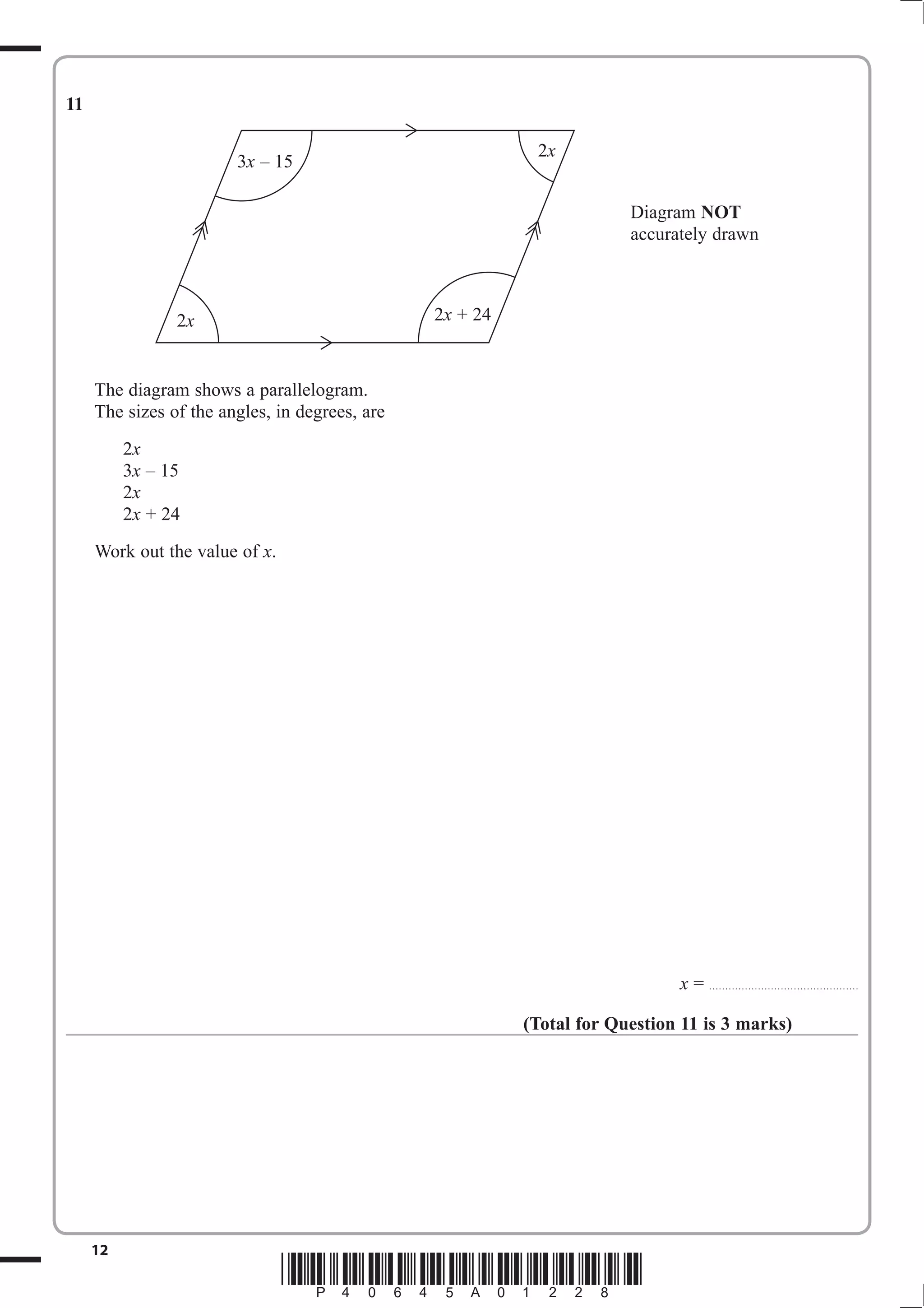
11

                                                           2x
                        3x – 15

                                                                       Diagram NOT
                                                                       accurately drawn


                2x                              2x + 24


     The diagram shows a parallelogram.
     The sizes of the angles, in degrees, are
          2x
          3x – 15
          2x
          2x + 24
     Work out the value of x.


                                                                             x = . . . . . . . . . . . . . . . . . . . . . . . . . . .. . . . . . . . . . . . . . . . . . .

                                                          (Total for Question 11 is 3 marks)


     12
                                *P40645A01228*
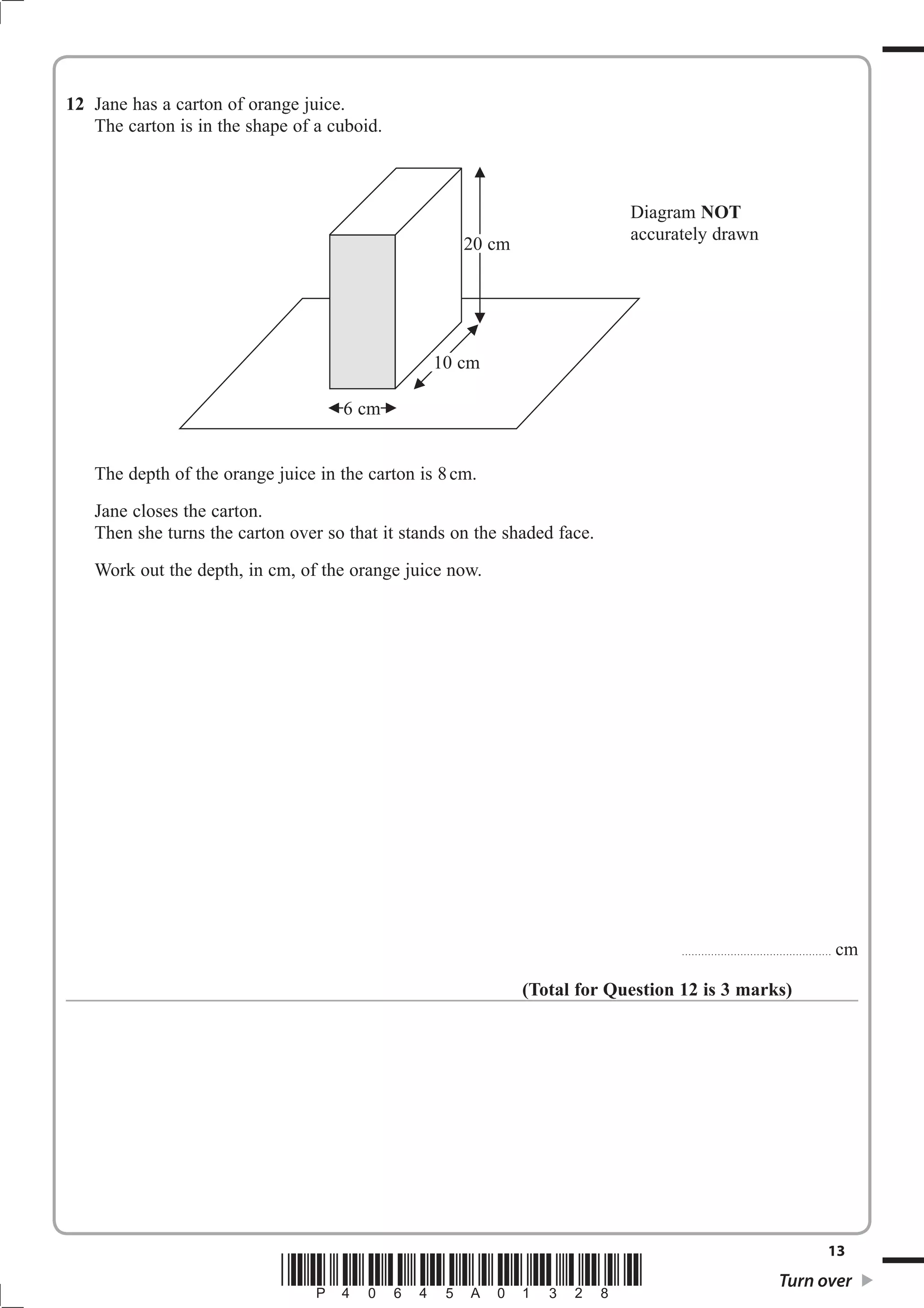
12 Jane has a carton of orange juice.
   The carton is in the shape of a cuboid.


                                                                          Diagram NOT
                                                                          accurately drawn
                                                     20 cm


                                                 10 cm

                                    6 cm


   The depth of the orange juice in the carton is 8 cm.
   Jane closes the carton.
   Then she turns the carton over so that it stands on the shaded face.
   Work out the depth, in cm, of the orange juice now.


                                                                                 ..............................................   cm

                                                             (Total for Question 12 is 3 marks)


                                                                                                                              13
                            *P40645A01328*                                                                    Turn over
13


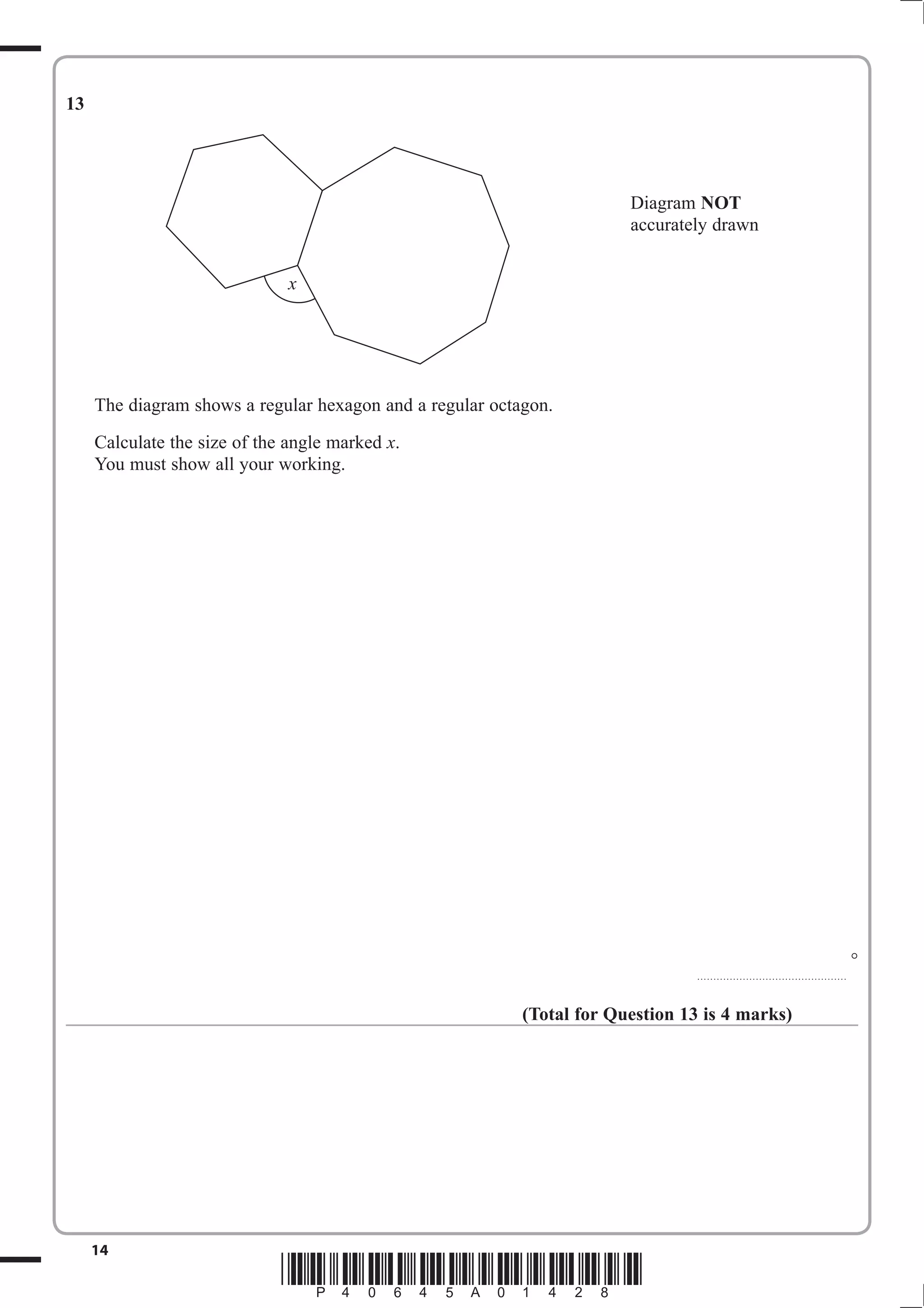
                                                                        Diagram NOT
                                                                        accurately drawn


                               x


     The diagram shows a regular hexagon and a regular octagon.
     Calculate the size of the angle marked x.
     You must show all your working.


                                                                                                                                  °
                                                                                 ..............................................


                                                           (Total for Question 13 is 4 marks)


     14
                              *P40645A01428*
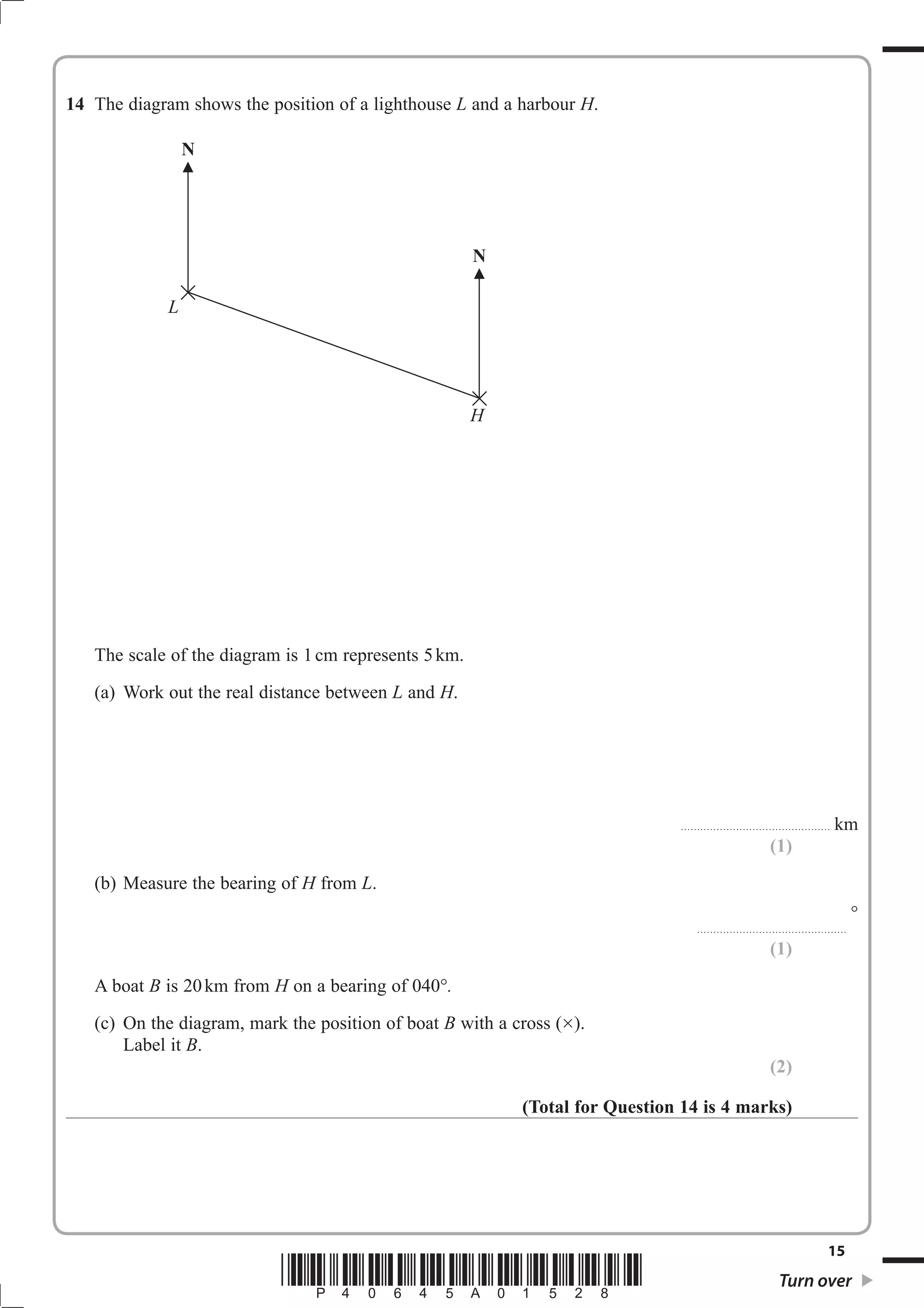
14 The diagram shows the position of a lighthouse L and a harbour H.

                 N


                                                       N

             L


                                                       H


   The scale of the diagram is 1 cm represents 5 km.
   (a) Work out the real distance between L and H.


                                                                              ..............................................   km
                                                                                                         (1)
   (b) Measure the bearing of H from L.
                                                                                                                                    °
                                                                                   ..............................................

                                                                                                         (1)
   A boat B is 20 km from H on a bearing of 040°
   (c) On the diagram, mark the position of boat B with a cross (×).
       Label it B.
                                                                                                         (2)

                                                           (Total for Question 14 is 4 marks)


                                                                                                                           15
                           *P40645A01528*                                                                   Turn over
15 Harry grows tomatoes.
   This year he put his tomato plants into two groups, group A and group B.
   Harry gave fertiliser to the tomato plants in group A.
   He did not give fertiliser to the tomato plants in group B.
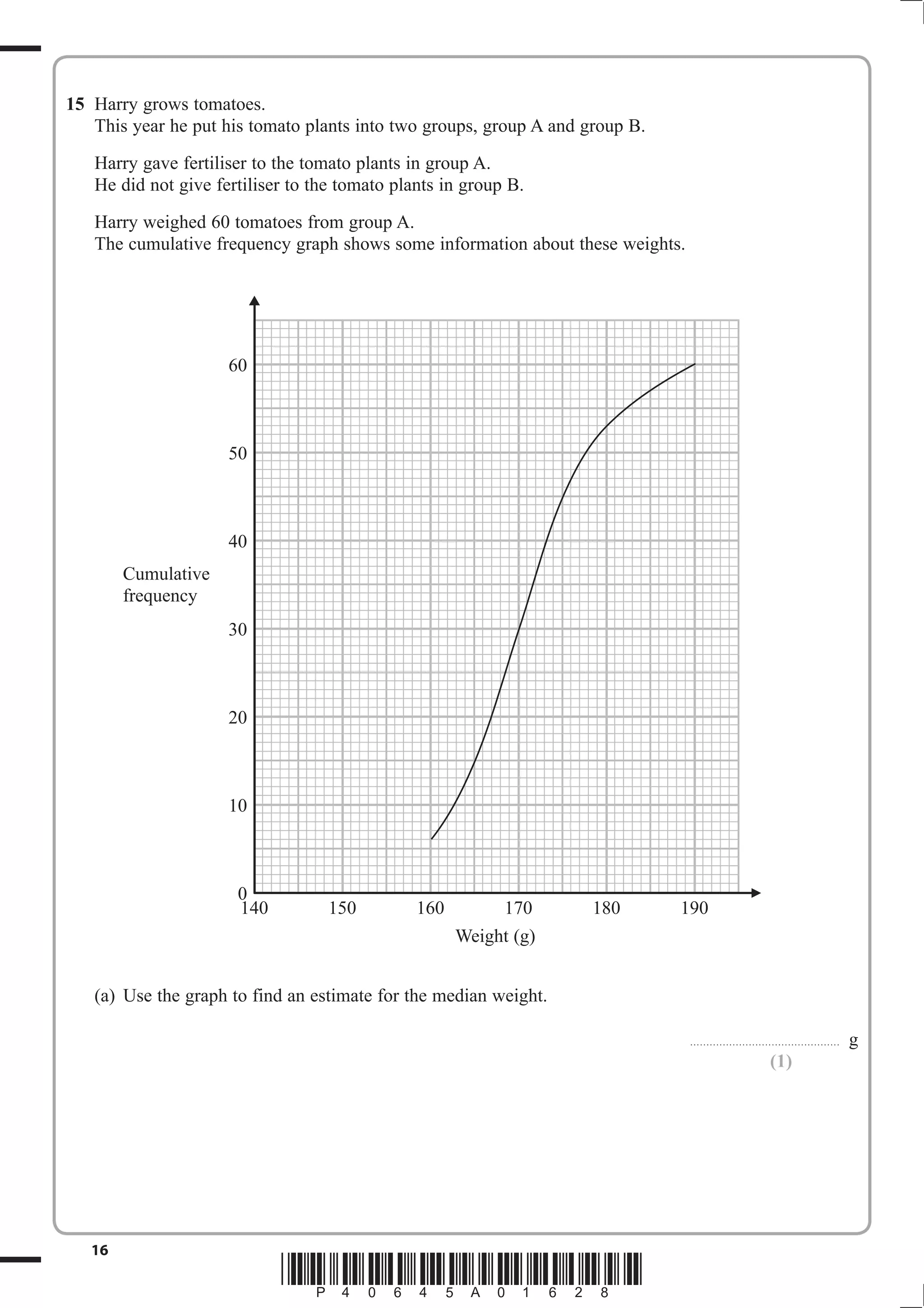
   Harry weighed 60 tomatoes from group A.
   The cumulative frequency graph shows some information about these weights.


                     60


                     50


                     40
        Cumulative
        frequency
                     30


                     20


                     10


                      0
                      140          150         160         170      180       190
                                                     Weight (g)


   (a) Use the graph to find an estimate for the median weight.

                                                                                ..............................................   g
                                                                                                        (1)


   16
                            *P40645A01628*
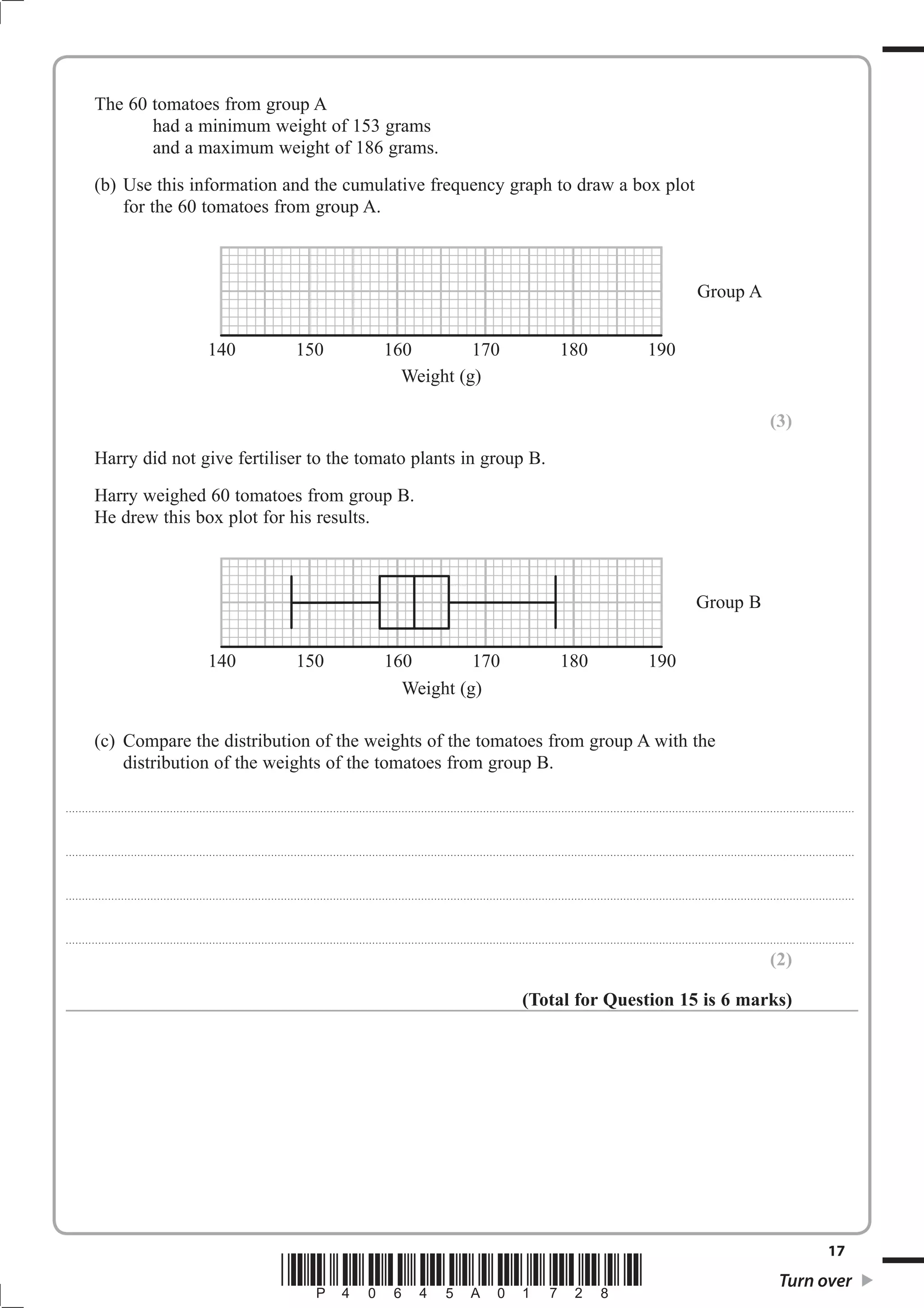
The 60 tomatoes from group A
                     had a minimum weight of 153 grams
                     and a maximum weight of 186 grams.
              (b) Use this information and the cumulative frequency graph to draw a box plot
                  for the 60 tomatoes from group A.


                                                                                                                                                                                                                                                                                                                        Group A


                                                                      140                                        150                                         160        170                                                                         180                                        190
                                                                                                                                                               Weight (g)

                                                                                                                                                                                                                                                                                                                                                            (3)
              Harry did not give fertiliser to the tomato plants in group B.
              Harry weighed 60 tomatoes from group B.
              He drew this box plot for his results.


                                                                                                                                                                                                                                                                                                                       Group B


                                                                      140                                        150                                         160        170                                                                         180                                         190
                                                                                                                                                               Weight (g)

              (c) Compare the distribution of the weights of the tomatoes from group A with the
                  distribution of the weights of the tomatoes from group B.

. . . . . . . . . . ............................................................................................. . . . . . . . . . . . . . . . . . . . . . . . .. . . . . . . . . . . . . . . . . . . . . . . . . . . . . . . . . . . . . . . . . . . . . . . . . . . . . . . . . . . . . . . . . . . . . . . . . . . . . . . . . . . . . . . . . . . . . . . . . . . . . . . . . . . . . . . . . . .


. . . . . . . . . . ............................................................................................. . . . . . . . . . . . . . . . . . . . . . . . .. . . . . . . . . . . . . . . . . . . . . . . . . . . . . . . . . . . . . . . . . . . . . . . . . . . . . . . . . . . . . . . . . . . . . . . . . . . . . . . . . . . . . . . . . . . . . . . . . . . . . . . . . . . . . . . . . . .


. . . . . . . . . . ............................................................................................. . . . . . . . . . . . . . . . . . . . . . . . .. . . . . . . . . . . . . . . . . . . . . . . . . . . . . . . . . . . . . . . . . . . . . . . . . . . . . . . . . . . . . . . . . . . . . . . . . . . . . . . . . . . . . . . . . . . . . . . . . . . . . . . . . . . . . . . . . . .


. . . . . . . . . . ............................................................................................. . . . . . . . . . . . . . . . . . . . . . . . .. . . . . . . . . . . . . . . . . . . . . . . . . . . . . . . . . . . . . . . . . . . . . . . . . . . . . . . . . . . . . . . . . . . . . . . . . . . . . . . . . . . . . . . . . . . . . . . . . . . . . . . . . . . . . . . . . . .

                                                                                                                                                                                                                                                                                                                                                            (2)

                                                                                                                                                                                                                                 (Total for Question 15 is 6 marks)


                                                                                                                                                                                                                                                                                                                                                                                         17
                                                                                                          *P40645A01728*                                                                                                                                                                                                                                        Turn over
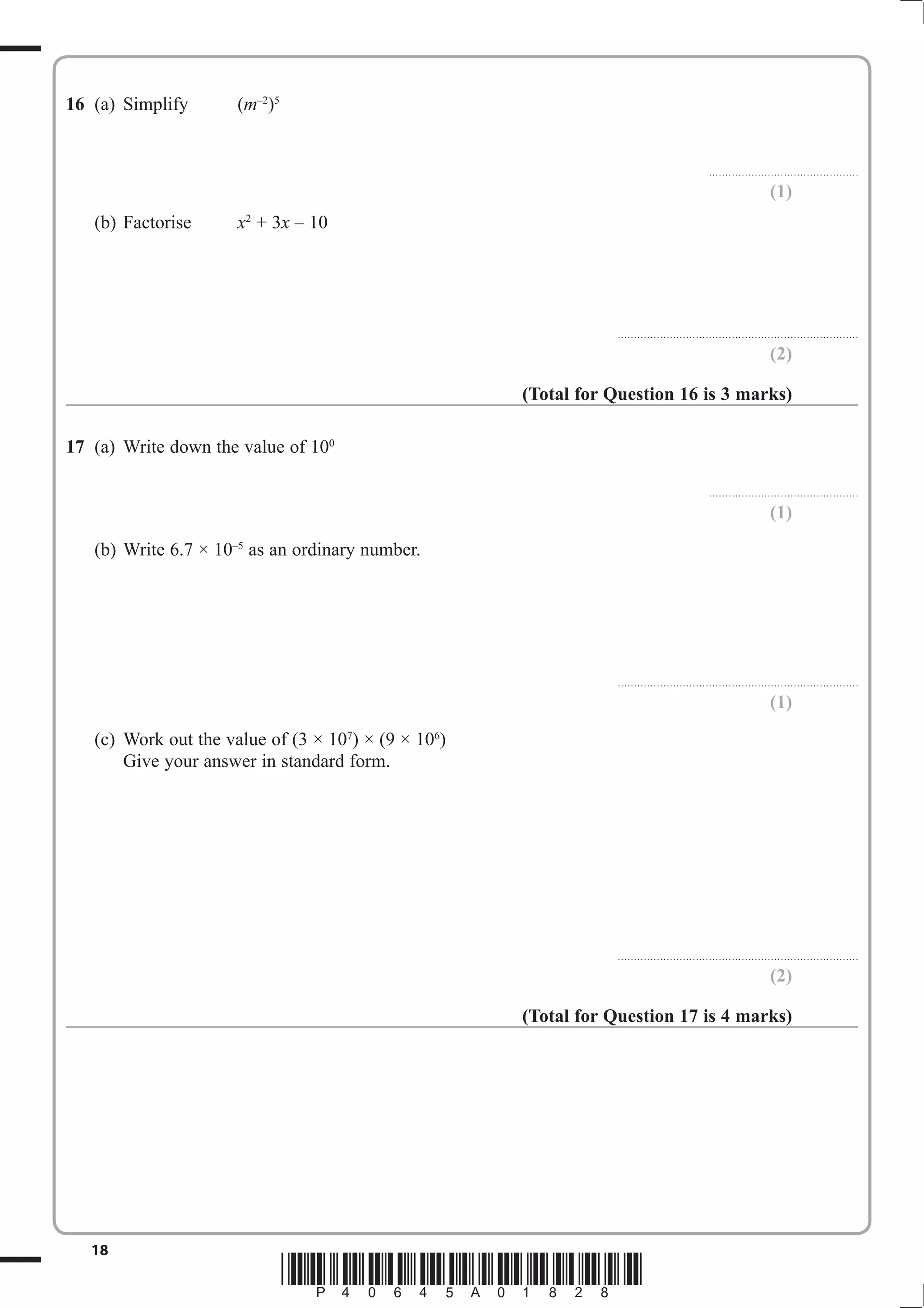
16 (a) Simplify       (m–2)5


                                                                                             . . . . . . . . . . . . . . . . . . . . . . . . . . .. . . . . . . . . . . . . . . . . . .

                                                                                                                                 (1)
   (b) Factorise      x2 + 3x – 10


                                                                 ..........................................................................

                                                                                                                                 (2)

                                                     (Total for Question 16 is 3 marks)

17 (a) Write down the value of 100

                                                                                             . . . . . . . . . . . . . . . . . . . . . . . . . . .. . . . . . . . . . . . . . . . . . .

                                                                                                                                 (1)
   (b) Write 6.7 × 10⁻⁵ as an ordinary number.


                                                                 ..........................................................................

                                                                                                                                 (1)
   (c) Work out the value of (3 × 107) × (9 × 106)
       Give your answer in standard form.


                                                                 ..........................................................................

                                                                                                                                 (2)

                                                     (Total for Question 17 is 4 marks)


   18
                               *P40645A01828*
18
                         y
                          7

                          6
                                                       C
                          5

                          4

                          3

                          2
                                      A                       B
                          1


                          O      1        2   3    4    5     6    7       8     x

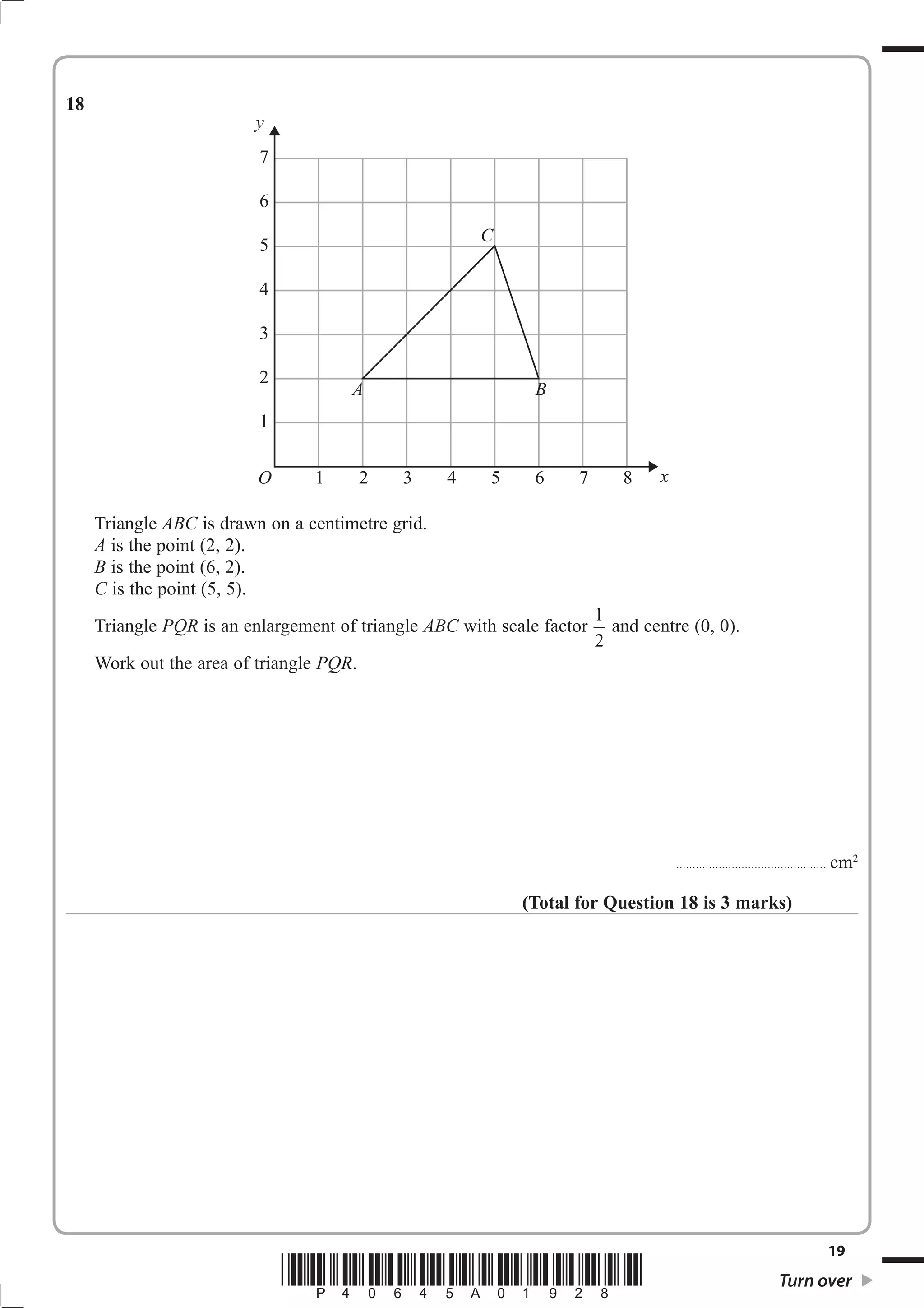
     Triangle ABC is drawn on a centimetre grid.
     A is the point (2, 2).
     B is the point (6, 2).
     C is the point (5, 5).
                                                                        1
     Triangle PQR is an enlargement of triangle ABC with scale factor     and centre (0, 0).
                                                                        2
     Work out the area of triangle PQR.


                                                                                     ..............................................   cm2

                                                            (Total for Question 18 is 3 marks)


                                                                                                                                      19
                              *P40645A01928*                                                                        Turn over
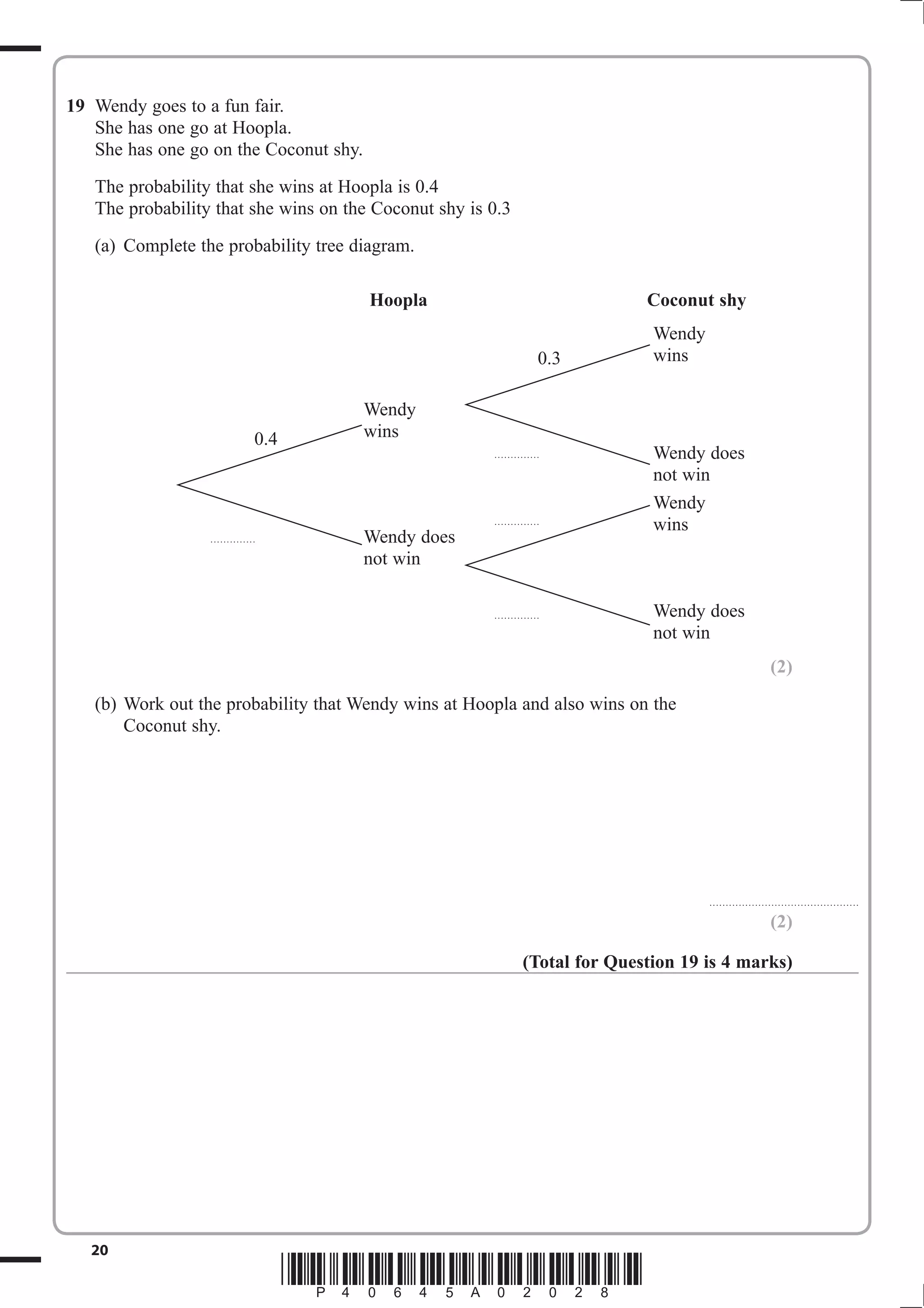
19 Wendy goes to a fun fair.
   She has one go at Hoopla.
   She has one go on the Coconut shy.
   The probability that she wins at Hoopla is 0.4
   The probability that she wins on the Coconut shy is 0.3
   (a) Complete the probability tree diagram.

                                        Hoopla                                Coconut shy
                                                                               Wendy
                                                                    0.3        wins

                                        Wendy
                               0.4      wins
                                                       ..............          Wendy does
                                                                               not win
                                                                               Wendy
                                                       ..............
                                                                               wins
                  ..............        Wendy does
                                        not win

                                                       ..............          Wendy does
                                                                               not win
                                                                                                         (2)
   (b) Work out the probability that Wendy wins at Hoopla and also wins on the
       Coconut shy.


                                                                                       ..............................................

                                                                                                         (2)

                                                               (Total for Question 19 is 4 marks)


   20
                                     *P40645A02028*
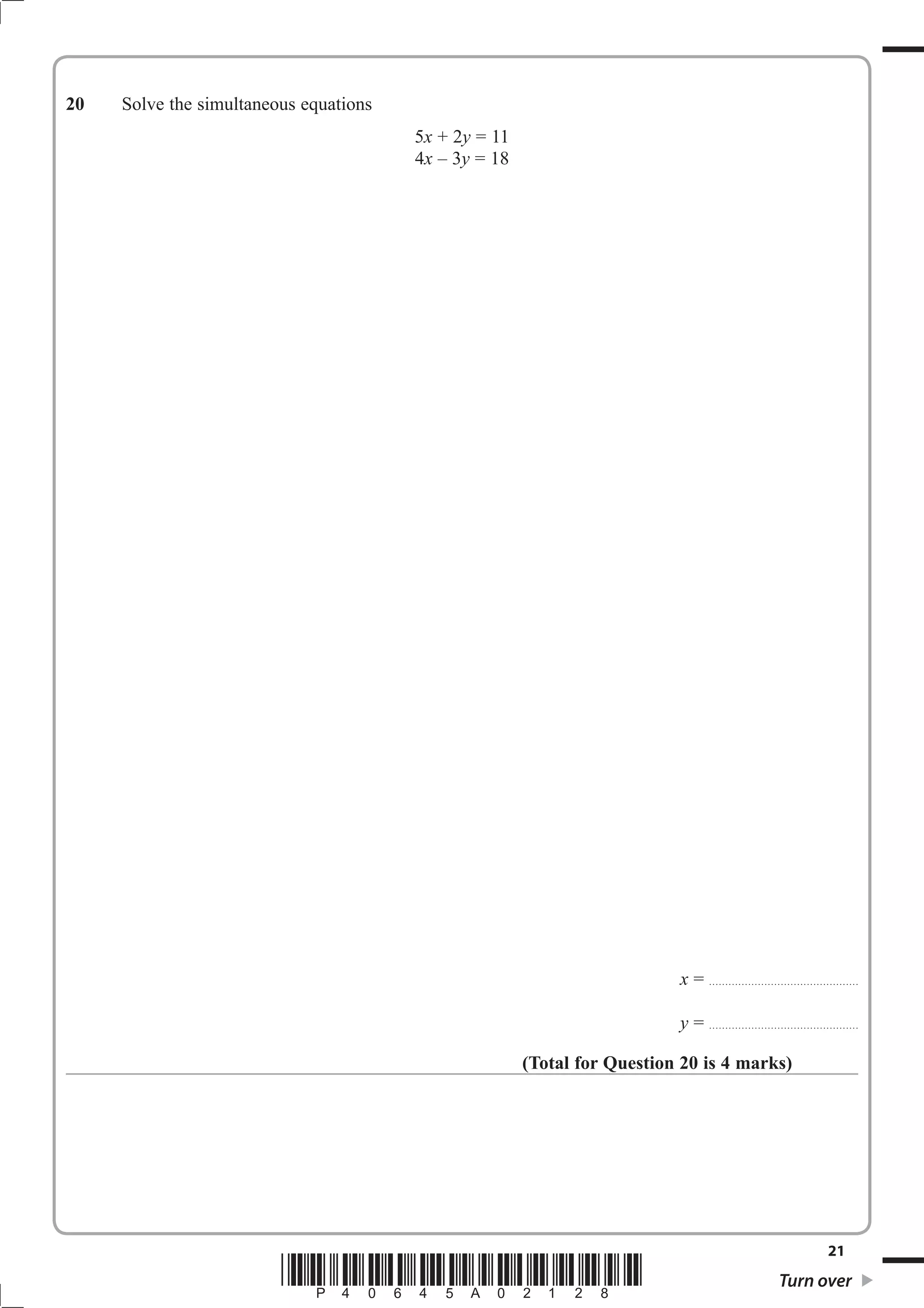
20   Solve the simultaneous equations
                                        5x + 2y = 11
                                        4x – 3y = 18


                                                                          x = . . . . . . . . . . . . . . . . . . . . . . . . . . .. . . . . . . . . . . . . . . . . . .

                                                                          y = . . . . . . . . . . . . . . . . . . . . . . . . . . .. . . . . . . . . . . . . . . . . . .

                                                       (Total for Question 20 is 4 marks)


                                                                                                                                                        21
                         *P40645A02128*                                                                                       Turn over
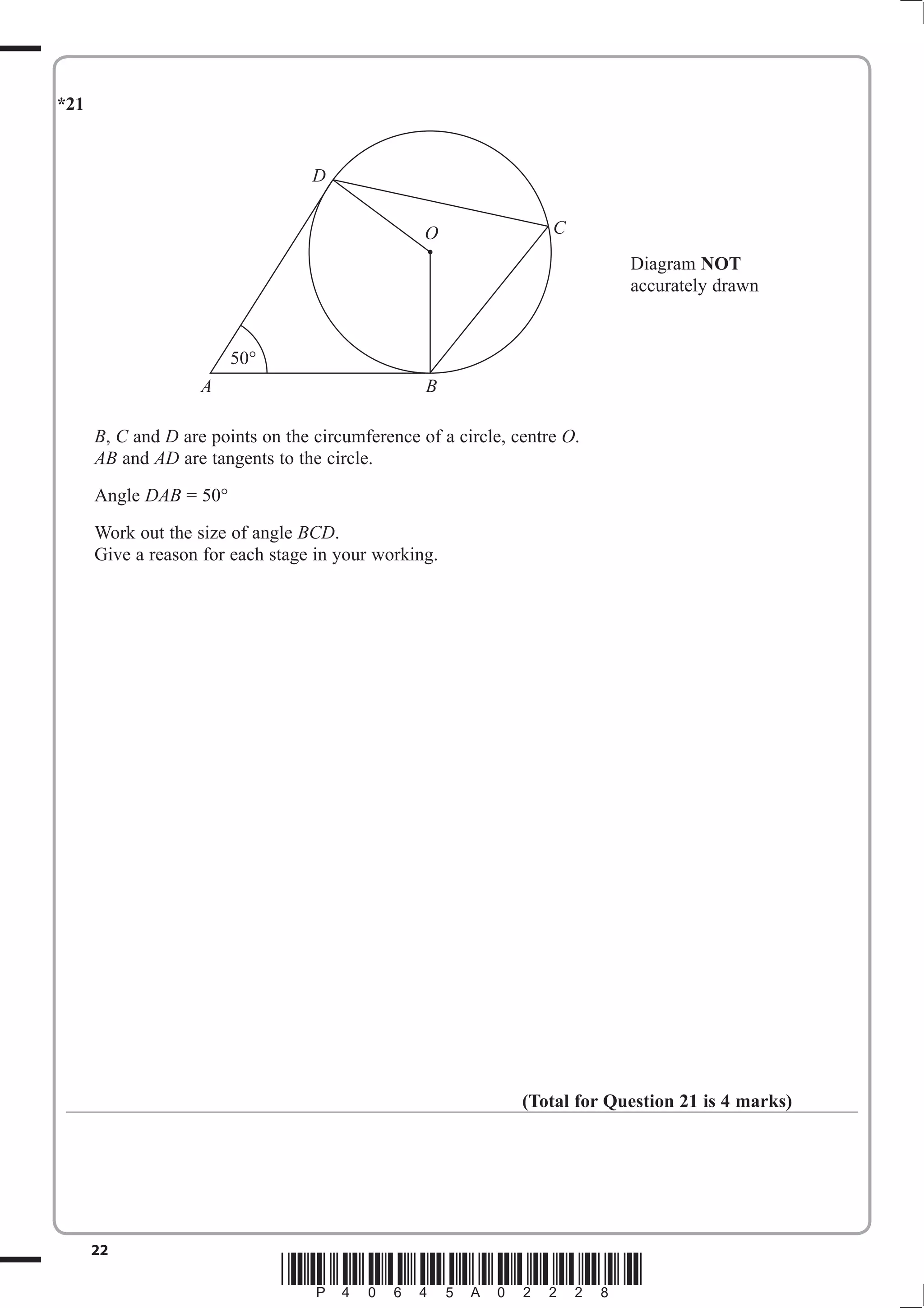
*21


                                   D


                                                  O                C
                                                                            Diagram NOT
                                                                            accurately drawn


                        50°
                    A                             B

      B, C and D are points on the circumference of a circle, centre O.
      AB and AD are tangents to the circle.
      Angle DAB = 50°
      Work out the size of angle BCD.
      Give a reason for each stage in your working.


                                                               (Total for Question 21 is 4 marks)


      22
                               *P40645A02228*
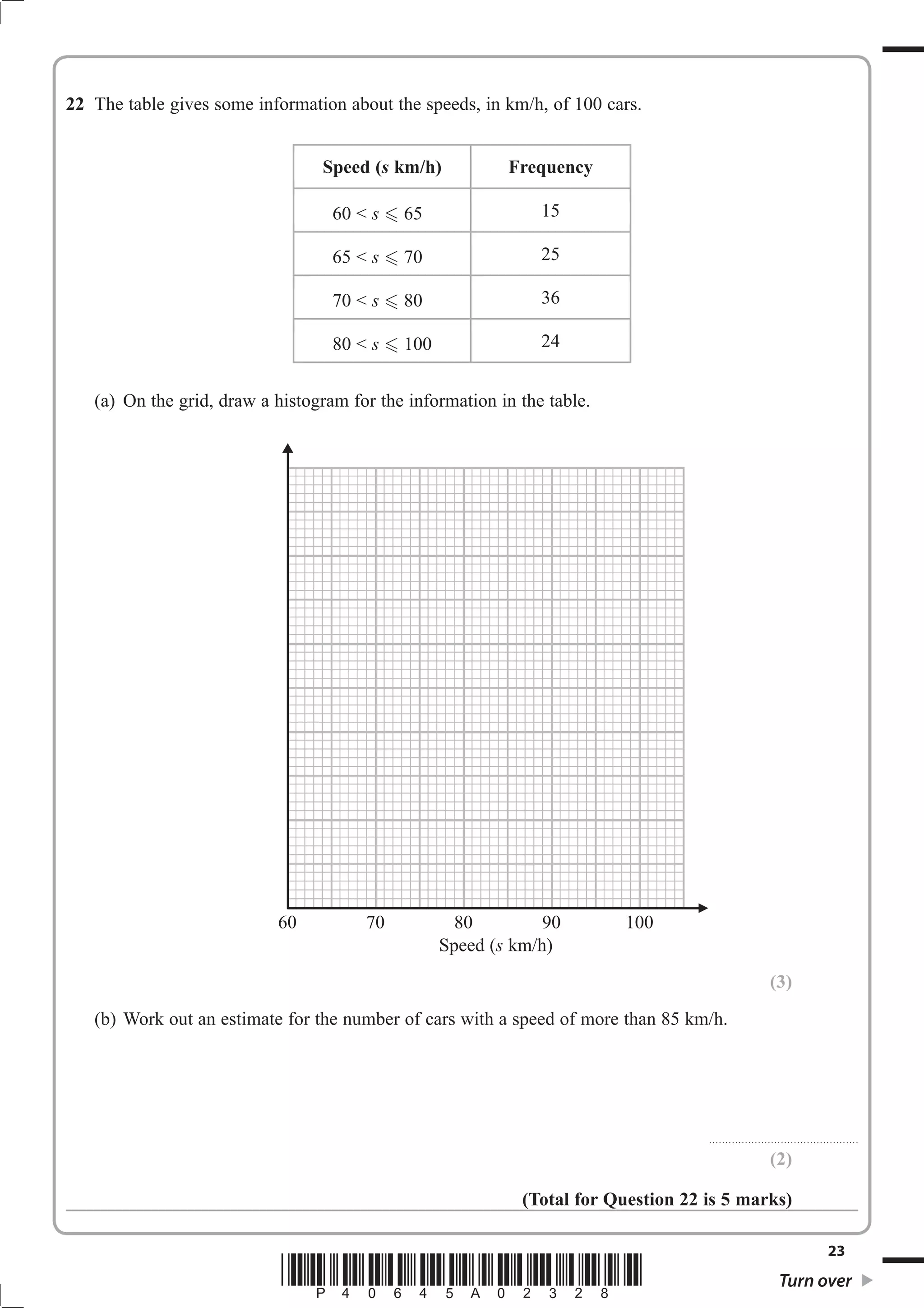
22 The table gives some information about the speeds, in km/h, of 100 cars.


                                 Speed (s km/h)           Frequency

                                   60  s - 65                 15

                                   65  s - 70                 25

                                   70  s - 80                 36

                                   80  s - 100                24


   (a) On the grid, draw a histogram for the information in the table.


                           60          70           80         90        100
                                                  Speed (s km/h)
                                                                                                     (3)
   (b) Work out an estimate for the number of cars with a speed of more than 85 km/h.


                                                                                   ..............................................

                                                                                                     (2)

                                                            (Total for Question 22 is 5 marks)

                                                                                                                       23
                            *P40645A02328*                                                              Turn over
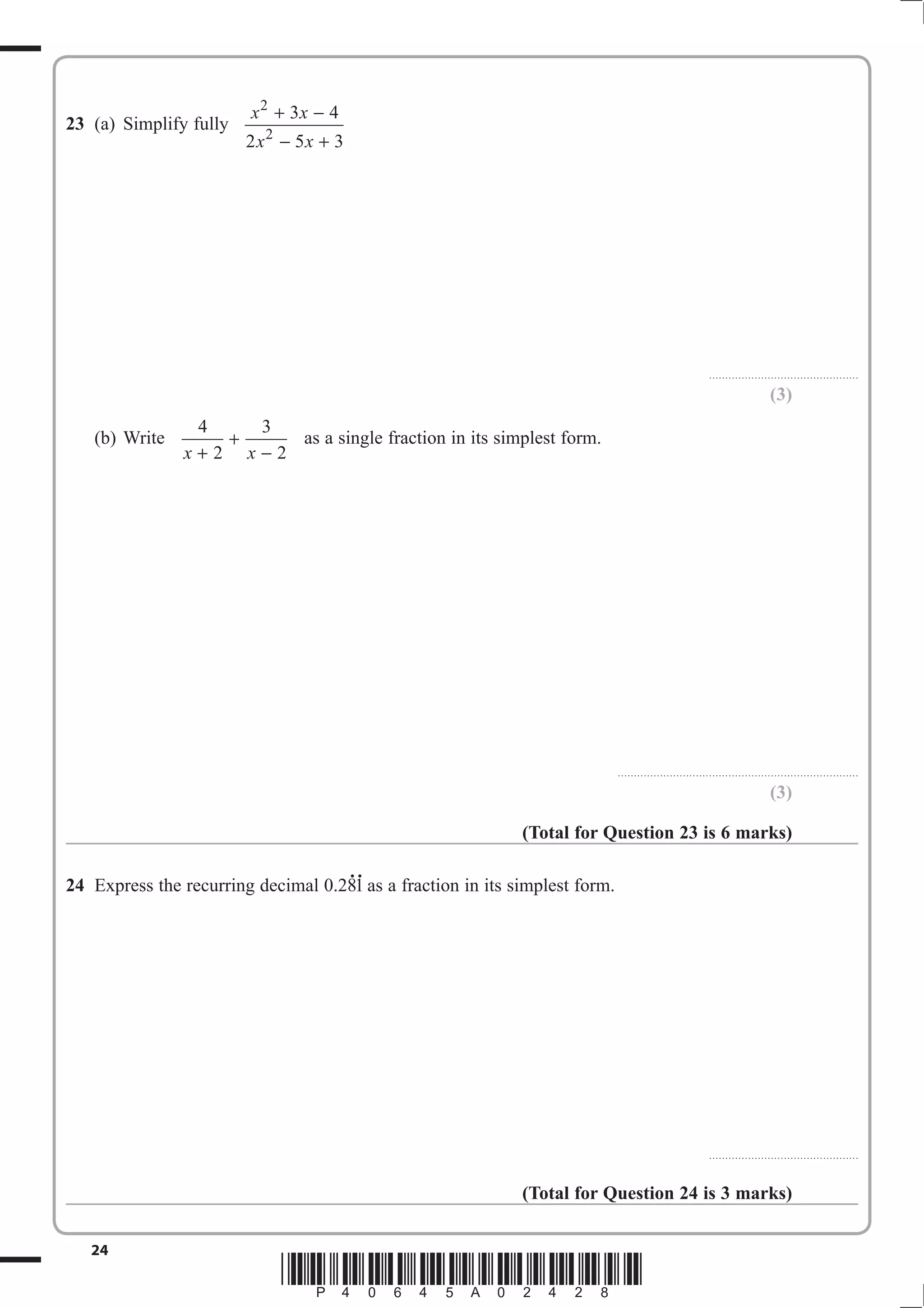
x 2 + 3x − 4
23 (a) Simplify fully
                        2 x2 − 5x + 3


                                                                                                         . . . . . . . . . . . . . . . . . . . . . . . . . . .. . . . . . . . . . . . . . . . . . .

                                                                                                                                             (3)
                4   3
   (b) Write      +    as a single fraction in its simplest form.
               x+2 x−2


                                                                             ..........................................................................

                                                                                                                                             (3)

                                                             (Total for Question 23 is 6 marks)

                                    ..
24 Express the recurring decimal 0.281 as a fraction in its simplest form.


                                                                                                         . . . . . . . . . . . . . . . . . . . . . . . . . . .. . . . . . . . . . . . . . . . . . .


                                                             (Total for Question 24 is 3 marks)


   24
                             *P40645A02428*
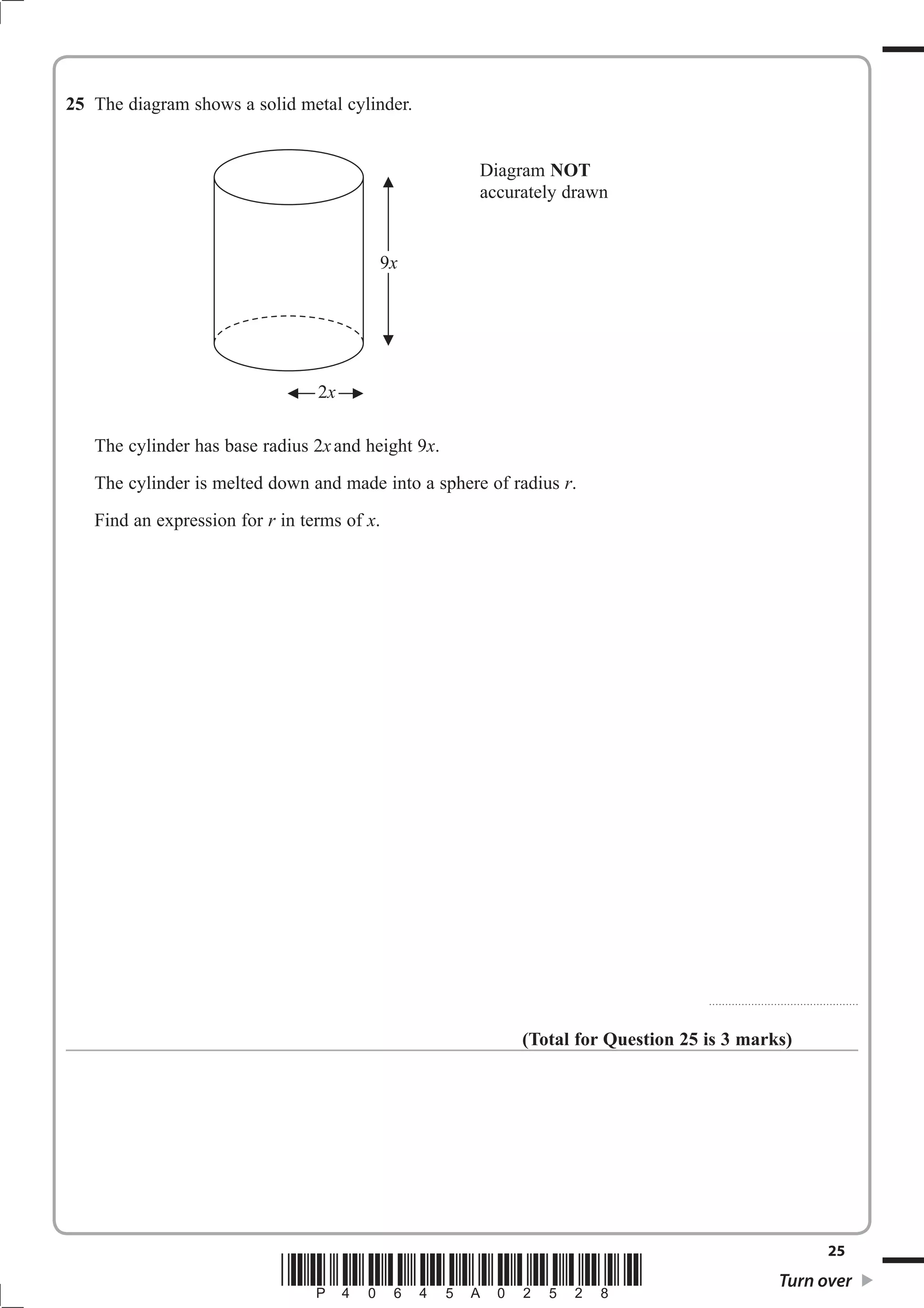
25 The diagram shows a solid metal cylinder.


                                                     Diagram NOT
                                                     accurately drawn


                                         9x


                                 2x

   The cylinder has base radius 2x and height 9x.
   The cylinder is melted down and made into a sphere of radius U.
   Find an expression for U in terms of x.


                                                                                 . . . . . . . . . . . . . . . . . . . . . . . . . . .. . . . . . . . . . . . . . . . . . .


                                                          (Total for Question 25 is 3 marks)


                                                                                                                                                        25
                            *P40645A02528*                                                                                 Turn over
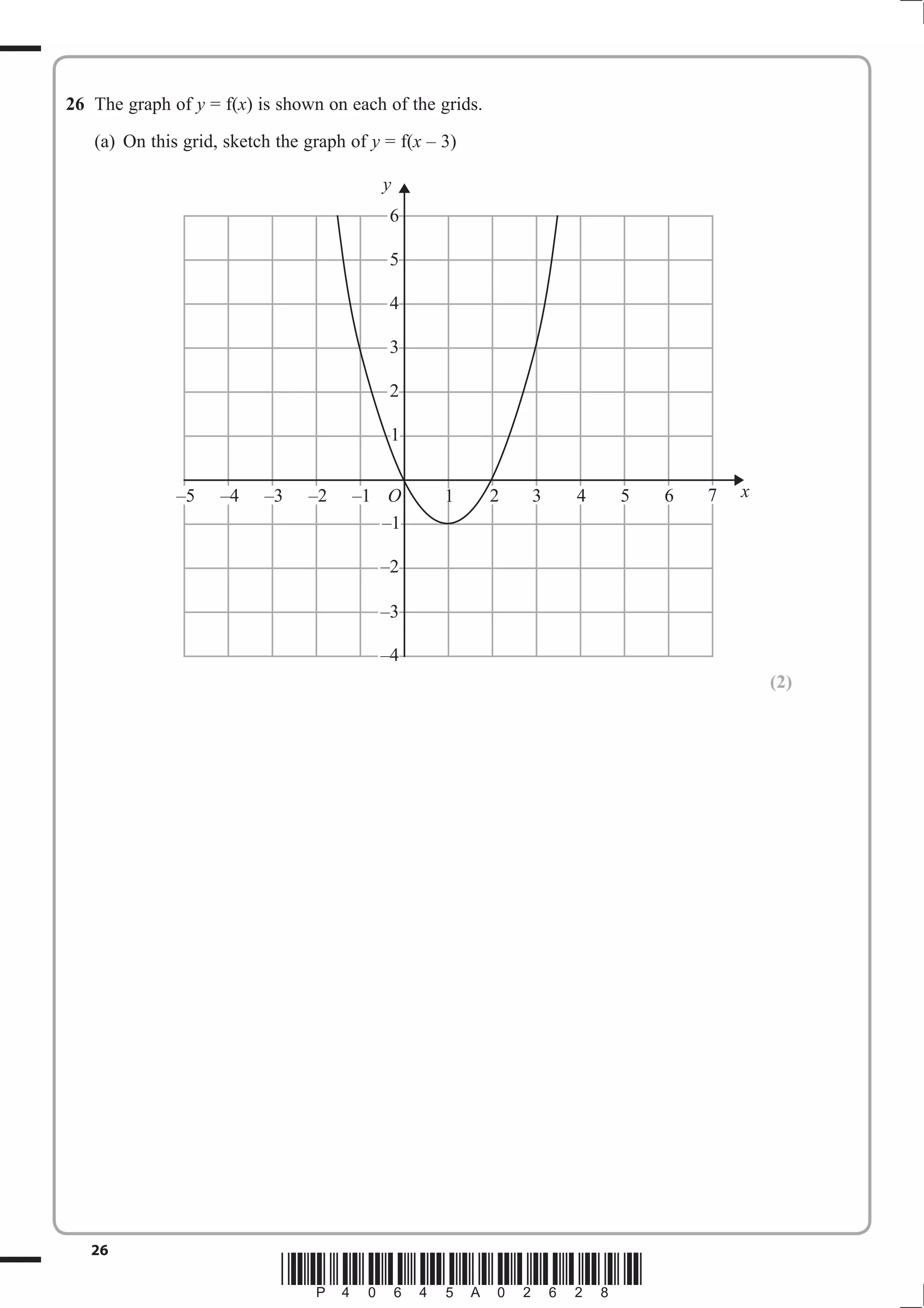
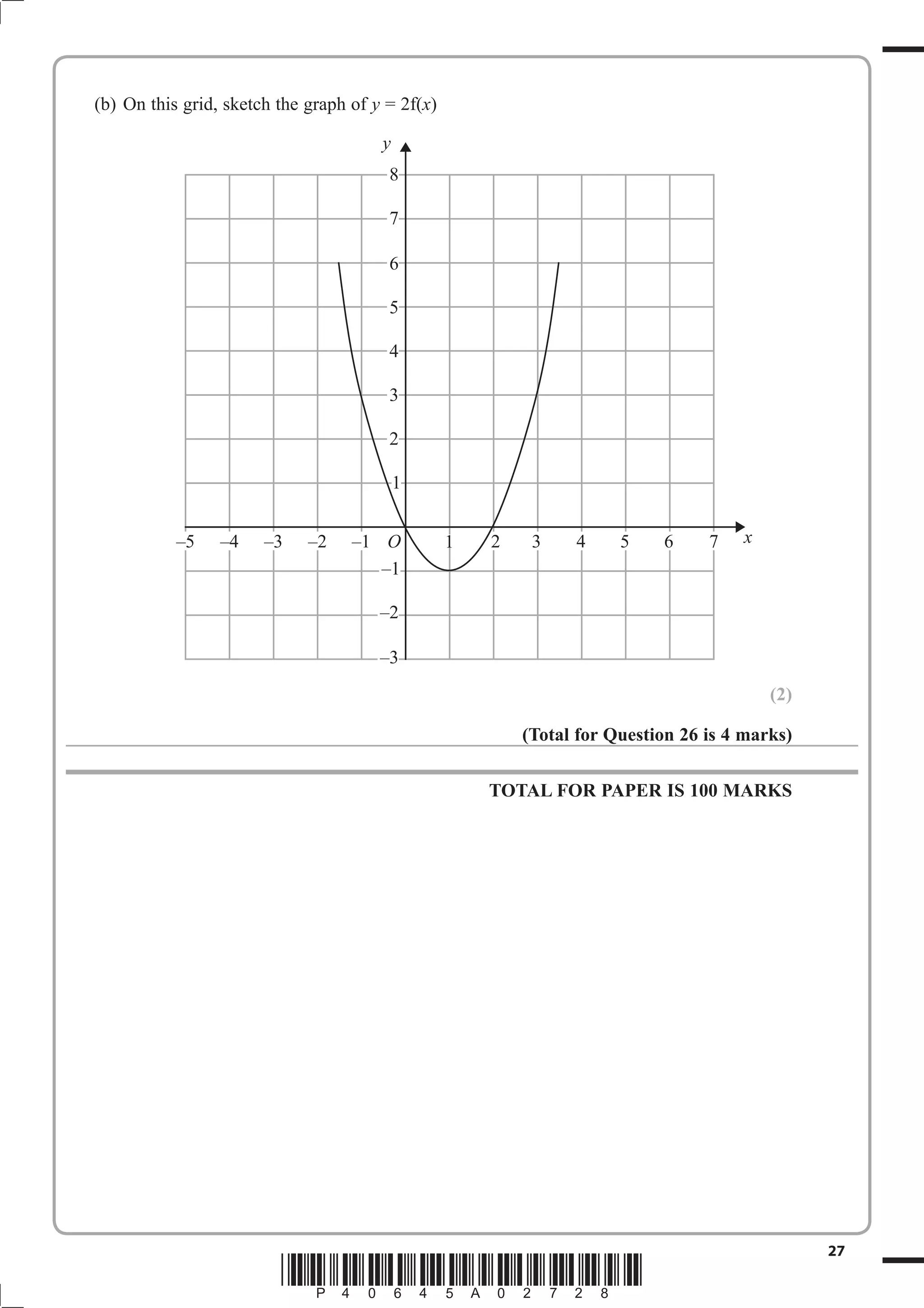
26 The graph of y = f(x) is shown on each of the grids.
   (a) On this grid, sketch the graph of y = f(x – 3)

                                          y
                                           6

                                           5

                                           4

                                           3

                                           2

                                           1


              –5    –4    –3    –2    –1 O         1      2   3   4   5   6   7   x
                                         –1

                                          –2

                                          –3

                                          –4
                                                                                      (2)


   26
                            *P40645A02628*
(b) On this grid, sketch the graph of y = 2f(x)

                                       y
                                        8

                                        7

                                        6

                                        5

                                        4

                                        3

                                        2

                                           1


           –5    –4    –3    –2    –1 O           1   2    3    4     5    6     7   x
                                      –1

                                       –2

                                       –3
                                                                                         (2)

                                                          (Total for Question 26 is 4 marks)

                                                      TOTAL FOR PAPER IS 100 MARKS


                                                                                               27
                         *P40645A02728*
BLANK PAGE


28
     *P40645A02828*

05a 1 ma0_1h_-_june_2012

  • 1.
    Write your namehere Surname Other names Centre Number Candidate Number Edexcel GCSE Mathematics A Paper 1 (Non-Calculator) Higher Tier Monday 11 June 2012 – Afternoon Paper Reference Time: 1 hour 45 minutes 1MA0/1H You must have: Ruler graduated in centimetres and millimetres, Total Marks protractor, pair of compasses, pen, HB pencil, eraser. Tracing paper may be used. Instructions Use black ink or ball-point pen. Fill in the boxes at the top of this page with your name, centre number and candidate number. Answer all questions. Answer the questions in the spaces provided – there may be more space than you need. Calculators must not be used. Information The total mark for this paper is 100 The marks for each question are shown in brackets – use this as a guide as to how much time to spend on each question. Questions labelled with an asterisk (*) are ones where the quality of your written communication will be assessed. Advice Read each question carefully before you start to answer it. Keep an eye on the time. Try to answer every question. Check your answers if you have time at the end. Turn over P40645A ©2012 Pearson Education Ltd. *P40645A0128* 6/6/7/3/
  • 2.
    GCSE Mathematics 1MA0 Formulae: Higher Tier You must not write on this formulae page. Anything you write on this formulae page will gain NO credit. 1 Volume of prism = area of cross section × length Area of trapezium = (a + b)h 2 a cross section h lengt h b 4 3 1 2 Volume of sphere = ʌU Volume of cone = ʌU h 3 3 Surface area of sphere = 4ʌU 2 Curved surface area of cone = ʌUO r l h r In any triangle ABC The Quadratic Equation The solutions of ax2 + bx + c = 0 C where D  0, are given by b a −b ± (b 2 − 4ac) x= 2a A c B a b c Sine Rule = = sin A sin B sin C Cosine Rule a2 = b2 + c 2 – 2bc cos A 1 Area of triangle = ab sin C 2 2 *P40645A0228*
  • 3.
    Answer ALL questions. Write your answers in the spaces provided. You must write down all stages in your working. You must NOT use a calculator. 1 Sam wants to find out the types of film people like best. He is going to ask whether they like comedy films or action films or science fiction films or musicals best. (a) Design a suitable table for a data collection sheet he could use to collect this information. (2) Sam collects his data by asking 10 students in his class at school. This might not be a good way to find out the types of film people like best. (b) Give one reason why. . . . . . . . . . . ............................................................................................. . . . . . . . . . . . . . . . . . . . . . . . .. . . . . . . . . . . . . . . . . . . . . . . . . . . . . . . . . . . . . . . . . . . . . . . . . . . . . . . . . . . . . . . . . . . . . . . . . . . . . . . . . . . . . . . . . . . . . . . . . . . . . . . . . . . . . . . . . . . . . . . . . . . . . ............................................................................................. . . . . . . . . . . . . . . . . . . . . . . . .. . . . . . . . . . . . . . . . . . . . . . . . . . . . . . . . . . . . . . . . . . . . . . . . . . . . . . . . . . . . . . . . . . . . . . . . . . . . . . . . . . . . . . . . . . . . . . . . . . . . . . . . . . . . . . . . . . . (1) (Total for Question 1 is 3 marks) 3 *P40645A0328* Turn over
  • 4.
    2 The diagram shows a patio in the shape of a rectangle. Diagram NOT 3m accurately drawn 3.6 m The patio is 3.6 m long and 3 m wide. Matthew is going to cover the patio with paving slabs. Each paving slab is a square of side 60 cm. Matthew buys 32 of the paving slabs. (a) Does Matthew buy enough paving slabs to cover the patio? You must show all your working. . . . . . . . . . . . . . . . . . . . . . . . . . . .. . . . . . . . . . . . . . . . . . . (3) The paving slabs cost £8.63 each. (b) Work out the total cost of the 32 paving slabs. £ . . . . . . . . . . . . . . . . . . . . . . . . . . .. . . . . . . . . . . . . . . . . . . (3) (Total for Question 2 is 6 marks) 4 *P40645A0428*
  • 5.
    *3 Bill uses his van to deliver parcels. For each parcel Bill delivers there is a fixed charge plus £1.00 for each mile. You can use the graph to find the total cost of having a parcel delivered by Bill. 80 70 60 50 Cost (£) 40 30 20 10 0 0 5 10 15 20 25 30 35 40 45 50 Distance (miles) (a) How much is the fixed charge? £ . . . . . . . . . . . . . . . . . . . . . . . . . . .. . . . . . . . . . . . . . . . . . . (1) Ed uses a van to deliver parcels. For each parcel Ed delivers it costs £1.50 for each mile. There is no fixed charge. (b) Compare the cost of having a parcel delivered by Bill with the cost of having a parcel delivered by Ed. (3) (Total for Question 3 is 4 marks) 5 *P40645A0528* Turn over
  • 6.
    4 Here are the speeds, in miles per hour, of 16 cars. 31 52 43 49 36 35 33 29 54 43 44 46 42 39 55 48 Draw an ordered stem and leaf diagram for these speeds. (Total for Question 4 is 3 marks) 6 *P40645A0628*
  • 7.
    5 Medicine You can work out the amount of medicine, c mO, to give to a child by using the formula ma c= 150 m is the age of the child, in months. a is an adult dose, in mO A child is 30 months old. An adult’s dose is 40 mO. Work out the amount of medicine you can give to the child. ................................. . . . . . . . . . . . . . mO (Total for Question 5 is 2 marks) 7 *P40645A0728* Turn over
  • 8.
    6 Here are the ingredients needed to make 12 shortcakes. Shortcakes Makes 12 shortcakes 50 g of sugar 200 g of butter 200 g of flour 10 mO of milk Liz makes some shortcakes. She uses 25 mO of milk. (a) How many shortcakes does Liz make? . . . . . . . . . . . . . . . . . . . . . . . . . . .. . . . . . . . . . . . . . . . . . . (2) Robert has 500 g of sugar 1000 g of butter 1000 g of flour 500 mO of milk (b) Work out the greatest number of shortcakes Robert can make. . . . . . . . . . . . . . . . . . . . . . . . . . . .. . . . . . . . . . . . . . . . . . . (2) (Total for Question 6 is 4 marks) 8 *P40645A0828*
  • 9.
    7 Buses to Acton leave a bus station every 24 minutes. Buses to Barton leave the same bus station every 20 minutes. A bus to Acton and a bus to Barton both leave the bus station at 9 00 am. When will a bus to Acton and a bus to Barton next leave the bus station at the same time? . . . . . . . . . . . . . . . . . . . . . . . . . . .. . . . . . . . . . . . . . . . . . . (Total for Question 7 is 3 marks) 8 (a) Expand 3(2y – 5) . . . . . . . . . . . . . . . . . . . . . . . . . . .. . . . . . . . . . . . . . . . . . . (1) (b) Factorise completely 8x2 + 4xy . . . . . . . . . . . . . . . . . . . . . . . . . . .. . . . . . . . . . . . . . . . . . . (2) (c) Make h the subject of the formula gh t = 10 h = . . . . . . . . . . . . . . . . . . . . . . . . . . .. . . . . . . . . . . . . . . . . . . (2) (Total for Question 8 is 5 marks) 9 *P40645A0928* Turn over
  • 10.
    9 y 7 6 5 4 B 3 A 2 1 –2 –1 O 1 2 3 4 5 6 7 x –1 –2 Describe fully the single transformation that maps triangle A onto triangle B. . . . . . . . . . . ............................................................................................. . . . . . . . . . . . . . . . . . . . . . . . .. . . . . . . . . . . . . . . . . . . . . . . . . . . . . . . . . . . . . . . . . . . . . . . . . . . . . . . . . . . . . . . . . . . . . . . . . . . . . . . . . . . . . . . . . . . . . . . . . . . . . . . . . . . . . . . . . . . . . . . . . . . . . ............................................................................................. . . . . . . . . . . . . . . . . . . . . . . . .. . . . . . . . . . . . . . . . . . . . . . . . . . . . . . . . . . . . . . . . . . . . . . . . . . . . . . . . . . . . . . . . . . . . . . . . . . . . . . . . . . . . . . . . . . . . . . . . . . . . . . . . . . . . . . . . . . . (Total for Question 9 is 3 marks) 10 *P40645A01028*
  • 11.
    *10 Railtickets andCheaptrains are two websites selling train tickets. Each of the websites adds a credit card charge and a booking fee to the ticket price. Railtickets Cheaptrains Credit card charge: 2.25% of ticket price Credit card charge: 1.5% of ticket price Booking fee: 80 pence Booking fee: £1.90 Nadia wants to buy a train ticket. The ticket price is £60 on each website. Nadia will pay by credit card. Will it be cheaper for Nadia to buy the train ticket from Railtickets or from Cheaptrains? (Total for Question 10 is 4 marks) 11 *P40645A01128* Turn over
  • 12.
    11 2x 3x – 15 Diagram NOT accurately drawn 2x 2x + 24 The diagram shows a parallelogram. The sizes of the angles, in degrees, are 2x 3x – 15 2x 2x + 24 Work out the value of x. x = . . . . . . . . . . . . . . . . . . . . . . . . . . .. . . . . . . . . . . . . . . . . . . (Total for Question 11 is 3 marks) 12 *P40645A01228*
  • 13.
    12 Jane hasa carton of orange juice. The carton is in the shape of a cuboid. Diagram NOT accurately drawn 20 cm 10 cm 6 cm The depth of the orange juice in the carton is 8 cm. Jane closes the carton. Then she turns the carton over so that it stands on the shaded face. Work out the depth, in cm, of the orange juice now. .............................................. cm (Total for Question 12 is 3 marks) 13 *P40645A01328* Turn over
  • 14.
    13 Diagram NOT accurately drawn x The diagram shows a regular hexagon and a regular octagon. Calculate the size of the angle marked x. You must show all your working. ° .............................................. (Total for Question 13 is 4 marks) 14 *P40645A01428*
  • 15.
    14 The diagramshows the position of a lighthouse L and a harbour H. N N L H The scale of the diagram is 1 cm represents 5 km. (a) Work out the real distance between L and H. .............................................. km (1) (b) Measure the bearing of H from L. ° .............................................. (1) A boat B is 20 km from H on a bearing of 040° (c) On the diagram, mark the position of boat B with a cross (×). Label it B. (2) (Total for Question 14 is 4 marks) 15 *P40645A01528* Turn over
  • 16.
    15 Harry growstomatoes. This year he put his tomato plants into two groups, group A and group B. Harry gave fertiliser to the tomato plants in group A. He did not give fertiliser to the tomato plants in group B. Harry weighed 60 tomatoes from group A. The cumulative frequency graph shows some information about these weights. 60 50 40 Cumulative frequency 30 20 10 0 140 150 160 170 180 190 Weight (g) (a) Use the graph to find an estimate for the median weight. .............................................. g (1) 16 *P40645A01628*
  • 17.
    The 60 tomatoesfrom group A had a minimum weight of 153 grams and a maximum weight of 186 grams. (b) Use this information and the cumulative frequency graph to draw a box plot for the 60 tomatoes from group A. Group A 140 150 160 170 180 190 Weight (g) (3) Harry did not give fertiliser to the tomato plants in group B. Harry weighed 60 tomatoes from group B. He drew this box plot for his results. Group B 140 150 160 170 180 190 Weight (g) (c) Compare the distribution of the weights of the tomatoes from group A with the distribution of the weights of the tomatoes from group B. . . . . . . . . . . ............................................................................................. . . . . . . . . . . . . . . . . . . . . . . . .. . . . . . . . . . . . . . . . . . . . . . . . . . . . . . . . . . . . . . . . . . . . . . . . . . . . . . . . . . . . . . . . . . . . . . . . . . . . . . . . . . . . . . . . . . . . . . . . . . . . . . . . . . . . . . . . . . . . . . . . . . . . . ............................................................................................. . . . . . . . . . . . . . . . . . . . . . . . .. . . . . . . . . . . . . . . . . . . . . . . . . . . . . . . . . . . . . . . . . . . . . . . . . . . . . . . . . . . . . . . . . . . . . . . . . . . . . . . . . . . . . . . . . . . . . . . . . . . . . . . . . . . . . . . . . . . . . . . . . . . . . ............................................................................................. . . . . . . . . . . . . . . . . . . . . . . . .. . . . . . . . . . . . . . . . . . . . . . . . . . . . . . . . . . . . . . . . . . . . . . . . . . . . . . . . . . . . . . . . . . . . . . . . . . . . . . . . . . . . . . . . . . . . . . . . . . . . . . . . . . . . . . . . . . . . . . . . . . . . . ............................................................................................. . . . . . . . . . . . . . . . . . . . . . . . .. . . . . . . . . . . . . . . . . . . . . . . . . . . . . . . . . . . . . . . . . . . . . . . . . . . . . . . . . . . . . . . . . . . . . . . . . . . . . . . . . . . . . . . . . . . . . . . . . . . . . . . . . . . . . . . . . . . (2) (Total for Question 15 is 6 marks) 17 *P40645A01728* Turn over
  • 18.
    16 (a) Simplify (m–2)5 . . . . . . . . . . . . . . . . . . . . . . . . . . .. . . . . . . . . . . . . . . . . . . (1) (b) Factorise x2 + 3x – 10 .......................................................................... (2) (Total for Question 16 is 3 marks) 17 (a) Write down the value of 100 . . . . . . . . . . . . . . . . . . . . . . . . . . .. . . . . . . . . . . . . . . . . . . (1) (b) Write 6.7 × 10⁻⁵ as an ordinary number. .......................................................................... (1) (c) Work out the value of (3 × 107) × (9 × 106) Give your answer in standard form. .......................................................................... (2) (Total for Question 17 is 4 marks) 18 *P40645A01828*
  • 19.
    18 y 7 6 C 5 4 3 2 A B 1 O 1 2 3 4 5 6 7 8 x Triangle ABC is drawn on a centimetre grid. A is the point (2, 2). B is the point (6, 2). C is the point (5, 5). 1 Triangle PQR is an enlargement of triangle ABC with scale factor and centre (0, 0). 2 Work out the area of triangle PQR. .............................................. cm2 (Total for Question 18 is 3 marks) 19 *P40645A01928* Turn over
  • 20.
    19 Wendy goesto a fun fair. She has one go at Hoopla. She has one go on the Coconut shy. The probability that she wins at Hoopla is 0.4 The probability that she wins on the Coconut shy is 0.3 (a) Complete the probability tree diagram. Hoopla Coconut shy Wendy 0.3 wins Wendy 0.4 wins .............. Wendy does not win Wendy .............. wins .............. Wendy does not win .............. Wendy does not win (2) (b) Work out the probability that Wendy wins at Hoopla and also wins on the Coconut shy. .............................................. (2) (Total for Question 19 is 4 marks) 20 *P40645A02028*
  • 21.
    20 Solve the simultaneous equations 5x + 2y = 11 4x – 3y = 18 x = . . . . . . . . . . . . . . . . . . . . . . . . . . .. . . . . . . . . . . . . . . . . . . y = . . . . . . . . . . . . . . . . . . . . . . . . . . .. . . . . . . . . . . . . . . . . . . (Total for Question 20 is 4 marks) 21 *P40645A02128* Turn over
  • 22.
    *21 D O C Diagram NOT accurately drawn 50° A B B, C and D are points on the circumference of a circle, centre O. AB and AD are tangents to the circle. Angle DAB = 50° Work out the size of angle BCD. Give a reason for each stage in your working. (Total for Question 21 is 4 marks) 22 *P40645A02228*
  • 23.
    22 The tablegives some information about the speeds, in km/h, of 100 cars. Speed (s km/h) Frequency 60 s - 65 15 65 s - 70 25 70 s - 80 36 80 s - 100 24 (a) On the grid, draw a histogram for the information in the table. 60 70 80 90 100 Speed (s km/h) (3) (b) Work out an estimate for the number of cars with a speed of more than 85 km/h. .............................................. (2) (Total for Question 22 is 5 marks) 23 *P40645A02328* Turn over
  • 24.
    x 2 +3x − 4 23 (a) Simplify fully 2 x2 − 5x + 3 . . . . . . . . . . . . . . . . . . . . . . . . . . .. . . . . . . . . . . . . . . . . . . (3) 4 3 (b) Write + as a single fraction in its simplest form. x+2 x−2 .......................................................................... (3) (Total for Question 23 is 6 marks) .. 24 Express the recurring decimal 0.281 as a fraction in its simplest form. . . . . . . . . . . . . . . . . . . . . . . . . . . .. . . . . . . . . . . . . . . . . . . (Total for Question 24 is 3 marks) 24 *P40645A02428*
  • 25.
    25 The diagramshows a solid metal cylinder. Diagram NOT accurately drawn 9x 2x The cylinder has base radius 2x and height 9x. The cylinder is melted down and made into a sphere of radius U. Find an expression for U in terms of x. . . . . . . . . . . . . . . . . . . . . . . . . . . .. . . . . . . . . . . . . . . . . . . (Total for Question 25 is 3 marks) 25 *P40645A02528* Turn over
  • 26.
    26 The graphof y = f(x) is shown on each of the grids. (a) On this grid, sketch the graph of y = f(x – 3) y 6 5 4 3 2 1 –5 –4 –3 –2 –1 O 1 2 3 4 5 6 7 x –1 –2 –3 –4 (2) 26 *P40645A02628*
  • 27.
    (b) On thisgrid, sketch the graph of y = 2f(x) y 8 7 6 5 4 3 2 1 –5 –4 –3 –2 –1 O 1 2 3 4 5 6 7 x –1 –2 –3 (2) (Total for Question 26 is 4 marks) TOTAL FOR PAPER IS 100 MARKS 27 *P40645A02728*
  • 28.
    BLANK PAGE 28 *P40645A02828*