SPM ZOOM–IN
Form 4: Chapter 1 Functions
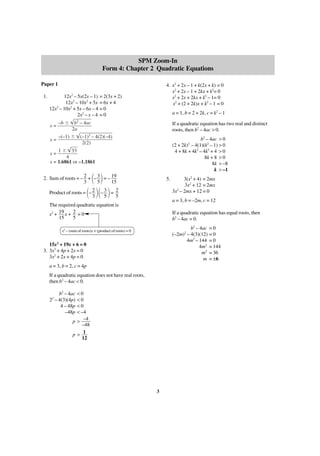
4. (a) gf : x → x2 + 6x + 2
gf (x) = x2 + 6x + 2
g(x + 4) = x2 + 6x + 2

Paper 1
1. The relation in the given graph can be represented
using the following arrow diagram.
A

Let x + 4 = u
x=u–4

B

1

10

2

20

3

30

4

40

g(u) = (u – 4)2 + 6(u – 4) + 2
= u2 – 8u + 16 + 6u – 24 + 2
= u2 – 2u – 6
∴ g(x) = x2 – 2x – 6

[

Based on the above arrow diagram,
(a) the object of 40 is 3,
(b) the type of the relation is many-to-many
relation.

(b) fg(4) = f 42 – 2(4) – 6
= f(2)
=2+4
=6

2.

5. Let g–1(x) = y
g(y) = x
3y + k = x
x–k
y=
3
1
k
y = x–
3
3
1
k
∴ g–1(x) = x –
3
3

–4
–3
–2
2
3
4

16
9
4

(a) The above relation is a many-to-one relation.
(b) The function which represents the above
relation is f(x) = x2.

It is given that g–1(x) = mx –

5
6

Hence, by comparison,
1
k
5
5
m = and – = – ⇒ k =
3
3
6
2

3. f 2 (x) = ff (x)
= f (px + q)
= p (px + q) + q
= p2 x + pq + q
It is given that f 2 (x) = 4x + 9
By comparison,
p2 = 4
pq + q
p =–2
–2q + q
–q
q

]

=9
=9
=9
= –9

The question
requires p < 0.

1
Paper 2

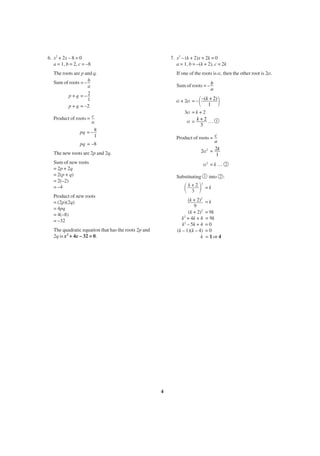
2. (a) Let f –1(x)
f(y)
y
–2
2
y
2
y
y
∴ f –1(x)
∴ f –1(3)

hx
x–3
hx
f(x) =
x–3

1. (a) f : x →

Let f –1(x)
f(y)
hy
y–3
hy
hy
3x
3x

=y
=x
=x

= 2(x + 2)
= 2x + 4
= 2x + 4
= 2(3) + 4 = 10

Hence, by comparison,
2k + 4 = –4
2k = –8
k = –4

kx
, x ≠ 2.
x–2
Hence, by comparison, h = 2 and k = 3.

[

(c) hf(x) : x → 9x – 3
h[f(x)] = 9x – 3
x
h – 2 = 9x – 3
2
x
Let
–2 =u
2
x
=u+2
2
x = 2u + 4

]

gf –1(x) = g f –1(x)
3x
=g
x–2

΂

΂

΃

1
3x
x–2
x–2
=
3x
gf –1(x) = –5x
x–2
= –5x
3x
x – 2 = –15x2
2
15x + x – 2 = 0
(3x – 1)(5x + 2) = 0
1
2
x = or –
3
5

(

=x+2

But it is given that
f –1g : x → 6x – 4
f –1g (x) = 6x – 4

But it is given that f –1(x) =

=

=x

(b) f –1g(x) = f –1[g(x)]
= f –1(3x + k)
= 2(3x + k) + 4
= 6x + 2k + 4

= x (y – 3)
= xy – 3x
= xy – hy
= y(x – h)
3x
y=
x–h
3x
∴ f –1 (x) =
x–h

(b)

=y
=x

)

΃

h(u) = 9(2u + 4) – 3
= 18u + 33
∴ h : x → 18x + 33

2
SPM Zoom-In
Form 4: Chapter 2 Quadratic Equations
Paper 1
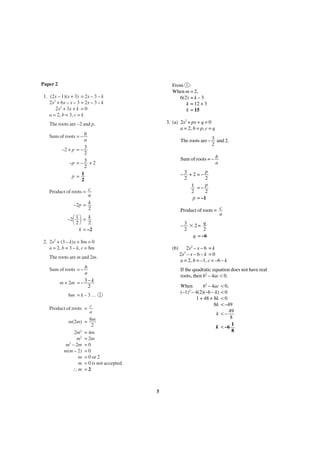
1.

4. x2 + 2x – 1 + k(2x + k) = 0
x2 + 2x – 1 + 2kx + k2= 0
x2 + 2x + 2kx + k2 – 1= 0
x2 + (2 + 2k)x + k2 – 1 = 0

12x2 – 5x(2x – 1) = 2(3x + 2)
12x2 – 10x2 + 5x = 6x + 4
2
12x – 10x2 + 5x – 6x – 4 = 0
2x2 – x – 4 = 0
x=

–b Ϯ

x=

–(–1) Ϯ

a = 1, b = 2 + 2k, c = k2 – 1

b2 – 4ac
2a

If a quadratic equation has two real and distinct
roots, then b2 – 4ac > 0.

(–1)2 – 4(2)(–4)
2(2)

b2 – 4ac > 0
(2 + 2k) – 4(1)(k2 – 1) > 0
4 + 8k + 4k2 – 4k2 + 4 > 0
8k + 8 > 0
8k > –8
k > –1
2

1 Ϯ 33
4
x = 1.6861 or –1.1861
x=

΂ ΃
Product of roots = ΂– 2 ΃΂– 3 ΃ = 2
3
5
5

2. Sum of roots = – 2 + – 3 = – 19
3
5
15

5.

a = 3, b = –2m, c = 12

The required quadratic equation is
x2 + 19 x + 2 = 0
15
5

If a quadratic equation has equal roots, then
b2 – 4ac = 0.
b2 – 4ac = 0
(–2m) – 4(3)(12) = 0
4m2 – 144 = 0
4m2 = 144
m2 = 36
m = ±6

x2 – (sum of roots)x + (product of roots) = 0

2

15x2 + 19x + 6 = 0
3. 3x2 + 4p + 2x = 0
3x2 + 2x + 4p = 0
a = 3, b = 2, c = 4p
If a quadratic equation does not have real roots,
then b2 – 4ac < 0.
<0
<0
<0
< –4
p > –4
–48
p> 1
12

b2 – 4ac
2 – 4(3)(4p)
4 – 48p
–48p
2

3(x2 + 4) = 2mx
3x2 + 12 = 2mx
2
3x – 2mx + 12 = 0

3
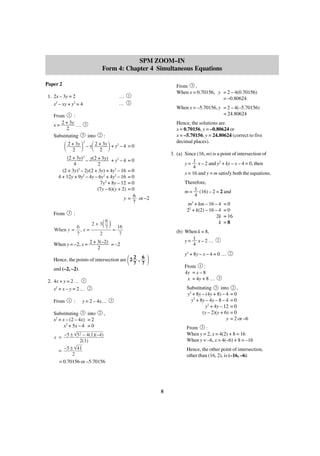
6. x2 + 2x – 8 = 0
a = 1, b = 2, c = –8

7. x2 – (k + 2)x + 2k = 0
a = 1, b = –(k + 2), c = 2k
If one of the roots is α, then the other root is 2α.

The roots are p and q.
Sum of roots = – b
a
p + q = –2
1
p + q = –2

Sum of roots = – b
a

΂

α + 2α = – –(k + 2)
1
3α = k + 2
α = k+2 …
3

Product of roots = c
a
pq = – 8
1

΃

1

Product of roots = c
a
2α2 = 2k
1

pq = –8
The new roots are 2p and 2q.
Sum of new roots
= 2p + 2q
= 2(p + q)
= 2(–2)
= –4

α2 = k …
1

Substituting

΂ k+2΃
3

2

Product of new roots
= (2p)(2q)
= 4pq
= 4(–8)
= –32

(k + 2)2
9
(k + 2)2
k2 + 4k + 4
k2 – 5k + 4
(k – 1)(k – 4)
k

The quadratic equation that has the roots 2p and
2q is x2 + 4x – 32 = 0.

4

into

2

=k
=k
= 9k
= 9k
=0
=0
= 1 or 4

2

:
Paper 2

From 1 :
When m = 2,
6(2) = k – 3
k = 12 + 3
k = 15

1. (2x – 1)(x + 3) = 2x – 3 – k
2x2 + 6x – x – 3 = 2x – 3 – k
2x2 + 3x + k = 0
a = 2, b = 3, c = k

3. (a) 2x2 + px + q = 0
a = 2, b = p, c = q

The roots are –2 and p.
Sum of roots = – b
a
–2 + p = – 3
2
–p = – 3 + 2
2
p = 1
2

The roots are – 3 and 2.
2
Sum of roots = – b
a
p
–3 +2 =–
2
2
1 =– p
2
2
p = –1

Product of roots = c
a
–2p = k
2

Product of roots = c
a

΂ ΃

–2 1 = k
2
2
k = –2

q
– 3 ϫ2=
2
2
q = –6

2. 2x2 + (3 – k)x + 8m = 0
a = 2, b = 3 – k, c = 8m

(b)

2x2 – x – 6 = k
2x – x – 6 – k = 0
a = 2, b = –1, c = –6 – k
2

The roots are m and 2m.
Sum of roots = – b
a
m + 2m = – 3 – k
2
6m = k – 3 …

If the quadratic equation does not have real
roots, then b2 – 4ac < 0.
< 0,
<0
<0
< –49
49
k <–
8
1
k < –6
8

When
b2 – 4ac
2
(–1) – 4(2)(–6 – k)
1 + 48 + 8k
8k

1

Product of roots = c
a
m(2m) = 8m
2
2m2 = 4m
m2 = 2m
2
m – 2m = 0
m(m – 2) = 0
m = 0 or 2
m = 0 is not accepted.
∴m =2

5
SPM ZOOM–IN
Form 4: Chapter 3 Quadratic Functions
Paper 1
1. f(x) = 2x2 + 8x + 6
= 2(x2 + 4x + 3)
4 2
4
= 2 x2 + 4x +
–
2
2
= 2(x2 + 4x + 22 – 22 + 3)
= 2[(x + 2)2 – 1]
= 2(x + 2)2 – 2
∴ a = 2, p = 2, q = –2

[

–1

΂ ΃ ΂ ΃ + 3]
2

p

5

Hence, the required range of values of p is
p < –1 or p > 5.
5. 3x2 + hx + 27 = 0
a = 3, b = h, c = 27
If a quadratic equation does not have real roots,
b2 – 4ac < 0
2
h – 4(3) (27) < 0
h2 – 324 < 0
(h + 18)(h – 18) < 0

2. From f(x) = – (x – 4)2 + h, we can state that the
coordinates of the maximum point are (4, h). But it
is given that the coordinates of the maximum point
are (k, 9). Hence, by comparison,
(a) k = 4
(b) h = 9
(c) The equation of the tangent to the curve at its
maximum point is y = 9.

h
–18

3. (a) y = (x + m)2 + n
The axis of symmetry is x = –m.
But it is given that the axis of symmetry is
x = 1.
∴ m = –1

Hence, the required range of values of h is
–18 < h < 18.
6. g(x) = (2 – 3k)x2 + (4 – k)x + 2
a = 2 – 3k, b = 4 – k, c = 2

When m = –1, y = (x – 1)2 + n
Since the y-intercept is 3, the point is (0, 3).
∴ 3 = (0 – 1)2 + n
n =2

If a quadratic curve intersects the x-axis at two
distinct points, then
b2 – 4ac > 0
2
(4 – k) – 4(2 – 3k)(2) > 0
16 – 8k + k2 – 16 + 24k > 0
k2 + 16k > 0
k(k + 16) > 0

(b) When m = –1 and n = 2,
y = (x – 1)2 + 2
Hence, the minimum point is (1, 2).
4.

18

(2 + p)(6 – p) < 7
12 + 4p – p2 – 7 < 0
–p2 + 4p + 5 < 0
p2 – 4p – 5 > 0
(p + 1)(p – 5) > 0

–16

0

k

Hence, the required range of values of k is
k < –16 or k > 0.

6
Paper 2

(b) g(x) = –2x2 + 8x – 12 = –2(x – 2)2 – 4

΂ 2 ϫ 5΃ = 4

(a) f(x) = 2x2 + 10x + k
k
= 2 x2 + 5x +
2
25
25 k
= 2 x2 + 5x +
–
+
4
4
2
5 2 25
k
=2 x+
–
+
2
4
2
2
5
25
=2 x+
–
+k
2
2

΂
΂
[΂
΂

΃

΃

1

2

25

The maximum point is (2, –4).
When x = 0, y = –12 ∴ (0, –12)
The graph of the function g(x) is as shown
below.

΃

y

]

O (2, –4)

΃

(b) (i) Minimum value = 32
25
–
+ k = 32
2
89
k =
2
(ii)

–12

3. y = h – 2x… 1
y2 + xy + 8 = 0 …

b2 – 4ac
2
10 – 4(2)(k)
100 – 8k
– 8k

<0
<0
<0
< –100
–100
k>
–8
25
k >
2

΂

(c) Minimum point is –2

2

Substituting 1 into 2 :
(h – 2x)2 + x(h – 2x) + 8 = 0
h2 – 4hx + 4x2 + hx – 2x2 + 8 = 0
2x2 – 3hx + h2 + 8 = 0
a = 2, b = –3h, c = h2 + 8
If a straight line does not meet a curve, then
b2 – 4ac < 0
2
(–3h) – 4(2) (h2 + 8) < 0
9h2 –8h2 – 64 < 0
h2 – 64 < 0
(h + 8)(h – 8) < 0

΃

1
, 32 .
2

2. (a) g(x) = –2x2 + px – 12 = –2(x + q)2 – 4
–2x2 + px – 12 = –2(x2 + 2qx + q2) – 4
= –2x2 – 4qx – 2q2 – 4
By comparison,
p = – 4q … 1 and –12
–2q2
q2
q

x

–8

= –2q2 – 4
= –8
=4
= ±2

8

h

Hence, the required range of values of h is
–8 < h < 8.

From 1 :
When q = 2, p = –4(2) = –8 (Not accepted)
When q = –2, p = –4(–2) = 8 (Accepted)
because p > 0 and q < 0)

7
SPM ZOOM–IN
Form 4: Chapter 4 Simultaneous Equations
Paper 2
1. 2x – 3y = 2
x2 – xy + y2 = 4

…
…

From 3 ,
When x = 0.70156, y = 2 – 4(0.70156)
= –0.80624

1
2

When x = –5.70156, y = 2 – 4(–5.70156)
= 24.80624

1

From
:
2 + 3y
x=
… 3
2
Substituting 3 into

2

Hence, the solutions are
x = 0.70156, y = –0.80624 or
x = –5.70156, y = 24.80624 (correct to five
decimal places).

:

΂ 2 +23y ΃ – y΂ 2 +23y ΃ + y – 4 = 0
2

2

(2 + 3y)2 – y(2 + 3y) + y2 – 4
4
2
(2 + 3y)2 – 2y(2 + 3y) + 4y2 – 16
4 + 12y + 9y2 – 4y – 6y2 + 4y2 – 16
7y2 + 8y – 12
(7y – 6)(y + 2)

3. (a) Since (16, m) is a point of intersection of
1
y = x – 2 and y2 + ky – x – 4 = 0, then
4
x = 16 and y = m satisfy both the equations.

=0

=0
=0
=0
=0
6
y=
or –2
7

From

3

When y = –2, x =

2+3
2

6
( 7 ) = 16

(b) When k = 8,
1
y= x–2…
4

7

2 + 3(–2)
= –2
2

΂

2 6
Hence, the points of intersection are 2 ,
7 7
and (–2, –2).
2. 4x + y = 2 … 1
x2 + x – y = 2 …
1

:

y = 2 – 4x…
2

=0
=0
= 16
=8

1

y2 + 8y – x – 4 = 0 …

΃

From 1 :
4y = x – 8
x = 4y + 8 …

3

,

2

3

Substituting 3 into
y2 + 8y – (4y + 8) – 4
y2 + 8y – 4y – 8 – 4
y2 + 4y – 12
(y – 2)(y + 6)
y

2

Substituting 3 into
x2 + x – (2 – 4x) = 2
x2 + 5x – 4 = 0
x = –5 ±

m2 + km – 16 – 4
22 + k(2) – 16 – 4
2k
k

:

6
When y = , x =
7

From

Therefore,
1
m = (16) – 2 = 2 and
4

2 ,
=0
=0
=0
=0
= 2 or –6

From 3 :
When y = 2, x = 4(2) + 8 = 16
When y = –6, x = 4(–6) + 8 = –16

52

– 4(1)(–4)
2(1)
= –5 ± 41
2
= 0.70156 or –5.70156

Hence, the other point of intersection,
other than (16, 2), is (–16, –6).

8
SPM ZOOM–IN
Form 4: Chapter 5 Indices and Logarithms
Paper 1

4.

5x
lg 5x
x lg 5
x lg 5
x lg 5 – 2x lg 3
x(lg 5 – 2lg 3)

5.

log10 (p + 3)
log10 (p + 3) – log10 p
log10 p + 3
p
p+3
p
p+3
9p

1. 2 x + 3 + 2x + 16 (2x – 1)
2x
= 2x.23 + 2x + 16
2
= 8(2x) + 2x + 8(2x)
= (8 + 1 + 8)( 2x)
= 17(2x)

΂ ΃

2.

3x + 3 – 3x + 2
3 (33) – 3x (32)
27(3x) – 9(3x)
(27 – 9)(3x)
18(3x)
x

3x
3x
3x
x
3.

m = 3a
log3 m = a

΂

=6
=6
=6
=6
=6
= 6
18
= 1
3
= 3–1
= –1

= 32x – 1
= lg 32x –1
= (2x – 1) lg 3
= 2x lg 3 – lg 3
= – lg 3
= –lg 3
–lg 3
x =
lg 5 – 2 lg 3
x = 1.87

΂

= 1 + log10 p
=1

΃ =1
= 101

= 10p
=3
1
p =
3

n = 3b
log3 n = b

6.

΃

mn4
log3
27
= log3 m + log3 n4 – log3 27
= log3 m + 4 log3 n – log3 33
= a + 4b – 3

log2 y – log8 x
log2 x
log2 y –
log2 8
log2 x
log2 y –
3
3 log2 y – log2 x
log2 y3 – log2 x
y3
log2
x
y3
x
y3

=1
=1
=1
=3
=3

΂ ΃ =3
= 23

= 8x
y3
x =
8

9

log2 8 = log2 23 = 3
SPM ZOOM–IN
Form 4: Chapter 6 Coordinate Geometry
Hence, the area of ∆PQR
1 4 0 2 4
=
2 0 –3 5 0
1 |–12 – (–6 + 20)|
=
2
= 1 |–26|
2
= 1 ϫ 26
2
= 13 units2

Paper 1
1. Let point A be (0, k).
AB = 10
2 + (k – 7)2 = 10
(0 – 8)
64 + k2 – 14k + 49 = 102
k2 – 14k + 13 = 0
(k – 1)(k – 13) = 0
k = 1 or 13
Based on the diagram, k < 7.
∴k=1
∴ A(0, 1)

4. (a) 2y = 3x – 12
At point L (on the x-axis), y = 0
2(0) = 3x – 12
x =4
∴ L (4, 0)

2. (a) x + 2y + 6 = 0
x + 2y = –6
x
2y
–6
+
=
(–6) (–6) –6
x
y
+
=1
(–6) (–3)

΂ ΃

(b) mMN = – –3 = – 1
–6
2

At point N (on the y-axis), x = 0.
2y = 3(0) – 12
y = –6
∴ N (0, –6)

Intercept form:
x y
+ =1
a b

΂

΃

∴ M = 4 + 0 , 0 + (–6) = (2, –3)
2
2

m = – y-intercept
x-intercept

(b) mLN = –6 – 0 = 3
0–4
2

Therefore, the gradient of the perpendicular
line is 2.

∴ Gradient of perpendicular line = – 2
3

Hence, the equation of the straight line which
passes through the point N and is
perpendicular to the straight line MN is
y = 2x – 3.

Hence, the equation of the perpendicular
line is
y – y1 = m(x – x1)
y – (–3) = – 2 (x – 2)
3
3(y + 3) = –2(x – 2)
3y + 9 = –2x + 4
3y = –2x – 5

y
3. x – = 1
4 3
At point P (on the x-axis), y = 0.
x – 0 =1⇒x=4
4 3
∴ P is point (4, 0).

5.

PA
(x –
+ (y – 2)2
2
(x – 1) + (y – 2)2
2
x – 2x + 1 + y2 – 4y + 4
–2x – 4y + 5
–2x + 2y – 4
–x + y – 2
y

At point Q (on the y-axis), x = 0.
0 – y = 1 ⇒ y = –3
4 3
∴ Q is point (0, –3).

1)2

10

= PB
= (x – 0)2 + (y – 3)2
= x2 + y2 – 6y + 9
= –6y + 9
=0
=0
=x+2
Paper 2

(c) A(–18, 0), B(2, 0), C(0, –6), D(–20, –6)
Area of ABCD
1 –18 2 0 –20 –18
=
2
0 0 –6 –6 0
1 |–12 – (120 + 108)|
=
2
= 1 ϫ 240
2
= 120 units2

1. (a) y – 3x + 6 = 0
At point B (x-axis), y = 0.
0 – 3x + 6 = 0 ⇒ x = 2
∴ B is point (2, 0).
y – 3x + 6 = 0
At point C (y-axis), x = 0.
y – 3(0) + 6 = 0 ⇒ y = –6
∴ C is point (0, –6).

2. (a) (i) y – 3x + 6 = 0
At point P (on the y-axis), x = 0.
y – 3(0) + 6 = 0 ⇒ y = –6
∴ P is point (0, –6).
(ii) The coordinates of point S are
4(0) + 3(7) , 4(–6) + 3(15) = (3, 3)
3+4
3+4

y = 3x – 6
mBC = 3
∴mAC = – 1
3

΂

Let A(k, 0).
∴ mAC = – 1
3
0 – (–6) = – 1
k–0
3
–k = 18
k = –18
∴ A is point (–18, 0).
(b) Let D (p, q).
Midpoint of BD = Midpoint of AC
2 + p , 0 + q = –18 + 0 , 0 + (–6)
2
2
2
2

΂

΃ ΂
΂ 2 + p , q ΃ = (–9, –3)
2
2

΃

(b) Area of ∆QRS = 48 units2
1 k
7 3 k = 48
2 0 15 3 0
15k + 21 – (45 + 3k) = 96
12k – 24 = 96
12k = 120
k = 10
(c) S(3, 3), Q(10, 0), T(x, y)
TS : TQ = 2 : 3
TS = 2
TQ 3
3TS = 2TQ
9(TS)2 = 4(TQ)2
9[(x – 3)2 + (y – 3)2] = 4[(x – 10)2 + (y – 0)2]
9(x2 – 6x + 9 + y2 – 6y + 9) =
4(x2 – 20x + 100 + y2)
2
2
9x – 54x + 81 + 9y – 54y + 81 =
4x2 – 80x + 400 + 4y2
2
2
5x + 26x + 5y – 54y – 238 = 0

΃

Equating the x-coordinates,
2 + p = –9
2
p = –20
Equating the y-coordinates,
q = –3
2
q = –6
∴ D is point (–20, –6).

11
SPM ZOOM–IN
Form 4: Chapter 7 Statistics
Paper 1

␴2 =
1. After the given score are arranged in
ascending order, we have
6

6

6

k

k

=

9

Since the mode is 6, then k ≠ 9.

6

6

8

8

4.

2

Number

1

k

6

2

2

1

(a) 1 < k < 6
k = 2, 3, 4, 5

After two new scores, 7 and 10, are added to the
original scores, the mean of the eight scores
= 6 + 6 + 6 + 8 + 8 + 9 + 7 + 10
8
= 7.5

(b)

΂ ΃

10 132
318
–
10
10

Frequency

9

Median = 7

2. (a)

2

= 1.96

For 7 to be the median, k = 8, as shown below.
6

΂ ΃

∑fx 2
∑fx
–
∑f
∑f

k + 3 11
3

1

13
1

6 < k + 3 < 11
3<k<8
k = 4, 5, 6, 7

Taking into consideration both cases,
k = 4 or 5
(b) 1, 1, 4, 4, 6,

– ∑x
x =
n
189
27 =
n
189
n=
27
n =7

7, 7, 7, 11, 13
M

Q3

∴ Q3 = 7
Paper 2
1.
Mass (kg)

␴=

1.1 – 2.0
2.1 – 3.0
3.1 – 4.0
4.1 – 5.0
5.1 – 6.0

∑x 2
_
— – ( x )2
—
n

=

Frequency

5278
— — – 27 2
—
7

= 25
= 5

(a)

5
9
12
8
6

Cumulative
frequency
5
14
26
34
40

Frequency
12

3.

x
30
32
34
Sum

f
3
5
2
10

fx
90
160
68
318

fx2
2700
5120
2312
10 132

10
8
6
4
2
0

1.05

2.05

Mode = 3.5 kg
12

3.05 4.05 5.05
3.5 (Mode)

6.05
Mass (kg)
(b) The Q1 class is given by

(a)

Median = 46.5

΄ ΅

n –F
2
c = 46.5
L+
fm

T 40 = T 10 = 2.1 – 3.0
4

Q1 = 2.05 +

΄

40 – 5
4
(1) = 2.61 kg
9

΅

΄

The Q3 class is given by

΄

T 3 (40) = T 30 = 4.1 – 5.0
4

Q3 = 4.05 +

΄

΅

26 + k– –11
2
(10) = 46.5
39.5 +
k

΅

3
(40) – 26
4
(1) = 4.55 kg
8

΅

26 + k– –11
2
(10) = 7
k
26 + k – 11 = 0.7k
2
26 + k – 22 = 1.4k

Hence, the interquartile range
= Q3 – Q1 = 4.55 – 2.61 = 1.94 kg

0.4k = 4
k = 10

(c) New interquartile range
= Original interquartile range
= 1.94 kg

(b)
Marks

2.
Marks

f

20 – 29
30 – 39
40 – 49
50 – 59
60 – 69
70 – 79

4
7
k
8
5
2

20 – 29
30 – 39
40 – 49
50 – 59
60 – 69
70 – 79

Cumulative
frequency
4
11
11 + k
19 + k
24 + k
26 + k

f
4
7
10
8
5
2
36

Midpoint (x)
24.5
34.5
44.5
54.5
64.5
74.5

Variance =

=

fx

fx2

98.0
241.5
445.0
436.0
322.5
149.0
1692

2401.00
8331.75
19802.50
23762.00
20801.25
11100.50
86199

΂ ΃

∑fx 2
∑fx
–
∑f
∑f

΂

2

86 199
1692
–
36
36

΃

2

= 185.42
(c) (i) New median = Original median + 10
= 46.5 + 10
= 56.5
(ii) New variance = Original variance
= 185.42

13
SPM ZOOM–IN
Form 4: Chapter 8 Circular Measure
Paper 1
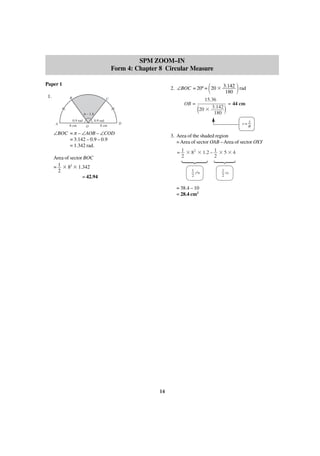
1.

2. ∠BOC = 20º = 20 ϫ 3.142 rad
180

΂

B

C

OB =
π – 1.8
A

0.9 rad
8 cm
O

0.9 rad
8 cm

΃

15.36
= 44 cm
20 ϫ 3.142
180

(

)

D

r=

∠BOC = π – ∠AOB – ∠COD
= 3.142 – 0.9 – 0.9
= 1.342 rad.

s
θ

3. Area of the shaded region
= Area of sector OAB – Area of sector OXY
= 1 ϫ 82 ϫ 1.2 – 1 ϫ 5 ϫ 4
2
2
1 2
rθ
2

= 38.4 – 10
= 28.4 cm2

14

·

·

Area of sector BOC
= 1 ϫ 82 ϫ 1.342
2
= 42.94

1
rs
2
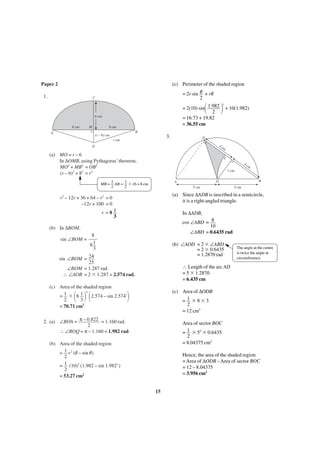
Paper 2

(c) Perimeter of the shaded region

1.

= 2r sin θ + rθ
2

C

΂

= 2(10) sin 1.982
2
= 16.73 + 19.82
= 36.55 cm

6 cm
8 cm

8 cm

M

΃ + 10(1.982)
r

B

A

(r – 6) cm

3.

r cm

D

4c

O

m

(a) MO = r – 6
In ∆OMB, using Pythagoras’ theorem,
MO2 + MB2 = OB2
(r – 6)2 + 82 = r2
MB =

C

4c

m

3 cm

1
1
AB = ϫ 16 = 8 cm
2
2

5 cm

r =8 1
3

In ∆ADB,
cos ∠ABD = 8
10
∠ABD = 0.6435 rad

(b) In ∆BOM,
8
81
3

(b) ∠AOD = 2 ϫ ∠ABD
= 2 ϫ 0.6435
= 1.2870 rad

sin ∠BOM = 24
25
∠BOM = 1.287 rad.
∴ ∠AOB = 2 ϫ 1.287 = 2.574 rad.

The angle at the centre
is twice the angle at
circumference.

∴ Length of the arc AD
= 5 ϫ 1.2870
= 6.435 cm

(c) Area of the shaded region
2
=1 ϫ 81
2.574 – sin 2.574r
2
3
= 70.71 cm2

΂ ΃΂

5 cm

(a) Since ∆ADB is inscribed in a semicircle,
it is a right-angled triangle.

r2 – 12r + 36 + 64 – r2 = 0
–12r + 100 = 0

sin ∠BOM =

B

O

A

(c) Area of ∆ODB
= 1 ϫ8ϫ3
2
= 12 cm2

΃

2. (a) ∠BOA = π – 0.822 = 1.160 rad.
2
∴ ∠BOQ = π – 1.160 = 1.982 rad.

Area of sector BOC
= 1 ϫ 52 ϫ 0.6435
2
= 8.04375 cm2

(b) Area of the shaded region
= 1 r 2 (θ – sin θ)
2
= 1 (10)2 (1.982 – sin 1.982 r )
2
= 53.27 cm2

Hence, the area of the shaded region
= Area of ∆ODB – Area of sector BOC
= 12 – 8.04375
= 3.956 cm2

15
SPM ZOOM–IN
Form 4: Chapter 9 Differentiation
Paper 1

4. z = xy
z = x(30 – x)
z = 30x – x2
dz = 30 – 2x
dx

1
= (5x – k)–2
(5x – k)2
f ′(x) = –2(5x – k)–3 (5)
= –10 3
(5x – k)

1. f (x) =

f ′(1)
–10
[5(1) – k]3
(5 – k)3
5–k
k
2.

= 10
= 10
= –1
=–1
=6

d 2z = –2 (negative)
dx2
Hence, the maximum value of z
= 30(15) – 152
= 225

y = (x + 1) (2x – 1)2
dy = (x + 1) 2 (2x – 1)1 (2) + (2x – 1)2 (1)
dx
= (2x – 1)[4(x + 1) + (2x – 1)]
= (2x – 1)(6x + 3)

[

3.

When z has a stationary value,
dz = 0
dx
30 – 2x = 0
x = 15

]

5.

y=

1
= (2x – 5)–3
(2x – 5)3

dy = –3 (2x – 5)–4 (2) = – 6
dx
(2x – 5)4

3

y = 2x – 4x + 5
dy = 6x2 – 4
dx

δy ≈ dy
δx dx
δy ≈ dy ϫ δy
dx
= – 6 4 ϫ (3.01 – 3)
(2x – 5)
–6
=
ϫ 0.01
[2(3) – 5]4
= – 0.06

Gradient at the point (–1, 7)
= 6 (–1)2 – 4
=2
Equation of the tangent is
y – 7 = 2[x – (–1)]
y – 7 = 2(x + 1)
y – 7 = 2x + 2
y = 2x + 9

6. A = 2πr 2 + 2πrh
= 2πr 2 + 2πr(3r)
= 8πr 2
dA = dA ϫ dr
dt
dt
dr
= 16πr ϫ 0.1
= 16π (5) ϫ 0.1
= 8π cm2 s–1

16
Paper 2
1.

(b) When p = –3 and k = 4,
y = –3x3 + 4x
dy = –9x 2 + 4
dx
d 2 y = –18x
dx2

y = 12 – 13 = x–2 – x–3
x
x
dy = –2x – 3 + 3x – 4 = – 2 + 3
dx
x3 x4
2
d y = 6x– 4 – 12x– 5 = 6 – 12
x4 x5
dx2

At turning points,
dy = 0
dx
–9x2 + 4 = 0
x2 = 4
9
x =± 2
3

΂
΃
x ΂ – 2 + 3 + 6 – 12 ΃ +
x
x
x
x
x4 dy + d y + x 2y + 5 = 0
dx dx 2
2

4

3

4

4

5

x2

΂ x1 – x1 ΃ + 5 = 0
2

3

–2x + 3 + 6 – 12 + 1 – 1 + 5 = 0
x
x
–2x + 15 – 13 = 0
x
2
–2x + 15x – 13 = 0
2x2 – 15x + 13 = 0
(2x – 13)(x – 1) = 0
x = 13 or 1
2

When x = 2 ,
3

΂ ΃ + 4΂ 2 ΃ = 1 7
3
9
d y = – 18 2 = –12 (< 0)
΂ 3΃
dx
∴ ΂ 2 , 1 7 ΃ is a turning point which is
3 9
y = –3 2
3
2

2

2. (a) y = px3 + kx
dy = 3px2 + k
dx

a maximum.
When x = – 2 ,
3

At (1, 1), x = 1 and m = dy = –5.
dx
∴ 3px2 + k = –5
3p(1)2 + k = –5
3p + k = –5 … 1

΂ ΃ + 4΂– 2 ΃ = –1 7
9
3
d y = –18 – 2 = 12 (> 0)
΂ 3΃
dx
∴ ΂ – 2 , –1 7 ΃ is a turning point which is
3
9
y = –3 – 2
3

–

2

2

2

a minimum.

: 2p = –6 ⇒ p = –3

From

3

2

The curve passes through point (1, 1).
∴ 1 = p(1)3 + k(1)
p+k=1… 2

: –3 + k = 1 ⇒ k = 4

1

3

17
3.

(b)

V
4x m
5x m
H

E

F

G
D

3x m y m

At stationary point,
dL = 0
dx
3888 = 0
192x –
x2
192 x = 3888
x2
x 3 = 3888
192

C
6x m

A

6x m

L = 96x2 + 3888 = 96x2 + 3888x–1
x
dL = 192x – 3888x–2 = 192x – 3888
dx
x2

B

(a) Volume of the cuboid = 5832 cm3
(6x)(6x)(y) = 5832
36x2y = 5832
x2y = 162
y = 162
x2

x 3 = 20.25
x = 2.73

L = Area of ABCD + 4 (Area of GBCH)
+ 4 (Area of VGH)
L = (6x)2 + 4(6xy) + 4 ϫ 1 (6x)(5x)
2
L = 36x2 + 24xy + 60x2
L = 96x2 + 24xy
L = 96x2 + 24x 162
x2
L = 96x2 + 3888 (shown)
x

d 2L = 192 + 7776x–3 = 192 + 7776 (> 0)
x3
dx 2
∴ L is a minimum.

4.

΂ ΃

y=

h
= h(1 + 2x)–2
(1 + 2x)2

dy = –2h(1 + 2x)–3 (2) = – 4h
dx
(1 + 2x)3
δy = dy ϫ δx
dx
8c = – 4h
–
ϫc
3
(1 + 2x)3
4h
– 8c = –
ϫc
3
[1 + 2(1)]3
– 8c = – 4hc
3
27
h = 8 ϫ 27
3
4
h = 18

18
SPM ZOOM–IN
Form 4: Chapter 10 Solution of Triangles
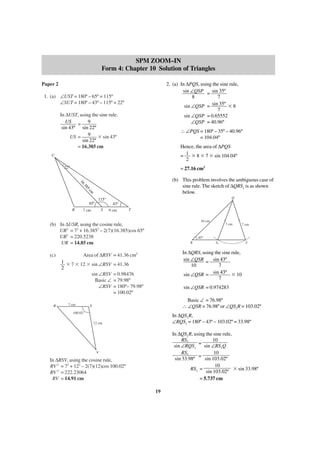
2. (a) In ∆PQS, using the sine rule,
sin ∠QSP = sin 35º
8
7
sin ∠QSP = sin 35º ϫ 8
7
sin ∠QSP = 0.65552
∠QSP = 40.96º

Paper 2
1. (a) ∠UST = 180º – 65º = 115º
∠SUT = 180º – 43º – 115º = 22º
In ∆UST, using the sine rule,
US = 9
sin 43º sin 22º
US = 9 ϫ sin 43º
sin 22º
= 16.385 cm

∴ ∠PQS = 180º – 35º – 40.96º
= 104.04º
Hence, the area of ∆PQS
= 1 ϫ 8 ϫ 7 ϫ sin 104.04º
2

U
22°

= 27.16 cm2
16

(b) This problem involves the ambiguous case of
sine rule. The sketch of ∆QRS1 is as shown
below.

.3
85
cm

Q

115°
65°
R

43°
S

7 cm

9 cm

T
10 cm

(b) In ∆USR, using the cosine rule,
UR2 = 72 + 16.3852 – 2(7)(16.385)cos 65º
UR2 = 220.5238
UR = 14.85 cm

1 ϫ 7 ϫ 12 ϫ sin ∠RSV
2
sin ∠RSV
Basic ∠
∠RSV

R

7 cm

7 cm

43°
R

S1

S

In ∆QRS, using the sine rule,
sin ∠QSR = sin 43º
10
7
sin 43º ϫ 10
sin ∠QSR =
7

Area of ∆RSV = 41.36 cm2

(c)

7 cm

= 41.36
= 0.98476
= 79.98º
= 180º– 79.98º
= 100.02º

sin ∠QSR = 0.974283
Basic ∠ = 76.98º
∴ ∠QSR = 76.98º or ∠QS1R = 103.02º

S

100.02°

In ∆QS1R,
∠RQS1 = 180º – 43º – 103.02º = 33.98º

12 cm

In ∆QS1R, using the sine rule,
RS1
10
=
sin ∠RQS1
sin ∠RS1Q
RS1
10
=
sin 33.98º
sin 103.02º
10
RS1 =
ϫ sin 33.98º
sin 103.02º
= 5.737 cm

V

In ∆RSV, using the cosine rule,
RV 2 = 72 + 122 – 2(7)(12)cos 100.02º
RV 2 = 222.23064
RV = 14.91 cm
19
SPM ZOOM–IN
Form 4: Chapter 11 Index Numbers
Paper 2
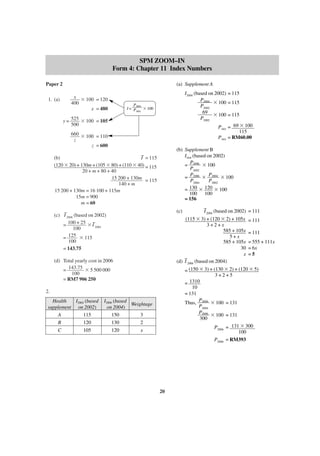
1. (a)

(a) Supplement A
x ϫ 100 = 120
400
x = 480

I2004 (based on 2002) = 115
P2004
ϫ 100 = 115
P2002
69
ϫ 100 = 115
P2002
P2002 = 69 ϫ 100
115
P2002 = RM60.00

P2004
I= P
ϫ 100
2002

y = 525 ϫ 100 = 105
500
660 ϫ 100 = 110
z
z = 600

(b) Supplement B
I2006 (based on 2002)
P
= 2006 ϫ 100
P2002
P
P
= 2006 ϫ 2004 ϫ 100
P2004
P2002
= 130 ϫ 120 ϫ 100
100 100
= 156

–
(b)
I = 115
(120 ϫ 20) + 130m + (105 ϫ 80) + (110 ϫ 40) = 115
20 + m + 80 + 40
15 200 + 130m = 115
140 + m
15 200 + 130m = 16 100 + 115m
15m = 900
m = 60

(c)

–
(c) I 2006 (based on 2002)
–
= 100 + 25 ϫ I 2004
100
= 125 ϫ 115
100
= 143.75

(115 ϫ 3) + (120 ϫ 2) + 105x
3+2+x
585 + 105x
5+x
585 + 105x
30
x
–
(d) I 2006 (based on 2004)

(d) Total yearly cost in 2006
= 143.75 ϫ 5 500 000
100
= RM7 906 250

= 111
= 111
= 555 + 111x
= 6x
=5

= (150 ϫ 3) + (130 ϫ 2) + (120 ϫ 5)
3+2+5
= 1310
10
= 131
P
Thus, 2006 ϫ 100 = 131
P2004
P2006
ϫ 100 = 131
300
P2006 = 131 ϫ 300
100
P2006 = RM393

2.
Health
I2004 (based
supplement on 2002)
A
115
B
120
C
105

–
I 2004 (based on 2002) = 111

I2006 (based
Weightage
on 2004)
150
3
130
2
120
x

20
SPM ZOOM–IN
Form 5: Chapter 1 Progressions
4.

Paper 1
1. (a)

T6 = 38
a + 5d = 38
a + 5(7) = 38
a =3

r = – 1 or 3
2
2

(b) S9 – S3
= 9 [2(3) + 8(7)] – 3 [2(3) + 2(7)]
2
2
= 279 – 30
= 249
2. (a)

T2 – T1
2h – 1 – (h – 2)
h+1
h

5. 0.242424 …
= 0.24 + 0.0024 + 0.000024 + …
a
= 0.24
S∞ =
1 – 0.01
1–r
= 0.24
0.99
= 24
99
= 8
33

= T3 – T2
= 4h – 7 – (2h – 1)
= 2h – 6
=7

(b) When h = 7, the arithmetic progression is 5,
13, 21, … with a = 5 and d = 8.

6. The numbers of bacteria form a geometric
progression 3, 6, 12, …

S8 – S3
= 8 [2(5) + 7(8)] – 3 [2(5) + 2(8)]
2
2
= 264 – 39
= 225
3.

T3 – T2 = 3
ar 2 – ar = 3
4r 2 – 4r = 3
2
4r – 4r – 3 = 0
(2r + 1)(2r – 3) = 0

The number of bacteria after 50 seconds
= T11 = ar10 = 3(210) = 3072
Paper 2
1. (a) The volumes of cylinders are
πr 2h, πr 2 (h + 1), πr 2 (h + 2), …

T2 T3
=
T1 T2
x+2 = x–4
9x + 4
x+2
(x
= (x – 4)(9x + 4)
x2 + 4x + 4 = 9x2 – 32x – 16
2
8x – 36x – 20 = 0
2x2 – 9x – 5 = 0
(2x + 1)(x – 5) = 0
x = – 1 or 5
2

T2 – T1 = πr 2 (h + 1) – πr 2h
= πr 2h + πr 2 – πr 2h
= πr2
T3 – T2 = πr 2 (h + 2) – πr 2 (h + 1)
= πr 2h + 2πr 2 – πr 2h – πr 2
= πr2
Since T2 – T1 = T3 – T2 = πr 2, the
volumes of cylinders form an arithmetic
progression with a common difference of πr2.

21
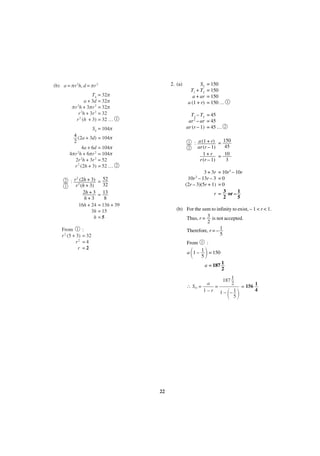
2. (a)

(b) a = πr 2h, d = πr 2
T4 = 32π
a + 3d = 32π
πr 2h + 3πr 2 = 32π
r 2h + 3r 2 = 32
r 2 (h + 3) = 32 …

2
1

1

2

: a (1 + r) = 150
45
ar (r – 1)
1 + r = 10
r (r – 1)
3

1
2

2

3 + 3r = 10r2 – 10r
10r – 13r – 3 = 0
(2r – 3)(5r + 1) = 0
r = 3 or – 1
2
5
2

2
: r 2(2h + 3) = 52
32
r (h + 3)
2h + 3 = 13
h+3
8
16h + 24 = 13h + 39
3h = 15
h =5

From 1
r 2 (5 + 3)
r2
r

= 150
= 150
= 150
= 150 …

T3 – T2 = 45
ar 2 – ar = 45
ar (r – 1) = 45 …

1

S4 = 104π
4 (2a + 3d) = 104π
2
4a + 6d = 104π
4πr 2h + 6πr 2 = 104π
2r 2h + 3r 2 = 52
r 2 (2h + 3) = 52 …

S2
T1 + T2
a + ar
a (1 + r)

(b) For the sum to infinity to exist, – 1 < r < 1.
Thus, r = 3 is not accepted.
2
Therefore, r = – 1
5

:
= 32
=4
=2

From

1

:
1 = 150
a 1–
5

΂

΃

a = 187 1
2
1
187
a
2
∴ S∞ =
=
1–r 1– –1
5

΂ ΃

22

= 156 1
4
SPM ZOOM–IN
Form 5: Chapter 2 Linear Law
Paper 2

Paper 1
y = 2 + qx
x
y = 2 +q
x x2
y =2( 1 )+q
x
x2

1.

1
x2

1. (a)

y = hxk
log10 y = log10 (hxk)
1

log10 y 2 = log10 h + log10 xk
1 log y = log h + klog x
10
10
2 10
log10 y = 2log10 h + 2klog10 x

y
x

log10 y = 2k log10 x + 2 log10 h

5 = 2(1) + q
q=3

(1, 5)

(b)
1
x2

q=3

y
x
(3, p)

2.

y
k
lg

x
x

lg y – lg k

p = 2(3) + 3
p=9

1.5
142
0.18
2.15

2.0
338
0.30
2.53

2.5
660
0.40
2.82

3.0
1348
0.48
3.13

3.5
1995
0.54
3.30

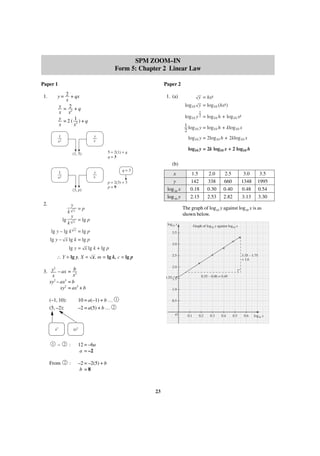
The graph of log10 y against log10 x is as
shown below.

=p
= lg p

y

k

x
y
log 10 x
log 10 y

x

log10 y

= lg p

Graph of log10 y against log10 x

3.5

lg y – x lg k = lg p
3.0

lg y = x lg k + lg p
∴ Y = lg y, X = x, m = lg k, c = lg p

2.0

2
3. y – ax = b2
x
x
2
3
xy – ax = b
xy2 = ax3 + b

1.0
0.5

O

x3

1

xy2

–

2

:

12 = –6a
a = –2

From

2

:

0.55 – 0.06 = 0.49

1.55 1.5

10 = a(–1) + b … 1
–2 = a(5) + b … 2

(–1, 10):
(5, –2):

3.35 – 1.75
= 1.6

2.5

–2 = –2(5) + b
b =8

23

0.1

0.2

0.3

0.4

0.5

0.6

log10 x
(c) 2k = Gradient
2k = 3.35 – 1.75
0.55 – 0.06
2k = 3.2653
k = 1.63
2 log10 h
2 log10 h
log10 h
h

(b) (i) 1
=
y

1 = x+p
y2
q
1 = 1x+ p
y2 q
q

= Y–intercept
= 1.55
= 0.775
= 5.96

Gradient =

x
y

0.1 0.3
0.78 0.60

0.4
0.54

0.5
0.50

0.7
0.44

0.8
0.42

1
y2

1.64 2.78

3.43

4.00

5.17

5.67

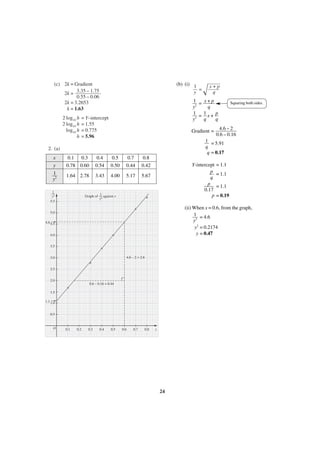
Graph of

Y-intercept
p
q
p
0.17
p

1
against x
y2

4.6 – 2
0.6 – 0.16

= 1.1
= 1.1
= 1.1
= 0.19

(ii) When x = 0.6, from the graph,
1 = 4.6
y2
y2 = 0.2174
y = 0.47

5.0
4.6 4.5
4.0
3.5
4.6 – 2 = 2.6

3.0
2.5
2.0
0.6 – 0.16 = 0.44
1.5
1.1 1.0
0.5

O

Squaring both sides.

1 = 5.91
q
q = 0.17

2. (a)

1
y2
5.5

x+p
q

0.1

0.2

0.3

0.4

0.5

0.6

0.7

0.8

x

24
SPM ZOOM–IN
Form 5: Chapter 3 Integration
4. Area of the shaded region

Paper 1
(y – 5) dy = 8
5
k

]

[
΂

2

2

=

k

1.

΃

2

=
=

–1

y2 –5y = 8
5
2
2

k – 5k – 5 – 5(5) = 8
2
2
2
k – 5k + 25 = 8
2
2
k2 – 10k + 25
= 16
k2 – 10k + 9 = 0
(k – 1)(k – 9) = 0
k = 1 or 9

–1

y dx
(x2 – 2x + 1) dx
2

[ x3 – x + x]
3

2

–1

΂

΃

= 8 – 4 + 2 – – 1 –1 – 1
3
3
= 3 units2
Paper 2
y

1.
y = –x3 – x

2.

2
–1

4

3g (x) dx +

[
= 3[
=3

2
–1
4
–1

2

3g (x) dx
4

g(x) dx +

2

]

g(x) dx

1O

]

g(x) dx

x

2

P

Q

= 3(20)
= 60
3. dy = x4 – 8x3 + 6x2
dx
y=

΂

4

3

Area P
0

x – 8x + 6x

5

΃

2

–1

dx

0

=

΂ ΃ ΂ ΃+c
4

y dx

3

y = x –8 x +6 x
5
4
3
5
4
3
y = x – 2x + 2x + c
5

–1

(–x3 –x) dx
0

[

]

4
2
= – x – x
4
2 –1
(–1)4 – (–1)2
=0– –
4
2
= 1 + 1
4
2
= 3
4

[

Since the curve passes through the point

΂1, – 1 4 ΃,
5
– 9 = 1 –2 + 2 + c
5
5
c = –2

Area Q

Hence, the equation of the curve is
5
y = x – 2x4 + 2x3 – 2.
5

=

2
0

y dx
2
0

[

(–x3 – x) dx
2

]

4
2
= – x – x
4
2 0
24 – 22 – 0
=–
4
2
= –4 – 2
= –6

25

]
Hence, the total area of the shaded region
= Area P + |Area Q|
= 3 + |–6|
4
= 6 3 units2
4
2. (a)

(b) When h = 1 and k = 4, y = x2 + 4
y
y = x2 + 4
P

y = hx2 + k
dy = 2hx
dx

x =3

4

At the point (–2, 8), the gradient of the
curve is – 4.
∴ dy = – 4
dx
2hx = – 4
2h (–2) = – 4
– 4h = – 4
h =1

x

O

2

3
Q

Volume generated, Vx
= Volume generated by the curve –
Volume generated by the straight line PQ
(from x = 0 to x = 2)
3
= π 0 y2 dx – 1 πr2h
3
3
2
2
= π 0 (x + 4) dx – 1 π(4)2 (2)
3
3
4
2
= π 0 (x + 8x + 16) dx – 32 π
3
3
5
3
32 π
= π x + 8x + 16x –
0
3
5
3
5
= π 3 + 8 (3)3 + 16(3) – 0] – 32 π
3
3
5
14 π units3
= 157
15

The curve y = hx2 + k passes through the
point (–2, 8).
∴ 8 = h(–2)2 + k
8 = 4h + k
8 = 4(1) + k
k =4

[
[

26

]
SPM ZOOM–IN
Form 5: Chapter 4 Vectors
Paper 1

4. (a) If the vectors _ and _ are parallel, then
a
b

→
→
1. (a) EA = 3 DC = 3 (12p) = 9p
_
_
4
4

a = hb (h is a constant).
_ _
2i – 5j = h(ki – 3j)
_ _
_ _
2i – 5j = hki – 3hj
_ _
_
_

→
→
(b) EQ = 1 ED
2
→ → → →
= 1 EA + AB + BC + CD
2

Equating the coefficients of _
j
–3h = –5
h= 5
3

΂
΃
= 1 ΂ 9p – 6r – 9q – 12p΃
_ _
_
2 _
= 1 ΂ – 3p – 6r – 9q ΃
_ _ _
2

Equating the coefficients of _
i
hk = 2
5 k =2
3
k= 6
5

→
→ →
2. XY = XD + DY
→
→
= 1 BD + 2 DC
2
3
→ →
→
= 1 BA + AD + 2 AB
2
3

(b)

΂
΃
= 1 ΂ –6b + 2a΃ + 2 (6b)
_ _
2
3 _

|a| 5
|b| = 3
|a| : |b| = 5 : 3

= –3b + _ + 4b
_ a _
=_ +_
a b

→ → →
5. (a) AC = AB + BC
= 9i – 4j + (–6i + mj )
_ _
_
_

3. (a) _ + 1 _ + 2c
a
b _
5
= 7j + 1 (10i – 5j ) + 2(–4i +_ )
_ _
_ j
_ 5
= 7j + 2i – _ – 8i + 2j
_ _ j _ _

= 3i + (m – 4)_
_
j
→
(b) If AC is parallel to the x-axis, the
coefficient of _ equals zero.
j
m–4 =0
m =4

= – 6i + 8j
_ _
(b) |a + 1 _ + 2c | = (–6)2 + 82 = 10
b _
_
5
Hence, the unit vector in the direction of
a 1b _
_ + _ + 2c
5

΂

= 1 –6i + 8j
_ _
10

a
_ = hb
_
5
a
_ = b
_
3

΃

= – 3_ + 4_
i
j
5
5

27
Paper 2

(c) Since the points O, T and S are collinear,
→
→
then, OT = kOS , where k is a constant.

→ → →
1. (a) OT = OA + AT
→
= 4x + 1 AQ
_
3
→ →
= 4x + 1 (AO + OQ )
_
3
= 4x + 1 (–4x + 6y)
_
_ _
3
= 8 _ + 2y
x _
3

→
→
OT = kOS
8 _ + 2y = k [(6 – 6h)y + 16hx
x _
_]
_
3
8 _ + 2y = k (6 – 6h)y + 16hkx
x _
_
_
3
8 _ + 2y = (6k – 6hk)y + 16hkx
x _
_
_
3

→
→ →
(b) OS = OQ + QS
→
= 6y + hQP
_
→ →
= 6y + h(QO + OP )
_
→
→
= 6y + h(QO + 4OA )
_

Equating the coefficients of _,
x
8 = 16hk
3
1 = 6hk
hk = 1 … 1
6

= 6y + h[–6y + 4(4x
_)]
_
_

Equating the coefficients of _,
y
6k – 6hk = 2 … 2

= (6 – 6h) _ + 16hx
y
_

Substituting

1

into

΂ ΃

6k – 6 1 = 2
6
6k = 3
k= 1
2
From

2

:

hk = 1
6

΂ ΃

h 1 =1
2
6
h= 1
3

28

2

:
→
→
2. (a) (i) OM = 5 OB = 5 (14y) = 10y
_
_
7
7

→ → →
(c) AK = AL + LK

΂

_
_
– 1 _ + 7 _ = –2px + 10py + 3 qx + 7 qy
x
y
_
_
2
2
2
2

→
→
(ii) AK = 1 AB
4
→
→
= 1 AO + OB
4

΂

–x + 7y = (–4p + 3q)x + (20p + 7q)y
_ _
_
_
Equating the coefficients of _ ,
x
– 4p + 3q = –1 … 1

=– 1 _ + 7_
x
y
2
2

Equating the coefficients of _ ,
y
20p + 7q = 7 … 2

→
→
(b) (i) AL = pAM
→
→
= p AO + OM

΃

+

= p(–2x + 10y)
_
_
= –2px + 10py
_
→
→
(ii) KL = qKO
→ →
= q KA + AO

΃

·

΂

΃

– 1 _ + 7 _ = –2p + 3 q _ + 10p + 7 q _
x
y
x
y
2
2
2
2

΂
΃
= 1 ΂ –2x + 14y΃
_
_
4

΂

΃ ΂

΃

–20p + 15q = –5 …
20p + 7q= 7 …
22q = 2
q= 1
11
From

1
2

1

:
– 4p + 3 1 = –1
11

΂ ΃

→
→
KA = –AK
= 1_ – 7_
x
y
2
2

– 4p = – 14
11
7
p=
22

΂
΃
= q΂ – 3 _ – 7 _΃
x
y
2
2
= q 1 _ – 7 _ – 2x
x
y _
2
2

= – 3 qx – 7 qy
_
2
2 _

29

ϫ5
WebsiteZI F505_4th pp

10/15/08

9:40 AM

Page 30

SPM ZOOM–IN
Form 5: Chapter 5 Trigonometric Functions
Paper 1

3.

3 tan θ = 2 tan (45º – θ)
3 tan θ = 2

45º –
΂ 1tantan 45ºtan θθ ΃
+
tan

3 tan θ = 2

1.

– tan
΂ 11 + tan θθ ΃

1 + p2

θ

1
O

–p

3 tan θ + 3 tan2 θ = 2 – 2 tan θ
3 tan2 θ + 5 tan θ – 2 = 0
(3 tan θ – 1)(tan θ + 2) = 0
tan θ = 1 or tan θ = –2
3

sin (90º – θ)
= cos θ
=–

p

When tan θ = 1 ,
3
Basic ∠ = 18.43º
θ = 18.43º, 198.43º

1 + p2
2.

3
– 10 tan x = 0
cos2 x
3 sec2 x – 10 tan x = 0
2
3(tan x + 1) – 10 tan x = 0
3 tan2 x + 3 – 10 tan x = 0
3 tan2 x – 10 tan x + 3 = 0
(3 tan x – 1)(tan x – 3) = 0
tan x = 1 or tan x = 3
3

When tan θ = –2,
Basic ∠ = 63.43º
θ = 116.57º, 296.57º
∴ θ = 18.43º, 116.57º, 198.43º, 296.57º

When tan x = 1 ,
3
x = 18.43º, 198.43º
When tan x = 3,
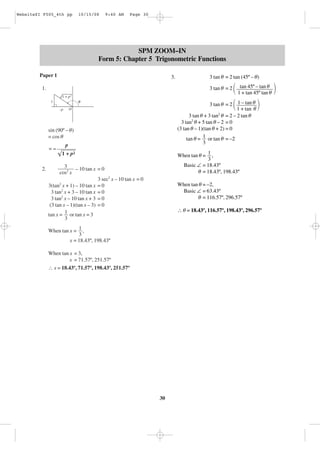
x = 71.57º, 251.57º
∴ x = 18.43º, 71.57º, 198.43º, 251.57º

30
WebsiteZI F505_4th pp

10/15/08

9:40 AM

Page 31

Paper 2

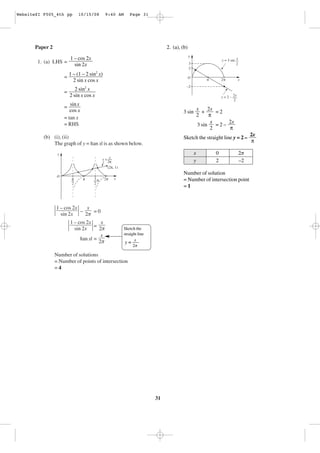
2. (a), (b)

1. (a) LHS =
=
=

y

1 – cos 2x
sin 2x

y = 3 sin x
2

3
2

1 – (1 – 2 sin2 x)
2 sin x cos x

O

␲

2␲

x

–2

2 sin2 x
2 sin x cos x

y = 2 – 2x
2

sin x
cos x
= tan x
= RHS
=

x
2x
+
=2
2
π
x
2x
3 sin
=2–
2
π

3 sin

(b) (i), (ii)
The graph of y = |tan x| is as shown below.

Sketch the straight line y = 2 –
x
y

y
y=

π

0
2

2π
–2

(2π, 1)
O

π

π

3π
2

π

Number of solution
= Number of intersection point
=1

x

1 – cos 2x
x
–
=0
sin 2x
2π
1 – cos 2x
x
=
sin 2x
2π
x
|tan x| =
2π

Sketch the
straight line
y= x .
2π

Number of solutions
= Number of points of intersection
=4

31

2x
π
WebsiteZI F506_4th pp

10/15/08

9:40 AM

Page 32

SPM ZOOM–IN
Form 5: Chapter 6 Permutations and Combinations
Paper 1

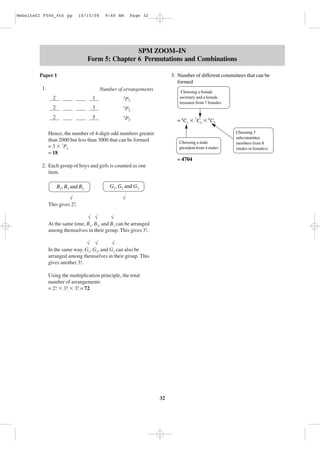
3. Number of different committees that can be
formed

1.

Number of arrangements
2

1

2

3

3P
2

2

5

Choosing a female
secretary and a female
treasurer from 7 females

3P
2

3P
2

= 4C1 ϫ 7C2 ϫ 8C3

Hence, the number of 4-digit odd numbers greater
than 2000 but less than 3000 that can be formed
= 3 ϫ 3P2
= 18

Choosing a male
president from 4 males

= 4704
2. Each group of boys and girls is counted as one
item.
B1, B2 and B3
√
This gives 2!.

G1, G2 and G3
√

√ √
√
At the same time, B1, B2, and B3 can be arranged
among themselves in their group. This gives 3!.
√ √
√
In the same way, G1, G2, and G3 can also be
arranged among themselves in their group. This
gives another 3!.
Using the multiplication principle, the total
number of arrangements
= 2! ϫ 3! ϫ 3! = 72

32

Choosing 3
subcommittee
members from 8
(males or females).
SPM ZOOM–IN
Form 5: Chapter 7 Probability
Paper 1
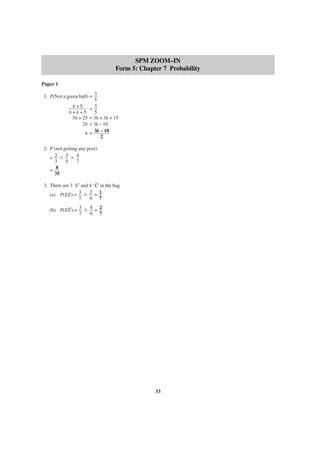
1. P(Not a green ball) = 3
5
h+5 = 3
h+k+5
5
5h + 25 = 3h + 3k + 15
2h = 3k – 10
h = 3k – 10
2
2. P (not getting any post)
=2 ϫ3 ϫ4
3
5
7
8
=
35
–
3. There are 3 ‘E’ and 4 ‘E ’ in the bag
(a) P(EE) = 3 ϫ 2 = 1
7
6 7
–
(b) P(EE ) = 3 ϫ 4 = 2
7
6 7

33
SPM ZOOM–IN
Form 5: Chapter 8 Probability Distributions
Paper 1

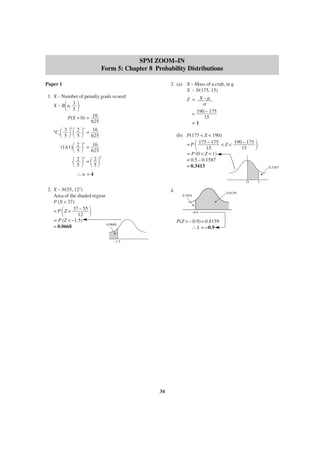
3. (a) X – Mass of a crab, in g
X ∼ N(175, 15)

1. X – Number of penalty goals scored
X ∼ B n, 3
5
P(X = 0) = 16
625

΂

΃

΂ ΃΂ ΃

Co 3
5

n

Z = X–µ
σ
= 190 – 175
15
=1

0

2
5

n

= 16
625

(b) P(175 < X < 190)
= P 175 – 175 < Z < 190 – 175
15
15
= P (0 < Z < 1)
= 0.5 – 0.1587
= 0.3413

΂

16
΂ ΃ = 625
΂ 2 ΃ =΂ 2΃
5
5

(1)(1) 2
5

n

n

4

΃
0.1587

∴n =4
O

2. X ∼ N(55, 12 )
Area of the shaded region
P (X < 37)
= P Z < 37 – 55
12
= P (Z < –1.5)
0.0668
= 0.0668
2

΂

4.
0.1841

΃

–0.9

P(Z > – 0.9) = 0.8159
∴ k = –0.9

–1.5

34

0.8159

1
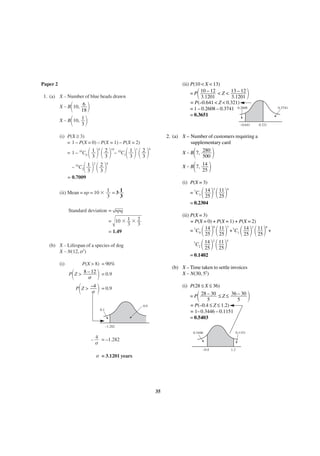
(ii) P(10 < X < 13)
= P 10 – 12 < Z < 13 – 12
3.1201
3.1201
= P(–0.641 < Z < 0.321)
= 1 – 0.2608 – 0.3741 0.2608
= 0.3651

Paper 2

΂

1. (a) X – Number of blue beads drawn

΂ ΃
X ∼ B΂ 10, 1 ΃
3

X ∼ B 10, 6
18

0.3741

–0.641

(i) P(X ≥ 3)
= 1 – P(X = 0) – P(X = 1) – P(X = 2)

΂ ΃ ΂2΃
3
C΂1΃ ΂2΃
3
3

= 1 – 10C0 1
3
– 10

΃

0

10

2

2. (a) X – Number of customers requiring a
supplementary card

΂ ΃ ΂2΃
3

– 10C1 1
3

0.321

1

΂
΃
X ∼ B΂ 7, 14 ΃
25

9

X ∼ B 7, 280
500

8

2

= 0.7009
(i) P(X = 3)

΂ ΃ ΂ 11 ΃
25

(ii) Mean = np = 10 ϫ 1 = 3 1
3
3

= 7C3 14
25
= 0.2304

Standard deviation = npq

΂ ΃΂ ΃
C ΂ 14 ΃ ΂ 11 ΃
25
25

΂ ΃΂ ΃

5

2

= 0.1402

P(X > 8) = 90%

΂

2

7

(b) X – Lifespan of a species of dog
X ∼ N(12, σ2)

(b) X – Time taken to settle invoices
X ∼ N(30, 52)

΃
P΂ Z > –4 ΃ = 0.9
σ

P Z > 8 – 12
σ

4

(ii) P(X = 3)
= P(X = 0) + P(X = 1) + P(X = 2)
0
11 7 +7C 14 1 11 6 +
= 7C0 14
1
25
25
25
25

= 10 ϫ 1 ϫ 2
3 3
= 1.49

(i)

3

= 0.9

(i) P(28 ≤ X ≤ 36)

΂

= P 28 – 30 ≤ Z ≤ 36 – 30
5
5
= P(–0.4 ≤ Z ≤ 1.2)
= 1– 0.3446 – 0.1151
= 0.5403

0.9
0.1

–1.282
0.3446

0.1151

– 4 = –1.282
σ
–0.4

σ = 3.1201 years

35

1.2

΃
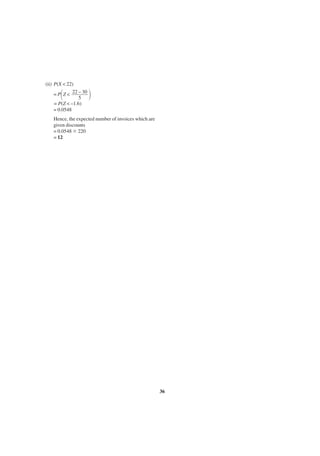
(ii) P(X < 22)

΂

= P Z < 22 – 30
5
= P(Z < –1.6)
= 0.0548

΃

Hence, the expected number of invoices which are
given discounts
= 0.0548 ϫ 220
= 12

36
SPM ZOOM–IN
Form 5: Chapter 9 Motion Along a Straight Line
Paper 2

(c) When particle A reverses its direction,
vA = 0
12 + t – t2 = 0
t2 – t – 12 = 0
(t + 3)(t – 4) = 0
t = –3 or 4
t = –3 is not accepted
∴t=4

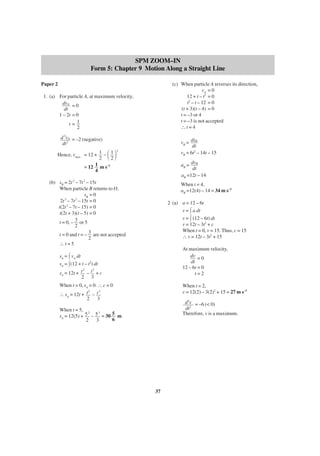
1. (a) For particle A, at maximum velocity,
dvA = 0
dt
1 – 2t = 0
t= 1
2
d 2vA = –2 (negative)
dt 2

vB = dsB
dt
vB = 6t2 – 14t – 15

΂ ΃

Hence, vmax = 12 + 1 – 1
2
2
= 12 1 m s–1
4

2

aB = dvB
dt
aB =12t – 14

(b) sB = 2t 3 – 7t 2 – 15t
When particle B returns to O,
sB = 0
2t 3 – 7t 2 – 15t = 0
t(2t 2 – 7t – 15) = 0
t(2t + 3)(t – 5) = 0
t = 0, – 3 or 5
2
t = 0 and t = – 3 are not accepted
2
∴t=5

When t = 4,
aB =12(4) – 14 = 34 m s–2
2 (a) a = 12 – 6t
v = a dt
v = (12 – 6t) dt
v = 12t – 3t2 + c
When t = 0, v = 15. Thus, c = 15
∴ v = 12t – 3t2 + 15
At maximum velocity,
dv = 0
dt
12 – 6t = 0
t=2

sA = vA dt
sA = (12 + t – t2) dt
2
3
sA = 12t + t – t + c
2 3
When t = 0, sA = 0. ∴ c = 0
2
3
∴ sA = 12t + t – t
2
3

When t = 2,
v = 12(2) – 3(2)2 + 15 = 27 m s–1
d2v = –6 (< 0)
dt2
Therefore, v is a maximum.

When t = 5, 2
3
sA = 12(5) + 5 – 5 = 30 5 m
6
2
3

37
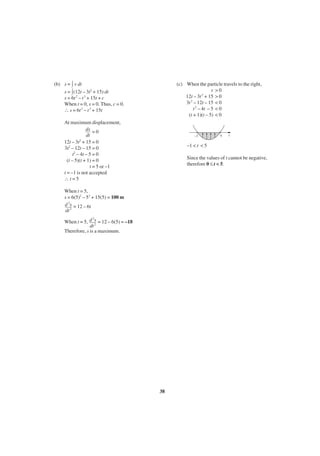
(b) s = v dt
s = (12t – 3t2 + 15) dt
s = 6t 2 – t 3 + 15t + c
When t = 0, s = 0. Thus, c = 0.
∴ s = 6t 2 – t 3 + 15t

(c) When the particle travels to the right,
v >0
12t – 3t 2 + 15 > 0
3t 2 – 12t – 15 < 0
t 2 – 4t – 5 < 0
(t + 1)(t – 5) < 0

At maximum displacement,
ds = 0
dt
12t – 3t2 + 15 = 0
3t2 – 12t – 15 = 0
t2 – 4t – 5 = 0
(t – 5)(t + 1) = 0
t = 5 or –1
t = –1 is not accepted
∴t=5

–1

5

t

–1 < t < 5
Since the values of t cannot be negative,
therefore 0 ≤ t < 5.

When t = 5,
s = 6(5)2 – 53 + 15(5) = 100 m
d 2s = 12 – 6t
dt 2
2
When t = 5, d s = 12 – 6(5) = –18
dt 2
Therefore, s is a maximum.

38
SPM ZOOM–IN
Form 5: Chapter 10 Motion Along a Straight Line
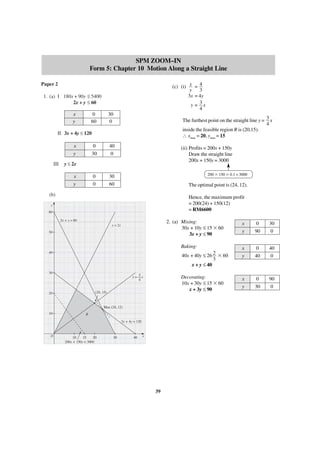
(c) (i) x = 4
y
3
3x = 4y
y = 3x
4

Paper 2
1. (a) I 180x + 90y ≤ 5400
2x + y ≤ 60
x
y

0
60

30
0

The furthest point on the straight line y = 3 x
4
inside the feasible region R is (20,15).
∴ xmax = 20, ymax = 15

II 3x + 4y ≤ 120
x
y
III

0
30

40
0

0
0

30
60

(ii) Profits = 200x + 150y
Draw the straight line
200x + 150y = 3000

y ≤ 2x
x
y

200 ϫ 150 ϫ 0.1 = 3000

The optimal point is (24, 12).

(b)

Hence, the maximum profit
= 200(24) + 150(12)
= RM6600

y
60
2x + y = 60

2. (a) Mixing:
30x + 10y ≤ 15 ϫ 60
3x + y ≤ 90

y = 2x
50

Baking:
40x + 40y ≤ 26 2 ϫ 60
3
x + y ≤ 40

40

30
y=

3
x
4

Decorating:
10x + 30y ≤ 15 ϫ 60
x + 3y ≤ 90

(20, 15)

20

Max (24, 12)
10

R
3x + 4y = 120

O

10
15
20
200x + 150y = 3000

30

40

x

39

x
y

0
90

30
0

x
y

0
40

40
0

x
y

0
30

90
0
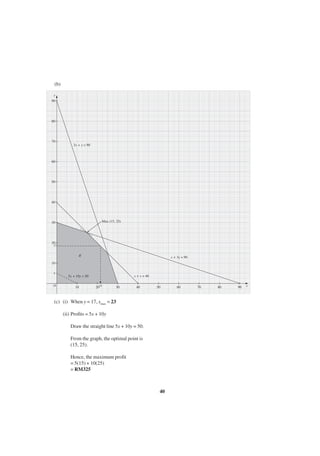
(b)
y
90

80

70
3x + y = 90

60

50

40

Max (15, 25)

30

20

17

R

x + 3y = 90

10
5

O

x + y = 40

5x + 10y = 50
10

2023

30

40

50

(c) (i) When y = 17, xmax = 23
(ii) Profits = 5x + 10y
Draw the straight line 5x + 10y = 50.
From the graph, the optimal point is
(15, 25).
Hence, the maximum profit
= 5(15) + 10(25)
= RM325

40

60

70

80

90

x

35182797 additional-mathematics-form-4-and-5-notes

  • 1.
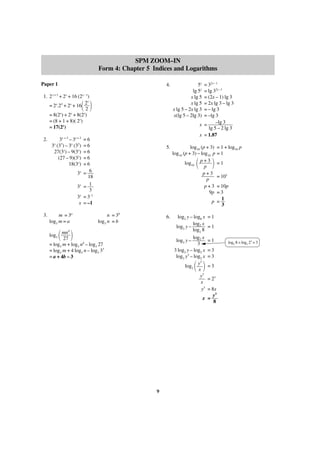
    SPM ZOOM–IN Form 4:Chapter 1 Functions 4. (a) gf : x → x2 + 6x + 2 gf (x) = x2 + 6x + 2 g(x + 4) = x2 + 6x + 2 Paper 1 1. The relation in the given graph can be represented using the following arrow diagram. A Let x + 4 = u x=u–4 B 1 10 2 20 3 30 4 40 g(u) = (u – 4)2 + 6(u – 4) + 2 = u2 – 8u + 16 + 6u – 24 + 2 = u2 – 2u – 6 ∴ g(x) = x2 – 2x – 6 [ Based on the above arrow diagram, (a) the object of 40 is 3, (b) the type of the relation is many-to-many relation. (b) fg(4) = f 42 – 2(4) – 6 = f(2) =2+4 =6 2. 5. Let g–1(x) = y g(y) = x 3y + k = x x–k y= 3 1 k y = x– 3 3 1 k ∴ g–1(x) = x – 3 3 –4 –3 –2 2 3 4 16 9 4 (a) The above relation is a many-to-one relation. (b) The function which represents the above relation is f(x) = x2. It is given that g–1(x) = mx – 5 6 Hence, by comparison, 1 k 5 5 m = and – = – ⇒ k = 3 3 6 2 3. f 2 (x) = ff (x) = f (px + q) = p (px + q) + q = p2 x + pq + q It is given that f 2 (x) = 4x + 9 By comparison, p2 = 4 pq + q p =–2 –2q + q –q q ] =9 =9 =9 = –9 The question requires p < 0. 1
  • 2.
    Paper 2 2. (a)Let f –1(x) f(y) y –2 2 y 2 y y ∴ f –1(x) ∴ f –1(3) hx x–3 hx f(x) = x–3 1. (a) f : x → Let f –1(x) f(y) hy y–3 hy hy 3x 3x =y =x =x = 2(x + 2) = 2x + 4 = 2x + 4 = 2(3) + 4 = 10 Hence, by comparison, 2k + 4 = –4 2k = –8 k = –4 kx , x ≠ 2. x–2 Hence, by comparison, h = 2 and k = 3. [ (c) hf(x) : x → 9x – 3 h[f(x)] = 9x – 3 x h – 2 = 9x – 3 2 x Let –2 =u 2 x =u+2 2 x = 2u + 4 ] gf –1(x) = g f –1(x) 3x =g x–2 ΂ ΂ ΃ 1 3x x–2 x–2 = 3x gf –1(x) = –5x x–2 = –5x 3x x – 2 = –15x2 2 15x + x – 2 = 0 (3x – 1)(5x + 2) = 0 1 2 x = or – 3 5 ( =x+2 But it is given that f –1g : x → 6x – 4 f –1g (x) = 6x – 4 But it is given that f –1(x) = = =x (b) f –1g(x) = f –1[g(x)] = f –1(3x + k) = 2(3x + k) + 4 = 6x + 2k + 4 = x (y – 3) = xy – 3x = xy – hy = y(x – h) 3x y= x–h 3x ∴ f –1 (x) = x–h (b) =y =x ) ΃ h(u) = 9(2u + 4) – 3 = 18u + 33 ∴ h : x → 18x + 33 2
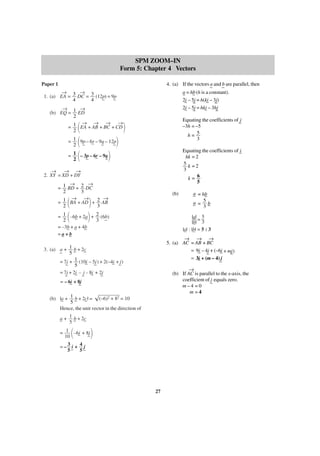
  • 3.
    SPM Zoom-In Form 4:Chapter 2 Quadratic Equations Paper 1 1. 4. x2 + 2x – 1 + k(2x + k) = 0 x2 + 2x – 1 + 2kx + k2= 0 x2 + 2x + 2kx + k2 – 1= 0 x2 + (2 + 2k)x + k2 – 1 = 0 12x2 – 5x(2x – 1) = 2(3x + 2) 12x2 – 10x2 + 5x = 6x + 4 2 12x – 10x2 + 5x – 6x – 4 = 0 2x2 – x – 4 = 0 x= –b Ϯ x= –(–1) Ϯ a = 1, b = 2 + 2k, c = k2 – 1 b2 – 4ac 2a If a quadratic equation has two real and distinct roots, then b2 – 4ac > 0. (–1)2 – 4(2)(–4) 2(2) b2 – 4ac > 0 (2 + 2k) – 4(1)(k2 – 1) > 0 4 + 8k + 4k2 – 4k2 + 4 > 0 8k + 8 > 0 8k > –8 k > –1 2 1 Ϯ 33 4 x = 1.6861 or –1.1861 x= ΂ ΃ Product of roots = ΂– 2 ΃΂– 3 ΃ = 2 3 5 5 2. Sum of roots = – 2 + – 3 = – 19 3 5 15 5. a = 3, b = –2m, c = 12 The required quadratic equation is x2 + 19 x + 2 = 0 15 5 If a quadratic equation has equal roots, then b2 – 4ac = 0. b2 – 4ac = 0 (–2m) – 4(3)(12) = 0 4m2 – 144 = 0 4m2 = 144 m2 = 36 m = ±6 x2 – (sum of roots)x + (product of roots) = 0 2 15x2 + 19x + 6 = 0 3. 3x2 + 4p + 2x = 0 3x2 + 2x + 4p = 0 a = 3, b = 2, c = 4p If a quadratic equation does not have real roots, then b2 – 4ac < 0. <0 <0 <0 < –4 p > –4 –48 p> 1 12 b2 – 4ac 2 – 4(3)(4p) 4 – 48p –48p 2 3(x2 + 4) = 2mx 3x2 + 12 = 2mx 2 3x – 2mx + 12 = 0 3
  • 4.
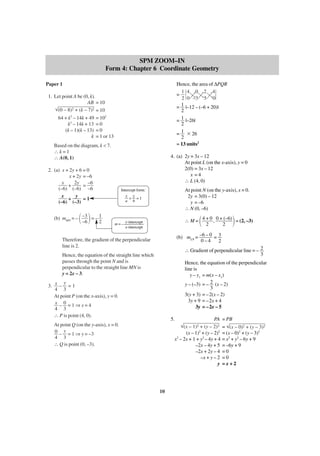
    6. x2 +2x – 8 = 0 a = 1, b = 2, c = –8 7. x2 – (k + 2)x + 2k = 0 a = 1, b = –(k + 2), c = 2k If one of the roots is α, then the other root is 2α. The roots are p and q. Sum of roots = – b a p + q = –2 1 p + q = –2 Sum of roots = – b a ΂ α + 2α = – –(k + 2) 1 3α = k + 2 α = k+2 … 3 Product of roots = c a pq = – 8 1 ΃ 1 Product of roots = c a 2α2 = 2k 1 pq = –8 The new roots are 2p and 2q. Sum of new roots = 2p + 2q = 2(p + q) = 2(–2) = –4 α2 = k … 1 Substituting ΂ k+2΃ 3 2 Product of new roots = (2p)(2q) = 4pq = 4(–8) = –32 (k + 2)2 9 (k + 2)2 k2 + 4k + 4 k2 – 5k + 4 (k – 1)(k – 4) k The quadratic equation that has the roots 2p and 2q is x2 + 4x – 32 = 0. 4 into 2 =k =k = 9k = 9k =0 =0 = 1 or 4 2 :
  • 5.
    Paper 2 From 1: When m = 2, 6(2) = k – 3 k = 12 + 3 k = 15 1. (2x – 1)(x + 3) = 2x – 3 – k 2x2 + 6x – x – 3 = 2x – 3 – k 2x2 + 3x + k = 0 a = 2, b = 3, c = k 3. (a) 2x2 + px + q = 0 a = 2, b = p, c = q The roots are –2 and p. Sum of roots = – b a –2 + p = – 3 2 –p = – 3 + 2 2 p = 1 2 The roots are – 3 and 2. 2 Sum of roots = – b a p –3 +2 =– 2 2 1 =– p 2 2 p = –1 Product of roots = c a –2p = k 2 Product of roots = c a ΂ ΃ –2 1 = k 2 2 k = –2 q – 3 ϫ2= 2 2 q = –6 2. 2x2 + (3 – k)x + 8m = 0 a = 2, b = 3 – k, c = 8m (b) 2x2 – x – 6 = k 2x – x – 6 – k = 0 a = 2, b = –1, c = –6 – k 2 The roots are m and 2m. Sum of roots = – b a m + 2m = – 3 – k 2 6m = k – 3 … If the quadratic equation does not have real roots, then b2 – 4ac < 0. < 0, <0 <0 < –49 49 k <– 8 1 k < –6 8 When b2 – 4ac 2 (–1) – 4(2)(–6 – k) 1 + 48 + 8k 8k 1 Product of roots = c a m(2m) = 8m 2 2m2 = 4m m2 = 2m 2 m – 2m = 0 m(m – 2) = 0 m = 0 or 2 m = 0 is not accepted. ∴m =2 5
  • 6.
    SPM ZOOM–IN Form 4:Chapter 3 Quadratic Functions Paper 1 1. f(x) = 2x2 + 8x + 6 = 2(x2 + 4x + 3) 4 2 4 = 2 x2 + 4x + – 2 2 = 2(x2 + 4x + 22 – 22 + 3) = 2[(x + 2)2 – 1] = 2(x + 2)2 – 2 ∴ a = 2, p = 2, q = –2 [ –1 ΂ ΃ ΂ ΃ + 3] 2 p 5 Hence, the required range of values of p is p < –1 or p > 5. 5. 3x2 + hx + 27 = 0 a = 3, b = h, c = 27 If a quadratic equation does not have real roots, b2 – 4ac < 0 2 h – 4(3) (27) < 0 h2 – 324 < 0 (h + 18)(h – 18) < 0 2. From f(x) = – (x – 4)2 + h, we can state that the coordinates of the maximum point are (4, h). But it is given that the coordinates of the maximum point are (k, 9). Hence, by comparison, (a) k = 4 (b) h = 9 (c) The equation of the tangent to the curve at its maximum point is y = 9. h –18 3. (a) y = (x + m)2 + n The axis of symmetry is x = –m. But it is given that the axis of symmetry is x = 1. ∴ m = –1 Hence, the required range of values of h is –18 < h < 18. 6. g(x) = (2 – 3k)x2 + (4 – k)x + 2 a = 2 – 3k, b = 4 – k, c = 2 When m = –1, y = (x – 1)2 + n Since the y-intercept is 3, the point is (0, 3). ∴ 3 = (0 – 1)2 + n n =2 If a quadratic curve intersects the x-axis at two distinct points, then b2 – 4ac > 0 2 (4 – k) – 4(2 – 3k)(2) > 0 16 – 8k + k2 – 16 + 24k > 0 k2 + 16k > 0 k(k + 16) > 0 (b) When m = –1 and n = 2, y = (x – 1)2 + 2 Hence, the minimum point is (1, 2). 4. 18 (2 + p)(6 – p) < 7 12 + 4p – p2 – 7 < 0 –p2 + 4p + 5 < 0 p2 – 4p – 5 > 0 (p + 1)(p – 5) > 0 –16 0 k Hence, the required range of values of k is k < –16 or k > 0. 6
  • 7.
    Paper 2 (b) g(x)= –2x2 + 8x – 12 = –2(x – 2)2 – 4 ΂ 2 ϫ 5΃ = 4 (a) f(x) = 2x2 + 10x + k k = 2 x2 + 5x + 2 25 25 k = 2 x2 + 5x + – + 4 4 2 5 2 25 k =2 x+ – + 2 4 2 2 5 25 =2 x+ – +k 2 2 ΂ ΂ [΂ ΂ ΃ ΃ 1 2 25 The maximum point is (2, –4). When x = 0, y = –12 ∴ (0, –12) The graph of the function g(x) is as shown below. ΃ y ] O (2, –4) ΃ (b) (i) Minimum value = 32 25 – + k = 32 2 89 k = 2 (ii) –12 3. y = h – 2x… 1 y2 + xy + 8 = 0 … b2 – 4ac 2 10 – 4(2)(k) 100 – 8k – 8k <0 <0 <0 < –100 –100 k> –8 25 k > 2 ΂ (c) Minimum point is –2 2 Substituting 1 into 2 : (h – 2x)2 + x(h – 2x) + 8 = 0 h2 – 4hx + 4x2 + hx – 2x2 + 8 = 0 2x2 – 3hx + h2 + 8 = 0 a = 2, b = –3h, c = h2 + 8 If a straight line does not meet a curve, then b2 – 4ac < 0 2 (–3h) – 4(2) (h2 + 8) < 0 9h2 –8h2 – 64 < 0 h2 – 64 < 0 (h + 8)(h – 8) < 0 ΃ 1 , 32 . 2 2. (a) g(x) = –2x2 + px – 12 = –2(x + q)2 – 4 –2x2 + px – 12 = –2(x2 + 2qx + q2) – 4 = –2x2 – 4qx – 2q2 – 4 By comparison, p = – 4q … 1 and –12 –2q2 q2 q x –8 = –2q2 – 4 = –8 =4 = ±2 8 h Hence, the required range of values of h is –8 < h < 8. From 1 : When q = 2, p = –4(2) = –8 (Not accepted) When q = –2, p = –4(–2) = 8 (Accepted) because p > 0 and q < 0) 7
  • 8.
    SPM ZOOM–IN Form 4:Chapter 4 Simultaneous Equations Paper 2 1. 2x – 3y = 2 x2 – xy + y2 = 4 … … From 3 , When x = 0.70156, y = 2 – 4(0.70156) = –0.80624 1 2 When x = –5.70156, y = 2 – 4(–5.70156) = 24.80624 1 From : 2 + 3y x= … 3 2 Substituting 3 into 2 Hence, the solutions are x = 0.70156, y = –0.80624 or x = –5.70156, y = 24.80624 (correct to five decimal places). : ΂ 2 +23y ΃ – y΂ 2 +23y ΃ + y – 4 = 0 2 2 (2 + 3y)2 – y(2 + 3y) + y2 – 4 4 2 (2 + 3y)2 – 2y(2 + 3y) + 4y2 – 16 4 + 12y + 9y2 – 4y – 6y2 + 4y2 – 16 7y2 + 8y – 12 (7y – 6)(y + 2) 3. (a) Since (16, m) is a point of intersection of 1 y = x – 2 and y2 + ky – x – 4 = 0, then 4 x = 16 and y = m satisfy both the equations. =0 =0 =0 =0 =0 6 y= or –2 7 From 3 When y = –2, x = 2+3 2 6 ( 7 ) = 16 (b) When k = 8, 1 y= x–2… 4 7 2 + 3(–2) = –2 2 ΂ 2 6 Hence, the points of intersection are 2 , 7 7 and (–2, –2). 2. 4x + y = 2 … 1 x2 + x – y = 2 … 1 : y = 2 – 4x… 2 =0 =0 = 16 =8 1 y2 + 8y – x – 4 = 0 … ΃ From 1 : 4y = x – 8 x = 4y + 8 … 3 , 2 3 Substituting 3 into y2 + 8y – (4y + 8) – 4 y2 + 8y – 4y – 8 – 4 y2 + 4y – 12 (y – 2)(y + 6) y 2 Substituting 3 into x2 + x – (2 – 4x) = 2 x2 + 5x – 4 = 0 x = –5 ± m2 + km – 16 – 4 22 + k(2) – 16 – 4 2k k : 6 When y = , x = 7 From Therefore, 1 m = (16) – 2 = 2 and 4 2 , =0 =0 =0 =0 = 2 or –6 From 3 : When y = 2, x = 4(2) + 8 = 16 When y = –6, x = 4(–6) + 8 = –16 52 – 4(1)(–4) 2(1) = –5 ± 41 2 = 0.70156 or –5.70156 Hence, the other point of intersection, other than (16, 2), is (–16, –6). 8
  • 9.
    SPM ZOOM–IN Form 4:Chapter 5 Indices and Logarithms Paper 1 4. 5x lg 5x x lg 5 x lg 5 x lg 5 – 2x lg 3 x(lg 5 – 2lg 3) 5. log10 (p + 3) log10 (p + 3) – log10 p log10 p + 3 p p+3 p p+3 9p 1. 2 x + 3 + 2x + 16 (2x – 1) 2x = 2x.23 + 2x + 16 2 = 8(2x) + 2x + 8(2x) = (8 + 1 + 8)( 2x) = 17(2x) ΂ ΃ 2. 3x + 3 – 3x + 2 3 (33) – 3x (32) 27(3x) – 9(3x) (27 – 9)(3x) 18(3x) x 3x 3x 3x x 3. m = 3a log3 m = a ΂ =6 =6 =6 =6 =6 = 6 18 = 1 3 = 3–1 = –1 = 32x – 1 = lg 32x –1 = (2x – 1) lg 3 = 2x lg 3 – lg 3 = – lg 3 = –lg 3 –lg 3 x = lg 5 – 2 lg 3 x = 1.87 ΂ = 1 + log10 p =1 ΃ =1 = 101 = 10p =3 1 p = 3 n = 3b log3 n = b 6. ΃ mn4 log3 27 = log3 m + log3 n4 – log3 27 = log3 m + 4 log3 n – log3 33 = a + 4b – 3 log2 y – log8 x log2 x log2 y – log2 8 log2 x log2 y – 3 3 log2 y – log2 x log2 y3 – log2 x y3 log2 x y3 x y3 =1 =1 =1 =3 =3 ΂ ΃ =3 = 23 = 8x y3 x = 8 9 log2 8 = log2 23 = 3
  • 10.
    SPM ZOOM–IN Form 4:Chapter 6 Coordinate Geometry Hence, the area of ∆PQR 1 4 0 2 4 = 2 0 –3 5 0 1 |–12 – (–6 + 20)| = 2 = 1 |–26| 2 = 1 ϫ 26 2 = 13 units2 Paper 1 1. Let point A be (0, k). AB = 10 2 + (k – 7)2 = 10 (0 – 8) 64 + k2 – 14k + 49 = 102 k2 – 14k + 13 = 0 (k – 1)(k – 13) = 0 k = 1 or 13 Based on the diagram, k < 7. ∴k=1 ∴ A(0, 1) 4. (a) 2y = 3x – 12 At point L (on the x-axis), y = 0 2(0) = 3x – 12 x =4 ∴ L (4, 0) 2. (a) x + 2y + 6 = 0 x + 2y = –6 x 2y –6 + = (–6) (–6) –6 x y + =1 (–6) (–3) ΂ ΃ (b) mMN = – –3 = – 1 –6 2 At point N (on the y-axis), x = 0. 2y = 3(0) – 12 y = –6 ∴ N (0, –6) Intercept form: x y + =1 a b ΂ ΃ ∴ M = 4 + 0 , 0 + (–6) = (2, –3) 2 2 m = – y-intercept x-intercept (b) mLN = –6 – 0 = 3 0–4 2 Therefore, the gradient of the perpendicular line is 2. ∴ Gradient of perpendicular line = – 2 3 Hence, the equation of the straight line which passes through the point N and is perpendicular to the straight line MN is y = 2x – 3. Hence, the equation of the perpendicular line is y – y1 = m(x – x1) y – (–3) = – 2 (x – 2) 3 3(y + 3) = –2(x – 2) 3y + 9 = –2x + 4 3y = –2x – 5 y 3. x – = 1 4 3 At point P (on the x-axis), y = 0. x – 0 =1⇒x=4 4 3 ∴ P is point (4, 0). 5. PA (x – + (y – 2)2 2 (x – 1) + (y – 2)2 2 x – 2x + 1 + y2 – 4y + 4 –2x – 4y + 5 –2x + 2y – 4 –x + y – 2 y At point Q (on the y-axis), x = 0. 0 – y = 1 ⇒ y = –3 4 3 ∴ Q is point (0, –3). 1)2 10 = PB = (x – 0)2 + (y – 3)2 = (x – 0)2 + (y – 3)2 = x2 + y2 – 6y + 9 = –6y + 9 =0 =0 =x+2
  • 11.
    Paper 2 (c) A(–18,0), B(2, 0), C(0, –6), D(–20, –6) Area of ABCD 1 –18 2 0 –20 –18 = 2 0 0 –6 –6 0 1 |–12 – (120 + 108)| = 2 = 1 ϫ 240 2 = 120 units2 1. (a) y – 3x + 6 = 0 At point B (x-axis), y = 0. 0 – 3x + 6 = 0 ⇒ x = 2 ∴ B is point (2, 0). y – 3x + 6 = 0 At point C (y-axis), x = 0. y – 3(0) + 6 = 0 ⇒ y = –6 ∴ C is point (0, –6). 2. (a) (i) y – 3x + 6 = 0 At point P (on the y-axis), x = 0. y – 3(0) + 6 = 0 ⇒ y = –6 ∴ P is point (0, –6). (ii) The coordinates of point S are 4(0) + 3(7) , 4(–6) + 3(15) = (3, 3) 3+4 3+4 y = 3x – 6 mBC = 3 ∴mAC = – 1 3 ΂ Let A(k, 0). ∴ mAC = – 1 3 0 – (–6) = – 1 k–0 3 –k = 18 k = –18 ∴ A is point (–18, 0). (b) Let D (p, q). Midpoint of BD = Midpoint of AC 2 + p , 0 + q = –18 + 0 , 0 + (–6) 2 2 2 2 ΂ ΃ ΂ ΂ 2 + p , q ΃ = (–9, –3) 2 2 ΃ (b) Area of ∆QRS = 48 units2 1 k 7 3 k = 48 2 0 15 3 0 15k + 21 – (45 + 3k) = 96 12k – 24 = 96 12k = 120 k = 10 (c) S(3, 3), Q(10, 0), T(x, y) TS : TQ = 2 : 3 TS = 2 TQ 3 3TS = 2TQ 9(TS)2 = 4(TQ)2 9[(x – 3)2 + (y – 3)2] = 4[(x – 10)2 + (y – 0)2] 9(x2 – 6x + 9 + y2 – 6y + 9) = 4(x2 – 20x + 100 + y2) 2 2 9x – 54x + 81 + 9y – 54y + 81 = 4x2 – 80x + 400 + 4y2 2 2 5x + 26x + 5y – 54y – 238 = 0 ΃ Equating the x-coordinates, 2 + p = –9 2 p = –20 Equating the y-coordinates, q = –3 2 q = –6 ∴ D is point (–20, –6). 11
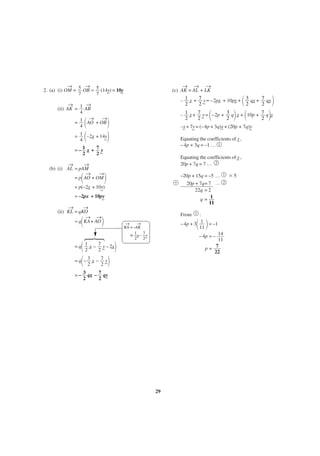
  • 12.
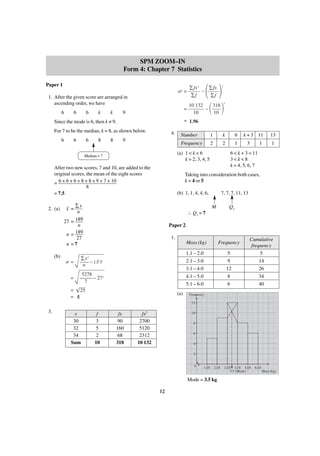
    SPM ZOOM–IN Form 4:Chapter 7 Statistics Paper 1 ␴2 = 1. After the given score are arranged in ascending order, we have 6 6 6 k k = 9 Since the mode is 6, then k ≠ 9. 6 6 8 8 4. 2 Number 1 k 6 2 2 1 (a) 1 < k < 6 k = 2, 3, 4, 5 After two new scores, 7 and 10, are added to the original scores, the mean of the eight scores = 6 + 6 + 6 + 8 + 8 + 9 + 7 + 10 8 = 7.5 (b) ΂ ΃ 10 132 318 – 10 10 Frequency 9 Median = 7 2. (a) 2 = 1.96 For 7 to be the median, k = 8, as shown below. 6 ΂ ΃ ∑fx 2 ∑fx – ∑f ∑f k + 3 11 3 1 13 1 6 < k + 3 < 11 3<k<8 k = 4, 5, 6, 7 Taking into consideration both cases, k = 4 or 5 (b) 1, 1, 4, 4, 6, – ∑x x = n 189 27 = n 189 n= 27 n =7 7, 7, 7, 11, 13 M Q3 ∴ Q3 = 7 Paper 2 1. Mass (kg) ␴= 1.1 – 2.0 2.1 – 3.0 3.1 – 4.0 4.1 – 5.0 5.1 – 6.0 ∑x 2 _ — – ( x )2 — n = Frequency 5278 — — – 27 2 — 7 = 25 = 5 (a) 5 9 12 8 6 Cumulative frequency 5 14 26 34 40 Frequency 12 3. x 30 32 34 Sum f 3 5 2 10 fx 90 160 68 318 fx2 2700 5120 2312 10 132 10 8 6 4 2 0 1.05 2.05 Mode = 3.5 kg 12 3.05 4.05 5.05 3.5 (Mode) 6.05 Mass (kg)
  • 13.
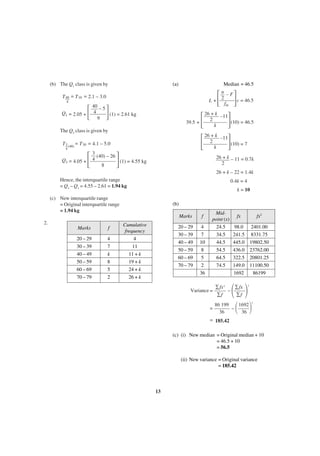
    (b) The Q1class is given by (a) Median = 46.5 ΄ ΅ n –F 2 c = 46.5 L+ fm T 40 = T 10 = 2.1 – 3.0 4 Q1 = 2.05 + ΄ 40 – 5 4 (1) = 2.61 kg 9 ΅ ΄ The Q3 class is given by ΄ T 3 (40) = T 30 = 4.1 – 5.0 4 Q3 = 4.05 + ΄ ΅ 26 + k– –11 2 (10) = 46.5 39.5 + k ΅ 3 (40) – 26 4 (1) = 4.55 kg 8 ΅ 26 + k– –11 2 (10) = 7 k 26 + k – 11 = 0.7k 2 26 + k – 22 = 1.4k Hence, the interquartile range = Q3 – Q1 = 4.55 – 2.61 = 1.94 kg 0.4k = 4 k = 10 (c) New interquartile range = Original interquartile range = 1.94 kg (b) Marks 2. Marks f 20 – 29 30 – 39 40 – 49 50 – 59 60 – 69 70 – 79 4 7 k 8 5 2 20 – 29 30 – 39 40 – 49 50 – 59 60 – 69 70 – 79 Cumulative frequency 4 11 11 + k 19 + k 24 + k 26 + k f 4 7 10 8 5 2 36 Midpoint (x) 24.5 34.5 44.5 54.5 64.5 74.5 Variance = = fx fx2 98.0 241.5 445.0 436.0 322.5 149.0 1692 2401.00 8331.75 19802.50 23762.00 20801.25 11100.50 86199 ΂ ΃ ∑fx 2 ∑fx – ∑f ∑f ΂ 2 86 199 1692 – 36 36 ΃ 2 = 185.42 (c) (i) New median = Original median + 10 = 46.5 + 10 = 56.5 (ii) New variance = Original variance = 185.42 13
  • 14.
    SPM ZOOM–IN Form 4:Chapter 8 Circular Measure Paper 1 1. 2. ∠BOC = 20º = 20 ϫ 3.142 rad 180 ΂ B C OB = π – 1.8 A 0.9 rad 8 cm O 0.9 rad 8 cm ΃ 15.36 = 44 cm 20 ϫ 3.142 180 ( ) D r= ∠BOC = π – ∠AOB – ∠COD = 3.142 – 0.9 – 0.9 = 1.342 rad. s θ 3. Area of the shaded region = Area of sector OAB – Area of sector OXY = 1 ϫ 82 ϫ 1.2 – 1 ϫ 5 ϫ 4 2 2 1 2 rθ 2 = 38.4 – 10 = 28.4 cm2 14 · · Area of sector BOC = 1 ϫ 82 ϫ 1.342 2 = 42.94 1 rs 2
  • 15.
    Paper 2 (c) Perimeterof the shaded region 1. = 2r sin θ + rθ 2 C ΂ = 2(10) sin 1.982 2 = 16.73 + 19.82 = 36.55 cm 6 cm 8 cm 8 cm M ΃ + 10(1.982) r B A (r – 6) cm 3. r cm D 4c O m (a) MO = r – 6 In ∆OMB, using Pythagoras’ theorem, MO2 + MB2 = OB2 (r – 6)2 + 82 = r2 MB = C 4c m 3 cm 1 1 AB = ϫ 16 = 8 cm 2 2 5 cm r =8 1 3 In ∆ADB, cos ∠ABD = 8 10 ∠ABD = 0.6435 rad (b) In ∆BOM, 8 81 3 (b) ∠AOD = 2 ϫ ∠ABD = 2 ϫ 0.6435 = 1.2870 rad sin ∠BOM = 24 25 ∠BOM = 1.287 rad. ∴ ∠AOB = 2 ϫ 1.287 = 2.574 rad. The angle at the centre is twice the angle at circumference. ∴ Length of the arc AD = 5 ϫ 1.2870 = 6.435 cm (c) Area of the shaded region 2 =1 ϫ 81 2.574 – sin 2.574r 2 3 = 70.71 cm2 ΂ ΃΂ 5 cm (a) Since ∆ADB is inscribed in a semicircle, it is a right-angled triangle. r2 – 12r + 36 + 64 – r2 = 0 –12r + 100 = 0 sin ∠BOM = B O A (c) Area of ∆ODB = 1 ϫ8ϫ3 2 = 12 cm2 ΃ 2. (a) ∠BOA = π – 0.822 = 1.160 rad. 2 ∴ ∠BOQ = π – 1.160 = 1.982 rad. Area of sector BOC = 1 ϫ 52 ϫ 0.6435 2 = 8.04375 cm2 (b) Area of the shaded region = 1 r 2 (θ – sin θ) 2 = 1 (10)2 (1.982 – sin 1.982 r ) 2 = 53.27 cm2 Hence, the area of the shaded region = Area of ∆ODB – Area of sector BOC = 12 – 8.04375 = 3.956 cm2 15
  • 16.
    SPM ZOOM–IN Form 4:Chapter 9 Differentiation Paper 1 4. z = xy z = x(30 – x) z = 30x – x2 dz = 30 – 2x dx 1 = (5x – k)–2 (5x – k)2 f ′(x) = –2(5x – k)–3 (5) = –10 3 (5x – k) 1. f (x) = f ′(1) –10 [5(1) – k]3 (5 – k)3 5–k k 2. = 10 = 10 = –1 =–1 =6 d 2z = –2 (negative) dx2 Hence, the maximum value of z = 30(15) – 152 = 225 y = (x + 1) (2x – 1)2 dy = (x + 1) 2 (2x – 1)1 (2) + (2x – 1)2 (1) dx = (2x – 1)[4(x + 1) + (2x – 1)] = (2x – 1)(6x + 3) [ 3. When z has a stationary value, dz = 0 dx 30 – 2x = 0 x = 15 ] 5. y= 1 = (2x – 5)–3 (2x – 5)3 dy = –3 (2x – 5)–4 (2) = – 6 dx (2x – 5)4 3 y = 2x – 4x + 5 dy = 6x2 – 4 dx δy ≈ dy δx dx δy ≈ dy ϫ δy dx = – 6 4 ϫ (3.01 – 3) (2x – 5) –6 = ϫ 0.01 [2(3) – 5]4 = – 0.06 Gradient at the point (–1, 7) = 6 (–1)2 – 4 =2 Equation of the tangent is y – 7 = 2[x – (–1)] y – 7 = 2(x + 1) y – 7 = 2x + 2 y = 2x + 9 6. A = 2πr 2 + 2πrh = 2πr 2 + 2πr(3r) = 8πr 2 dA = dA ϫ dr dt dt dr = 16πr ϫ 0.1 = 16π (5) ϫ 0.1 = 8π cm2 s–1 16
  • 17.
    Paper 2 1. (b) Whenp = –3 and k = 4, y = –3x3 + 4x dy = –9x 2 + 4 dx d 2 y = –18x dx2 y = 12 – 13 = x–2 – x–3 x x dy = –2x – 3 + 3x – 4 = – 2 + 3 dx x3 x4 2 d y = 6x– 4 – 12x– 5 = 6 – 12 x4 x5 dx2 At turning points, dy = 0 dx –9x2 + 4 = 0 x2 = 4 9 x =± 2 3 ΂ ΃ x ΂ – 2 + 3 + 6 – 12 ΃ + x x x x x4 dy + d y + x 2y + 5 = 0 dx dx 2 2 4 3 4 4 5 x2 ΂ x1 – x1 ΃ + 5 = 0 2 3 –2x + 3 + 6 – 12 + 1 – 1 + 5 = 0 x x –2x + 15 – 13 = 0 x 2 –2x + 15x – 13 = 0 2x2 – 15x + 13 = 0 (2x – 13)(x – 1) = 0 x = 13 or 1 2 When x = 2 , 3 ΂ ΃ + 4΂ 2 ΃ = 1 7 3 9 d y = – 18 2 = –12 (< 0) ΂ 3΃ dx ∴ ΂ 2 , 1 7 ΃ is a turning point which is 3 9 y = –3 2 3 2 2 2. (a) y = px3 + kx dy = 3px2 + k dx a maximum. When x = – 2 , 3 At (1, 1), x = 1 and m = dy = –5. dx ∴ 3px2 + k = –5 3p(1)2 + k = –5 3p + k = –5 … 1 ΂ ΃ + 4΂– 2 ΃ = –1 7 9 3 d y = –18 – 2 = 12 (> 0) ΂ 3΃ dx ∴ ΂ – 2 , –1 7 ΃ is a turning point which is 3 9 y = –3 – 2 3 – 2 2 2 a minimum. : 2p = –6 ⇒ p = –3 From 3 2 The curve passes through point (1, 1). ∴ 1 = p(1)3 + k(1) p+k=1… 2 : –3 + k = 1 ⇒ k = 4 1 3 17
  • 18.
    3. (b) V 4x m 5x m H E F G D 3xm y m At stationary point, dL = 0 dx 3888 = 0 192x – x2 192 x = 3888 x2 x 3 = 3888 192 C 6x m A 6x m L = 96x2 + 3888 = 96x2 + 3888x–1 x dL = 192x – 3888x–2 = 192x – 3888 dx x2 B (a) Volume of the cuboid = 5832 cm3 (6x)(6x)(y) = 5832 36x2y = 5832 x2y = 162 y = 162 x2 x 3 = 20.25 x = 2.73 L = Area of ABCD + 4 (Area of GBCH) + 4 (Area of VGH) L = (6x)2 + 4(6xy) + 4 ϫ 1 (6x)(5x) 2 L = 36x2 + 24xy + 60x2 L = 96x2 + 24xy L = 96x2 + 24x 162 x2 L = 96x2 + 3888 (shown) x d 2L = 192 + 7776x–3 = 192 + 7776 (> 0) x3 dx 2 ∴ L is a minimum. 4. ΂ ΃ y= h = h(1 + 2x)–2 (1 + 2x)2 dy = –2h(1 + 2x)–3 (2) = – 4h dx (1 + 2x)3 δy = dy ϫ δx dx 8c = – 4h – ϫc 3 (1 + 2x)3 4h – 8c = – ϫc 3 [1 + 2(1)]3 – 8c = – 4hc 3 27 h = 8 ϫ 27 3 4 h = 18 18
  • 19.
    SPM ZOOM–IN Form 4:Chapter 10 Solution of Triangles 2. (a) In ∆PQS, using the sine rule, sin ∠QSP = sin 35º 8 7 sin ∠QSP = sin 35º ϫ 8 7 sin ∠QSP = 0.65552 ∠QSP = 40.96º Paper 2 1. (a) ∠UST = 180º – 65º = 115º ∠SUT = 180º – 43º – 115º = 22º In ∆UST, using the sine rule, US = 9 sin 43º sin 22º US = 9 ϫ sin 43º sin 22º = 16.385 cm ∴ ∠PQS = 180º – 35º – 40.96º = 104.04º Hence, the area of ∆PQS = 1 ϫ 8 ϫ 7 ϫ sin 104.04º 2 U 22° = 27.16 cm2 16 (b) This problem involves the ambiguous case of sine rule. The sketch of ∆QRS1 is as shown below. .3 85 cm Q 115° 65° R 43° S 7 cm 9 cm T 10 cm (b) In ∆USR, using the cosine rule, UR2 = 72 + 16.3852 – 2(7)(16.385)cos 65º UR2 = 220.5238 UR = 14.85 cm 1 ϫ 7 ϫ 12 ϫ sin ∠RSV 2 sin ∠RSV Basic ∠ ∠RSV R 7 cm 7 cm 43° R S1 S In ∆QRS, using the sine rule, sin ∠QSR = sin 43º 10 7 sin 43º ϫ 10 sin ∠QSR = 7 Area of ∆RSV = 41.36 cm2 (c) 7 cm = 41.36 = 0.98476 = 79.98º = 180º– 79.98º = 100.02º sin ∠QSR = 0.974283 Basic ∠ = 76.98º ∴ ∠QSR = 76.98º or ∠QS1R = 103.02º S 100.02° In ∆QS1R, ∠RQS1 = 180º – 43º – 103.02º = 33.98º 12 cm In ∆QS1R, using the sine rule, RS1 10 = sin ∠RQS1 sin ∠RS1Q RS1 10 = sin 33.98º sin 103.02º 10 RS1 = ϫ sin 33.98º sin 103.02º = 5.737 cm V In ∆RSV, using the cosine rule, RV 2 = 72 + 122 – 2(7)(12)cos 100.02º RV 2 = 222.23064 RV = 14.91 cm 19
  • 20.
    SPM ZOOM–IN Form 4:Chapter 11 Index Numbers Paper 2 1. (a) (a) Supplement A x ϫ 100 = 120 400 x = 480 I2004 (based on 2002) = 115 P2004 ϫ 100 = 115 P2002 69 ϫ 100 = 115 P2002 P2002 = 69 ϫ 100 115 P2002 = RM60.00 P2004 I= P ϫ 100 2002 y = 525 ϫ 100 = 105 500 660 ϫ 100 = 110 z z = 600 (b) Supplement B I2006 (based on 2002) P = 2006 ϫ 100 P2002 P P = 2006 ϫ 2004 ϫ 100 P2004 P2002 = 130 ϫ 120 ϫ 100 100 100 = 156 – (b) I = 115 (120 ϫ 20) + 130m + (105 ϫ 80) + (110 ϫ 40) = 115 20 + m + 80 + 40 15 200 + 130m = 115 140 + m 15 200 + 130m = 16 100 + 115m 15m = 900 m = 60 (c) – (c) I 2006 (based on 2002) – = 100 + 25 ϫ I 2004 100 = 125 ϫ 115 100 = 143.75 (115 ϫ 3) + (120 ϫ 2) + 105x 3+2+x 585 + 105x 5+x 585 + 105x 30 x – (d) I 2006 (based on 2004) (d) Total yearly cost in 2006 = 143.75 ϫ 5 500 000 100 = RM7 906 250 = 111 = 111 = 555 + 111x = 6x =5 = (150 ϫ 3) + (130 ϫ 2) + (120 ϫ 5) 3+2+5 = 1310 10 = 131 P Thus, 2006 ϫ 100 = 131 P2004 P2006 ϫ 100 = 131 300 P2006 = 131 ϫ 300 100 P2006 = RM393 2. Health I2004 (based supplement on 2002) A 115 B 120 C 105 – I 2004 (based on 2002) = 111 I2006 (based Weightage on 2004) 150 3 130 2 120 x 20
  • 21.
    SPM ZOOM–IN Form 5:Chapter 1 Progressions 4. Paper 1 1. (a) T6 = 38 a + 5d = 38 a + 5(7) = 38 a =3 r = – 1 or 3 2 2 (b) S9 – S3 = 9 [2(3) + 8(7)] – 3 [2(3) + 2(7)] 2 2 = 279 – 30 = 249 2. (a) T2 – T1 2h – 1 – (h – 2) h+1 h 5. 0.242424 … = 0.24 + 0.0024 + 0.000024 + … a = 0.24 S∞ = 1 – 0.01 1–r = 0.24 0.99 = 24 99 = 8 33 = T3 – T2 = 4h – 7 – (2h – 1) = 2h – 6 =7 (b) When h = 7, the arithmetic progression is 5, 13, 21, … with a = 5 and d = 8. 6. The numbers of bacteria form a geometric progression 3, 6, 12, … S8 – S3 = 8 [2(5) + 7(8)] – 3 [2(5) + 2(8)] 2 2 = 264 – 39 = 225 3. T3 – T2 = 3 ar 2 – ar = 3 4r 2 – 4r = 3 2 4r – 4r – 3 = 0 (2r + 1)(2r – 3) = 0 The number of bacteria after 50 seconds = T11 = ar10 = 3(210) = 3072 Paper 2 1. (a) The volumes of cylinders are πr 2h, πr 2 (h + 1), πr 2 (h + 2), … T2 T3 = T1 T2 x+2 = x–4 9x + 4 x+2 (x = (x – 4)(9x + 4) x2 + 4x + 4 = 9x2 – 32x – 16 2 8x – 36x – 20 = 0 2x2 – 9x – 5 = 0 (2x + 1)(x – 5) = 0 x = – 1 or 5 2 T2 – T1 = πr 2 (h + 1) – πr 2h = πr 2h + πr 2 – πr 2h = πr2 T3 – T2 = πr 2 (h + 2) – πr 2 (h + 1) = πr 2h + 2πr 2 – πr 2h – πr 2 = πr2 Since T2 – T1 = T3 – T2 = πr 2, the volumes of cylinders form an arithmetic progression with a common difference of πr2. 21
  • 22.
    2. (a) (b) a= πr 2h, d = πr 2 T4 = 32π a + 3d = 32π πr 2h + 3πr 2 = 32π r 2h + 3r 2 = 32 r 2 (h + 3) = 32 … 2 1 1 2 : a (1 + r) = 150 45 ar (r – 1) 1 + r = 10 r (r – 1) 3 1 2 2 3 + 3r = 10r2 – 10r 10r – 13r – 3 = 0 (2r – 3)(5r + 1) = 0 r = 3 or – 1 2 5 2 2 : r 2(2h + 3) = 52 32 r (h + 3) 2h + 3 = 13 h+3 8 16h + 24 = 13h + 39 3h = 15 h =5 From 1 r 2 (5 + 3) r2 r = 150 = 150 = 150 = 150 … T3 – T2 = 45 ar 2 – ar = 45 ar (r – 1) = 45 … 1 S4 = 104π 4 (2a + 3d) = 104π 2 4a + 6d = 104π 4πr 2h + 6πr 2 = 104π 2r 2h + 3r 2 = 52 r 2 (2h + 3) = 52 … S2 T1 + T2 a + ar a (1 + r) (b) For the sum to infinity to exist, – 1 < r < 1. Thus, r = 3 is not accepted. 2 Therefore, r = – 1 5 : = 32 =4 =2 From 1 : 1 = 150 a 1– 5 ΂ ΃ a = 187 1 2 1 187 a 2 ∴ S∞ = = 1–r 1– –1 5 ΂ ΃ 22 = 156 1 4
  • 23.
    SPM ZOOM–IN Form 5:Chapter 2 Linear Law Paper 2 Paper 1 y = 2 + qx x y = 2 +q x x2 y =2( 1 )+q x x2 1. 1 x2 1. (a) y = hxk log10 y = log10 (hxk) 1 log10 y 2 = log10 h + log10 xk 1 log y = log h + klog x 10 10 2 10 log10 y = 2log10 h + 2klog10 x y x log10 y = 2k log10 x + 2 log10 h 5 = 2(1) + q q=3 (1, 5) (b) 1 x2 q=3 y x (3, p) 2. y k lg x x lg y – lg k p = 2(3) + 3 p=9 1.5 142 0.18 2.15 2.0 338 0.30 2.53 2.5 660 0.40 2.82 3.0 1348 0.48 3.13 3.5 1995 0.54 3.30 The graph of log10 y against log10 x is as shown below. =p = lg p y k x y log 10 x log 10 y x log10 y = lg p Graph of log10 y against log10 x 3.5 lg y – x lg k = lg p 3.0 lg y = x lg k + lg p ∴ Y = lg y, X = x, m = lg k, c = lg p 2.0 2 3. y – ax = b2 x x 2 3 xy – ax = b xy2 = ax3 + b 1.0 0.5 O x3 1 xy2 – 2 : 12 = –6a a = –2 From 2 : 0.55 – 0.06 = 0.49 1.55 1.5 10 = a(–1) + b … 1 –2 = a(5) + b … 2 (–1, 10): (5, –2): 3.35 – 1.75 = 1.6 2.5 –2 = –2(5) + b b =8 23 0.1 0.2 0.3 0.4 0.5 0.6 log10 x
  • 24.
    (c) 2k =Gradient 2k = 3.35 – 1.75 0.55 – 0.06 2k = 3.2653 k = 1.63 2 log10 h 2 log10 h log10 h h (b) (i) 1 = y 1 = x+p y2 q 1 = 1x+ p y2 q q = Y–intercept = 1.55 = 0.775 = 5.96 Gradient = x y 0.1 0.3 0.78 0.60 0.4 0.54 0.5 0.50 0.7 0.44 0.8 0.42 1 y2 1.64 2.78 3.43 4.00 5.17 5.67 Graph of Y-intercept p q p 0.17 p 1 against x y2 4.6 – 2 0.6 – 0.16 = 1.1 = 1.1 = 1.1 = 0.19 (ii) When x = 0.6, from the graph, 1 = 4.6 y2 y2 = 0.2174 y = 0.47 5.0 4.6 4.5 4.0 3.5 4.6 – 2 = 2.6 3.0 2.5 2.0 0.6 – 0.16 = 0.44 1.5 1.1 1.0 0.5 O Squaring both sides. 1 = 5.91 q q = 0.17 2. (a) 1 y2 5.5 x+p q 0.1 0.2 0.3 0.4 0.5 0.6 0.7 0.8 x 24
  • 25.
    SPM ZOOM–IN Form 5:Chapter 3 Integration 4. Area of the shaded region Paper 1 (y – 5) dy = 8 5 k ] [ ΂ 2 2 = k 1. ΃ 2 = = –1 y2 –5y = 8 5 2 2 k – 5k – 5 – 5(5) = 8 2 2 2 k – 5k + 25 = 8 2 2 k2 – 10k + 25 = 16 k2 – 10k + 9 = 0 (k – 1)(k – 9) = 0 k = 1 or 9 –1 y dx (x2 – 2x + 1) dx 2 [ x3 – x + x] 3 2 –1 ΂ ΃ = 8 – 4 + 2 – – 1 –1 – 1 3 3 = 3 units2 Paper 2 y 1. y = –x3 – x 2. 2 –1 4 3g (x) dx + [ = 3[ =3 2 –1 4 –1 2 3g (x) dx 4 g(x) dx + 2 ] g(x) dx 1O ] g(x) dx x 2 P Q = 3(20) = 60 3. dy = x4 – 8x3 + 6x2 dx y= ΂ 4 3 Area P 0 x – 8x + 6x 5 ΃ 2 –1 dx 0 = ΂ ΃ ΂ ΃+c 4 y dx 3 y = x –8 x +6 x 5 4 3 5 4 3 y = x – 2x + 2x + c 5 –1 (–x3 –x) dx 0 [ ] 4 2 = – x – x 4 2 –1 (–1)4 – (–1)2 =0– – 4 2 = 1 + 1 4 2 = 3 4 [ Since the curve passes through the point ΂1, – 1 4 ΃, 5 – 9 = 1 –2 + 2 + c 5 5 c = –2 Area Q Hence, the equation of the curve is 5 y = x – 2x4 + 2x3 – 2. 5 = 2 0 y dx 2 0 [ (–x3 – x) dx 2 ] 4 2 = – x – x 4 2 0 24 – 22 – 0 =– 4 2 = –4 – 2 = –6 25 ]
  • 26.
    Hence, the totalarea of the shaded region = Area P + |Area Q| = 3 + |–6| 4 = 6 3 units2 4 2. (a) (b) When h = 1 and k = 4, y = x2 + 4 y y = x2 + 4 P y = hx2 + k dy = 2hx dx x =3 4 At the point (–2, 8), the gradient of the curve is – 4. ∴ dy = – 4 dx 2hx = – 4 2h (–2) = – 4 – 4h = – 4 h =1 x O 2 3 Q Volume generated, Vx = Volume generated by the curve – Volume generated by the straight line PQ (from x = 0 to x = 2) 3 = π 0 y2 dx – 1 πr2h 3 3 2 2 = π 0 (x + 4) dx – 1 π(4)2 (2) 3 3 4 2 = π 0 (x + 8x + 16) dx – 32 π 3 3 5 3 32 π = π x + 8x + 16x – 0 3 5 3 5 = π 3 + 8 (3)3 + 16(3) – 0] – 32 π 3 3 5 14 π units3 = 157 15 The curve y = hx2 + k passes through the point (–2, 8). ∴ 8 = h(–2)2 + k 8 = 4h + k 8 = 4(1) + k k =4 [ [ 26 ]
  • 27.
    SPM ZOOM–IN Form 5:Chapter 4 Vectors Paper 1 4. (a) If the vectors _ and _ are parallel, then a b → → 1. (a) EA = 3 DC = 3 (12p) = 9p _ _ 4 4 a = hb (h is a constant). _ _ 2i – 5j = h(ki – 3j) _ _ _ _ 2i – 5j = hki – 3hj _ _ _ _ → → (b) EQ = 1 ED 2 → → → → = 1 EA + AB + BC + CD 2 Equating the coefficients of _ j –3h = –5 h= 5 3 ΂ ΃ = 1 ΂ 9p – 6r – 9q – 12p΃ _ _ _ 2 _ = 1 ΂ – 3p – 6r – 9q ΃ _ _ _ 2 Equating the coefficients of _ i hk = 2 5 k =2 3 k= 6 5 → → → 2. XY = XD + DY → → = 1 BD + 2 DC 2 3 → → → = 1 BA + AD + 2 AB 2 3 (b) ΂ ΃ = 1 ΂ –6b + 2a΃ + 2 (6b) _ _ 2 3 _ |a| 5 |b| = 3 |a| : |b| = 5 : 3 = –3b + _ + 4b _ a _ =_ +_ a b → → → 5. (a) AC = AB + BC = 9i – 4j + (–6i + mj ) _ _ _ _ 3. (a) _ + 1 _ + 2c a b _ 5 = 7j + 1 (10i – 5j ) + 2(–4i +_ ) _ _ _ j _ 5 = 7j + 2i – _ – 8i + 2j _ _ j _ _ = 3i + (m – 4)_ _ j → (b) If AC is parallel to the x-axis, the coefficient of _ equals zero. j m–4 =0 m =4 = – 6i + 8j _ _ (b) |a + 1 _ + 2c | = (–6)2 + 82 = 10 b _ _ 5 Hence, the unit vector in the direction of a 1b _ _ + _ + 2c 5 ΂ = 1 –6i + 8j _ _ 10 a _ = hb _ 5 a _ = b _ 3 ΃ = – 3_ + 4_ i j 5 5 27
  • 28.
    Paper 2 (c) Sincethe points O, T and S are collinear, → → then, OT = kOS , where k is a constant. → → → 1. (a) OT = OA + AT → = 4x + 1 AQ _ 3 → → = 4x + 1 (AO + OQ ) _ 3 = 4x + 1 (–4x + 6y) _ _ _ 3 = 8 _ + 2y x _ 3 → → OT = kOS 8 _ + 2y = k [(6 – 6h)y + 16hx x _ _] _ 3 8 _ + 2y = k (6 – 6h)y + 16hkx x _ _ _ 3 8 _ + 2y = (6k – 6hk)y + 16hkx x _ _ _ 3 → → → (b) OS = OQ + QS → = 6y + hQP _ → → = 6y + h(QO + OP ) _ → → = 6y + h(QO + 4OA ) _ Equating the coefficients of _, x 8 = 16hk 3 1 = 6hk hk = 1 … 1 6 = 6y + h[–6y + 4(4x _)] _ _ Equating the coefficients of _, y 6k – 6hk = 2 … 2 = (6 – 6h) _ + 16hx y _ Substituting 1 into ΂ ΃ 6k – 6 1 = 2 6 6k = 3 k= 1 2 From 2 : hk = 1 6 ΂ ΃ h 1 =1 2 6 h= 1 3 28 2 :
  • 29.
    → → 2. (a) (i)OM = 5 OB = 5 (14y) = 10y _ _ 7 7 → → → (c) AK = AL + LK ΂ _ _ – 1 _ + 7 _ = –2px + 10py + 3 qx + 7 qy x y _ _ 2 2 2 2 → → (ii) AK = 1 AB 4 → → = 1 AO + OB 4 ΂ –x + 7y = (–4p + 3q)x + (20p + 7q)y _ _ _ _ Equating the coefficients of _ , x – 4p + 3q = –1 … 1 =– 1 _ + 7_ x y 2 2 Equating the coefficients of _ , y 20p + 7q = 7 … 2 → → (b) (i) AL = pAM → → = p AO + OM ΃ + = p(–2x + 10y) _ _ = –2px + 10py _ → → (ii) KL = qKO → → = q KA + AO ΃ · ΂ ΃ – 1 _ + 7 _ = –2p + 3 q _ + 10p + 7 q _ x y x y 2 2 2 2 ΂ ΃ = 1 ΂ –2x + 14y΃ _ _ 4 ΂ ΃ ΂ ΃ –20p + 15q = –5 … 20p + 7q= 7 … 22q = 2 q= 1 11 From 1 2 1 : – 4p + 3 1 = –1 11 ΂ ΃ → → KA = –AK = 1_ – 7_ x y 2 2 – 4p = – 14 11 7 p= 22 ΂ ΃ = q΂ – 3 _ – 7 _΃ x y 2 2 = q 1 _ – 7 _ – 2x x y _ 2 2 = – 3 qx – 7 qy _ 2 2 _ 29 ϫ5
  • 30.
    WebsiteZI F505_4th pp 10/15/08 9:40AM Page 30 SPM ZOOM–IN Form 5: Chapter 5 Trigonometric Functions Paper 1 3. 3 tan θ = 2 tan (45º – θ) 3 tan θ = 2 45º – ΂ 1tantan 45ºtan θθ ΃ + tan 3 tan θ = 2 1. – tan ΂ 11 + tan θθ ΃ 1 + p2 θ 1 O –p 3 tan θ + 3 tan2 θ = 2 – 2 tan θ 3 tan2 θ + 5 tan θ – 2 = 0 (3 tan θ – 1)(tan θ + 2) = 0 tan θ = 1 or tan θ = –2 3 sin (90º – θ) = cos θ =– p When tan θ = 1 , 3 Basic ∠ = 18.43º θ = 18.43º, 198.43º 1 + p2 2. 3 – 10 tan x = 0 cos2 x 3 sec2 x – 10 tan x = 0 2 3(tan x + 1) – 10 tan x = 0 3 tan2 x + 3 – 10 tan x = 0 3 tan2 x – 10 tan x + 3 = 0 (3 tan x – 1)(tan x – 3) = 0 tan x = 1 or tan x = 3 3 When tan θ = –2, Basic ∠ = 63.43º θ = 116.57º, 296.57º ∴ θ = 18.43º, 116.57º, 198.43º, 296.57º When tan x = 1 , 3 x = 18.43º, 198.43º When tan x = 3, x = 71.57º, 251.57º ∴ x = 18.43º, 71.57º, 198.43º, 251.57º 30
  • 31.
    WebsiteZI F505_4th pp 10/15/08 9:40AM Page 31 Paper 2 2. (a), (b) 1. (a) LHS = = = y 1 – cos 2x sin 2x y = 3 sin x 2 3 2 1 – (1 – 2 sin2 x) 2 sin x cos x O ␲ 2␲ x –2 2 sin2 x 2 sin x cos x y = 2 – 2x 2 sin x cos x = tan x = RHS = x 2x + =2 2 π x 2x 3 sin =2– 2 π 3 sin (b) (i), (ii) The graph of y = |tan x| is as shown below. Sketch the straight line y = 2 – x y y y= π 0 2 2π –2 (2π, 1) O π π 3π 2 π Number of solution = Number of intersection point =1 x 1 – cos 2x x – =0 sin 2x 2π 1 – cos 2x x = sin 2x 2π x |tan x| = 2π Sketch the straight line y= x . 2π Number of solutions = Number of points of intersection =4 31 2x π
  • 32.
    WebsiteZI F506_4th pp 10/15/08 9:40AM Page 32 SPM ZOOM–IN Form 5: Chapter 6 Permutations and Combinations Paper 1 3. Number of different committees that can be formed 1. Number of arrangements 2 1 2 3 3P 2 2 5 Choosing a female secretary and a female treasurer from 7 females 3P 2 3P 2 = 4C1 ϫ 7C2 ϫ 8C3 Hence, the number of 4-digit odd numbers greater than 2000 but less than 3000 that can be formed = 3 ϫ 3P2 = 18 Choosing a male president from 4 males = 4704 2. Each group of boys and girls is counted as one item. B1, B2 and B3 √ This gives 2!. G1, G2 and G3 √ √ √ √ At the same time, B1, B2, and B3 can be arranged among themselves in their group. This gives 3!. √ √ √ In the same way, G1, G2, and G3 can also be arranged among themselves in their group. This gives another 3!. Using the multiplication principle, the total number of arrangements = 2! ϫ 3! ϫ 3! = 72 32 Choosing 3 subcommittee members from 8 (males or females).
  • 33.
    SPM ZOOM–IN Form 5:Chapter 7 Probability Paper 1 1. P(Not a green ball) = 3 5 h+5 = 3 h+k+5 5 5h + 25 = 3h + 3k + 15 2h = 3k – 10 h = 3k – 10 2 2. P (not getting any post) =2 ϫ3 ϫ4 3 5 7 8 = 35 – 3. There are 3 ‘E’ and 4 ‘E ’ in the bag (a) P(EE) = 3 ϫ 2 = 1 7 6 7 – (b) P(EE ) = 3 ϫ 4 = 2 7 6 7 33
  • 34.
    SPM ZOOM–IN Form 5:Chapter 8 Probability Distributions Paper 1 3. (a) X – Mass of a crab, in g X ∼ N(175, 15) 1. X – Number of penalty goals scored X ∼ B n, 3 5 P(X = 0) = 16 625 ΂ ΃ ΂ ΃΂ ΃ Co 3 5 n Z = X–µ σ = 190 – 175 15 =1 0 2 5 n = 16 625 (b) P(175 < X < 190) = P 175 – 175 < Z < 190 – 175 15 15 = P (0 < Z < 1) = 0.5 – 0.1587 = 0.3413 ΂ 16 ΂ ΃ = 625 ΂ 2 ΃ =΂ 2΃ 5 5 (1)(1) 2 5 n n 4 ΃ 0.1587 ∴n =4 O 2. X ∼ N(55, 12 ) Area of the shaded region P (X < 37) = P Z < 37 – 55 12 = P (Z < –1.5) 0.0668 = 0.0668 2 ΂ 4. 0.1841 ΃ –0.9 P(Z > – 0.9) = 0.8159 ∴ k = –0.9 –1.5 34 0.8159 1
  • 35.
    (ii) P(10 <X < 13) = P 10 – 12 < Z < 13 – 12 3.1201 3.1201 = P(–0.641 < Z < 0.321) = 1 – 0.2608 – 0.3741 0.2608 = 0.3651 Paper 2 ΂ 1. (a) X – Number of blue beads drawn ΂ ΃ X ∼ B΂ 10, 1 ΃ 3 X ∼ B 10, 6 18 0.3741 –0.641 (i) P(X ≥ 3) = 1 – P(X = 0) – P(X = 1) – P(X = 2) ΂ ΃ ΂2΃ 3 C΂1΃ ΂2΃ 3 3 = 1 – 10C0 1 3 – 10 ΃ 0 10 2 2. (a) X – Number of customers requiring a supplementary card ΂ ΃ ΂2΃ 3 – 10C1 1 3 0.321 1 ΂ ΃ X ∼ B΂ 7, 14 ΃ 25 9 X ∼ B 7, 280 500 8 2 = 0.7009 (i) P(X = 3) ΂ ΃ ΂ 11 ΃ 25 (ii) Mean = np = 10 ϫ 1 = 3 1 3 3 = 7C3 14 25 = 0.2304 Standard deviation = npq ΂ ΃΂ ΃ C ΂ 14 ΃ ΂ 11 ΃ 25 25 ΂ ΃΂ ΃ 5 2 = 0.1402 P(X > 8) = 90% ΂ 2 7 (b) X – Lifespan of a species of dog X ∼ N(12, σ2) (b) X – Time taken to settle invoices X ∼ N(30, 52) ΃ P΂ Z > –4 ΃ = 0.9 σ P Z > 8 – 12 σ 4 (ii) P(X = 3) = P(X = 0) + P(X = 1) + P(X = 2) 0 11 7 +7C 14 1 11 6 + = 7C0 14 1 25 25 25 25 = 10 ϫ 1 ϫ 2 3 3 = 1.49 (i) 3 = 0.9 (i) P(28 ≤ X ≤ 36) ΂ = P 28 – 30 ≤ Z ≤ 36 – 30 5 5 = P(–0.4 ≤ Z ≤ 1.2) = 1– 0.3446 – 0.1151 = 0.5403 0.9 0.1 –1.282 0.3446 0.1151 – 4 = –1.282 σ –0.4 σ = 3.1201 years 35 1.2 ΃
  • 36.
    (ii) P(X <22) ΂ = P Z < 22 – 30 5 = P(Z < –1.6) = 0.0548 ΃ Hence, the expected number of invoices which are given discounts = 0.0548 ϫ 220 = 12 36
  • 37.
    SPM ZOOM–IN Form 5:Chapter 9 Motion Along a Straight Line Paper 2 (c) When particle A reverses its direction, vA = 0 12 + t – t2 = 0 t2 – t – 12 = 0 (t + 3)(t – 4) = 0 t = –3 or 4 t = –3 is not accepted ∴t=4 1. (a) For particle A, at maximum velocity, dvA = 0 dt 1 – 2t = 0 t= 1 2 d 2vA = –2 (negative) dt 2 vB = dsB dt vB = 6t2 – 14t – 15 ΂ ΃ Hence, vmax = 12 + 1 – 1 2 2 = 12 1 m s–1 4 2 aB = dvB dt aB =12t – 14 (b) sB = 2t 3 – 7t 2 – 15t When particle B returns to O, sB = 0 2t 3 – 7t 2 – 15t = 0 t(2t 2 – 7t – 15) = 0 t(2t + 3)(t – 5) = 0 t = 0, – 3 or 5 2 t = 0 and t = – 3 are not accepted 2 ∴t=5 When t = 4, aB =12(4) – 14 = 34 m s–2 2 (a) a = 12 – 6t v = a dt v = (12 – 6t) dt v = 12t – 3t2 + c When t = 0, v = 15. Thus, c = 15 ∴ v = 12t – 3t2 + 15 At maximum velocity, dv = 0 dt 12 – 6t = 0 t=2 sA = vA dt sA = (12 + t – t2) dt 2 3 sA = 12t + t – t + c 2 3 When t = 0, sA = 0. ∴ c = 0 2 3 ∴ sA = 12t + t – t 2 3 When t = 2, v = 12(2) – 3(2)2 + 15 = 27 m s–1 d2v = –6 (< 0) dt2 Therefore, v is a maximum. When t = 5, 2 3 sA = 12(5) + 5 – 5 = 30 5 m 6 2 3 37
  • 38.
    (b) s =v dt s = (12t – 3t2 + 15) dt s = 6t 2 – t 3 + 15t + c When t = 0, s = 0. Thus, c = 0. ∴ s = 6t 2 – t 3 + 15t (c) When the particle travels to the right, v >0 12t – 3t 2 + 15 > 0 3t 2 – 12t – 15 < 0 t 2 – 4t – 5 < 0 (t + 1)(t – 5) < 0 At maximum displacement, ds = 0 dt 12t – 3t2 + 15 = 0 3t2 – 12t – 15 = 0 t2 – 4t – 5 = 0 (t – 5)(t + 1) = 0 t = 5 or –1 t = –1 is not accepted ∴t=5 –1 5 t –1 < t < 5 Since the values of t cannot be negative, therefore 0 ≤ t < 5. When t = 5, s = 6(5)2 – 53 + 15(5) = 100 m d 2s = 12 – 6t dt 2 2 When t = 5, d s = 12 – 6(5) = –18 dt 2 Therefore, s is a maximum. 38
  • 39.
    SPM ZOOM–IN Form 5:Chapter 10 Motion Along a Straight Line (c) (i) x = 4 y 3 3x = 4y y = 3x 4 Paper 2 1. (a) I 180x + 90y ≤ 5400 2x + y ≤ 60 x y 0 60 30 0 The furthest point on the straight line y = 3 x 4 inside the feasible region R is (20,15). ∴ xmax = 20, ymax = 15 II 3x + 4y ≤ 120 x y III 0 30 40 0 0 0 30 60 (ii) Profits = 200x + 150y Draw the straight line 200x + 150y = 3000 y ≤ 2x x y 200 ϫ 150 ϫ 0.1 = 3000 The optimal point is (24, 12). (b) Hence, the maximum profit = 200(24) + 150(12) = RM6600 y 60 2x + y = 60 2. (a) Mixing: 30x + 10y ≤ 15 ϫ 60 3x + y ≤ 90 y = 2x 50 Baking: 40x + 40y ≤ 26 2 ϫ 60 3 x + y ≤ 40 40 30 y= 3 x 4 Decorating: 10x + 30y ≤ 15 ϫ 60 x + 3y ≤ 90 (20, 15) 20 Max (24, 12) 10 R 3x + 4y = 120 O 10 15 20 200x + 150y = 3000 30 40 x 39 x y 0 90 30 0 x y 0 40 40 0 x y 0 30 90 0
  • 40.
    (b) y 90 80 70 3x + y= 90 60 50 40 Max (15, 25) 30 20 17 R x + 3y = 90 10 5 O x + y = 40 5x + 10y = 50 10 2023 30 40 50 (c) (i) When y = 17, xmax = 23 (ii) Profits = 5x + 10y Draw the straight line 5x + 10y = 50. From the graph, the optimal point is (15, 25). Hence, the maximum profit = 5(15) + 10(25) = RM325 40 60 70 80 90 x