Downloaded 632 times
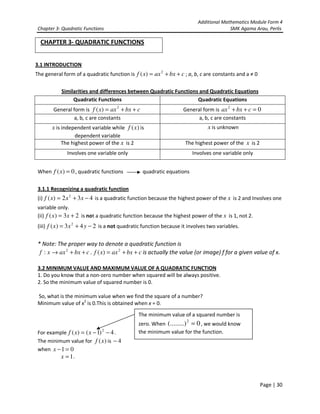
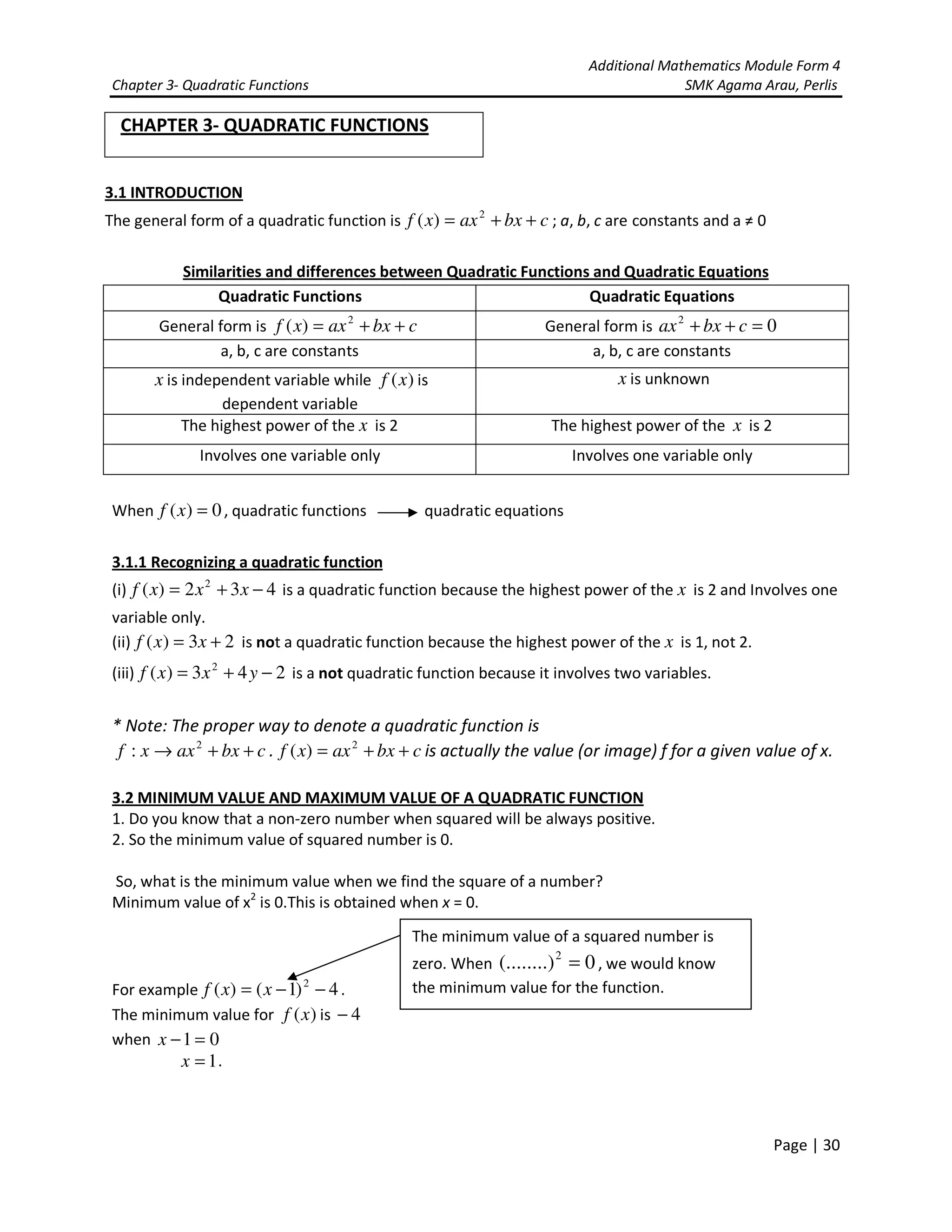
![Additional Mathematics Module Form 4
Chapter 3- Quadratic Functions SMK Agama Arau, Perlis
Page | 32
Example 2:
Express 1482)( 2
−+−= xxxf in form f(x) = a (x + p)2
+ q. Hence, find the coordinates of the turning
point of the graph.
1482)( 2
−+−= xxxf
]7)2()2(4[2 222
+−−−+−−= xx
]74)2[(2 2
+−−−= x
]3)2[(2 2
+−−= x
6)2(2 2
−−−= x
The maximum value for 6)( −=xf
when 02 =−x ( 2, -6)
2=x
EXERCISE 3.2
1. State the minimum value of the following function and the corresponding value of x
(a) 8)1()( 2
−+= xxf
(b) 152)( 2
−+= xxxg
2. State the maximum value of the following function and the corresponding value of x
(a) 342)( 2
++−= xxxf
(b) 52)( 2
−+−= xxxg
3. Given that the minimum value of the quadratic function qpxxxf ++= 2
2)( is 1 when 3−=x , find
the value of p and of q.
This is in the form a (x + p)2
+ q. The value
of a is -2 which is less than 0.
The coordinates of the turning point means
the coordinates of the minimum of maximum
point for the function. For this question, it is
maximum point because a < 0](https://image.slidesharecdn.com/chapter3-quadratcfunctions-130531233447-phpapp02/85/Chapter-3-quadratc-functions-3-320.jpg)
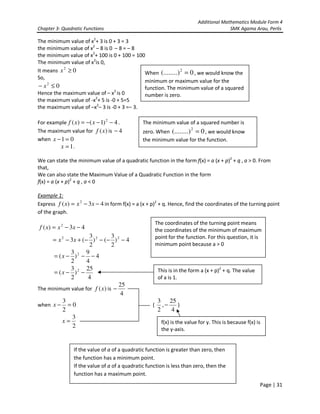
![Additional Mathematics Module Form 4
Chapter 3- Quadratic Functions SMK Agama Arau, Perlis
Page | 34
Example 3:
Sketch the graph of 34)( 2
+−= xxxf
34)( 2
+−= xxxf
3)2()2(4)( 222
+−−−+−= xxxf
34)2()( 2
+−−= xxf
1)2()( 2
−−= xxf
The minimum value of 3)( =xf
when 02 =−x
2=x
Minimum point is (2,3).
0=x ,
3)0(4)0()0( 2
+−=f
3=
The point is (0,3)
Example 4:
Express the function 2
241)( xxxf −+= in the form of a(x+ p)2
+ q. Hence
(a) state the minimum or maximum point.
(b) the equation of axis 0f symmetry
)
2
1
2(2)( 2
−−−= xxxf
]
2
1
)1()1(2[2 222
−−−−+−−= xx
a = 1, b = −4 and c = 3
a = −2, b = 4 and c = 1
By using the information given,
sketch the graph.](https://image.slidesharecdn.com/chapter3-quadratcfunctions-130531233447-phpapp02/85/Chapter-3-quadratc-functions-5-320.jpg)
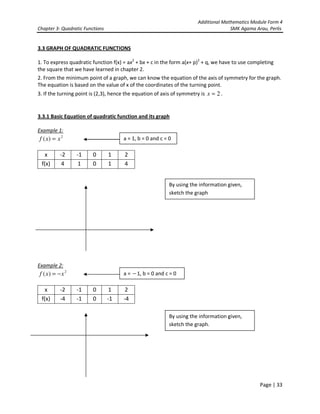
![Additional Mathematics Module Form 4
Chapter 3- Quadratic Functions SMK Agama Arau, Perlis
Page | 35
]
2
1
1)1[(2 2
−−−−= x
]
2
1
1)1[(2 2
−−−−= x
]
2
1
1)1[(2 2
−−−−= x
]
2
3
)1[(2 2
−−−= x
3)1[(2 2
+−−= x
The maximum value of 3)( =xf
when 01 =−x
1=x
So, the maximum point is (1, 3).
The equation of axis of symmetry is 1=x .
EXERCISE 3.3
1. Express the quadratic function 13122
+−= xxy in the form of cbxy ++= 2
)( . State the minimum
point and the y-intercept. Hence, sketch the graph of the function y.
2. Express the quadratic function xxxf 42)( 2
−−= in the form of 2
)()( pxqxf +−= . Determine
the maximum point and the y-intercept. Hence, sketch the graph of the function f(x).
3. Given that the curve 2
)2( nxmy +−= has a maximum point (1, 4), find the values of m and of n.
Hence, sketch the curve.
4. For the quadratic function 2
( ) 2 3 2g x x x= − + , find the equation of the axis of symmetry.
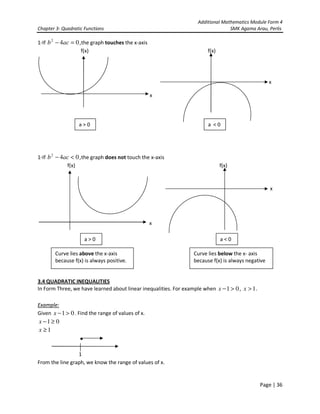
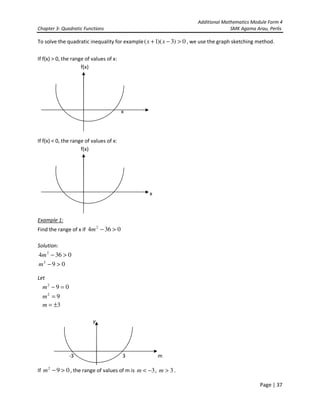
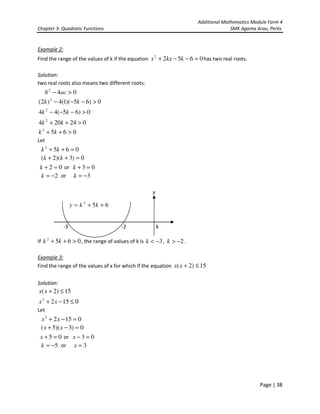
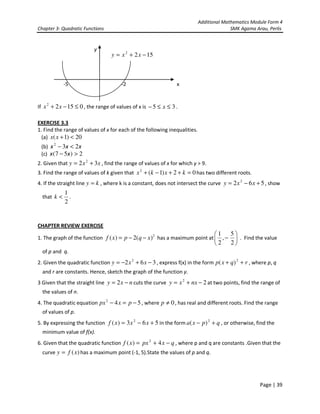
3.4 RELATIONSHIP BETWEEN “b2
– 4ac” AND THE POSITION OF GRAPH f(x)= y
1-If 042
>− acb ,the graph cuts x-axis at two different points
f(x) f(x)
x x
a < 0, so it is maximum value
a > 0 a < 0](https://image.slidesharecdn.com/chapter3-quadratcfunctions-130531233447-phpapp02/85/Chapter-3-quadratc-functions-6-320.jpg)

The document provides information about quadratic functions including: - The general form of a quadratic function is f(x) = ax2 + bx + c. - A quadratic function has a minimum or maximum point which can be used to find the axis of symmetry. - The relationship between the discriminant (b2 - 4ac) and the position of the graph is explained. If it is greater than 0, the graph cuts the x-axis at two points. If it is equal to 0, the graph touches the x-axis at one point. If it is less than 0, the graph does not cut or touch the x-axis. - Quadratic inequalities can be solved by sketching


