EDEXCEL DECISION MATHEMATICS D1 (6689) – JANUARY 2013 FINAL MARK SCHEME
Question
Number
Scheme Marks
1 (a)
N E R Qn
72 8 8.5 N
8.5 8.485 294 118 N
8.485 294 118 8.485 281 374 N
8.485 281 374 8.485 281 374 Y
Output is R = 8.485 281 4
M1
A1
A1
A1ft (4)
(b) We would get a negative output for R/ We would get the negative
square root
B1 (1)
(c) E cannot be zero
B1 (1)
Total
6 marks
2 (a)
Pivot 1 = [ ] [ ] 145.132
261
==+
letter N reject A – N M1 A1
Pivot 2 = [ ] [ ] 215.202
2615
==+
letter U reject U – Z
Pivot 3 = [ ] [ ] 185.172
2015
==+
letter R reject R – T A1
Pivot 4 = [ ] 162
1715
=+
letter P – located A1 (4)
(b)
E.g. The maximum number of letters at the start of each iteration is
26, 13, 6, 3, 1
M1
So a maximum of 5 iterations is necessary A1 (2)
Total
6 marks
EDEXCEL DECISION MATHEMATICS D1 (6689) – JANUARY 2013 FINAL MARK SCHEME
Question
Number
Scheme Marks
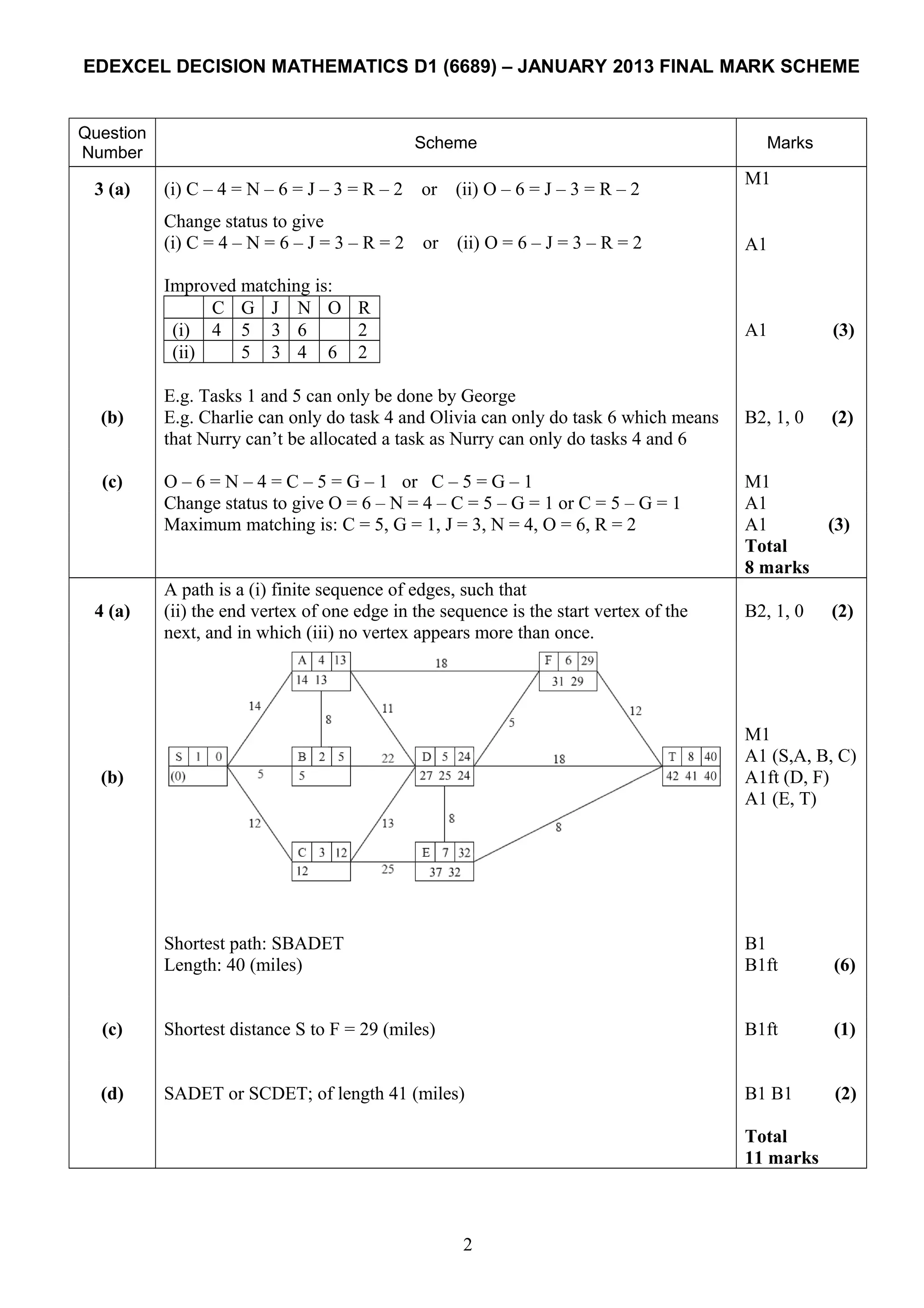
3 (a) (i) C – 4 = N – 6 = J – 3 = R – 2 or (ii) O – 6 = J – 3 = R – 2
M1
Change status to give
(i) C = 4 – N = 6 – J = 3 – R = 2 or (ii) O = 6 – J = 3 – R = 2
Improved matching is:
C G J N O R
(i) 4 5 3 6 2
(ii) 5 3 4 6 2
A1
A1 (3)
(b)
E.g. Tasks 1 and 5 can only be done by George
E.g. Charlie can only do task 4 and Olivia can only do task 6 which means
that Nurry can’t be allocated a task as Nurry can only do tasks 4 and 6
B2, 1, 0 (2)
(c) O – 6 = N – 4 = C – 5 = G – 1 or C – 5 = G – 1 M1
Change status to give O = 6 – N = 4 – C = 5 – G = 1 or C = 5 – G = 1 A1
Maximum matching is: C = 5, G = 1, J = 3, N = 4, O = 6, R = 2 A1 (3)
Total
8 marks
4 (a)
A path is a (i) finite sequence of edges, such that
(ii) the end vertex of one edge in the sequence is the start vertex of the
next, and in which (iii) no vertex appears more than once.
B2, 1, 0 (2)
(b)
M1
A1 (S,A, B, C)
A1ft (D, F)
A1 (E, T)
Shortest path: SBADET
Length: 40 (miles)
B1
B1ft (6)
(c) Shortest distance S to F = 29 (miles) B1ft (1)
(d) SADET or SCDET; of length 41 (miles) B1 B1 (2)
Total
11 marks
2
EDEXCEL DECISION MATHEMATICS D1 (6689) – JANUARY 2013 FINAL MARK SCHEME
Question
Number
Scheme Marks
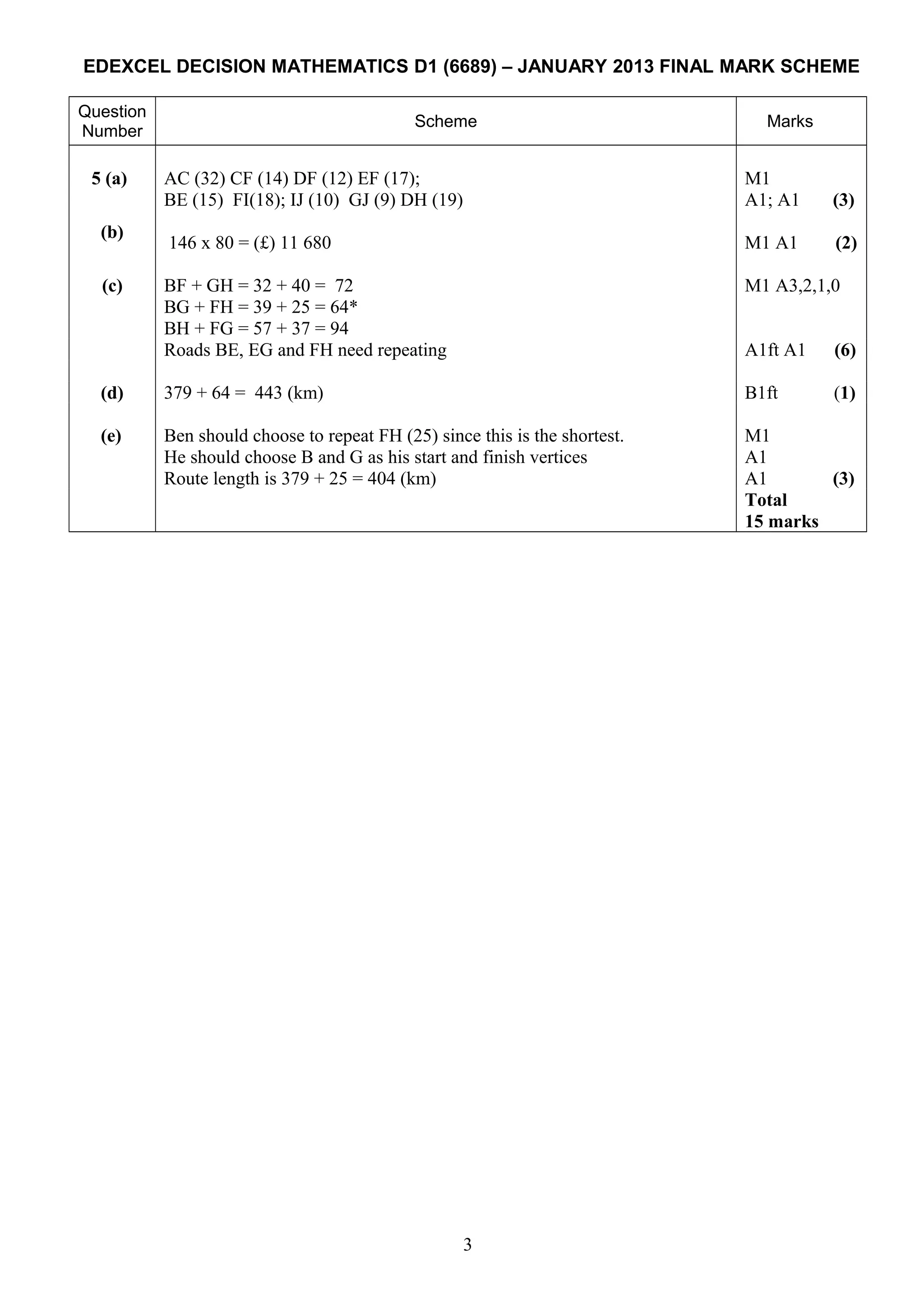
5 (a) AC (32) CF (14) DF (12) EF (17);
BE (15) FI(18); IJ (10) GJ (9) DH (19)
M1
A1; A1 (3)
(b)
146 x 80 = (£) 11 680 M1 A1 (2)
(c) BF + GH = 32 + 40 = 72 M1 A3,2,1,0
BG + FH = 39 + 25 = 64*
BH + FG = 57 + 37 = 94
Roads BE, EG and FH need repeating A1ft A1 (6)
(d) 379 + 64 = 443 (km) B1ft (1)
(e) Ben should choose to repeat FH (25) since this is the shortest.
He should choose B and G as his start and finish vertices
M1
A1
Route length is 379 + 25 = 404 (km) A1 (3)
Total
15 marks
3
EDEXCEL DECISION MATHEMATICS D1 (6689) – JANUARY 2013 FINAL MARK SCHEME
Question
Number
Scheme Marks
6.
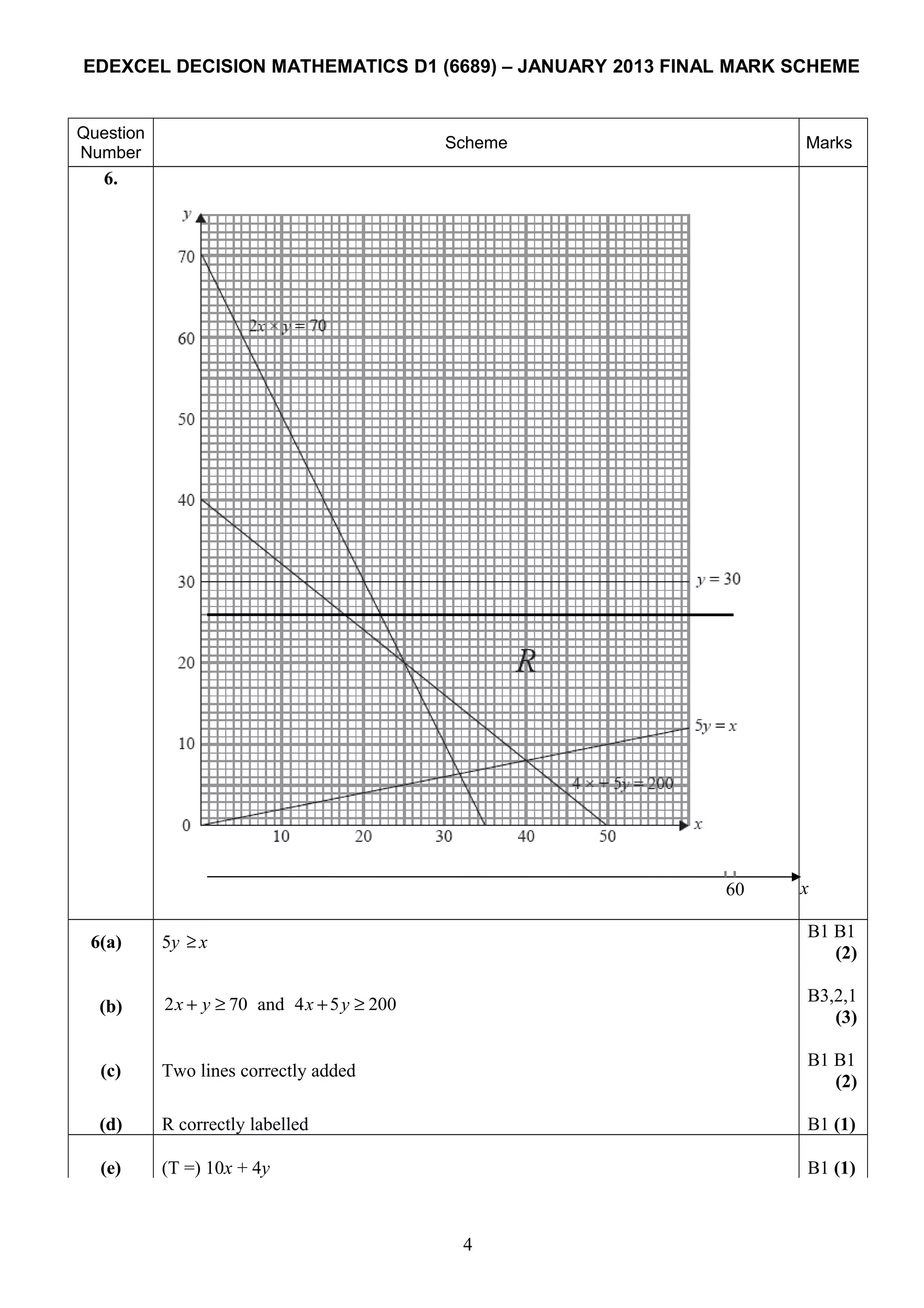
6(a) 5y ≥ x
B1 B1
(2)
(b) 2 70 and 4 5 200x y x y+ ≥ + ≥ B3,2,1
(3)
(c) Two lines correctly added
B1 B1
(2)
(d) R correctly labelled B1 (1)
(e) (T =) 10x + 4y B1 (1)
4
60 x
EDEXCEL DECISION MATHEMATICS D1 (6689) – JANUARY 2013 FINAL MARK SCHEME
Question
Number
Scheme Marks
(f)
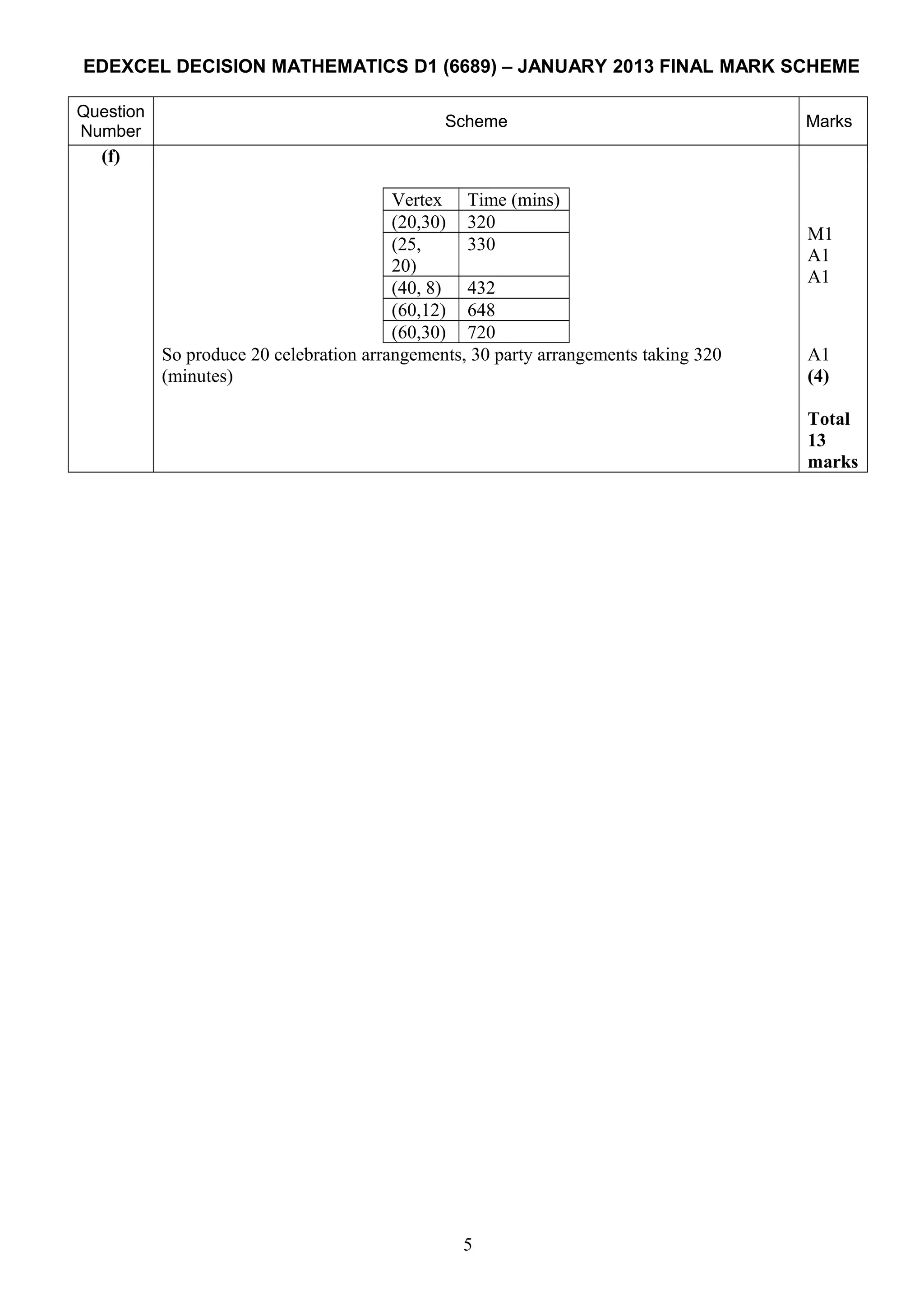
Vertex Time (mins)
(20,30) 320
(25,
20)
330
(40, 8) 432
(60,12) 648
(60,30) 720
M1
A1
A1
So produce 20 celebration arrangements, 30 party arrangements taking 320
(minutes)
A1
(4)
Total
13
marks
5
EDEXCEL DECISION MATHEMATICS D1 (6689) – JANUARY 2013 FINAL MARK SCHEME
Question
Number
Scheme Marks
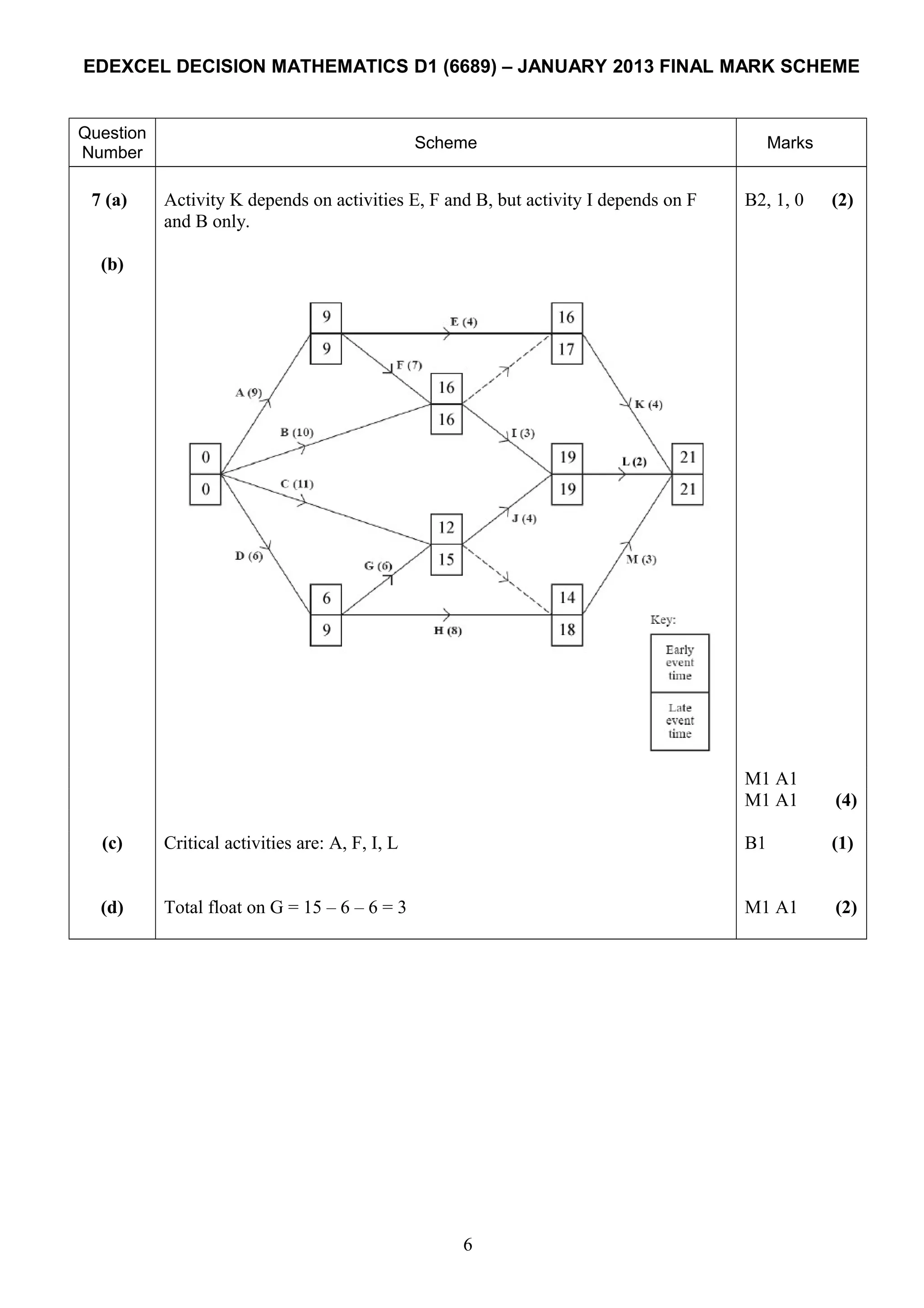
7 (a) Activity K depends on activities E, F and B, but activity I depends on F
and B only.
B2, 1, 0 (2)
(b)
M1 A1
M1 A1 (4)
(c) Critical activities are: A, F, I, L B1 (1)
(d) Total float on G = 15 – 6 – 6 = 3 M1 A1 (2)
6
EDEXCEL DECISION MATHEMATICS D1 (6689) – JANUARY 2013 FINAL MARK SCHEME
Question
Number
Scheme Marks
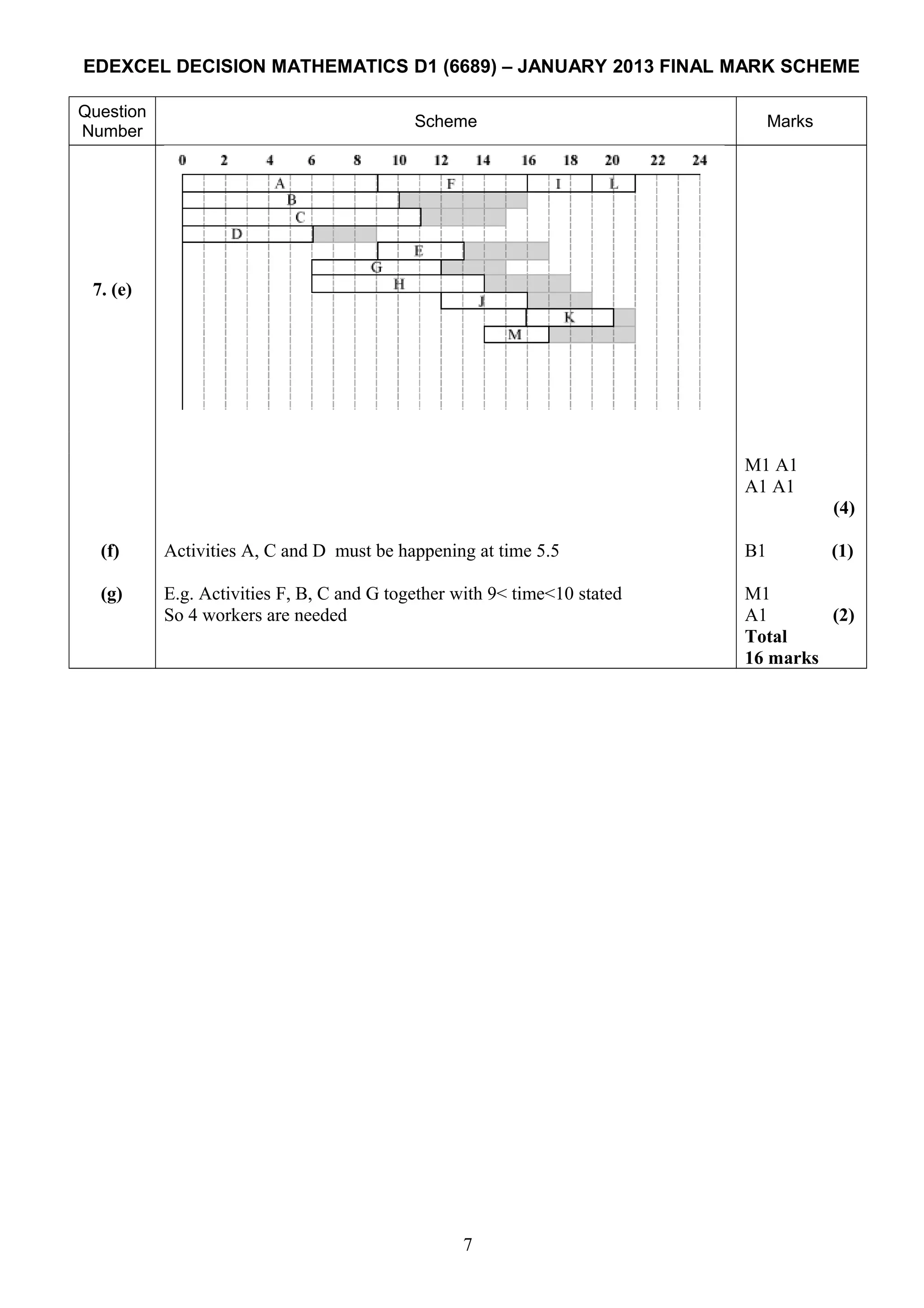
7. (e)
M1 A1
A1 A1
(4)
(f) Activities A, C and D must be happening at time 5.5 B1 (1)
(g) E.g. Activities F, B, C and G together with 9< time<10 stated M1
So 4 workers are needed A1 (2)
Total
16 marks
7

1301 d1 january_2013_mark_scheme

  • 1.
    EDEXCEL DECISION MATHEMATICSD1 (6689) – JANUARY 2013 FINAL MARK SCHEME Question Number Scheme Marks 1 (a) N E R Qn 72 8 8.5 N 8.5 8.485 294 118 N 8.485 294 118 8.485 281 374 N 8.485 281 374 8.485 281 374 Y Output is R = 8.485 281 4 M1 A1 A1 A1ft (4) (b) We would get a negative output for R/ We would get the negative square root B1 (1) (c) E cannot be zero B1 (1) Total 6 marks 2 (a) Pivot 1 = [ ] [ ] 145.132 261 ==+ letter N reject A – N M1 A1 Pivot 2 = [ ] [ ] 215.202 2615 ==+ letter U reject U – Z Pivot 3 = [ ] [ ] 185.172 2015 ==+ letter R reject R – T A1 Pivot 4 = [ ] 162 1715 =+ letter P – located A1 (4) (b) E.g. The maximum number of letters at the start of each iteration is 26, 13, 6, 3, 1 M1 So a maximum of 5 iterations is necessary A1 (2) Total 6 marks
  • 2.
    EDEXCEL DECISION MATHEMATICSD1 (6689) – JANUARY 2013 FINAL MARK SCHEME Question Number Scheme Marks 3 (a) (i) C – 4 = N – 6 = J – 3 = R – 2 or (ii) O – 6 = J – 3 = R – 2 M1 Change status to give (i) C = 4 – N = 6 – J = 3 – R = 2 or (ii) O = 6 – J = 3 – R = 2 Improved matching is: C G J N O R (i) 4 5 3 6 2 (ii) 5 3 4 6 2 A1 A1 (3) (b) E.g. Tasks 1 and 5 can only be done by George E.g. Charlie can only do task 4 and Olivia can only do task 6 which means that Nurry can’t be allocated a task as Nurry can only do tasks 4 and 6 B2, 1, 0 (2) (c) O – 6 = N – 4 = C – 5 = G – 1 or C – 5 = G – 1 M1 Change status to give O = 6 – N = 4 – C = 5 – G = 1 or C = 5 – G = 1 A1 Maximum matching is: C = 5, G = 1, J = 3, N = 4, O = 6, R = 2 A1 (3) Total 8 marks 4 (a) A path is a (i) finite sequence of edges, such that (ii) the end vertex of one edge in the sequence is the start vertex of the next, and in which (iii) no vertex appears more than once. B2, 1, 0 (2) (b) M1 A1 (S,A, B, C) A1ft (D, F) A1 (E, T) Shortest path: SBADET Length: 40 (miles) B1 B1ft (6) (c) Shortest distance S to F = 29 (miles) B1ft (1) (d) SADET or SCDET; of length 41 (miles) B1 B1 (2) Total 11 marks 2
  • 3.
    EDEXCEL DECISION MATHEMATICSD1 (6689) – JANUARY 2013 FINAL MARK SCHEME Question Number Scheme Marks 5 (a) AC (32) CF (14) DF (12) EF (17); BE (15) FI(18); IJ (10) GJ (9) DH (19) M1 A1; A1 (3) (b) 146 x 80 = (£) 11 680 M1 A1 (2) (c) BF + GH = 32 + 40 = 72 M1 A3,2,1,0 BG + FH = 39 + 25 = 64* BH + FG = 57 + 37 = 94 Roads BE, EG and FH need repeating A1ft A1 (6) (d) 379 + 64 = 443 (km) B1ft (1) (e) Ben should choose to repeat FH (25) since this is the shortest. He should choose B and G as his start and finish vertices M1 A1 Route length is 379 + 25 = 404 (km) A1 (3) Total 15 marks 3
  • 4.
    EDEXCEL DECISION MATHEMATICSD1 (6689) – JANUARY 2013 FINAL MARK SCHEME Question Number Scheme Marks 6. 6(a) 5y ≥ x B1 B1 (2) (b) 2 70 and 4 5 200x y x y+ ≥ + ≥ B3,2,1 (3) (c) Two lines correctly added B1 B1 (2) (d) R correctly labelled B1 (1) (e) (T =) 10x + 4y B1 (1) 4 60 x
  • 5.
    EDEXCEL DECISION MATHEMATICSD1 (6689) – JANUARY 2013 FINAL MARK SCHEME Question Number Scheme Marks (f) Vertex Time (mins) (20,30) 320 (25, 20) 330 (40, 8) 432 (60,12) 648 (60,30) 720 M1 A1 A1 So produce 20 celebration arrangements, 30 party arrangements taking 320 (minutes) A1 (4) Total 13 marks 5
  • 6.
    EDEXCEL DECISION MATHEMATICSD1 (6689) – JANUARY 2013 FINAL MARK SCHEME Question Number Scheme Marks 7 (a) Activity K depends on activities E, F and B, but activity I depends on F and B only. B2, 1, 0 (2) (b) M1 A1 M1 A1 (4) (c) Critical activities are: A, F, I, L B1 (1) (d) Total float on G = 15 – 6 – 6 = 3 M1 A1 (2) 6
  • 7.
    EDEXCEL DECISION MATHEMATICSD1 (6689) – JANUARY 2013 FINAL MARK SCHEME Question Number Scheme Marks 7. (e) M1 A1 A1 A1 (4) (f) Activities A, C and D must be happening at time 5.5 B1 (1) (g) E.g. Activities F, B, C and G together with 9< time<10 stated M1 So 4 workers are needed A1 (2) Total 16 marks 7