Bury Community School
GCSE
Revision
Pack
June 2017
Tutor: HELEN SMITH
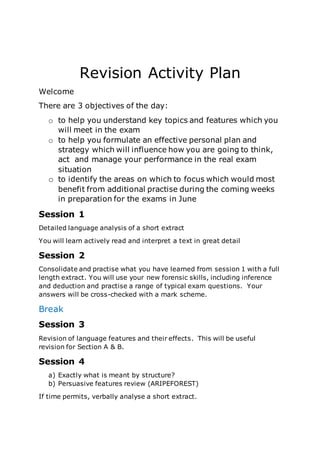
Revision Activity Plan
Welcome
There are 3 objectives of the day:
o to help you understand key topics and features which you
will meet in the exam
o to help you formulate an effective personal plan and
strategy which will influence how you are going to think,
act and manage your performance in the real exam
situation
o to identify the areas on which to focus which would most
benefit from additional practise during the coming weeks
in preparation for the exams in June
Session 1
Detailed language analysis of a short extract
You will learn actively read and interpret a text in great detail
Session 2
Consolidate and practise what you have learned from session 1 with a full
length extract. You will use your new forensic skills, including inference
and deduction and practise a range of typical exam questions. Your
answers will be cross-checked with a mark scheme.
Break
Session 3
Revision of language features and their effects. This will be useful
revision for Section A & B.
Session 4
a) Exactly what is meant by structure?
b) Persuasive features review (ARIPEFOREST)
If time permits, verbally analyse a short extract.
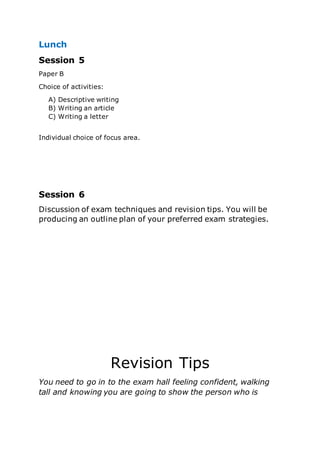
Lunch
Session 5
Paper B
Choice of activities:
A) Descriptive writing
B) Writing an article
C) Writing a letter
Individual choice of focus area.
Session 6
Discussion of exam techniques and revision tips. You will be
producing an outline plan of your preferred exam strategies.
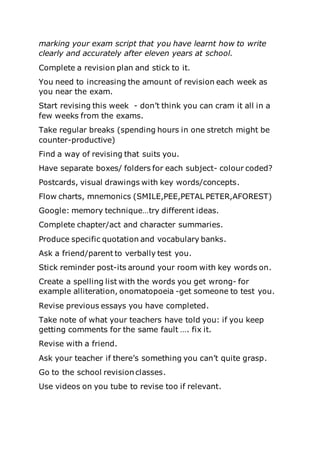
Revision Tips
You need to go in to the exam hall feeling confident, walking
tall and knowing you are going to show the person who is
marking your exam script that you have learnt how to write
clearly and accurately after eleven years at school.
Complete a revision plan and stick to it.
You need to increasing the amount of revision each week as
you near the exam.
Start revising this week - don’t think you can cram it all in a
few weeks from the exams.
Take regular breaks (spending hours in one stretch might be
counter-productive)
Find a way of revising that suits you.
Have separate boxes/ folders for each subject- colour coded?
Postcards, visual drawings with key words/concepts.
Flow charts, mnemonics (SMILE,PEE,PETAL PETER,AFOREST)
Google: memory technique…try different ideas.
Complete chapter/act and character summaries.
Produce specific quotation and vocabulary banks.
Ask a friend/parent to verbally test you.
Stick reminder post-its around your room with key words on.
Create a spelling list with the words you get wrong- for
example alliteration, onomatopoeia -get someone to test you.
Revise previous essays you have completed.
Take note of what your teachers have told you: if you keep
getting comments for the same fault …. fix it.
Revise with a friend.
Ask your teacher if there’s something you can’t quite grasp.
Go to the school revision classes.
Use videos on you tube to revise too if relevant.
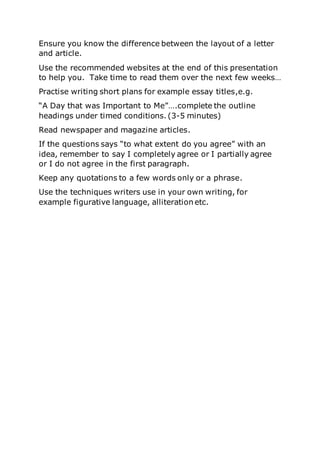
Ensure you know the difference between the layout of a letter
and article.
Use the recommended websites at the end of this presentation
to help you. Take time to read them over the next few weeks…
Practise writing short plans for example essay titles,e.g.
“A Day that was Important to Me”….complete the outline
headings under timed conditions. (3-5 minutes)
Read newspaper and magazine articles.
If the questions says “to what extent do you agree” with an
idea, remember to say I completely agree or I partially agree
or I do not agree in the first paragraph.
Keep any quotations to a few words only or a phrase.
Use the techniques writers use in your own writing, for
example figurative language, alliteration etc.
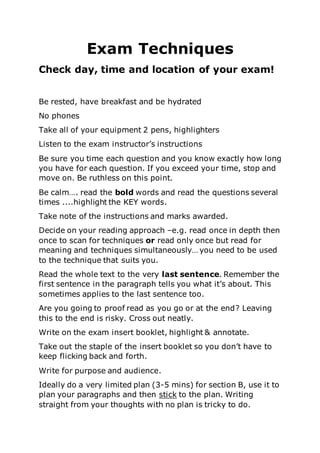
Exam Techniques
Check day, time and location of your exam!
Be rested, have breakfast and be hydrated
No phones
Take all of your equipment 2 pens, highlighters
Listen to the exam instructor’s instructions
Be sure you time each question and you know exactly how long
you have for each question. If you exceed your time, stop and
move on. Be ruthless on this point.
Be calm…. read the bold words and read the questions several
times ....highlight the KEY words.
Take note of the instructions and marks awarded.
Decide on your reading approach –e.g. read once in depth then
once to scan for techniques or read only once but read for
meaning and techniques simultaneously… you need to be used
to the technique that suits you.
Read the whole text to the very last sentence. Remember the
first sentence in the paragraph tells you what it’s about. This
sometimes applies to the last sentence too.
Are you going to proof read as you go or at the end? Leaving
this to the end is risky. Cross out neatly.
Write on the exam insert booklet, highlight & annotate.
Take out the staple of the insert booklet so you don’t have to
keep flicking back and forth.
Write for purpose and audience.
Ideally do a very limited plan (3-5 mins) for section B, use it to
plan your paragraphs and then stick to the plan. Writing
straight from your thoughts with no plan is tricky to do.
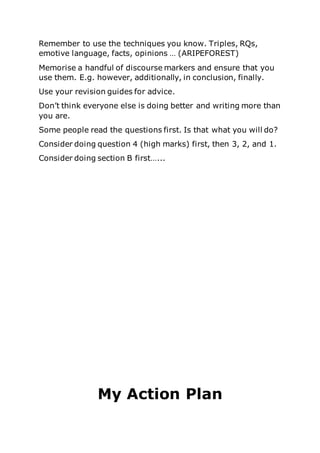
Remember to use the techniques you know. Triples, RQs,
emotive language, facts, opinions … (ARIPEFOREST)
Memorise a handful of discourse markers and ensure that you
use them. E.g. however, additionally, in conclusion, finally.
Use your revision guides for advice.
Don’t think everyone else is doing better and writing more than
you are.
Some people read the questions first. Is that what you will do?
Consider doing question 4 (high marks) first, then 3, 2, and 1.
Consider doing section B first…...
My Action Plan
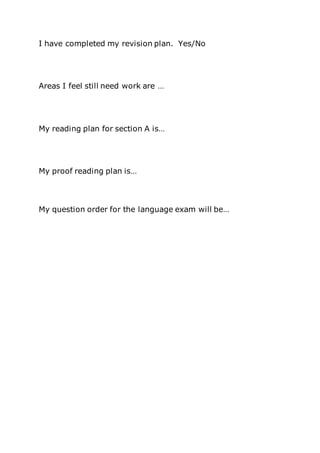
I have completed my revision plan. Yes/No
Areas I feel still need work are …
My reading plan for section A is…
My proof reading plan is…
My question order for the language exam will be…
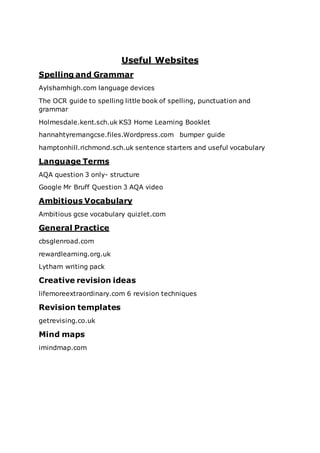
Useful Websites
Spelling and Grammar
Aylshamhigh.com language devices
The OCR guide to spelling little book of spelling, punctuation and
grammar
Holmesdale.kent.sch.uk KS3 Home Learning Booklet
hannahtyremangcse.files.Wordpress.com bumper guide
hamptonhill.richmond.sch.uk sentence starters and useful vocabulary
Language Terms
AQA question 3 only- structure
Google Mr Bruff Question 3 AQA video
Ambitious Vocabulary
Ambitious gcse vocabulary quizlet.com
General Practice
cbsglenroad.com
rewardlearning.org.uk
Lytham writing pack
Creative revision ideas
lifemoreextraordinary.com 6 revision techniques
Revision templates
getrevising.co.uk
Mind maps
imindmap.com

Community school revision

  • 1.
  • 2.
    Revision Activity Plan Welcome Thereare 3 objectives of the day: o to help you understand key topics and features which you will meet in the exam o to help you formulate an effective personal plan and strategy which will influence how you are going to think, act and manage your performance in the real exam situation o to identify the areas on which to focus which would most benefit from additional practise during the coming weeks in preparation for the exams in June Session 1 Detailed language analysis of a short extract You will learn actively read and interpret a text in great detail Session 2 Consolidate and practise what you have learned from session 1 with a full length extract. You will use your new forensic skills, including inference and deduction and practise a range of typical exam questions. Your answers will be cross-checked with a mark scheme. Break Session 3 Revision of language features and their effects. This will be useful revision for Section A & B. Session 4 a) Exactly what is meant by structure? b) Persuasive features review (ARIPEFOREST) If time permits, verbally analyse a short extract.
  • 3.
    Lunch Session 5 Paper B Choiceof activities: A) Descriptive writing B) Writing an article C) Writing a letter Individual choice of focus area. Session 6 Discussion of exam techniques and revision tips. You will be producing an outline plan of your preferred exam strategies. Revision Tips You need to go in to the exam hall feeling confident, walking tall and knowing you are going to show the person who is
  • 4.
    marking your examscript that you have learnt how to write clearly and accurately after eleven years at school. Complete a revision plan and stick to it. You need to increasing the amount of revision each week as you near the exam. Start revising this week - don’t think you can cram it all in a few weeks from the exams. Take regular breaks (spending hours in one stretch might be counter-productive) Find a way of revising that suits you. Have separate boxes/ folders for each subject- colour coded? Postcards, visual drawings with key words/concepts. Flow charts, mnemonics (SMILE,PEE,PETAL PETER,AFOREST) Google: memory technique…try different ideas. Complete chapter/act and character summaries. Produce specific quotation and vocabulary banks. Ask a friend/parent to verbally test you. Stick reminder post-its around your room with key words on. Create a spelling list with the words you get wrong- for example alliteration, onomatopoeia -get someone to test you. Revise previous essays you have completed. Take note of what your teachers have told you: if you keep getting comments for the same fault …. fix it. Revise with a friend. Ask your teacher if there’s something you can’t quite grasp. Go to the school revision classes. Use videos on you tube to revise too if relevant.
  • 5.
    Ensure you knowthe difference between the layout of a letter and article. Use the recommended websites at the end of this presentation to help you. Take time to read them over the next few weeks… Practise writing short plans for example essay titles,e.g. “A Day that was Important to Me”….complete the outline headings under timed conditions. (3-5 minutes) Read newspaper and magazine articles. If the questions says “to what extent do you agree” with an idea, remember to say I completely agree or I partially agree or I do not agree in the first paragraph. Keep any quotations to a few words only or a phrase. Use the techniques writers use in your own writing, for example figurative language, alliteration etc.
  • 6.
    Exam Techniques Check day,time and location of your exam! Be rested, have breakfast and be hydrated No phones Take all of your equipment 2 pens, highlighters Listen to the exam instructor’s instructions Be sure you time each question and you know exactly how long you have for each question. If you exceed your time, stop and move on. Be ruthless on this point. Be calm…. read the bold words and read the questions several times ....highlight the KEY words. Take note of the instructions and marks awarded. Decide on your reading approach –e.g. read once in depth then once to scan for techniques or read only once but read for meaning and techniques simultaneously… you need to be used to the technique that suits you. Read the whole text to the very last sentence. Remember the first sentence in the paragraph tells you what it’s about. This sometimes applies to the last sentence too. Are you going to proof read as you go or at the end? Leaving this to the end is risky. Cross out neatly. Write on the exam insert booklet, highlight & annotate. Take out the staple of the insert booklet so you don’t have to keep flicking back and forth. Write for purpose and audience. Ideally do a very limited plan (3-5 mins) for section B, use it to plan your paragraphs and then stick to the plan. Writing straight from your thoughts with no plan is tricky to do.
  • 7.
    Remember to usethe techniques you know. Triples, RQs, emotive language, facts, opinions … (ARIPEFOREST) Memorise a handful of discourse markers and ensure that you use them. E.g. however, additionally, in conclusion, finally. Use your revision guides for advice. Don’t think everyone else is doing better and writing more than you are. Some people read the questions first. Is that what you will do? Consider doing question 4 (high marks) first, then 3, 2, and 1. Consider doing section B first…... My Action Plan
  • 8.
    I have completedmy revision plan. Yes/No Areas I feel still need work are … My reading plan for section A is… My proof reading plan is… My question order for the language exam will be…
  • 9.
    Useful Websites Spelling andGrammar Aylshamhigh.com language devices The OCR guide to spelling little book of spelling, punctuation and grammar Holmesdale.kent.sch.uk KS3 Home Learning Booklet hannahtyremangcse.files.Wordpress.com bumper guide hamptonhill.richmond.sch.uk sentence starters and useful vocabulary Language Terms AQA question 3 only- structure Google Mr Bruff Question 3 AQA video Ambitious Vocabulary Ambitious gcse vocabulary quizlet.com General Practice cbsglenroad.com rewardlearning.org.uk Lytham writing pack Creative revision ideas lifemoreextraordinary.com 6 revision techniques Revision templates getrevising.co.uk Mind maps imindmap.com