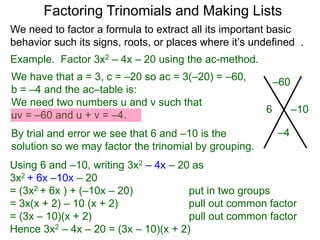
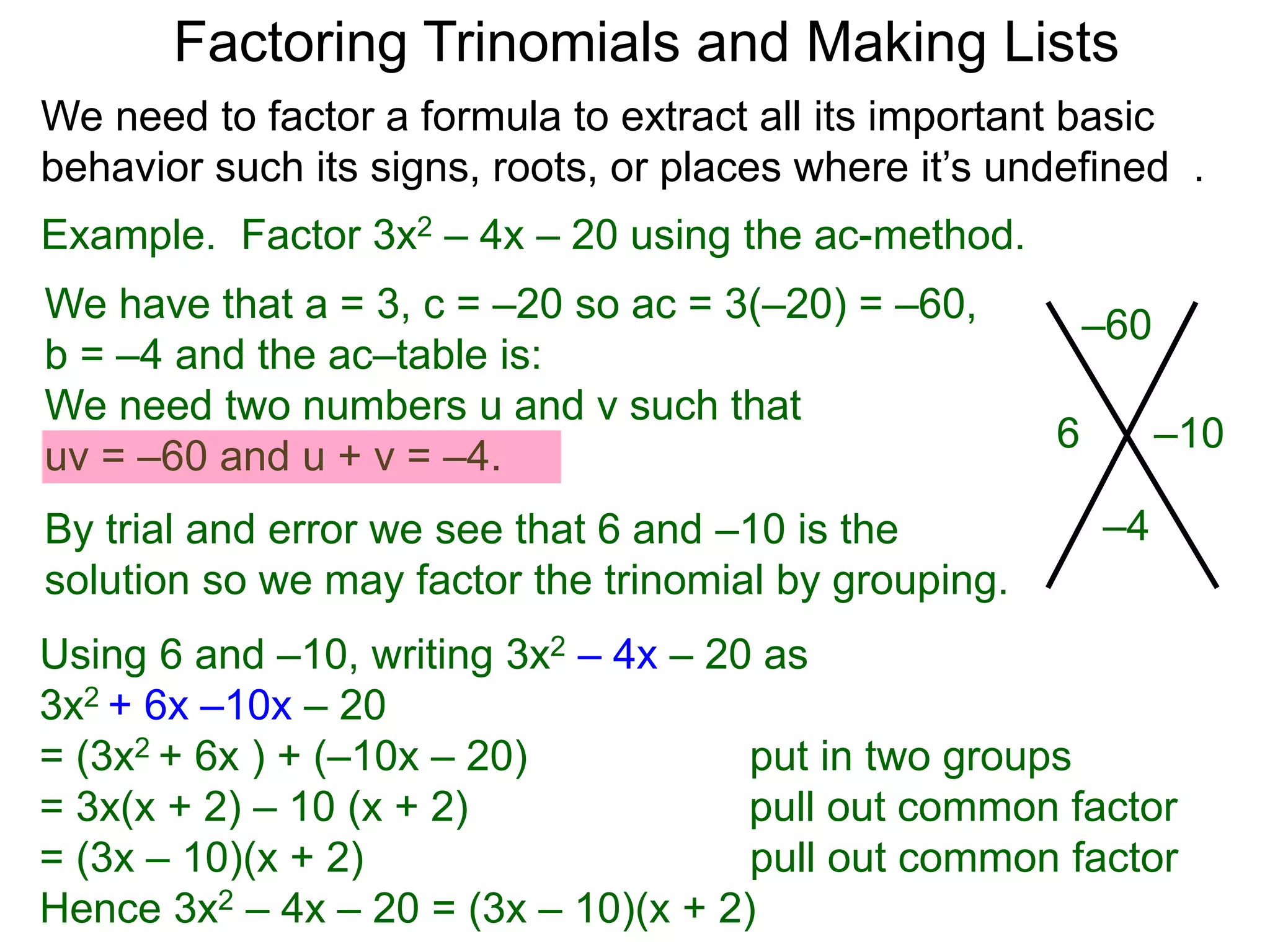
Example. Factor 3x2 – 4x – 20 using the ac-method.
We have that a = 3, c = –20 so ac = 3(–20) = –60,
b = –4 and the ac–table is:
We need two numbers u and v such that
uv = –60 and u + v = –4.
By trial and error we see that 6 and –10 is the
solution so we may factor the trinomial by grouping.
–60
–4
–106
Factoring Trinomials and Making Lists
Using 6 and –10, writing 3x2 – 4x – 20 as
3x2 + 6x –10x – 20
= (3x2 + 6x ) + (–10x – 20) put in two groups
= 3x(x + 2) – 10 (x + 2) pull out common factor
= (3x – 10)(x + 2) pull out common factor
Hence 3x2 – 4x – 20 = (3x – 10)(x + 2)
We need to factor a formula to extract all its important basic
behavior such its signs, roots, or places where it’s undefined .
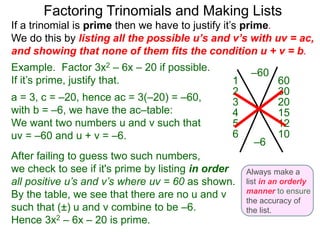
Example. Factor 3x2 – 6x – 20 if possible.
If it’s prime, justify that.
a = 3, c = –20, hence ac = 3(–20) = –60,
with b = –6, we have the ac–table:
We want two numbers u and v such that
uv = –60 and u + v = –6.
After failing to guess two such numbers,
we check to see if it's prime by listing in order
all positive u’s and v’s where uv = 60 as shown.
By the table, we see that there are no u and v
such that (±) u and v combine to be –6.
Hence 3x2 – 6x – 20 is prime.
Factoring Trinomials and Making Lists
–60
–6
601
302
203
154
125
106
Always make a
list in an orderly
manner to ensure
the accuracy of
the list.
If a trinomial is prime then we have to justify it’s prime.
We do this by listing all the possible u’s and v’s with uv = ac,
and showing that none of them fits the condition u + v = b.
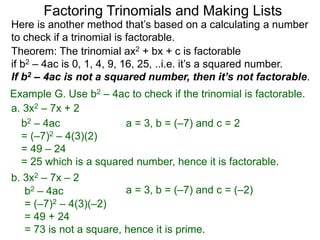
Example G. Use b2 – 4ac to check if the trinomial is factorable.
b2 – 4ac
= (–7)2 – 4(3)(–2)
= 49 + 24
= 73 is not a square, hence it is prime.
Theorem: The trinomial ax2 + bx + c is factorable
if b2 – 4ac is 0, 1, 4, 9, 16, 25, ..i.e. it’s a squared number.
If b2 – 4ac is not a squared number, then it’s not factorable.
a. 3x2 – 7x + 2
b2 – 4ac
= (–7)2 – 4(3)(2)
= 49 – 24
= 25 which is a squared number, hence it is factorable.
Here is another method that’s based on a calculating a number
to check if a trinomial is factorable.
Factoring Trinomials and Making Lists
b. 3x2 – 7x – 2
a = 3, b = (–7) and c = 2
a = 3, b = (–7) and c = (–2)
1. 3x2 – x – 2 2. 3x2 + x – 2 3. 3x2 – 2x – 1
4. 3x2 + 2x – 1 5. 2x2 – 3x + 1 6. 2x2 + 3x – 1
8. 2x2 – 3x – 27. 2x2 + 3x – 2
15. 6x2 + 5x – 6
10. 5x2 + 9x – 2
9. 5x2 – 3x – 2
12. 3x2 – 5x – 211. 3x2 + 5x + 2
14. 6x2 – 5x – 613. 3x2 – 5x – 2
16. 6x2 – x – 2 17. 6x2 – 13x + 2 18. 6x2 – 13x + 2
19. 6x2 + 7x + 2 20. 6x2 – 7x + 2 21. 6x2 – 13x + 6
22. 6x2 + 13x + 6 23. 6x2 – 5x – 4 24. 6x2 – 13x + 8
25. 6x2 – 13x – 8 25. 4x2 – 9 26. 4x2 – 49
27. 25x2 – 4 28. 4x2 + 9 29. 25x2 + 9
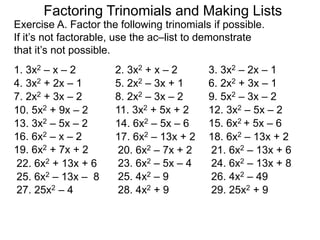
Exercise A. Factor the following trinomials if possible.
If it’s not factorable, use the ac–list to demonstrate
that it’s not possible.
Factoring Trinomials and Making Lists
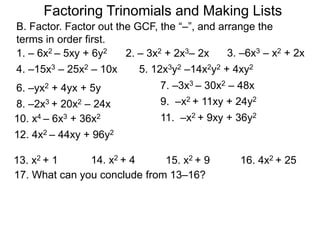
7. –3x3 – 30x2 – 48x6. –yx2 + 4yx + 5y
8. –2x3 + 20x2 – 24x
12. 4x2 – 44xy + 96y2
9. –x2 + 11xy + 24y2
10. x4 – 6x3 + 36x2 11. –x2 + 9xy + 36y2
13. x2 + 1 14. x2 + 4 15. x2 + 9 16. 4x2 + 25
17. What can you conclude from 13–16?
Factoring Trinomials and Making Lists
B. Factor. Factor out the GCF, the “–”, and arrange the
terms in order first.
1. – 6x2 – 5xy + 6y2 2. – 3x2 + 2x3– 2x 3. –6x3 – x2 + 2x
4. –15x3 – 25x2 – 10x 5. 12x3y2 –14x2y2 + 4xy2
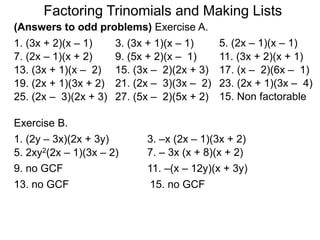
1. (3x + 2)(x – 1) 3. (3x + 1)(x – 1)
7. (2x – 1)(x + 2) 9. (5x + 2)(x – 1) 11. (3x + 2)(x + 1)
15. (3x – 2)(2x + 3)13. (3x + 1)(x – 2)
15. Non factorable
19. (2x + 1)(3x + 2)
17. (x – 2)(6x – 1)
23. (2x + 1)(3x – 4)21. (2x – 3)(3x – 2)
27. (5x – 2)(5x + 2)25. (2x – 3)(2x + 3)
(Answers to odd problems) Exercise A.
Factoring Trinomials and Making Lists
5. (2x – 1)(x – 1)
Exercise B.
1. (2y – 3x)(2x + 3y) 3. –x (2x – 1)(3x + 2)
5. 2xy2(2x – 1)(3x – 2) 7. – 3x (x + 8)(x + 2)
9. no GCF 11. –(x – 12y)(x + 3y)
15. no GCF13. no GCF

1.0 factoring trinomials the ac method and making lists-t

  • 1.
    Example. Factor 3x2– 4x – 20 using the ac-method. We have that a = 3, c = –20 so ac = 3(–20) = –60, b = –4 and the ac–table is: We need two numbers u and v such that uv = –60 and u + v = –4. By trial and error we see that 6 and –10 is the solution so we may factor the trinomial by grouping. –60 –4 –106 Factoring Trinomials and Making Lists Using 6 and –10, writing 3x2 – 4x – 20 as 3x2 + 6x –10x – 20 = (3x2 + 6x ) + (–10x – 20) put in two groups = 3x(x + 2) – 10 (x + 2) pull out common factor = (3x – 10)(x + 2) pull out common factor Hence 3x2 – 4x – 20 = (3x – 10)(x + 2) We need to factor a formula to extract all its important basic behavior such its signs, roots, or places where it’s undefined .
  • 2.
    Example. Factor 3x2– 6x – 20 if possible. If it’s prime, justify that. a = 3, c = –20, hence ac = 3(–20) = –60, with b = –6, we have the ac–table: We want two numbers u and v such that uv = –60 and u + v = –6. After failing to guess two such numbers, we check to see if it's prime by listing in order all positive u’s and v’s where uv = 60 as shown. By the table, we see that there are no u and v such that (±) u and v combine to be –6. Hence 3x2 – 6x – 20 is prime. Factoring Trinomials and Making Lists –60 –6 601 302 203 154 125 106 Always make a list in an orderly manner to ensure the accuracy of the list. If a trinomial is prime then we have to justify it’s prime. We do this by listing all the possible u’s and v’s with uv = ac, and showing that none of them fits the condition u + v = b.
  • 3.
    Example G. Useb2 – 4ac to check if the trinomial is factorable. b2 – 4ac = (–7)2 – 4(3)(–2) = 49 + 24 = 73 is not a square, hence it is prime. Theorem: The trinomial ax2 + bx + c is factorable if b2 – 4ac is 0, 1, 4, 9, 16, 25, ..i.e. it’s a squared number. If b2 – 4ac is not a squared number, then it’s not factorable. a. 3x2 – 7x + 2 b2 – 4ac = (–7)2 – 4(3)(2) = 49 – 24 = 25 which is a squared number, hence it is factorable. Here is another method that’s based on a calculating a number to check if a trinomial is factorable. Factoring Trinomials and Making Lists b. 3x2 – 7x – 2 a = 3, b = (–7) and c = 2 a = 3, b = (–7) and c = (–2)
  • 4.
    1. 3x2 –x – 2 2. 3x2 + x – 2 3. 3x2 – 2x – 1 4. 3x2 + 2x – 1 5. 2x2 – 3x + 1 6. 2x2 + 3x – 1 8. 2x2 – 3x – 27. 2x2 + 3x – 2 15. 6x2 + 5x – 6 10. 5x2 + 9x – 2 9. 5x2 – 3x – 2 12. 3x2 – 5x – 211. 3x2 + 5x + 2 14. 6x2 – 5x – 613. 3x2 – 5x – 2 16. 6x2 – x – 2 17. 6x2 – 13x + 2 18. 6x2 – 13x + 2 19. 6x2 + 7x + 2 20. 6x2 – 7x + 2 21. 6x2 – 13x + 6 22. 6x2 + 13x + 6 23. 6x2 – 5x – 4 24. 6x2 – 13x + 8 25. 6x2 – 13x – 8 25. 4x2 – 9 26. 4x2 – 49 27. 25x2 – 4 28. 4x2 + 9 29. 25x2 + 9 Exercise A. Factor the following trinomials if possible. If it’s not factorable, use the ac–list to demonstrate that it’s not possible. Factoring Trinomials and Making Lists
  • 5.
    7. –3x3 –30x2 – 48x6. –yx2 + 4yx + 5y 8. –2x3 + 20x2 – 24x 12. 4x2 – 44xy + 96y2 9. –x2 + 11xy + 24y2 10. x4 – 6x3 + 36x2 11. –x2 + 9xy + 36y2 13. x2 + 1 14. x2 + 4 15. x2 + 9 16. 4x2 + 25 17. What can you conclude from 13–16? Factoring Trinomials and Making Lists B. Factor. Factor out the GCF, the “–”, and arrange the terms in order first. 1. – 6x2 – 5xy + 6y2 2. – 3x2 + 2x3– 2x 3. –6x3 – x2 + 2x 4. –15x3 – 25x2 – 10x 5. 12x3y2 –14x2y2 + 4xy2
  • 6.
    1. (3x +2)(x – 1) 3. (3x + 1)(x – 1) 7. (2x – 1)(x + 2) 9. (5x + 2)(x – 1) 11. (3x + 2)(x + 1) 15. (3x – 2)(2x + 3)13. (3x + 1)(x – 2) 15. Non factorable 19. (2x + 1)(3x + 2) 17. (x – 2)(6x – 1) 23. (2x + 1)(3x – 4)21. (2x – 3)(3x – 2) 27. (5x – 2)(5x + 2)25. (2x – 3)(2x + 3) (Answers to odd problems) Exercise A. Factoring Trinomials and Making Lists 5. (2x – 1)(x – 1) Exercise B. 1. (2y – 3x)(2x + 3y) 3. –x (2x – 1)(3x + 2) 5. 2xy2(2x – 1)(3x – 2) 7. – 3x (x + 8)(x + 2) 9. no GCF 11. –(x – 12y)(x + 3y) 15. no GCF13. no GCF