Mark Scheme (Results)

Summer 2012


GCSE Mathematics (Linear) 1MA0
Higher (Non-Calculator) Paper 1H
Edexcel and BTEC Qualifications

Edexcel and BTEC qualifications come from Pearson, the world’s leading
learning company. We provide a wide range of qualifications including
academic, vocational, occupational and specific programmes for employers.
For further information, please visit our website at www.edexcel.com.

Our website subject pages hold useful resources, support material and live
feeds from our subject advisors giving you access to a portal of information.
If you have any subject specific questions about this specification that
require the help of a subject specialist, you may find our Ask The Expert
email service helpful.

www.edexcel.com/contactus


Pearson: helping people progress, everywhere
Our aim is to help everyone progress in their lives through education. We
believe in every kind of learning, for all kinds of people, wherever they are
in the world. We’ve been involved in education for over 150 years, and by
working across 70 countries, in 100 languages, we have built an
international reputation for our commitment to high standards and raising
achievement through innovation in education. Find out more about how we
can help you and your students at: www.pearson.com/uk


Summer 2012
Publications Code UG032625
All the material in this publication is copyright
© Pearson Education Ltd 2012
NOTES ON MARKING PRINCIPLES

1    All candidates must receive the same treatment. Examiners must mark the first candidate in exactly the same way as they mark the last.

2    Mark schemes should be applied positively. Candidates must be rewarded for what they have shown they can do rather than penalised for omissions.

3    All the marks on the mark scheme are designed to be awarded. Examiners should always award full marks if deserved, i.e if the answer matches the
     mark scheme. Examiners should also be prepared to award zero marks if the candidate’s response is not worthy of credit according to the mark
     scheme.

4    Where some judgement is required, mark schemes will provide the principles by which marks will be awarded and exemplification may be limited.

5    Crossed out work should be marked UNLESS the candidate has replaced it with an alternative response.

6    Mark schemes will indicate within the table where, and which strands of QWC, are being assessed. The strands are as follows:

     i) ensure that text is legible and that spelling, punctuation and grammar are accurate so that meaning is clear
             Comprehension and meaning is clear by using correct notation and labeling conventions.

     ii) select and use a form and style of writing appropriate to purpose and to complex subject matter
               Reasoning, explanation or argument is correct and appropriately structured to convey mathematical reasoning.

     iii) organise information clearly and coherently, using specialist vocabulary when appropriate.
              The mathematical methods and processes used are coherently and clearly organised and the appropriate mathematical vocabulary used.
7    With working
     If there is a wrong answer indicated on the answer line always check the working in the body of the script (and on any diagrams), and award any
     marks appropriate from the mark scheme.
     If working is crossed out and still legible, then it should be given any appropriate marks, as long as it has not been replaced by alternative work.
     If it is clear from the working that the “correct” answer has been obtained from incorrect working, award 0 marks. Send the response to review, and
     discuss each of these situations with your Team Leader.
     If there is no answer on the answer line then check the working for an obvious answer.
     Any case of suspected misread loses A (and B) marks on that part, but can gain the M marks. Discuss each of these situations with your Team
     Leader.
     If there is a choice of methods shown, then no marks should be awarded, unless the answer on the answer line makes clear the method that has been
     used.

8    Follow through marks
     Follow through marks which involve a single stage calculation can be awarded without working since you can check the answer yourself, but if
     ambiguous do not award.
     Follow through marks which involve more than one stage of calculation can only be awarded on sight of the relevant working, even if it appears
     obvious that there is only one way you could get the answer given.

9    Ignoring subsequent work
     It is appropriate to ignore subsequent work when the additional work does not change the answer in a way that is inappropriate for the question: e.g.
     incorrect canceling of a fraction that would otherwise be correct
     It is not appropriate to ignore subsequent work when the additional work essentially makes the answer incorrect e.g. algebra.
     Transcription errors occur when candidates present a correct answer in working, and write it incorrectly on the answer line; mark the correct answer.

10   Probability
     Probability answers must be given a fractions, percentages or decimals. If a candidate gives a decimal equivalent to a probability, this should be
     written to at least 2 decimal places (unless tenths).
     Incorrect notation should lose the accuracy marks, but be awarded any implied method marks.
     If a probability answer is given on the answer line using both incorrect and correct notation, award the marks.
     If a probability fraction is given then cancelled incorrectly, ignore the incorrectly cancelled answer.
11   Linear equations
     Full marks can be gained if the solution alone is given on the answer line, or otherwise unambiguously indicated in working (without contradiction
     elsewhere). Where the correct solution only is shown substituted, but not identified as the solution, the accuracy mark is lost but any method marks
     can be awarded.

12   Parts of questions
     Unless allowed by the mark scheme, the marks allocated to one part of the question CANNOT be awarded in another.

13   Range of answers
     Unless otherwise stated, when an answer is given as a range (e.g 3.5 – 4.2) then this is inclusive of the end points (e.g 3.5, 4.2) and includes all
     numbers within the range (e.g 4, 4.1)


      Guidance on the use of codes within this mark scheme


      M1 – method mark
      A1 – accuracy mark
      B1 – Working mark
      C1 – communication mark
      QWC – quality of written communication
      oe – or equivalent
      cao – correct answer only
      ft – follow through
      sc – special case
      dep – dependent (on a previous mark or conclusion)
      indep – independent
      isw – ignore subsequent working
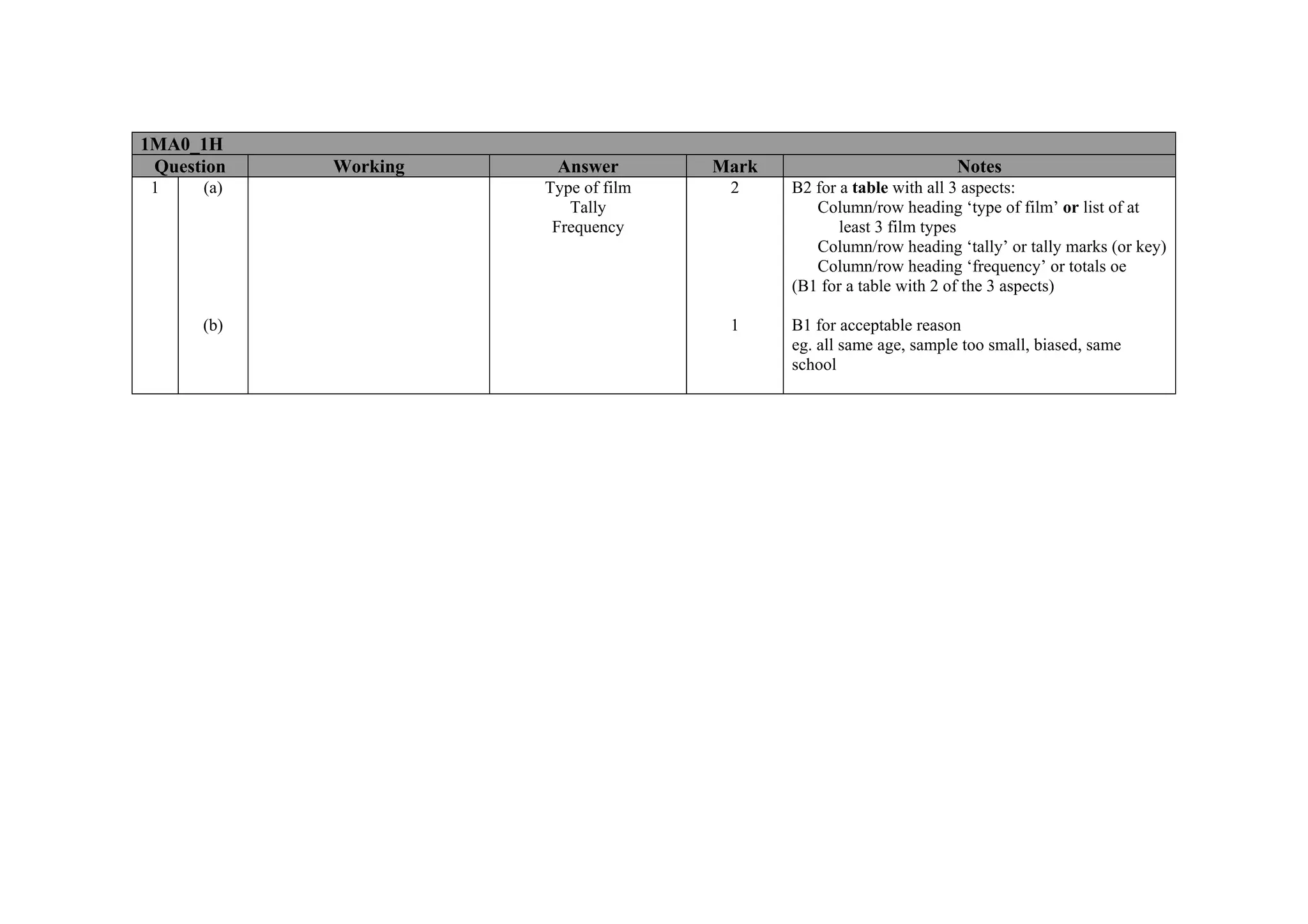
1MA0_1H
 Question   Working    Answer        Mark                           Notes
 1    (a)             Type of film    2     B2 for a table with all 3 aspects:
                         Tally                 Column/row heading ‘type of film’ or list of at
                       Frequency                   least 3 film types
                                               Column/row heading ‘tally’ or tally marks (or key)
                                               Column/row heading ‘frequency’ or totals oe
                                            (B1 for a table with 2 of the 3 aspects)

      (b)                             1     B1 for acceptable reason
                                            eg. all same age, sample too small, biased, same
                                            school
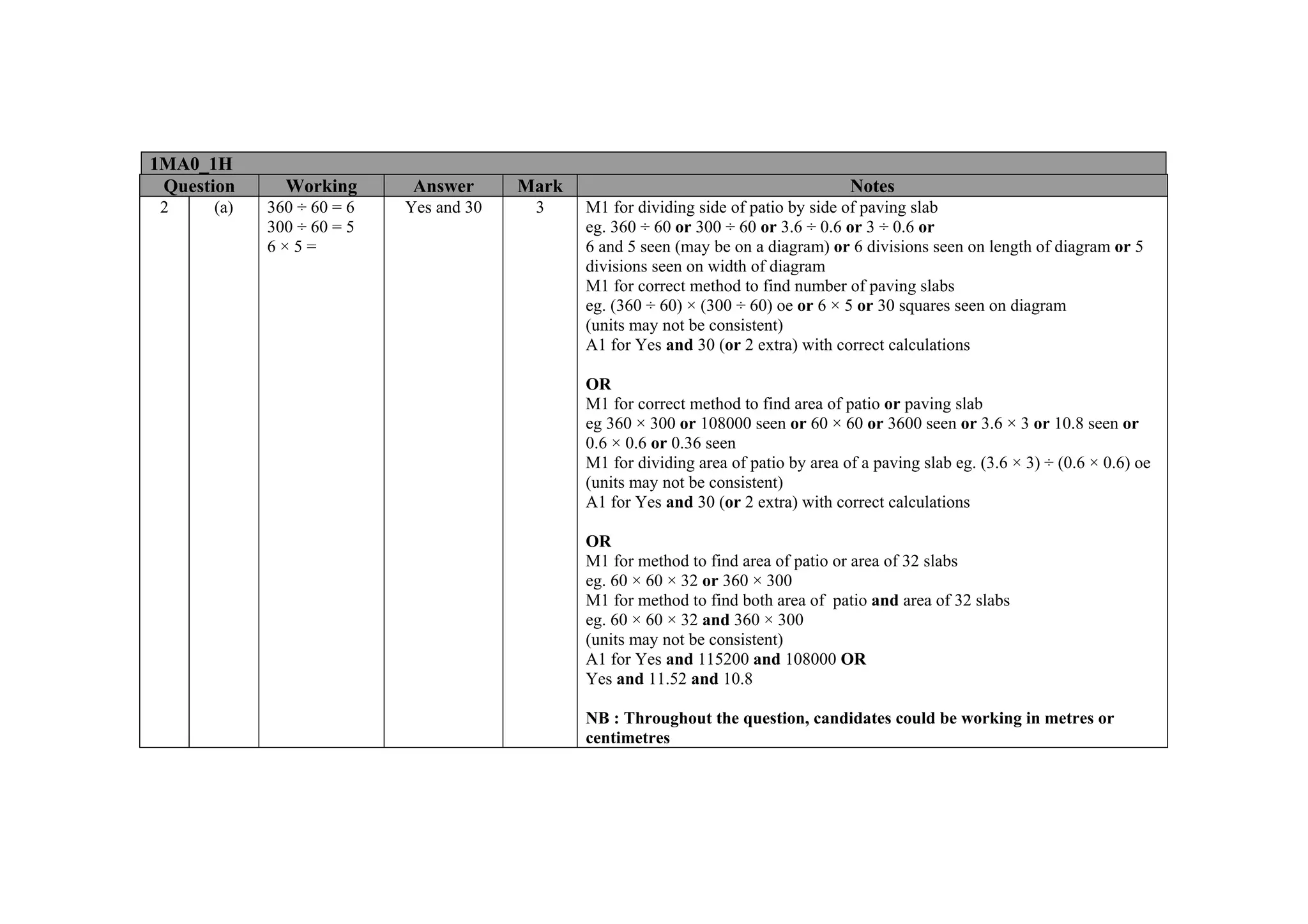
1MA0_1H
 Question     Working       Answer      Mark                                          Notes
 2    (a)   360 ÷ 60 = 6   Yes and 30    3     M1 for dividing side of patio by side of paving slab
            300 ÷ 60 = 5                       eg. 360 ÷ 60 or 300 ÷ 60 or 3.6 ÷ 0.6 or 3 ÷ 0.6 or
            6×5=                               6 and 5 seen (may be on a diagram) or 6 divisions seen on length of diagram or 5
                                               divisions seen on width of diagram
                                               M1 for correct method to find number of paving slabs
                                               eg. (360 ÷ 60) × (300 ÷ 60) oe or 6 × 5 or 30 squares seen on diagram
                                               (units may not be consistent)
                                               A1 for Yes and 30 (or 2 extra) with correct calculations

                                               OR
                                               M1 for correct method to find area of patio or paving slab
                                               eg 360 × 300 or 108000 seen or 60 × 60 or 3600 seen or 3.6 × 3 or 10.8 seen or
                                               0.6 × 0.6 or 0.36 seen
                                               M1 for dividing area of patio by area of a paving slab eg. (3.6 × 3) ÷ (0.6 × 0.6) oe
                                               (units may not be consistent)
                                               A1 for Yes and 30 (or 2 extra) with correct calculations

                                               OR
                                               M1 for method to find area of patio or area of 32 slabs
                                               eg. 60 × 60 × 32 or 360 × 300
                                               M1 for method to find both area of patio and area of 32 slabs
                                               eg. 60 × 60 × 32 and 360 × 300
                                               (units may not be consistent)
                                               A1 for Yes and 115200 and 108000 OR
                                               Yes and 11.52 and 10.8

                                               NB : Throughout the question, candidates could be working in metres or
                                               centimetres
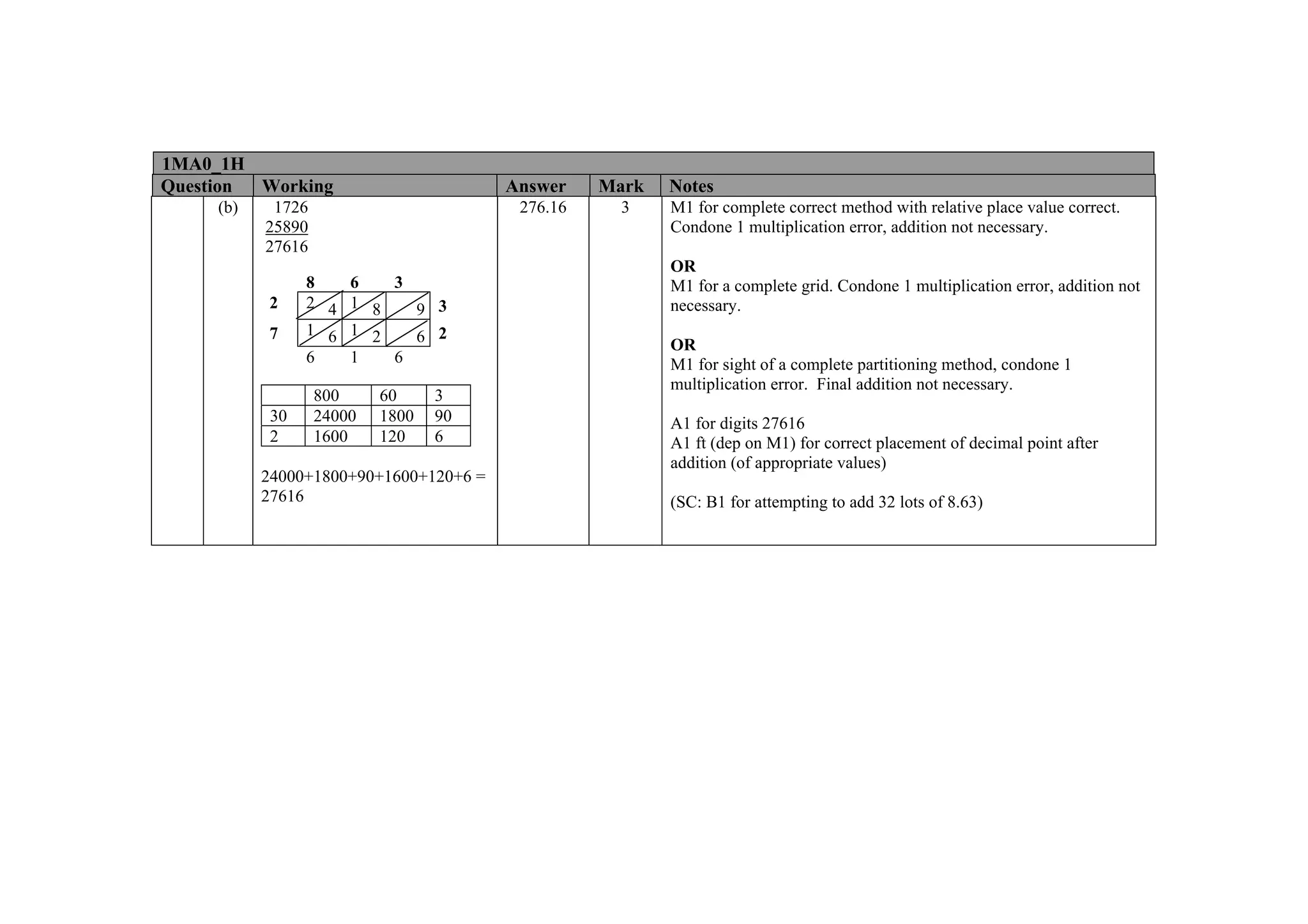
1MA0_1H
Question Working                        Answer    Mark   Notes
     (b)    1726                         276.16     3    M1 for complete correct method with relative place value correct.
           25890                                         Condone 1 multiplication error, addition not necessary.
           27616
                                                         OR
                 8   6   3                               M1 for a complete grid. Condone 1 multiplication error, addition not
           2     2 4 1 8   9 3                           necessary.
           7     1 6 1 2   6 2                           OR
                 6   1   6                               M1 for sight of a complete partitioning method, condone 1
                                                         multiplication error. Final addition not necessary.
                   800     60     3
            30     24000   1800   90                     A1 for digits 27616
            2      1600    120    6                      A1 ft (dep on M1) for correct placement of decimal point after
                                                         addition (of appropriate values)
           24000+1800+90+1600+120+6 =
           27616                                         (SC: B1 for attempting to add 32 lots of 8.63)
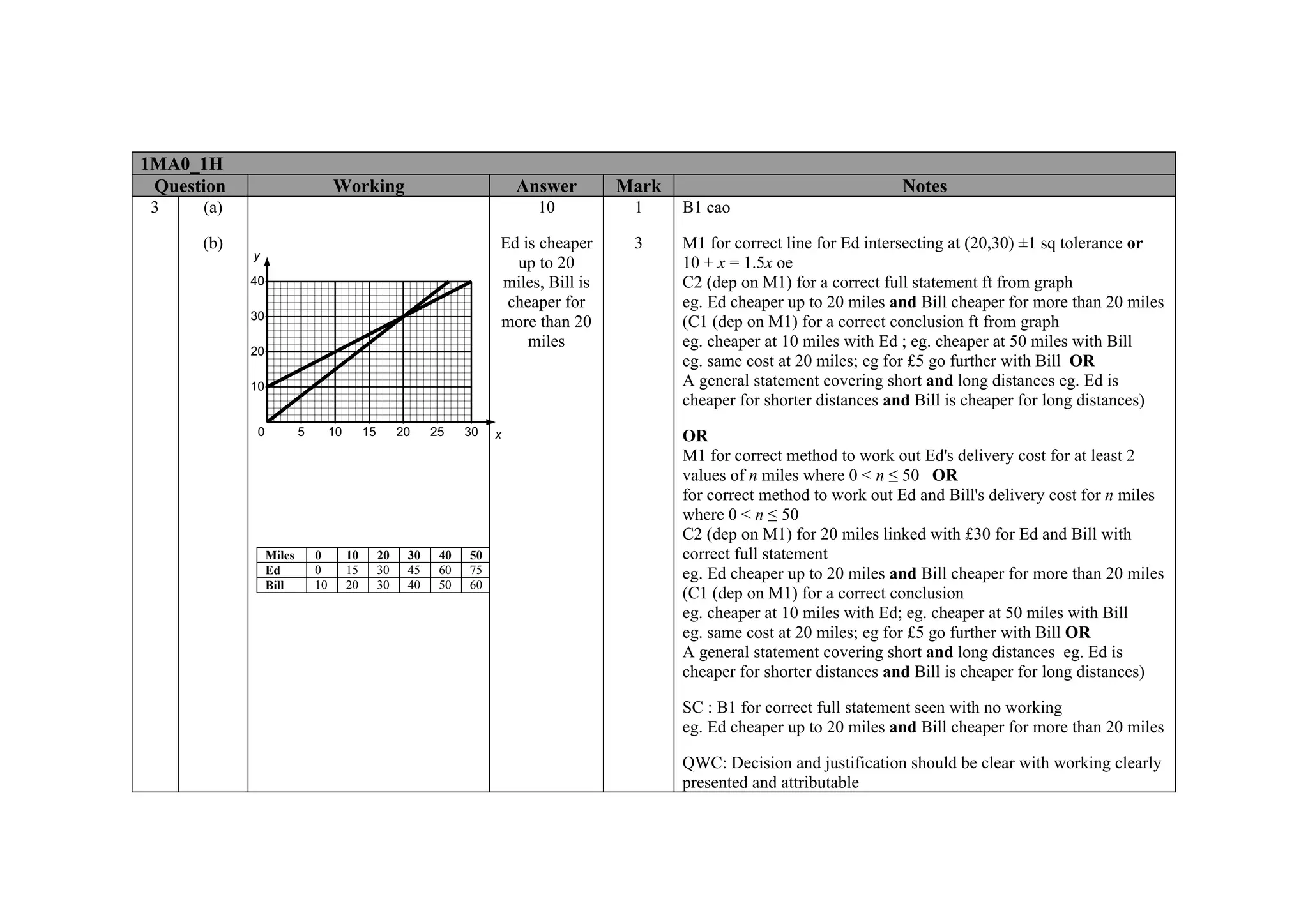
1MA0_1H
 Question                         Working                                  Answer       Mark                                  Notes
 3    (a)                                                                    10          1     B1 cao

      (b)                                                              Ed is cheaper     3     M1 for correct line for Ed intersecting at (20,30) ±1 sq tolerance or
            y
                                                                         up to 20              10 + x = 1.5x oe
            40                                                         miles, Bill is          C2 (dep on M1) for a correct full statement ft from graph
                                                                        cheaper for            eg. Ed cheaper up to 20 miles and Bill cheaper for more than 20 miles
            30
                                                                       more than 20            (C1 (dep on M1) for a correct conclusion ft from graph
                                                                           miles               eg. cheaper at 10 miles with Ed ; eg. cheaper at 50 miles with Bill
            20
                                                                                               eg. same cost at 20 miles; eg for £5 go further with Bill OR
            10                                                                                 A general statement covering short and long distances eg. Ed is
                                                                                               cheaper for shorter distances and Bill is cheaper for long distances)
             0           5        10        15        20    25    30   x                       OR
                                                                                               M1 for correct method to work out Ed's delivery cost for at least 2
                                                                                               values of n miles where 0 < n ≤ 50 OR
                                                                                               for correct method to work out Ed and Bill's delivery cost for n miles
                                                                                               where 0 < n ≤ 50
                                                                                               C2 (dep on M1) for 20 miles linked with £30 for Ed and Bill with
                 Miles       0         10        20    30    40   50                           correct full statement
                 Ed          0         15        30    45    60   75                           eg. Ed cheaper up to 20 miles and Bill cheaper for more than 20 miles
                 Bill        10        20        30    40    50   60
                                                                                               (C1 (dep on M1) for a correct conclusion
                                                                                               eg. cheaper at 10 miles with Ed; eg. cheaper at 50 miles with Bill
                                                                                               eg. same cost at 20 miles; eg for £5 go further with Bill OR
                                                                                               A general statement covering short and long distances eg. Ed is
                                                                                               cheaper for shorter distances and Bill is cheaper for long distances)

                                                                                               SC : B1 for correct full statement seen with no working
                                                                                               eg. Ed cheaper up to 20 miles and Bill cheaper for more than 20 miles

                                                                                               QWC: Decision and justification should be clear with working clearly
                                                                                               presented and attributable
1MA0_1H
 Question           Working         Answer     Mark                                    Notes
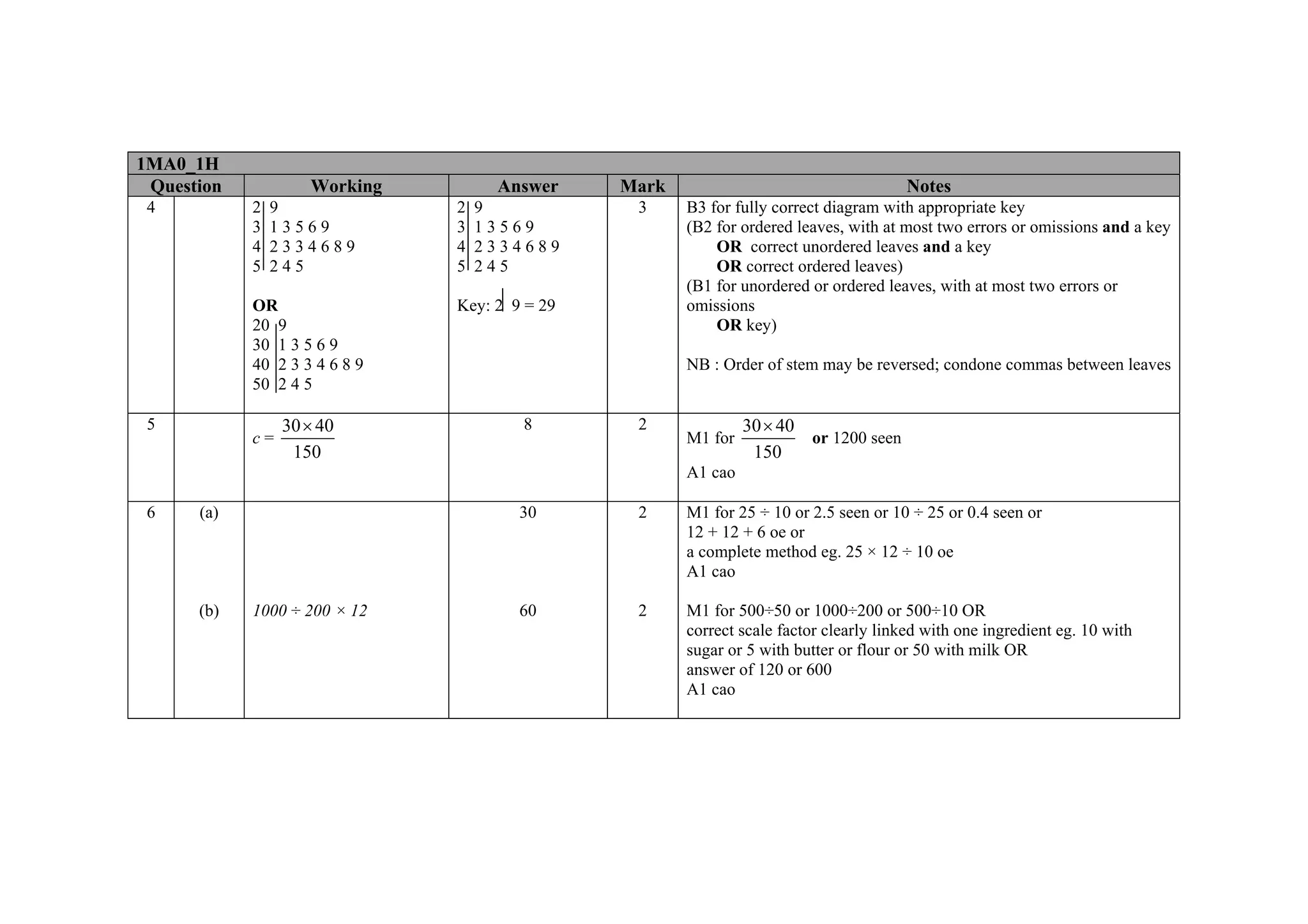
 4          2   9              2   9            3     B3 for fully correct diagram with appropriate key
            3   13569          3   13569              (B2 for ordered leaves, with at most two errors or omissions and a key
            4   2334689        4   2334689                OR correct unordered leaves and a key
            5   245            5   245                    OR correct ordered leaves)
                                                      (B1 for unordered or ordered leaves, with at most two errors or
            OR                 Key: 2 9 = 29          omissions
            20 9                                          OR key)
            30 1 3 5 6 9
            40 2 3 3 4 6 8 9                          NB : Order of stem may be reversed; condone commas between leaves
            50 2 4 5

 5               30 × 40               8        2              30 × 40
            c=                                        M1 for           or 1200 seen
                  150                                           150
                                                      A1 cao

 6    (a)                              30       2     M1 for 25 ÷ 10 or 2.5 seen or 10 ÷ 25 or 0.4 seen or
                                                      12 + 12 + 6 oe or
                                                      a complete method eg. 25 × 12 ÷ 10 oe
                                                      A1 cao

      (b)   1000 ÷ 200 × 12            60       2     M1 for 500÷50 or 1000÷200 or 500÷10 OR
                                                      correct scale factor clearly linked with one ingredient eg. 10 with
                                                      sugar or 5 with butter or flour or 50 with milk OR
                                                      answer of 120 or 600
                                                      A1 cao
1MA0_1H
 Question              Working                  Answer      Mark                           Notes
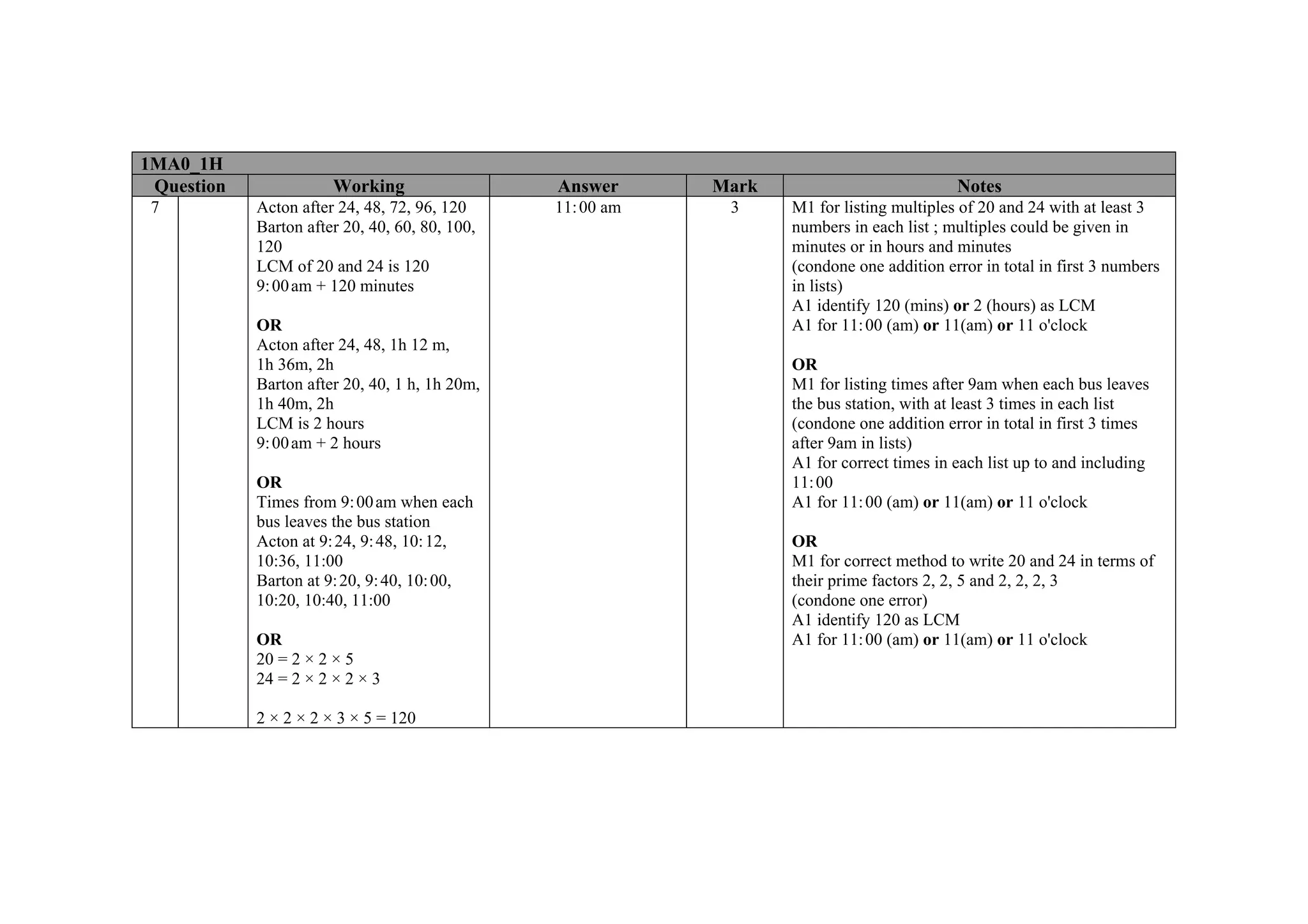
 7          Acton after 24, 48, 72, 96, 120     11: 00 am    3     M1 for listing multiples of 20 and 24 with at least 3
            Barton after 20, 40, 60, 80, 100,                      numbers in each list ; multiples could be given in
            120                                                    minutes or in hours and minutes
            LCM of 20 and 24 is 120                                (condone one addition error in total in first 3 numbers
            9: 00 am + 120 minutes                                 in lists)
                                                                   A1 identify 120 (mins) or 2 (hours) as LCM
            OR                                                     A1 for 11: 00 (am) or 11(am) or 11 o'clock
            Acton after 24, 48, 1h 12 m,
            1h 36m, 2h                                             OR
            Barton after 20, 40, 1 h, 1h 20m,                      M1 for listing times after 9am when each bus leaves
            1h 40m, 2h                                             the bus station, with at least 3 times in each list
            LCM is 2 hours                                         (condone one addition error in total in first 3 times
            9: 00 am + 2 hours                                     after 9am in lists)
                                                                   A1 for correct times in each list up to and including
            OR                                                     11: 00
            Times from 9: 00 am when each                          A1 for 11: 00 (am) or 11(am) or 11 o'clock
            bus leaves the bus station
            Acton at 9: 24, 9: 48, 10: 12,                         OR
            10:36, 11:00                                           M1 for correct method to write 20 and 24 in terms of
            Barton at 9: 20, 9: 40, 10: 00,                        their prime factors 2, 2, 5 and 2, 2, 2, 3
            10:20, 10:40, 11:00                                    (condone one error)
                                                                   A1 identify 120 as LCM
            OR                                                     A1 for 11: 00 (am) or 11(am) or 11 o'clock
            20 = 2 × 2 × 5
            24 = 2 × 2 × 2 × 3

            2 × 2 × 2 × 3 × 5 = 120
1MA0_1H
 Question              Working   Answer       Mark                           Notes
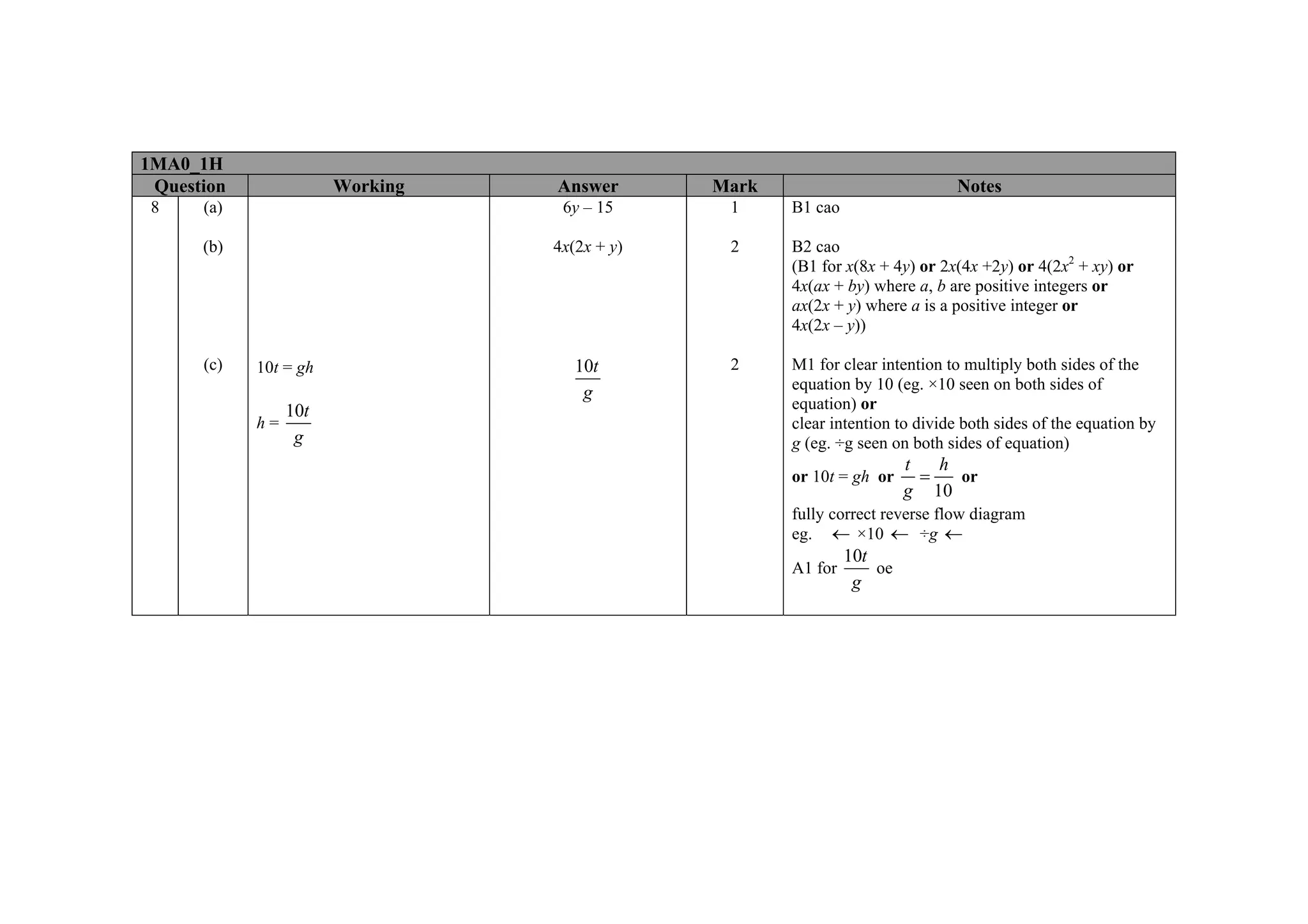
 8    (a)                         6y – 15      1     B1 cao

      (b)                        4x(2x + y)    2     B2 cao
                                                     (B1 for x(8x + 4y) or 2x(4x +2y) or 4(2x2 + xy) or
                                                     4x(ax + by) where a, b are positive integers or
                                                     ax(2x + y) where a is a positive integer or
                                                     4x(2x – y))

      (c)   10t = gh                10t        2     M1 for clear intention to multiply both sides of the
                                                     equation by 10 (eg. ×10 seen on both sides of
                                     g
                 10t                                 equation) or
            h=                                       clear intention to divide both sides of the equation by
                  g                                  g (eg. ÷g seen on both sides of equation)
                                                                       t   h
                                                     or 10t = gh or      =   or
                                                                       g 10
                                                     fully correct reverse flow diagram
                                                     eg. ← ×10 ← ÷g ←
                                                              10t
                                                     A1 for       oe
                                                               g
1MA0_1H
 Question   Working     Answer          Mark                            Notes
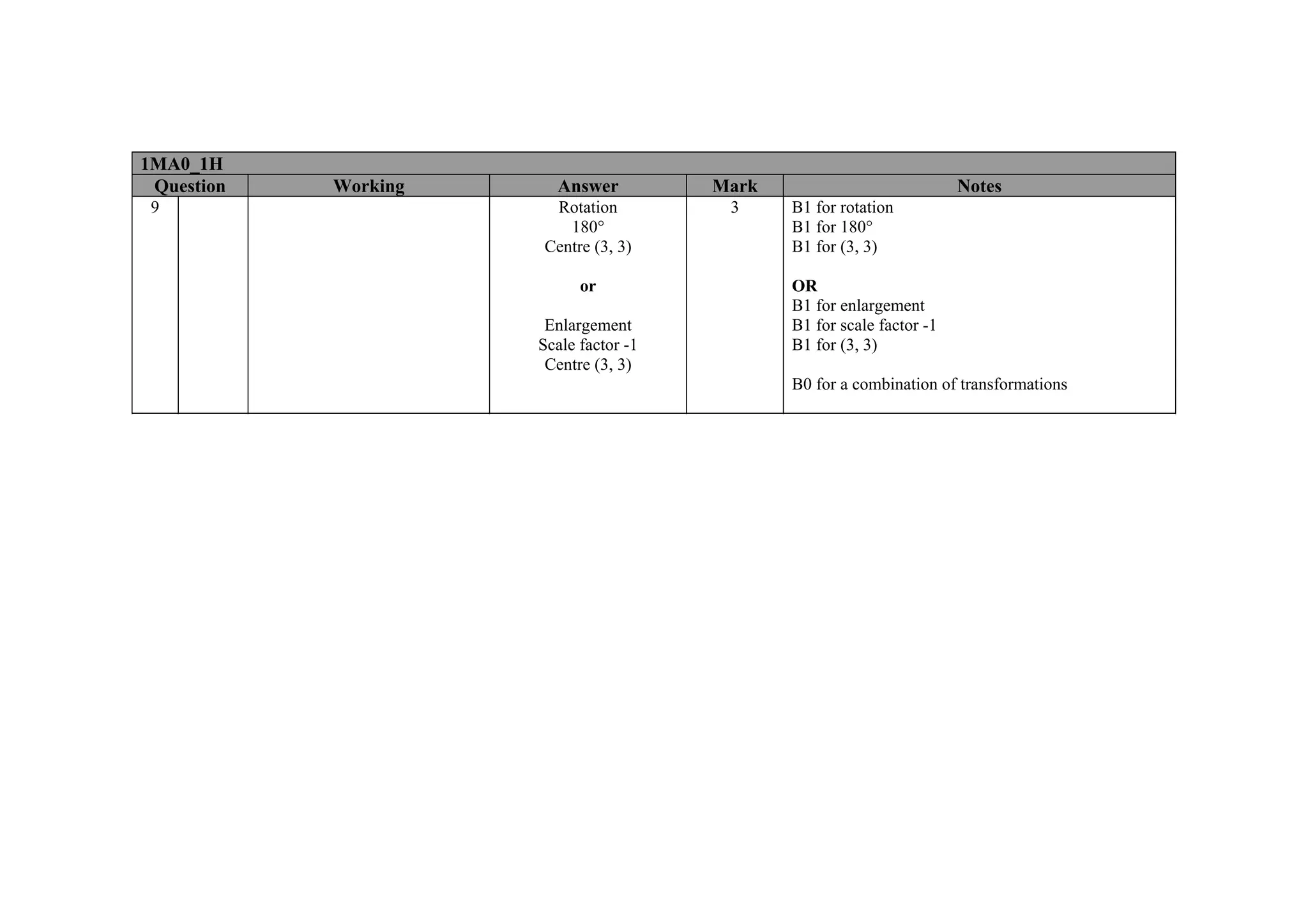
 9                     Rotation          3     B1 for rotation
                         180°                  B1 for 180°
                      Centre (3, 3)            B1 for (3, 3)

                            or                 OR
                                               B1 for enlargement
                       Enlargement             B1 for scale factor -1
                      Scale factor -1          B1 for (3, 3)
                       Centre (3, 3)
                                               B0 for a combination of transformations
1MA0_1H
 Question             Working             Answer            Mark                               Notes
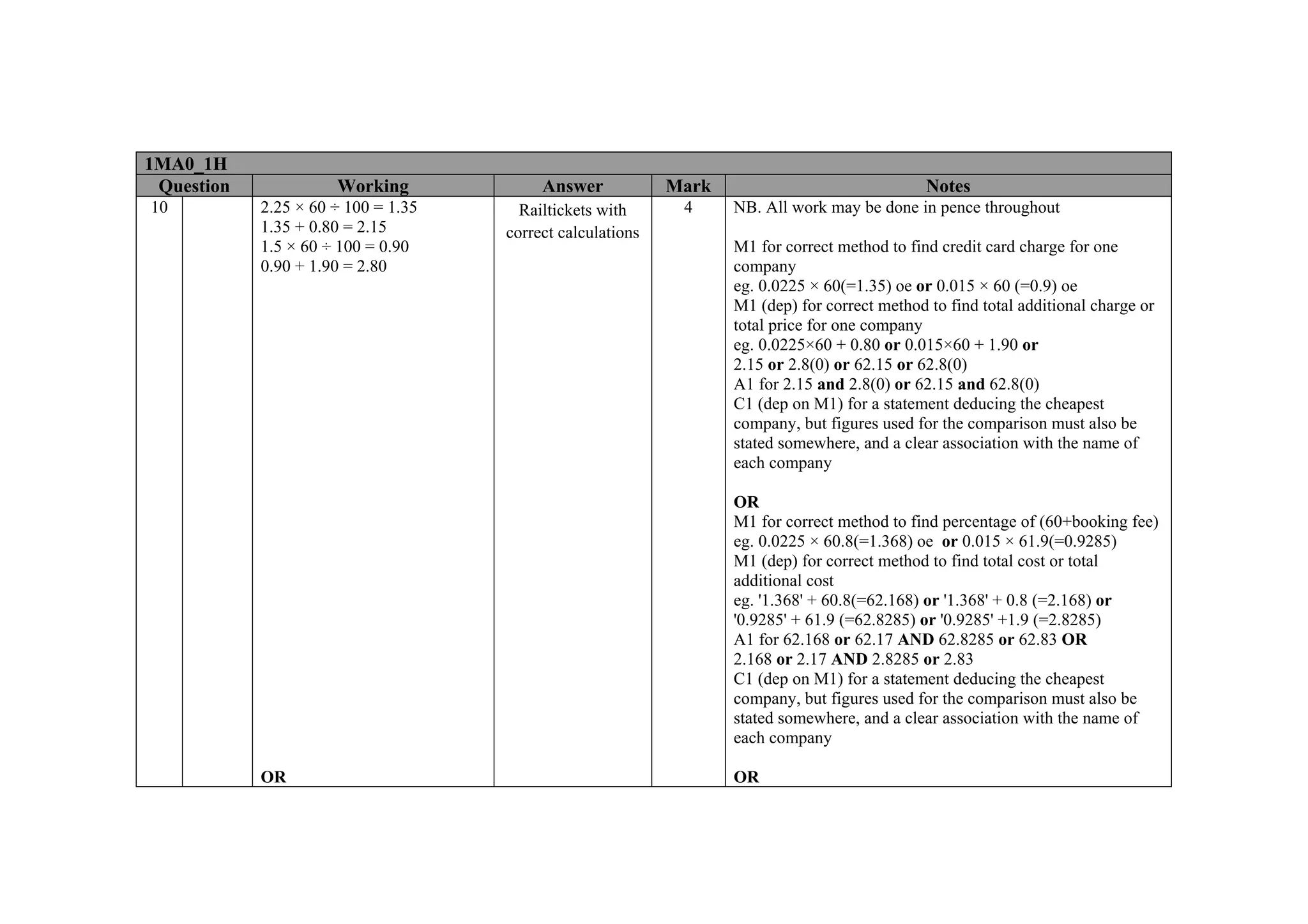
10          2.25 × 60 ÷ 100 = 1.35     Railtickets with      4     NB. All work may be done in pence throughout
            1.35 + 0.80 = 2.15       correct calculations
            1.5 × 60 ÷ 100 = 0.90                                  M1 for correct method to find credit card charge for one
            0.90 + 1.90 = 2.80                                     company
                                                                   eg. 0.0225 × 60(=1.35) oe or 0.015 × 60 (=0.9) oe
                                                                   M1 (dep) for correct method to find total additional charge or
                                                                   total price for one company
                                                                   eg. 0.0225×60 + 0.80 or 0.015×60 + 1.90 or
                                                                   2.15 or 2.8(0) or 62.15 or 62.8(0)
                                                                   A1 for 2.15 and 2.8(0) or 62.15 and 62.8(0)
                                                                   C1 (dep on M1) for a statement deducing the cheapest
                                                                   company, but figures used for the comparison must also be
                                                                   stated somewhere, and a clear association with the name of
                                                                   each company

                                                                   OR
                                                                   M1 for correct method to find percentage of (60+booking fee)
                                                                   eg. 0.0225 × 60.8(=1.368) oe or 0.015 × 61.9(=0.9285)
                                                                   M1 (dep) for correct method to find total cost or total
                                                                   additional cost
                                                                   eg. '1.368' + 60.8(=62.168) or '1.368' + 0.8 (=2.168) or
                                                                   '0.9285' + 61.9 (=62.8285) or '0.9285' +1.9 (=2.8285)
                                                                   A1 for 62.168 or 62.17 AND 62.8285 or 62.83 OR
                                                                   2.168 or 2.17 AND 2.8285 or 2.83
                                                                   C1 (dep on M1) for a statement deducing the cheapest
                                                                   company, but figures used for the comparison must also be
                                                                   stated somewhere, and a clear association with the name of
                                                                   each company

            OR                                                     OR
1MA0_1H
 Question             Working         Answer   Mark                               Notes
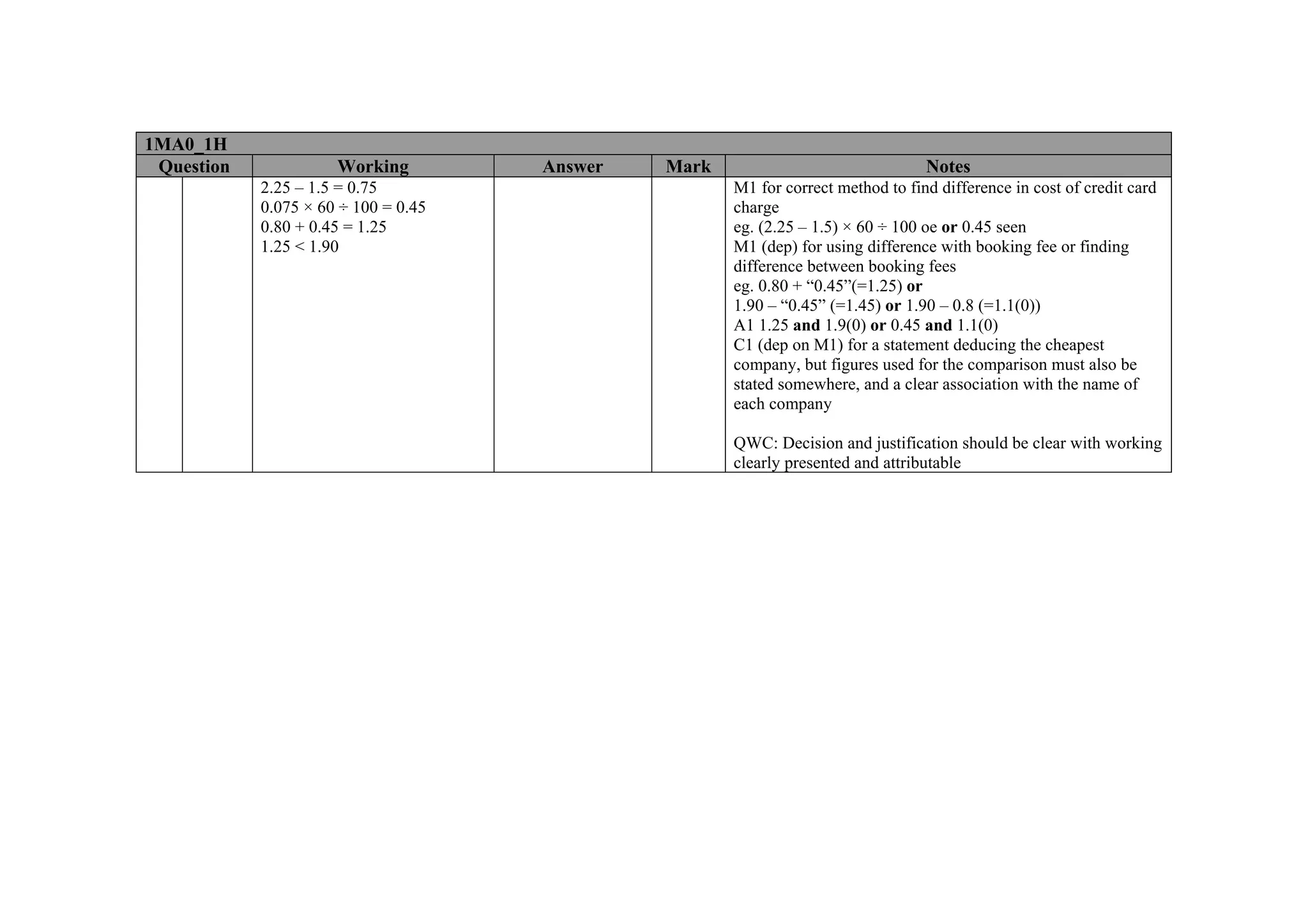
            2.25 – 1.5 = 0.75                         M1 for correct method to find difference in cost of credit card
            0.075 × 60 ÷ 100 = 0.45                   charge
            0.80 + 0.45 = 1.25                        eg. (2.25 – 1.5) × 60 ÷ 100 oe or 0.45 seen
            1.25 < 1.90                               M1 (dep) for using difference with booking fee or finding
                                                      difference between booking fees
                                                      eg. 0.80 + “0.45”(=1.25) or
                                                      1.90 – “0.45” (=1.45) or 1.90 – 0.8 (=1.1(0))
                                                      A1 1.25 and 1.9(0) or 0.45 and 1.1(0)
                                                      C1 (dep on M1) for a statement deducing the cheapest
                                                      company, but figures used for the comparison must also be
                                                      stated somewhere, and a clear association with the name of
                                                      each company

                                                      QWC: Decision and justification should be clear with working
                                                      clearly presented and attributable
1MA0_1H
 Question             Working           Answer   Mark                           Notes
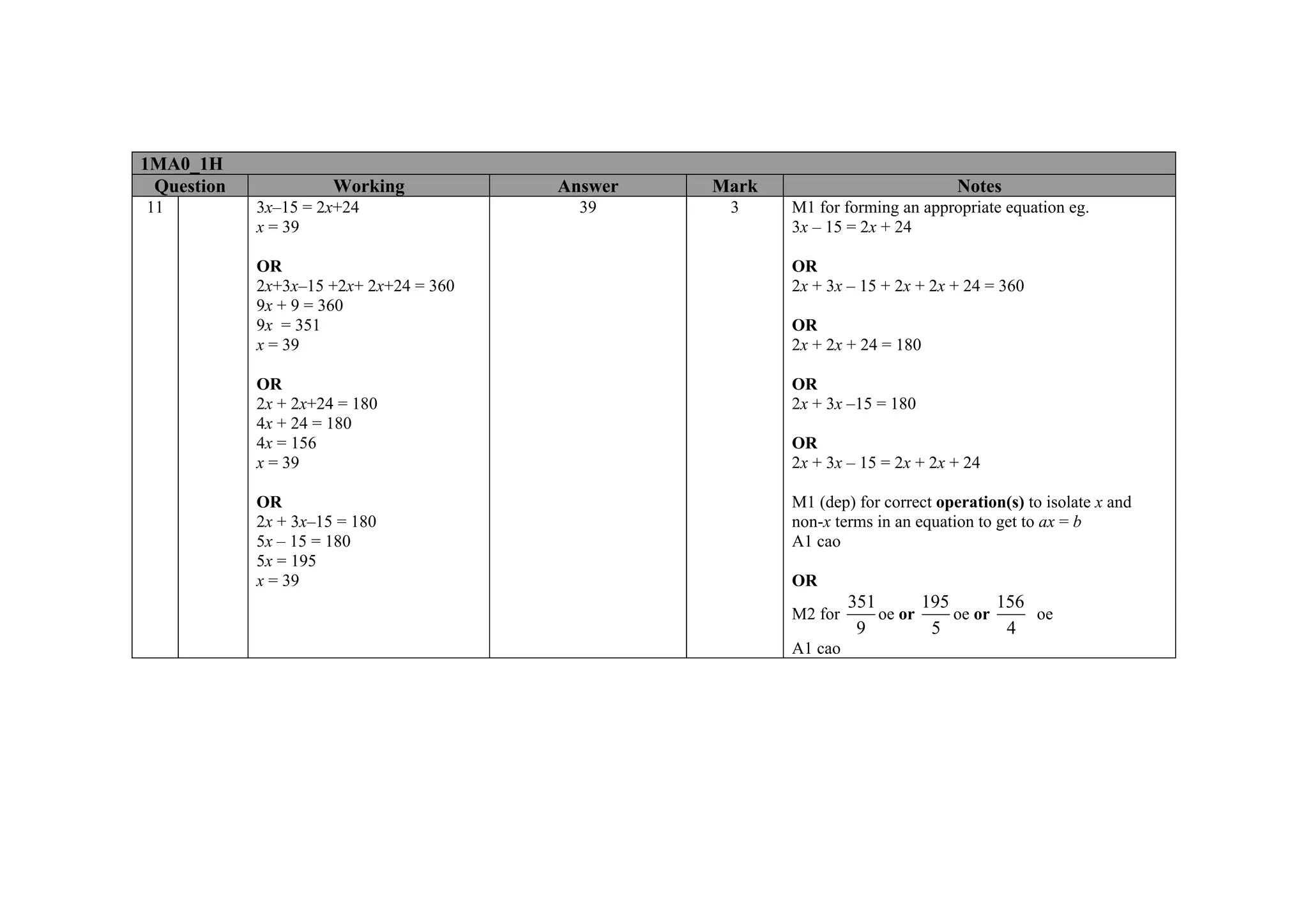
11          3x–15 = 2x+24                 39      3     M1 for forming an appropriate equation eg.
            x = 39                                      3x – 15 = 2x + 24

            OR                                          OR
            2x+3x–15 +2x+ 2x+24 = 360                   2x + 3x – 15 + 2x + 2x + 24 = 360
            9x + 9 = 360
            9x = 351                                    OR
            x = 39                                      2x + 2x + 24 = 180

            OR                                          OR
            2x + 2x+24 = 180                            2x + 3x –15 = 180
            4x + 24 = 180
            4x = 156                                    OR
            x = 39                                      2x + 3x – 15 = 2x + 2x + 24

            OR                                          M1 (dep) for correct operation(s) to isolate x and
            2x + 3x–15 = 180                            non-x terms in an equation to get to ax = b
            5x – 15 = 180                               A1 cao
            5x = 195
            x = 39                                      OR
                                                                 351       195       156
                                                        M2 for       oe or     oe or     oe
                                                                  9         5         4
                                                        A1 cao
1MA0_1H
 Question             Working   Answer   Mark                              Notes
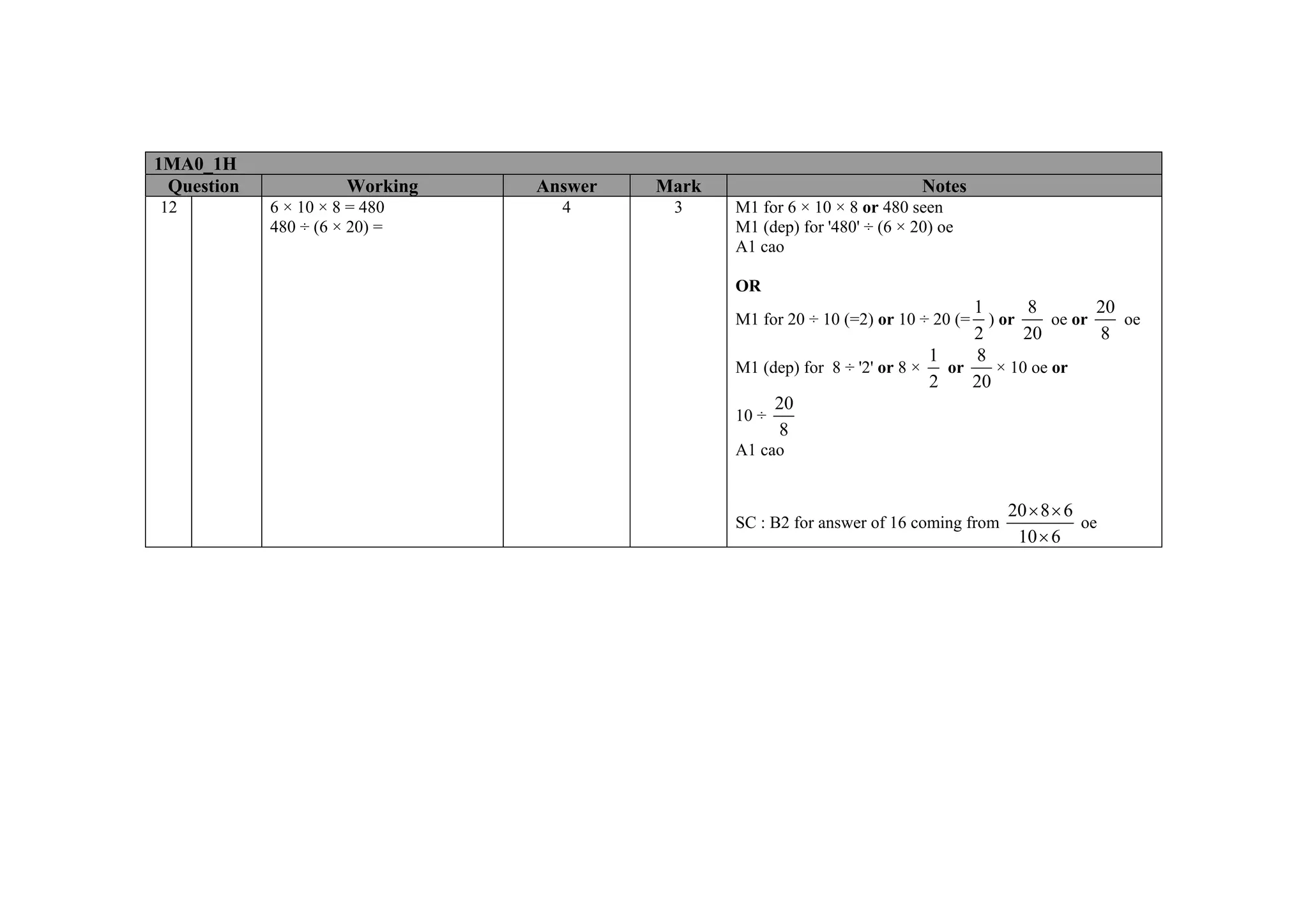
12          6 × 10 × 8 = 480      4       3     M1 for 6 × 10 × 8 or 480 seen
            480 ÷ (6 × 20) =                    M1 (dep) for '480' ÷ (6 × 20) oe
                                                A1 cao

                                                OR
                                                                                 1      8         20
                                                M1 for 20 ÷ 10 (=2) or 10 ÷ 20 (=  ) or     oe or    oe
                                                                                 2      20        8
                                                                            1    8
                                                M1 (dep) for 8 ÷ '2' or 8 ×   or    × 10 oe or
                                                                            2    20
                                                     20
                                                10 ÷
                                                     8
                                                A1 cao


                                                                                       20 × 8 × 6
                                                SC : B2 for answer of 16 coming from              oe
                                                                                        10 × 6
1MA0_1H
 Question         Working           Answer   Mark                                     Notes
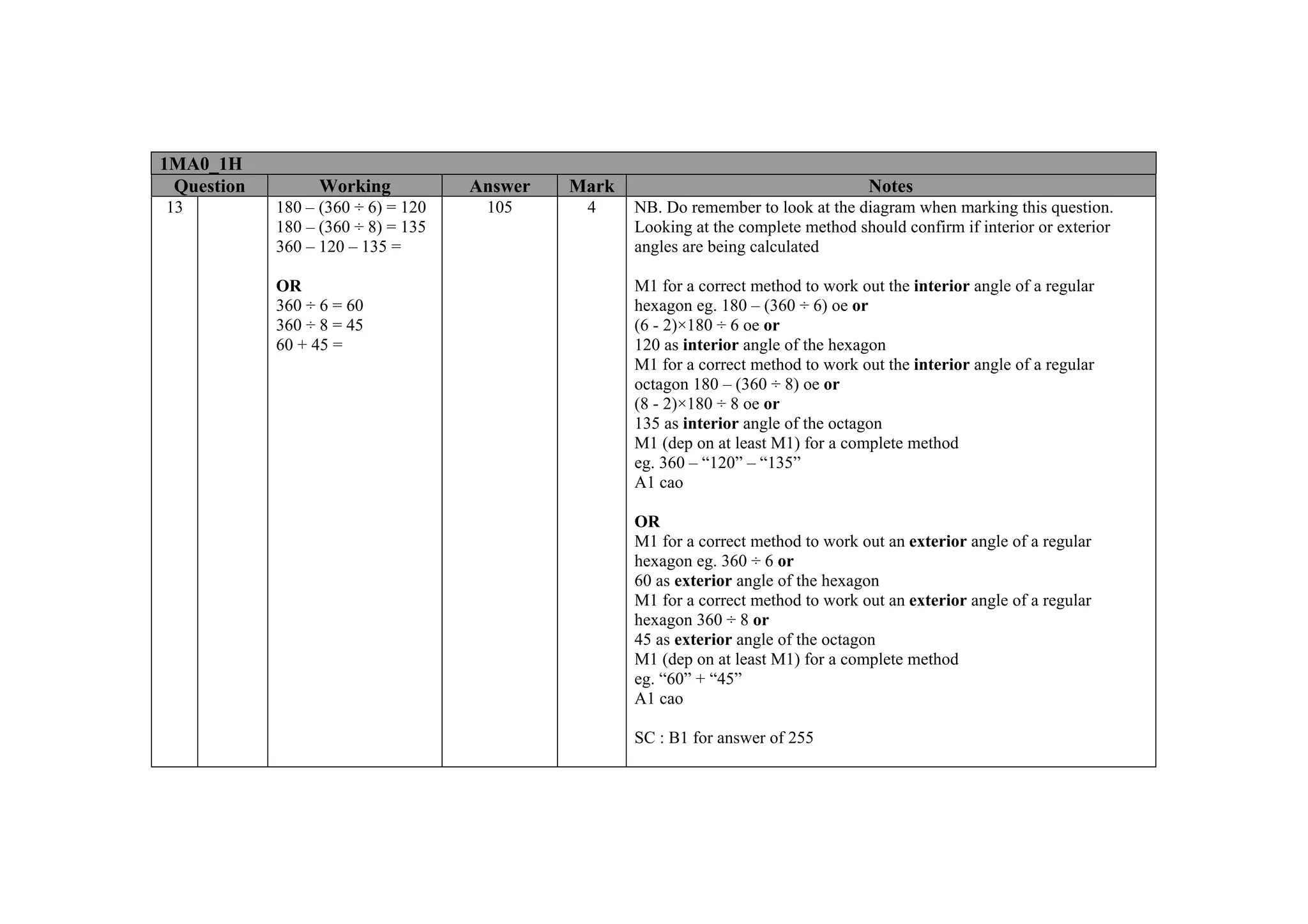
13          180 – (360 ÷ 6) = 120    105      4     NB. Do remember to look at the diagram when marking this question.
            180 – (360 ÷ 8) = 135                   Looking at the complete method should confirm if interior or exterior
            360 – 120 – 135 =                       angles are being calculated

            OR                                      M1 for a correct method to work out the interior angle of a regular
            360 ÷ 6 = 60                            hexagon eg. 180 – (360 ÷ 6) oe or
            360 ÷ 8 = 45                            (6 - 2)×180 ÷ 6 oe or
            60 + 45 =                               120 as interior angle of the hexagon
                                                    M1 for a correct method to work out the interior angle of a regular
                                                    octagon 180 – (360 ÷ 8) oe or
                                                    (8 - 2)×180 ÷ 8 oe or
                                                    135 as interior angle of the octagon
                                                    M1 (dep on at least M1) for a complete method
                                                    eg. 360 – “120” – “135”
                                                    A1 cao

                                                    OR
                                                    M1 for a correct method to work out an exterior angle of a regular
                                                    hexagon eg. 360 ÷ 6 or
                                                    60 as exterior angle of the hexagon
                                                    M1 for a correct method to work out an exterior angle of a regular
                                                    hexagon 360 ÷ 8 or
                                                    45 as exterior angle of the octagon
                                                    M1 (dep on at least M1) for a complete method
                                                    eg. “60” + “45”
                                                    A1 cao

                                                    SC : B1 for answer of 255
1MA0_1H
 Question   Working     Answer        Mark                                      Notes
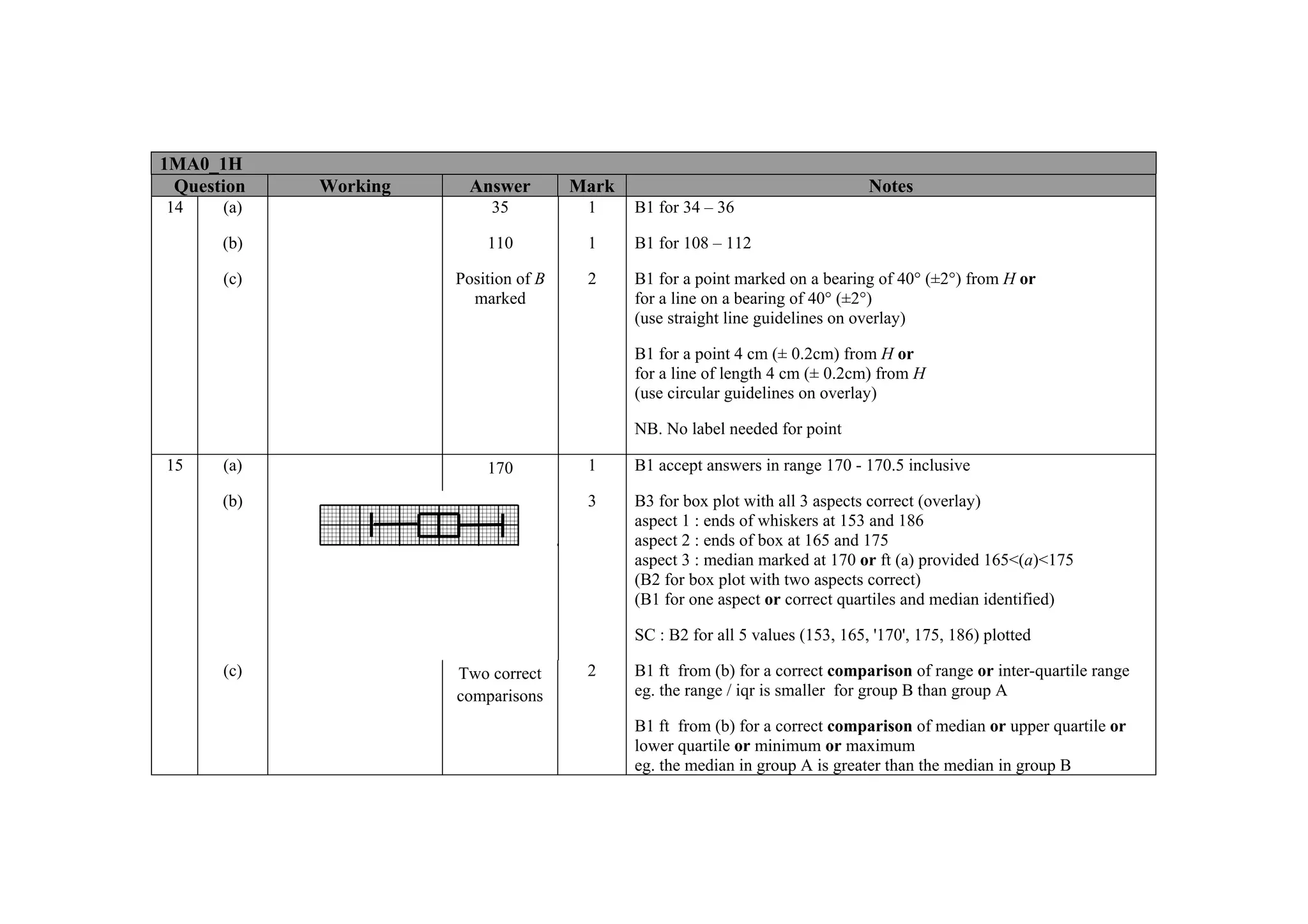
14    (a)                  35          1     B1 for 34 – 36

      (b)                 110          1     B1 for 108 – 112

      (c)             Position of B    2     B1 for a point marked on a bearing of 40° (±2°) from H or
                        marked               for a line on a bearing of 40° (±2°)
                                             (use straight line guidelines on overlay)

                                             B1 for a point 4 cm (± 0.2cm) from H or
                                             for a line of length 4 cm (± 0.2cm) from H
                                             (use circular guidelines on overlay)

                                             NB. No label needed for point

15    (a)                 170          1     B1 accept answers in range 170 - 170.5 inclusive

      (b)                              3     B3 for box plot with all 3 aspects correct (overlay)
                                             aspect 1 : ends of whiskers at 153 and 186
                                             aspect 2 : ends of box at 165 and 175
                                             aspect 3 : median marked at 170 or ft (a) provided 165<(a)<175
                                             (B2 for box plot with two aspects correct)
                                             (B1 for one aspect or correct quartiles and median identified)

                                             SC : B2 for all 5 values (153, 165, '170', 175, 186) plotted

      (c)             Two correct      2     B1 ft from (b) for a correct comparison of range or inter-quartile range
                      comparisons            eg. the range / iqr is smaller for group B than group A

                                             B1 ft from (b) for a correct comparison of median or upper quartile or
                                             lower quartile or minimum or maximum
                                             eg. the median in group A is greater than the median in group B
1MA0_1H
 Question   Working     Answer         Mark                            Notes
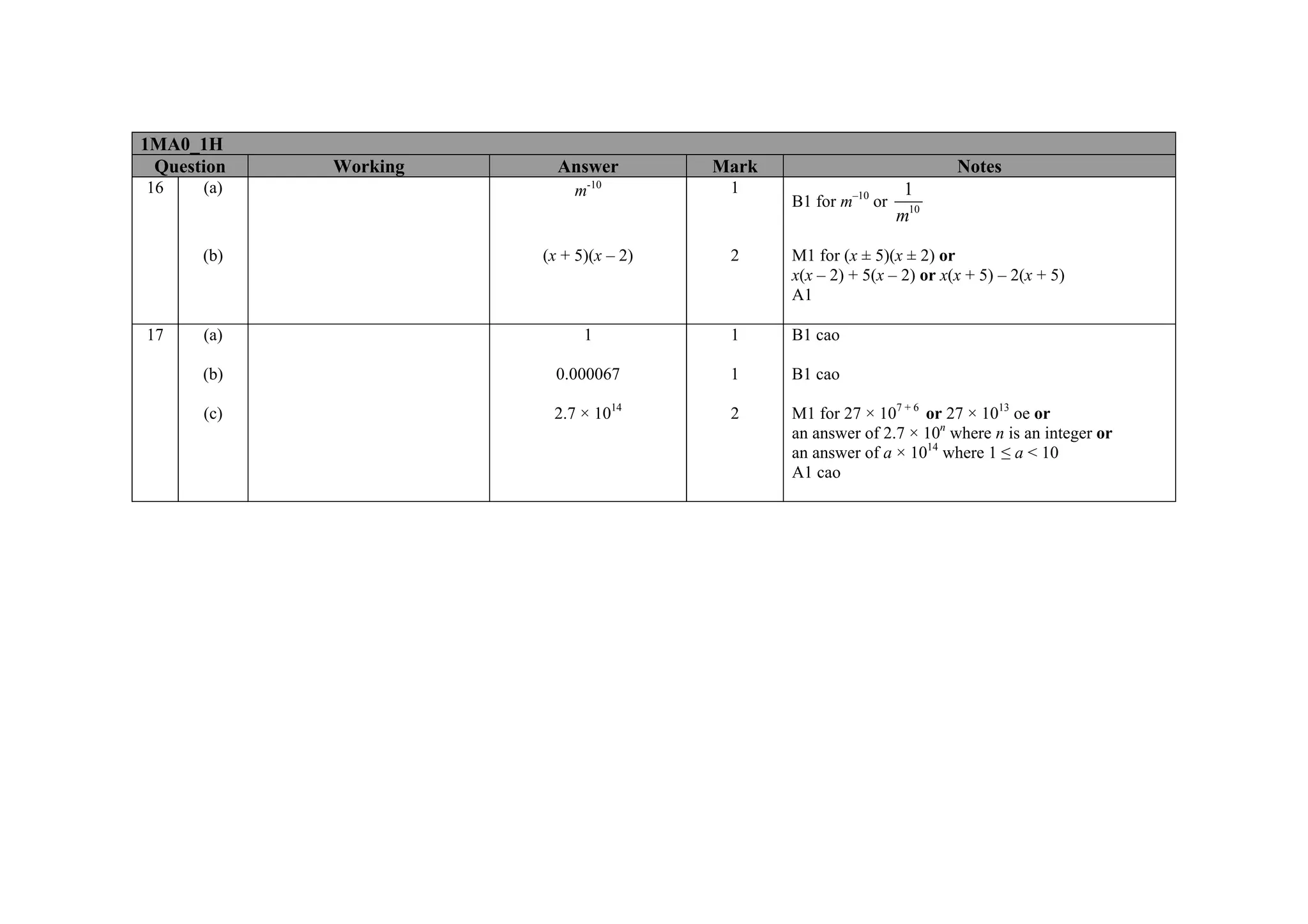
16    (a)                 m -10         1                       1
                                              B1 for m–10 or
                                                               m10

      (b)             (x + 5)(x – 2)    2     M1 for (x ± 5)(x ± 2) or
                                              x(x – 2) + 5(x – 2) or x(x + 5) – 2(x + 5)
                                              A1

17    (a)                   1           1     B1 cao

      (b)               0.000067        1     B1 cao

      (c)              2.7 × 10¹⁴       2     M1 for 27 × 107 + 6 or 27 × 1013 oe or
                                              an answer of 2.7 × 10n where n is an integer or
                                              an answer of a × 1014 where 1 ≤ a < 10
                                              A1 cao
1MA0_1H
 Question                 Working    Answer         Mark                             Notes
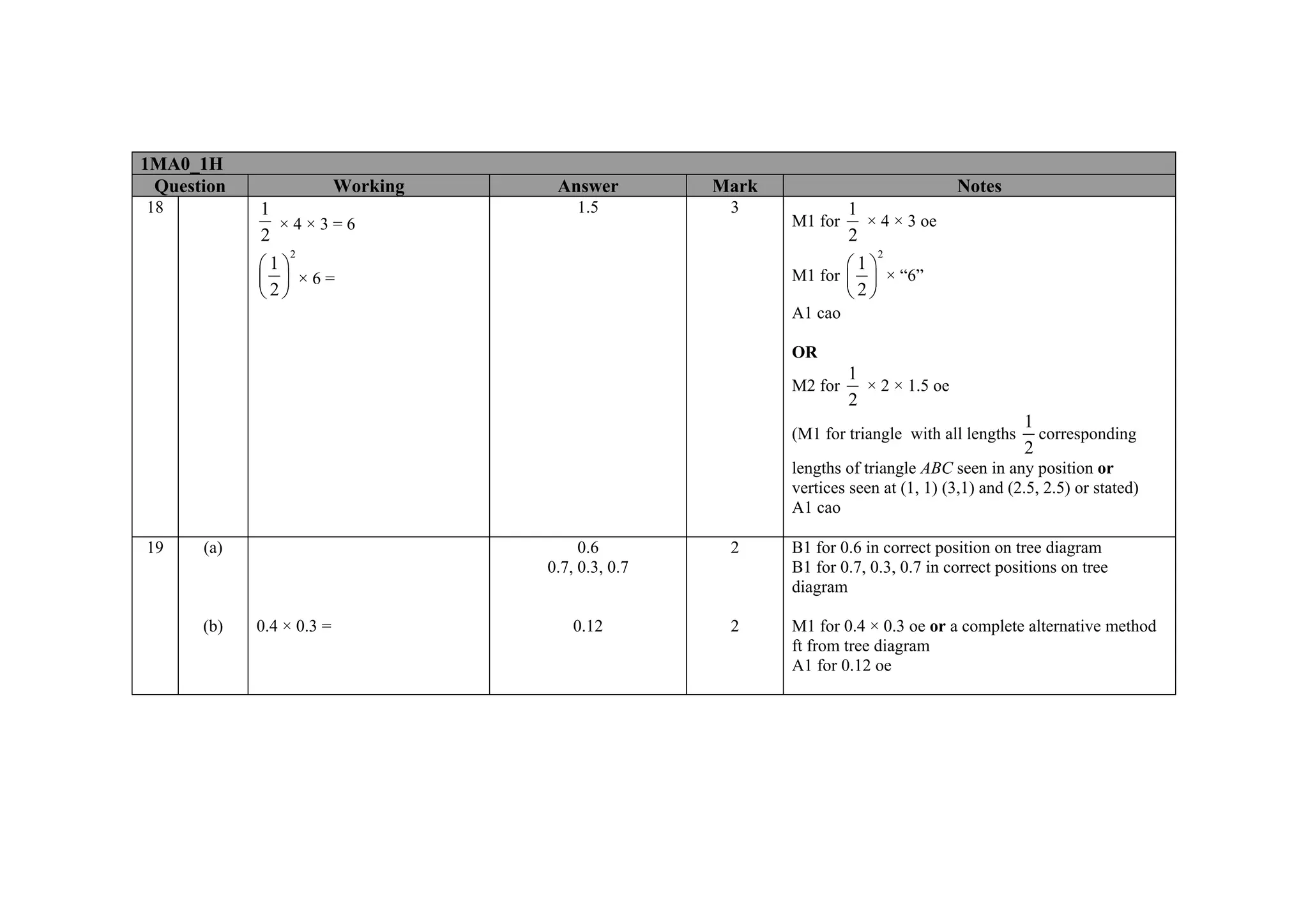
18          1                           1.5          3              1
              ×4×3=6                                       M1 for     × 4 × 3 oe
            2                                                       2
                2                                                       2
            ⎛1⎞                                                   ⎛1⎞
            ⎜ ⎟ ×6=                                        M1 for ⎜ ⎟ × “6”
            ⎝2⎠                                                   ⎝2⎠
                                                           A1 cao

                                                           OR
                                                                    1
                                                           M2 for     × 2 × 1.5 oe
                                                                    2
                                                                                               1
                                                           (M1 for triangle with all lengths     corresponding
                                                                                               2
                                                           lengths of triangle ABC seen in any position or
                                                           vertices seen at (1, 1) (3,1) and (2.5, 2.5) or stated)
                                                           A1 cao

19    (a)                                0.6         2     B1 for 0.6 in correct position on tree diagram
                                    0.7, 0.3, 0.7          B1 for 0.7, 0.3, 0.7 in correct positions on tree
                                                           diagram

      (b)   0.4 × 0.3 =                 0.12         2     M1 for 0.4 × 0.3 oe or a complete alternative method
                                                           ft from tree diagram
                                                           A1 for 0.12 oe
1MA0_1H
 Question                Working         Answer   Mark                                 Notes
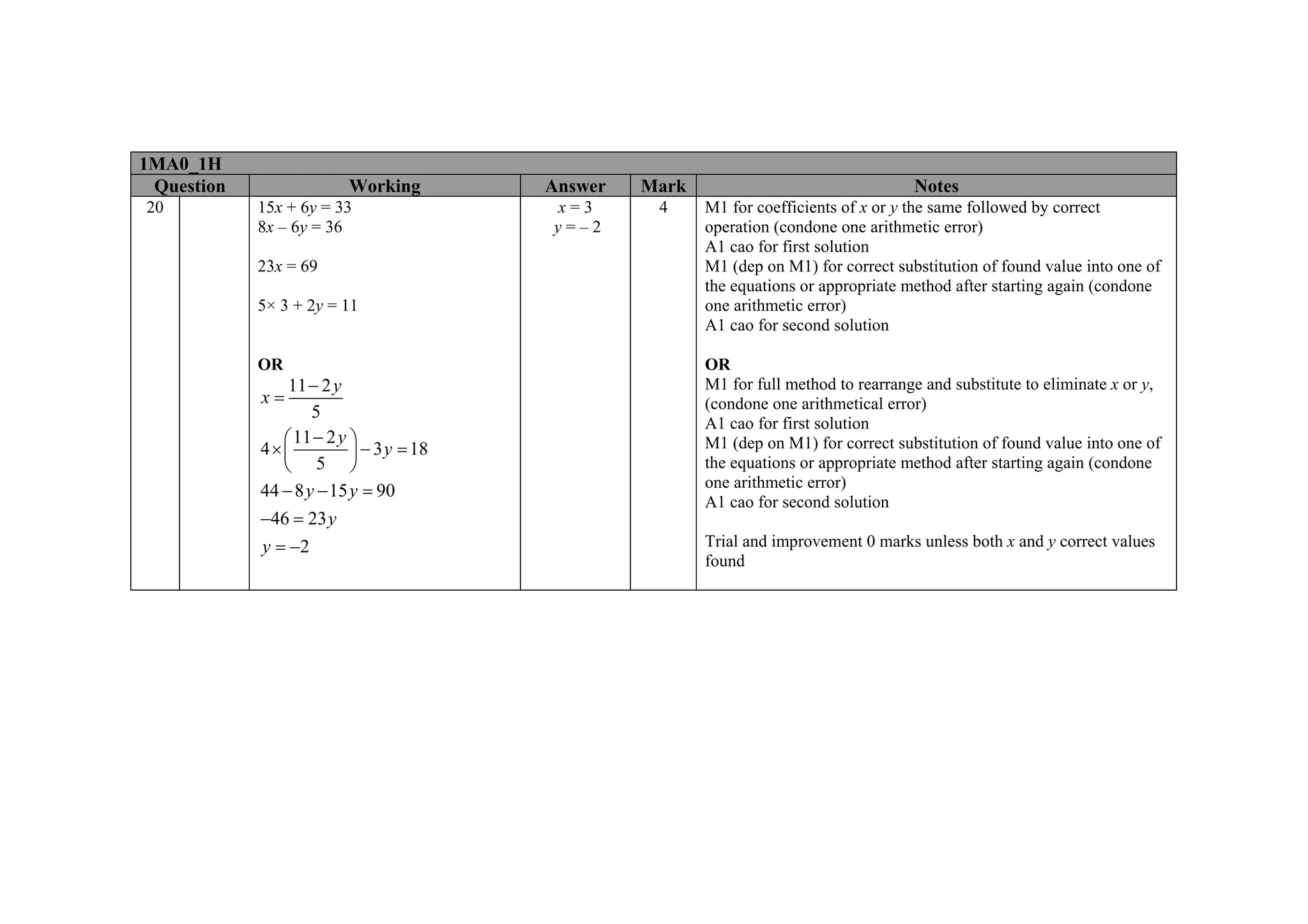
20          15x + 6y = 33                x=3       4     M1 for coefficients of x or y the same followed by correct
            8x – 6y = 36                 y=–2            operation (condone one arithmetic error)
                                                         A1 cao for first solution
            23x = 69                                     M1 (dep on M1) for correct substitution of found value into one of
                                                         the equations or appropriate method after starting again (condone
            5× 3 + 2y = 11                               one arithmetic error)
                                                         A1 cao for second solution

            OR                                           OR
                11 − 2 y                                 M1 for full method to rearrange and substitute to eliminate x or y,
            x=                                           (condone one arithmetical error)
                    5
                                                         A1 cao for first solution
               ⎛ 11 − 2 y ⎞                              M1 (dep on M1) for correct substitution of found value into one of
            4×⎜           ⎟ − 3 y = 18
               ⎝ 5 ⎠                                     the equations or appropriate method after starting again (condone
                                                         one arithmetic error)
            44 − 8 y − 15 y = 90
                                                         A1 cao for second solution
            −46 = 23 y
            y = −2                                       Trial and improvement 0 marks unless both x and y correct values
                                                         found
1MA0_1H
 Question                Working                     Answer     Mark                                    Notes
                                                            o
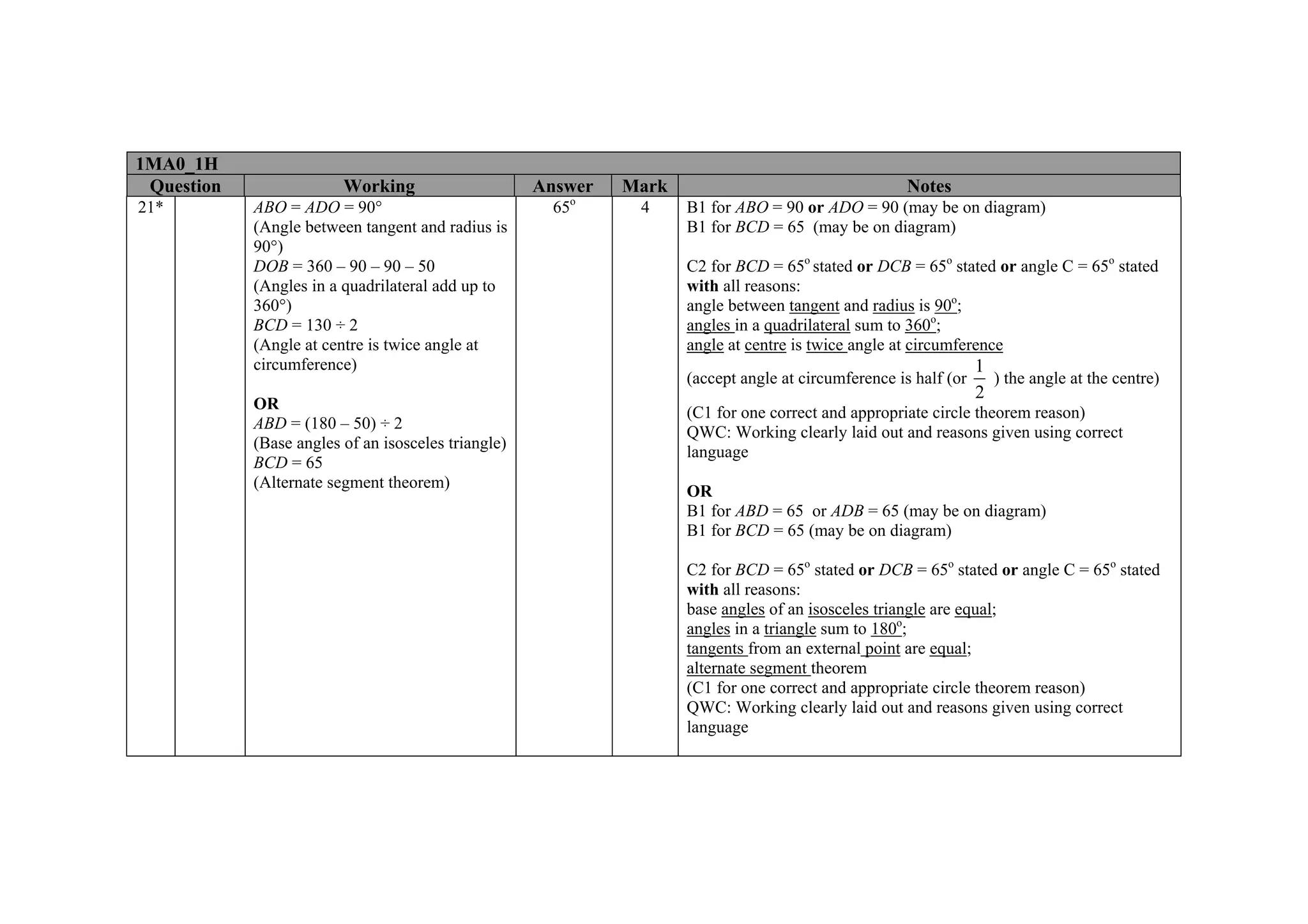
21*         ABO = ADO = 90°                            65        4     B1 for ABO = 90 or ADO = 90 (may be on diagram)
            (Angle between tangent and radius is                       B1 for BCD = 65 (may be on diagram)
            90°)
            DOB = 360 – 90 – 90 – 50                                   C2 for BCD = 65o stated or DCB = 65o stated or angle C = 65o stated
            (Angles in a quadrilateral add up to                       with all reasons:
            360°)                                                      angle between tangent and radius is 90o;
            BCD = 130 ÷ 2                                              angles in a quadrilateral sum to 360o;
            (Angle at centre is twice angle at                         angle at centre is twice angle at circumference
            circumference)                                                                                          1
                                                                       (accept angle at circumference is half (or     ) the angle at the centre)
                                                                                                                    2
            OR
                                                                       (C1 for one correct and appropriate circle theorem reason)
            ABD = (180 – 50) ÷ 2
                                                                       QWC: Working clearly laid out and reasons given using correct
            (Base angles of an isosceles triangle)
                                                                       language
            BCD = 65
            (Alternate segment theorem)
                                                                       OR
                                                                       B1 for ABD = 65 or ADB = 65 (may be on diagram)
                                                                       B1 for BCD = 65 (may be on diagram)

                                                                       C2 for BCD = 65o stated or DCB = 65o stated or angle C = 65o stated
                                                                       with all reasons:
                                                                       base angles of an isosceles triangle are equal;
                                                                       angles in a triangle sum to 180o;
                                                                       tangents from an external point are equal;
                                                                       alternate segment theorem
                                                                       (C1 for one correct and appropriate circle theorem reason)
                                                                       QWC: Working clearly laid out and reasons given using correct
                                                                       language
1MA0_1H
 Question             Working               Answer          Mark                             Notes
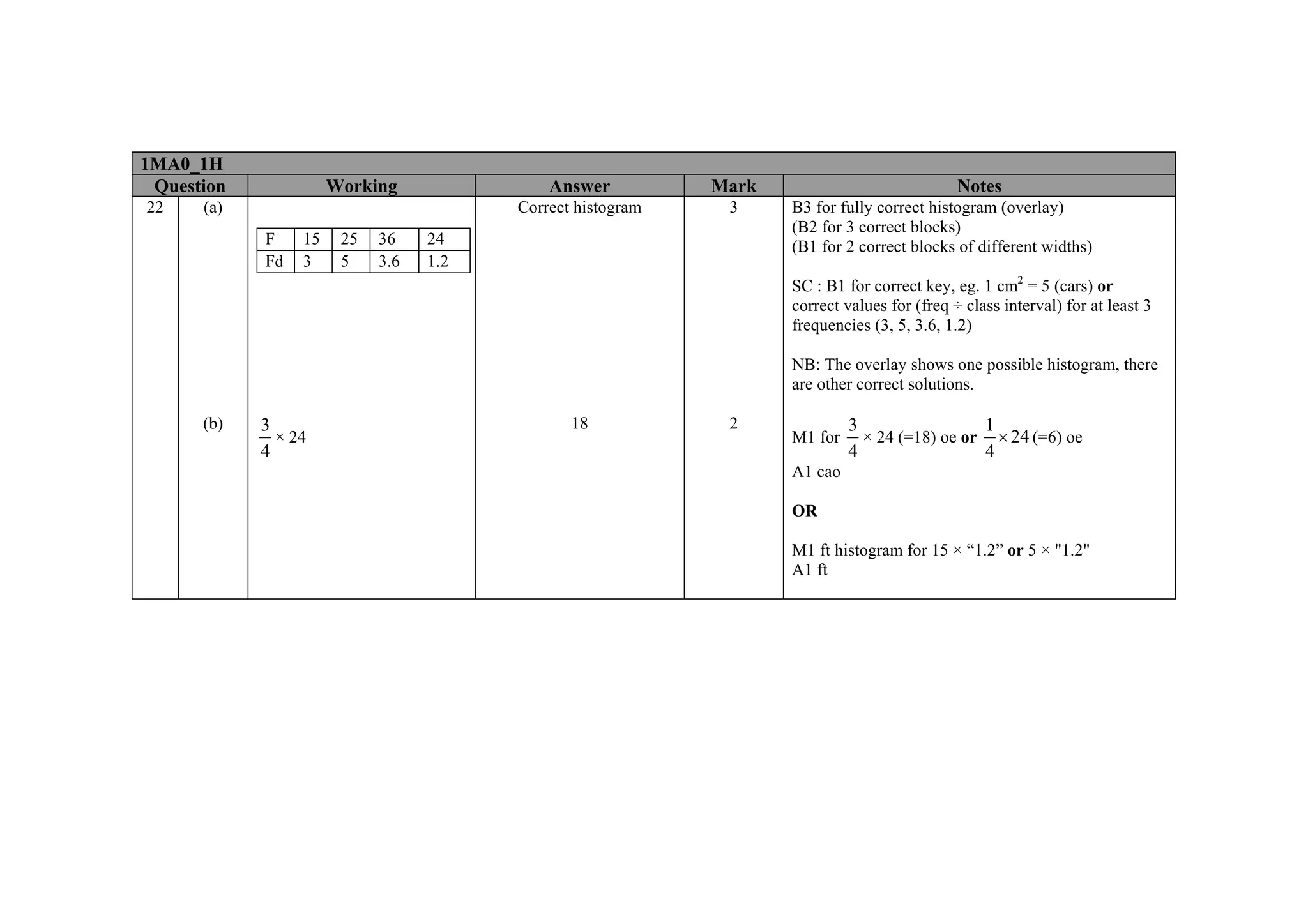
22    (a)                               Correct histogram    3     B3 for fully correct histogram (overlay)
                                                                   (B2 for 3 correct blocks)
            F    15    25   36    24                               (B1 for 2 correct blocks of different widths)
            Fd   3     5    3.6   1.2
                                                                   SC : B1 for correct key, eg. 1 cm2 = 5 (cars) or
                                                                   correct values for (freq ÷ class interval) for at least 3
                                                                   frequencies (3, 5, 3.6, 1.2)

                                                                   NB: The overlay shows one possible histogram, there
                                                                   are other correct solutions.

      (b)   3                                  18            2              3                 1
              × 24                                                 M1 for     × 24 (=18) oe or × 24 (=6) oe
            4                                                               4                 4
                                                                   A1 cao

                                                                   OR

                                                                   M1 ft histogram for 15 × “1.2” or 5 × "1.2"
                                                                   A1 ft
1MA0_1H
 Question               Working                   Answer           Mark                             Notes
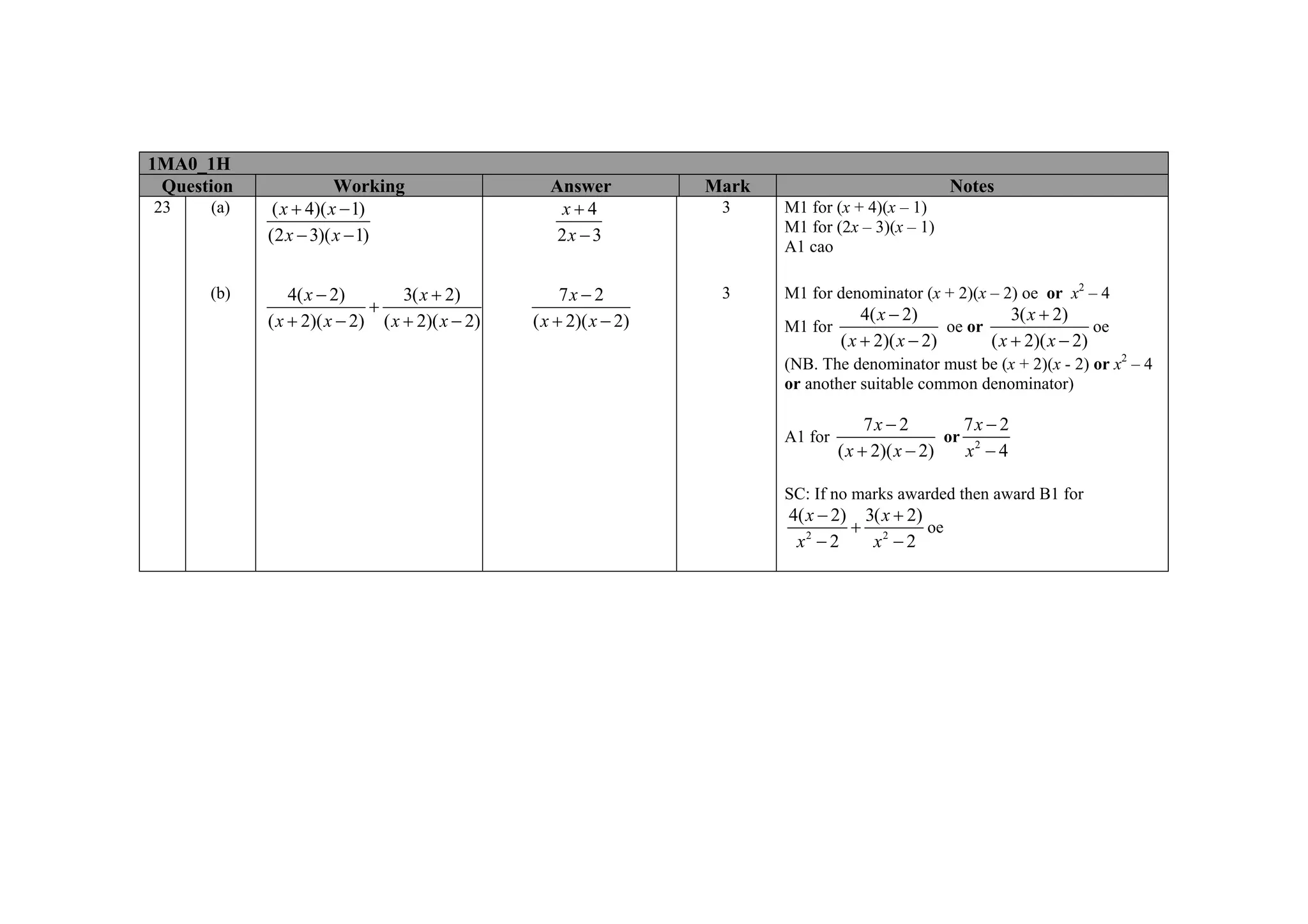
23    (a)    ( x + 4)( x − 1)                      x+4              3     M1 for (x + 4)(x – 1)
                                                                          M1 for (2x – 3)(x – 1)
            (2 x − 3)( x − 1)                      2x − 3
                                                                          A1 cao

      (b)       4( x − 2)        3( x + 2)           7x − 2         3     M1 for denominator (x + 2)(x – 2) oe or x2 – 4
                            +                                                          4( x − 2)              3( x + 2)
            ( x + 2)( x − 2) ( x + 2)( x − 2)   ( x + 2)( x − 2)          M1 for                    oe or                  oe
                                                                                   ( x + 2)( x − 2)       ( x + 2)( x − 2)
                                                                          (NB. The denominator must be (x + 2)(x - 2) or x2 – 4
                                                                          or another suitable common denominator)

                                                                                        7x − 2        7x − 2
                                                                          A1 for                    or 2
                                                                                   ( x + 2)( x − 2)   x −4

                                                                          SC: If no marks awarded then award B1 for
                                                                          4( x − 2) 3( x + 2)
                                                                                   + 2        oe
                                                                           x2 − 2    x −2
1MA0_1H
 Question               Working             Answer   Mark                                Notes
24          eg.                               31      3     M1 for 0.28181(...) or 0.2 + 0.08181(...) or
            x = 0.28181...                                  evidence of correct recurring decimal eg. 281.81(...)
                                             110
            100x = 28.181...                                M1 for two correct recurring decimals that, when
                                                            subtracted, would result in a terminating decimal, and
            99x = 27.9                                      attempting the subtraction
                                                            eg. 100x = 28.1818…, x = 0.28181… and subtracting

                                                            eg. 1000x = 281.8181…, 10x = 2.8181… and subtracting

                                                                 27.9    279
                                                            OR        or     oe
                                                                  99     990
                                                            A1 cao

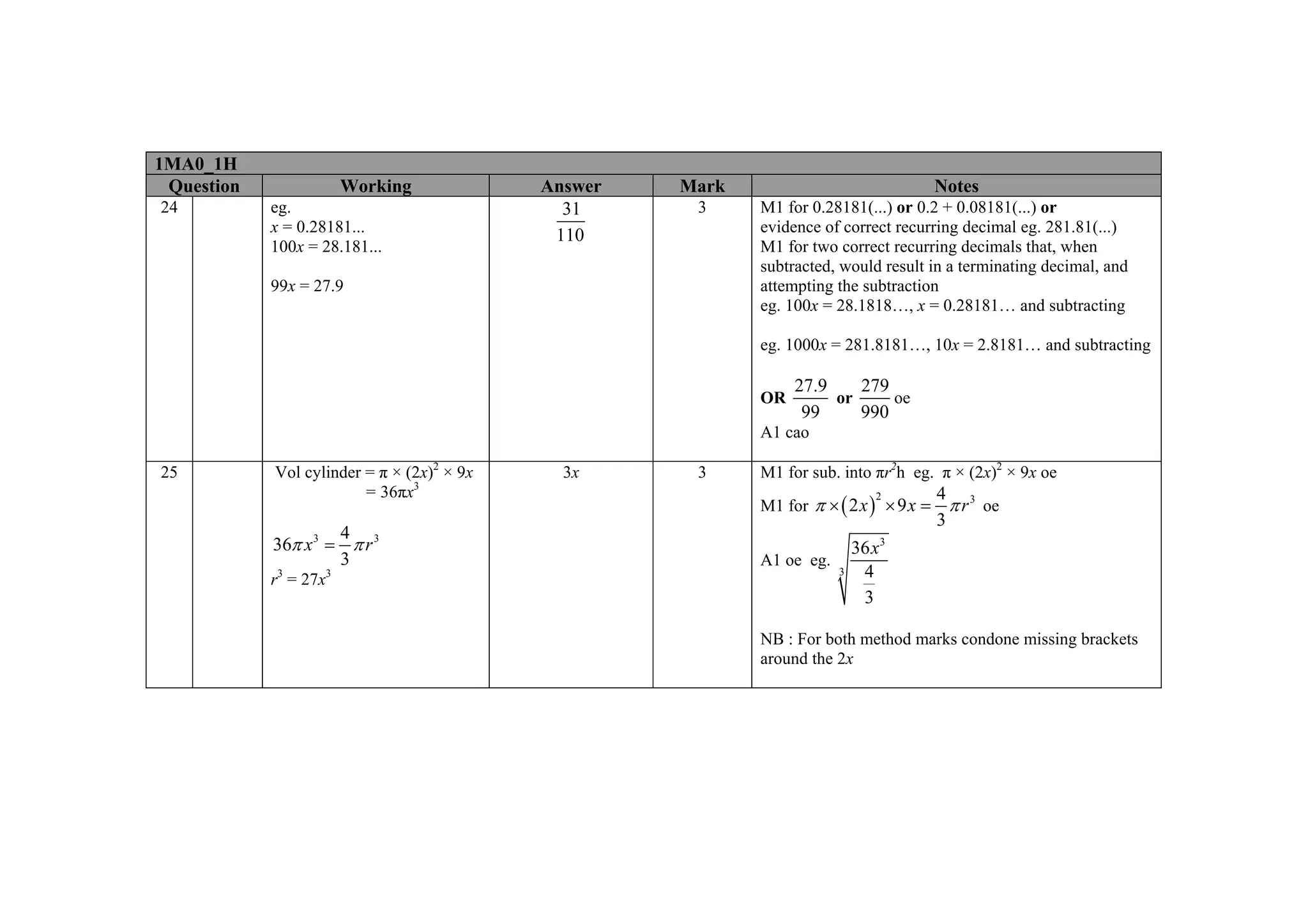
25          Vol cylinder = π × (2x)2 × 9x     3x      3     M1 for sub. into πr2h eg. π × (2x)2 × 9x oe
                         = 36πx3                                                         4 3
                                                            M1 for π × ( 2 x ) × 9 x =
                                                                                2
                                                                                           π r oe
                                                                                         3
                     4
            36π x 3 = π r 3                                                 36 x 3
                     3                                      A1 oe eg.
            r3 = 27x3
                                                                        3    4
                                                                             3

                                                            NB : For both method marks condone missing brackets
                                                            around the 2x
1MA0_1H
 Question   Working              Answer                Mark                            Notes
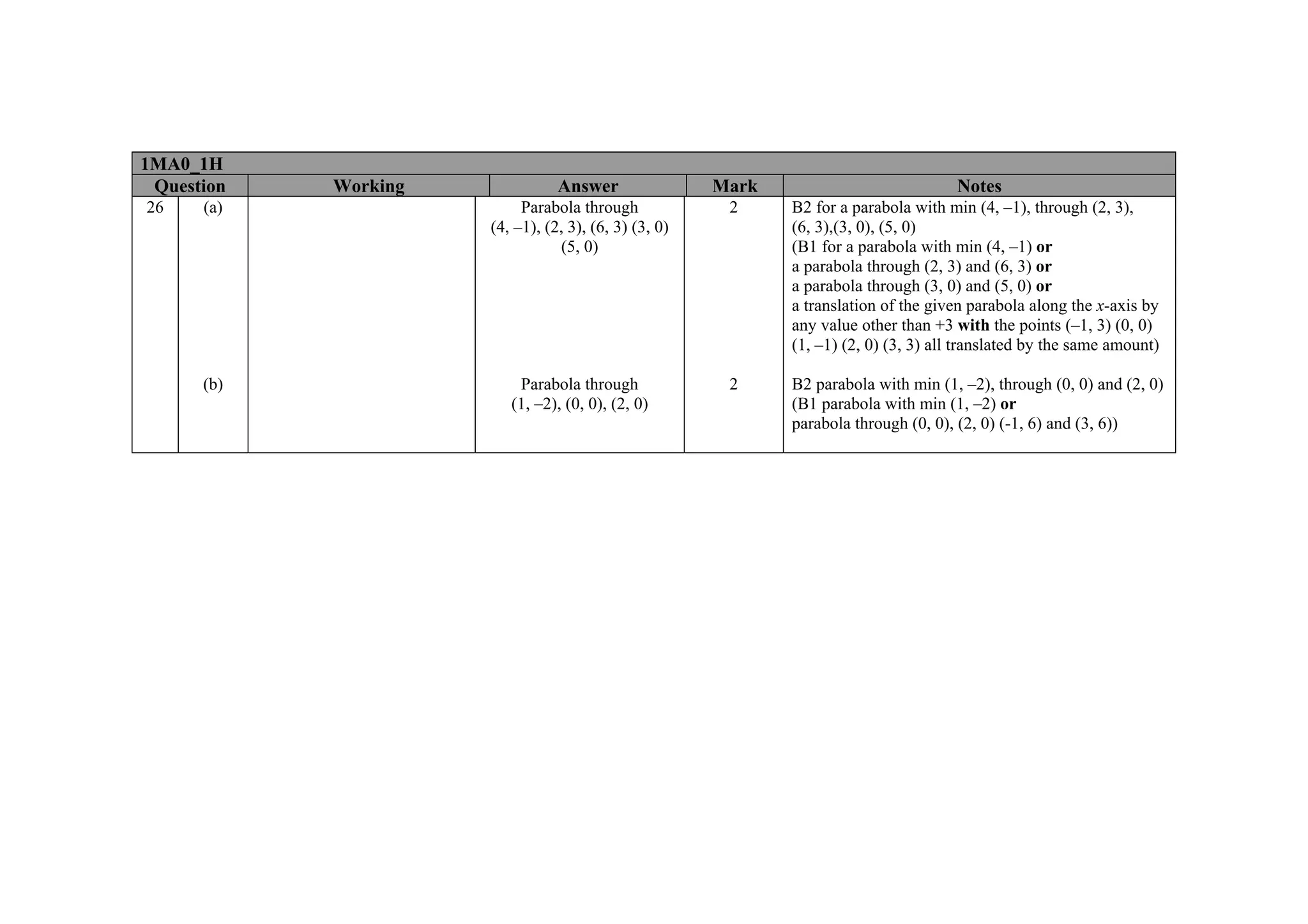
26    (a)                  Parabola through             2     B2 for a parabola with min (4, –1), through (2, 3),
                      (4, –1), (2, 3), (6, 3) (3, 0)          (6, 3),(3, 0), (5, 0)
                                 (5, 0)                       (B1 for a parabola with min (4, –1) or
                                                              a parabola through (2, 3) and (6, 3) or
                                                              a parabola through (3, 0) and (5, 0) or
                                                              a translation of the given parabola along the x-axis by
                                                              any value other than +3 with the points (–1, 3) (0, 0)
                                                              (1, –1) (2, 0) (3, 3) all translated by the same amount)

      (b)                 Parabola through              2     B2 parabola with min (1, –2), through (0, 0) and (2, 0)
                         (1, –2), (0, 0), (2, 0)              (B1 parabola with min (1, –2) or
                                                              parabola through (0, 0), (2, 0) (-1, 6) and (3, 6))
Further copies of this publication are available from
Edexcel Publications, Adamsway, Mansfield, Notts, NG18 4FN


Telephone 01623 467467
Fax 01623 450481
Email publication.orders@edexcel.com
Order Code UG032625 Summer 2012


For more information on Edexcel qualifications, please visit our website
www.edexcel.com


Pearson Education Limited. Registered company number 872828
with its registered office at Edinburgh Gate, Harlow, Essex CM20 2JE

06a 1 ma0_1h_mark_scheme_-_june_2012

  • 1.
    Mark Scheme (Results) Summer2012 GCSE Mathematics (Linear) 1MA0 Higher (Non-Calculator) Paper 1H
  • 2.
    Edexcel and BTECQualifications Edexcel and BTEC qualifications come from Pearson, the world’s leading learning company. We provide a wide range of qualifications including academic, vocational, occupational and specific programmes for employers. For further information, please visit our website at www.edexcel.com. Our website subject pages hold useful resources, support material and live feeds from our subject advisors giving you access to a portal of information. If you have any subject specific questions about this specification that require the help of a subject specialist, you may find our Ask The Expert email service helpful. www.edexcel.com/contactus Pearson: helping people progress, everywhere Our aim is to help everyone progress in their lives through education. We believe in every kind of learning, for all kinds of people, wherever they are in the world. We’ve been involved in education for over 150 years, and by working across 70 countries, in 100 languages, we have built an international reputation for our commitment to high standards and raising achievement through innovation in education. Find out more about how we can help you and your students at: www.pearson.com/uk Summer 2012 Publications Code UG032625 All the material in this publication is copyright © Pearson Education Ltd 2012
  • 3.
    NOTES ON MARKINGPRINCIPLES 1 All candidates must receive the same treatment. Examiners must mark the first candidate in exactly the same way as they mark the last. 2 Mark schemes should be applied positively. Candidates must be rewarded for what they have shown they can do rather than penalised for omissions. 3 All the marks on the mark scheme are designed to be awarded. Examiners should always award full marks if deserved, i.e if the answer matches the mark scheme. Examiners should also be prepared to award zero marks if the candidate’s response is not worthy of credit according to the mark scheme. 4 Where some judgement is required, mark schemes will provide the principles by which marks will be awarded and exemplification may be limited. 5 Crossed out work should be marked UNLESS the candidate has replaced it with an alternative response. 6 Mark schemes will indicate within the table where, and which strands of QWC, are being assessed. The strands are as follows: i) ensure that text is legible and that spelling, punctuation and grammar are accurate so that meaning is clear Comprehension and meaning is clear by using correct notation and labeling conventions. ii) select and use a form and style of writing appropriate to purpose and to complex subject matter Reasoning, explanation or argument is correct and appropriately structured to convey mathematical reasoning. iii) organise information clearly and coherently, using specialist vocabulary when appropriate. The mathematical methods and processes used are coherently and clearly organised and the appropriate mathematical vocabulary used.
  • 4.
    7 With working If there is a wrong answer indicated on the answer line always check the working in the body of the script (and on any diagrams), and award any marks appropriate from the mark scheme. If working is crossed out and still legible, then it should be given any appropriate marks, as long as it has not been replaced by alternative work. If it is clear from the working that the “correct” answer has been obtained from incorrect working, award 0 marks. Send the response to review, and discuss each of these situations with your Team Leader. If there is no answer on the answer line then check the working for an obvious answer. Any case of suspected misread loses A (and B) marks on that part, but can gain the M marks. Discuss each of these situations with your Team Leader. If there is a choice of methods shown, then no marks should be awarded, unless the answer on the answer line makes clear the method that has been used. 8 Follow through marks Follow through marks which involve a single stage calculation can be awarded without working since you can check the answer yourself, but if ambiguous do not award. Follow through marks which involve more than one stage of calculation can only be awarded on sight of the relevant working, even if it appears obvious that there is only one way you could get the answer given. 9 Ignoring subsequent work It is appropriate to ignore subsequent work when the additional work does not change the answer in a way that is inappropriate for the question: e.g. incorrect canceling of a fraction that would otherwise be correct It is not appropriate to ignore subsequent work when the additional work essentially makes the answer incorrect e.g. algebra. Transcription errors occur when candidates present a correct answer in working, and write it incorrectly on the answer line; mark the correct answer. 10 Probability Probability answers must be given a fractions, percentages or decimals. If a candidate gives a decimal equivalent to a probability, this should be written to at least 2 decimal places (unless tenths). Incorrect notation should lose the accuracy marks, but be awarded any implied method marks. If a probability answer is given on the answer line using both incorrect and correct notation, award the marks. If a probability fraction is given then cancelled incorrectly, ignore the incorrectly cancelled answer.
  • 5.
    11 Linear equations Full marks can be gained if the solution alone is given on the answer line, or otherwise unambiguously indicated in working (without contradiction elsewhere). Where the correct solution only is shown substituted, but not identified as the solution, the accuracy mark is lost but any method marks can be awarded. 12 Parts of questions Unless allowed by the mark scheme, the marks allocated to one part of the question CANNOT be awarded in another. 13 Range of answers Unless otherwise stated, when an answer is given as a range (e.g 3.5 – 4.2) then this is inclusive of the end points (e.g 3.5, 4.2) and includes all numbers within the range (e.g 4, 4.1) Guidance on the use of codes within this mark scheme M1 – method mark A1 – accuracy mark B1 – Working mark C1 – communication mark QWC – quality of written communication oe – or equivalent cao – correct answer only ft – follow through sc – special case dep – dependent (on a previous mark or conclusion) indep – independent isw – ignore subsequent working
  • 7.
    1MA0_1H Question Working Answer Mark Notes 1 (a) Type of film 2 B2 for a table with all 3 aspects: Tally Column/row heading ‘type of film’ or list of at Frequency least 3 film types Column/row heading ‘tally’ or tally marks (or key) Column/row heading ‘frequency’ or totals oe (B1 for a table with 2 of the 3 aspects) (b) 1 B1 for acceptable reason eg. all same age, sample too small, biased, same school
  • 8.
    1MA0_1H Question Working Answer Mark Notes 2 (a) 360 ÷ 60 = 6 Yes and 30 3 M1 for dividing side of patio by side of paving slab 300 ÷ 60 = 5 eg. 360 ÷ 60 or 300 ÷ 60 or 3.6 ÷ 0.6 or 3 ÷ 0.6 or 6×5= 6 and 5 seen (may be on a diagram) or 6 divisions seen on length of diagram or 5 divisions seen on width of diagram M1 for correct method to find number of paving slabs eg. (360 ÷ 60) × (300 ÷ 60) oe or 6 × 5 or 30 squares seen on diagram (units may not be consistent) A1 for Yes and 30 (or 2 extra) with correct calculations OR M1 for correct method to find area of patio or paving slab eg 360 × 300 or 108000 seen or 60 × 60 or 3600 seen or 3.6 × 3 or 10.8 seen or 0.6 × 0.6 or 0.36 seen M1 for dividing area of patio by area of a paving slab eg. (3.6 × 3) ÷ (0.6 × 0.6) oe (units may not be consistent) A1 for Yes and 30 (or 2 extra) with correct calculations OR M1 for method to find area of patio or area of 32 slabs eg. 60 × 60 × 32 or 360 × 300 M1 for method to find both area of patio and area of 32 slabs eg. 60 × 60 × 32 and 360 × 300 (units may not be consistent) A1 for Yes and 115200 and 108000 OR Yes and 11.52 and 10.8 NB : Throughout the question, candidates could be working in metres or centimetres
  • 9.
    1MA0_1H Question Working Answer Mark Notes (b) 1726 276.16 3 M1 for complete correct method with relative place value correct. 25890 Condone 1 multiplication error, addition not necessary. 27616 OR 8 6 3 M1 for a complete grid. Condone 1 multiplication error, addition not 2 2 4 1 8 9 3 necessary. 7 1 6 1 2 6 2 OR 6 1 6 M1 for sight of a complete partitioning method, condone 1 multiplication error. Final addition not necessary. 800 60 3 30 24000 1800 90 A1 for digits 27616 2 1600 120 6 A1 ft (dep on M1) for correct placement of decimal point after addition (of appropriate values) 24000+1800+90+1600+120+6 = 27616 (SC: B1 for attempting to add 32 lots of 8.63)
  • 10.
    1MA0_1H Question Working Answer Mark Notes 3 (a) 10 1 B1 cao (b) Ed is cheaper 3 M1 for correct line for Ed intersecting at (20,30) ±1 sq tolerance or y up to 20 10 + x = 1.5x oe 40 miles, Bill is C2 (dep on M1) for a correct full statement ft from graph cheaper for eg. Ed cheaper up to 20 miles and Bill cheaper for more than 20 miles 30 more than 20 (C1 (dep on M1) for a correct conclusion ft from graph miles eg. cheaper at 10 miles with Ed ; eg. cheaper at 50 miles with Bill 20 eg. same cost at 20 miles; eg for £5 go further with Bill OR 10 A general statement covering short and long distances eg. Ed is cheaper for shorter distances and Bill is cheaper for long distances) 0 5 10 15 20 25 30 x OR M1 for correct method to work out Ed's delivery cost for at least 2 values of n miles where 0 < n ≤ 50 OR for correct method to work out Ed and Bill's delivery cost for n miles where 0 < n ≤ 50 C2 (dep on M1) for 20 miles linked with £30 for Ed and Bill with Miles 0 10 20 30 40 50 correct full statement Ed 0 15 30 45 60 75 eg. Ed cheaper up to 20 miles and Bill cheaper for more than 20 miles Bill 10 20 30 40 50 60 (C1 (dep on M1) for a correct conclusion eg. cheaper at 10 miles with Ed; eg. cheaper at 50 miles with Bill eg. same cost at 20 miles; eg for £5 go further with Bill OR A general statement covering short and long distances eg. Ed is cheaper for shorter distances and Bill is cheaper for long distances) SC : B1 for correct full statement seen with no working eg. Ed cheaper up to 20 miles and Bill cheaper for more than 20 miles QWC: Decision and justification should be clear with working clearly presented and attributable
  • 11.
    1MA0_1H Question Working Answer Mark Notes 4 2 9 2 9 3 B3 for fully correct diagram with appropriate key 3 13569 3 13569 (B2 for ordered leaves, with at most two errors or omissions and a key 4 2334689 4 2334689 OR correct unordered leaves and a key 5 245 5 245 OR correct ordered leaves) (B1 for unordered or ordered leaves, with at most two errors or OR Key: 2 9 = 29 omissions 20 9 OR key) 30 1 3 5 6 9 40 2 3 3 4 6 8 9 NB : Order of stem may be reversed; condone commas between leaves 50 2 4 5 5 30 × 40 8 2 30 × 40 c= M1 for or 1200 seen 150 150 A1 cao 6 (a) 30 2 M1 for 25 ÷ 10 or 2.5 seen or 10 ÷ 25 or 0.4 seen or 12 + 12 + 6 oe or a complete method eg. 25 × 12 ÷ 10 oe A1 cao (b) 1000 ÷ 200 × 12 60 2 M1 for 500÷50 or 1000÷200 or 500÷10 OR correct scale factor clearly linked with one ingredient eg. 10 with sugar or 5 with butter or flour or 50 with milk OR answer of 120 or 600 A1 cao
  • 12.
    1MA0_1H Question Working Answer Mark Notes 7 Acton after 24, 48, 72, 96, 120 11: 00 am 3 M1 for listing multiples of 20 and 24 with at least 3 Barton after 20, 40, 60, 80, 100, numbers in each list ; multiples could be given in 120 minutes or in hours and minutes LCM of 20 and 24 is 120 (condone one addition error in total in first 3 numbers 9: 00 am + 120 minutes in lists) A1 identify 120 (mins) or 2 (hours) as LCM OR A1 for 11: 00 (am) or 11(am) or 11 o'clock Acton after 24, 48, 1h 12 m, 1h 36m, 2h OR Barton after 20, 40, 1 h, 1h 20m, M1 for listing times after 9am when each bus leaves 1h 40m, 2h the bus station, with at least 3 times in each list LCM is 2 hours (condone one addition error in total in first 3 times 9: 00 am + 2 hours after 9am in lists) A1 for correct times in each list up to and including OR 11: 00 Times from 9: 00 am when each A1 for 11: 00 (am) or 11(am) or 11 o'clock bus leaves the bus station Acton at 9: 24, 9: 48, 10: 12, OR 10:36, 11:00 M1 for correct method to write 20 and 24 in terms of Barton at 9: 20, 9: 40, 10: 00, their prime factors 2, 2, 5 and 2, 2, 2, 3 10:20, 10:40, 11:00 (condone one error) A1 identify 120 as LCM OR A1 for 11: 00 (am) or 11(am) or 11 o'clock 20 = 2 × 2 × 5 24 = 2 × 2 × 2 × 3 2 × 2 × 2 × 3 × 5 = 120
  • 13.
    1MA0_1H Question Working Answer Mark Notes 8 (a) 6y – 15 1 B1 cao (b) 4x(2x + y) 2 B2 cao (B1 for x(8x + 4y) or 2x(4x +2y) or 4(2x2 + xy) or 4x(ax + by) where a, b are positive integers or ax(2x + y) where a is a positive integer or 4x(2x – y)) (c) 10t = gh 10t 2 M1 for clear intention to multiply both sides of the equation by 10 (eg. ×10 seen on both sides of g 10t equation) or h= clear intention to divide both sides of the equation by g g (eg. ÷g seen on both sides of equation) t h or 10t = gh or = or g 10 fully correct reverse flow diagram eg. ← ×10 ← ÷g ← 10t A1 for oe g
  • 14.
    1MA0_1H Question Working Answer Mark Notes 9 Rotation 3 B1 for rotation 180° B1 for 180° Centre (3, 3) B1 for (3, 3) or OR B1 for enlargement Enlargement B1 for scale factor -1 Scale factor -1 B1 for (3, 3) Centre (3, 3) B0 for a combination of transformations
  • 15.
    1MA0_1H Question Working Answer Mark Notes 10 2.25 × 60 ÷ 100 = 1.35 Railtickets with 4 NB. All work may be done in pence throughout 1.35 + 0.80 = 2.15 correct calculations 1.5 × 60 ÷ 100 = 0.90 M1 for correct method to find credit card charge for one 0.90 + 1.90 = 2.80 company eg. 0.0225 × 60(=1.35) oe or 0.015 × 60 (=0.9) oe M1 (dep) for correct method to find total additional charge or total price for one company eg. 0.0225×60 + 0.80 or 0.015×60 + 1.90 or 2.15 or 2.8(0) or 62.15 or 62.8(0) A1 for 2.15 and 2.8(0) or 62.15 and 62.8(0) C1 (dep on M1) for a statement deducing the cheapest company, but figures used for the comparison must also be stated somewhere, and a clear association with the name of each company OR M1 for correct method to find percentage of (60+booking fee) eg. 0.0225 × 60.8(=1.368) oe or 0.015 × 61.9(=0.9285) M1 (dep) for correct method to find total cost or total additional cost eg. '1.368' + 60.8(=62.168) or '1.368' + 0.8 (=2.168) or '0.9285' + 61.9 (=62.8285) or '0.9285' +1.9 (=2.8285) A1 for 62.168 or 62.17 AND 62.8285 or 62.83 OR 2.168 or 2.17 AND 2.8285 or 2.83 C1 (dep on M1) for a statement deducing the cheapest company, but figures used for the comparison must also be stated somewhere, and a clear association with the name of each company OR OR
  • 16.
    1MA0_1H Question Working Answer Mark Notes 2.25 – 1.5 = 0.75 M1 for correct method to find difference in cost of credit card 0.075 × 60 ÷ 100 = 0.45 charge 0.80 + 0.45 = 1.25 eg. (2.25 – 1.5) × 60 ÷ 100 oe or 0.45 seen 1.25 < 1.90 M1 (dep) for using difference with booking fee or finding difference between booking fees eg. 0.80 + “0.45”(=1.25) or 1.90 – “0.45” (=1.45) or 1.90 – 0.8 (=1.1(0)) A1 1.25 and 1.9(0) or 0.45 and 1.1(0) C1 (dep on M1) for a statement deducing the cheapest company, but figures used for the comparison must also be stated somewhere, and a clear association with the name of each company QWC: Decision and justification should be clear with working clearly presented and attributable
  • 17.
    1MA0_1H Question Working Answer Mark Notes 11 3x–15 = 2x+24 39 3 M1 for forming an appropriate equation eg. x = 39 3x – 15 = 2x + 24 OR OR 2x+3x–15 +2x+ 2x+24 = 360 2x + 3x – 15 + 2x + 2x + 24 = 360 9x + 9 = 360 9x = 351 OR x = 39 2x + 2x + 24 = 180 OR OR 2x + 2x+24 = 180 2x + 3x –15 = 180 4x + 24 = 180 4x = 156 OR x = 39 2x + 3x – 15 = 2x + 2x + 24 OR M1 (dep) for correct operation(s) to isolate x and 2x + 3x–15 = 180 non-x terms in an equation to get to ax = b 5x – 15 = 180 A1 cao 5x = 195 x = 39 OR 351 195 156 M2 for oe or oe or oe 9 5 4 A1 cao
  • 18.
    1MA0_1H Question Working Answer Mark Notes 12 6 × 10 × 8 = 480 4 3 M1 for 6 × 10 × 8 or 480 seen 480 ÷ (6 × 20) = M1 (dep) for '480' ÷ (6 × 20) oe A1 cao OR 1 8 20 M1 for 20 ÷ 10 (=2) or 10 ÷ 20 (= ) or oe or oe 2 20 8 1 8 M1 (dep) for 8 ÷ '2' or 8 × or × 10 oe or 2 20 20 10 ÷ 8 A1 cao 20 × 8 × 6 SC : B2 for answer of 16 coming from oe 10 × 6
  • 19.
    1MA0_1H Question Working Answer Mark Notes 13 180 – (360 ÷ 6) = 120 105 4 NB. Do remember to look at the diagram when marking this question. 180 – (360 ÷ 8) = 135 Looking at the complete method should confirm if interior or exterior 360 – 120 – 135 = angles are being calculated OR M1 for a correct method to work out the interior angle of a regular 360 ÷ 6 = 60 hexagon eg. 180 – (360 ÷ 6) oe or 360 ÷ 8 = 45 (6 - 2)×180 ÷ 6 oe or 60 + 45 = 120 as interior angle of the hexagon M1 for a correct method to work out the interior angle of a regular octagon 180 – (360 ÷ 8) oe or (8 - 2)×180 ÷ 8 oe or 135 as interior angle of the octagon M1 (dep on at least M1) for a complete method eg. 360 – “120” – “135” A1 cao OR M1 for a correct method to work out an exterior angle of a regular hexagon eg. 360 ÷ 6 or 60 as exterior angle of the hexagon M1 for a correct method to work out an exterior angle of a regular hexagon 360 ÷ 8 or 45 as exterior angle of the octagon M1 (dep on at least M1) for a complete method eg. “60” + “45” A1 cao SC : B1 for answer of 255
  • 20.
    1MA0_1H Question Working Answer Mark Notes 14 (a) 35 1 B1 for 34 – 36 (b) 110 1 B1 for 108 – 112 (c) Position of B 2 B1 for a point marked on a bearing of 40° (±2°) from H or marked for a line on a bearing of 40° (±2°) (use straight line guidelines on overlay) B1 for a point 4 cm (± 0.2cm) from H or for a line of length 4 cm (± 0.2cm) from H (use circular guidelines on overlay) NB. No label needed for point 15 (a) 170 1 B1 accept answers in range 170 - 170.5 inclusive (b) 3 B3 for box plot with all 3 aspects correct (overlay) aspect 1 : ends of whiskers at 153 and 186 aspect 2 : ends of box at 165 and 175 aspect 3 : median marked at 170 or ft (a) provided 165<(a)<175 (B2 for box plot with two aspects correct) (B1 for one aspect or correct quartiles and median identified) SC : B2 for all 5 values (153, 165, '170', 175, 186) plotted (c) Two correct 2 B1 ft from (b) for a correct comparison of range or inter-quartile range comparisons eg. the range / iqr is smaller for group B than group A B1 ft from (b) for a correct comparison of median or upper quartile or lower quartile or minimum or maximum eg. the median in group A is greater than the median in group B
  • 21.
    1MA0_1H Question Working Answer Mark Notes 16 (a) m -10 1 1 B1 for m–10 or m10 (b) (x + 5)(x – 2) 2 M1 for (x ± 5)(x ± 2) or x(x – 2) + 5(x – 2) or x(x + 5) – 2(x + 5) A1 17 (a) 1 1 B1 cao (b) 0.000067 1 B1 cao (c) 2.7 × 10¹⁴ 2 M1 for 27 × 107 + 6 or 27 × 1013 oe or an answer of 2.7 × 10n where n is an integer or an answer of a × 1014 where 1 ≤ a < 10 A1 cao
  • 22.
    1MA0_1H Question Working Answer Mark Notes 18 1 1.5 3 1 ×4×3=6 M1 for × 4 × 3 oe 2 2 2 2 ⎛1⎞ ⎛1⎞ ⎜ ⎟ ×6= M1 for ⎜ ⎟ × “6” ⎝2⎠ ⎝2⎠ A1 cao OR 1 M2 for × 2 × 1.5 oe 2 1 (M1 for triangle with all lengths corresponding 2 lengths of triangle ABC seen in any position or vertices seen at (1, 1) (3,1) and (2.5, 2.5) or stated) A1 cao 19 (a) 0.6 2 B1 for 0.6 in correct position on tree diagram 0.7, 0.3, 0.7 B1 for 0.7, 0.3, 0.7 in correct positions on tree diagram (b) 0.4 × 0.3 = 0.12 2 M1 for 0.4 × 0.3 oe or a complete alternative method ft from tree diagram A1 for 0.12 oe
  • 23.
    1MA0_1H Question Working Answer Mark Notes 20 15x + 6y = 33 x=3 4 M1 for coefficients of x or y the same followed by correct 8x – 6y = 36 y=–2 operation (condone one arithmetic error) A1 cao for first solution 23x = 69 M1 (dep on M1) for correct substitution of found value into one of the equations or appropriate method after starting again (condone 5× 3 + 2y = 11 one arithmetic error) A1 cao for second solution OR OR 11 − 2 y M1 for full method to rearrange and substitute to eliminate x or y, x= (condone one arithmetical error) 5 A1 cao for first solution ⎛ 11 − 2 y ⎞ M1 (dep on M1) for correct substitution of found value into one of 4×⎜ ⎟ − 3 y = 18 ⎝ 5 ⎠ the equations or appropriate method after starting again (condone one arithmetic error) 44 − 8 y − 15 y = 90 A1 cao for second solution −46 = 23 y y = −2 Trial and improvement 0 marks unless both x and y correct values found
  • 24.
    1MA0_1H Question Working Answer Mark Notes o 21* ABO = ADO = 90° 65 4 B1 for ABO = 90 or ADO = 90 (may be on diagram) (Angle between tangent and radius is B1 for BCD = 65 (may be on diagram) 90°) DOB = 360 – 90 – 90 – 50 C2 for BCD = 65o stated or DCB = 65o stated or angle C = 65o stated (Angles in a quadrilateral add up to with all reasons: 360°) angle between tangent and radius is 90o; BCD = 130 ÷ 2 angles in a quadrilateral sum to 360o; (Angle at centre is twice angle at angle at centre is twice angle at circumference circumference) 1 (accept angle at circumference is half (or ) the angle at the centre) 2 OR (C1 for one correct and appropriate circle theorem reason) ABD = (180 – 50) ÷ 2 QWC: Working clearly laid out and reasons given using correct (Base angles of an isosceles triangle) language BCD = 65 (Alternate segment theorem) OR B1 for ABD = 65 or ADB = 65 (may be on diagram) B1 for BCD = 65 (may be on diagram) C2 for BCD = 65o stated or DCB = 65o stated or angle C = 65o stated with all reasons: base angles of an isosceles triangle are equal; angles in a triangle sum to 180o; tangents from an external point are equal; alternate segment theorem (C1 for one correct and appropriate circle theorem reason) QWC: Working clearly laid out and reasons given using correct language
  • 25.
    1MA0_1H Question Working Answer Mark Notes 22 (a) Correct histogram 3 B3 for fully correct histogram (overlay) (B2 for 3 correct blocks) F 15 25 36 24 (B1 for 2 correct blocks of different widths) Fd 3 5 3.6 1.2 SC : B1 for correct key, eg. 1 cm2 = 5 (cars) or correct values for (freq ÷ class interval) for at least 3 frequencies (3, 5, 3.6, 1.2) NB: The overlay shows one possible histogram, there are other correct solutions. (b) 3 18 2 3 1 × 24 M1 for × 24 (=18) oe or × 24 (=6) oe 4 4 4 A1 cao OR M1 ft histogram for 15 × “1.2” or 5 × "1.2" A1 ft
  • 26.
    1MA0_1H Question Working Answer Mark Notes 23 (a) ( x + 4)( x − 1) x+4 3 M1 for (x + 4)(x – 1) M1 for (2x – 3)(x – 1) (2 x − 3)( x − 1) 2x − 3 A1 cao (b) 4( x − 2) 3( x + 2) 7x − 2 3 M1 for denominator (x + 2)(x – 2) oe or x2 – 4 + 4( x − 2) 3( x + 2) ( x + 2)( x − 2) ( x + 2)( x − 2) ( x + 2)( x − 2) M1 for oe or oe ( x + 2)( x − 2) ( x + 2)( x − 2) (NB. The denominator must be (x + 2)(x - 2) or x2 – 4 or another suitable common denominator) 7x − 2 7x − 2 A1 for or 2 ( x + 2)( x − 2) x −4 SC: If no marks awarded then award B1 for 4( x − 2) 3( x + 2) + 2 oe x2 − 2 x −2
  • 27.
    1MA0_1H Question Working Answer Mark Notes 24 eg. 31 3 M1 for 0.28181(...) or 0.2 + 0.08181(...) or x = 0.28181... evidence of correct recurring decimal eg. 281.81(...) 110 100x = 28.181... M1 for two correct recurring decimals that, when subtracted, would result in a terminating decimal, and 99x = 27.9 attempting the subtraction eg. 100x = 28.1818…, x = 0.28181… and subtracting eg. 1000x = 281.8181…, 10x = 2.8181… and subtracting 27.9 279 OR or oe 99 990 A1 cao 25 Vol cylinder = π × (2x)2 × 9x 3x 3 M1 for sub. into πr2h eg. π × (2x)2 × 9x oe = 36πx3 4 3 M1 for π × ( 2 x ) × 9 x = 2 π r oe 3 4 36π x 3 = π r 3 36 x 3 3 A1 oe eg. r3 = 27x3 3 4 3 NB : For both method marks condone missing brackets around the 2x
  • 28.
    1MA0_1H Question Working Answer Mark Notes 26 (a) Parabola through 2 B2 for a parabola with min (4, –1), through (2, 3), (4, –1), (2, 3), (6, 3) (3, 0) (6, 3),(3, 0), (5, 0) (5, 0) (B1 for a parabola with min (4, –1) or a parabola through (2, 3) and (6, 3) or a parabola through (3, 0) and (5, 0) or a translation of the given parabola along the x-axis by any value other than +3 with the points (–1, 3) (0, 0) (1, –1) (2, 0) (3, 3) all translated by the same amount) (b) Parabola through 2 B2 parabola with min (1, –2), through (0, 0) and (2, 0) (1, –2), (0, 0), (2, 0) (B1 parabola with min (1, –2) or parabola through (0, 0), (2, 0) (-1, 6) and (3, 6))
  • 30.
    Further copies ofthis publication are available from Edexcel Publications, Adamsway, Mansfield, Notts, NG18 4FN Telephone 01623 467467 Fax 01623 450481 Email publication.orders@edexcel.com Order Code UG032625 Summer 2012 For more information on Edexcel qualifications, please visit our website www.edexcel.com Pearson Education Limited. Registered company number 872828 with its registered office at Edinburgh Gate, Harlow, Essex CM20 2JE