CORAL GSM CDMA
   GATEWAY
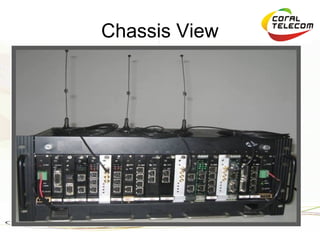
Chassis View
Overview
CORAL GSM Gateway is universal gateway equipment
offering integrated interfaces for GSM/CDMA/VOIP/ ISDN
BRI/PRI, T1/E1 and POTS networks. It’s developed on
existing IRIS LITE architecture.

It can be used with any Brand of existing PBXs or even in a
stand –alone mode.

 The Coral GSM-Gateway allows the users to make and
receive calls on all the networks transparently.

It supports flexible and intelligent Least Cost Routing (LCR)
options providing significant cost saving.
Hardware Support
  It supports all the all the IRIS LITE interface cards as
  explained in overview.
  Find the brief description of supported interface in GSM –
 Chassis – Same as IRIS LITE as shown above
 4 Port GSM/CDMA card - in any combination
 UDGT card – Can be Configured as PRI or as E-1
 VOIP
• IP trunk – SIP & H.323
• IP extension /users – SIP with 254 users
Hardware Support
• ISDN –U card – Can connect 8 port ISDN subscribers within 4-
  5 KM.
• ISDN-S card – Can be Configured in trunk mode or in
  extension mode
• FXO – 8 port Analog Trunk card
• FXS - 8/12 port Analog Extensions
• AC PSU – AC 220V to DC 48V converter (Optional)
• DC PSU – DC 48V to DC 48/24/12/5 volt converter
• MIC – It generates all the tones like Dial Tone/RBT/Busy &
  also provide the resources of DTMF/MFC dialer/receiver
• BWT/TWT – 4 port card
• ENM - 8 port card. Supports both 2 & 4 wire interface
Features
  Its support all the IRIS LITE features so now we talk only
  features which converts IRIS LITE in to GSM/CDMA
  Gateway -
 SIM Registration States – View on CLI/GUI/EMS

      •   Inserted
      •   Registration Failed
      •   No Base Station
      •   Network Lost
      •   Searching New OPR
      •   Un regs Searching
      •   Register Denied
      •   BTS Mismatch
      •   MNC Mismatch
      •   No Service
      •   Registered Home
      •   Registered Roaming
Features
SIM Locking (Subscriber Identity Module Locking)
SIM Locking feature is provided for security purposes. The
SIM once locked with a GSM/CDMA module can only work
in that and all other SIM s will not be detected by that Module.

Network Locking
Network locking feature is again important for security
purposes. The GSM/CDMA Module can be locked with a
specific service provider (IDEA, Airtel, Reliance, and BSNL).
Once locked Module will not detect SIM of any other service
provider. This is different from the SIM Locking in the way
that in this case, different SIMs of one service provider will be
detected whereas in SIM Locking, single SIM will work in
that GSM/CDMA Module.
Features
  BTS (Base Transceiver System) Locking
BTS Locking is a feature through which the GSM/CDMA Module can be
  locked with a particular BTS (Base Transceiver Station). Once locked, that
  GSM/CDMA Module will not be able to receive signals from any other
  cell site. This is also provided for security purposes and to avoid its misuse
  and in this case, the GSM/CDMA Module will be fixed to operate only in
  the vicinity of that BTS and nowhere else.

  FAX Support (in future)
  Currently in GSM, there are two facsimile services specified: teleservice
  TS61 "Alternate speech/facsimile G3" and TS62 "Automatic facsimile
  G3". These two services utilize the T.30 protocol between the mobile
  station and the facsimile machine at the other end. Both services exist in
  two modes, transparent (acc. GSM TS 03.45) and nontransparent (acc.
  GSM TS 03.46).
  FAX service uses a transparent bearer service for the transmission of the
  fax data. The coding and transmission of the facsimile data uses the fax
  protocol according to the ITU-T recommendation T30.
Features
Routing/LCR
DNI based
Time based
GSM/CDMA Port on which minimum minutes are consumed.

RCOC – Returned calls to originator caller - USP
If any user make an outgoing call through GSM or CDMA trunk & that
call is not Answered by the far-end party then that call will be registered as
missed call in far-end party equipment. In this case if far-end party will
revert back on the same number then that call will land on the originator
extension.

Allowed and Denied Lists
Allowed and Denied Lists are used to restrict dialing of long-distance and
international numbers. A number is blocked if its prefix matches any entry
in the Denied Lists. On the other hand, a number is allowed to go through
if it matches with any entry of Allowed List. This provides flexibility of
allowing only specific numbers while blocking all others.
Features
Automatic Number Translation (ANT)
GSM/CDMA Gateway should control the actual digits contained in the
telephone numbers that enter or leave the gateway. It should be able to add
the area code to a call that is routed out of the public switched telephone
network (PSTN), or remove a site code from an intra company call, for
instance. Digit manipulation encompasses adding, subtracting, and
changing telephone numbers like PSTN, GSM/CDMA and VoIP. For
example in the case of VoIP network, if a user dials the number (001-
223344) to call US subscriber but our service provider has given the code
556 & then dial the number without country code so in this case our system
will remove the 001 & add 556 in the same number.
Features
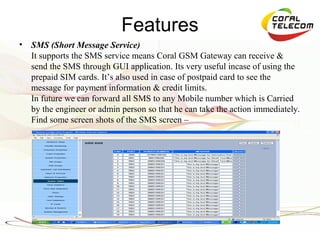
•   SMS (Short Message Service)
    It supports the SMS service means Coral GSM Gateway can receive &
    send the SMS through GUI application. Its very useful incase of using the
    prepaid SIM cards. It’s also used in case of postpaid card to see the
    message for payment information & credit limits.
    In future we can forward all SMS to any Mobile number which is Carried
    by the engineer or admin person so that he can take the action immediately.
    Find some screen shots of the SMS screen –
Features
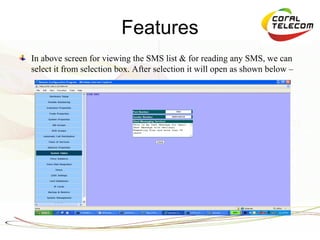
In above screen for viewing the SMS list & for reading any SMS, we can
select it from selection box. After selection it will open as shown below –
Features
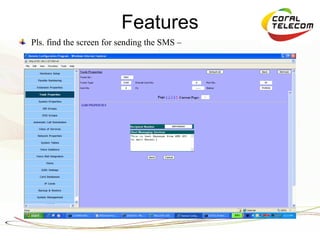
Pls. find the screen for sending the SMS –
Features
    Caller Line Identification Presentation (CLIP) & Translation
    It supports the CLI in transit case means it sends the incoming CLI to the
    connected PBX/Service Provider through IPTC/PRI/E1 or can translate the
    same as per requirement of the service Provider.
    Call Detail Recording (CDR) - Outgoing & Incoming
    Its stores all the outgoing/Incoming calls made in its internal memory & also
    provide the Call billing string to the call billing s/w through Ethernet port.
    Various reports can be generated through Call Billing Software online.
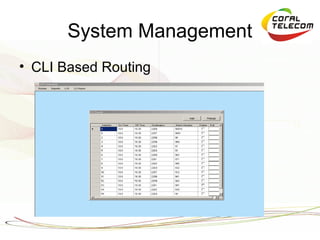
    CLI Based Routing
    It can route the call based on the calling party number. This allows
    routing certain callers to specific ports directly without intervention of
    the operator.
    DDI (Direct Dial IN)
•   It supports the DID/DDI on GSM through Voice Guidance System. So
    anyone can reach through GSM port on any subscriber of the same unit
    or in transit if he know the number.
System Management
    There are three ways to manage the system –
•   Web based GUI
•   EMS (Element Management system)
•   CLI (Command Line Interface)
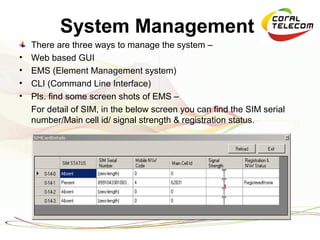
•   Pls. find some screen shots of EMS –
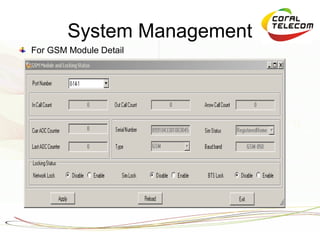
    For detail of SIM, in the below screen you can find the SIM serial
    number/Main cell id/ signal strength & registration status.
System Management
For GSM Module Detail
System Management
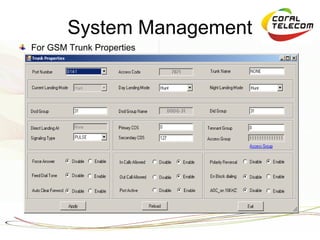
For GSM Trunk Properties
System Management
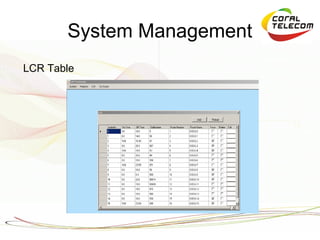
LCR Table
System Management
• CLI Based Routing
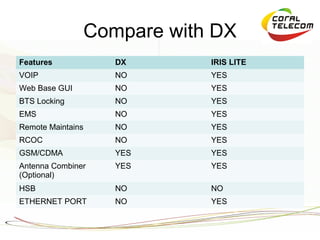
Compare with DX
Features              DX       IRIS LITE
VOIP                  NO       YES
Web Base GUI          NO       YES
BTS Locking           NO       YES
EMS                   NO       YES
Remote Maintains      NO       YES
RCOC                  NO       YES
GSM/CDMA              YES      YES
Antenna Combiner      YES      YES
(Optional)
HSB                   NO       NO
ETHERNET PORT         NO       YES
Thanks

Coral gsm cdma gateway

  • 1.
  • 2.
  • 3.
    Overview CORAL GSM Gatewayis universal gateway equipment offering integrated interfaces for GSM/CDMA/VOIP/ ISDN BRI/PRI, T1/E1 and POTS networks. It’s developed on existing IRIS LITE architecture. It can be used with any Brand of existing PBXs or even in a stand –alone mode. The Coral GSM-Gateway allows the users to make and receive calls on all the networks transparently. It supports flexible and intelligent Least Cost Routing (LCR) options providing significant cost saving.
  • 4.
    Hardware Support It supports all the all the IRIS LITE interface cards as explained in overview. Find the brief description of supported interface in GSM –  Chassis – Same as IRIS LITE as shown above  4 Port GSM/CDMA card - in any combination  UDGT card – Can be Configured as PRI or as E-1  VOIP • IP trunk – SIP & H.323 • IP extension /users – SIP with 254 users
  • 5.
    Hardware Support • ISDN–U card – Can connect 8 port ISDN subscribers within 4- 5 KM. • ISDN-S card – Can be Configured in trunk mode or in extension mode • FXO – 8 port Analog Trunk card • FXS - 8/12 port Analog Extensions • AC PSU – AC 220V to DC 48V converter (Optional) • DC PSU – DC 48V to DC 48/24/12/5 volt converter • MIC – It generates all the tones like Dial Tone/RBT/Busy & also provide the resources of DTMF/MFC dialer/receiver • BWT/TWT – 4 port card • ENM - 8 port card. Supports both 2 & 4 wire interface
  • 6.
    Features Itssupport all the IRIS LITE features so now we talk only features which converts IRIS LITE in to GSM/CDMA Gateway -  SIM Registration States – View on CLI/GUI/EMS • Inserted • Registration Failed • No Base Station • Network Lost • Searching New OPR • Un regs Searching • Register Denied • BTS Mismatch • MNC Mismatch • No Service • Registered Home • Registered Roaming
  • 7.
    Features SIM Locking (SubscriberIdentity Module Locking) SIM Locking feature is provided for security purposes. The SIM once locked with a GSM/CDMA module can only work in that and all other SIM s will not be detected by that Module. Network Locking Network locking feature is again important for security purposes. The GSM/CDMA Module can be locked with a specific service provider (IDEA, Airtel, Reliance, and BSNL). Once locked Module will not detect SIM of any other service provider. This is different from the SIM Locking in the way that in this case, different SIMs of one service provider will be detected whereas in SIM Locking, single SIM will work in that GSM/CDMA Module.
  • 8.
    Features BTS(Base Transceiver System) Locking BTS Locking is a feature through which the GSM/CDMA Module can be locked with a particular BTS (Base Transceiver Station). Once locked, that GSM/CDMA Module will not be able to receive signals from any other cell site. This is also provided for security purposes and to avoid its misuse and in this case, the GSM/CDMA Module will be fixed to operate only in the vicinity of that BTS and nowhere else. FAX Support (in future) Currently in GSM, there are two facsimile services specified: teleservice TS61 "Alternate speech/facsimile G3" and TS62 "Automatic facsimile G3". These two services utilize the T.30 protocol between the mobile station and the facsimile machine at the other end. Both services exist in two modes, transparent (acc. GSM TS 03.45) and nontransparent (acc. GSM TS 03.46). FAX service uses a transparent bearer service for the transmission of the fax data. The coding and transmission of the facsimile data uses the fax protocol according to the ITU-T recommendation T30.
  • 9.
    Features Routing/LCR DNI based Time based GSM/CDMAPort on which minimum minutes are consumed. RCOC – Returned calls to originator caller - USP If any user make an outgoing call through GSM or CDMA trunk & that call is not Answered by the far-end party then that call will be registered as missed call in far-end party equipment. In this case if far-end party will revert back on the same number then that call will land on the originator extension. Allowed and Denied Lists Allowed and Denied Lists are used to restrict dialing of long-distance and international numbers. A number is blocked if its prefix matches any entry in the Denied Lists. On the other hand, a number is allowed to go through if it matches with any entry of Allowed List. This provides flexibility of allowing only specific numbers while blocking all others.
  • 10.
    Features Automatic Number Translation(ANT) GSM/CDMA Gateway should control the actual digits contained in the telephone numbers that enter or leave the gateway. It should be able to add the area code to a call that is routed out of the public switched telephone network (PSTN), or remove a site code from an intra company call, for instance. Digit manipulation encompasses adding, subtracting, and changing telephone numbers like PSTN, GSM/CDMA and VoIP. For example in the case of VoIP network, if a user dials the number (001- 223344) to call US subscriber but our service provider has given the code 556 & then dial the number without country code so in this case our system will remove the 001 & add 556 in the same number.
  • 11.
    Features • SMS (Short Message Service) It supports the SMS service means Coral GSM Gateway can receive & send the SMS through GUI application. Its very useful incase of using the prepaid SIM cards. It’s also used in case of postpaid card to see the message for payment information & credit limits. In future we can forward all SMS to any Mobile number which is Carried by the engineer or admin person so that he can take the action immediately. Find some screen shots of the SMS screen –
  • 12.
    Features In above screenfor viewing the SMS list & for reading any SMS, we can select it from selection box. After selection it will open as shown below –
  • 13.
    Features Pls. find thescreen for sending the SMS –
  • 14.
    Features Caller Line Identification Presentation (CLIP) & Translation It supports the CLI in transit case means it sends the incoming CLI to the connected PBX/Service Provider through IPTC/PRI/E1 or can translate the same as per requirement of the service Provider. Call Detail Recording (CDR) - Outgoing & Incoming Its stores all the outgoing/Incoming calls made in its internal memory & also provide the Call billing string to the call billing s/w through Ethernet port. Various reports can be generated through Call Billing Software online. CLI Based Routing It can route the call based on the calling party number. This allows routing certain callers to specific ports directly without intervention of the operator. DDI (Direct Dial IN) • It supports the DID/DDI on GSM through Voice Guidance System. So anyone can reach through GSM port on any subscriber of the same unit or in transit if he know the number.
  • 15.
    System Management There are three ways to manage the system – • Web based GUI • EMS (Element Management system) • CLI (Command Line Interface) • Pls. find some screen shots of EMS – For detail of SIM, in the below screen you can find the SIM serial number/Main cell id/ signal strength & registration status.
  • 16.
  • 17.
    System Management For GSMTrunk Properties
  • 18.
  • 19.
  • 20.
    Compare with DX Features DX IRIS LITE VOIP NO YES Web Base GUI NO YES BTS Locking NO YES EMS NO YES Remote Maintains NO YES RCOC NO YES GSM/CDMA YES YES Antenna Combiner YES YES (Optional) HSB NO NO ETHERNET PORT NO YES
  • 21.