Recommended
PPTX
Cor pulmonale - october'18
PPTX
PPTX
PPTX
Seminar presentation on cor pulmonale ..pptx
PPTX
PPTX
COR-PULMONALE.pptx cardiovascular disorders
PPTX
COR-PULMONALE.pptx Adult Health Nursing II
PPTX
cor.pptx adult health nursing ppt nursing
PPT
Pulmonary vascular disease / Pulmoary hypertension
PPTX
DOCX
PPTX
PPTX
PULMONARY HEART DISEASE presentation.pptx
PDF
9. Cor pulmonale(right heart failure).pdf
PPTX
06 cor pulmonale.pptx under hypertensive disorders
PPTX
"Pulmonary Embolism Demystified: An Essential Primer for Nursing Education"
PPT
PPT
PPTX
Management of Pulmonary Edema 2014
PPTX
Pulmonaryedema 160624071007
PPT
PPTX
pulmonaryedema basic classifications.pptx
PPTX
CHRONIC COR PULMONALE FULL PRESENTATION DOWNLOAD
PPTX
DOCX
PPTX
PPTX
Anesthesia Consideration in pulmonary embolism .pptx
PPTX
PPTX
Pulmonary_Conditions for nursing students
PPTX
Oral_Health_Conditions for nursing students
More Related Content
PPTX
Cor pulmonale - october'18
PPTX
PPTX
PPTX
Seminar presentation on cor pulmonale ..pptx
PPTX
PPTX
COR-PULMONALE.pptx cardiovascular disorders
PPTX
COR-PULMONALE.pptx Adult Health Nursing II
PPTX
cor.pptx adult health nursing ppt nursing
Similar to Pulmonary_Conditions for nursing students
PPT
Pulmonary vascular disease / Pulmoary hypertension
PPTX
DOCX
PPTX
PPTX
PULMONARY HEART DISEASE presentation.pptx
PDF
9. Cor pulmonale(right heart failure).pdf
PPTX
06 cor pulmonale.pptx under hypertensive disorders
PPTX
"Pulmonary Embolism Demystified: An Essential Primer for Nursing Education"
PPT
PPT
PPTX
Management of Pulmonary Edema 2014
PPTX
Pulmonaryedema 160624071007
PPT
PPTX
pulmonaryedema basic classifications.pptx
PPTX
CHRONIC COR PULMONALE FULL PRESENTATION DOWNLOAD
PPTX
DOCX
PPTX
PPTX
Anesthesia Consideration in pulmonary embolism .pptx
PPTX
More from abdelam071
PPTX
Pulmonary_Conditions for nursing students
PPTX
Oral_Health_Conditions for nursing students
PPTX
Respiratory_System_Disorders_Presentation.pptx
PPTX
Gastric Analysis for nursing students in
PPTX
10.Acne vulgaris Part I RT FOR MEDICAL STUDENT
PPTX
6.Leprosy forb medical students in ethiopia
PPTX
8.Scabies & Pediculosis BB for medical students
PPTX
4 Bacterial Infection of the Skin for medical x
PPT
5 a new edited c-1 ABIY HIV & Neurology.ppt
PPTX
6 APPROACH TO PERIPHERAL NEUROPATHIES.pptx
PPTX
CHRONIC MYELOGENOUS LEUKEMIA for medical
PPTX
IRON DEFICIENCY ANEMIA for medical students
PPTX
ACUTE MYELOGENOUS LEUKEMIA for medical studepptx
PPTX
ACUTE LEUKEMIAS for medical students in e
PPTX
HEMOLYTIC ANEMIA for medical students in arsi
PPTX
LYMPHOMa for medical students at ethiopia
PPTX
Arsi University research Methodology for public
PPTX
HEALTH ASSESSMENT FOR NURSING STUDENTS OF TVET
PPTX
HEALTH Assessment for Nursing power point
PPTX
Providing Advanced Nursing Care for nursing
Recently uploaded
PPTX
HYPERTENSION III SEMESTER ADULT HEALTH NURSING-I
PPTX
ANTIMICROBIAL STEWARDSHIP PROGRAME Vijay.pptx
PPTX
History and Evolution of Microbiology.pptx
PPTX
muscles of facial expressions and mastication.pptx
PPTX
Template for presentation of patients at the MDT Meeting
PPTX
IDENTIFICATION OF BACTERIA.by Molecular methods
PDF
Medicinal &Toilet Preparation Act T.Y.B-PHARM
PPTX
Pharmacokinetic Aspects of Drug Metabolism and Excretion”
PPTX
Atrial Fibrillation and difference with Atrial flutter
PPTX
The Autonomic Nervous System and Visceral Reflexes
PDF
SEMINARIO BIOMOL.pdf (Samuel Cantillo y Karen Bohorquez)
PPTX
DNS deviated nasal septum ent ward s.pptx
PPT
Managemant of Mutilated Vital Teeth presentation
PDF
Seminario Biología Molecular - UNVEILING THE THERAPEUTIC POTENTIAL OF SUYIN ...
PDF
A beginner-friendly introduction to gym training
PDF
Antitubercular agents medicinal chemistry.pdf
PPTX
Nocardia.-Introduction,Morphology,Classification,Pathogenesis,Epidemiology,Cl...
PPTX
LOW DOSE RADIATHERAPY (LDRT) IN OSTEOARTHRITIS
PPTX
PERI-PROSTHETIC FRACTURE NAIL-PLATE CONSTRUCT [NPC].pptx
PPTX
ICU setup Admission & discharge criteria.pptx
Pulmonary_Conditions for nursing students 1. Cor Pulmonale
• Definition:
• Cor pulmonale is right ventricular hypertrophy
and failure due to pulmonary hypertension
caused by chronic lung diseases.
2. Etiology
• • Chronic obstructive pulmonary disease
(COPD)
• • Pulmonary hypertension
• • Interstitial lung diseases
• • Obstructive sleep apnea
• • Chronic pulmonary embolism
3. Pathophysiology
• • Chronic lung disease leads to hypoxia and
vasoconstriction.
• • Increased pulmonary vascular resistance
causes right ventricular hypertrophy.
• • Eventually, right heart failure occurs.
4. Signs and Symptoms
• • Dyspnea on exertion
• • Fatigue
• • Peripheral edema
• • Jugular venous distension (JVD)
• • Ascites
• • Hepatomegaly
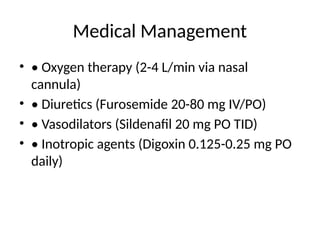
5. Medical Management
• • Oxygen therapy (2-4 L/min via nasal
cannula)
• • Diuretics (Furosemide 20-80 mg IV/PO)
• • Vasodilators (Sildenafil 20 mg PO TID)
• • Inotropic agents (Digoxin 0.125-0.25 mg PO
daily)
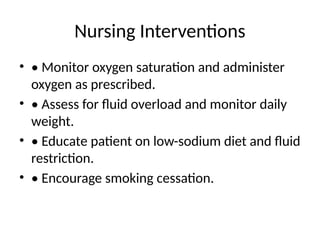
6. Nursing Interventions
• • Monitor oxygen saturation and administer
oxygen as prescribed.
• • Assess for fluid overload and monitor daily
weight.
• • Educate patient on low-sodium diet and fluid
restriction.
• • Encourage smoking cessation.
7. Surgical Intervention
• • Lung transplant in severe cases
• • Pulmonary thromboendarterectomy (for
chronic thromboembolic disease)
8. 9. 10. 11. Etiology
• • Deep vein thrombosis (DVT)
• • Hypercoagulable states (e.g., cancer,
pregnancy)
• • Prolonged immobility
• • Post-surgical complications
• • Trauma
12. Pathophysiology
• • A thrombus dislodges and travels to the
pulmonary arteries.
• • It obstructs blood flow, leading to
ventilation-perfusion mismatch.
• • Hypoxia and increased pulmonary vascular
resistance occur, possibly leading to shock.
13. Signs and Symptoms
• • Sudden dyspnea
• • Chest pain (pleuritic)
• • Hemoptysis
• • Tachypnea
• • Tachycardia
• • Hypotension (in massive PE)
14. Medical Management
• • Anticoagulants (Heparin IV 5000 units bolus,
then 1000 units/hr)
• • Thrombolytics (Alteplase 100 mg IV over 2
hours)
• • Oxygen therapy (as needed to maintain
SpO2 >90%)
• • Pain management (Morphine 2-4 mg IV PRN)
15. 16. Pulmonary Edema
• Definition:
• Pulmonary edema is the accumulation of fluid
in the alveoli and interstitial spaces of the
lungs, leading to impaired gas exchange.
17. Etiology
• • Left heart failure
• • Acute myocardial infarction
• • Hypertension crisis
• • Kidney failure
• • High-altitude exposure
18. Pathophysiology
• • Increased hydrostatic pressure in pulmonary
capillaries causes fluid to leak into alveoli.
• • Gas exchange is impaired, leading to
hypoxia.
• • Surfactant dilution further worsens lung
compliance.
19. Signs and Symptoms
• • Severe dyspnea
• • Pink, frothy sputum
• • Crackles on auscultation
• • Hypoxemia
• • Orthopnea
20. Medical Management
• • Oxygen therapy (High-flow or CPAP if severe)
• • Diuretics (Furosemide 40 mg IV)
• • Vasodilators (Nitroglycerin 5 mcg/min IV,
titrate as needed)
• • Morphine (2-4 mg IV for anxiety and
vasodilation)
21. Prevention
• • Control blood pressure and heart disease
• • Monitor fluid balance in at-risk patients
• • Avoid excessive IV fluids in heart failure
patients



![PERI-PROSTHETIC FRACTURE NAIL-PLATE CONSTRUCT [NPC].pptx](https://cdn.slidesharecdn.com/ss_thumbnails/drarunkumardrmohamedashrafperiprostheticfrasturenail-plateconstructnpc-260209164459-7e9d15a1-thumbnail.jpg?width=640&height=640&fit=bounds)
