
COPYRIGHT  BOARD FILMA VARGHESE TRADE MARK DEPARTMENT ALTACIT GLOBAL
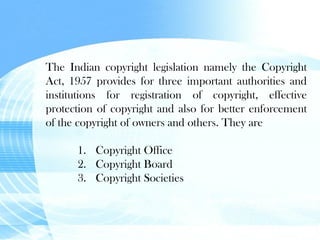
The Indian copyright legislation namely the Copyright Act, 1957 provides for three important authorities and institutions for registration of copyright, effective protection of copyright and also for better enforcement of the copyright of owners and others. They are Copyright Office Copyright Board Copyright Societies
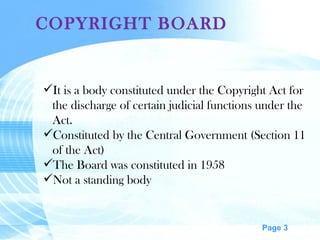
COPYRIGHT BOARD It is a body constituted under the Copyright Act for the discharge of certain judicial functions under the Act. Constituted by the Central Government (Section 11 of the Act) The Board was constituted in 1958 Not a standing body
CONSTITUTION OF THE BOARD Chairman Two or more (not exceeding fourteen) members The Registrar of the Copyright will perform all secretarial functions of the Copyright Board
QUALIFICATIONS OF CHAIRMAN Is either a High Court Judge Has been a Judge of a High Court Is qualified for appointment as a Judge of a High Court
TERM OF CHAIRMAN AND MEMBERS Five years Eligible for reappointment
POWERS AND PROCEDURE OF COPYRIGHT BOARD (Section 12 of the Act) Hear appeals against the orders of the Registrar of Copyright Power to regulate its own procedure – fixing of places and times of its sittings Hear any proceedings instituted before it within the zone. For this purpose the territory of India has  been divided into the following zones: The Northern zone The Central zone The Eastern zone The Western zone The Southern zone
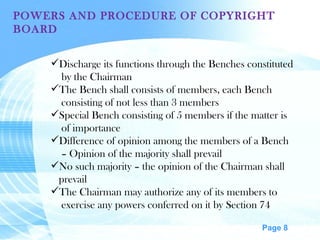
POWERS AND PROCEDURE OF COPYRIGHT BOARD Discharge its functions through the Benches constituted by the Chairman The Bench shall consists of members, each Bench  consisting of not less than 3 members Special Bench consisting of 5 members if the matter is of importance Difference of opinion among the members of a Bench  –  Opinion of the majority shall prevail No such majority – the opinion of the Chairman shall prevail The Chairman may authorize any of its members to exercise any powers conferred on it by Section 74
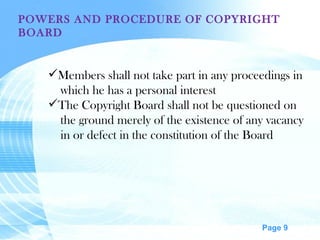
Members shall not take part in any proceedings in which he has a personal interest The Copyright Board shall not be questioned on the ground merely of the existence of any vacancy in or defect in the constitution of the Board POWERS AND PROCEDURE OF COPYRIGHT BOARD
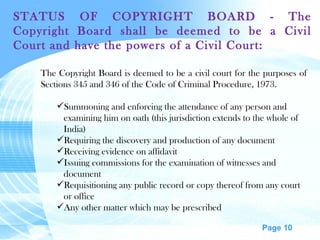
STATUS OF COPYRIGHT BOARD - The Copyright Board shall be deemed to be a Civil Court and have the powers of a Civil Court: The Copyright Board is deemed to be a civil court for the purposes of Sections 345 and 346 of the Code of Criminal Procedure, 1973.  Summoning and enforcing the attendance of any person and examining him on oath (this jurisdiction extends to the whole of India) Requiring the discovery and production of any document Receiving evidence on affidavit Issuing commissions for the examination of witnesses and document Requisitioning any public record or copy thereof from any court or office Any other matter which may be prescribed
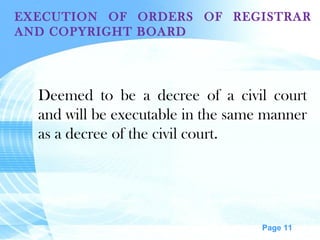
EXECUTION OF ORDERS OF REGISTRAR AND COPYRIGHT BOARD Deemed to be a decree of a civil court and will be executable in the same manner as a decree of the civil court.
PROTECTION OF ACTION IN GOOD FAITH No suit or other legal proceedings can be taken – done in good faith
FUNCTIONS OF THE COPYRIGHT BOARD  To decide whether a work has been published or as to the date on which the work was published  To settle disputes arising in respect of assignment of copyright  To grant compulsory licenses in respect of Indian  works withheld from public To grant compulsory licenses to publish unpublished Indian works
To grant compulsory licenses to produce and publish translation of literary and dramatic works To grant compulsory licenses to reproduce and publish certain categories of literary, scientific or artistic works for certain purposes To rectify the register on the application of Registrar of Copyright or of any person aggrieved
APPEAL   An appeal against all orders except under Section 6 lies to the High court [Section 72 (2)] Within 3 months
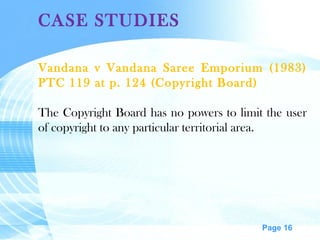
CASE STUDIES Vandana v Vandana Saree Emporium (1983) PTC 119 at p. 124 (Copyright Board) The Copyright Board has no powers to limit the user of copyright to any particular territorial area.
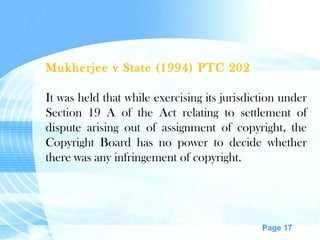
Mukherjee v State (1994) PTC 202 It was held that while exercising its jurisdiction under Section 19 A of the Act relating to settlement of dispute arising out of assignment of copyright, the Copyright Board has no power to decide whether there was any infringement of copyright.
THANK YOU

Copyright board

  • 1.
    COPYRIGHT BOARDFILMA VARGHESE TRADE MARK DEPARTMENT ALTACIT GLOBAL
  • 2.
    The Indian copyrightlegislation namely the Copyright Act, 1957 provides for three important authorities and institutions for registration of copyright, effective protection of copyright and also for better enforcement of the copyright of owners and others. They are Copyright Office Copyright Board Copyright Societies
  • 3.
    COPYRIGHT BOARD Itis a body constituted under the Copyright Act for the discharge of certain judicial functions under the Act. Constituted by the Central Government (Section 11 of the Act) The Board was constituted in 1958 Not a standing body
  • 4.
    CONSTITUTION OF THEBOARD Chairman Two or more (not exceeding fourteen) members The Registrar of the Copyright will perform all secretarial functions of the Copyright Board
  • 5.
    QUALIFICATIONS OF CHAIRMANIs either a High Court Judge Has been a Judge of a High Court Is qualified for appointment as a Judge of a High Court
  • 6.
    TERM OF CHAIRMANAND MEMBERS Five years Eligible for reappointment
  • 7.
    POWERS AND PROCEDUREOF COPYRIGHT BOARD (Section 12 of the Act) Hear appeals against the orders of the Registrar of Copyright Power to regulate its own procedure – fixing of places and times of its sittings Hear any proceedings instituted before it within the zone. For this purpose the territory of India has been divided into the following zones: The Northern zone The Central zone The Eastern zone The Western zone The Southern zone
  • 8.
    POWERS AND PROCEDUREOF COPYRIGHT BOARD Discharge its functions through the Benches constituted by the Chairman The Bench shall consists of members, each Bench consisting of not less than 3 members Special Bench consisting of 5 members if the matter is of importance Difference of opinion among the members of a Bench – Opinion of the majority shall prevail No such majority – the opinion of the Chairman shall prevail The Chairman may authorize any of its members to exercise any powers conferred on it by Section 74
  • 9.
    Members shall nottake part in any proceedings in which he has a personal interest The Copyright Board shall not be questioned on the ground merely of the existence of any vacancy in or defect in the constitution of the Board POWERS AND PROCEDURE OF COPYRIGHT BOARD
  • 10.
    STATUS OF COPYRIGHTBOARD - The Copyright Board shall be deemed to be a Civil Court and have the powers of a Civil Court: The Copyright Board is deemed to be a civil court for the purposes of Sections 345 and 346 of the Code of Criminal Procedure, 1973. Summoning and enforcing the attendance of any person and examining him on oath (this jurisdiction extends to the whole of India) Requiring the discovery and production of any document Receiving evidence on affidavit Issuing commissions for the examination of witnesses and document Requisitioning any public record or copy thereof from any court or office Any other matter which may be prescribed
  • 11.
    EXECUTION OF ORDERSOF REGISTRAR AND COPYRIGHT BOARD Deemed to be a decree of a civil court and will be executable in the same manner as a decree of the civil court.
  • 12.
    PROTECTION OF ACTIONIN GOOD FAITH No suit or other legal proceedings can be taken – done in good faith
  • 13.
    FUNCTIONS OF THECOPYRIGHT BOARD To decide whether a work has been published or as to the date on which the work was published To settle disputes arising in respect of assignment of copyright To grant compulsory licenses in respect of Indian works withheld from public To grant compulsory licenses to publish unpublished Indian works
  • 14.
    To grant compulsorylicenses to produce and publish translation of literary and dramatic works To grant compulsory licenses to reproduce and publish certain categories of literary, scientific or artistic works for certain purposes To rectify the register on the application of Registrar of Copyright or of any person aggrieved
  • 15.
    APPEAL An appeal against all orders except under Section 6 lies to the High court [Section 72 (2)] Within 3 months
  • 16.
    CASE STUDIES Vandanav Vandana Saree Emporium (1983) PTC 119 at p. 124 (Copyright Board) The Copyright Board has no powers to limit the user of copyright to any particular territorial area.
  • 17.
    Mukherjee v State(1994) PTC 202 It was held that while exercising its jurisdiction under Section 19 A of the Act relating to settlement of dispute arising out of assignment of copyright, the Copyright Board has no power to decide whether there was any infringement of copyright.
  • 18.