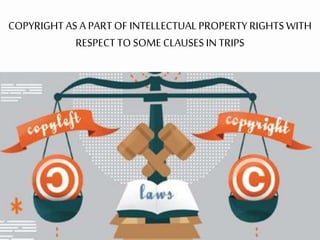
COPYRIGHT AS A PARTOF INTELLECTUAL PROPERTYRIGHTS WITH
RESPECTTO SOME CLAUSES IN TRIPS
INDEX
SR. NO CONTENT
1 Introduction
2 History
3 Importance of IPR
4 WIPO & NIPO
5 Copyright
6 Copyright Society
7 Copyright Infringement and its remedies
8 Comparison between India and Brazil
9 Copyleft
10 Statistical Data
11 Case study
INTRODUCTION
Intellectual property is a legal concept which refers
to creations of the mind for which exclusive
rights are recognized.
Under intellectual property law, owners are
granted certain exclusive rights to a variety
of intangible assets, such as musical, literary, and
artistic works; discoveries and inventions; and
words, phrases, symbols, and designs.
IntellectualPropertyRights
Intellectual property rights are the rights given the
creator an exclusive right over the use of his/her
creation for a certain period of time.
Intellectual property rights are customarily divided
into two main areas:
• Protection of distinctive signs and geographical
understanding
• Industrial Property
HISTORY
Modern copyright law developed in India
gradually, in what we may identify roughly as three
distinct phases spanning more than 150 years:
• Phase I- East India Company Statute
• Phase II- Copyright Act 1914
• Phase III- Post Independence
TRIPS Agreement
The Agreement on Trade Related Aspects of
Intellectual Property Rights (TRIPS) is
an international agreement administered by
the World Trade Organization that sets down
minimum standards for many forms of intellectual
property regulation as applied to nationals of other
WTO Members
Main features of the agreement
• Standards
• Enforcement
• Dispute settlement
Types of Intellectual Property Rights
• Copyright
• Trademarks
• Patents
• Industrial design rights
• Trade dress
• Trade secrets
RIGHTSRELATED TO COPYRIGHT
Related rights have been granted to three
categories of beneficiaries:
• Performers
• Producers of phonograms
• Broadcasting organizations.
WIPO
World intellectualproperty organization
• It is the United Nations agency dedicated to the use
of intellectual property.
• Their mission is to lead the development of a
balanced and effective international intellectual
property system that enables innovation and
creativity for the benefit of all.
WIPO's StrategicGoals
• Balanced Evolution of the International Normative
Framework for IP
• Provision of Premier Global IP Services
• Facilitating the Use of IP for Development
• Coordination and Development of Global IP Infrastructure
• World Reference Source for IP Information and Analysis
• International Cooperation on Building Respect for IP
• Addressing IP in Relation to Global Policy Issues
• A Responsive Communications Interface between WIPO, its
Member States and All Stakeholders
NIPO
nationalintellectualproperty organization
• It is an initiative destined to put India on the map of
intellectual superpowers.
• It includes
 Developing policy initiatives in the area of IP
 Mobilizing the use of IP for economic and social
development
 Provides all stakeholders a strong voice on IP matters.
Mission and Objectives of NIPO
• Catalyzes awareness about the rights of intellectual
property owners
• Promotes development of infrastructural facilities
for registration of intellectual property
• Carries out Research and Development activities for
development and protection of IPR’s.
• Conducts training and capacity building activities
for corporate and government personnel
COPYRIGHT
• A copyright gives the creator of original work exclusive rights to it,
usually for a limited time.
• Copyright may apply to a wide range of creative, intellectual, or
artistic forms, or "works".
• It includes
 poems,
 plays and other literary works,
 musical compositions, sound recordings,
 computer software, radio and television broadcasts, and industrial
designs.
COPYRIGHTACT, 1957
• Copyright Act refers to laws that regulate the use of the
work of a creator, such as an artist or author.
• This includes copying, distributing, altering and displaying
creative, literary and other types of work. Unless otherwise
stated in a contract, the author or creator of a work retains
the copyright.
• Copyright does not ordinarily protect titles by themselves
or names, short word combinations, slogans, short phrases,
methods, plots or factual information.
NEED FOR COPYRIGHT
• It gives you the exclusive right to reproduce or
copy the work or change its form.
• Registration informs the world that you own the
work
• If you succeed in an infringement suit, you are
entitled to money damages.
Indianperspective on CopyrightProtection
The Copyright Act, 1957 provides copyright
protection in India. It confers copyright protection
in the following two forms:
(a) Economic rights of the author
(b) Moral Rights of the author
(i) Right of Paternity
(ii) Right of Integrity
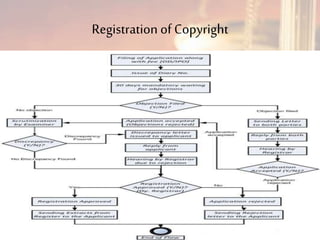
Registration of Copyright
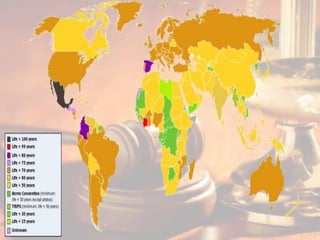
TERM OF COPYRIGHT
• It varies according to the nature of work - 60 years, in India.
 literary, dramatic, musical or artistic work (other than a
photograph), when published during the lifetime of the author,
copyright subsists during the lifetime of the author, plus 60 years.
 In the case of photographs, cinematograph films and sounds
recordings; the term is 60 years from the date of publication.
 When the first owner of copyright is the government or a public
undertaking, the term of copyright is 60 years from the date of
publication.
Administration of Copyright Law
• Copyright Society
• Tariff Scheme of copyright societies
• Fair use Provisions
• Fair use in digital works
• Notice and take down procedures
• Special Provisions for Access to the disabled
• Fair use rights to the disabled
COPYRIGHTSOCIETY
• A copyright society is a registered collective
administration society formed by copyright owners.
• Minimum membership required for registration of
a society is 7.
FUNCTIONSOF A COPYRIGHTSOCIETY
A copyright society may –
• Issue licenses in respect of the rights administered
by the society.
• Collect fees in pursuance of such licenses.
• Distribute such fees among owners of copyright
after making deductions for the administrative
expenses.
COPYRIGHTIN THE DIGITAL WORLD
• Copyright gives the people involved in
creating music various rights over the
copying, distribution, performance and
internet transmission of their music.
• Uploading & downloading of music to & from
the internet is an infringement of copyright if
done without the rights owners' permission.
COPYRIGHTINFRINGEMENT
Copyright infringement is the use
of works under copyright, infringing the copyright
holder's exclusive rights without permission from
the copyright holder.
Eg:
Making infringing copies for sale or hire
Distributing infringing copies for the purpose of
trade
COPYRIGHT INFRINGEMENT OCCURS WHEN THE
COPYRIGHT OWNER'S RIGHTS ARE VIOLATED
• The Right to Reproduce the Work.
• The Right to Derivative Works
• The Right to Distribution
• The Public Display Right
• The Public Performance Right
EXCEPTIONSTO COPYRIGHTINFRINGEMENT
• Reproduction for use in judicial proceedings
• Publication of short passages for educational
purposes.
• Playing of records or performance by a club or
society for the benefit of the members of religious
institutions
• Making of a drawing, engraving or photograph of
an architectural work of art, or a sculpture kept in
a public place
Remedies against Infringement
• Civil Remedies
• Criminal Remedies
• Administrative Remedies
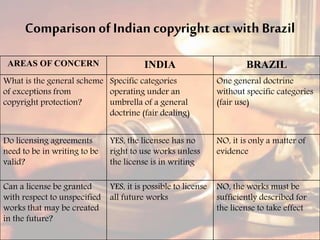
Comparison ofIndian copyright act with Brazil
AREAS OF CONCERN INDIA BRAZIL
What is the general scheme
of exceptions from
copyright protection?
Specific categories
operating under an
umbrella of a general
doctrine (fair dealing)
One general doctrine
without specific categories
(fair use)
Do licensing agreements
need to be in writing to be
valid?
YES, the licensee has no
right to use works unless
the license is in writing
NO, it is only a matter of
evidence
Can a license be granted
with respect to unspecified
works that may be created
in the future?
YES, it is possible to license
all future works
NO, the works must be
sufficiently described for
the license to take effect
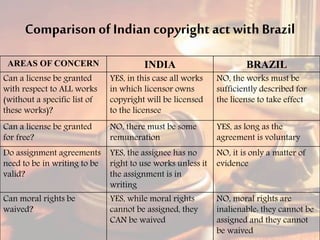
Comparison ofIndian copyright act with Brazil
AREAS OF CONCERN INDIA BRAZIL
Can a license be granted
with respect to ALL works
(without a specific list of
these works)?
YES, in this case all works
in which licensor owns
copyright will be licensed
to the licensee
NO, the works must be
sufficiently described for
the license to take effect
Can a license be granted
for free?
NO, there must be some
remuneration
YES, as long as the
agreement is voluntary
Do assignment agreements
need to be in writing to be
valid?
YES, the assignee has no
right to use works unless it
the assignment is in
writing
NO, it is only a matter of
evidence
Can moral rights be
waived?
YES, while moral rights
cannot be assigned, they
CAN be waived
NO, moral rights are
inalienable: they cannot be
assigned and they cannot
be waived
COPYLEFT
An arrangement whereby software
or artistic work may be used,
modified, and distributed freely on
condition that anything derived from
it, is bound by the same conditions
FREEDOMS GIVENIN COPYLEFT
• Freedom 0 – the freedom to use the work
• Freedom 1 – the freedom to study the work
• Freedom 2 – the freedom to copy and share the
work with others
• Freedom 3 – the freedom to modify the work, and
the freedom to distribute modified and therefore
derivative works.
TYPESOF COPYLEFT
1. Strong and weak
2. Full and Partial
3. Share - alike
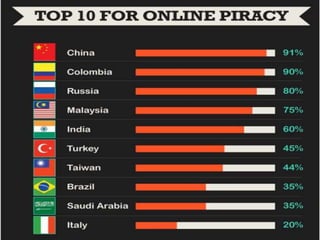
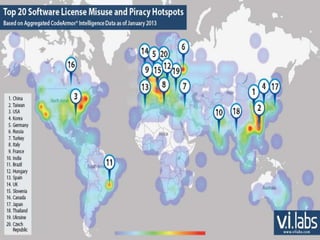
STATISTICALDATA
CASESTUDY
Case of copyright infringement by Zee Khana Khazana
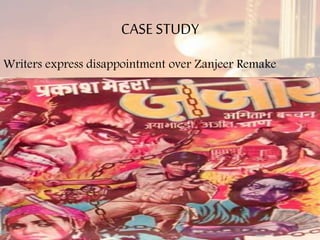
CASESTUDY
Writers express disappointment over Zanjeer Remake
CASESTUDY
Yahoo Sued by T Series for Copyright Infringment
CASESTUDY
India TV wins case against Yash Raj Films
Conclusion
• The Indian Copyright Act was enacted with a motive of
protecting the rights of the original authors. It aimed to
encourage and provide incentive to create original works.
• Copyright laws are enacted with necessary exceptions and
limitations to ensure that a balance is maintained between
the interests of the creators and of the community.
• Copyright law confers exclusive right to performers like
actors, musicians, jugglers, snake charmers, etc. to do
certain acts. These rights conferred on the performers are a
positive step in encouraging their creativity
BIBLIOGRAPHY
• http://www.nipo.in/
• http://www.wipo.int
• http://www.socialsamosa.com/2012/03/case-of-copyright-
infringement-by-zee-khana-khazana/
• http://www.ip-watch.org/category/copyright-policy
• http://www.go-gulf.com/blog/online-piracy/
• http://www.archiving-performance.org/
• www.copyright.gov.in
• http://en.wikipedia.org/wiki/TRIPS_Agreement
Preparedby:
1. Farheen Ansari - 13025
2. Harsh Shah - 13028
3. Hetanshi Desai - 13030
4. Imad Sirkhot - 13032
5. Ishan Khanna - 13034
6. Karen D’souza - 13037
7. Kirk Coutinho - 13040
8. Mausumi Sen - 13042
9. Nikita Bhinde - 13046

copyright law

  • 1.
    COPYRIGHT AS APARTOF INTELLECTUAL PROPERTYRIGHTS WITH RESPECTTO SOME CLAUSES IN TRIPS
  • 2.
    INDEX SR. NO CONTENT 1Introduction 2 History 3 Importance of IPR 4 WIPO & NIPO 5 Copyright 6 Copyright Society 7 Copyright Infringement and its remedies 8 Comparison between India and Brazil 9 Copyleft 10 Statistical Data 11 Case study
  • 3.
    INTRODUCTION Intellectual property isa legal concept which refers to creations of the mind for which exclusive rights are recognized. Under intellectual property law, owners are granted certain exclusive rights to a variety of intangible assets, such as musical, literary, and artistic works; discoveries and inventions; and words, phrases, symbols, and designs.
  • 4.
    IntellectualPropertyRights Intellectual property rightsare the rights given the creator an exclusive right over the use of his/her creation for a certain period of time. Intellectual property rights are customarily divided into two main areas: • Protection of distinctive signs and geographical understanding • Industrial Property
  • 5.
    HISTORY Modern copyright lawdeveloped in India gradually, in what we may identify roughly as three distinct phases spanning more than 150 years: • Phase I- East India Company Statute • Phase II- Copyright Act 1914 • Phase III- Post Independence
  • 6.
    TRIPS Agreement The Agreementon Trade Related Aspects of Intellectual Property Rights (TRIPS) is an international agreement administered by the World Trade Organization that sets down minimum standards for many forms of intellectual property regulation as applied to nationals of other WTO Members
  • 7.
    Main features ofthe agreement • Standards • Enforcement • Dispute settlement
  • 8.
    Types of IntellectualProperty Rights • Copyright • Trademarks • Patents • Industrial design rights • Trade dress • Trade secrets
  • 9.
    RIGHTSRELATED TO COPYRIGHT Relatedrights have been granted to three categories of beneficiaries: • Performers • Producers of phonograms • Broadcasting organizations.
  • 10.
    WIPO World intellectualproperty organization •It is the United Nations agency dedicated to the use of intellectual property. • Their mission is to lead the development of a balanced and effective international intellectual property system that enables innovation and creativity for the benefit of all.
  • 11.
    WIPO's StrategicGoals • BalancedEvolution of the International Normative Framework for IP • Provision of Premier Global IP Services • Facilitating the Use of IP for Development • Coordination and Development of Global IP Infrastructure • World Reference Source for IP Information and Analysis • International Cooperation on Building Respect for IP • Addressing IP in Relation to Global Policy Issues • A Responsive Communications Interface between WIPO, its Member States and All Stakeholders
  • 12.
    NIPO nationalintellectualproperty organization • Itis an initiative destined to put India on the map of intellectual superpowers. • It includes  Developing policy initiatives in the area of IP  Mobilizing the use of IP for economic and social development  Provides all stakeholders a strong voice on IP matters.
  • 13.
    Mission and Objectivesof NIPO • Catalyzes awareness about the rights of intellectual property owners • Promotes development of infrastructural facilities for registration of intellectual property • Carries out Research and Development activities for development and protection of IPR’s. • Conducts training and capacity building activities for corporate and government personnel
  • 14.
    COPYRIGHT • A copyrightgives the creator of original work exclusive rights to it, usually for a limited time. • Copyright may apply to a wide range of creative, intellectual, or artistic forms, or "works". • It includes  poems,  plays and other literary works,  musical compositions, sound recordings,  computer software, radio and television broadcasts, and industrial designs.
  • 15.
    COPYRIGHTACT, 1957 • CopyrightAct refers to laws that regulate the use of the work of a creator, such as an artist or author. • This includes copying, distributing, altering and displaying creative, literary and other types of work. Unless otherwise stated in a contract, the author or creator of a work retains the copyright. • Copyright does not ordinarily protect titles by themselves or names, short word combinations, slogans, short phrases, methods, plots or factual information.
  • 16.
    NEED FOR COPYRIGHT •It gives you the exclusive right to reproduce or copy the work or change its form. • Registration informs the world that you own the work • If you succeed in an infringement suit, you are entitled to money damages.
  • 17.
    Indianperspective on CopyrightProtection TheCopyright Act, 1957 provides copyright protection in India. It confers copyright protection in the following two forms: (a) Economic rights of the author (b) Moral Rights of the author (i) Right of Paternity (ii) Right of Integrity
  • 18.
  • 20.
    TERM OF COPYRIGHT •It varies according to the nature of work - 60 years, in India.  literary, dramatic, musical or artistic work (other than a photograph), when published during the lifetime of the author, copyright subsists during the lifetime of the author, plus 60 years.  In the case of photographs, cinematograph films and sounds recordings; the term is 60 years from the date of publication.  When the first owner of copyright is the government or a public undertaking, the term of copyright is 60 years from the date of publication.
  • 22.
    Administration of CopyrightLaw • Copyright Society • Tariff Scheme of copyright societies • Fair use Provisions • Fair use in digital works • Notice and take down procedures • Special Provisions for Access to the disabled • Fair use rights to the disabled
  • 23.
    COPYRIGHTSOCIETY • A copyrightsociety is a registered collective administration society formed by copyright owners. • Minimum membership required for registration of a society is 7.
  • 24.
    FUNCTIONSOF A COPYRIGHTSOCIETY Acopyright society may – • Issue licenses in respect of the rights administered by the society. • Collect fees in pursuance of such licenses. • Distribute such fees among owners of copyright after making deductions for the administrative expenses.
  • 25.
    COPYRIGHTIN THE DIGITALWORLD • Copyright gives the people involved in creating music various rights over the copying, distribution, performance and internet transmission of their music. • Uploading & downloading of music to & from the internet is an infringement of copyright if done without the rights owners' permission.
  • 26.
    COPYRIGHTINFRINGEMENT Copyright infringement isthe use of works under copyright, infringing the copyright holder's exclusive rights without permission from the copyright holder. Eg: Making infringing copies for sale or hire Distributing infringing copies for the purpose of trade
  • 27.
    COPYRIGHT INFRINGEMENT OCCURSWHEN THE COPYRIGHT OWNER'S RIGHTS ARE VIOLATED • The Right to Reproduce the Work. • The Right to Derivative Works • The Right to Distribution • The Public Display Right • The Public Performance Right
  • 28.
    EXCEPTIONSTO COPYRIGHTINFRINGEMENT • Reproductionfor use in judicial proceedings • Publication of short passages for educational purposes. • Playing of records or performance by a club or society for the benefit of the members of religious institutions • Making of a drawing, engraving or photograph of an architectural work of art, or a sculpture kept in a public place
  • 29.
    Remedies against Infringement •Civil Remedies • Criminal Remedies • Administrative Remedies
  • 31.
    Comparison ofIndian copyrightact with Brazil AREAS OF CONCERN INDIA BRAZIL What is the general scheme of exceptions from copyright protection? Specific categories operating under an umbrella of a general doctrine (fair dealing) One general doctrine without specific categories (fair use) Do licensing agreements need to be in writing to be valid? YES, the licensee has no right to use works unless the license is in writing NO, it is only a matter of evidence Can a license be granted with respect to unspecified works that may be created in the future? YES, it is possible to license all future works NO, the works must be sufficiently described for the license to take effect
  • 32.
    Comparison ofIndian copyrightact with Brazil AREAS OF CONCERN INDIA BRAZIL Can a license be granted with respect to ALL works (without a specific list of these works)? YES, in this case all works in which licensor owns copyright will be licensed to the licensee NO, the works must be sufficiently described for the license to take effect Can a license be granted for free? NO, there must be some remuneration YES, as long as the agreement is voluntary Do assignment agreements need to be in writing to be valid? YES, the assignee has no right to use works unless it the assignment is in writing NO, it is only a matter of evidence Can moral rights be waived? YES, while moral rights cannot be assigned, they CAN be waived NO, moral rights are inalienable: they cannot be assigned and they cannot be waived
  • 34.
    COPYLEFT An arrangement wherebysoftware or artistic work may be used, modified, and distributed freely on condition that anything derived from it, is bound by the same conditions
  • 35.
    FREEDOMS GIVENIN COPYLEFT •Freedom 0 – the freedom to use the work • Freedom 1 – the freedom to study the work • Freedom 2 – the freedom to copy and share the work with others • Freedom 3 – the freedom to modify the work, and the freedom to distribute modified and therefore derivative works.
  • 36.
    TYPESOF COPYLEFT 1. Strongand weak 2. Full and Partial 3. Share - alike
  • 37.
  • 41.
    CASESTUDY Case of copyrightinfringement by Zee Khana Khazana
  • 42.
  • 43.
    CASESTUDY Yahoo Sued byT Series for Copyright Infringment
  • 44.
    CASESTUDY India TV winscase against Yash Raj Films
  • 45.
    Conclusion • The IndianCopyright Act was enacted with a motive of protecting the rights of the original authors. It aimed to encourage and provide incentive to create original works. • Copyright laws are enacted with necessary exceptions and limitations to ensure that a balance is maintained between the interests of the creators and of the community. • Copyright law confers exclusive right to performers like actors, musicians, jugglers, snake charmers, etc. to do certain acts. These rights conferred on the performers are a positive step in encouraging their creativity
  • 46.
    BIBLIOGRAPHY • http://www.nipo.in/ • http://www.wipo.int •http://www.socialsamosa.com/2012/03/case-of-copyright- infringement-by-zee-khana-khazana/ • http://www.ip-watch.org/category/copyright-policy • http://www.go-gulf.com/blog/online-piracy/ • http://www.archiving-performance.org/ • www.copyright.gov.in • http://en.wikipedia.org/wiki/TRIPS_Agreement
  • 47.
    Preparedby: 1. Farheen Ansari- 13025 2. Harsh Shah - 13028 3. Hetanshi Desai - 13030 4. Imad Sirkhot - 13032 5. Ishan Khanna - 13034 6. Karen D’souza - 13037 7. Kirk Coutinho - 13040 8. Mausumi Sen - 13042 9. Nikita Bhinde - 13046