Copyright Law
Rahi Alhat
This Photo by Unknown author is licensed under CC BY-SA.
Contains of
the Unit
• Meaning, definition and subject matter
of copyright,
• Registration of Copyright, Term of
Copyright,
• Rights and limitations of owners and
broadcasters,
• Transfer of copyright,
• Infringement of copyright
• Remedies for infringement of copyright
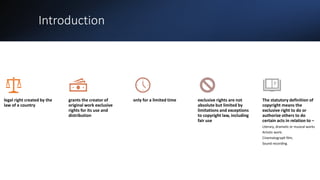
Introduction
legal right created by the
law of a country
grants the creator of
original work exclusive
rights for its use and
distribution
only for a limited time exclusive rights are not
absolute but limited by
limitations and exceptions
to copyright law, including
fair use
The statutory definition of
copyright means the
exclusive right to do or
authorize others to do
certain acts in relation to –
Literary, dramatic or musical works
Artistic work;
Cinematograph film;
Sound recording.
Meaning
of
the
word
"Copyright"
The word ‘copyright’ is derived from the
expression ‘copier of word’ first used in the
context. The word ‘copy’ is presumed to date
back to 1485 A D and was used to connote a
manuscript or other matter prepared for
printing.
Copyright as defined in the Oxford English
Dictionary is an exclusive right given by law
for a certain term of years to an author,
composer, etc., (or his assignors) to print,
publish and sell copies of his original work.
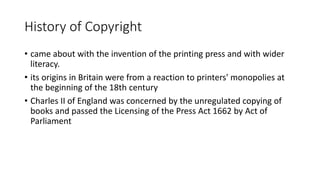
History of Copyright
• came about with the invention of the printing press and with wider
literacy.
• its origins in Britain were from a reaction to printers' monopolies at
the beginning of the 18th century
• Charles II of England was concerned by the unregulated copying of
books and passed the Licensing of the Press Act 1662 by Act of
Parliament
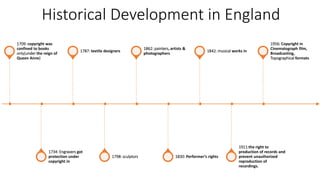
Historical Development in England
1709: copyright was
confined to books
only(under the reign of
Queen Anne)
1734: Engravers got
protection under
copyright in
1787: textile designers
1798: sculptors
1862: painters, artists &
photographers
1830: Performer’s rights
1842: musical works in
1911:the right to
production of records and
prevent unauthorized
reproduction of
recordings.
1956: Copyright in
Cinematograph film,
Broadcasting,
Topographical formats
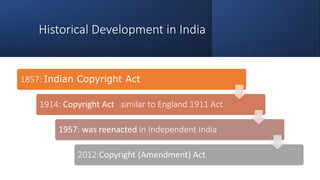
Historical Development in India
1857: Indian Copyright Act
1914: Copyright Act similar to England 1911 Act.
1957: was reenacted in Independent India
2012:Copyright (Amendment) Act
Changes
in
Indian
Copyright
Acts
and
Rules
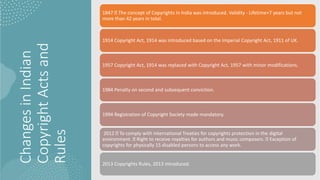
1847 The concept of Copyrights in India was introduced. Validity - Lifetime+7 years but not
more than 42 years in total.
1914 Copyright Act, 1914 was introduced based on the Imperial Copyright Act, 1911 of UK.
1957 Copyright Act, 1914 was replaced with Copyright Act, 1957 with minor modifications.
1984 Penalty on second and subsequent conviction.
1994 Registration of Copyright Society made mandatory.
2012 To comply with international Treaties for copyrights protection in the digital
environment. Right to receive royalties for authors and music composers. Exception of
copyrights for physically 15 disabled persons to access any work.
2013 Copyrights Rules, 2013 introduced.
NEED FOR
COPYRIGHT
PROTECTION
• Earlier people in performing arts,
like music, drama – composers,
singers, actors and performers
never thought of protection as
there were no means of
reproduction.
• But with inventions of devices
capable of easy reproductions
like phonograms, gramophones,
tape recorder, television, videos
etc, protection fore their work
became a grey area of concern.
OBJECT OF COPYRIGHT
To encourage the authors, composers,
artists to come up with original works.
After they come up with original work then
reward their work by giving them exclusive
rights to exploit their wok for limited period.
Once the limited period is over then the work
falls in public domain, and any one can make
use that work.
International
Position
India is a member of most of the important
international conventions governing the area of copyright law
the Berne Convention of 1886 (as modified at Paris in 1971),
the Universal Copyright Convention of 1951,
the Rome Convention of 1961
the Agreement on Trade Related Aspects of Intellectual
Property Rights (TRIPS)
WIPO Copyright Treaty(WCT)
WIPO Performances and Phonograms Treaty(WPPT)
Indian Copyright
• The Copyright Act 1957 as amended governs the
subject of copyright law in India
• Applicable from 21 January 1958.
• law has been amended six times since 1957
• The most recent amendment was in the year 2012,
through the Copyright (Amendment) Act 2012.
• 79 Sections
Author vs Work
The term ‘author’ refers to an individual who develops the content
(of work). The author can be a writer (literary work), computer
programmer (software), composer (musical work), producer (cinema
films, sound recording), photographer (photos).
The term ‘work’ is a task undertaken in the fields of literature,
dramas, music, artistic, cinematograph film and sound recording.
Classes of Copyrights
Literature.
Dramatics
Sound Recordings
Artistic
Musical
Cinematograph Films This Photo by Unknown author is licensed under CC BY-SA.
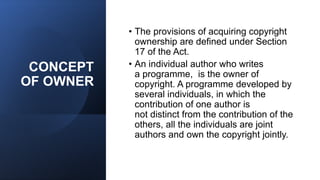
Essential features of Copyright
physical
(or
tangible)
form
work has
to be
original
creative
effort on
the part of
the author
Copyright
CONCEPT
OF OWNER
• The provisions of acquiring copyright
ownership are defined under Section
17 of the Act.
• An individual author who writes
a programme, is the owner of
copyright. A programme developed by
several individuals, in which the
contribution of one author is
not distinct from the contribution of the
others, all the individuals are joint
authors and own the copyright jointly.
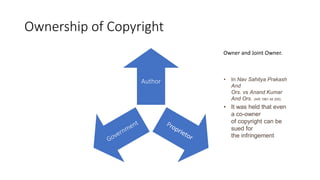
Ownership of Copyright
Author
Owner and Joint Owner.
• In Nav Sahitya Prakash
And
Ors. vs Anand Kumar
And Ors. (AIR 1981 All 200)
• It was held that even
a co-owner
of copyright can be
sued for
the infringement
The Copyright Act consists of 15 chapters
• Chapter I – Section 1 to 8 preliminary sections
• Chapter II – Section 9 to 12 establishes a copyright office under the control of the Registrar of Copyrights, The
Copyright Board
• Chapters III to IV – Section 13 to 16 & Section 17 to 21 of the Act are really the heart and they deal with the
meaning of a copyright and the works in which a copyright subsists
• Chapter V – Section 22 to 29 (The term of a copyright )
• Chapter VI – Section 30 to 32 of the Copyright Act deals with licensing of the copyright.
• Chapter VII – Section 33 to 36 concerns itself with Copyright Societies
• Chapter VIII – Section 37 to 39 of the Act concerns itself with the rights of broadcasting organizations and of
performers.
• Chapter IX – Section 40 to 43 of the Act deals with a copyright obtained in a foreign country.
• Chapters X and XI – Section 44 to 50 & Section 51 to 53 of the Act deal with the Registration and Infringement
of copyright
• Chapters XII to XIV – Section 54 to 62, Section 63 to 70 & Section 71 to 73 deal with civil remedies, criminal
offences and Appeals under the Act.
• Chapter XV – Section 74 to 79 of the Act deal with the Miscellaneous Provisions.
Indian work means a
literary, dramatic or
musical work,(S.2(l)
(i) the author of which is a citizen of
India; or
(ii) which is first published in India; or
(iii) the author of which, in the case of
an unpublished work, is, at the time of
the making of the work, a citizen of
India]
When work deemed to be
first published in India.
• For the purposes of this Act, a work
published in India shall be deemed to be first
published in India, notwithstanding that it has
been published simultaneously in some other
country, unless such other country provides a
shorter term of copyright for such work; and
a work shall be deemed to be published
simultaneously in India and in another
country if the time between the publication
in India and the publication in such other
country does not exceed thirty days or such
other period as the Central Government may,
in relation to any specified country,
determine
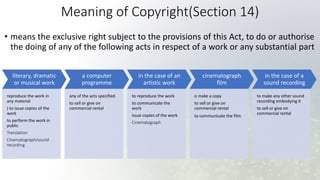
Meaning of Copyright(Section 14)
• means the exclusive right subject to the provisions of this Act, to do or authorise
the doing of any of the following acts in respect of a work or any substantial part
literary, dramatic
or musical work
reproduce the work in
any material
) to issue copies of the
work
to perform the work in
public
Translation
Cinematograph/sound
recording
a computer
programme
any of the acts specified
to sell or give on
commercial rental
in the case of an
artistic work
to reproduce the work
to communicate the
work
issue copies of the work
Cinematograph
cinematograph
film
o make a copy
to sell or give on
commercial rental
to communicate the film
in the case of a
sound recording
to make any other sound
recording embodying it
to sell or give on
commercial rental
Works in which copyright subsists(Section 13)
Copyright shall not subsist (a) in any cinematograph film if a substantial part of
the film is an infringement of the copyright in any
other work;
(b) in any [sound recording] made in respect of a
literary, dramatic or musical work, if in making the
[sound recording], copyright in such work has been
infringed.
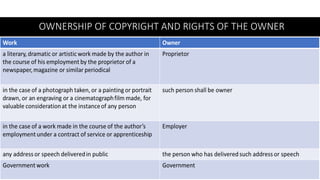
OWNERSHIP OF COPYRIGHT AND RIGHTS OF THE OWNER
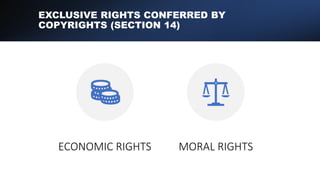
EXCLUSIVE RIGHTS CONFERRED BY
COPYRIGHTS (SECTION 14)
ECONOMIC RIGHTS MORAL RIGHTS
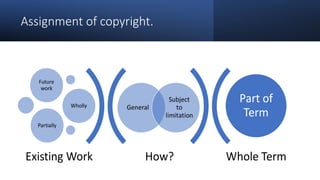
Assignment of copyright.
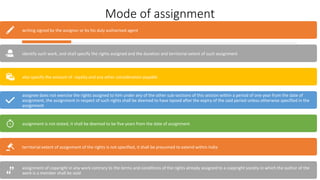
Mode of assignment
writing signed by the assignor or by his duly authorised agent
identify such work, and shall specify the rights assigned and the duration and territorial extent of such assignment
also specify the amount of royalty and any other consideration payable
assignee does not exercise the rights assigned to him under any of the other sub-sections of this section within a period of one year from the date of
assignment, the assignment in respect of such rights shall be deemed to have lapsed after the expiry of the said period unless otherwise specified in the
assignment
assignment is not stated, it shall be deemed to be five years from the date of assignment
territorial extent of assignment of the rights is not specified, it shall be presumed to extend within India
assignment of copyright in any work contrary to the terms and conditions of the rights already assigned to a copyright society in which the author of the
work is a member shall be void
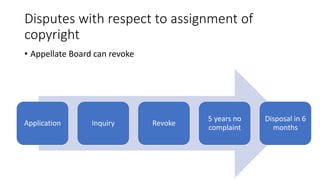
Disputes with respect to assignment of
copyright
• Appellate Board can revoke
Application Inquiry Revoke
5 years no
complaint
Disposal in 6
months
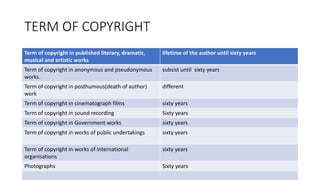
TERM OF COPYRIGHT
Term of copyright in published literary, dramatic,
musical and artistic works
lifetime of the author until sixty years
Term of copyright in anonymous and pseudonymous
works.
subsist until sixty years
Term of copyright in posthumous(death of author)
work
different
Term of copyright in cinematograph films sixty years
Term of copyright in sound recording Sixty years
Term of copyright in Government works sixty years
Term of copyright in works of public undertakings sixty years
Term of copyright in works of international
organisations
sixty years
Photographs Sixty years
LICENCES(Chapter VI)
.
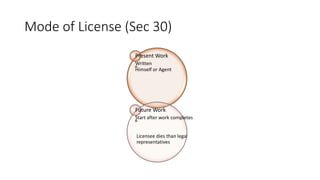
Mode of License (Sec 30)
Present Work
Written
Himself or Agent
Future Work
Start after work completes
Licensee dies than legal
representatives
Compulsory licence in works withheld from
public(S.31)
• This provision is typically included in copyright laws to strike a
balance between protecting the rights of copyright holders and
ensuring that certain works are made available to the public,
especially when the copyright owner is not making the work
accessible.
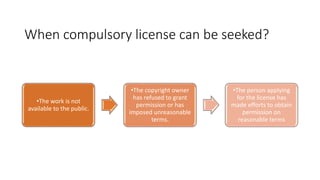
When compulsory license can be seeked?
•The work is not
available to the public.
•The copyright owner
has refused to grant
permission or has
imposed unreasonable
terms.
•The person applying
for the license has
made efforts to obtain
permission on
reasonable terms
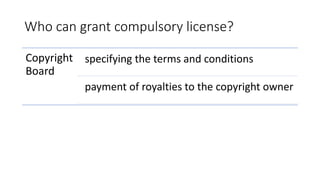
Who can grant compulsory license?
Copyright
Board
specifying the terms and conditions
payment of royalties to the copyright owner
Section 32 - Compulsory License in
the Case of Non-Use of Works
• three years not used or licensed
• or if the work is not available to the public at a reasonable price,
they can apply for a compulsory license
• Copyright Board (IPAB) may grant the license under certain
conditions, including the payment of royalties to the copyright
owner.
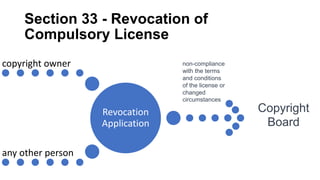
Section 33 - Revocation of
Compulsory License
Revocation
Application
copyright owner
any other person
Copyright
Board
non-compliance
with the terms
and conditions
of the license or
changed
circumstances
Super Cassettes Industries Ltd. v. Music
Broadcast Pvt. Ltd. (Radio City):
• In this case, the Copyright Board granted a compulsory license
to Music Broadcast Pvt. Ltd. for broadcasting sound recordings
owned by Super Cassettes Industries Ltd. (T-Series).This was
overturned by Supreme Court
• The key issue revolved around whether the refusal to grant a
license by T-Series was unreasonable. The Copyright Board
determined that Radio City had made reasonable efforts to
obtain the license, and it was in the interest of the general
public to grant the license.
• This case emphasized the importance of balancing the rights of
copyright owners with the public interest when considering
compulsory licenses.
Sajeev Pillai v. VenuKunnapalli &
Anr
• The appellant, Sajeev Pillai, a film director, and a scriptwriter, claimed to have researched the
history of the grand festival Mamankam and prepared a script for a movie based on the same epic.
He met VenuKunnapalli and signed an MoU with Kavya Film Company which was associated with
Kunnapalli. Sajeev was initially appointed as the director, but his service was terminated and
replaced by someone else. The movie’s shooting was after that completed, which Sajeev alleged
was done by mutilating, distorting, and modifying his script. Sajeev, in light of that, filed a suit
seeking various reliefs. An interim injunction application was filed to restrain the respondents from
releasing, publishing, distributing, and exploiting the film and issuing pre-release publicity without
providing good authorship credits to Pillai as per film industry standards.
Judgment:
• In deciding the issue, the Court noted that the first sub-section of Section 57(1) provides the author
to restrain third parties. The second sub-section provides the author the entitlement to claim
damages by such a third party for any distortion, mutilation, or other modifications to his work or any
other action that would be prejudicial to his honor or reputation. This provided the appellant an
unparalleled advantage in the case and that his copyright assignment of the work would not exhaust
the legal right to claim authorship over it.
Tips Industries v Wynk Music
• The dispute centers around section 31D of the Copyright Act, 1957, which provides for a statutory
licensing scheme, whereby any ‘broadcasting organization’ desirous of ‘communicating to the public’
any sound recording can obtain a statutory license to do so provided they pay royalty rates to the
copyright owners at rates fixed by the Intellectual Property Law Board.
Facts:
• Tips Industries Ltd (Plaintiff) is an Indian music label that exercises copyright over a significant music
repository that, in 2016, granted Wynk Music Ltd (Defendant) a license to access this music repository.
At the expiry of the said license, both parties attempted to renegotiate the licensing conditions. Still, they
failed to do so; hence, Wynk took refuge by invoking Section 31D of the Copyright Act. Tips challenged
Wynk’s invocation of Section 31D and prosecuted Wynk according to Section 14(1)(e) for breach of
their exclusive sound recording rights.
Judgement:
• The judgment was passed in favor of the plaintiff, and the Court held that the plaintiff was entitled to an
interim injunction, having regard to the reality that they had made a prima facie case, and would suffer
irreparable harm in the way of lost revenue.
Raj Rewal v Union of India
&Ors
• Facts:
• The present case concerns Mr. Raj Rewal, who designed and Mr. Mahendra Raj, who was the
structural designer of the Hall of Nations building. The said building was hailed as an icon of
modernist Indian architecture and was erected on the Pragati Maidan grounds in New Delhi. The
ITPO, in 2016, proposed to demolish the Hall of Nations complex to build an ‘Integrated Exhibition
cum Convention Centre.’ Despite several attempts made by Plaintiff to protect the building from
demolition, it resulted in what ITPO desired. Post demolition of the building, Plaintiff instituted a suit
against the actions of ITPO by claiming that the acts of demolition had derogated Plaintiff’s special
rights under Section 57.
• he dispute centers around section 57 of the Copyright Act 1957, under which the plaintiff has filed
for a mandatory injunction to reinstate the building according to the original plans. Section 57 of the
Copyright Act 1957 provides the author with special rights called ‘moral rights,’ which exists with the
author of the work over and above the economic rights of others.
YRF v Sri Sai Ganesh
Productions
• A copyright infringement suit was filed against Sri Sai Ganesh Productions
&Ors by Yash Raj Films Pvt Ltd on the grounds that it blatantly copied the
movie Band Baja Baarat produced under the YRF banner and producing
Jabardasht which showcased substantial and material similarities in terms of
theme, concept, plot, character, sketches, story, script, form and expression
amongst other thing.
• In the instant case, the Court found that the defendants had blatantly copied
the plaintiff’s film’s fundamental, essential, and distinctive feature
Krishna Kishore Singh vs. Sarla A. Saraogi &
Ors.
• In this case, the Delhi High Court refused to grant an interim injunction against
publication and release of films purportedly related to Sushant Singh Rajput
(SSR) as the plaintiff, SSR’s father failed to make out a prima facie case, and
because irreparable harm and balance of convenience were in favour of the
defendants. The plaintiff in the case argued that films and series such as ‘NYAY
The Justice,’ ‘Suicide or Murder,’ and ‘Shashank,’ must be injuncted and
restrained from being released, published and communicated to the public. The
plaintiff filed the case on several grounds including violation of publicity rights and
privacy rights, right to fair trial, defamation, and violation of Article 21 of the
Constitution.
• After reviewing the facts and relevant cases, the Court came to the conclusion
that the plaintiff failed to make out a valid case for violation of celebrity or publicity
rights of SSR or his family members because the plaintiff was not aware of the
content of the films, the defendants were not using SSR’s image, likeness or
name, and because the films had appropriate disclaimers. It also pointed out that
celebrity rights may not subsist after the death of the celebrity, and that facts that
form part of the public record may be used by the defendants without liability.
About defamation, the Court stated that a case of defamation is merely
speculative without access to the defamatory content.
Mr. John Hart Jr. & Anr. vs. Mr. Mukul Deora
& Ors.
• In this case, Plaintiff No. 1 claimed exclusive copyright for making a movie
adaptation of the book "The White Tiger" by Aravind Adiga, based on a Literary
Option/Purchase Agreement dated March 4, 2009. Plaintiffs sought an injunction
to stop the release of the film "The White Tiger" on Netflix, alleging that it would
cause irreparable injury and asserting they were unaware of the film's production
due to the COVID-19 pandemic.
• The court found no basis for granting an interlocutory injunction and considered
the case an abuse of the judicial process. It noted that Plaintiffs were aware of
the possibility of the film's release on Netflix since October 4, 2019, yet
approached the court less than 24 hours before the film's release. Such a delay
was deemed fatal, and the court cited precedents emphasizing that last-minute
requests for injunctions against cinematographic film releases are disfavored.
• The Delhi High Court held that the balance of convenience favored the
Defendants, and granting an injunction at the last minute would cause greater
irreparable loss and injury. Plaintiffs were barred from seeking an interlocutory
injunction due to their unconscionable delay in approaching the court.
Nevertheless, the court directed the Defendants to maintain detailed earnings
accounts from the film, potentially facilitating damages or monetary compensation
should the Plaintiffs succeed in the future.
COPYRIGHT
SOCIETIES:
Rahi Alhat
Concept of
Copyright
Societies
Collective administration of copyright
management and protection of copyright in
works are undertaken by a society of authors
better vigil over the uses made of that work
throughout the country and collect due royalties
from the users of those works
reciprocal agreements with similar societies in
other countries
Copyright
societies in
India
Section 33 of the Copyright Act, 1957
minimum membership required for registration
of a society is seven
same class of work
can issue or grant licenses in respect of any
work
e registration granted to a copyright society
shall be for a period of five years(section 36)
Functions of a copyright society
Conditions subject to which a copyright society may issue licences, collect fees and distribute such fees.
Administration of rights of owner by copyright society (Section 34 of Copyright Act)
Control over the copyright society by the authors and other owner of rights.‐ (Section 35 of Copyright Act
Records to be maintained by copyright societies
Tariff Scheme by copyright societies.
Distribution Scheme
Meeting of a copyright societies
Documents to be presented at the Annual General Meeting of Owners of Rights
Returns to be filed by the copyright societies with the Registrar of Copyrights
Code of Conduct for copyright societies
Registered copyright societies in
India:
• For Literary works associated with Musical Works: The
Indian Performing Right Society Limited (IPRS)
• ii. For Reprographic (photo copying) works: Indian
Reprographic Rights Organization (IRRO)
• iii. For Performers (Singers) Rights: Indian Singers Rights
Association (ISRA)
Case Laws
IPRS Limited v Hello FM Radio (Malar
publications Limited).(Delhi HC)
Phonographic Performance Limited v Hotels(PPL
is the sole authority to administer the
broadcasting, telecasting and public performance
rights and to collect license fees on behalf of the
music industry.)(Mumbai HC)
M/s Phonographic Performance Ltd. v M/s Hotel
Gold Regency & Others
(MANU/DE/0942/2008)(Delhi HC)
RIGHTS OF BROADCASTING ORGANISATION
AND OF PERFORMERS
.
Broadcast reproduction right(Sec 37)
Broadcasting organisations have a special right
called "broadcast reproduction right" for their
broadcasts.
The broadcast reproduction right is valid for
twenty-five years from the beginning of the
calendar year following the broadcast.
During the duration of the broadcast
reproduction right:
Unauthorized actions include:
•Re-broadcasting the original broadcast.
•Allowing the broadcast to be heard or seen by the public for a
fee.
•Creating sound recordings or visual recordings of the
broadcast.
•Making reproductions of such sound or visual recordings if
the initial recording was done without a license or for a
purpose not covered by the license.
•Selling, offering for commercial rental, or offering for sale or
rental sound recordings or visual recordings created under
clause (c) or clause (d).
Performer’s right (Sec.38)
Performers have a special right known as "performer's right" related to
their performances.
The performer's right remains in effect for fifty years from the beginning of
the calendar year following the year in which the performance took place.
Sarah gives a live concert on December 15, 2023. How long does the
performer's right last, according to the law?
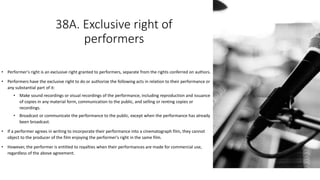
38A. Exclusive right of
performers
• Performer's right is an exclusive right granted to performers, separate from the rights conferred on authors.
• Performers have the exclusive right to do or authorize the following acts in relation to their performance or
any substantial part of it:
• Make sound recordings or visual recordings of the performance, including reproduction and issuance
of copies in any material form, communication to the public, and selling or renting copies or
recordings.
• Broadcast or communicate the performance to the public, except when the performance has already
been broadcast.
• If a performer agrees in writing to incorporate their performance into a cinematograph film, they cannot
object to the producer of the film enjoying the performer's right in the same film.
• However, the performer is entitled to royalties when their performances are made for commercial use,
regardless of the above agreement.
38B. Moral rights of the performer
Performers of a performance have moral rights,
which they retain independently even after
assigning or partially assigning their rights.
These moral rights include:
The right to be identified as the performer of their
performance, except when the nature of use makes it
impractical.
The right to prevent or seek compensation for any distortion,
mutilation, or other modification of their performance that
could harm their reputation.
It's clarified that certain modifications, such as
removing parts of a performance for editing or
fitting the recording within a limited duration or
any other changes required for purely technical
reasons, are not considered harmful to the
performer's reputation
Section 39A: Application of Certain Provisions to Broadcast Reproduction
Right and Performer's Rights
Sections 18, 19, 30, 30A, 33, 33A, 34, 35, 36, 53, 55, 58, 63, 64, 65, 65A, 65B, and 66 of the law shall apply, with
necessary adaptations and modifications, in relation to both the broadcast reproduction right in any broadcast and the
performer's right in any performance. These provisions are applied similarly to how they apply to copyright in a work.
There is a proviso that states that if copyright to performer's rights exists for any work or performance that has been
broadcast, no license to reproduce such broadcast can be given without the consent of the owner of the rights or the
performer, or both.
Additionally, it's mentioned that the broadcast reproduction right or performer's right will not exist if the broadcast or
performance infringes the copyright of any work.
The broadcast reproduction right or performer's right does not impact the separate copyright in any work for which the
broadcast or performance was created.
Section 39: Acts Not Infringing Broadcast Reproduction Right or Performer's Right
• Neither the broadcast reproduction right nor the performer's right shall be
considered infringed by the following acts:
• Making sound recordings or visual recordings for private use or for legitimate teaching or
research purposes.
• Using excerpts from a performance or a broadcast in a manner consistent with fair dealing.
This includes using excerpts for reporting current events, bona fide review, teaching, or
research.
• Engaging in other acts, with any necessary adaptations and modifications, that do not
constitute copyright infringement under Section 52 of the law.
• These provisions allow for certain exceptions where the rights of broadcast reproduction and
performers are not violated, particularly when the use is for private, educational, research, or
fair dealing purposes
INTERNATIONAL
COPYRIGHT
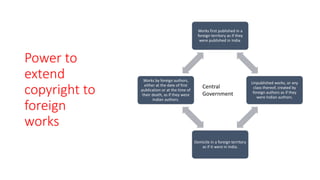
Power to
extend
copyright to
foreign
works
Works first published in a
foreign territory as if they
were published in India.
Unpublished works, or any
class thereof, created by
foreign authors as if they
were Indian authors.
Domicile in a foreign territory
as if it were in India.
Works by foreign authors,
either at the date of first
publication or at the time of
their death, as if they were
Indian authors.
Central
Government
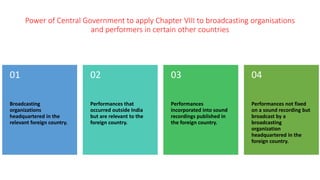
Power of Central Government to apply Chapter VIII to broadcasting organisations
and performers in certain other countries
Broadcasting
organizations
headquartered in the
relevant foreign country.
01
Performances that
occurred outside India
but are relevant to the
foreign country.
02
Performances
incorporated into sound
recordings published in
the foreign country.
03
Performances not fixed
on a sound recording but
broadcast by a
broadcasting
organization
headquartered in the
foreign country.
04
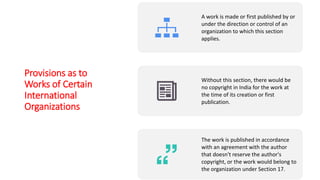
Provisions as to
Works of Certain
International
Organizations
A work is made or first published by or
under the direction or control of an
organization to which this section
applies.
Without this section, there would be
no copyright in India for the work at
the time of its creation or first
publication.
The work is published in accordance
with an agreement with the author
that doesn't reserve the author's
copyright, or the work would belong to
the organization under Section 17.
Power to Restrict
Rights in Works of
Foreign Authors
First Published in
India (Section 42)
This restriction is applicable when:
• The Central Government believes that
a foreign country does not provide
adequate protection to the works of
Indian authors.
• The foreign country has not
committed to providing such
protection.
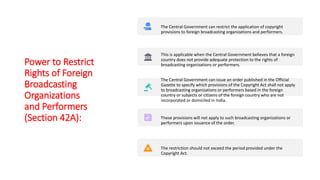
Power to Restrict
Rights of Foreign
Broadcasting
Organizations
and Performers
(Section 42A):
The Central Government can restrict the application of copyright
provisions to foreign broadcasting organizations and performers.
This is applicable when the Central Government believes that a foreign
country does not provide adequate protection to the rights of
broadcasting organizations or performers.
The Central Government can issue an order published in the Official
Gazette to specify which provisions of the Copyright Act shall not apply
to broadcasting organizations or performers based in the foreign
country or subjects or citizens of the foreign country who are not
incorporated or domiciled in India.
These provisions will not apply to such broadcasting organizations or
performers upon issuance of the order.
The restriction should not exceed the period provided under the
Copyright Act.
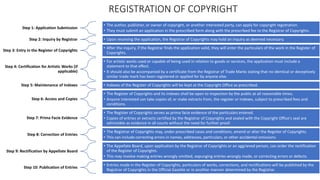
REGISTRATION OF COPYRIGHT
Step 1: Application Submission
• The author, publisher, or owner of copyright, or another interested party, can apply for copyright registration.
• They must submit an application in the prescribed form along with the prescribed fee to the Registrar of Copyrights.
Step 2: Inquiry by Registrar • Upon receiving the application, the Registrar of Copyrights may hold an inquiry as deemed necessary.
Step 3: Entry in the Register of Copyrights
• After the inquiry, if the Registrar finds the application valid, they will enter the particulars of the work in the Register of
Copyrights.
Step 4: Certification for Artistic Works (if
applicable)
• For artistic works used or capable of being used in relation to goods or services, the application must include a
statement to that effect.
• It should also be accompanied by a certificate from the Registrar of Trade Marks stating that no identical or deceptively
similar trade mark has been registered or applied for by anyone else.
Step 5: Maintenance of Indexes • Indexes of the Register of Copyrights will be kept at the Copyright Office as prescribed.
Step 6: Access and Copies
• The Register of Copyrights and its indexes shall be open to inspection by the public at all reasonable times.
• Anyone interested can take copies of, or make extracts from, the register or indexes, subject to prescribed fees and
conditions.
Step 7: Prima Facie Evidence
• The Register of Copyrights serves as prima facie evidence of the particulars entered.
• Copies of entries or extracts certified by the Registrar of Copyrights and sealed with the Copyright Office's seal are
admissible as evidence in all courts without the need for further proof.
Step 8: Correction of Entries
• The Registrar of Copyrights may, under prescribed cases and conditions, amend or alter the Register of Copyrights.
• This can include correcting errors in names, addresses, particulars, or other accidental omissions.
Step 9: Rectification by Appellate Board
• The Appellate Board, upon application by the Registrar of Copyrights or an aggrieved person, can order the rectification
of the Register of Copyrights.
• This may involve making entries wrongly omitted, expunging entries wrongly made, or correcting errors or defects.
Step 10: Publication of Entries
• Entries made in the Register of Copyrights, particulars of works, corrections, and rectifications will be published by the
Registrar of Copyrights in the Official Gazette or in another manner determined by the Registrar.
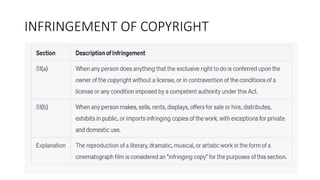
INFRINGEMENT OF COPYRIGHT
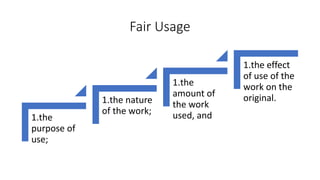
Fair Usage
1.the
purpose of
use;
1.the nature
of the work;
1.the
amount of
the work
used, and
1.the effect
of use of the
work on the
original.
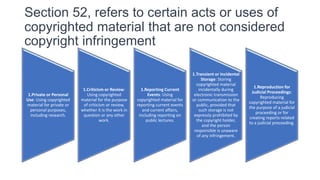
Section 52, refers to certain acts or uses of
copyrighted material that are not considered
copyright infringement
1.Private or Personal
Use: Using copyrighted
material for private or
personal purposes,
including research.
1.Criticism or Review:
Using copyrighted
material for the purpose
of criticism or review,
whether it is the work in
question or any other
work.
1.Reporting Current
Events: Using
copyrighted material for
reporting current events
and current affairs,
including reporting on
public lectures.
1.Transient or Incidental
Storage: Storing
copyrighted material
incidentally during
electronic transmission
or communication to the
public, provided that
such storage is not
expressly prohibited by
the copyright holder,
and the person
responsible is unaware
of any infringement.
1.Reproduction for
Judicial Proceedings:
Reproducing
copyrighted material for
the purpose of a judicial
proceeding or for
creating reports related
to a judicial proceeding.
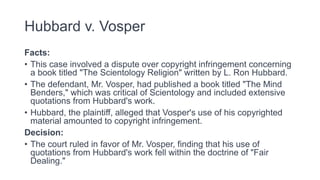
Hubbard v. Vosper
Facts:
• This case involved a dispute over copyright infringement concerning
a book titled "The Scientology Religion" written by L. Ron Hubbard.
• The defendant, Mr. Vosper, had published a book titled "The Mind
Benders," which was critical of Scientology and included extensive
quotations from Hubbard's work.
• Hubbard, the plaintiff, alleged that Vosper's use of his copyrighted
material amounted to copyright infringement.
Decision:
• The court ruled in favor of Mr. Vosper, finding that his use of
quotations from Hubbard's work fell within the doctrine of "Fair
Dealing."
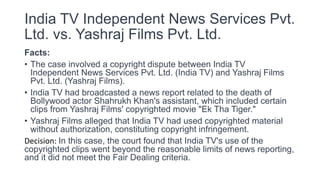
India TV Independent News Services Pvt.
Ltd. vs. Yashraj Films Pvt. Ltd.
Facts:
• The case involved a copyright dispute between India TV
Independent News Services Pvt. Ltd. (India TV) and Yashraj Films
Pvt. Ltd. (Yashraj Films).
• India TV had broadcasted a news report related to the death of
Bollywood actor Shahrukh Khan's assistant, which included certain
clips from Yashraj Films' copyrighted movie "Ek Tha Tiger."
• Yashraj Films alleged that India TV had used copyrighted material
without authorization, constituting copyright infringement.
Decision: In this case, the court found that India TV's use of the
copyrighted clips went beyond the reasonable limits of news reporting,
and it did not meet the Fair Dealing criteria.
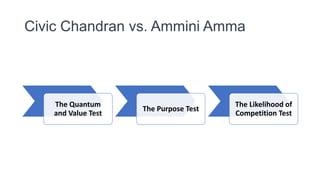
Civic Chandran vs. Ammini Amma
The Quantum
and Value Test
The Purpose Test
The Likelihood of
Competition Test
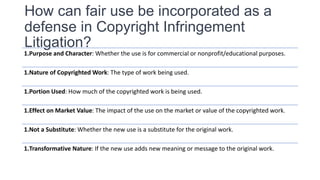
How can fair use be incorporated as a
defense in Copyright Infringement
Litigation?
1.Purpose and Character: Whether the use is for commercial or nonprofit/educational purposes.
1.Nature of Copyrighted Work: The type of work being used.
1.Portion Used: How much of the copyrighted work is being used.
1.Effect on Market Value: The impact of the use on the market or value of the copyrighted work.
1.Not a Substitute: Whether the new use is a substitute for the original work.
1.Transformative Nature: If the new use adds new meaning or message to the original work.
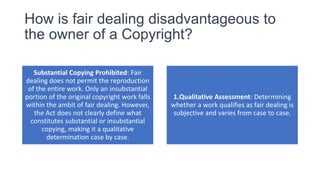
How is fair dealing disadvantageous to
the owner of a Copyright?
Substantial Copying Prohibited: Fair
dealing does not permit the reproduction
of the entire work. Only an insubstantial
portion of the original copyright work falls
within the ambit of fair dealing. However,
the Act does not clearly define what
constitutes substantial or insubstantial
copying, making it a qualitative
determination case by case.
1.Qualitative Assessment: Determining
whether a work qualifies as fair dealing is
subjective and varies from case to case.
The Chancellor, Masters and Scholars of the
University of Oxford v Rameshwari Photocopy
Services
1.Fact: The plaintiffs in this case were Oxford University Press, Cambridge University Press, and their
Indian affiliates, along with Taylor & Francis and its Indian affiliate. These publishers filed a suit for a
permanent injunction against Rameshwari Photocopy Services and the Delhi School of Economics,
Delhi University.
2.Rameshwari Photocopy Services reproduced selected portions of various copyrighted publications
owned by the plaintiffs and distributed them to students in course packs. The amount of content copied
ranged from 5% to 33.25% of the original books.
3.The Delhi School of Economics used these course packs for suggested reading for students but did not
require the entire packs to be reproduced; only selected portions were included in the packs.
Decision:
• The judgment in this case did not explicitly address whether the reproduction of entire books was
allowed or if only reproducing excerpts from several books would be considered fair dealing under the
Copyright Act, 1957.
• However, the court ruled that making course packs for suggested reading for students by photocopying
portions of various prescribed reference books did not violate the copyright of the publishers. The court
seemed to support the notion that reproducing selected portions for educational purposes might fall
within the scope of fair dealing, but it did not provide specific guidelines on the extent of such use.
• This case highlighted the complex nature of fair dealing in Indian copyright law, leaving room for
interpretation and further legal scrutiny in determining what constitutes fair dealing, especially in an

Copyright

  • 1.
    Copyright Law Rahi Alhat ThisPhoto by Unknown author is licensed under CC BY-SA.
  • 2.
    Contains of the Unit •Meaning, definition and subject matter of copyright, • Registration of Copyright, Term of Copyright, • Rights and limitations of owners and broadcasters, • Transfer of copyright, • Infringement of copyright • Remedies for infringement of copyright
  • 3.
    Introduction legal right createdby the law of a country grants the creator of original work exclusive rights for its use and distribution only for a limited time exclusive rights are not absolute but limited by limitations and exceptions to copyright law, including fair use The statutory definition of copyright means the exclusive right to do or authorize others to do certain acts in relation to – Literary, dramatic or musical works Artistic work; Cinematograph film; Sound recording.
  • 4.
    Meaning of the word "Copyright" The word ‘copyright’is derived from the expression ‘copier of word’ first used in the context. The word ‘copy’ is presumed to date back to 1485 A D and was used to connote a manuscript or other matter prepared for printing. Copyright as defined in the Oxford English Dictionary is an exclusive right given by law for a certain term of years to an author, composer, etc., (or his assignors) to print, publish and sell copies of his original work.
  • 5.
    History of Copyright •came about with the invention of the printing press and with wider literacy. • its origins in Britain were from a reaction to printers' monopolies at the beginning of the 18th century • Charles II of England was concerned by the unregulated copying of books and passed the Licensing of the Press Act 1662 by Act of Parliament
  • 6.
    Historical Development inEngland 1709: copyright was confined to books only(under the reign of Queen Anne) 1734: Engravers got protection under copyright in 1787: textile designers 1798: sculptors 1862: painters, artists & photographers 1830: Performer’s rights 1842: musical works in 1911:the right to production of records and prevent unauthorized reproduction of recordings. 1956: Copyright in Cinematograph film, Broadcasting, Topographical formats
  • 7.
    Historical Development inIndia 1857: Indian Copyright Act 1914: Copyright Act similar to England 1911 Act. 1957: was reenacted in Independent India 2012:Copyright (Amendment) Act
  • 8.
    Changes in Indian Copyright Acts and Rules 1847 The conceptof Copyrights in India was introduced. Validity - Lifetime+7 years but not more than 42 years in total. 1914 Copyright Act, 1914 was introduced based on the Imperial Copyright Act, 1911 of UK. 1957 Copyright Act, 1914 was replaced with Copyright Act, 1957 with minor modifications. 1984 Penalty on second and subsequent conviction. 1994 Registration of Copyright Society made mandatory. 2012 To comply with international Treaties for copyrights protection in the digital environment. Right to receive royalties for authors and music composers. Exception of copyrights for physically 15 disabled persons to access any work. 2013 Copyrights Rules, 2013 introduced.
  • 9.
    NEED FOR COPYRIGHT PROTECTION • Earlierpeople in performing arts, like music, drama – composers, singers, actors and performers never thought of protection as there were no means of reproduction. • But with inventions of devices capable of easy reproductions like phonograms, gramophones, tape recorder, television, videos etc, protection fore their work became a grey area of concern.
  • 10.
    OBJECT OF COPYRIGHT Toencourage the authors, composers, artists to come up with original works. After they come up with original work then reward their work by giving them exclusive rights to exploit their wok for limited period. Once the limited period is over then the work falls in public domain, and any one can make use that work.
  • 11.
    International Position India is amember of most of the important international conventions governing the area of copyright law the Berne Convention of 1886 (as modified at Paris in 1971), the Universal Copyright Convention of 1951, the Rome Convention of 1961 the Agreement on Trade Related Aspects of Intellectual Property Rights (TRIPS) WIPO Copyright Treaty(WCT) WIPO Performances and Phonograms Treaty(WPPT)
  • 12.
    Indian Copyright • TheCopyright Act 1957 as amended governs the subject of copyright law in India • Applicable from 21 January 1958. • law has been amended six times since 1957 • The most recent amendment was in the year 2012, through the Copyright (Amendment) Act 2012. • 79 Sections
  • 13.
    Author vs Work Theterm ‘author’ refers to an individual who develops the content (of work). The author can be a writer (literary work), computer programmer (software), composer (musical work), producer (cinema films, sound recording), photographer (photos). The term ‘work’ is a task undertaken in the fields of literature, dramas, music, artistic, cinematograph film and sound recording.
  • 14.
    Classes of Copyrights Literature. Dramatics SoundRecordings Artistic Musical Cinematograph Films This Photo by Unknown author is licensed under CC BY-SA.
  • 15.
    Essential features ofCopyright physical (or tangible) form work has to be original creative effort on the part of the author Copyright
  • 16.
    CONCEPT OF OWNER • Theprovisions of acquiring copyright ownership are defined under Section 17 of the Act. • An individual author who writes a programme, is the owner of copyright. A programme developed by several individuals, in which the contribution of one author is not distinct from the contribution of the others, all the individuals are joint authors and own the copyright jointly.
  • 17.
    Ownership of Copyright Author Ownerand Joint Owner. • In Nav Sahitya Prakash And Ors. vs Anand Kumar And Ors. (AIR 1981 All 200) • It was held that even a co-owner of copyright can be sued for the infringement
  • 18.
    The Copyright Actconsists of 15 chapters • Chapter I – Section 1 to 8 preliminary sections • Chapter II – Section 9 to 12 establishes a copyright office under the control of the Registrar of Copyrights, The Copyright Board • Chapters III to IV – Section 13 to 16 & Section 17 to 21 of the Act are really the heart and they deal with the meaning of a copyright and the works in which a copyright subsists • Chapter V – Section 22 to 29 (The term of a copyright ) • Chapter VI – Section 30 to 32 of the Copyright Act deals with licensing of the copyright. • Chapter VII – Section 33 to 36 concerns itself with Copyright Societies • Chapter VIII – Section 37 to 39 of the Act concerns itself with the rights of broadcasting organizations and of performers. • Chapter IX – Section 40 to 43 of the Act deals with a copyright obtained in a foreign country. • Chapters X and XI – Section 44 to 50 & Section 51 to 53 of the Act deal with the Registration and Infringement of copyright • Chapters XII to XIV – Section 54 to 62, Section 63 to 70 & Section 71 to 73 deal with civil remedies, criminal offences and Appeals under the Act. • Chapter XV – Section 74 to 79 of the Act deal with the Miscellaneous Provisions.
  • 19.
    Indian work meansa literary, dramatic or musical work,(S.2(l) (i) the author of which is a citizen of India; or (ii) which is first published in India; or (iii) the author of which, in the case of an unpublished work, is, at the time of the making of the work, a citizen of India]
  • 20.
    When work deemedto be first published in India. • For the purposes of this Act, a work published in India shall be deemed to be first published in India, notwithstanding that it has been published simultaneously in some other country, unless such other country provides a shorter term of copyright for such work; and a work shall be deemed to be published simultaneously in India and in another country if the time between the publication in India and the publication in such other country does not exceed thirty days or such other period as the Central Government may, in relation to any specified country, determine
  • 21.
    Meaning of Copyright(Section14) • means the exclusive right subject to the provisions of this Act, to do or authorise the doing of any of the following acts in respect of a work or any substantial part literary, dramatic or musical work reproduce the work in any material ) to issue copies of the work to perform the work in public Translation Cinematograph/sound recording a computer programme any of the acts specified to sell or give on commercial rental in the case of an artistic work to reproduce the work to communicate the work issue copies of the work Cinematograph cinematograph film o make a copy to sell or give on commercial rental to communicate the film in the case of a sound recording to make any other sound recording embodying it to sell or give on commercial rental
  • 22.
    Works in whichcopyright subsists(Section 13) Copyright shall not subsist (a) in any cinematograph film if a substantial part of the film is an infringement of the copyright in any other work; (b) in any [sound recording] made in respect of a literary, dramatic or musical work, if in making the [sound recording], copyright in such work has been infringed.
  • 23.
    OWNERSHIP OF COPYRIGHTAND RIGHTS OF THE OWNER
  • 24.
    EXCLUSIVE RIGHTS CONFERREDBY COPYRIGHTS (SECTION 14) ECONOMIC RIGHTS MORAL RIGHTS
  • 25.
  • 26.
    Mode of assignment writingsigned by the assignor or by his duly authorised agent identify such work, and shall specify the rights assigned and the duration and territorial extent of such assignment also specify the amount of royalty and any other consideration payable assignee does not exercise the rights assigned to him under any of the other sub-sections of this section within a period of one year from the date of assignment, the assignment in respect of such rights shall be deemed to have lapsed after the expiry of the said period unless otherwise specified in the assignment assignment is not stated, it shall be deemed to be five years from the date of assignment territorial extent of assignment of the rights is not specified, it shall be presumed to extend within India assignment of copyright in any work contrary to the terms and conditions of the rights already assigned to a copyright society in which the author of the work is a member shall be void
  • 27.
    Disputes with respectto assignment of copyright • Appellate Board can revoke Application Inquiry Revoke 5 years no complaint Disposal in 6 months
  • 28.
    TERM OF COPYRIGHT Termof copyright in published literary, dramatic, musical and artistic works lifetime of the author until sixty years Term of copyright in anonymous and pseudonymous works. subsist until sixty years Term of copyright in posthumous(death of author) work different Term of copyright in cinematograph films sixty years Term of copyright in sound recording Sixty years Term of copyright in Government works sixty years Term of copyright in works of public undertakings sixty years Term of copyright in works of international organisations sixty years Photographs Sixty years
  • 29.
  • 30.
    Mode of License(Sec 30) Present Work Written Himself or Agent Future Work Start after work completes Licensee dies than legal representatives
  • 31.
    Compulsory licence inworks withheld from public(S.31) • This provision is typically included in copyright laws to strike a balance between protecting the rights of copyright holders and ensuring that certain works are made available to the public, especially when the copyright owner is not making the work accessible.
  • 32.
    When compulsory licensecan be seeked? •The work is not available to the public. •The copyright owner has refused to grant permission or has imposed unreasonable terms. •The person applying for the license has made efforts to obtain permission on reasonable terms
  • 33.
    Who can grantcompulsory license? Copyright Board specifying the terms and conditions payment of royalties to the copyright owner
  • 34.
    Section 32 -Compulsory License in the Case of Non-Use of Works • three years not used or licensed • or if the work is not available to the public at a reasonable price, they can apply for a compulsory license • Copyright Board (IPAB) may grant the license under certain conditions, including the payment of royalties to the copyright owner.
  • 35.
    Section 33 -Revocation of Compulsory License Revocation Application copyright owner any other person Copyright Board non-compliance with the terms and conditions of the license or changed circumstances
  • 36.
    Super Cassettes IndustriesLtd. v. Music Broadcast Pvt. Ltd. (Radio City): • In this case, the Copyright Board granted a compulsory license to Music Broadcast Pvt. Ltd. for broadcasting sound recordings owned by Super Cassettes Industries Ltd. (T-Series).This was overturned by Supreme Court • The key issue revolved around whether the refusal to grant a license by T-Series was unreasonable. The Copyright Board determined that Radio City had made reasonable efforts to obtain the license, and it was in the interest of the general public to grant the license. • This case emphasized the importance of balancing the rights of copyright owners with the public interest when considering compulsory licenses.
  • 37.
    Sajeev Pillai v.VenuKunnapalli & Anr • The appellant, Sajeev Pillai, a film director, and a scriptwriter, claimed to have researched the history of the grand festival Mamankam and prepared a script for a movie based on the same epic. He met VenuKunnapalli and signed an MoU with Kavya Film Company which was associated with Kunnapalli. Sajeev was initially appointed as the director, but his service was terminated and replaced by someone else. The movie’s shooting was after that completed, which Sajeev alleged was done by mutilating, distorting, and modifying his script. Sajeev, in light of that, filed a suit seeking various reliefs. An interim injunction application was filed to restrain the respondents from releasing, publishing, distributing, and exploiting the film and issuing pre-release publicity without providing good authorship credits to Pillai as per film industry standards. Judgment: • In deciding the issue, the Court noted that the first sub-section of Section 57(1) provides the author to restrain third parties. The second sub-section provides the author the entitlement to claim damages by such a third party for any distortion, mutilation, or other modifications to his work or any other action that would be prejudicial to his honor or reputation. This provided the appellant an unparalleled advantage in the case and that his copyright assignment of the work would not exhaust the legal right to claim authorship over it.
  • 38.
    Tips Industries vWynk Music • The dispute centers around section 31D of the Copyright Act, 1957, which provides for a statutory licensing scheme, whereby any ‘broadcasting organization’ desirous of ‘communicating to the public’ any sound recording can obtain a statutory license to do so provided they pay royalty rates to the copyright owners at rates fixed by the Intellectual Property Law Board. Facts: • Tips Industries Ltd (Plaintiff) is an Indian music label that exercises copyright over a significant music repository that, in 2016, granted Wynk Music Ltd (Defendant) a license to access this music repository. At the expiry of the said license, both parties attempted to renegotiate the licensing conditions. Still, they failed to do so; hence, Wynk took refuge by invoking Section 31D of the Copyright Act. Tips challenged Wynk’s invocation of Section 31D and prosecuted Wynk according to Section 14(1)(e) for breach of their exclusive sound recording rights. Judgement: • The judgment was passed in favor of the plaintiff, and the Court held that the plaintiff was entitled to an interim injunction, having regard to the reality that they had made a prima facie case, and would suffer irreparable harm in the way of lost revenue.
  • 39.
    Raj Rewal vUnion of India &Ors • Facts: • The present case concerns Mr. Raj Rewal, who designed and Mr. Mahendra Raj, who was the structural designer of the Hall of Nations building. The said building was hailed as an icon of modernist Indian architecture and was erected on the Pragati Maidan grounds in New Delhi. The ITPO, in 2016, proposed to demolish the Hall of Nations complex to build an ‘Integrated Exhibition cum Convention Centre.’ Despite several attempts made by Plaintiff to protect the building from demolition, it resulted in what ITPO desired. Post demolition of the building, Plaintiff instituted a suit against the actions of ITPO by claiming that the acts of demolition had derogated Plaintiff’s special rights under Section 57. • he dispute centers around section 57 of the Copyright Act 1957, under which the plaintiff has filed for a mandatory injunction to reinstate the building according to the original plans. Section 57 of the Copyright Act 1957 provides the author with special rights called ‘moral rights,’ which exists with the author of the work over and above the economic rights of others.
  • 40.
    YRF v SriSai Ganesh Productions • A copyright infringement suit was filed against Sri Sai Ganesh Productions &Ors by Yash Raj Films Pvt Ltd on the grounds that it blatantly copied the movie Band Baja Baarat produced under the YRF banner and producing Jabardasht which showcased substantial and material similarities in terms of theme, concept, plot, character, sketches, story, script, form and expression amongst other thing. • In the instant case, the Court found that the defendants had blatantly copied the plaintiff’s film’s fundamental, essential, and distinctive feature
  • 41.
    Krishna Kishore Singhvs. Sarla A. Saraogi & Ors. • In this case, the Delhi High Court refused to grant an interim injunction against publication and release of films purportedly related to Sushant Singh Rajput (SSR) as the plaintiff, SSR’s father failed to make out a prima facie case, and because irreparable harm and balance of convenience were in favour of the defendants. The plaintiff in the case argued that films and series such as ‘NYAY The Justice,’ ‘Suicide or Murder,’ and ‘Shashank,’ must be injuncted and restrained from being released, published and communicated to the public. The plaintiff filed the case on several grounds including violation of publicity rights and privacy rights, right to fair trial, defamation, and violation of Article 21 of the Constitution. • After reviewing the facts and relevant cases, the Court came to the conclusion that the plaintiff failed to make out a valid case for violation of celebrity or publicity rights of SSR or his family members because the plaintiff was not aware of the content of the films, the defendants were not using SSR’s image, likeness or name, and because the films had appropriate disclaimers. It also pointed out that celebrity rights may not subsist after the death of the celebrity, and that facts that form part of the public record may be used by the defendants without liability. About defamation, the Court stated that a case of defamation is merely speculative without access to the defamatory content.
  • 42.
    Mr. John HartJr. & Anr. vs. Mr. Mukul Deora & Ors. • In this case, Plaintiff No. 1 claimed exclusive copyright for making a movie adaptation of the book "The White Tiger" by Aravind Adiga, based on a Literary Option/Purchase Agreement dated March 4, 2009. Plaintiffs sought an injunction to stop the release of the film "The White Tiger" on Netflix, alleging that it would cause irreparable injury and asserting they were unaware of the film's production due to the COVID-19 pandemic. • The court found no basis for granting an interlocutory injunction and considered the case an abuse of the judicial process. It noted that Plaintiffs were aware of the possibility of the film's release on Netflix since October 4, 2019, yet approached the court less than 24 hours before the film's release. Such a delay was deemed fatal, and the court cited precedents emphasizing that last-minute requests for injunctions against cinematographic film releases are disfavored. • The Delhi High Court held that the balance of convenience favored the Defendants, and granting an injunction at the last minute would cause greater irreparable loss and injury. Plaintiffs were barred from seeking an interlocutory injunction due to their unconscionable delay in approaching the court. Nevertheless, the court directed the Defendants to maintain detailed earnings accounts from the film, potentially facilitating damages or monetary compensation should the Plaintiffs succeed in the future.
  • 43.
  • 44.
    Concept of Copyright Societies Collective administrationof copyright management and protection of copyright in works are undertaken by a society of authors better vigil over the uses made of that work throughout the country and collect due royalties from the users of those works reciprocal agreements with similar societies in other countries
  • 45.
    Copyright societies in India Section 33of the Copyright Act, 1957 minimum membership required for registration of a society is seven same class of work can issue or grant licenses in respect of any work e registration granted to a copyright society shall be for a period of five years(section 36)
  • 46.
    Functions of acopyright society Conditions subject to which a copyright society may issue licences, collect fees and distribute such fees. Administration of rights of owner by copyright society (Section 34 of Copyright Act) Control over the copyright society by the authors and other owner of rights.‐ (Section 35 of Copyright Act Records to be maintained by copyright societies Tariff Scheme by copyright societies. Distribution Scheme Meeting of a copyright societies Documents to be presented at the Annual General Meeting of Owners of Rights Returns to be filed by the copyright societies with the Registrar of Copyrights Code of Conduct for copyright societies
  • 47.
    Registered copyright societiesin India: • For Literary works associated with Musical Works: The Indian Performing Right Society Limited (IPRS) • ii. For Reprographic (photo copying) works: Indian Reprographic Rights Organization (IRRO) • iii. For Performers (Singers) Rights: Indian Singers Rights Association (ISRA)
  • 48.
    Case Laws IPRS Limitedv Hello FM Radio (Malar publications Limited).(Delhi HC) Phonographic Performance Limited v Hotels(PPL is the sole authority to administer the broadcasting, telecasting and public performance rights and to collect license fees on behalf of the music industry.)(Mumbai HC) M/s Phonographic Performance Ltd. v M/s Hotel Gold Regency & Others (MANU/DE/0942/2008)(Delhi HC)
  • 49.
    RIGHTS OF BROADCASTINGORGANISATION AND OF PERFORMERS .
  • 50.
    Broadcast reproduction right(Sec37) Broadcasting organisations have a special right called "broadcast reproduction right" for their broadcasts. The broadcast reproduction right is valid for twenty-five years from the beginning of the calendar year following the broadcast. During the duration of the broadcast reproduction right: Unauthorized actions include: •Re-broadcasting the original broadcast. •Allowing the broadcast to be heard or seen by the public for a fee. •Creating sound recordings or visual recordings of the broadcast. •Making reproductions of such sound or visual recordings if the initial recording was done without a license or for a purpose not covered by the license. •Selling, offering for commercial rental, or offering for sale or rental sound recordings or visual recordings created under clause (c) or clause (d).
  • 51.
    Performer’s right (Sec.38) Performershave a special right known as "performer's right" related to their performances. The performer's right remains in effect for fifty years from the beginning of the calendar year following the year in which the performance took place. Sarah gives a live concert on December 15, 2023. How long does the performer's right last, according to the law?
  • 52.
    38A. Exclusive rightof performers • Performer's right is an exclusive right granted to performers, separate from the rights conferred on authors. • Performers have the exclusive right to do or authorize the following acts in relation to their performance or any substantial part of it: • Make sound recordings or visual recordings of the performance, including reproduction and issuance of copies in any material form, communication to the public, and selling or renting copies or recordings. • Broadcast or communicate the performance to the public, except when the performance has already been broadcast. • If a performer agrees in writing to incorporate their performance into a cinematograph film, they cannot object to the producer of the film enjoying the performer's right in the same film. • However, the performer is entitled to royalties when their performances are made for commercial use, regardless of the above agreement.
  • 53.
    38B. Moral rightsof the performer Performers of a performance have moral rights, which they retain independently even after assigning or partially assigning their rights. These moral rights include: The right to be identified as the performer of their performance, except when the nature of use makes it impractical. The right to prevent or seek compensation for any distortion, mutilation, or other modification of their performance that could harm their reputation. It's clarified that certain modifications, such as removing parts of a performance for editing or fitting the recording within a limited duration or any other changes required for purely technical reasons, are not considered harmful to the performer's reputation
  • 54.
    Section 39A: Applicationof Certain Provisions to Broadcast Reproduction Right and Performer's Rights Sections 18, 19, 30, 30A, 33, 33A, 34, 35, 36, 53, 55, 58, 63, 64, 65, 65A, 65B, and 66 of the law shall apply, with necessary adaptations and modifications, in relation to both the broadcast reproduction right in any broadcast and the performer's right in any performance. These provisions are applied similarly to how they apply to copyright in a work. There is a proviso that states that if copyright to performer's rights exists for any work or performance that has been broadcast, no license to reproduce such broadcast can be given without the consent of the owner of the rights or the performer, or both. Additionally, it's mentioned that the broadcast reproduction right or performer's right will not exist if the broadcast or performance infringes the copyright of any work. The broadcast reproduction right or performer's right does not impact the separate copyright in any work for which the broadcast or performance was created.
  • 55.
    Section 39: ActsNot Infringing Broadcast Reproduction Right or Performer's Right • Neither the broadcast reproduction right nor the performer's right shall be considered infringed by the following acts: • Making sound recordings or visual recordings for private use or for legitimate teaching or research purposes. • Using excerpts from a performance or a broadcast in a manner consistent with fair dealing. This includes using excerpts for reporting current events, bona fide review, teaching, or research. • Engaging in other acts, with any necessary adaptations and modifications, that do not constitute copyright infringement under Section 52 of the law. • These provisions allow for certain exceptions where the rights of broadcast reproduction and performers are not violated, particularly when the use is for private, educational, research, or fair dealing purposes
  • 56.
  • 57.
    Power to extend copyright to foreign works Worksfirst published in a foreign territory as if they were published in India. Unpublished works, or any class thereof, created by foreign authors as if they were Indian authors. Domicile in a foreign territory as if it were in India. Works by foreign authors, either at the date of first publication or at the time of their death, as if they were Indian authors. Central Government
  • 58.
    Power of CentralGovernment to apply Chapter VIII to broadcasting organisations and performers in certain other countries Broadcasting organizations headquartered in the relevant foreign country. 01 Performances that occurred outside India but are relevant to the foreign country. 02 Performances incorporated into sound recordings published in the foreign country. 03 Performances not fixed on a sound recording but broadcast by a broadcasting organization headquartered in the foreign country. 04
  • 59.
    Provisions as to Worksof Certain International Organizations A work is made or first published by or under the direction or control of an organization to which this section applies. Without this section, there would be no copyright in India for the work at the time of its creation or first publication. The work is published in accordance with an agreement with the author that doesn't reserve the author's copyright, or the work would belong to the organization under Section 17.
  • 60.
    Power to Restrict Rightsin Works of Foreign Authors First Published in India (Section 42) This restriction is applicable when: • The Central Government believes that a foreign country does not provide adequate protection to the works of Indian authors. • The foreign country has not committed to providing such protection.
  • 61.
    Power to Restrict Rightsof Foreign Broadcasting Organizations and Performers (Section 42A): The Central Government can restrict the application of copyright provisions to foreign broadcasting organizations and performers. This is applicable when the Central Government believes that a foreign country does not provide adequate protection to the rights of broadcasting organizations or performers. The Central Government can issue an order published in the Official Gazette to specify which provisions of the Copyright Act shall not apply to broadcasting organizations or performers based in the foreign country or subjects or citizens of the foreign country who are not incorporated or domiciled in India. These provisions will not apply to such broadcasting organizations or performers upon issuance of the order. The restriction should not exceed the period provided under the Copyright Act.
  • 62.
    REGISTRATION OF COPYRIGHT Step1: Application Submission • The author, publisher, or owner of copyright, or another interested party, can apply for copyright registration. • They must submit an application in the prescribed form along with the prescribed fee to the Registrar of Copyrights. Step 2: Inquiry by Registrar • Upon receiving the application, the Registrar of Copyrights may hold an inquiry as deemed necessary. Step 3: Entry in the Register of Copyrights • After the inquiry, if the Registrar finds the application valid, they will enter the particulars of the work in the Register of Copyrights. Step 4: Certification for Artistic Works (if applicable) • For artistic works used or capable of being used in relation to goods or services, the application must include a statement to that effect. • It should also be accompanied by a certificate from the Registrar of Trade Marks stating that no identical or deceptively similar trade mark has been registered or applied for by anyone else. Step 5: Maintenance of Indexes • Indexes of the Register of Copyrights will be kept at the Copyright Office as prescribed. Step 6: Access and Copies • The Register of Copyrights and its indexes shall be open to inspection by the public at all reasonable times. • Anyone interested can take copies of, or make extracts from, the register or indexes, subject to prescribed fees and conditions. Step 7: Prima Facie Evidence • The Register of Copyrights serves as prima facie evidence of the particulars entered. • Copies of entries or extracts certified by the Registrar of Copyrights and sealed with the Copyright Office's seal are admissible as evidence in all courts without the need for further proof. Step 8: Correction of Entries • The Registrar of Copyrights may, under prescribed cases and conditions, amend or alter the Register of Copyrights. • This can include correcting errors in names, addresses, particulars, or other accidental omissions. Step 9: Rectification by Appellate Board • The Appellate Board, upon application by the Registrar of Copyrights or an aggrieved person, can order the rectification of the Register of Copyrights. • This may involve making entries wrongly omitted, expunging entries wrongly made, or correcting errors or defects. Step 10: Publication of Entries • Entries made in the Register of Copyrights, particulars of works, corrections, and rectifications will be published by the Registrar of Copyrights in the Official Gazette or in another manner determined by the Registrar.
  • 63.
  • 64.
    Fair Usage 1.the purpose of use; 1.thenature of the work; 1.the amount of the work used, and 1.the effect of use of the work on the original.
  • 65.
    Section 52, refersto certain acts or uses of copyrighted material that are not considered copyright infringement 1.Private or Personal Use: Using copyrighted material for private or personal purposes, including research. 1.Criticism or Review: Using copyrighted material for the purpose of criticism or review, whether it is the work in question or any other work. 1.Reporting Current Events: Using copyrighted material for reporting current events and current affairs, including reporting on public lectures. 1.Transient or Incidental Storage: Storing copyrighted material incidentally during electronic transmission or communication to the public, provided that such storage is not expressly prohibited by the copyright holder, and the person responsible is unaware of any infringement. 1.Reproduction for Judicial Proceedings: Reproducing copyrighted material for the purpose of a judicial proceeding or for creating reports related to a judicial proceeding.
  • 66.
    Hubbard v. Vosper Facts: •This case involved a dispute over copyright infringement concerning a book titled "The Scientology Religion" written by L. Ron Hubbard. • The defendant, Mr. Vosper, had published a book titled "The Mind Benders," which was critical of Scientology and included extensive quotations from Hubbard's work. • Hubbard, the plaintiff, alleged that Vosper's use of his copyrighted material amounted to copyright infringement. Decision: • The court ruled in favor of Mr. Vosper, finding that his use of quotations from Hubbard's work fell within the doctrine of "Fair Dealing."
  • 67.
    India TV IndependentNews Services Pvt. Ltd. vs. Yashraj Films Pvt. Ltd. Facts: • The case involved a copyright dispute between India TV Independent News Services Pvt. Ltd. (India TV) and Yashraj Films Pvt. Ltd. (Yashraj Films). • India TV had broadcasted a news report related to the death of Bollywood actor Shahrukh Khan's assistant, which included certain clips from Yashraj Films' copyrighted movie "Ek Tha Tiger." • Yashraj Films alleged that India TV had used copyrighted material without authorization, constituting copyright infringement. Decision: In this case, the court found that India TV's use of the copyrighted clips went beyond the reasonable limits of news reporting, and it did not meet the Fair Dealing criteria.
  • 68.
    Civic Chandran vs.Ammini Amma The Quantum and Value Test The Purpose Test The Likelihood of Competition Test
  • 69.
    How can fairuse be incorporated as a defense in Copyright Infringement Litigation? 1.Purpose and Character: Whether the use is for commercial or nonprofit/educational purposes. 1.Nature of Copyrighted Work: The type of work being used. 1.Portion Used: How much of the copyrighted work is being used. 1.Effect on Market Value: The impact of the use on the market or value of the copyrighted work. 1.Not a Substitute: Whether the new use is a substitute for the original work. 1.Transformative Nature: If the new use adds new meaning or message to the original work.
  • 70.
    How is fairdealing disadvantageous to the owner of a Copyright? Substantial Copying Prohibited: Fair dealing does not permit the reproduction of the entire work. Only an insubstantial portion of the original copyright work falls within the ambit of fair dealing. However, the Act does not clearly define what constitutes substantial or insubstantial copying, making it a qualitative determination case by case. 1.Qualitative Assessment: Determining whether a work qualifies as fair dealing is subjective and varies from case to case.
  • 71.
    The Chancellor, Mastersand Scholars of the University of Oxford v Rameshwari Photocopy Services 1.Fact: The plaintiffs in this case were Oxford University Press, Cambridge University Press, and their Indian affiliates, along with Taylor & Francis and its Indian affiliate. These publishers filed a suit for a permanent injunction against Rameshwari Photocopy Services and the Delhi School of Economics, Delhi University. 2.Rameshwari Photocopy Services reproduced selected portions of various copyrighted publications owned by the plaintiffs and distributed them to students in course packs. The amount of content copied ranged from 5% to 33.25% of the original books. 3.The Delhi School of Economics used these course packs for suggested reading for students but did not require the entire packs to be reproduced; only selected portions were included in the packs. Decision: • The judgment in this case did not explicitly address whether the reproduction of entire books was allowed or if only reproducing excerpts from several books would be considered fair dealing under the Copyright Act, 1957. • However, the court ruled that making course packs for suggested reading for students by photocopying portions of various prescribed reference books did not violate the copyright of the publishers. The court seemed to support the notion that reproducing selected portions for educational purposes might fall within the scope of fair dealing, but it did not provide specific guidelines on the extent of such use. • This case highlighted the complex nature of fair dealing in Indian copyright law, leaving room for interpretation and further legal scrutiny in determining what constitutes fair dealing, especially in an