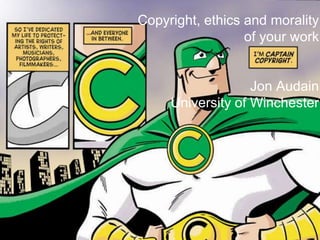
Copyright, ethics and morality
                  of your work


                   Jon Audain
     University of Winchester
Discussion
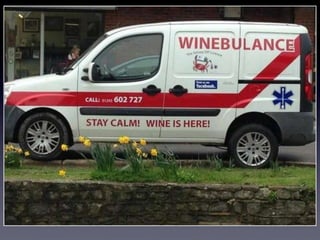
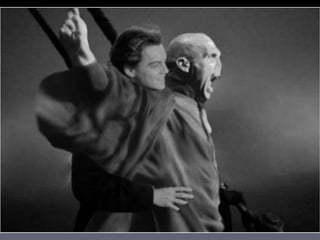
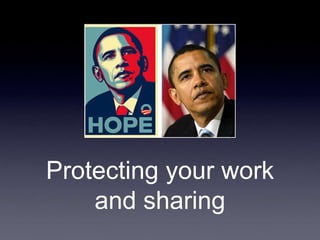
Are any of the following photographs allowed under
copyright? Can I place them on my own web page?
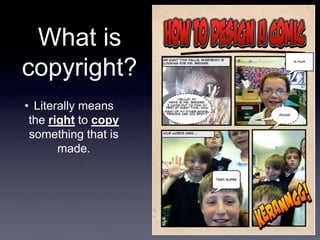
What is
copyright?
• Literally means
 the right to copy
 something that is
       made.
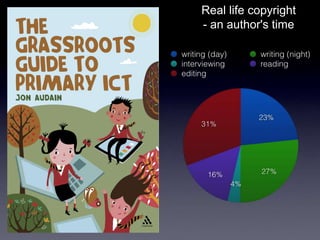
Real life copyright
- an author's time
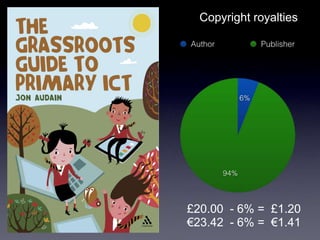
Copyright royalties


£20.00 - 6% = £1.20
€23.42 - 6% = €1.41
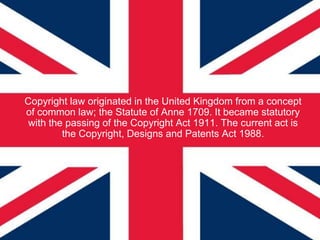
Copyright law originated in the United Kingdom from a concept
of common law; the Statute of Anne 1709. It became statutory
 with the passing of the Copyright Act 1911. The current act is
         the Copyright, Designs and Patents Act 1988.
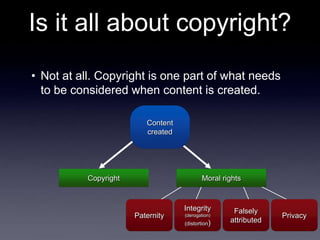
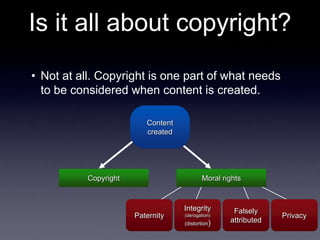
Is it all about copyright?
• Not at all. Copyright is one part of what needs
  to be considered when content is created.

                          Content
                          created


           Copyright                       Moral rights


                                    Integrity       Falsely
                       Paternity    (derogation)                Privacy
                                    (distortion)
                                                   attributed
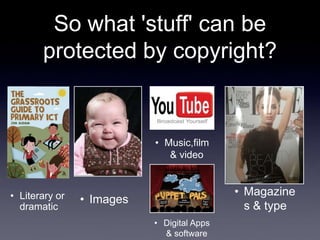
So what 'stuff' can be
       protected by copyright?


                           • Music,film
                              & video


• Literary or                               • Magazine
                • Images
  dramatic                                    s & type
                           • Digital Apps
                             & software
Copyright is an automatic
 right and arises whenever an
individual or company creates
   a work. To qualify, a work
     should be regarded as
 original, and exhibit a degree
 of labour, skill or judgement.
Interpretation is related to the independent creation
      rather than the idea behind the creation.


    For example, your idea for a book would not itself be
 protected, but the actual content of a book you write would
be. In other words, someone else is still entitled to write their
own book around the same idea, provided they do not directly
                copy or adapt yours to do so.
• The law gives the creators of literary, dramatic,
   musical, artistic works, sound recordings,
   broadcasts, films and typographical arrangement of
   published editions, rights to control the ways in
   which their material may be used.
• The rights cover; broadcast and public
   performance, copying, adapting, issuing, renting
   and lending copies to the public.
• In many cases, the creator will also have the right
   to be identified as the author and to object to
   distortions of his work.
• International conventions give protection in most
   countries, subject to national laws.
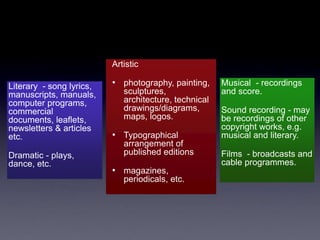
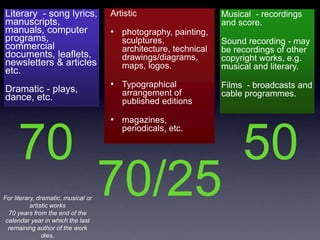
Artistic

Literary - song lyrics,   • photography, painting,     Musical - recordings
manuscripts, manuals,        sculptures,               and score.
computer programs,           architecture, technical
commercial                   drawings/diagrams,        Sound recording - may
documents, leaflets,         maps, logos.              be recordings of other
newsletters & articles                                 copyright works, e.g.
etc.                      • Typographical              musical and literary.
                             arrangement of
Dramatic - plays,            published editions        Films - broadcasts and
dance, etc.                                            cable programmes.
                          • magazines,
                             periodicals, etc.
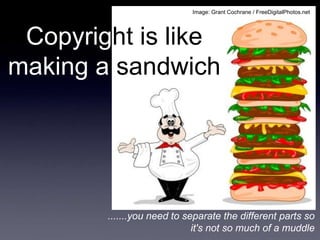
Image: Grant Cochrane / FreeDigitalPhotos.net


 Copyright is like
making a sandwich


        .......you need to separate the different parts so
                             it's not so much of a muddle
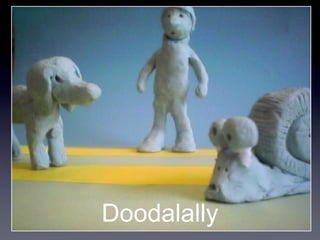
Doodalally
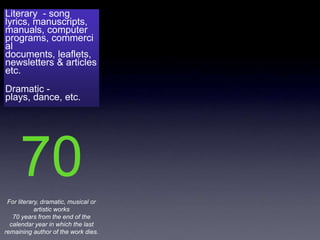
Literary - song
lyrics, manuscripts,
manuals, computer
programs, commerci
al
documents, leaflets,
newsletters & articles
etc.
Dramatic -
plays, dance, etc.


     70
 For literary, dramatic, musical or
            artistic works
   70 years from the end of the
  calendar year in which the last
remaining author of the work dies.
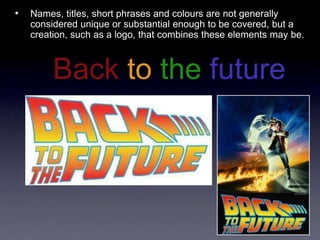
•   Names, titles, short phrases and colours are not generally
    considered unique or substantial enough to be covered, but a
    creation, such as a logo, that combines these elements may be.


         Back to the future
Literary - song lyrics,              Artistic                     Musical - recordings
manuscripts,                                                      and score.
manuals, computer                    • photography, painting,
programs,                               sculptures,               Sound recording - may
commercial                              architecture, technical   be recordings of other
documents, leaflets,                    drawings/diagrams,        copyright works, e.g.
newsletters & articles                  maps, logos.              musical and literary.
etc.
                                     • Typographical              Films - broadcasts and
Dramatic - plays,                       arrangement of            cable programmes.
dance, etc.                             published editions

                                     • magazines,


     70                                                                50
                                        periodicals, etc.


For literary, dramatic, musical or
           artistic works
  70 years from the end of the
                                     70/25
 calendar year in which the last
  remaining author of the work
                dies.
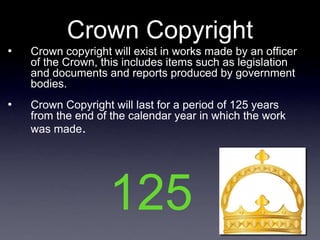
Crown Copyright
•   Crown copyright will exist in works made by an officer
    of the Crown, this includes items such as legislation
    and documents and reports produced by government
    bodies.
•   Crown Copyright will last for a period of 125 years
    from the end of the calendar year in which the work
    was made.


                   125
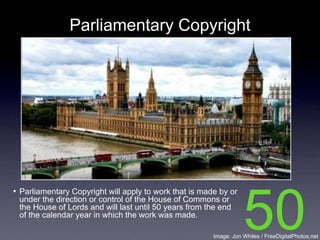
Parliamentary Copyright


• Parliamentary Copyright will apply to work that is made by or
 under the direction or control of the House of Commons or
 the House of Lords and will last until 50 years from the end
 of the calendar year in which the work was made.
                                                                   50
                                                        Image: Jon Whiles / FreeDigitalPhotos.net
What you can not do
•   It is an offence to perform any of the following acts without the
    consent of the owner:


•   Copy the work.
•   Rent, lend or issue copies of the work to the public.
•   Perform, broadcast or show the work in public.


•   Adapt the work.
•   The author of a work, or a director of a film may also have certain
    moral rights:
•   The right to be identified as the author.
•   Right to object to derogatory treatment.
Is it all about copyright?
• Not at all. Copyright is one part of what needs
  to be considered when content is created.

                          Content
                          created


           Copyright                       Moral rights


                                    Integrity       Falsely
                       Paternity    (derogation)                Privacy
                                    (distortion)
                                                   attributed
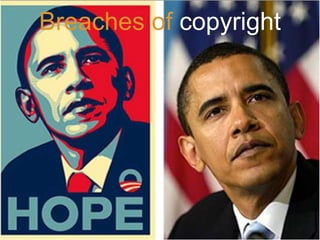
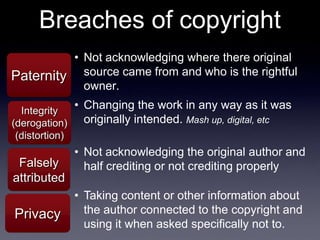
Breaches of copyright
          • Not acknowledging where there original
Paternity   source came from and who is the rightful
            owner.

  Integrity
             • Changing the work in any way as it was
(derogation)   originally intended. Mash up, digital, etc
(distortion)
               • Not acknowledging the original author and
 Falsely         half crediting or not crediting properly
attributed
               • Taking content or other information about
Privacy          the author connected to the copyright and
                 using it when asked specifically not to.
http://www.everythingisaremix.info/watch-the-series/
Just like any other asset, copyright may be transferred or sold by
               the copyright owner to another party.

 Rights cannot be claimed for any part of a work which is a copy
  taken from a previous work. For example, in a piece of music
   featuring samples from a previous work, the copyright of the
        samples would still remain with the original author.

Only the owner, or his exclusive licensee can bring proceedings in
                            the courts.
Plagiarism and
copyright infringement
    How does this affect copyright?
Copyright Infringement
• Copyright infringement is using someone else's work
  without getting that person's permission.

• The author of any original work, including books,
  essays, Webpages, songs, pictures, and videos,
  automatically gets the copyright to that work, even if she
  doesn't label it with the copyright symbol and her name.

• The work must be fixed in form tangible, which means it
  must be stored on something physical, such as paper,
  canvas, a CD, or a hard disk.


                                Taken from www.plagiarismchecker.com
Copyright Infringement
• The owner of a copyright gets to decide who can legally
  make copies of that work.

• It is illegal to copy large sections of someone else's
  copyrighted work without permission,even if you give the
  original author credit.

• Imagine someone making copies of the movie Finding
  Nemo without asking for permission. I'm sure you won't get
  away with it just by giving the authors credit on the DVD
  cover!


                                 Taken from www.plagiarismchecker.com
The rules
What you can do and what you can not do
Fair usage of copyright


• Fair usage is a term used to describe what and how much is
  reasonable to use of an author's work.
What counts as fair usage?
•   Private and research study      •   Acts for the purposes of royal
    purposes.                           commissions, statutory enquiries, judicial
                                        proceedings and parliamentary purposes.
•   Performance, copies or
    lending for educational         •   Recording of broadcasts for the purposes
    purposes.                           of listening to or viewing at a more
                                        convenient time, this is known as time
•   Criticism and news reporting.       shifting.

•   Incidental inclusion.           •   Producing a back up copy for personal
                                        use of a computer program.
•   Copies and lending by
    librarians.                     •   Playing sound recording for a non profit
                                        making organisation, club or society.

                                    •   (Profit making organisations and
                                        individuals should obtain a license from
                                        PRS for Music.)
Audio Network
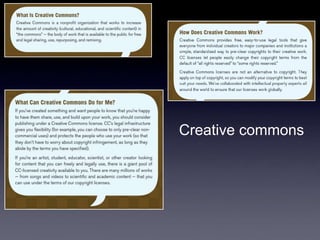
Protecting your work
    and sharing
Creative commons
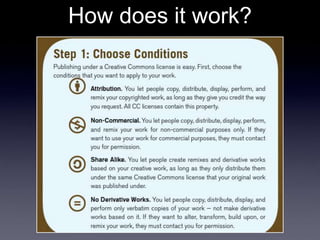
How does it work?
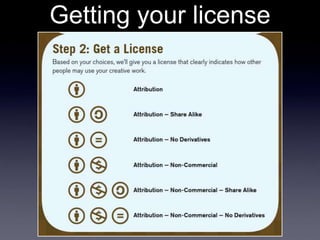
Getting your license
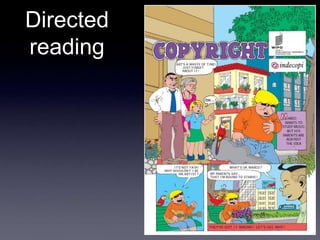
Directed
reading
Copyright, ethics and morality
                  of your work


                   Jon Audain
     University of Winchester

New Copyright and Ethics 2013

  • 1.
    Copyright, ethics andmorality of your work Jon Audain University of Winchester
  • 2.
    Discussion Are any ofthe following photographs allowed under copyright? Can I place them on my own web page?
  • 9.
    What is copyright? • Literallymeans the right to copy something that is made.
  • 10.
    Real life copyright -an author's time
  • 11.
    Copyright royalties £20.00 -6% = £1.20 €23.42 - 6% = €1.41
  • 12.
    Copyright law originatedin the United Kingdom from a concept of common law; the Statute of Anne 1709. It became statutory with the passing of the Copyright Act 1911. The current act is the Copyright, Designs and Patents Act 1988.
  • 13.
    Is it allabout copyright? • Not at all. Copyright is one part of what needs to be considered when content is created. Content created Copyright Moral rights Integrity Falsely Paternity (derogation) Privacy (distortion) attributed
  • 14.
    So what 'stuff'can be protected by copyright? • Music,film & video • Literary or • Magazine • Images dramatic s & type • Digital Apps & software
  • 15.
    Copyright is anautomatic right and arises whenever an individual or company creates a work. To qualify, a work should be regarded as original, and exhibit a degree of labour, skill or judgement.
  • 16.
    Interpretation is relatedto the independent creation rather than the idea behind the creation. For example, your idea for a book would not itself be protected, but the actual content of a book you write would be. In other words, someone else is still entitled to write their own book around the same idea, provided they do not directly copy or adapt yours to do so.
  • 17.
    • The lawgives the creators of literary, dramatic, musical, artistic works, sound recordings, broadcasts, films and typographical arrangement of published editions, rights to control the ways in which their material may be used. • The rights cover; broadcast and public performance, copying, adapting, issuing, renting and lending copies to the public. • In many cases, the creator will also have the right to be identified as the author and to object to distortions of his work. • International conventions give protection in most countries, subject to national laws.
  • 18.
    Artistic Literary - songlyrics, • photography, painting, Musical - recordings manuscripts, manuals, sculptures, and score. computer programs, architecture, technical commercial drawings/diagrams, Sound recording - may documents, leaflets, maps, logos. be recordings of other newsletters & articles copyright works, e.g. etc. • Typographical musical and literary. arrangement of Dramatic - plays, published editions Films - broadcasts and dance, etc. cable programmes. • magazines, periodicals, etc.
  • 19.
    Image: Grant Cochrane/ FreeDigitalPhotos.net Copyright is like making a sandwich .......you need to separate the different parts so it's not so much of a muddle
  • 20.
  • 22.
    Literary - song lyrics,manuscripts, manuals, computer programs, commerci al documents, leaflets, newsletters & articles etc. Dramatic - plays, dance, etc. 70 For literary, dramatic, musical or artistic works 70 years from the end of the calendar year in which the last remaining author of the work dies.
  • 23.
    Names, titles, short phrases and colours are not generally considered unique or substantial enough to be covered, but a creation, such as a logo, that combines these elements may be. Back to the future
  • 24.
    Literary - songlyrics, Artistic Musical - recordings manuscripts, and score. manuals, computer • photography, painting, programs, sculptures, Sound recording - may commercial architecture, technical be recordings of other documents, leaflets, drawings/diagrams, copyright works, e.g. newsletters & articles maps, logos. musical and literary. etc. • Typographical Films - broadcasts and Dramatic - plays, arrangement of cable programmes. dance, etc. published editions • magazines, 70 50 periodicals, etc. For literary, dramatic, musical or artistic works 70 years from the end of the 70/25 calendar year in which the last remaining author of the work dies.
  • 25.
    Crown Copyright • Crown copyright will exist in works made by an officer of the Crown, this includes items such as legislation and documents and reports produced by government bodies. • Crown Copyright will last for a period of 125 years from the end of the calendar year in which the work was made. 125
  • 26.
    Parliamentary Copyright • ParliamentaryCopyright will apply to work that is made by or under the direction or control of the House of Commons or the House of Lords and will last until 50 years from the end of the calendar year in which the work was made. 50 Image: Jon Whiles / FreeDigitalPhotos.net
  • 27.
    What you cannot do • It is an offence to perform any of the following acts without the consent of the owner: • Copy the work. • Rent, lend or issue copies of the work to the public. • Perform, broadcast or show the work in public. • Adapt the work. • The author of a work, or a director of a film may also have certain moral rights: • The right to be identified as the author. • Right to object to derogatory treatment.
  • 28.
    Is it allabout copyright? • Not at all. Copyright is one part of what needs to be considered when content is created. Content created Copyright Moral rights Integrity Falsely Paternity (derogation) Privacy (distortion) attributed
  • 29.
  • 30.
    Breaches of copyright • Not acknowledging where there original Paternity source came from and who is the rightful owner. Integrity • Changing the work in any way as it was (derogation) originally intended. Mash up, digital, etc (distortion) • Not acknowledging the original author and Falsely half crediting or not crediting properly attributed • Taking content or other information about Privacy the author connected to the copyright and using it when asked specifically not to.
  • 31.
  • 32.
    Just like anyother asset, copyright may be transferred or sold by the copyright owner to another party. Rights cannot be claimed for any part of a work which is a copy taken from a previous work. For example, in a piece of music featuring samples from a previous work, the copyright of the samples would still remain with the original author. Only the owner, or his exclusive licensee can bring proceedings in the courts.
  • 33.
    Plagiarism and copyright infringement How does this affect copyright?
  • 34.
    Copyright Infringement • Copyrightinfringement is using someone else's work without getting that person's permission. • The author of any original work, including books, essays, Webpages, songs, pictures, and videos, automatically gets the copyright to that work, even if she doesn't label it with the copyright symbol and her name. • The work must be fixed in form tangible, which means it must be stored on something physical, such as paper, canvas, a CD, or a hard disk. Taken from www.plagiarismchecker.com
  • 35.
    Copyright Infringement • Theowner of a copyright gets to decide who can legally make copies of that work. • It is illegal to copy large sections of someone else's copyrighted work without permission,even if you give the original author credit. • Imagine someone making copies of the movie Finding Nemo without asking for permission. I'm sure you won't get away with it just by giving the authors credit on the DVD cover! Taken from www.plagiarismchecker.com
  • 36.
    The rules What youcan do and what you can not do
  • 37.
    Fair usage ofcopyright • Fair usage is a term used to describe what and how much is reasonable to use of an author's work.
  • 38.
    What counts asfair usage? • Private and research study • Acts for the purposes of royal purposes. commissions, statutory enquiries, judicial proceedings and parliamentary purposes. • Performance, copies or lending for educational • Recording of broadcasts for the purposes purposes. of listening to or viewing at a more convenient time, this is known as time • Criticism and news reporting. shifting. • Incidental inclusion. • Producing a back up copy for personal use of a computer program. • Copies and lending by librarians. • Playing sound recording for a non profit making organisation, club or society. • (Profit making organisations and individuals should obtain a license from PRS for Music.)
  • 39.
  • 40.
  • 41.
  • 42.
  • 43.
  • 44.
  • 45.
    Copyright, ethics andmorality of your work Jon Audain University of Winchester