
The Trademarks Act, 1999
By Saurabh Gupta
Snehil Dixit
Manish Chaudhery
Pushpit Singhla
Introduction
 A trademark is a mark used in relation to goods for
the purpose of indicating a connection between the
goods and some person having the right as
proprietor to use the mark.
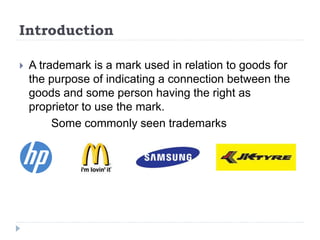
Some commonly seen trademarks
Trademark Act, 1999
 The Government enacted the Indian Merchandise
Marks Act, 1889 and with development and changes,
on 25th November 1958 The Trade And
Merchandise Marks Act came into force.
 Later in 1999, The Trade And Merchandise Marks
Act was repealed and Trademark Act came into
force.
Salient features of Trademark Act, 1999
 Providing for registration of trademarks for services.
 Providing for an appellate board for speedy
disposal of appeals.
 Transferring the final authority relating to
registration of certification trade mark to registrar.
 Providing enhanced punishments for the offenses
related to trademarks.
 Increasing the period of registration and renewal
from 7 years to 10 years.
Some landmark cases in Trademark Act
Amul vs Ichhamati Co-Operative Milk
Producers Union Limited
 Registrar General of Trademark, Kolkata,
allowed the registration of ‘Imul’ as the trademark
of the Ichhamati Co-Operative Milk Producers
Union Limited
 While ‘Amul’ as a trade name has been used
since 1955.
 Due to long and continuous use, ‘Amul’ has
become associated and identified by the public
with the Anand-based milk producers’ union.
 The Registrar ruled in favour of the Ichhamati
union, saying its sales turnover had increased
periodically and refusing registration would
cause unnecessary inconvenience and damage
to it.
 Aggrieved by the said order, the Amul filed the
appeal before the IPAB. Setting aside the
Registrar’s order, the IPAB noted that the sales
turnover of the West Bengal producers’ union
was irrelevant.
SBL Limited v. Himalaya Drug Company (1997)
 The plaintiff Himalaya Drug Co. is engaged in the
manufacture and sale of Ayurvedic medical
preparations since 1930. One of the preparation
manufactured and marketed by the plaintiff is under
the trade mark Liv-52. It is a liver tonic prescribed for
liver disorder and to protect the liver against various
dysfunction, damage and hepatotoxins.
 SBL also launched its product in the same category
under the name ‘LIV-T’.
 Plantiff claimed that LIV-T is deceptively similar with
the mark Liv. 52 and is likely to mislead or confuse
those who are likely to purchase such preparations
in the market.
It was held that
‘Nobody can claim exclusive right to use any generic
word, abbreviation, or acronym which has become
publici juris. In the trade of drugs it is common practice
to name a drug by the name of the organ or ailment,
which it treats or the main ingredient of the drug. Such
an organ ailment or ingredient being public jurisdiction
or generic cannot be owned by anyone for use as a
trademark.’
Hence, the plaintiff's claim is not valid.
Before coming to this case, we would like to
tell you about Trade Dress.
What is trade dress?
 Trade Dress can be defined as the total image of the
product.
 It encompasses the overall image created by the
product or package. It includes features such as
size, shape, package, colour or colour combinations
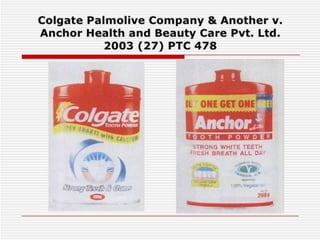
 In this case, the plaintiff sought interim injunction
against the use of ‘trade dress’ i.e. the can and
‘colour combination’ of one third red and two
third white on the packaging of Tooth Powder.
 The plantiff claimed that Anchor adopted a
similar trade-dress (particular combination of
"red and white“) to pass off the goods of plantiff
as its own.
 This was the third case that Colgate had filed
against Anchor.
The defendant resisted the allegations by saying that
1. The shape of the container cannot be monopolized by the
plaintiff unless and until it is registered under the Designs
Act.
2. The shape of packaging or any combination thereof do not
fall within the ambit of mark or trademark as envisaged in
the TM Act, 1999.
3. The use of red and white colour combination is neither
distinctive nor capable of identifying the goods with the
plaintiff nor business of the plaintiff nor capable of
secondary significance.
4. That the plaintiffs have abandoned the colour combination
of red and white and have used various other colour
combinations in respect of different ranges of products
and, therefore, the claim of the distinctiveness or
uniqueness of the colour combination is unfounded.
It was held that Colgate Pamolive Company’s claims were not
Trademark Act, 1999

Trademark Act, 1999

  • 1.
    The Trademarks Act,1999 By Saurabh Gupta Snehil Dixit Manish Chaudhery Pushpit Singhla
  • 2.
    Introduction  A trademarkis a mark used in relation to goods for the purpose of indicating a connection between the goods and some person having the right as proprietor to use the mark. Some commonly seen trademarks
  • 3.
    Trademark Act, 1999 The Government enacted the Indian Merchandise Marks Act, 1889 and with development and changes, on 25th November 1958 The Trade And Merchandise Marks Act came into force.  Later in 1999, The Trade And Merchandise Marks Act was repealed and Trademark Act came into force.
  • 4.
    Salient features ofTrademark Act, 1999  Providing for registration of trademarks for services.  Providing for an appellate board for speedy disposal of appeals.  Transferring the final authority relating to registration of certification trade mark to registrar.  Providing enhanced punishments for the offenses related to trademarks.  Increasing the period of registration and renewal from 7 years to 10 years.
  • 5.
    Some landmark casesin Trademark Act
  • 6.
    Amul vs IchhamatiCo-Operative Milk Producers Union Limited  Registrar General of Trademark, Kolkata, allowed the registration of ‘Imul’ as the trademark of the Ichhamati Co-Operative Milk Producers Union Limited  While ‘Amul’ as a trade name has been used since 1955.  Due to long and continuous use, ‘Amul’ has become associated and identified by the public with the Anand-based milk producers’ union.
  • 7.
     The Registrarruled in favour of the Ichhamati union, saying its sales turnover had increased periodically and refusing registration would cause unnecessary inconvenience and damage to it.  Aggrieved by the said order, the Amul filed the appeal before the IPAB. Setting aside the Registrar’s order, the IPAB noted that the sales turnover of the West Bengal producers’ union was irrelevant.
  • 8.
    SBL Limited v.Himalaya Drug Company (1997)  The plaintiff Himalaya Drug Co. is engaged in the manufacture and sale of Ayurvedic medical preparations since 1930. One of the preparation manufactured and marketed by the plaintiff is under the trade mark Liv-52. It is a liver tonic prescribed for liver disorder and to protect the liver against various dysfunction, damage and hepatotoxins.  SBL also launched its product in the same category under the name ‘LIV-T’.  Plantiff claimed that LIV-T is deceptively similar with the mark Liv. 52 and is likely to mislead or confuse those who are likely to purchase such preparations in the market.
  • 9.
    It was heldthat ‘Nobody can claim exclusive right to use any generic word, abbreviation, or acronym which has become publici juris. In the trade of drugs it is common practice to name a drug by the name of the organ or ailment, which it treats or the main ingredient of the drug. Such an organ ailment or ingredient being public jurisdiction or generic cannot be owned by anyone for use as a trademark.’ Hence, the plaintiff's claim is not valid.
  • 10.
    Before coming tothis case, we would like to tell you about Trade Dress. What is trade dress?
  • 11.
     Trade Dresscan be defined as the total image of the product.  It encompasses the overall image created by the product or package. It includes features such as size, shape, package, colour or colour combinations
  • 13.
     In thiscase, the plaintiff sought interim injunction against the use of ‘trade dress’ i.e. the can and ‘colour combination’ of one third red and two third white on the packaging of Tooth Powder.  The plantiff claimed that Anchor adopted a similar trade-dress (particular combination of "red and white“) to pass off the goods of plantiff as its own.  This was the third case that Colgate had filed against Anchor.
  • 14.
    The defendant resistedthe allegations by saying that 1. The shape of the container cannot be monopolized by the plaintiff unless and until it is registered under the Designs Act. 2. The shape of packaging or any combination thereof do not fall within the ambit of mark or trademark as envisaged in the TM Act, 1999. 3. The use of red and white colour combination is neither distinctive nor capable of identifying the goods with the plaintiff nor business of the plaintiff nor capable of secondary significance. 4. That the plaintiffs have abandoned the colour combination of red and white and have used various other colour combinations in respect of different ranges of products and, therefore, the claim of the distinctiveness or uniqueness of the colour combination is unfounded. It was held that Colgate Pamolive Company’s claims were not