
1
Intellectual Property Rights:
Incentives for Creation
By:-
Dr. Seweta Srivastava
Assistant Professor
Lovely Professional University, Jalandhar
Objective & Plan of Presentation
Objective
 To give a general introduction to the concept of
Intellectual Property Rights and Their Role in
Technology Transfer
Plan of Presentation
 Rationale of Protection
 Different kinds of IPRs
 IPRs & Licensing/Technology Agreements
 IPR related to Agriculture
2
Kinds of Property
 Movable Property
 Car, Pen, Furniture, Dress
 Immovable Property
 Land, Building
 Intellectual Property
 Literary works, Inventions
 Novel creations of human intellect
3
4
INTELLECTUAL PROPERTY RIGHTS (IPR)
 Intellectual Property (IP) is defined as any “ideas, inventions
and original creative work manifested in a
tangible form that can be legally protected”.
 IPRs provide certain exclusive rights to the creators of IP, in order to
enable them to reap commercial benefits from their creative efforts or
reputation. The purpose of IPR legislation is to protect against
unauthorized imitation, copying or deceptive usage of identifying
marks.
 Rights associated with intellectual property which gives legal
protection is referred to as IPR.
 When we speak of IP rights, we refer to controlling the way IP is
used, accessed or distributed.
Nature of Intellectual Property
 Creation of human mind (Intellect)
 Intangible property
 Exclusive rights given by statutes
 Attended with limitations and exceptions
 Time-bound
 Territorial
5
“A right that is had by a person or by a
company to have exclusive rights to use its own
plans, ideas, or other intangible assets without
the worry of competition, at least for a specific
period of time. These rights may be enforced by
a court via a lawsuit. The reasoning for
intellectual property is to encourage innovation
without the fear that a competitor will steal the
idea and / or take the credit for it”.
6
Definition of
Intellectual Property
Intellectual Property Includes
“Intellectual Property” shall include the rights relating to
 literary, artistic and scientific works,
 performances of performing artists, phonograms, and
broadcasts,
 inventions in all fields of human endeavour
 scientific discoveries
 Industrial designs
 trademarks, service marks and commercial names and
designations
 protection against unfair competition
and all other rights resulting from
intellectual activity in the industrial,
scientific, literary or artistic fields.
7
1856 to 1972
 Patent laws in India were first made in 1856.
 Had 3 universities in Bombay, Calcutta and Madras
in 1857.
 Industries were traditional; unaware of patents etc.
 Patent laws modified in 1911 and then in 1970.
 Took us 23 years from 1947 to 1970 to notify
revised Patent Act and 25 years to implement it in
1972
HISTORY RELATED TO INTELLECTUAL
PROPERTY RIGHTS (IPR)
1972 to 1995
 Laws only for patents, copyrights, trademarks,
design and trade secret (through Contract Act
1872 and principles of common law)
 Process patents in areas of drugs and chemicals
helped India industries to grow
 Patent term: 14 years from grant; for drugs,
chemicals, food items 5 years from grant
 Filings very low
1995 to 2005
 Existing laws revised.
 New laws were promulgated: Geographical
indications, IC lay-out design, New plant
variety
 Laws are TRIPS compatible
 India became member of Paris Convention,
PCT, Budapest Treaty
 All this happened in 10 years!!
2005 to 2014
 Membership of Madrid Protocol
 Amendments to Copyright Act 2012
 Changes in rules in some Acts
12
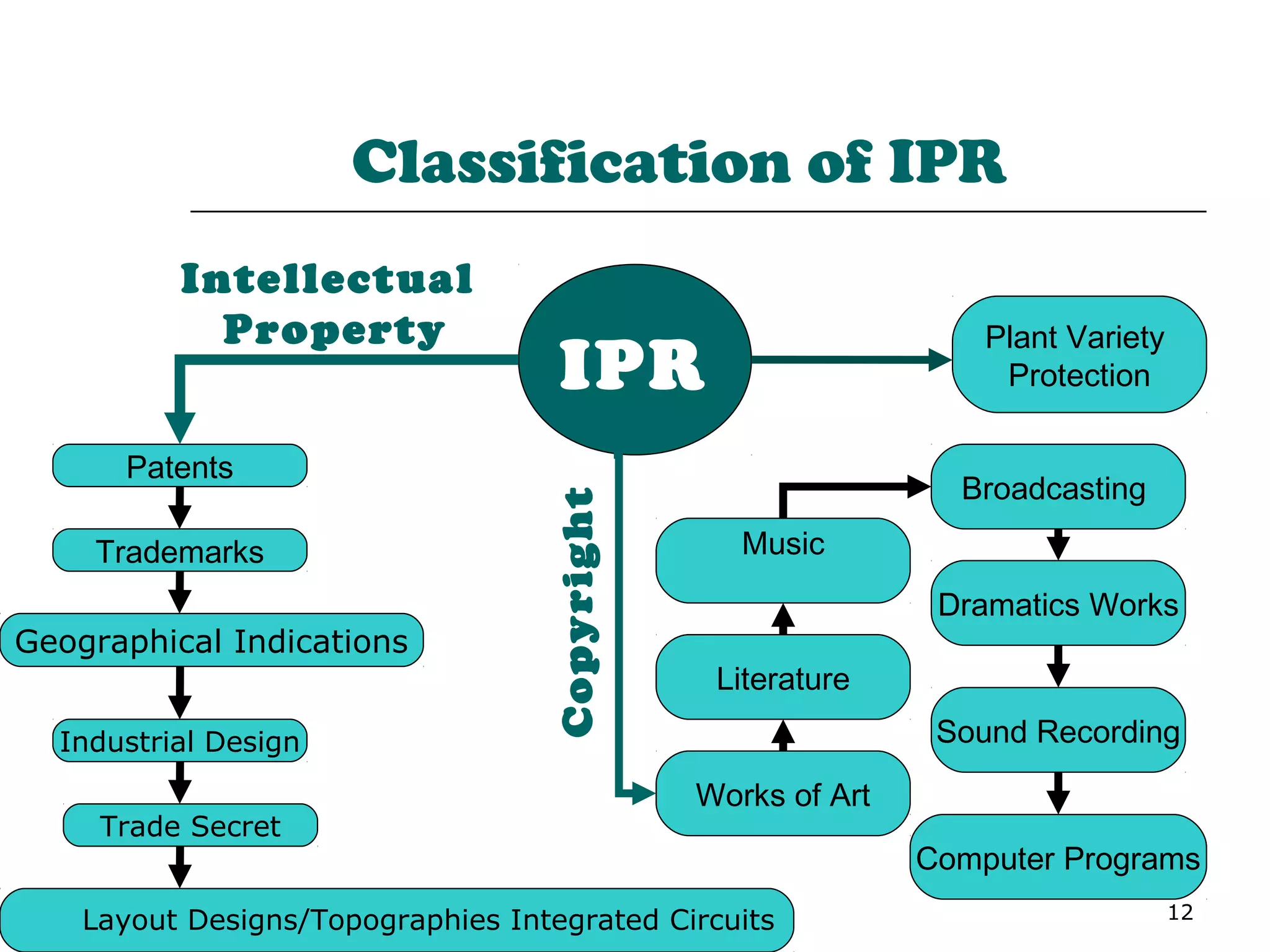
IPR
Patents
Geographical Indications
Trademarks
Works of Art
Literature
Music
Broadcasting
Dramatics Works
Sound Recording
Computer Programs
Industrial Design
Classification of IPR
Intellectual
Property
Copyright
Trade Secret
Layout Designs/Topographies Integrated Circuits
Plant Variety
Protection
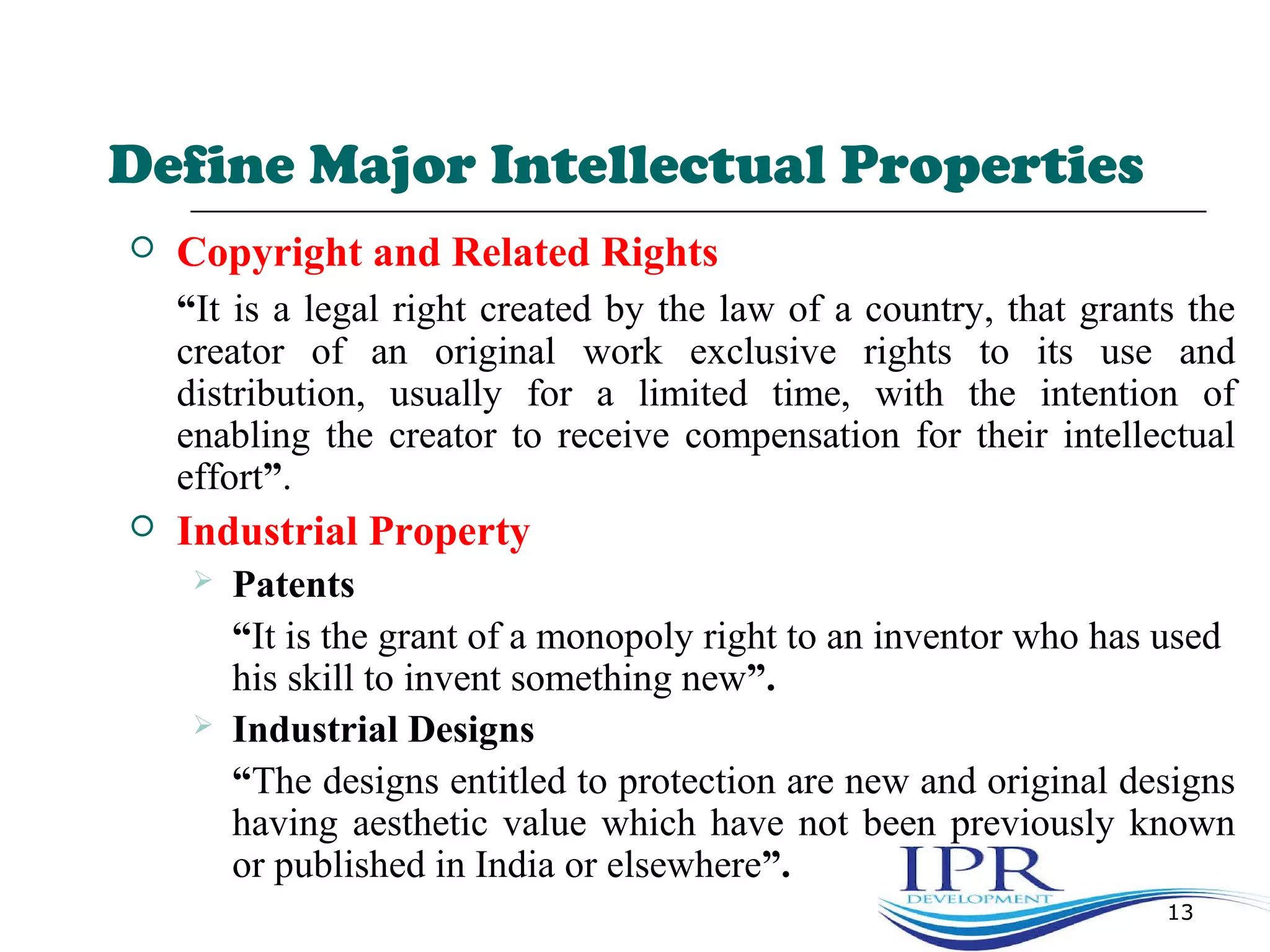
Define Major Intellectual Properties
 Copyright and Related Rights
“It is a legal right created by the law of a country, that grants the
creator of an original work exclusive rights to its use and
distribution, usually for a limited time, with the intention of
enabling the creator to receive compensation for their intellectual
effort”.
 Industrial Property
 Patents
“It is the grant of a monopoly right to an inventor who has used
his skill to invent something new”.
 Industrial Designs
“The designs entitled to protection are new and original designs
having aesthetic value which have not been previously known
or published in India or elsewhere”.
13
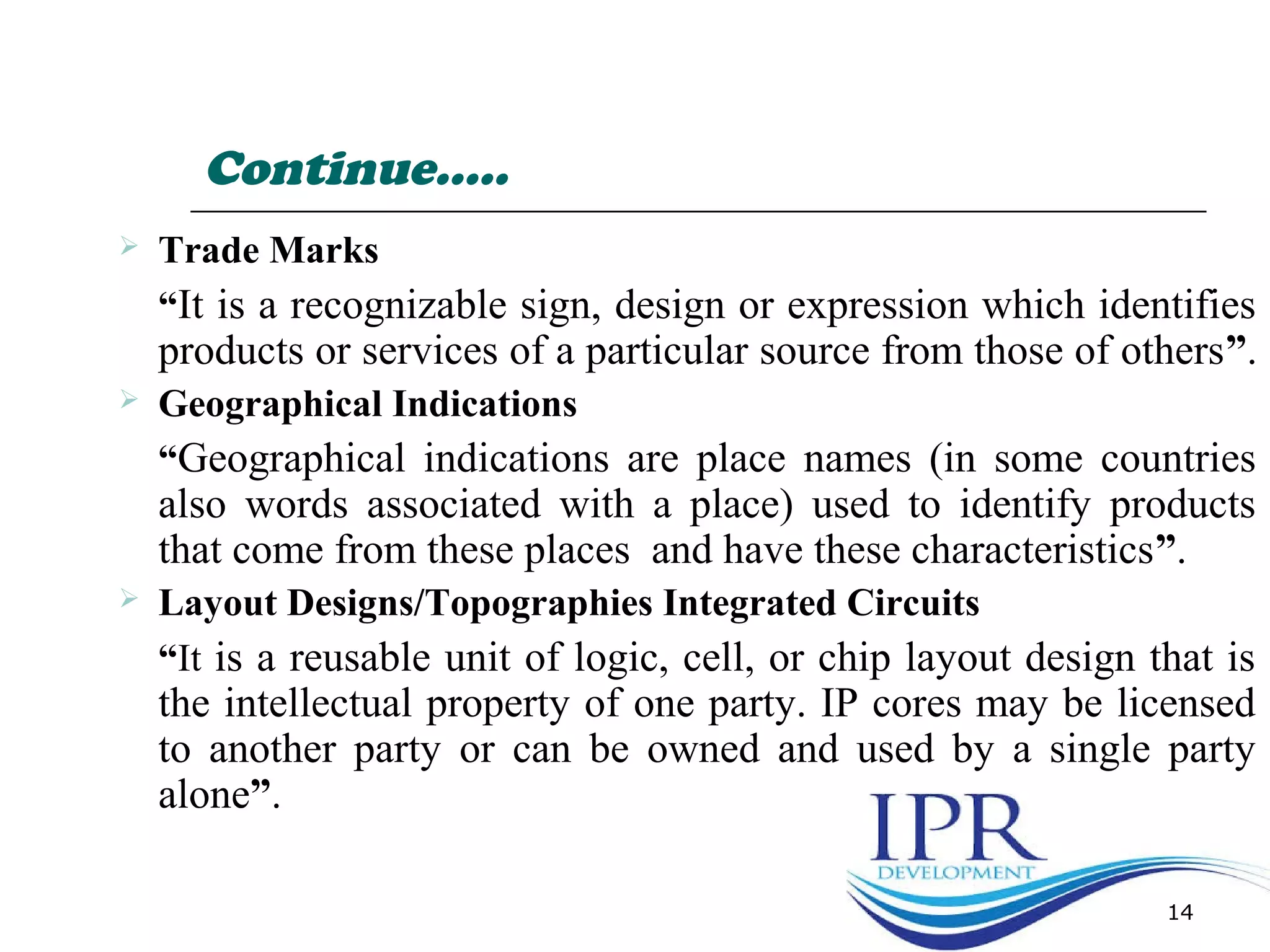
Continue…..
 Trade Marks
“It is a recognizable sign, design or expression which identifies
products or services of a particular source from those of others”.
 Geographical Indications
“Geographical indications are place names (in some countries
also words associated with a place) used to identify products
that come from these places and have these characteristics”.
 Layout Designs/Topographies Integrated Circuits
“It is a reusable unit of logic, cell, or chip layout design that is
the intellectual property of one party. IP cores may be licensed
to another party or can be owned and used by a single party
alone”.
14
 Trade Secrets
“It may a formula, practice, process, design, instrument,
pattern, commercial method, or compilation of information
which is not generally known or reasonably ascertainable
by others, and by which a business can obtain an economic
advantage over competitors or customers”.
 Protection of New Plant Varieties
“Plant breeders' rights (PBR), are rights granted to the
breeder of a new variety of plant that give the breeder
exclusive control over the propagating material and
harvested material of a new variety for a number of
years”.
15
Continue…..
16
IP- Duration of Term of Protection
 Patents (20 years)
 Trademarks (10 years + renewals)
 Copyrights in published literary, dramatic, musical, and artistic
works (Lifetime of author +60 years).
 Copyright in photographs ,cinematographic film, sound
recordings –(60 years from year in which it was published)
 Broadcast reproduction right-(25 years from the beginning
of the calendar year next following the year in which the
broadcast is made.)
 Performers right-(25 years from the beginning of the
calendar year next following the year in which the
performance is made)
 Industrial designs (10 years+ renewal permitted once for 5 years)
 Trade-secrets and know how collectively “proprietary
technology” (contract period-protected by contract provisions,
doctrine of breach of trust)
17
Different Acts governing IP assets
Trade Marks
The Patents Act, 1970
Patents
The Copyright Act, 1957Copyright
Designs
The Protection of plant varieties and
Farmers’ Right Act, 2001
Geographical Indications
Plant Varieties
Semi conductor IC layout design
Act,2000
The Designs Act, 2000
The Geographical Indications
Of Goods Act, 1999
The Trade Marks Act, 1999
Semi conductor IC layout
18
 Paris Convention (1883):- Protection of Industrial property
 Berne Convention (1886):-Literary & Artistic Works
 Madrid Agreement(1891):- Repression of false or deceptive
indications of source on goods
 Rome Convention (1961):- Protection of performers, producers of
phonograms and broadcast organizations
 Phonograms Convention (1971):- Protection of phonograms
against unauthorized duplication
 Brussels Convention (1974):-Distribution of Programme-carrying
signals distributed by satellite
 Budapest Treaty (1977):- Deposit of microorganisms for the
purposes of patent procedure
IP Conventions
19
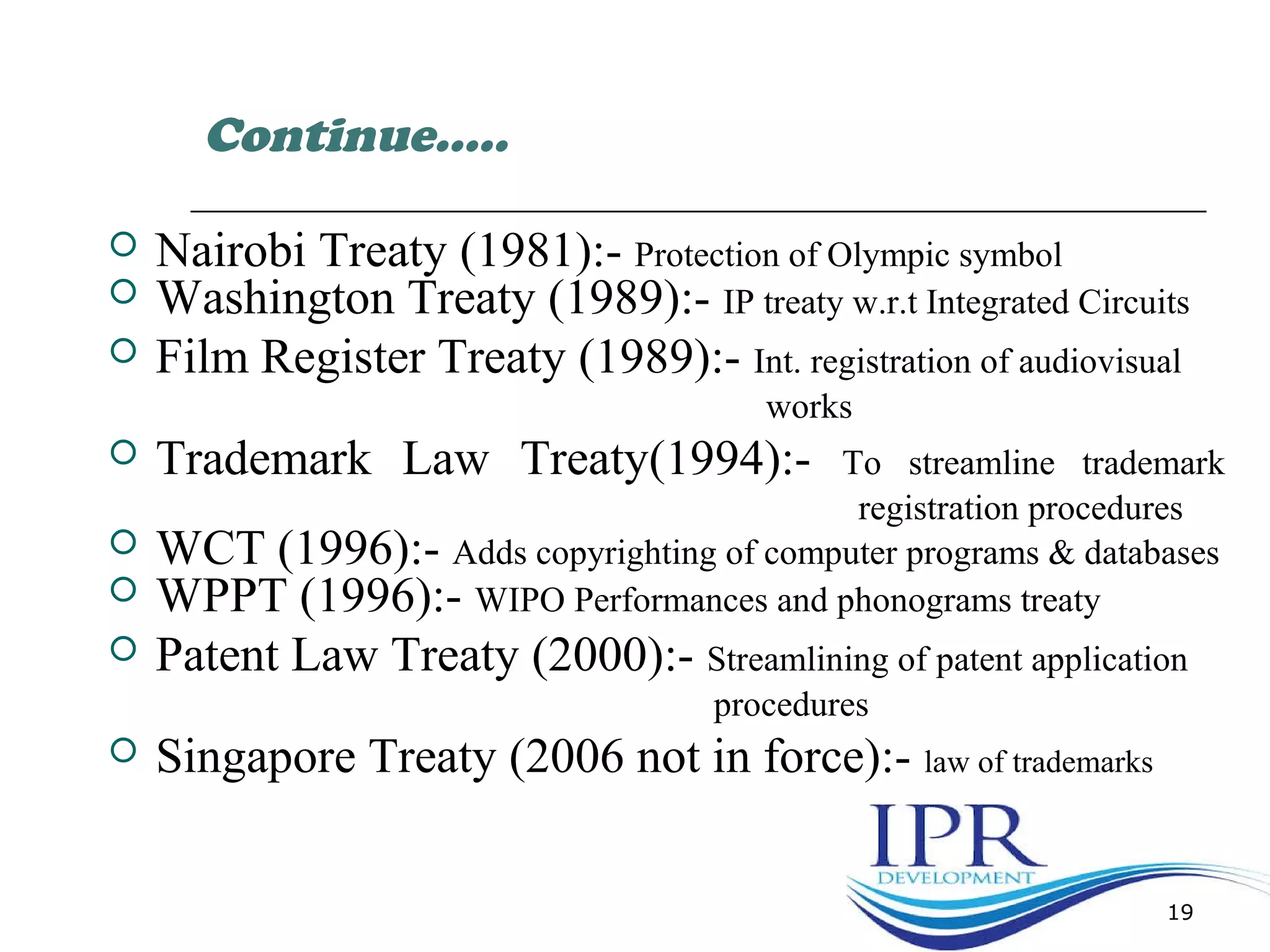
Continue…..
 Nairobi Treaty (1981):- Protection of Olympic symbol
 Washington Treaty (1989):- IP treaty w.r.t Integrated Circuits
 Film Register Treaty (1989):- Int. registration of audiovisual
works
 Trademark Law Treaty(1994):- To streamline trademark
registration procedures
 WCT (1996):- Adds copyrighting of computer programs & databases
 WPPT (1996):- WIPO Performances and phonograms treaty
 Patent Law Treaty (2000):- Streamlining of patent application
procedures
 Singapore Treaty (2006 not in force):- law of trademarks
20
Its creation is both time and cost intensive
Requires an assembled trained workforce for
its creation
Requires building of goodwill through
advertising programs
Generates customer loyalty
Adds to commercial value of organization
Its exploitation brings consistent additional
profits to an organization
Why are IP assets important ?
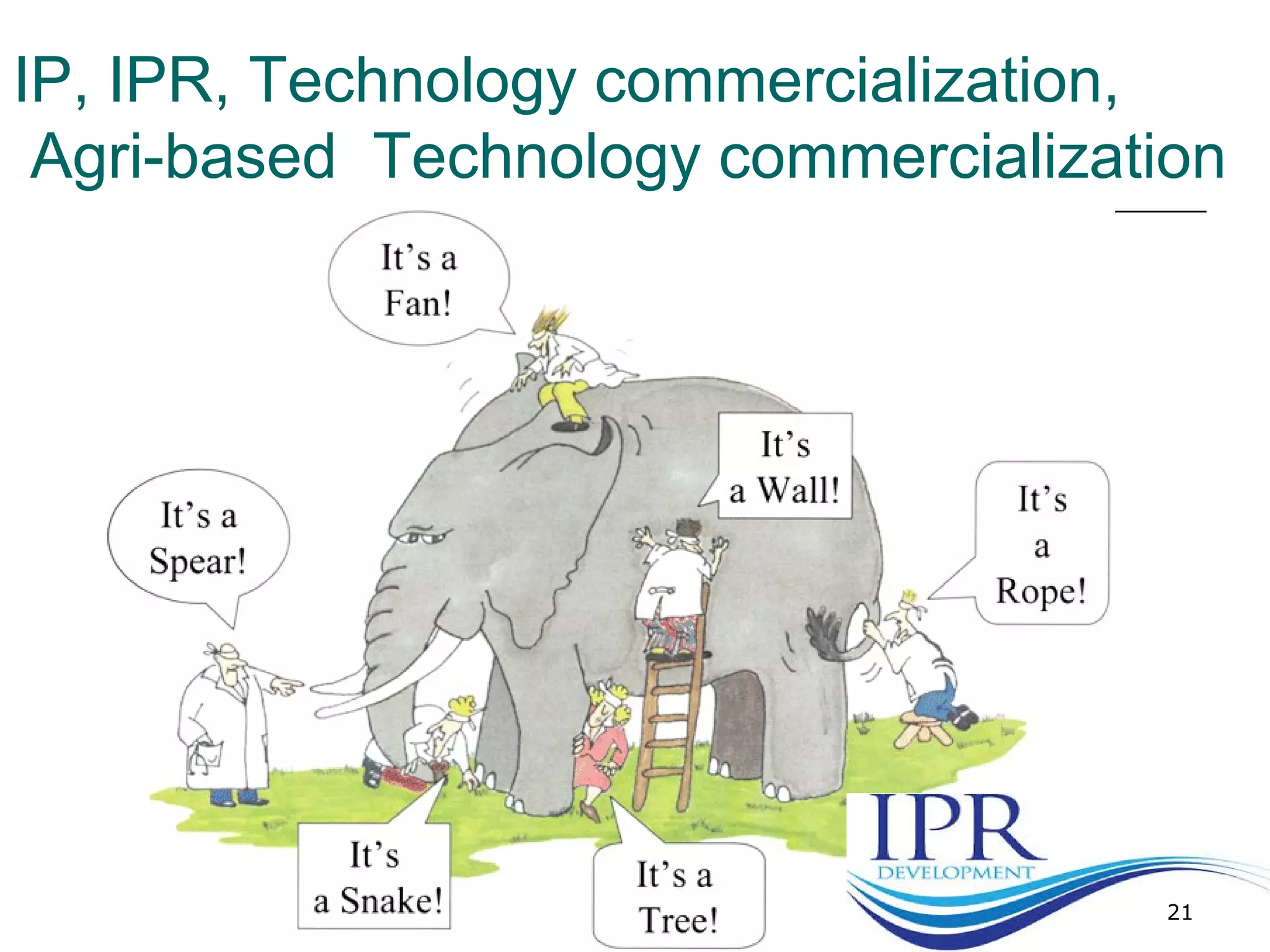
IP, IPR, Technology commercialization,
Agri-based Technology commercialization
21
22
IP adds value at every stage of the
innovation and commercialization process
Literary / Artistic
Creation
Invention
Financing Product Design
Commercialization
Marketing
Licensing
Exporting
Patents /
Utility Models
Copyright
Industrial Designs
Trademarks
Trademarks,
Ind. Designs,
Geo. Indications All IP
Rights
All IP rights
23
Patent
24
A patent is a protection given to a patentee for an
invention for a limited term by the government for
disclosing the invention
Right to exclude others from using your invention
without permission of patentee.
Owner has a legal right to use the invention.
What is a Patent ?
25
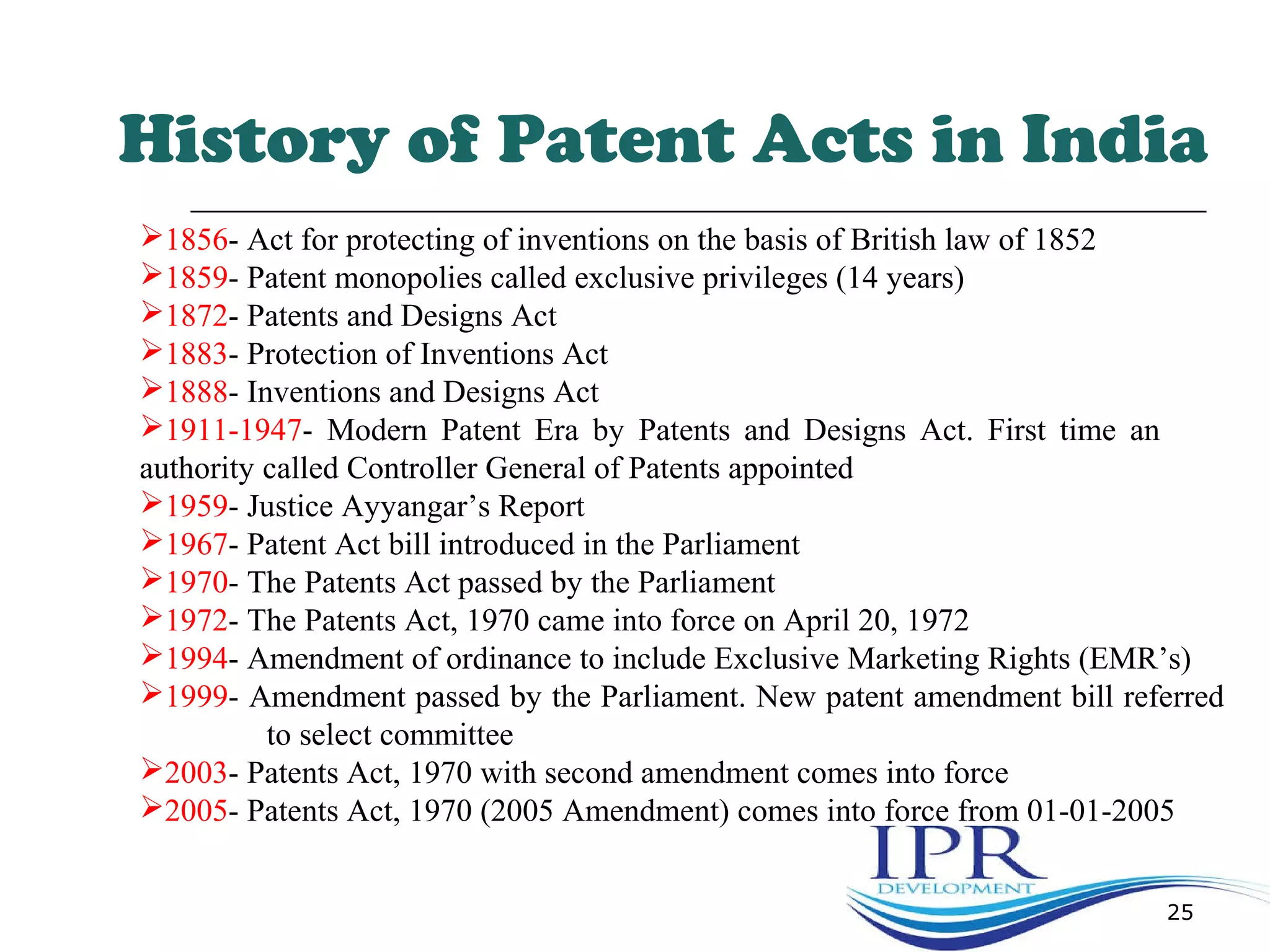
History of Patent Acts in India
1856- Act for protecting of inventions on the basis of British law of 1852
1859- Patent monopolies called exclusive privileges (14 years)
1872- Patents and Designs Act
1883- Protection of Inventions Act
1888- Inventions and Designs Act
1911-1947- Modern Patent Era by Patents and Designs Act. First time an
authority called Controller General of Patents appointed
1959- Justice Ayyangar’s Report
1967- Patent Act bill introduced in the Parliament
1970- The Patents Act passed by the Parliament
1972- The Patents Act, 1970 came into force on April 20, 1972
1994- Amendment of ordinance to include Exclusive Marketing Rights (EMR’s)
1999- Amendment passed by the Parliament. New patent amendment bill referred
to select committee
2003- Patents Act, 1970 with second amendment comes into force
2005- Patents Act, 1970 (2005 Amendment) comes into force from 01-01-2005
26
The Patents Act, 1970
In India, the patent law is governed by The Patents
Act, 1970 which has been amended six times:
The Patents (Amendment) Act, 1999 came into force retrospectively from
1st
January 1995,
The Patent (Amendment) Act, 2002, came into force with effect from20th
May 2003 and
The Patent (Amendment) Act, 2005, effective from 1st
January 2005.
The Patent (Amendment) Act, 2006, focused on the introduction of
reduced time lines and a fee structure based on specification size and number
of claims, in addition to a basic fee.
The Patent (Amendment) Act, 2012, focused on change in marks of Patent
Agent Examination.
The Patent (Amendment) Act, 2014, adding a clause "small entity" and
revised fees structure.
27
Meaning of ‘Invention’ under
Patent Law
The word “Invention” has been defined
under the Patents Act 1970 as amended
from time to time as “An invention
means a new product or process
involving an inventive step and
capable of industrial
application”.
28
Three Statutory Pillars of
PATENTABILITY
1. Novelty (new)
Invention not known to public prior to claim by inventor.
2. Inventive Step (non-obvious) (Sec 2(1)(ja))
Invention would not be obvious to a person with ordinary skill in
the art.
3. Industrial Applicability (utility) (Sec2(1)(ac))
Invention can be made or used in any useful, practical activity as
distinct from purely intellectual or aesthetic one.
29
Novelty
An invention will be considered novel if it does not
form a part of the global state of the art. Novelty is
assessed in a global context. An invention will cease to
be novel if it has been disclosed in the public through
any type of publications anywhere in the world before
filing a patent application in respect of the invention.
Therefore, it is advisable to file a patent application
before publishing a paper if there is a slight chance that
the invention may be patentable. Prior use of the
invention in the country of interest before the filing date
can also destroy the novelty.
30
Non-Obvious
THE DIFFERENCES BETWEEN THE
CLAIMED INVENTION and the PRIOR ART
are such that the subject matter as a whole
WOULD NOT HAVE BEEN OBVIOUS at the
time the invention was made to a PERSON
SKILLED IN THE ART, to which the subject
matter pertains.
31
Inventive Step
Section 2(1)(ja):
“Inventive Step" means a feature of an invention that
involves technical advance as compared to the existing
knowledge or having economic significance or both and
that makes the invention not obvious to a person skilled
in the art. The complexity or the simplicity of an
inventive step does not have any bearing on the grant of a
patent. In other words a very simple invention can qualify
for a patent.
32
Utility / Industrial Application
• Usefulness
• Workable
• At least one recognized, verifiable and
practical end-use
33
There are two types of patent documents usually
known as Patent Specification, namely
It should contain the
description of invention
with drawing, if
required. It is not
necessary to include
Claim. Provisional
Specification is filed to
establish priority of the
invention in case the
disclosed invention is
only at a conceptual
stage and specific
description of the
invention.
Complete Specification
should fully describe
the invention with
reference to drawing,
if required, disclosing
the best method
known to the applicant
and end with
Claim/Claims defining
the scope of protection
sought.
34
Patentable Inventions
Under the Patents Act, 1970 following patentable inventions
as below:
A.Art, process, method or manner of manufacture.
B.Machine, apparatus or other article, Substances produced
by manufacture, which include any new and useful
improvements of any of them and an alleged invention.
C.However, inventions claiming substance intended for use,
or capable of being used, as food or as medicine or drug or
relating to substances prepared or produced by chemical
processes (including alloys, optical glass, semiconductors and
inter-metallic compounds) are not patentable.
35
What is not Patentable
(a)Frivolous inventions
(b)Inventions contrary to well established natural
laws
(c)Commercial exploitation or primary use of
inventions,
(d)Formulation of an Abstract Theory or
(e)Discovery of any living thing or
(f)Discovery of non–living substance occurring in
nature
According to Sec 3 of the Patent
Act, 1970
36
What is not Patentable
(g) The mere discovery of a scientific principal or
formulation of an abstract theory, e.g. Raman effect
and Theory of Relativity cannot be patented.
(h) Substance obtained by mere admixture resulting
only in the aggregation of the properties of the
components thereof or a process for producing such
substance.
(i) Inventions which are Traditional Knowledge or
an aggregation or duplication of known properties
of traditionally known component or components.
(j) A literary, dramatic, musical or artistic work or
any other aesthetic creation including
cinematographic work and television productions.
Continue…..
37
What is not Patentable
(k) Any process for medicinal,
surgical, curative, prophylactic,
diagnostic, therapeutic or other
treatment of human beings or a
similar treatment of animals to
render them free of disease or to
increase their economic value or
that of their products.
(l) Mere arrangement or re-
arrangement or duplication of
known devices, each functioning
independently of one another in a
known way
Continue…..
38
What is not Patentable
(m) A method of agriculture or horticulture. For
example, the method of terrace farming
cannot be patented.
(n) Plants & animals in whole or any part
thereof other than micro- organisms, but
including seeds, varieties and species and
essentially biological process for
production or propagation of plants &
animals.
(o) Computer programs per se have not been
defined in the Act but would generally tend
to mean that a computer program without
any utility would not be patentable.
Similarly, topography of integrated circuits
is protected through yet another different
Act.
Continue…..
39
Importance of Patenting
A patent gives the right to exclude others from making the same product.
The patent holder has time to market the invention exclusively without
competition on higher prices.
It gives the right for legal action against the person making or selling the
product without permission from the patent holder.
If the invention has market potential and one thinks that another
company could make profits from that invention, it needs protection as a
patent then a patent gives the right to exclude others from making the same
product.
The patent holder has time to market the invention exclusively without
competition on higher prices.
It gives the right for legal action against the person making or selling the
product without permission from the patent holder.
40
Term of a Patent in the Indian
System
 Five years from the date of sealing of the patent
or seven years from the date of the patent (i.e., the
date of filing the complete specification),
whichever period is shorter, for an invention
claiming the method or process of manufacture of a
substance, where the substance is intended or
capable of being used as a drug, medicine or food.
 Twenty years from the date of patent in respect
of any other patentable invention.
41
1. To keep the patent in force, Renewal fee is to be paid every year.
2. The first renewal fee is payable for the third year and must be
paid before the expiration of the second year from the date of
patent.
3. If the patent has not been granted within two years the renewal
fees may be accumulated and paid immediately after the patent is
granted, or within three months of its record in Register of
Patents or within extended period of 9 months, by paying
extension fees of six month on Form 4, from the date of record.
4. If the renewal fee is not paid within the prescribed time, the
patent will cease to have effect. However, provision to restore the
patent is possible provided application is made within eighteen
months from the date of cessation.
Renewal and
Restoration
42
Essential Documents required
for
filing a Patent Application
1. Application form in duplicate (Form 1).
2. Provisional or complete specification in
duplicate. If the provisional specification is filed,
it must be followed by the complete specification
within 12 months. (Form 2).
3. Drawing in duplicate (if necessary).
4. Abstract of the invention in duplicate.
5. Information & undertaking listing the number,
filing date & current status of each foreign patent
application in duplicate (Form 3)..
43
6. Priority document (if priority date is claimed) in
convention application, when directed by the Controller.
7. Declaration of inventorship where provisional
specification is followed by complete specification or in
case of convention/PCT national phase application
(Form 5).
8. Power of attorney (if filed through Patent Agent).
9. Fee (to be paid in cash/by cheque/by demand draft)
(Schedule I).
(The cheque or demand draft should be payable to the "Controller of
Patents" drawn on any schedule bank at a place where the
appropriate office is situated).
Continue…..
44
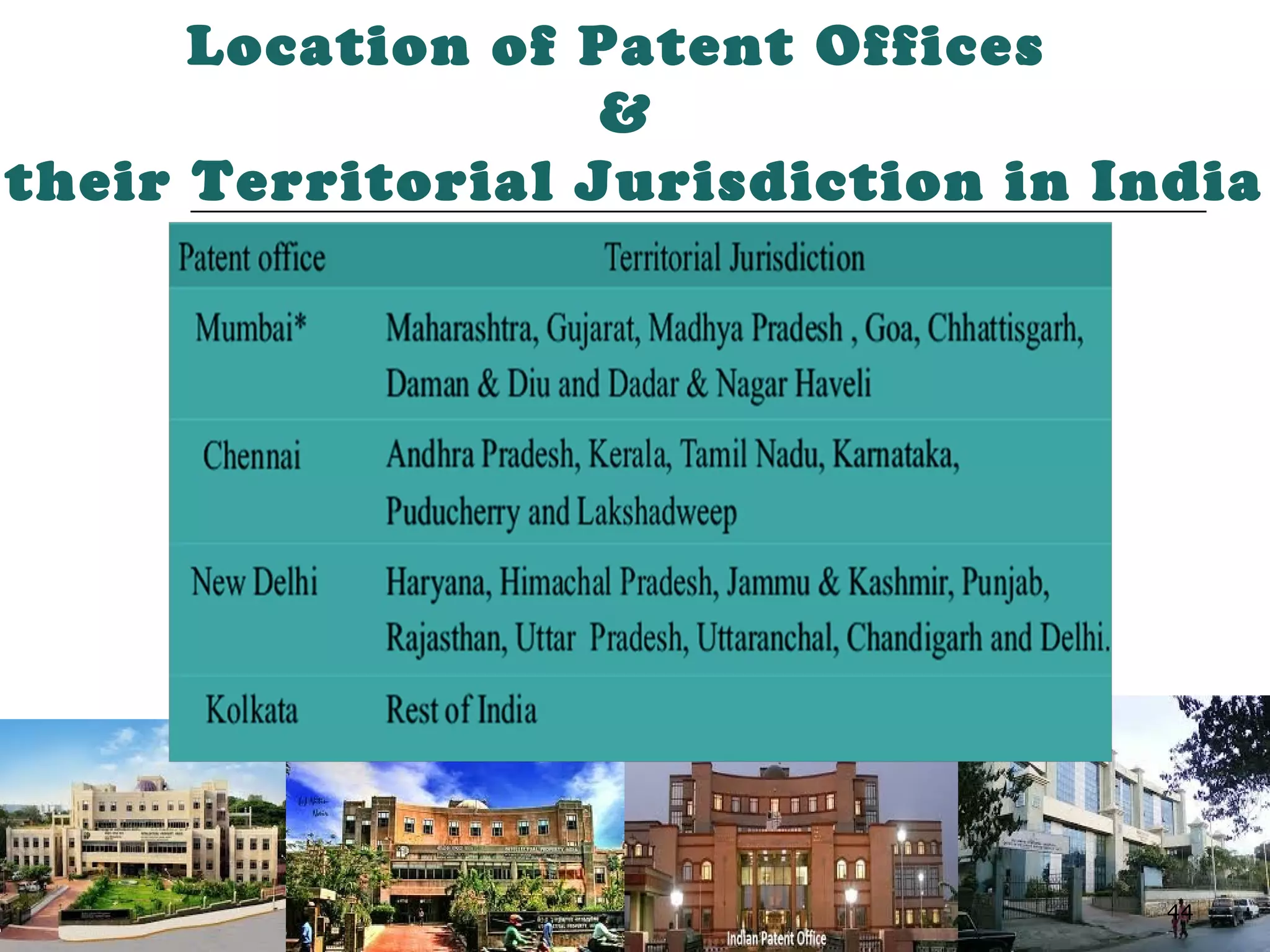
Location of Patent Offices
&
their Territorial Jurisdiction in India
45
Patent Application to be file
Abroad
A. If any application is to be filed abroad, without filing
in India, it should be made only after taking a written
permission from the Controller.
B. The request for permission for making patent
application outside India shall be made in Form-25
along with a fee of Rs 1000/- or Rs 4000/- for natural
person and other than natural person respectively.
C. A gist of invention should also be filed along with the
Form-25.
46
Patent Cooperation Treaty
(PCT)
As patent are territorial, patent laws differ from country
to country and there is no ‘World Patent’ or
‘International Patent’. But there is an international filing
system, where only one application is filed in one of the
member-states of the Patent Cooperation Treaty. The
application gets protection in all member states. This
buys the inventor time to decide which countries he
wants to file a patent application in. These applications
are referred to International Searching Authorities
(ISA) which usually the patent offices, appointed to carry
out the patent search on a global basis.
47
Enhancing Patent Awareness
in Uttar Pradesh
To increase the patent awareness in
Uttar Pradesh there is a need to make
people aware about the Intellectual
Property Rights and its role in
promotion of the economic
development of the country as well as
the respective states.
48
Trademark
49
Indian Trademark Act
a) The first statutory law related to trademark in India was the
Trade Marks Act, 1940 which introduced a machinery for the
registration & statutory protection of trademarks in India.
b) This Act of 1940 was replaced by the Trade and Merchandise
Marks Act, 1958 which consolidated the provisions related to
trademarks contained in other statutes like – the Indian Penal
Code, Criminal Procedure Code and the Sea Customs Act.
c) The Trade and Merchandise Marks Act, 1958 was again
repealed by the Trade Marks Act, 1999 and is the current
governing law related to registered trademarks. This Act came
into force w.e.f. September 15, 2003 vide notification in the
official gazette.
 A name of an enterprise or a Mark capable of being
represented graphically, distinguishing the goods or
services of one person from those of others e. g., LUX,
Godrej, TVS ,Telco, 555, APPLE
 Trade Mark can be -
o sign , words, letters, numbers,
o drawings, pictures, emblem,
o colours or combination of colours,
o shape of goods,
o graphic representation or packaging or
o any combination of the above
as applied to an article or a product.
50
Trademarks
51
 Must be graphically represented
 Must be distinctive / distinguishable
 Must not be descriptive
 Must not be deceptively similar to known /well-
known marks /Generics
• ORS: ORS-L, ORZ
• Cefixime – ZIFI, CEFI, Cefixin
Avoid –
Geographical Indications / Deities
National Leaders / Heroes / Symbols /
Laudatory words
Characteristics of Trademarks
52
Kinds of Trademarks
• Word Mark
• Device Marks
(Signs, Symbols, Logos)
• Collective Marks
• Certification Marks
• Service Marks
Registration of Trade Mark
 Trade Marks are registered by national
trade mark registries and are valid in that
country
 Registration is made after examination
and publication
 Period of registration is for 10 years but
can be renewed indefinitely
53
WELLKNOWN MARKS
•Coca Cola for soft drink
•Toblerone (Triangular-
shaped chocolates)
Trade Names
•Godrej- Furniture, Refrigerators, Storewell,
Compactor etc
•GE- Bulbs
54
Forms of Trademarks
 Visual: Words, letters, numerals, devices
including drawings and symbols or 2-D
representations of object or a combination of
two or more of these, colour combinations or
colour per se, 3-D sign as shape of goods or
packaging.
 Audio: Sounds, Musical Notes
 Olfactory: Smells
55
What is protected and what’s not?
 Right to use TM in relation to goods/ services
as registered are protected (If TM consists of
several parts, protection is for TM as a whole)
 State Emblems, Official Hallmarks, Emblems
of Intergovernmental Organizations cannot be
used as TM.
56
57
Geographical Indications
58
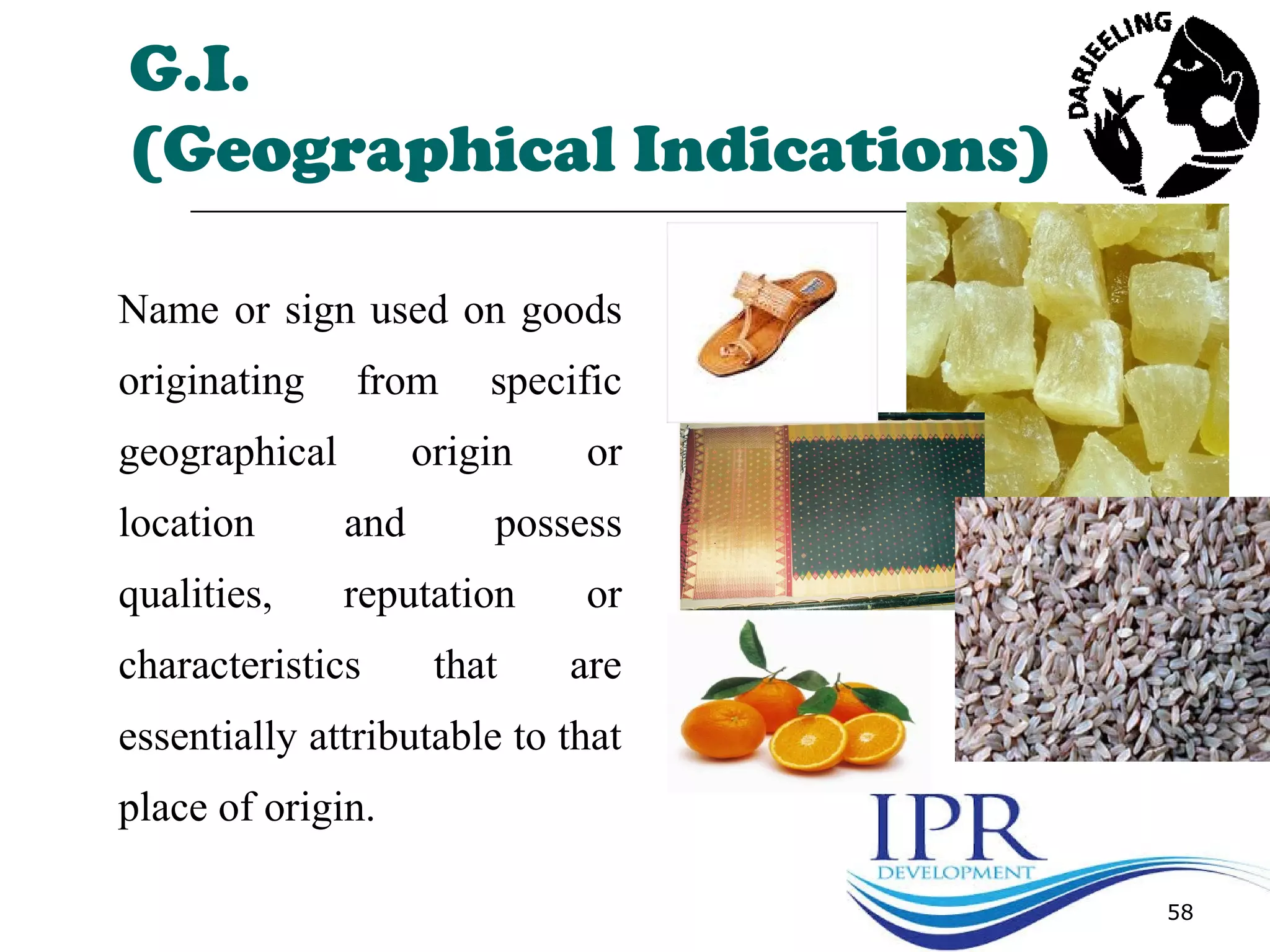
G.I.
(Geographical Indications)
Name or sign used on goods
originating from specific
geographical origin or
location and possess
qualities, reputation or
characteristics that are
essentially attributable to that
place of origin.
Geographical Indication
India, as a member of the World Trade Organization (WTO),
enacted the Geographical Indications of Goods (Registration
& Protection) Act, 1999 has come into force with effect from
15th
September 2003.
 Geographical Indications of Goods
(Registration & Protection) Act, 1999
 Geographical Indications of Goods
(Registration & Protection) Rules, 2002
59
Registration
 In India, geographical indications have to
be registered.
 Geographical Indications Registry
examines and publishes the application
before registration
 Registration is valid for 10 years but can
be renewed indefinitely
60
The GI Act, 1999
 Punishment for falsifying GI:
Imprisonment between 6 months to 3 years, & Fine between Rs.
50,000/- and Rs. 2 lakh
 Registration:
Controller General of Patents, Designs and Trade Mark shall be the
Registrar of GI
 Who can Apply:
Any association of persons or any organization or authority under law
representing the interest of procedures of concerned goods.
 Duration:
10 years ( Renewed from time to time after payment of prescribed fee).
Can be kept alive for an indefinite period
61
Some GIs of India
62
Geographical Indications
Registered in Uttar Pradesh
63
No. Geographical Indication Type
1. Allahabad Surkha Agricultural
2. Lucknow Chikan Craft Handicraft
3. Mango Malihabadi Dusseheri Agricultural
4. Banaras Brocades and Sarees Handicraft
5. Handmade Carpet of Bhadohi Handicraft
6. Agra Durries Handicraft
7. Farrukhabad Prints Handicraft
8. Lucknow Zardozi Handicraft
9. Banaras Brocades and Sarees (Logo) Handicraft
10. Kalanamak Rice Agricultural
11. Firozabad Glass Handicraft
12. Kannauj Perfume Manufactured
13. Kanpur Saddlery Manufactured
14. Moradabad Metal Craft Handicraft
15. Saharanpur Wood Craft Handicraft
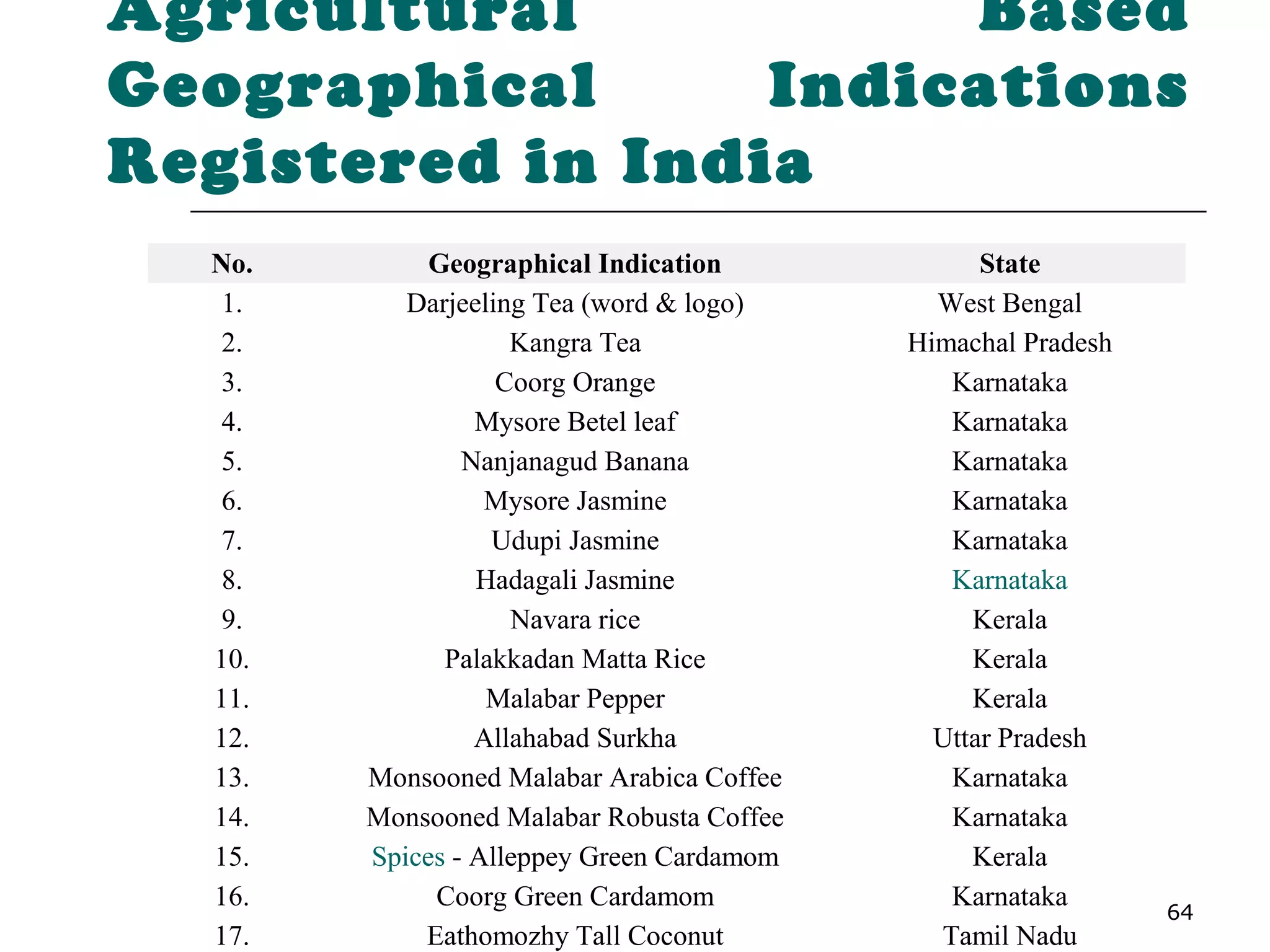
Agricultural Based
Geographical Indications
Registered in India
64
No. Geographical Indication State
1. Darjeeling Tea (word & logo) West Bengal
2. Kangra Tea Himachal Pradesh
3. Coorg Orange Karnataka
4. Mysore Betel leaf Karnataka
5. Nanjanagud Banana Karnataka
6. Mysore Jasmine Karnataka
7. Udupi Jasmine Karnataka
8. Hadagali Jasmine Karnataka
9. Navara rice Kerala
10. Palakkadan Matta Rice Kerala
11. Malabar Pepper Kerala
12. Allahabad Surkha Uttar Pradesh
13. Monsooned Malabar Arabica Coffee Karnataka
14. Monsooned Malabar Robusta Coffee Karnataka
15. Spices - Alleppey Green Cardamom Kerala
16. Coorg Green Cardamom Karnataka
17. Eathomozhy Tall Coconut Tamil Nadu
65
No. Geographical Indication State
18. Pokkali Rice Kerala
19. Laxman Bhog Mango West Bengal
20. Khirsapati (Himsagar) Mango West Bengal
21. Fazli Mango West Bengal
22. Naga Mircha Nagaland
23. Nilgiri(Orthodox) Logo Tamil Nadu
24. Assam (Orthodox) Logo Assam
25. Virupakshi Hill Banana Tamil Nadu
26. Sirumalai Hill Banana Tamil Nadu
27. Mango Malihabadi Dusseheri Uttar Pradesh
28. Vazhakulam Pineapple Kerala
29. Devanahalli Pomello Karnataka
30. Appemidi Mango Karnataka
31. Kamalapur Red Banana Karnataka
32. Bikaneri Bhujia Rajasthan
33. Guntur Sannam Chilli Andhra Pradesh
34. Mahabaleshwar Strawberry Maharashtra
Continue…..
66
No. Geographical Indication State
35. Central Travancore Jaggery Kerala
36. Wayanad Jeerakasala Rice Kerala
37. Wayanad Gandhakasala Rice Kerala
38. Nashik Grapes Maharashtra
39. Byadgi chilli Karnataka
40. Gir Kesar Mango Gujarat
41. Bhalia Wheat Gujarat
42. Udupi Mattu Gulla Brinjal Karnataka
43. Ganjam Kewda Rooh Orissa
44. Ganjam Kewda Flower Orissa
45. Madurai Malli Tamil Nadu
46. Bangalore Blue Grapes Karnataka
47. Kalanamak Rice Uttar Pradesh
48. Kaipad Rice Kerala
49. Kolhapur Jaggery Maharashtra
50. Nagpur Orange Maharashtra
Continue…..
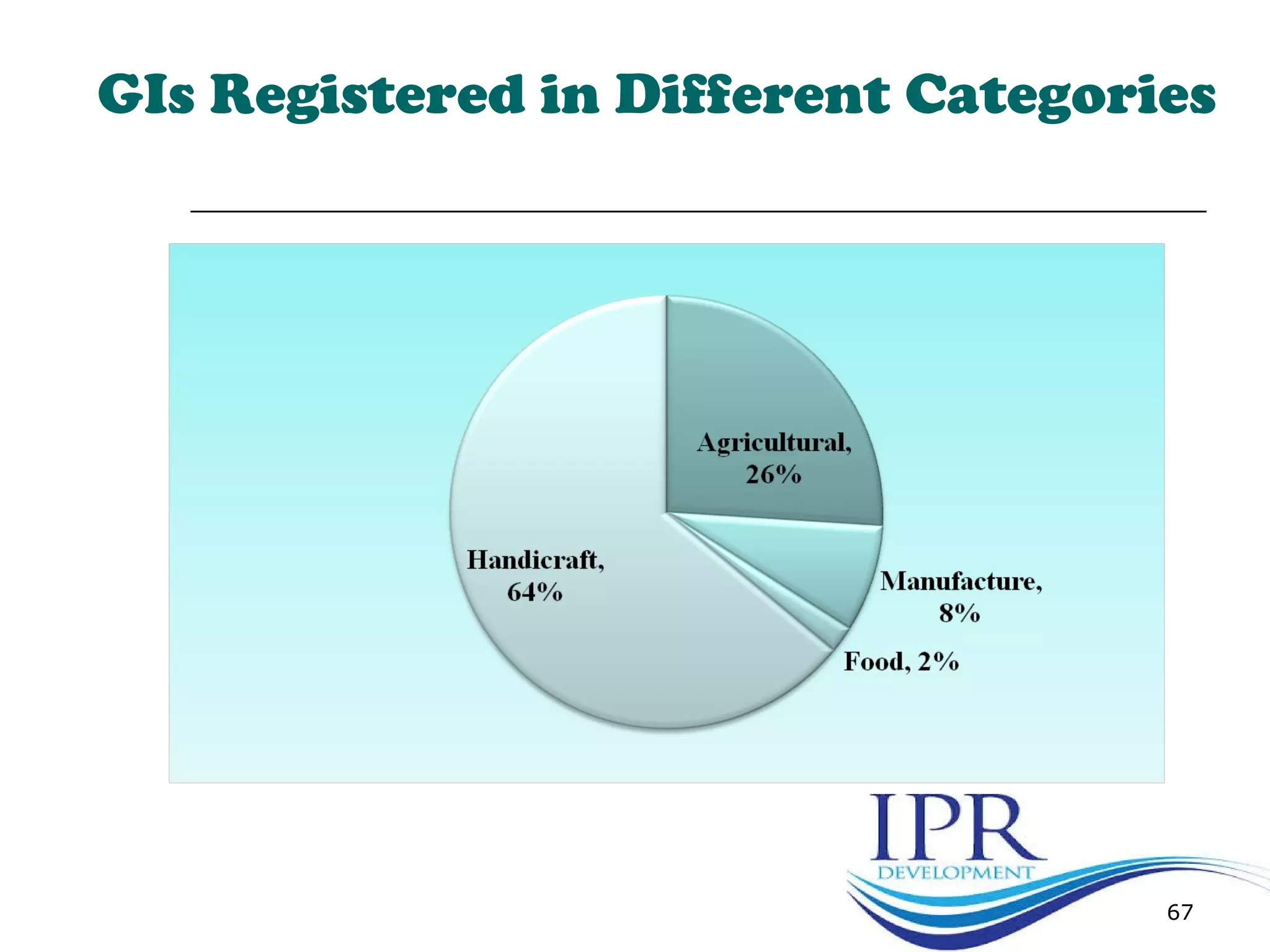
GIs Registered in Different Categories
67
68
Industrial/Utility Design
69
India's Design Act, 2000 was
enacted to consolidate and amend
the law relating to protection of
design and to comply with the
Articles 25 and 26 of TRIPS
agreement. The new act, (earlier
Patent and Design Act, 1911 was
repealed by this act).
Indian Design Act, 2000
What is an Industrial Design?
70
According to Indian Design Act, 2000:-
“Design" to mean only the features of shape,
configuration, pattern, ornament, or composition
of lines or colours applied to any article, whether
in two- or three-dimensional, or in both forms, by
any industrial process or means, whether manual
or mechanical or chemical, separate or combined,
which in the finished article appeal to and are
judged solely by the eye; but does not include any
mode or principle of construction.
Consumer
Products
71
Pharmaceutical
Product
72
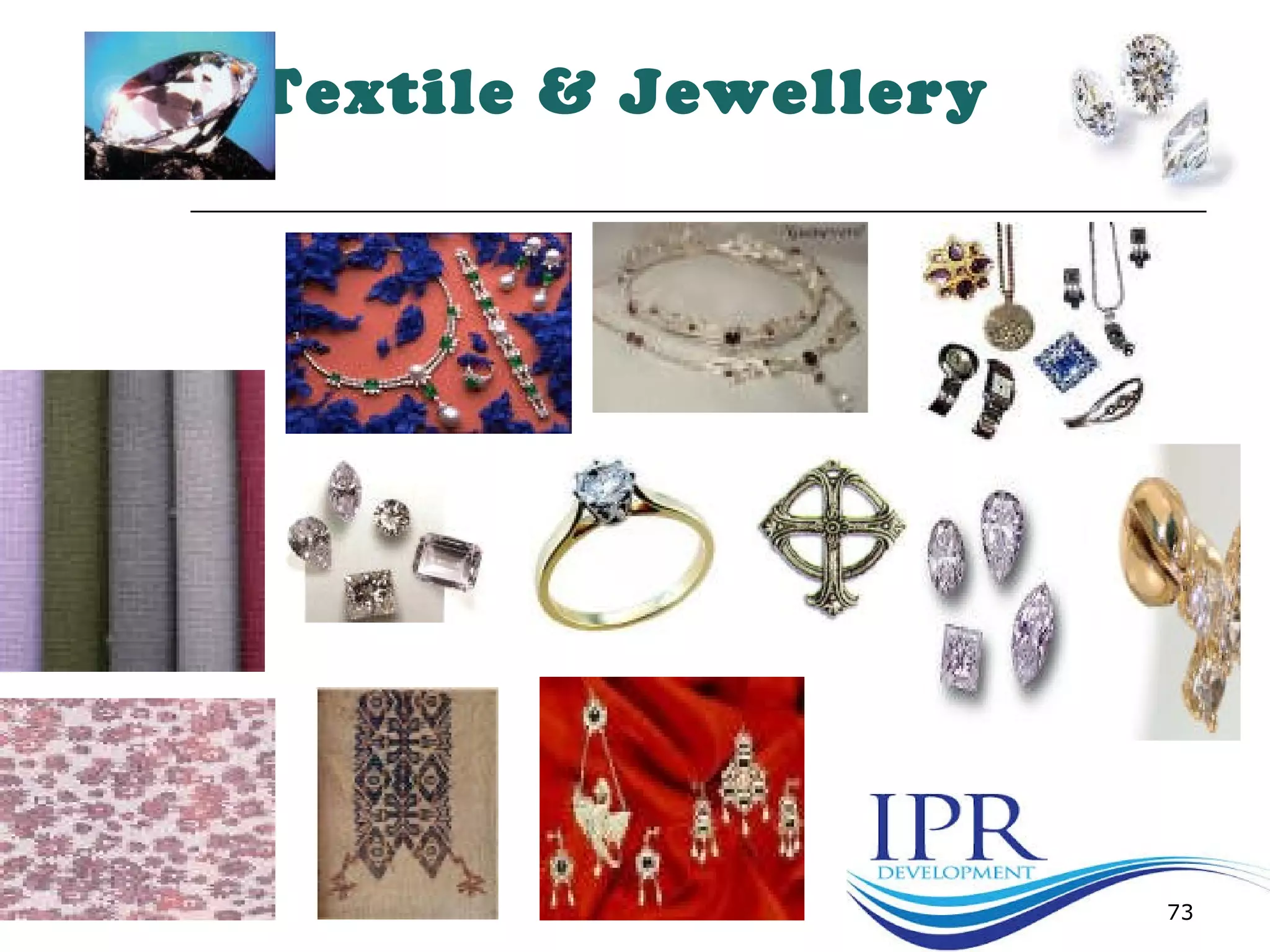
Textile & Jewellery
73
Rights of the Registered
Proprietor
 The proprietor of the registered design has
the exclusive right to apply the design to
any article in the class in which the design
is registered
 Period of protection is ten years extendable
by 5 years.
74
What is Excluded?
 Any mode or principle of construction or
anything which is in substance a mere
mechanical device
 Trade mark
 Property mark
 Artistic work
 Ideas
75
What is not registerable?
 A design which is not new or original
 A design which has been disclosed to the
public anywhere in the world prior to the
filing
 A design which is not significantly
distinguishable from known designs or
combination of known designs
76
77
Trade Secret
78
Act for Trade Secret
Unlike the US (Uniform Trades Secrets Act,
1970) and other developed countries India has no
legislation dealing with trade secrets.
In India protection of trade secrets is
Common Law based. However, Section 27 of the
Indian Contract Act, 1872 provides some sort of
limited remedy, it bars any person from
disclosing any information which he acquires as a
result of a contract.
Trade Secrets
 Some inventions, data, information cannot be
protected by any of the available means of
IPRs. Such information is held confidential as
a trade secret.
 Trade secret can be an invention, idea, survey
method, manufacturing process, experiment
results, chemical formula, recipe, financial
strategy, client database etc.
79
80
Generally, Trade Secrets, relate to different types
of information.
Some of these are as below :
I. Technical and Scientific information
II. Commercial information
III. Financial information and
IV. Negative information
Continue…..
81
Most famous example of trade
secret is the coca-cola formula.
This formula is kept locked in a
bank vault in Atlanta, can be
opened only by a resolution of the
company’s board and is known to
only two employees at the same
time. The public has no access to
the name of those employees and
they are not allowed to fly on the
same air plane.
Continue…..
When Trade Secrets are preferred?
 When invention is not patentable;
 Patent protection is limited to 20 years,
when secret can be kept beyond that
period;
 When cost of patent protection are
prohibitive;
 When it is difficult to reverse engineer
82
83
Till such time as a law is enacted in India, Indian companies
should take the following steps to protect confidential
information.
I.Companies should ensure that before disclosing confidential
information to employees, a non-disclosure agreement is in place.
II.Companies should ensure that the confidential nature of the
information is expressly communicated to the employees before
disclosure.
III.Companies should restrict the number of employees having access to
IV.confidential information at any point of time.
V.Companies should mark files and relevant documents as confidential.
Guidelines to Protect the Trade Secrets
84
V. Companies should have in place proper security systems for computers
and networks. Passwords should be provided and changed frequently.
VI.Companies should have in place proper policies for document retention
and destruction.
VII.Companies should very clearly set forth the standards of non-disclosure
of confidential information in the employee handbook.
VIII.Companies should take special care when an employee is leaving the
company. The employee should be reminded of his obligations and
asked to deposit all confidential material in his possession.
IX.A covenant of non-disclosure should also include a clause whereby the
employee is under an obligation to disclose to the employer any
confidential information acquired in the course of employment, which is
in the nature of a trade secret for the company but unknown to the
employer.
Continue…..
How to guard Trade Secret?
 Restricting number of people having access to
secret information
 Signing confidentiality agreements with business
partners and employees
 Using protective techniques like digital data
security tools and restricting entry into area where
trade secret is worked or held
 National legislations provide protection in form of
injunction and damages if secret information is
illegally acquired or used.
85
86
Layout Designs/Topographies Integrated Circuits
The Semiconductor Integrated Circuits Layout
- Design Act, 2000
 Provides Protection of Semiconductor IC layout design
 Layout - Design - A layout of transistors and other circuitry
elements and includes lead wires connecting such elements
and expressed in any manner in a semi conductor IC.
 Semiconductor IC -A product having transistors and other
circuitry elements which are inseparably formed on a
semiconductor material or an insulating material or inside
the semiconductor material and designed to perform an
electronic circuitry function.
87
IC Layout-Design
 Term 10 years from date of filing
 Rights conferred
1.Exclusive right to the use of the layout-
design and
2. Obtain relief in respect of Infringement.
88
Not Registerable as Layout-
Design
 Lay out Design :
 Not Original
 Commercially exploited anywhere in India or in a
convention country
 Inherently not distinctive
 Inherently not capable of being distinguishable
 From any other registered lay out - design
 Note: Design not exploited commercially for more than 2
years from date of registration of application shall be treated
as commercially not exploited for the purpose of this Act.
89
Protectable Layout Designs?
 Original and novel Layout-Designs of
semiconductor integrated circuits can get
protection through registration
 Registration is done after examination and
publication of the application
 Registration is valid for 10 years
90
Non-registrable Layout-Designs
 Not original
 Has been commercially exploited anywhere in
India or in a convention country
 Not inherently distinctive
 Not inherently capable of being
distinguishable from any other registered
layout-design
91
92
Copyright
93
Copyrights & Related Rights
Copyright is a legal
term describing rights
given to creators for
their literary and
artistic works.
Copyright Act
 1709 First Copyright Act (UK)
 1957 Indian Copyright Act
 Amended 1983, 1984, 1992, 1994 and 1999
 International Convention
 Bern Convention 1886, 1908, 1928,1948, 1989, 1990
 Universal Copyright Convention 1952
 TERM LIFE+60 YRS
94
95
Copyright - Extension
IT Revolution !
Recordings
Broadcastings
Audio visual works
Computer programs
Digital databases
Internet/web
Cable and Satellite T.V.
Indian Copyright Amendment Bill
Passed by Rajya Sabha on 17th
May, 2012
Passed by Lok Sabha on 22nd
May, 2012
96
IPR & Copyright
 Avoid verbatim reproduction (Plagiarism) - Likely to cause Copyright
violations.
 Always acknowledge / obtain prior permission.
 Abstract / Summary may be written in one’s own language / quote the
source.
“Copyright” / “All rights reserved”
“Do not use, reprint, reproduce or distribute without prior permission”
Quoting Medical References from Journals and Books
Copyright violations could lead to criminal/civil suits
Could lead to imprisonment too !
Ownership of Rights
• Literary – author
• Drama – Dramatist
• Music – Composer
• Artistic work – Artist e.g. Painter, sculptor, architect
• Photograph – Photographer
• Author of Computer Programme – Person who causes
the work to be created
• Cinematograph film – producer
• Sound Recording - producer
97
Author as Owner of Rights: Exceptions
 In the course of employment –
employer
 Employment by newspaper, magazine
– employer has publishing right; other
rights with author
 Photograph, painting, cinema for
valuable consideration – person who
pays money
98
 Lecture delivered in public – Person
delivering
 Government Work – Government
 Public Undertaking Work – public
undertaking
 Work of International Organization –
International Organization
99
Continue…..
 Work of apprentice – to Teacher
 If teacher writes a book then teacher because he
is employed to teach and not write
 Question Papers – Paper setter
 Encyclopedia, dictionary – editor for collection
 Music under contract by film producer – film
producer
100
Continue…..
Securing Copyright
 Formality free protection
 Voluntary Registration (S. 44 & 45)
 Registration does not as a matter of law
establish that what is registered is in fact
and in law copyrightable subject matter
101
Duration of Copyright
 Literary, dramatic, Musical and Artistic Works
published during life time of author: Life + 60
years
 All Other Works: 60 years from date of
publication
Posthumous, Anonymous Works
Works of Government and Organizations
Cinema and Sound Recording
Photograph
102
Related Rights
 Rights granted by law to
communicators of works to the public
Performers
Broadcasting Organizations
103
Performer’s Rights
 Recording, broadcasting and
communicating to the public of a live
performance
 Presumption of transfer of performer’s
right to cinematographic film producer
 Duration: 50 years
104
Rights Of Broadcasting Organizations
 Broadcast Reproduction Right
 Re-broadcasting, Recording and
Communicating to the Public of a
Broadcast
 Duration: 25 Years
105
106
Therapeutic Goods Legislation Amendment
(Copyright), 2011 Australia
To block frivolous
Copyright infringement
suits in Pharma /
Medicine product inserts.
107
Be Aware / Beware of the Web /
Domain in the new global
regime
× Use of internet for selling / marketing
× Downloading from Internet (except for
personal use)
108
Plant Variety & Farmer’s Right
109
India's Protection of Plant
Varieties and Farmers' Rights
Act, 2001India's Protection of Plant Varieties and Farmers' Rights Act, 2001 is the
most far-reaching legislation with regard to establishing rights for farmers to
save, use, exchange and sell farm-saved seed. The Act establishes nine
rights for farmers which are as follows (Art. 39):
Rights to Seed
Right to Register Varieties
Right to Reward & Recognition
Right to Benefit Sharing
Right to Information and Compensation for Crop Failure
Right to Compensation for Undisclosed Use of Traditional Varieties
Right to Adequate Availability of Registered Material
Right to Free Services
Protection from Legal Infringement in Case of Lack of Awareness
110
The Protection of Plant Varieties and Farmers'
Rights Act, 2001
Passed by Lok Sabha on 9th
August, 2001
Passed by Rajya Sabha on 28th
October, 2001
Assented by the President of India on 30th
October, 2001
Act no. 53 of 2001
The Protection of Plant PPV&FR Varieties and
Farmer’s Rights Rules, 2003
Protection of Plant Varieties
 Registrable varieties and criteria:
 New Varieties
 Novelty, Distinctiveness, uniformity and stability
 Extant varieties
 Distinctiveness, uniformity and stability
 Persons who can Register
 Breeders, farmers, universities, agricultural institutes
 Period of protection
 15 years for annual crops
 18 years for trees and vines
111
112
Non-registerable Plant Varieties of
India
113
Variety
A plant grouping except microorganisms within a single
botanical taxon of the lowest known rank, which can be
i.defined by the expression of the characteristics resulting
from a given genotype of a plant of that plant grouping;
ii.distinguished from any other plant grouping by
expression of at least one of the said characteristics; and
iii.considered as a unit with regard to its suitability for
being propagated, which remains unchanged after such
propagation and includes propagating material of such
variety, extant variety, transgenic variety, farmers’ variety
and essentially derived variety.
114
Types of Varieties
According to India's Protection of Plant
Varieties and Farmers' Rights Act, 2001
there are four types plant varieties which
are as follows:
Extant variety
Essentially derived variety
Transgenic variety
Farmers’ variety
115
A variety available in India which is -
I.notified under section 5 of Seeds Act,
1966, or
II.farmers’ variety, or
III.a variety about which there is common
knowledge, or
IV.any other variety which is in public
domain.
Extant Variety
116
A variety shall be said to be essentially derived when it -
I.is predominantly derived from such initial variety, or from a
variety that itself is predominantly derived from such initial
variety, while retaining the expression of the essential
characteristics that result from the genotype or combination of
genotypes of such initial variety;
II.is clearly distinguishable from such initial variety, and
III.conforms (excepting for the differences which result from
the act of derivation) to such initial variety in the expression of
the essential characteristics that result from the genotype or
combination of genotypes of such initial variety.
Essentially Derived Variety
117
Transgenic Varieties
A transgenic variety contains a gene or
genes which have been artificially
inserted instead of the plant acquiring
them through pollination.
The inserted gene sequence (known
as the transgene) may come from another
unrelated plant, or from a completely
different species
118
A variety which -
I.has been traditionally cultivated and
evolved by the farmers in their fields,
or
II.is a wild relative or land race of a
variety about which the farmers possess
common knowledge.
Farmers’ Variety
119
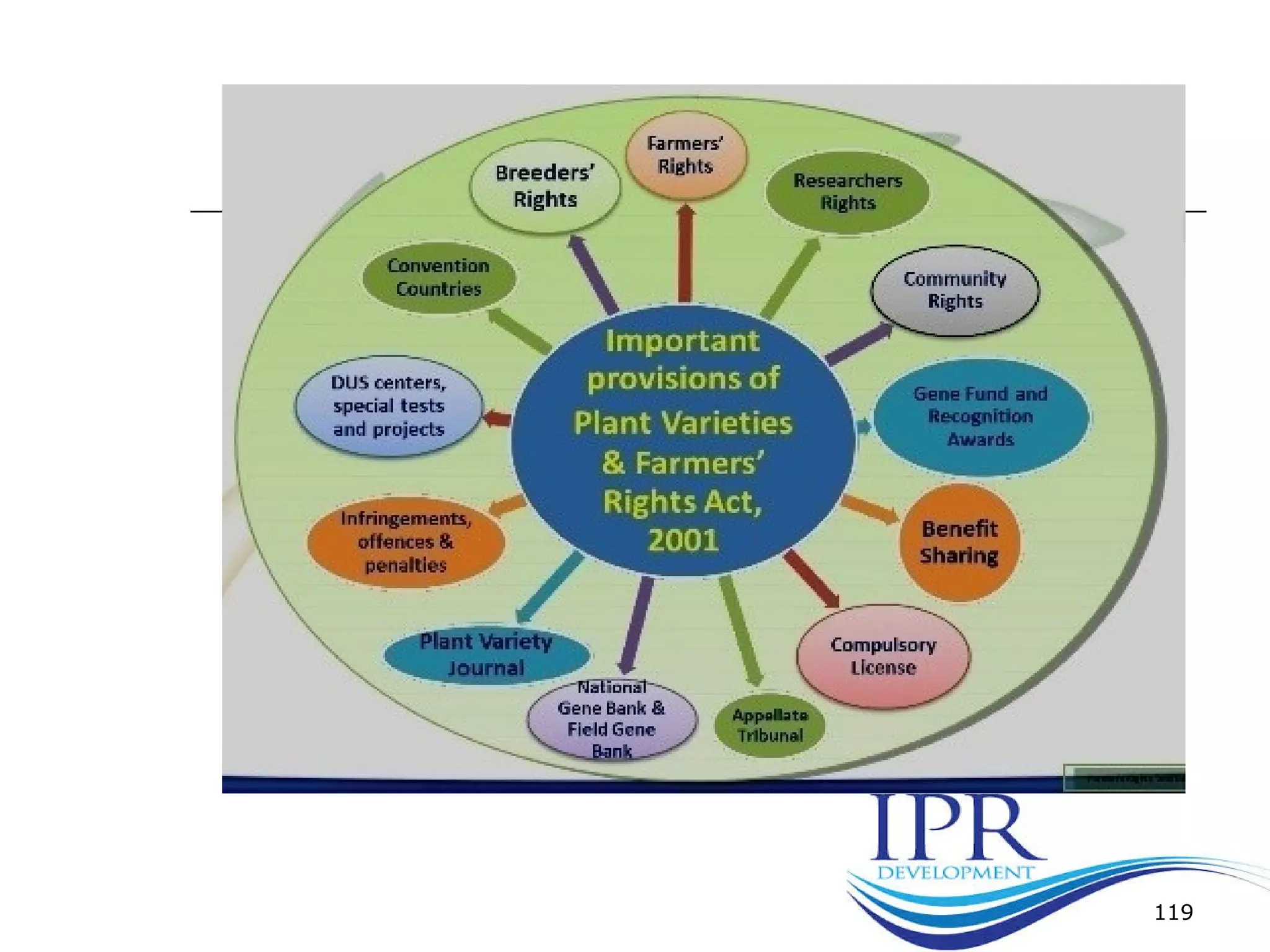
Rights of Breeder’s
 Production
 Sale
 Marketing
 Distribution
 Export
 Import
However, if the breeders’ variety is essentially
derived from a farmers’ variety, the breeder cannot
give any authorisation without the consent of the
farmers or communities from whose varieties the
protected variety is derived.
120
Farmers’ Rights
 To save, use, sow, re-sow, exchange, share or sell his
farm produce including seed in the same manner as he
was entitled earlier (Seeds for sale should not be
branded)
 To full disclosure of the expected performance of the
Seeds or planting material by the plant breeder.
Where these fail to perform in the manner claimed by
the breeder, the farmer may claim compensation from
the plant breeder.
121
ICAR
Research
Institutes
Seed
Industry
Farmers’
cooperatives &
organisations
Bioversity
International
Krishi Vigyan
Kendra (Farm
Science
Centres)
Network - 634
Non-
Governmenta
l
Organisations
State
Agricultural
Universities
National
Biodiversity
Authority
CGIAR
Institutes Protection of
Plant Varieties &
Farmers’ Rights
Authority
(for promotion of Farmers’ Rights)(for promotion of Farmers’ Rights)
Researchers’ Rights
 Free and complete access to protected
materials for research use in
developing new varieties of plants.
 However, authorisation of the breeder
is required “whose repeated use of
such variety as parental line is necessary
for commercial production of such other
newly developed variety”.
123
124
Community Rights
The rights of the communities as
defined, provide for compensation for
the contribution of communities in
the evolution of new varieties in
quantum's to be determined by the
PPVFR Authority [Section 41 (1)].
125
Registration of essentially derived
varieties
The breeder of the essentially derived variety shall
have the same rights as the plant breeder of other
new varieties, which include production, selling,
marketing and distribution, including export and
import of the variety. The other eligibility criteria
for award of registration are also the same as for
new variety registration under the Act [Section
23(1), (6)].
126
Compulsory License
The authority can grant compulsory license, in case of
any complaints about the availability of the seeds of any
registered variety to public at a reasonable price. The
license can be granted to any person interested to take
up such activities after the expiry of a period of three
years from the date of issue of certificate of registration
to undertake production, distribution and sale of the
seed or other propagating material of the variety
[Section 47(1)].
127
Benefit Sharing
Sharing of benefits accruing to a breeder from a
variety developed from indigenously derived
plant genetic resources has also been provided
[Section 26(1)]. The authority may invite claims
of benefit sharing of any variety registered
under the Act, and shall determine the quantum
of such award after ascertaining the extent and
nature of the benefit claim, after providing an
opportunity to be heard, to both the plant
breeder and the claimer.
128
National Gene Fund
The National Gene Fund to be constituted under the Act shall be credited
thereto:
a)The benefit sharing from the breeder.
b)The annual fee payable to the authority by way of royalties.
c)By the compensation provided to the communities as defined under
Section 41(1).
d)Contribution from any national and international organization and
other sources.
The fund will be applied for disbursing shares to benefit claimers, either
individuals or organization, and for compensation to village
communities. The fund will also be used for supporting conservation and
sustainable use of genetic resources, including in situ and ex situ
collection and for strengthening the capabilities of the panchayat in
carrying out such conservation and sustainable use [Section (45)].
129
International Union for the
Protection of Plant Varieties
(UPOV) & India
In 1961, five European countries agreed to provide sui generis IP protection to
plant varieties and formed the international Union for the Protection of New
Varieties of Plants (UPOV) which provided for the rights of plant breeders, and
prohibited two or more types of protection to a particular plant species. Article 5
of the UPOV Convention, 1961 provides for the protection of the interests of the
farmers as against those of plant breeders. The UPOV Acts underwent three
amendments in 1972, 1978 and 1991 which govern parties to the Convention.
It is a fact that neither of the two UPOV conventions contains operative
farmers’ rights. What UPOV provides for farmer’s are not the rights, but they are
mere privileges. Hence, if India were to become a member of UPOV, then it will
not be able to maintain a strong farmer rights regime, which the PPVFR Act
contains. That is, thereafter India will be under obligation to model its law
according to the terms specified by the UPOV Convention. The Indian plant
variety law contains various desirable UPOV features which India can uphold
only by not becoming a member of UPOV.
Main Mandates of the
PPVFRs
130
1. Registration of plant varieties,
2. Developing characterization and documentation of
registered varieties,
3. Documentation, indexing and cataloguing of farmer’s
varieties,
4. Providing compulsory cataloguing facility for all plant
varieties,
5. Ensuring that seeds of all registered varieties are made
available to farmers,
6. Collection of comprehensive statistics on plant varieties,
7. Maintenance of National Register of Plant variety.
2007 2008 2009 2010 2011 2012 2013 2014 2015 Total
Public 287 322 193 31 125 129 141 136 26 1390
Private 143 220 368 505 295 266 534 420 47 2798
Farmer 2 5 127 4 941 304 1002 1964 371 4720
Total 432 547 688 540 1361 699 1677 2520 444 8908
Applications received year-wise/applicant-wise
2007 2008 2009 2010 2011 2012 2013 2014 2015 Total
Public - - 149 49 95 154 154 250 21 872
Private - - 16 - 21 55 104 124 33 353
Farmer - - 3 - - 3 46 459 32 543
Total - - 168 49 116 212 304 833 86 1768
Registration Certificate Issued year-wise/applicant-wise
Sr.
No.
Crops
Number of
Applications filed
Certificate Issued
Public
Priva
te
Total
Publi
c
Private Total
1 Rice 250 280 530 141 75 216
2 Maize 120 293 413 78 55 133
3 Sorghum 107 91 198 67 35 102
4 Pearl millet 61 191 252 33 51 84
5 Cotton 115 975 1090 68 66 134
6 Pigeon pea 32 25 57 20 0 20
7 Field pea 37 2 39 24 0 24
8 Castor 6 9 15 3 3 6
9
Indian
mustard
(Sarso)
48 24 72 48 7 55
10 Sunflower 9 111 120 9 33 42
Total 785 2001 2786 491 325 816
Sr.
No.
Crops
Number of
Applications filed
Certificate Issued
Public Private Total Public Private Total
1 Potato 18 17 35 13 0 13
2 Cauliflower 4 50 54 2 0 2
3 Okra 12 120 132 0 0 0
4 Brinjal 21 247 268 6 0 6
5 Cabbage 2 17 19 1 0 1
6 Onion 9 9 18 0 0 0
7 Tomato 18 215 233 2 0 2
8 Bitter Gourd 3 21 24 0 0 0
9 Bottle Gourd 1 9 10 0 0 0
10 Cucumber 2 6 8 0 0 0
11 Rose 0 5 5 0 0 0
Total 90 716 806 24 0 24
134
Plant Variety Protection Appellate Tribunal
The Tribunal will be established by a
gazette notification by the Government
to exercise jurisdiction, powers and
authority conferred on it under this
Act. The Tribunal will consist of
Judicial as well as Technical members.
135
The effective implementation of the PPVFR Act hinges on the DUS
testing and the Authority should ensure trust, transparency, accountability
and efficiency for carrying out such tests. Suitable farm and other
infrastructure facilities for DUS testing, including seed storage facilities
need to be created. It is advisable to carry out DUS testing in at least two
locations in each major- agro climatic region relevant to the crop for at
least two successful years. Such an evaluation procedure would create
acceptance when followed for all types of varieties among all the stake-
holders.
It is imperative to define essential and additional characters for DUS
testing (morphological, biochemical and molecular characters), and
identification of possible reference varieties for each crop species.
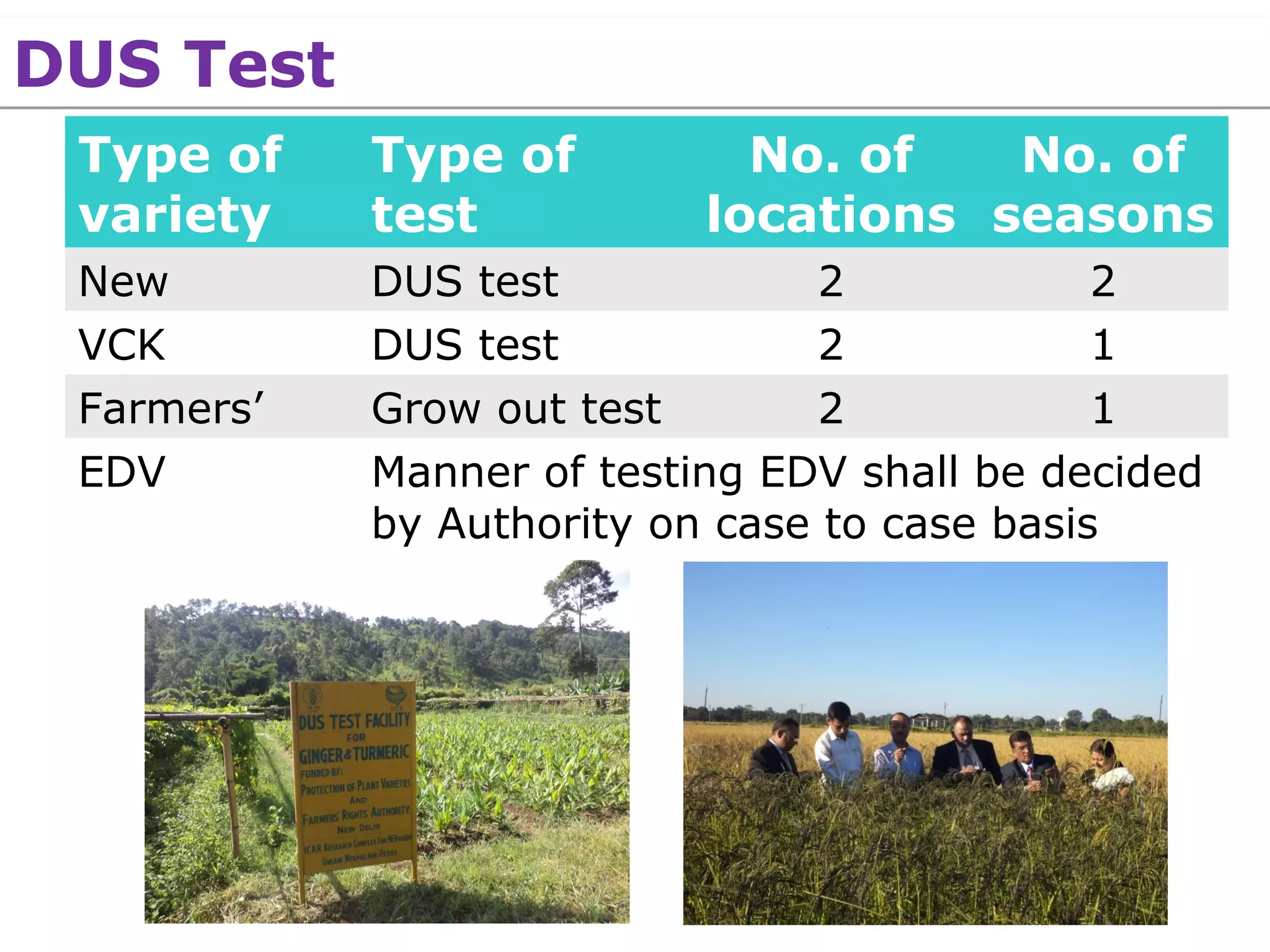
DUS Testing
DUS TestDUS Test
Type of
variety
Type of
test
No. of
locations
No. of
seasons
New DUS test 2 2
VCK DUS test 2 1
Farmers’ Grow out test 2 1
EDV Manner of testing EDV shall be decided
by Authority on case to case basis
• The special tests shall be conducted
only when DUS testing fails to
establish the requirement of
distinctiveness.
• Laboratory based
• These tests may include: physical,
biochemical, molecular, response and
organo-leptic tests
• The Authority shall charge separate
fees for conducting DUS test and
special test on each variety.
• The special tests shall be conducted
only when DUS testing fails to
establish the requirement of
distinctiveness.
• Laboratory based
• These tests may include: physical,
biochemical, molecular, response and
organo-leptic tests
• The Authority shall charge separate
fees for conducting DUS test and
special test on each variety.
IPR LICENSING
&
TECHNOLOGY
TRANSFER
138
Licensing of an IP
• Licence is a permission granted by an IP owner
to another person to use the IP on agreed terms
and conditions, while he continues to retain
ownership of the IP
• Licensing creates an income source
• It establishes a legal framework for transfer of
technology to a wider group of researchers and
engineers
• Creates market presence for the technology or
trademark
139
Licensing Conditions of IPRs
• Owners of IP prefer to transfer technology through
licensing agreements only
• All rights or limited rights can be licensed
• Can be exclusive or non-excusive or sole (owner and
licensee)
• Most such agreements provide for royalty payment and
non-transfer to a third party.
• Royalties can be upfront, part upfront and part % per
production/sale, only % per production/sale
• The particular uses for which the IP can be used are also
generally specified
• Needs to be careful about the Competition law
140
Is Licensing Profitable?
• IBM revenue from patent licensing $ 1.7 billion (2002)
• Texas Instruments generated $ 3 billion in licensing in
10 years
• US and Canadian Universities generated $ 1.1 billion
in royalties (2001)
• New York University $ 109 million (2004)
• Ohio University to get $52 M. From royalties on the
growth hormone drug SOMAVERT in 5 years (2011)
• CSIR $ 150 million in milestone payments + royalty
141
Biodiversity
&
Intellectual Property
Rights
142
Biodiversity
Biodiversity has been defined under Section 2(b) of
the Act as "the variability among living organisms
from all sources and the ecological complexes of
which they are part, and includes diversity within
species or between species and of eco-systems".
The Act also defines, Biological Resources as
"plants, animals and micro-organisms or parts
thereof, their genetic material and by-products
(excluding value added products) with actual or
potential use or value, but does not include human
genetic material."
143
Biological Diversity Act,
2002
The Biological Diversity Act, 2002 is an Act of
the Parliament of India for preservation of
biological diversity in India, and provides
mechanism for equitable sharing of benefits
arising out use of traditional biological
resources and knowledge. The Act was enacted
to meet the obligations under Convention on
Biological Diversity (CBD), to which India is a
party.
144
Convention
on Biological Diversity
The CBD's objectives are:
(1) to conserve biological diversity,
(2) to promote the sustainable use of its components,
and
(3) to achieve fair and equitable sharing of the
benefits arising out of the utilization of genetic
resources.
These objectives find expression in the
provisions of the CBD, many of which are affected,
directly or indirectly, by IPRs.
145
Budapest Treaty
 The Treaty on the International Recognition of the Deposit of
Microorganisms for the Purposes of Patent Procedure, or Budapest
Treaty, is an international treaty signed in Budapest, Hungary, on April
28, 1977. It entered into force on August 9, 1980 and was later
amended on September 26, 1980. The treaty is administered by the
World Intellectual Property Organization (WIPO).
 As of 2014, 79 countries were party to the Budapest Treaty. The
accession to the Treaty is open to States party to the Paris Convention
for the Protection of Industrial Property of 1883. The African
Regional Industrial Property Organization (ARIPO), the Eurasian
Patent Organization (EAPO) and the European Patent Organization
(EPO) have filed a declaration of acceptance under Article 9(1)(a) of
the Treaty.
146
National Biodiversity
Authority & State
Biodiversity Boards
The National Biodiversity Authority (NBA)is a
statutory autonomous body, headquartered in
Chennai, under the Ministry of Environment and
Forests, Government of India established in 2003
to implement the provisions under the Act. State
Biodiversity Boards (SBB) has been created in 28
States along with 31,574 Biological management
committees (for each local body) across India.
147
Functions of National Biodiversity
Authority & State Biodiversity
Boards
 Regulation of acts prohibited under the Act
 Advise the Government on conservation of
biodiversity
 Advise the Government on selection of
biological heritage sites
 Take appropriate steps to oppose grant of
intellectual property rights in foreign countries,
arising from the use of biological resources or
associated traditional knowledge.
148
Regulations
 A foreigner, non-resident Indian as defined in clause (30) of section 2 of The
Income-tax Act, 1961 or a foreign company or body corporate need to take
permission from the NBA before obtaining any biological resources or associated
knowledge from India for research, survey, commercial utilization. Indian citizens
or body corporate need to take permission from the concerned State Biodiversity
Board.
 Result of research using biological resources from India cannot be transferred to a
non-citizen or a foreign company without the permission of NBA. However, no
such permission is needed for publication of the research in a journal or seminar, or
in case of a collaborative research made by institutions approved by Central
Government.
 No person should apply for patent or other form of intellectual property protection
based on the research arising out of biological resources without the permission of
the NBA. The NBA while granting such permission may make an order for benefit
sharing or royalty based on utilization of such protection.
149
Benefit Sharing
Benefit sharing out of usage of biological resources
can be done in following manner:
 Joint ownership of intellectual property rights
 transfer of technology
 location of production, research development units
in the area of source
 payment of monetary and non-monetary
compensation
 setting up of venture capital fund for aiding the
cause of benefit claimers
150
Penalties
 If a person, violates the regulatory provisions he
will be "punishable with imprisonment for a
term which may extend to five years, or with
fine which may extend to ten lakh rupees and
where the damage caused exceeds ten lakh
rupees such fine may commensurate with the
damage caused, or with both."
 Any offence under this Act is non-bailable and
cognizable.
151
 Challenging and rewarding
dimension
 Need structured approach in
technology generation, protection and
commercialization
 Potential to support technology based
Entrepreneurship in agriculture in
UP
Conclusion
Thank
You
Dr Sujit Kumar +91 7607006314 iprcellupcar@gmail.com
154
Open for
Questions

Presentation on ipr by seweta srivastava

  • 1.
    1 Intellectual Property Rights: Incentivesfor Creation By:- Dr. Seweta Srivastava Assistant Professor Lovely Professional University, Jalandhar
  • 2.
    Objective & Planof Presentation Objective  To give a general introduction to the concept of Intellectual Property Rights and Their Role in Technology Transfer Plan of Presentation  Rationale of Protection  Different kinds of IPRs  IPRs & Licensing/Technology Agreements  IPR related to Agriculture 2
  • 3.
    Kinds of Property Movable Property  Car, Pen, Furniture, Dress  Immovable Property  Land, Building  Intellectual Property  Literary works, Inventions  Novel creations of human intellect 3
  • 4.
    4 INTELLECTUAL PROPERTY RIGHTS(IPR)  Intellectual Property (IP) is defined as any “ideas, inventions and original creative work manifested in a tangible form that can be legally protected”.  IPRs provide certain exclusive rights to the creators of IP, in order to enable them to reap commercial benefits from their creative efforts or reputation. The purpose of IPR legislation is to protect against unauthorized imitation, copying or deceptive usage of identifying marks.  Rights associated with intellectual property which gives legal protection is referred to as IPR.  When we speak of IP rights, we refer to controlling the way IP is used, accessed or distributed.
  • 5.
    Nature of IntellectualProperty  Creation of human mind (Intellect)  Intangible property  Exclusive rights given by statutes  Attended with limitations and exceptions  Time-bound  Territorial 5
  • 6.
    “A right thatis had by a person or by a company to have exclusive rights to use its own plans, ideas, or other intangible assets without the worry of competition, at least for a specific period of time. These rights may be enforced by a court via a lawsuit. The reasoning for intellectual property is to encourage innovation without the fear that a competitor will steal the idea and / or take the credit for it”. 6 Definition of Intellectual Property
  • 7.
    Intellectual Property Includes “IntellectualProperty” shall include the rights relating to  literary, artistic and scientific works,  performances of performing artists, phonograms, and broadcasts,  inventions in all fields of human endeavour  scientific discoveries  Industrial designs  trademarks, service marks and commercial names and designations  protection against unfair competition and all other rights resulting from intellectual activity in the industrial, scientific, literary or artistic fields. 7
  • 8.
    1856 to 1972 Patent laws in India were first made in 1856.  Had 3 universities in Bombay, Calcutta and Madras in 1857.  Industries were traditional; unaware of patents etc.  Patent laws modified in 1911 and then in 1970.  Took us 23 years from 1947 to 1970 to notify revised Patent Act and 25 years to implement it in 1972 HISTORY RELATED TO INTELLECTUAL PROPERTY RIGHTS (IPR)
  • 9.
    1972 to 1995 Laws only for patents, copyrights, trademarks, design and trade secret (through Contract Act 1872 and principles of common law)  Process patents in areas of drugs and chemicals helped India industries to grow  Patent term: 14 years from grant; for drugs, chemicals, food items 5 years from grant  Filings very low
  • 10.
    1995 to 2005 Existing laws revised.  New laws were promulgated: Geographical indications, IC lay-out design, New plant variety  Laws are TRIPS compatible  India became member of Paris Convention, PCT, Budapest Treaty  All this happened in 10 years!!
  • 11.
    2005 to 2014 Membership of Madrid Protocol  Amendments to Copyright Act 2012  Changes in rules in some Acts
  • 12.
    12 IPR Patents Geographical Indications Trademarks Works ofArt Literature Music Broadcasting Dramatics Works Sound Recording Computer Programs Industrial Design Classification of IPR Intellectual Property Copyright Trade Secret Layout Designs/Topographies Integrated Circuits Plant Variety Protection
  • 13.
    Define Major IntellectualProperties  Copyright and Related Rights “It is a legal right created by the law of a country, that grants the creator of an original work exclusive rights to its use and distribution, usually for a limited time, with the intention of enabling the creator to receive compensation for their intellectual effort”.  Industrial Property  Patents “It is the grant of a monopoly right to an inventor who has used his skill to invent something new”.  Industrial Designs “The designs entitled to protection are new and original designs having aesthetic value which have not been previously known or published in India or elsewhere”. 13
  • 14.
    Continue…..  Trade Marks “Itis a recognizable sign, design or expression which identifies products or services of a particular source from those of others”.  Geographical Indications “Geographical indications are place names (in some countries also words associated with a place) used to identify products that come from these places and have these characteristics”.  Layout Designs/Topographies Integrated Circuits “It is a reusable unit of logic, cell, or chip layout design that is the intellectual property of one party. IP cores may be licensed to another party or can be owned and used by a single party alone”. 14
  • 15.
     Trade Secrets “Itmay a formula, practice, process, design, instrument, pattern, commercial method, or compilation of information which is not generally known or reasonably ascertainable by others, and by which a business can obtain an economic advantage over competitors or customers”.  Protection of New Plant Varieties “Plant breeders' rights (PBR), are rights granted to the breeder of a new variety of plant that give the breeder exclusive control over the propagating material and harvested material of a new variety for a number of years”. 15 Continue…..
  • 16.
    16 IP- Duration ofTerm of Protection  Patents (20 years)  Trademarks (10 years + renewals)  Copyrights in published literary, dramatic, musical, and artistic works (Lifetime of author +60 years).  Copyright in photographs ,cinematographic film, sound recordings –(60 years from year in which it was published)  Broadcast reproduction right-(25 years from the beginning of the calendar year next following the year in which the broadcast is made.)  Performers right-(25 years from the beginning of the calendar year next following the year in which the performance is made)  Industrial designs (10 years+ renewal permitted once for 5 years)  Trade-secrets and know how collectively “proprietary technology” (contract period-protected by contract provisions, doctrine of breach of trust)
  • 17.
    17 Different Acts governingIP assets Trade Marks The Patents Act, 1970 Patents The Copyright Act, 1957Copyright Designs The Protection of plant varieties and Farmers’ Right Act, 2001 Geographical Indications Plant Varieties Semi conductor IC layout design Act,2000 The Designs Act, 2000 The Geographical Indications Of Goods Act, 1999 The Trade Marks Act, 1999 Semi conductor IC layout
  • 18.
    18  Paris Convention(1883):- Protection of Industrial property  Berne Convention (1886):-Literary & Artistic Works  Madrid Agreement(1891):- Repression of false or deceptive indications of source on goods  Rome Convention (1961):- Protection of performers, producers of phonograms and broadcast organizations  Phonograms Convention (1971):- Protection of phonograms against unauthorized duplication  Brussels Convention (1974):-Distribution of Programme-carrying signals distributed by satellite  Budapest Treaty (1977):- Deposit of microorganisms for the purposes of patent procedure IP Conventions
  • 19.
    19 Continue…..  Nairobi Treaty(1981):- Protection of Olympic symbol  Washington Treaty (1989):- IP treaty w.r.t Integrated Circuits  Film Register Treaty (1989):- Int. registration of audiovisual works  Trademark Law Treaty(1994):- To streamline trademark registration procedures  WCT (1996):- Adds copyrighting of computer programs & databases  WPPT (1996):- WIPO Performances and phonograms treaty  Patent Law Treaty (2000):- Streamlining of patent application procedures  Singapore Treaty (2006 not in force):- law of trademarks
  • 20.
    20 Its creation isboth time and cost intensive Requires an assembled trained workforce for its creation Requires building of goodwill through advertising programs Generates customer loyalty Adds to commercial value of organization Its exploitation brings consistent additional profits to an organization Why are IP assets important ?
  • 21.
    IP, IPR, Technologycommercialization, Agri-based Technology commercialization 21
  • 22.
    22 IP adds valueat every stage of the innovation and commercialization process Literary / Artistic Creation Invention Financing Product Design Commercialization Marketing Licensing Exporting Patents / Utility Models Copyright Industrial Designs Trademarks Trademarks, Ind. Designs, Geo. Indications All IP Rights All IP rights
  • 23.
  • 24.
    24 A patent isa protection given to a patentee for an invention for a limited term by the government for disclosing the invention Right to exclude others from using your invention without permission of patentee. Owner has a legal right to use the invention. What is a Patent ?
  • 25.
    25 History of PatentActs in India 1856- Act for protecting of inventions on the basis of British law of 1852 1859- Patent monopolies called exclusive privileges (14 years) 1872- Patents and Designs Act 1883- Protection of Inventions Act 1888- Inventions and Designs Act 1911-1947- Modern Patent Era by Patents and Designs Act. First time an authority called Controller General of Patents appointed 1959- Justice Ayyangar’s Report 1967- Patent Act bill introduced in the Parliament 1970- The Patents Act passed by the Parliament 1972- The Patents Act, 1970 came into force on April 20, 1972 1994- Amendment of ordinance to include Exclusive Marketing Rights (EMR’s) 1999- Amendment passed by the Parliament. New patent amendment bill referred to select committee 2003- Patents Act, 1970 with second amendment comes into force 2005- Patents Act, 1970 (2005 Amendment) comes into force from 01-01-2005
  • 26.
    26 The Patents Act,1970 In India, the patent law is governed by The Patents Act, 1970 which has been amended six times: The Patents (Amendment) Act, 1999 came into force retrospectively from 1st January 1995, The Patent (Amendment) Act, 2002, came into force with effect from20th May 2003 and The Patent (Amendment) Act, 2005, effective from 1st January 2005. The Patent (Amendment) Act, 2006, focused on the introduction of reduced time lines and a fee structure based on specification size and number of claims, in addition to a basic fee. The Patent (Amendment) Act, 2012, focused on change in marks of Patent Agent Examination. The Patent (Amendment) Act, 2014, adding a clause "small entity" and revised fees structure.
  • 27.
    27 Meaning of ‘Invention’under Patent Law The word “Invention” has been defined under the Patents Act 1970 as amended from time to time as “An invention means a new product or process involving an inventive step and capable of industrial application”.
  • 28.
    28 Three Statutory Pillarsof PATENTABILITY 1. Novelty (new) Invention not known to public prior to claim by inventor. 2. Inventive Step (non-obvious) (Sec 2(1)(ja)) Invention would not be obvious to a person with ordinary skill in the art. 3. Industrial Applicability (utility) (Sec2(1)(ac)) Invention can be made or used in any useful, practical activity as distinct from purely intellectual or aesthetic one.
  • 29.
    29 Novelty An invention willbe considered novel if it does not form a part of the global state of the art. Novelty is assessed in a global context. An invention will cease to be novel if it has been disclosed in the public through any type of publications anywhere in the world before filing a patent application in respect of the invention. Therefore, it is advisable to file a patent application before publishing a paper if there is a slight chance that the invention may be patentable. Prior use of the invention in the country of interest before the filing date can also destroy the novelty.
  • 30.
    30 Non-Obvious THE DIFFERENCES BETWEENTHE CLAIMED INVENTION and the PRIOR ART are such that the subject matter as a whole WOULD NOT HAVE BEEN OBVIOUS at the time the invention was made to a PERSON SKILLED IN THE ART, to which the subject matter pertains.
  • 31.
    31 Inventive Step Section 2(1)(ja): “InventiveStep" means a feature of an invention that involves technical advance as compared to the existing knowledge or having economic significance or both and that makes the invention not obvious to a person skilled in the art. The complexity or the simplicity of an inventive step does not have any bearing on the grant of a patent. In other words a very simple invention can qualify for a patent.
  • 32.
    32 Utility / IndustrialApplication • Usefulness • Workable • At least one recognized, verifiable and practical end-use
  • 33.
    33 There are twotypes of patent documents usually known as Patent Specification, namely It should contain the description of invention with drawing, if required. It is not necessary to include Claim. Provisional Specification is filed to establish priority of the invention in case the disclosed invention is only at a conceptual stage and specific description of the invention. Complete Specification should fully describe the invention with reference to drawing, if required, disclosing the best method known to the applicant and end with Claim/Claims defining the scope of protection sought.
  • 34.
    34 Patentable Inventions Under thePatents Act, 1970 following patentable inventions as below: A.Art, process, method or manner of manufacture. B.Machine, apparatus or other article, Substances produced by manufacture, which include any new and useful improvements of any of them and an alleged invention. C.However, inventions claiming substance intended for use, or capable of being used, as food or as medicine or drug or relating to substances prepared or produced by chemical processes (including alloys, optical glass, semiconductors and inter-metallic compounds) are not patentable.
  • 35.
    35 What is notPatentable (a)Frivolous inventions (b)Inventions contrary to well established natural laws (c)Commercial exploitation or primary use of inventions, (d)Formulation of an Abstract Theory or (e)Discovery of any living thing or (f)Discovery of non–living substance occurring in nature According to Sec 3 of the Patent Act, 1970
  • 36.
    36 What is notPatentable (g) The mere discovery of a scientific principal or formulation of an abstract theory, e.g. Raman effect and Theory of Relativity cannot be patented. (h) Substance obtained by mere admixture resulting only in the aggregation of the properties of the components thereof or a process for producing such substance. (i) Inventions which are Traditional Knowledge or an aggregation or duplication of known properties of traditionally known component or components. (j) A literary, dramatic, musical or artistic work or any other aesthetic creation including cinematographic work and television productions. Continue…..
  • 37.
    37 What is notPatentable (k) Any process for medicinal, surgical, curative, prophylactic, diagnostic, therapeutic or other treatment of human beings or a similar treatment of animals to render them free of disease or to increase their economic value or that of their products. (l) Mere arrangement or re- arrangement or duplication of known devices, each functioning independently of one another in a known way Continue…..
  • 38.
    38 What is notPatentable (m) A method of agriculture or horticulture. For example, the method of terrace farming cannot be patented. (n) Plants & animals in whole or any part thereof other than micro- organisms, but including seeds, varieties and species and essentially biological process for production or propagation of plants & animals. (o) Computer programs per se have not been defined in the Act but would generally tend to mean that a computer program without any utility would not be patentable. Similarly, topography of integrated circuits is protected through yet another different Act. Continue…..
  • 39.
    39 Importance of Patenting Apatent gives the right to exclude others from making the same product. The patent holder has time to market the invention exclusively without competition on higher prices. It gives the right for legal action against the person making or selling the product without permission from the patent holder. If the invention has market potential and one thinks that another company could make profits from that invention, it needs protection as a patent then a patent gives the right to exclude others from making the same product. The patent holder has time to market the invention exclusively without competition on higher prices. It gives the right for legal action against the person making or selling the product without permission from the patent holder.
  • 40.
    40 Term of aPatent in the Indian System  Five years from the date of sealing of the patent or seven years from the date of the patent (i.e., the date of filing the complete specification), whichever period is shorter, for an invention claiming the method or process of manufacture of a substance, where the substance is intended or capable of being used as a drug, medicine or food.  Twenty years from the date of patent in respect of any other patentable invention.
  • 41.
    41 1. To keepthe patent in force, Renewal fee is to be paid every year. 2. The first renewal fee is payable for the third year and must be paid before the expiration of the second year from the date of patent. 3. If the patent has not been granted within two years the renewal fees may be accumulated and paid immediately after the patent is granted, or within three months of its record in Register of Patents or within extended period of 9 months, by paying extension fees of six month on Form 4, from the date of record. 4. If the renewal fee is not paid within the prescribed time, the patent will cease to have effect. However, provision to restore the patent is possible provided application is made within eighteen months from the date of cessation. Renewal and Restoration
  • 42.
    42 Essential Documents required for filinga Patent Application 1. Application form in duplicate (Form 1). 2. Provisional or complete specification in duplicate. If the provisional specification is filed, it must be followed by the complete specification within 12 months. (Form 2). 3. Drawing in duplicate (if necessary). 4. Abstract of the invention in duplicate. 5. Information & undertaking listing the number, filing date & current status of each foreign patent application in duplicate (Form 3)..
  • 43.
    43 6. Priority document(if priority date is claimed) in convention application, when directed by the Controller. 7. Declaration of inventorship where provisional specification is followed by complete specification or in case of convention/PCT national phase application (Form 5). 8. Power of attorney (if filed through Patent Agent). 9. Fee (to be paid in cash/by cheque/by demand draft) (Schedule I). (The cheque or demand draft should be payable to the "Controller of Patents" drawn on any schedule bank at a place where the appropriate office is situated). Continue…..
  • 44.
    44 Location of PatentOffices & their Territorial Jurisdiction in India
  • 45.
    45 Patent Application tobe file Abroad A. If any application is to be filed abroad, without filing in India, it should be made only after taking a written permission from the Controller. B. The request for permission for making patent application outside India shall be made in Form-25 along with a fee of Rs 1000/- or Rs 4000/- for natural person and other than natural person respectively. C. A gist of invention should also be filed along with the Form-25.
  • 46.
    46 Patent Cooperation Treaty (PCT) Aspatent are territorial, patent laws differ from country to country and there is no ‘World Patent’ or ‘International Patent’. But there is an international filing system, where only one application is filed in one of the member-states of the Patent Cooperation Treaty. The application gets protection in all member states. This buys the inventor time to decide which countries he wants to file a patent application in. These applications are referred to International Searching Authorities (ISA) which usually the patent offices, appointed to carry out the patent search on a global basis.
  • 47.
    47 Enhancing Patent Awareness inUttar Pradesh To increase the patent awareness in Uttar Pradesh there is a need to make people aware about the Intellectual Property Rights and its role in promotion of the economic development of the country as well as the respective states.
  • 48.
  • 49.
    49 Indian Trademark Act a)The first statutory law related to trademark in India was the Trade Marks Act, 1940 which introduced a machinery for the registration & statutory protection of trademarks in India. b) This Act of 1940 was replaced by the Trade and Merchandise Marks Act, 1958 which consolidated the provisions related to trademarks contained in other statutes like – the Indian Penal Code, Criminal Procedure Code and the Sea Customs Act. c) The Trade and Merchandise Marks Act, 1958 was again repealed by the Trade Marks Act, 1999 and is the current governing law related to registered trademarks. This Act came into force w.e.f. September 15, 2003 vide notification in the official gazette.
  • 50.
     A nameof an enterprise or a Mark capable of being represented graphically, distinguishing the goods or services of one person from those of others e. g., LUX, Godrej, TVS ,Telco, 555, APPLE  Trade Mark can be - o sign , words, letters, numbers, o drawings, pictures, emblem, o colours or combination of colours, o shape of goods, o graphic representation or packaging or o any combination of the above as applied to an article or a product. 50 Trademarks
  • 51.
    51  Must begraphically represented  Must be distinctive / distinguishable  Must not be descriptive  Must not be deceptively similar to known /well- known marks /Generics • ORS: ORS-L, ORZ • Cefixime – ZIFI, CEFI, Cefixin Avoid – Geographical Indications / Deities National Leaders / Heroes / Symbols / Laudatory words Characteristics of Trademarks
  • 52.
    52 Kinds of Trademarks •Word Mark • Device Marks (Signs, Symbols, Logos) • Collective Marks • Certification Marks • Service Marks
  • 53.
    Registration of TradeMark  Trade Marks are registered by national trade mark registries and are valid in that country  Registration is made after examination and publication  Period of registration is for 10 years but can be renewed indefinitely 53
  • 54.
    WELLKNOWN MARKS •Coca Colafor soft drink •Toblerone (Triangular- shaped chocolates) Trade Names •Godrej- Furniture, Refrigerators, Storewell, Compactor etc •GE- Bulbs 54
  • 55.
    Forms of Trademarks Visual: Words, letters, numerals, devices including drawings and symbols or 2-D representations of object or a combination of two or more of these, colour combinations or colour per se, 3-D sign as shape of goods or packaging.  Audio: Sounds, Musical Notes  Olfactory: Smells 55
  • 56.
    What is protectedand what’s not?  Right to use TM in relation to goods/ services as registered are protected (If TM consists of several parts, protection is for TM as a whole)  State Emblems, Official Hallmarks, Emblems of Intergovernmental Organizations cannot be used as TM. 56
  • 57.
  • 58.
    58 G.I. (Geographical Indications) Name orsign used on goods originating from specific geographical origin or location and possess qualities, reputation or characteristics that are essentially attributable to that place of origin.
  • 59.
    Geographical Indication India, asa member of the World Trade Organization (WTO), enacted the Geographical Indications of Goods (Registration & Protection) Act, 1999 has come into force with effect from 15th September 2003.  Geographical Indications of Goods (Registration & Protection) Act, 1999  Geographical Indications of Goods (Registration & Protection) Rules, 2002 59
  • 60.
    Registration  In India,geographical indications have to be registered.  Geographical Indications Registry examines and publishes the application before registration  Registration is valid for 10 years but can be renewed indefinitely 60
  • 61.
    The GI Act,1999  Punishment for falsifying GI: Imprisonment between 6 months to 3 years, & Fine between Rs. 50,000/- and Rs. 2 lakh  Registration: Controller General of Patents, Designs and Trade Mark shall be the Registrar of GI  Who can Apply: Any association of persons or any organization or authority under law representing the interest of procedures of concerned goods.  Duration: 10 years ( Renewed from time to time after payment of prescribed fee). Can be kept alive for an indefinite period 61
  • 62.
    Some GIs ofIndia 62
  • 63.
    Geographical Indications Registered inUttar Pradesh 63 No. Geographical Indication Type 1. Allahabad Surkha Agricultural 2. Lucknow Chikan Craft Handicraft 3. Mango Malihabadi Dusseheri Agricultural 4. Banaras Brocades and Sarees Handicraft 5. Handmade Carpet of Bhadohi Handicraft 6. Agra Durries Handicraft 7. Farrukhabad Prints Handicraft 8. Lucknow Zardozi Handicraft 9. Banaras Brocades and Sarees (Logo) Handicraft 10. Kalanamak Rice Agricultural 11. Firozabad Glass Handicraft 12. Kannauj Perfume Manufactured 13. Kanpur Saddlery Manufactured 14. Moradabad Metal Craft Handicraft 15. Saharanpur Wood Craft Handicraft
  • 64.
    Agricultural Based Geographical Indications Registeredin India 64 No. Geographical Indication State 1. Darjeeling Tea (word & logo) West Bengal 2. Kangra Tea Himachal Pradesh 3. Coorg Orange Karnataka 4. Mysore Betel leaf Karnataka 5. Nanjanagud Banana Karnataka 6. Mysore Jasmine Karnataka 7. Udupi Jasmine Karnataka 8. Hadagali Jasmine Karnataka 9. Navara rice Kerala 10. Palakkadan Matta Rice Kerala 11. Malabar Pepper Kerala 12. Allahabad Surkha Uttar Pradesh 13. Monsooned Malabar Arabica Coffee Karnataka 14. Monsooned Malabar Robusta Coffee Karnataka 15. Spices - Alleppey Green Cardamom Kerala 16. Coorg Green Cardamom Karnataka 17. Eathomozhy Tall Coconut Tamil Nadu
  • 65.
    65 No. Geographical IndicationState 18. Pokkali Rice Kerala 19. Laxman Bhog Mango West Bengal 20. Khirsapati (Himsagar) Mango West Bengal 21. Fazli Mango West Bengal 22. Naga Mircha Nagaland 23. Nilgiri(Orthodox) Logo Tamil Nadu 24. Assam (Orthodox) Logo Assam 25. Virupakshi Hill Banana Tamil Nadu 26. Sirumalai Hill Banana Tamil Nadu 27. Mango Malihabadi Dusseheri Uttar Pradesh 28. Vazhakulam Pineapple Kerala 29. Devanahalli Pomello Karnataka 30. Appemidi Mango Karnataka 31. Kamalapur Red Banana Karnataka 32. Bikaneri Bhujia Rajasthan 33. Guntur Sannam Chilli Andhra Pradesh 34. Mahabaleshwar Strawberry Maharashtra Continue…..
  • 66.
    66 No. Geographical IndicationState 35. Central Travancore Jaggery Kerala 36. Wayanad Jeerakasala Rice Kerala 37. Wayanad Gandhakasala Rice Kerala 38. Nashik Grapes Maharashtra 39. Byadgi chilli Karnataka 40. Gir Kesar Mango Gujarat 41. Bhalia Wheat Gujarat 42. Udupi Mattu Gulla Brinjal Karnataka 43. Ganjam Kewda Rooh Orissa 44. Ganjam Kewda Flower Orissa 45. Madurai Malli Tamil Nadu 46. Bangalore Blue Grapes Karnataka 47. Kalanamak Rice Uttar Pradesh 48. Kaipad Rice Kerala 49. Kolhapur Jaggery Maharashtra 50. Nagpur Orange Maharashtra Continue…..
  • 67.
    GIs Registered inDifferent Categories 67
  • 68.
  • 69.
    69 India's Design Act,2000 was enacted to consolidate and amend the law relating to protection of design and to comply with the Articles 25 and 26 of TRIPS agreement. The new act, (earlier Patent and Design Act, 1911 was repealed by this act). Indian Design Act, 2000
  • 70.
    What is anIndustrial Design? 70 According to Indian Design Act, 2000:- “Design" to mean only the features of shape, configuration, pattern, ornament, or composition of lines or colours applied to any article, whether in two- or three-dimensional, or in both forms, by any industrial process or means, whether manual or mechanical or chemical, separate or combined, which in the finished article appeal to and are judged solely by the eye; but does not include any mode or principle of construction.
  • 71.
  • 72.
  • 73.
  • 74.
    Rights of theRegistered Proprietor  The proprietor of the registered design has the exclusive right to apply the design to any article in the class in which the design is registered  Period of protection is ten years extendable by 5 years. 74
  • 75.
    What is Excluded? Any mode or principle of construction or anything which is in substance a mere mechanical device  Trade mark  Property mark  Artistic work  Ideas 75
  • 76.
    What is notregisterable?  A design which is not new or original  A design which has been disclosed to the public anywhere in the world prior to the filing  A design which is not significantly distinguishable from known designs or combination of known designs 76
  • 77.
  • 78.
    78 Act for TradeSecret Unlike the US (Uniform Trades Secrets Act, 1970) and other developed countries India has no legislation dealing with trade secrets. In India protection of trade secrets is Common Law based. However, Section 27 of the Indian Contract Act, 1872 provides some sort of limited remedy, it bars any person from disclosing any information which he acquires as a result of a contract.
  • 79.
    Trade Secrets  Someinventions, data, information cannot be protected by any of the available means of IPRs. Such information is held confidential as a trade secret.  Trade secret can be an invention, idea, survey method, manufacturing process, experiment results, chemical formula, recipe, financial strategy, client database etc. 79
  • 80.
    80 Generally, Trade Secrets,relate to different types of information. Some of these are as below : I. Technical and Scientific information II. Commercial information III. Financial information and IV. Negative information Continue…..
  • 81.
    81 Most famous exampleof trade secret is the coca-cola formula. This formula is kept locked in a bank vault in Atlanta, can be opened only by a resolution of the company’s board and is known to only two employees at the same time. The public has no access to the name of those employees and they are not allowed to fly on the same air plane. Continue…..
  • 82.
    When Trade Secretsare preferred?  When invention is not patentable;  Patent protection is limited to 20 years, when secret can be kept beyond that period;  When cost of patent protection are prohibitive;  When it is difficult to reverse engineer 82
  • 83.
    83 Till such timeas a law is enacted in India, Indian companies should take the following steps to protect confidential information. I.Companies should ensure that before disclosing confidential information to employees, a non-disclosure agreement is in place. II.Companies should ensure that the confidential nature of the information is expressly communicated to the employees before disclosure. III.Companies should restrict the number of employees having access to IV.confidential information at any point of time. V.Companies should mark files and relevant documents as confidential. Guidelines to Protect the Trade Secrets
  • 84.
    84 V. Companies shouldhave in place proper security systems for computers and networks. Passwords should be provided and changed frequently. VI.Companies should have in place proper policies for document retention and destruction. VII.Companies should very clearly set forth the standards of non-disclosure of confidential information in the employee handbook. VIII.Companies should take special care when an employee is leaving the company. The employee should be reminded of his obligations and asked to deposit all confidential material in his possession. IX.A covenant of non-disclosure should also include a clause whereby the employee is under an obligation to disclose to the employer any confidential information acquired in the course of employment, which is in the nature of a trade secret for the company but unknown to the employer. Continue…..
  • 85.
    How to guardTrade Secret?  Restricting number of people having access to secret information  Signing confidentiality agreements with business partners and employees  Using protective techniques like digital data security tools and restricting entry into area where trade secret is worked or held  National legislations provide protection in form of injunction and damages if secret information is illegally acquired or used. 85
  • 86.
  • 87.
    The Semiconductor IntegratedCircuits Layout - Design Act, 2000  Provides Protection of Semiconductor IC layout design  Layout - Design - A layout of transistors and other circuitry elements and includes lead wires connecting such elements and expressed in any manner in a semi conductor IC.  Semiconductor IC -A product having transistors and other circuitry elements which are inseparably formed on a semiconductor material or an insulating material or inside the semiconductor material and designed to perform an electronic circuitry function. 87
  • 88.
    IC Layout-Design  Term10 years from date of filing  Rights conferred 1.Exclusive right to the use of the layout- design and 2. Obtain relief in respect of Infringement. 88
  • 89.
    Not Registerable asLayout- Design  Lay out Design :  Not Original  Commercially exploited anywhere in India or in a convention country  Inherently not distinctive  Inherently not capable of being distinguishable  From any other registered lay out - design  Note: Design not exploited commercially for more than 2 years from date of registration of application shall be treated as commercially not exploited for the purpose of this Act. 89
  • 90.
    Protectable Layout Designs? Original and novel Layout-Designs of semiconductor integrated circuits can get protection through registration  Registration is done after examination and publication of the application  Registration is valid for 10 years 90
  • 91.
    Non-registrable Layout-Designs  Notoriginal  Has been commercially exploited anywhere in India or in a convention country  Not inherently distinctive  Not inherently capable of being distinguishable from any other registered layout-design 91
  • 92.
  • 93.
    93 Copyrights & RelatedRights Copyright is a legal term describing rights given to creators for their literary and artistic works.
  • 94.
    Copyright Act  1709First Copyright Act (UK)  1957 Indian Copyright Act  Amended 1983, 1984, 1992, 1994 and 1999  International Convention  Bern Convention 1886, 1908, 1928,1948, 1989, 1990  Universal Copyright Convention 1952  TERM LIFE+60 YRS 94
  • 95.
    95 Copyright - Extension ITRevolution ! Recordings Broadcastings Audio visual works Computer programs Digital databases Internet/web Cable and Satellite T.V. Indian Copyright Amendment Bill Passed by Rajya Sabha on 17th May, 2012 Passed by Lok Sabha on 22nd May, 2012
  • 96.
    96 IPR & Copyright Avoid verbatim reproduction (Plagiarism) - Likely to cause Copyright violations.  Always acknowledge / obtain prior permission.  Abstract / Summary may be written in one’s own language / quote the source. “Copyright” / “All rights reserved” “Do not use, reprint, reproduce or distribute without prior permission” Quoting Medical References from Journals and Books Copyright violations could lead to criminal/civil suits Could lead to imprisonment too !
  • 97.
    Ownership of Rights •Literary – author • Drama – Dramatist • Music – Composer • Artistic work – Artist e.g. Painter, sculptor, architect • Photograph – Photographer • Author of Computer Programme – Person who causes the work to be created • Cinematograph film – producer • Sound Recording - producer 97
  • 98.
    Author as Ownerof Rights: Exceptions  In the course of employment – employer  Employment by newspaper, magazine – employer has publishing right; other rights with author  Photograph, painting, cinema for valuable consideration – person who pays money 98
  • 99.
     Lecture deliveredin public – Person delivering  Government Work – Government  Public Undertaking Work – public undertaking  Work of International Organization – International Organization 99 Continue…..
  • 100.
     Work ofapprentice – to Teacher  If teacher writes a book then teacher because he is employed to teach and not write  Question Papers – Paper setter  Encyclopedia, dictionary – editor for collection  Music under contract by film producer – film producer 100 Continue…..
  • 101.
    Securing Copyright  Formalityfree protection  Voluntary Registration (S. 44 & 45)  Registration does not as a matter of law establish that what is registered is in fact and in law copyrightable subject matter 101
  • 102.
    Duration of Copyright Literary, dramatic, Musical and Artistic Works published during life time of author: Life + 60 years  All Other Works: 60 years from date of publication Posthumous, Anonymous Works Works of Government and Organizations Cinema and Sound Recording Photograph 102
  • 103.
    Related Rights  Rightsgranted by law to communicators of works to the public Performers Broadcasting Organizations 103
  • 104.
    Performer’s Rights  Recording,broadcasting and communicating to the public of a live performance  Presumption of transfer of performer’s right to cinematographic film producer  Duration: 50 years 104
  • 105.
    Rights Of BroadcastingOrganizations  Broadcast Reproduction Right  Re-broadcasting, Recording and Communicating to the Public of a Broadcast  Duration: 25 Years 105
  • 106.
    106 Therapeutic Goods LegislationAmendment (Copyright), 2011 Australia To block frivolous Copyright infringement suits in Pharma / Medicine product inserts.
  • 107.
    107 Be Aware /Beware of the Web / Domain in the new global regime × Use of internet for selling / marketing × Downloading from Internet (except for personal use)
  • 108.
    108 Plant Variety &Farmer’s Right
  • 109.
    109 India's Protection ofPlant Varieties and Farmers' Rights Act, 2001India's Protection of Plant Varieties and Farmers' Rights Act, 2001 is the most far-reaching legislation with regard to establishing rights for farmers to save, use, exchange and sell farm-saved seed. The Act establishes nine rights for farmers which are as follows (Art. 39): Rights to Seed Right to Register Varieties Right to Reward & Recognition Right to Benefit Sharing Right to Information and Compensation for Crop Failure Right to Compensation for Undisclosed Use of Traditional Varieties Right to Adequate Availability of Registered Material Right to Free Services Protection from Legal Infringement in Case of Lack of Awareness
  • 110.
    110 The Protection ofPlant Varieties and Farmers' Rights Act, 2001 Passed by Lok Sabha on 9th August, 2001 Passed by Rajya Sabha on 28th October, 2001 Assented by the President of India on 30th October, 2001 Act no. 53 of 2001 The Protection of Plant PPV&FR Varieties and Farmer’s Rights Rules, 2003
  • 111.
    Protection of PlantVarieties  Registrable varieties and criteria:  New Varieties  Novelty, Distinctiveness, uniformity and stability  Extant varieties  Distinctiveness, uniformity and stability  Persons who can Register  Breeders, farmers, universities, agricultural institutes  Period of protection  15 years for annual crops  18 years for trees and vines 111
  • 112.
  • 113.
    113 Variety A plant groupingexcept microorganisms within a single botanical taxon of the lowest known rank, which can be i.defined by the expression of the characteristics resulting from a given genotype of a plant of that plant grouping; ii.distinguished from any other plant grouping by expression of at least one of the said characteristics; and iii.considered as a unit with regard to its suitability for being propagated, which remains unchanged after such propagation and includes propagating material of such variety, extant variety, transgenic variety, farmers’ variety and essentially derived variety.
  • 114.
    114 Types of Varieties Accordingto India's Protection of Plant Varieties and Farmers' Rights Act, 2001 there are four types plant varieties which are as follows: Extant variety Essentially derived variety Transgenic variety Farmers’ variety
  • 115.
    115 A variety availablein India which is - I.notified under section 5 of Seeds Act, 1966, or II.farmers’ variety, or III.a variety about which there is common knowledge, or IV.any other variety which is in public domain. Extant Variety
  • 116.
    116 A variety shallbe said to be essentially derived when it - I.is predominantly derived from such initial variety, or from a variety that itself is predominantly derived from such initial variety, while retaining the expression of the essential characteristics that result from the genotype or combination of genotypes of such initial variety; II.is clearly distinguishable from such initial variety, and III.conforms (excepting for the differences which result from the act of derivation) to such initial variety in the expression of the essential characteristics that result from the genotype or combination of genotypes of such initial variety. Essentially Derived Variety
  • 117.
    117 Transgenic Varieties A transgenicvariety contains a gene or genes which have been artificially inserted instead of the plant acquiring them through pollination. The inserted gene sequence (known as the transgene) may come from another unrelated plant, or from a completely different species
  • 118.
    118 A variety which- I.has been traditionally cultivated and evolved by the farmers in their fields, or II.is a wild relative or land race of a variety about which the farmers possess common knowledge. Farmers’ Variety
  • 119.
  • 120.
    Rights of Breeder’s Production  Sale  Marketing  Distribution  Export  Import However, if the breeders’ variety is essentially derived from a farmers’ variety, the breeder cannot give any authorisation without the consent of the farmers or communities from whose varieties the protected variety is derived. 120
  • 121.
    Farmers’ Rights  Tosave, use, sow, re-sow, exchange, share or sell his farm produce including seed in the same manner as he was entitled earlier (Seeds for sale should not be branded)  To full disclosure of the expected performance of the Seeds or planting material by the plant breeder. Where these fail to perform in the manner claimed by the breeder, the farmer may claim compensation from the plant breeder. 121
  • 122.
    ICAR Research Institutes Seed Industry Farmers’ cooperatives & organisations Bioversity International Krishi Vigyan Kendra(Farm Science Centres) Network - 634 Non- Governmenta l Organisations State Agricultural Universities National Biodiversity Authority CGIAR Institutes Protection of Plant Varieties & Farmers’ Rights Authority (for promotion of Farmers’ Rights)(for promotion of Farmers’ Rights)
  • 123.
    Researchers’ Rights  Freeand complete access to protected materials for research use in developing new varieties of plants.  However, authorisation of the breeder is required “whose repeated use of such variety as parental line is necessary for commercial production of such other newly developed variety”. 123
  • 124.
    124 Community Rights The rightsof the communities as defined, provide for compensation for the contribution of communities in the evolution of new varieties in quantum's to be determined by the PPVFR Authority [Section 41 (1)].
  • 125.
    125 Registration of essentiallyderived varieties The breeder of the essentially derived variety shall have the same rights as the plant breeder of other new varieties, which include production, selling, marketing and distribution, including export and import of the variety. The other eligibility criteria for award of registration are also the same as for new variety registration under the Act [Section 23(1), (6)].
  • 126.
    126 Compulsory License The authoritycan grant compulsory license, in case of any complaints about the availability of the seeds of any registered variety to public at a reasonable price. The license can be granted to any person interested to take up such activities after the expiry of a period of three years from the date of issue of certificate of registration to undertake production, distribution and sale of the seed or other propagating material of the variety [Section 47(1)].
  • 127.
    127 Benefit Sharing Sharing ofbenefits accruing to a breeder from a variety developed from indigenously derived plant genetic resources has also been provided [Section 26(1)]. The authority may invite claims of benefit sharing of any variety registered under the Act, and shall determine the quantum of such award after ascertaining the extent and nature of the benefit claim, after providing an opportunity to be heard, to both the plant breeder and the claimer.
  • 128.
    128 National Gene Fund TheNational Gene Fund to be constituted under the Act shall be credited thereto: a)The benefit sharing from the breeder. b)The annual fee payable to the authority by way of royalties. c)By the compensation provided to the communities as defined under Section 41(1). d)Contribution from any national and international organization and other sources. The fund will be applied for disbursing shares to benefit claimers, either individuals or organization, and for compensation to village communities. The fund will also be used for supporting conservation and sustainable use of genetic resources, including in situ and ex situ collection and for strengthening the capabilities of the panchayat in carrying out such conservation and sustainable use [Section (45)].
  • 129.
    129 International Union forthe Protection of Plant Varieties (UPOV) & India In 1961, five European countries agreed to provide sui generis IP protection to plant varieties and formed the international Union for the Protection of New Varieties of Plants (UPOV) which provided for the rights of plant breeders, and prohibited two or more types of protection to a particular plant species. Article 5 of the UPOV Convention, 1961 provides for the protection of the interests of the farmers as against those of plant breeders. The UPOV Acts underwent three amendments in 1972, 1978 and 1991 which govern parties to the Convention. It is a fact that neither of the two UPOV conventions contains operative farmers’ rights. What UPOV provides for farmer’s are not the rights, but they are mere privileges. Hence, if India were to become a member of UPOV, then it will not be able to maintain a strong farmer rights regime, which the PPVFR Act contains. That is, thereafter India will be under obligation to model its law according to the terms specified by the UPOV Convention. The Indian plant variety law contains various desirable UPOV features which India can uphold only by not becoming a member of UPOV.
  • 130.
    Main Mandates ofthe PPVFRs 130 1. Registration of plant varieties, 2. Developing characterization and documentation of registered varieties, 3. Documentation, indexing and cataloguing of farmer’s varieties, 4. Providing compulsory cataloguing facility for all plant varieties, 5. Ensuring that seeds of all registered varieties are made available to farmers, 6. Collection of comprehensive statistics on plant varieties, 7. Maintenance of National Register of Plant variety.
  • 131.
    2007 2008 20092010 2011 2012 2013 2014 2015 Total Public 287 322 193 31 125 129 141 136 26 1390 Private 143 220 368 505 295 266 534 420 47 2798 Farmer 2 5 127 4 941 304 1002 1964 371 4720 Total 432 547 688 540 1361 699 1677 2520 444 8908 Applications received year-wise/applicant-wise 2007 2008 2009 2010 2011 2012 2013 2014 2015 Total Public - - 149 49 95 154 154 250 21 872 Private - - 16 - 21 55 104 124 33 353 Farmer - - 3 - - 3 46 459 32 543 Total - - 168 49 116 212 304 833 86 1768 Registration Certificate Issued year-wise/applicant-wise
  • 132.
    Sr. No. Crops Number of Applications filed CertificateIssued Public Priva te Total Publi c Private Total 1 Rice 250 280 530 141 75 216 2 Maize 120 293 413 78 55 133 3 Sorghum 107 91 198 67 35 102 4 Pearl millet 61 191 252 33 51 84 5 Cotton 115 975 1090 68 66 134 6 Pigeon pea 32 25 57 20 0 20 7 Field pea 37 2 39 24 0 24 8 Castor 6 9 15 3 3 6 9 Indian mustard (Sarso) 48 24 72 48 7 55 10 Sunflower 9 111 120 9 33 42 Total 785 2001 2786 491 325 816
  • 133.
    Sr. No. Crops Number of Applications filed CertificateIssued Public Private Total Public Private Total 1 Potato 18 17 35 13 0 13 2 Cauliflower 4 50 54 2 0 2 3 Okra 12 120 132 0 0 0 4 Brinjal 21 247 268 6 0 6 5 Cabbage 2 17 19 1 0 1 6 Onion 9 9 18 0 0 0 7 Tomato 18 215 233 2 0 2 8 Bitter Gourd 3 21 24 0 0 0 9 Bottle Gourd 1 9 10 0 0 0 10 Cucumber 2 6 8 0 0 0 11 Rose 0 5 5 0 0 0 Total 90 716 806 24 0 24
  • 134.
    134 Plant Variety ProtectionAppellate Tribunal The Tribunal will be established by a gazette notification by the Government to exercise jurisdiction, powers and authority conferred on it under this Act. The Tribunal will consist of Judicial as well as Technical members.
  • 135.
    135 The effective implementationof the PPVFR Act hinges on the DUS testing and the Authority should ensure trust, transparency, accountability and efficiency for carrying out such tests. Suitable farm and other infrastructure facilities for DUS testing, including seed storage facilities need to be created. It is advisable to carry out DUS testing in at least two locations in each major- agro climatic region relevant to the crop for at least two successful years. Such an evaluation procedure would create acceptance when followed for all types of varieties among all the stake- holders. It is imperative to define essential and additional characters for DUS testing (morphological, biochemical and molecular characters), and identification of possible reference varieties for each crop species. DUS Testing
  • 136.
    DUS TestDUS Test Typeof variety Type of test No. of locations No. of seasons New DUS test 2 2 VCK DUS test 2 1 Farmers’ Grow out test 2 1 EDV Manner of testing EDV shall be decided by Authority on case to case basis
  • 137.
    • The specialtests shall be conducted only when DUS testing fails to establish the requirement of distinctiveness. • Laboratory based • These tests may include: physical, biochemical, molecular, response and organo-leptic tests • The Authority shall charge separate fees for conducting DUS test and special test on each variety. • The special tests shall be conducted only when DUS testing fails to establish the requirement of distinctiveness. • Laboratory based • These tests may include: physical, biochemical, molecular, response and organo-leptic tests • The Authority shall charge separate fees for conducting DUS test and special test on each variety.
  • 138.
  • 139.
    Licensing of anIP • Licence is a permission granted by an IP owner to another person to use the IP on agreed terms and conditions, while he continues to retain ownership of the IP • Licensing creates an income source • It establishes a legal framework for transfer of technology to a wider group of researchers and engineers • Creates market presence for the technology or trademark 139
  • 140.
    Licensing Conditions ofIPRs • Owners of IP prefer to transfer technology through licensing agreements only • All rights or limited rights can be licensed • Can be exclusive or non-excusive or sole (owner and licensee) • Most such agreements provide for royalty payment and non-transfer to a third party. • Royalties can be upfront, part upfront and part % per production/sale, only % per production/sale • The particular uses for which the IP can be used are also generally specified • Needs to be careful about the Competition law 140
  • 141.
    Is Licensing Profitable? •IBM revenue from patent licensing $ 1.7 billion (2002) • Texas Instruments generated $ 3 billion in licensing in 10 years • US and Canadian Universities generated $ 1.1 billion in royalties (2001) • New York University $ 109 million (2004) • Ohio University to get $52 M. From royalties on the growth hormone drug SOMAVERT in 5 years (2011) • CSIR $ 150 million in milestone payments + royalty 141
  • 142.
  • 143.
    Biodiversity Biodiversity has beendefined under Section 2(b) of the Act as "the variability among living organisms from all sources and the ecological complexes of which they are part, and includes diversity within species or between species and of eco-systems". The Act also defines, Biological Resources as "plants, animals and micro-organisms or parts thereof, their genetic material and by-products (excluding value added products) with actual or potential use or value, but does not include human genetic material." 143
  • 144.
    Biological Diversity Act, 2002 TheBiological Diversity Act, 2002 is an Act of the Parliament of India for preservation of biological diversity in India, and provides mechanism for equitable sharing of benefits arising out use of traditional biological resources and knowledge. The Act was enacted to meet the obligations under Convention on Biological Diversity (CBD), to which India is a party. 144
  • 145.
    Convention on Biological Diversity TheCBD's objectives are: (1) to conserve biological diversity, (2) to promote the sustainable use of its components, and (3) to achieve fair and equitable sharing of the benefits arising out of the utilization of genetic resources. These objectives find expression in the provisions of the CBD, many of which are affected, directly or indirectly, by IPRs. 145
  • 146.
    Budapest Treaty  TheTreaty on the International Recognition of the Deposit of Microorganisms for the Purposes of Patent Procedure, or Budapest Treaty, is an international treaty signed in Budapest, Hungary, on April 28, 1977. It entered into force on August 9, 1980 and was later amended on September 26, 1980. The treaty is administered by the World Intellectual Property Organization (WIPO).  As of 2014, 79 countries were party to the Budapest Treaty. The accession to the Treaty is open to States party to the Paris Convention for the Protection of Industrial Property of 1883. The African Regional Industrial Property Organization (ARIPO), the Eurasian Patent Organization (EAPO) and the European Patent Organization (EPO) have filed a declaration of acceptance under Article 9(1)(a) of the Treaty. 146
  • 147.
    National Biodiversity Authority &State Biodiversity Boards The National Biodiversity Authority (NBA)is a statutory autonomous body, headquartered in Chennai, under the Ministry of Environment and Forests, Government of India established in 2003 to implement the provisions under the Act. State Biodiversity Boards (SBB) has been created in 28 States along with 31,574 Biological management committees (for each local body) across India. 147
  • 148.
    Functions of NationalBiodiversity Authority & State Biodiversity Boards  Regulation of acts prohibited under the Act  Advise the Government on conservation of biodiversity  Advise the Government on selection of biological heritage sites  Take appropriate steps to oppose grant of intellectual property rights in foreign countries, arising from the use of biological resources or associated traditional knowledge. 148
  • 149.
    Regulations  A foreigner,non-resident Indian as defined in clause (30) of section 2 of The Income-tax Act, 1961 or a foreign company or body corporate need to take permission from the NBA before obtaining any biological resources or associated knowledge from India for research, survey, commercial utilization. Indian citizens or body corporate need to take permission from the concerned State Biodiversity Board.  Result of research using biological resources from India cannot be transferred to a non-citizen or a foreign company without the permission of NBA. However, no such permission is needed for publication of the research in a journal or seminar, or in case of a collaborative research made by institutions approved by Central Government.  No person should apply for patent or other form of intellectual property protection based on the research arising out of biological resources without the permission of the NBA. The NBA while granting such permission may make an order for benefit sharing or royalty based on utilization of such protection. 149
  • 150.
    Benefit Sharing Benefit sharingout of usage of biological resources can be done in following manner:  Joint ownership of intellectual property rights  transfer of technology  location of production, research development units in the area of source  payment of monetary and non-monetary compensation  setting up of venture capital fund for aiding the cause of benefit claimers 150
  • 151.
    Penalties  If aperson, violates the regulatory provisions he will be "punishable with imprisonment for a term which may extend to five years, or with fine which may extend to ten lakh rupees and where the damage caused exceeds ten lakh rupees such fine may commensurate with the damage caused, or with both."  Any offence under this Act is non-bailable and cognizable. 151
  • 152.
     Challenging andrewarding dimension  Need structured approach in technology generation, protection and commercialization  Potential to support technology based Entrepreneurship in agriculture in UP Conclusion
  • 153.
    Thank You Dr Sujit Kumar+91 7607006314 iprcellupcar@gmail.com
  • 154.