Presentation
     on
Automobiles


       Naveen Sihag
       B.Tech(CS)
Contents.
   Introduction
   Summary of automobiles.
   The First Mast Produced Car
   Necessity of cars
   Different models of cars
   Efficiency
   Transmission and its modes
   Brakes
   Heat pumps.
   Heat engines.
Introduction
   Automobiles plays a very vital role in our daily
    life, a person who wants to sustain in this world
    must have to be aware of these facts,and auto-
      mobiles are the one those major things in
    which a single word “technology” is dominating
    completely .Modern technologies are introduced
    in automobiles to increase their efficiences as
    well as their looks, and now if you have drunked
    ,then the car don’t allow you to sit over the
    driver’s seat and let you drive.
Summary About Automobiles

• Cylinders expand hot gas to do work
• Uses the flow of heat from hot burned
gases to cold atmosphere to produce
work
• Energy efficiency is limited by
thermodyn.
• Higher temperatures increase
efficiency
The first mast produce car.
   This to your right is the
    model T.
   The first mast produce car.
   Henry Ford designed this
    car which was one of the
    most popular of it’s time.
   It made going from point a
    to point b a lot easier than a
    horse and buggy.
Why are cars important today?
   Car are so important today because they are
    what we use for transportation.
   If we did not have cars we would not be able to
    just go down to the store you would have to
    walk to the store and back with what you bought
    that would be a pain.
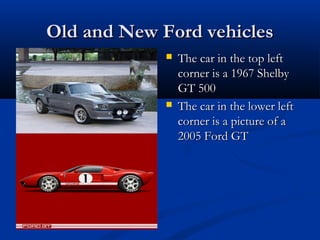
Old and New Ford vehicles
                The car in the top left
                 corner is a 1967 Shelby
                 GT 500
                The car in the lower left
                 corner is a picture of a
                 2005 Ford GT
Old and New Chevy's
   In the top right corner is
    a 1970 Chevrolet
    Chevelle SS.
   On your bottom right is
    a 2004 SSR.
Old and New Dodges
            To your top left is a 2004
             dodge viper.
            At the your bottom left
             is a dodge charger.
New and Old Pontiacs
   In the top right is a 2004
    gto.
   In the bottom right is a
    1970 gto you can see
    how much technology
    has improved.
EFFICIENCY
   Definition and it dependance


     • As the temperature difference
     between hot and cold increases.
     – Heat’s change in entropy increases.
     – A heat pump becomes less efficient.
     – A heat engine becomes more
     efficient.
TRANSMISSION
• Changes force/distance (actually
torque/rotation rate) relationships
between
the engine and the wheels
• Two basic types
– Manual: clutch and gears
– Automatic: fluid coupling and gears
Manual Transmission

• Clutch uses friction to convey torque
from
engine to drive shaft
  Opening clutch decouples engine and
shaft
Closing clutch allows engine to twist
shaft
• Gears control mechanical advantage
Automatic Transmission

   Fluid coupling uses moving fluid to convey
    torque to drive shaft
    Engine turns impeller (fan) that pushes fluid
    Moving fluid spins turbine (fan) and drive shaft
    Decoupling isn’t required Gears control
    mechanical advantage
Top view
Hydraulic automobile
Electric automobiles.
HEAT PUMPS


   • A heat pump transfers some heat from
   cold to hot, against the natural flow, as it
   converts useful work into heat
   – Reverse heat flow decreases entropy
   – Converting work to heat increases entropy
   • Entropy doesn’t decrease
   • Some heat flows from cold to hot
HEAT ENGINE


   A heat engine diverts some heat as it
   flows naturally from hot to cold and
   converts that heat into useful work
   – Natural heat flow increases entropy
   – Converting heat to work decreases entropy
    Entropy doesn’t decrease
    Some heat becomes work
Engine, Step 1

   • Fuel and air mixture after induction stroke
   • Pressure = Atmospheric
   • Temperature = Ambient


          Engine, Step 1
Engine, Step 2


• Fuel/airmixture
after compression
stroke
• Pressure = High
• Temperature = Hot
ENGINE STEP 3

•  Burned gases after ignition
 • Pressure = Very high

 • Temperature = Very hot
Diesel Engine
• Uses compression heating
to ignite fuel
– Squeezes pure air to high
pressure/temperature
– Injects fuel into air
between compression and
power
strokes
– Fuel burns upon entry into
superheated air
• Power stroke extracts work
from burned gase
Internal Combustion Engine

 • Burns fuel and air in enclosed space
 • Produces hot burned gases

 • Allows heat to flow to cold outside air

 • Converts some heat into useful work
Four Stroke Engine

• Induction Stroke: fill cylinder with fuel & air
 • Compression Stroke: squeeze mixture
 • Power Stroke: burn and extract work
 • Exhaust Stroke: empty cylinder of exhaust•
   Induction Stroke: fill cylinder with fuel & air
 • Compression Stroke: squeeze mixture
 • Power Stroke: burn and extract work
 • Exhaust Stroke: empty cylinder of exhaust
Induction Stroke
   • Engine pulls piston out of cylinder
   • Low pressure inside cylinder
   • Atmospheric pressure pushes
   fuel and air mixture into cylinder
   • Engine does work on the gases
   during this stroke
Compression Stroke
  Engine pushes piston into cylinder
 Mixture is compressed

to high
 pressure and

 temperature
 Engine does work

on the gases
 during this stroke
Power Stroke
  Mixture burns to form
 hot gases
 Gases push piston

out of cylinder
 Gases expand to lower

pressureand temperature
 Gases do work on

engine during
this stroke
Thank you for having your
        attention

Automobile

  • 1.
    Presentation on Automobiles Naveen Sihag B.Tech(CS)
  • 2.
    Contents.  Introduction  Summary of automobiles.  The First Mast Produced Car  Necessity of cars  Different models of cars  Efficiency  Transmission and its modes  Brakes  Heat pumps.  Heat engines.
  • 3.
    Introduction  Automobiles plays a very vital role in our daily life, a person who wants to sustain in this world must have to be aware of these facts,and auto- mobiles are the one those major things in which a single word “technology” is dominating completely .Modern technologies are introduced in automobiles to increase their efficiences as well as their looks, and now if you have drunked ,then the car don’t allow you to sit over the driver’s seat and let you drive.
  • 4.
    Summary About Automobiles •Cylinders expand hot gas to do work • Uses the flow of heat from hot burned gases to cold atmosphere to produce work • Energy efficiency is limited by thermodyn. • Higher temperatures increase efficiency
  • 5.
    The first mastproduce car.  This to your right is the model T.  The first mast produce car.  Henry Ford designed this car which was one of the most popular of it’s time.  It made going from point a to point b a lot easier than a horse and buggy.
  • 6.
    Why are carsimportant today?  Car are so important today because they are what we use for transportation.  If we did not have cars we would not be able to just go down to the store you would have to walk to the store and back with what you bought that would be a pain.
  • 7.
    Old and NewFord vehicles  The car in the top left corner is a 1967 Shelby GT 500  The car in the lower left corner is a picture of a 2005 Ford GT
  • 8.
    Old and NewChevy's  In the top right corner is a 1970 Chevrolet Chevelle SS.  On your bottom right is a 2004 SSR.
  • 9.
    Old and NewDodges  To your top left is a 2004 dodge viper.  At the your bottom left is a dodge charger.
  • 10.
    New and OldPontiacs  In the top right is a 2004 gto.  In the bottom right is a 1970 gto you can see how much technology has improved.
  • 11.
    EFFICIENCY  Definition and it dependance • As the temperature difference between hot and cold increases. – Heat’s change in entropy increases. – A heat pump becomes less efficient. – A heat engine becomes more efficient.
  • 12.
    TRANSMISSION • Changes force/distance(actually torque/rotation rate) relationships between the engine and the wheels • Two basic types – Manual: clutch and gears – Automatic: fluid coupling and gears
  • 13.
    Manual Transmission • Clutchuses friction to convey torque from engine to drive shaft Opening clutch decouples engine and shaft Closing clutch allows engine to twist shaft • Gears control mechanical advantage
  • 14.
    Automatic Transmission  Fluid coupling uses moving fluid to convey torque to drive shaft  Engine turns impeller (fan) that pushes fluid  Moving fluid spins turbine (fan) and drive shaft  Decoupling isn’t required Gears control mechanical advantage
  • 15.
  • 16.
  • 17.
  • 18.
    HEAT PUMPS  • A heat pump transfers some heat from  cold to hot, against the natural flow, as it  converts useful work into heat  – Reverse heat flow decreases entropy  – Converting work to heat increases entropy  • Entropy doesn’t decrease  • Some heat flows from cold to hot
  • 19.
    HEAT ENGINE  A heat engine diverts some heat as it  flows naturally from hot to cold and  converts that heat into useful work  – Natural heat flow increases entropy  – Converting heat to work decreases entropy  Entropy doesn’t decrease  Some heat becomes work
  • 20.
    Engine, Step 1  • Fuel and air mixture after induction stroke  • Pressure = Atmospheric  • Temperature = Ambient Engine, Step 1
  • 21.
    Engine, Step 2 •Fuel/airmixture after compression stroke • Pressure = High • Temperature = Hot
  • 22.
    ENGINE STEP 3 • Burned gases after ignition  • Pressure = Very high  • Temperature = Very hot
  • 23.
    Diesel Engine • Usescompression heating to ignite fuel – Squeezes pure air to high pressure/temperature – Injects fuel into air between compression and power strokes – Fuel burns upon entry into superheated air • Power stroke extracts work from burned gase
  • 24.
    Internal Combustion Engine • Burns fuel and air in enclosed space  • Produces hot burned gases  • Allows heat to flow to cold outside air  • Converts some heat into useful work
  • 25.
    Four Stroke Engine •Induction Stroke: fill cylinder with fuel & air  • Compression Stroke: squeeze mixture  • Power Stroke: burn and extract work  • Exhaust Stroke: empty cylinder of exhaust• Induction Stroke: fill cylinder with fuel & air  • Compression Stroke: squeeze mixture  • Power Stroke: burn and extract work  • Exhaust Stroke: empty cylinder of exhaust
  • 26.
    Induction Stroke  • Engine pulls piston out of cylinder  • Low pressure inside cylinder  • Atmospheric pressure pushes  fuel and air mixture into cylinder  • Engine does work on the gases  during this stroke
  • 27.
    Compression Stroke  Engine pushes piston into cylinder  Mixture is compressed to high  pressure and temperature  Engine does work on the gases  during this stroke
  • 28.
    Power Stroke  Mixture burns to form hot gases  Gases push piston out of cylinder  Gases expand to lower pressureand temperature  Gases do work on engine during this stroke
  • 29.
    Thank you forhaving your attention