MANAGEMENT CONCEPTS AND
FUNDAMENTALS
Ts.Oyundari Ph.D
Senior Lecturer School of Nursing
Contents
 WHAT IS MANAGEMENT?
 CONCEPT OF MANAGEMENT
 DEFINITION-MANAGEMENT
 IMPORTANCE OF MANAGEMENT
Two or more people who work together in a
structuredway to achieve a specific goal or set
of goals.
Management is the process of administering
and coordinating resources effectively and
efficiently in an effort to achieve the goals of
the organization.
MANAGEMENT
CONCEPT OF MANAGEMENT
The term management is used in three alternative
ways:
 Management as a discipline,
 Management as a group of people,
 Management as a process.
WHAT IS MANAGEMENT?
1.Field of Study -Management principles,
techniques, functions, etc-Profession
2.Team or Class of people-Individual who
performs managerial activities or may be a
group of persons
3.Process-Managerial activities -planning,
organizing, staffing, directing, controlling.
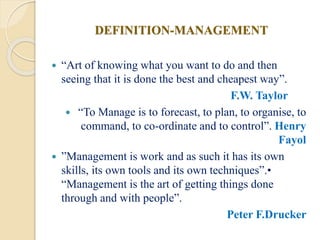
DEFINITION-MANAGEMENT
 “Art of knowing what you want to do and then
seeing that it is done the best and cheapest way”.
F.W. Taylor
 “To Manage is to forecast, to plan, to organise, to
command, to co-ordinate and to control”. Henry
Fayol
 ”Management is work and as such it has its own
skills, its own tools and its own techniques”.•
“Management is the art of getting things done
through and with people”.
Peter F.Drucker
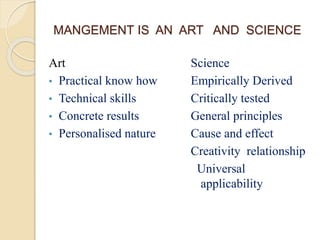
MANGEMENT IS AN ART AND SCIENCE
Art
• Practical know how
• Technical skills
• Concrete results
• Personalised nature
Science
Empirically Derived
Critically tested
General principles
Cause and effect
Creativity relationship
Universal
applicability
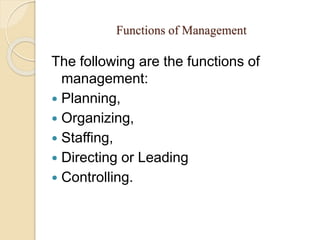
Functions of Management
The following are the functions of
management:
 Planning,
 Organizing,
 Staffing,
 Directing or Leading
 Controlling.
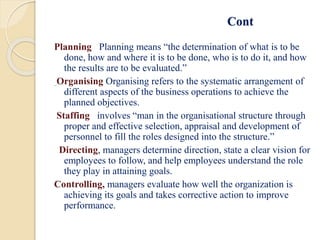
Cont
Planning Planning means “the determination of what is to be
done, how and where it is to be done, who is to do it, and how
the results are to be evaluated.”
Organising Organising refers to the systematic arrangement of
different aspects of the business operations to achieve the
planned objectives.
Staffing involves “man in the organisational structure through
proper and effective selection, appraisal and development of
personnel to fill the roles designed into the structure.”
Directing, managers determine direction, state a clear vision for
employees to follow, and help employees understand the role
they play in attaining goals.
Controlling, managers evaluate how well the organization is
achieving its goals and takes corrective action to improve
performance.
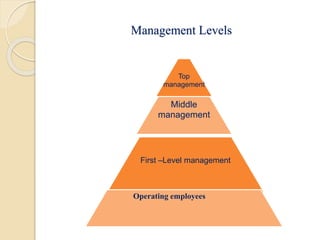
Management Levels
Top
management
Middle
management
First –Level management
Operating employees
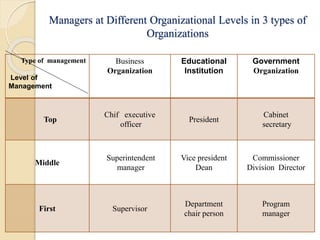
Managers at Different Organizational Levels in 3 types of
Organizations
Type of management
Level of
Management
Business
Organization
Educational
Institution
Government
Organization
Top
Chif executive
officer
President
Cabinet
secretary
Middle
Superintendent
manager
Vice president
Dean
Commissioner
Division Director
First Supervisor
Department
chair person
Program
manager
IMPORTANCE OF MANAGEMENT
 The importance of management may be traced in
the following contexts:
 Effective Utilisation of Resources
 Development of Resources
 To incorporate Innovations
 Integrating Various Interest Groups
 Stability in the Society
Thank you

Management concepts and

  • 1.
    MANAGEMENT CONCEPTS AND FUNDAMENTALS Ts.OyundariPh.D Senior Lecturer School of Nursing
  • 2.
    Contents  WHAT ISMANAGEMENT?  CONCEPT OF MANAGEMENT  DEFINITION-MANAGEMENT  IMPORTANCE OF MANAGEMENT
  • 3.
    Two or morepeople who work together in a structuredway to achieve a specific goal or set of goals. Management is the process of administering and coordinating resources effectively and efficiently in an effort to achieve the goals of the organization. MANAGEMENT
  • 4.
    CONCEPT OF MANAGEMENT Theterm management is used in three alternative ways:  Management as a discipline,  Management as a group of people,  Management as a process.
  • 5.
    WHAT IS MANAGEMENT? 1.Fieldof Study -Management principles, techniques, functions, etc-Profession 2.Team or Class of people-Individual who performs managerial activities or may be a group of persons 3.Process-Managerial activities -planning, organizing, staffing, directing, controlling.
  • 6.
    DEFINITION-MANAGEMENT  “Art ofknowing what you want to do and then seeing that it is done the best and cheapest way”. F.W. Taylor  “To Manage is to forecast, to plan, to organise, to command, to co-ordinate and to control”. Henry Fayol  ”Management is work and as such it has its own skills, its own tools and its own techniques”.• “Management is the art of getting things done through and with people”. Peter F.Drucker
  • 7.
    MANGEMENT IS ANART AND SCIENCE Art • Practical know how • Technical skills • Concrete results • Personalised nature Science Empirically Derived Critically tested General principles Cause and effect Creativity relationship Universal applicability
  • 8.
    Functions of Management Thefollowing are the functions of management:  Planning,  Organizing,  Staffing,  Directing or Leading  Controlling.
  • 9.
    Cont Planning Planning means“the determination of what is to be done, how and where it is to be done, who is to do it, and how the results are to be evaluated.” Organising Organising refers to the systematic arrangement of different aspects of the business operations to achieve the planned objectives. Staffing involves “man in the organisational structure through proper and effective selection, appraisal and development of personnel to fill the roles designed into the structure.” Directing, managers determine direction, state a clear vision for employees to follow, and help employees understand the role they play in attaining goals. Controlling, managers evaluate how well the organization is achieving its goals and takes corrective action to improve performance.
  • 10.
  • 11.
    Managers at DifferentOrganizational Levels in 3 types of Organizations Type of management Level of Management Business Organization Educational Institution Government Organization Top Chif executive officer President Cabinet secretary Middle Superintendent manager Vice president Dean Commissioner Division Director First Supervisor Department chair person Program manager
  • 12.
    IMPORTANCE OF MANAGEMENT The importance of management may be traced in the following contexts:  Effective Utilisation of Resources  Development of Resources  To incorporate Innovations  Integrating Various Interest Groups  Stability in the Society
  • 13.