INTRODUCTION TO
DRYING PROCESSES
Mr. R. R. Patil
Dr. Shivajirao Kadam College of Pharmacy,
Kasabe digraj, Sangli
Introduction
 “ Drying is defined as the final removal
of liquid from solids by vaporisation with
the aid of heat.”
 The equipment used for drying is called
dryer.
Theory of drying
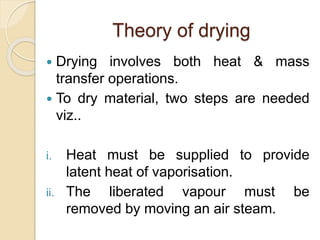
 Drying involves both heat & mass
transfer operations.
 To dry material, two steps are needed
viz..
i. Heat must be supplied to provide
latent heat of vaporisation.
ii. The liberated vapour must be
removed by moving an air steam.
Cont..
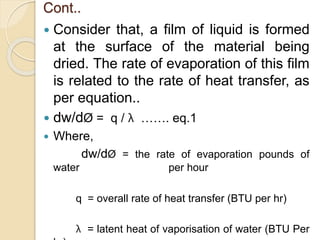
 Consider that, a film of liquid is formed
at the surface of the material being
dried. The rate of evaporation of this film
is related to the rate of heat transfer, as
per equation..
 dw/dØ = q / λ ……. eq.1
 Where,
dw/dØ = the rate of evaporation pounds of
water per hour
q = overall rate of heat transfer (BTU per hr)
λ = latent heat of vaporisation of water (BTU Per
Cont..
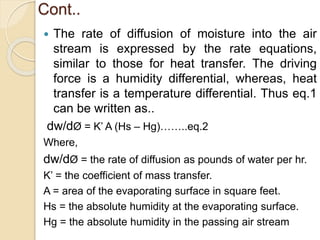
 The rate of diffusion of moisture into the air
stream is expressed by the rate equations,
similar to those for heat transfer. The driving
force is a humidity differential, whereas, heat
transfer is a temperature differential. Thus eq.1
can be written as..
dw/dØ = K’ A (Hs – Hg)……..eq.2
Where,
dw/dØ = the rate of diffusion as pounds of water per hr.
K’ = the coefficient of mass transfer.
A = area of the evaporating surface in square feet.
Hs = the absolute humidity at the evaporating surface.
Hg = the absolute humidity in the passing air stream
Cont…
 K’ is not a constant but it varies with the velocity
of the air stream passing over the evaporating
surface thus..
K’ = cGn
where, c = a proportionality constant
G = the rate of flow of air
n = a fractional exponent usually about
0.82
After certain period, the rate of evaporation is
equal to the rate of diffusion of vapour. The rate
of heat transfer can be equated with the rate of
mass transfer i.e eq.1 can be equated with eq.2
i.e
Applications of drying
 Used in manufacturing of granules.
 Used to reduce the bulk & weight of
material.
 It helps in the preservation of crude drugs
or plant from mould growth.
 It helps in the size reduction process.
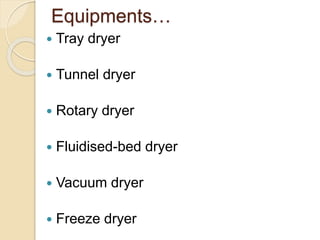
Equipments…
 Tray dryer
 Tunnel dryer
 Rotary dryer
 Fluidised-bed dryer
 Vacuum dryer
 Freeze dryer
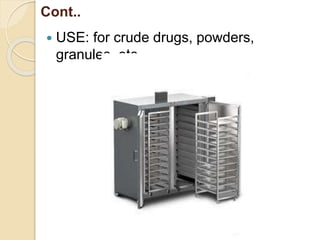
 It is the simplest form of dryer, in this
arrangement of heater at the bottom in cabinet
e.g. laboratory oven.
 In that the best type of tray dryer is directed
circulation form, in which air is heated & is
directed across the material in a controlled flow.
 In modern tray dryers, a uniform temperature &
air flow is maintained by the use of a well
cabinet with strategically placed fans & heating
coil.
 In that heater is fixed in a such way that the air
is reheated before passing over each shelf.
 When the air passes over each shelf a certain
amount of heat is given up to provide latent
heat of vaporisation.
TRAY DRYER
Cont..
 USE: for crude drugs, powders,
granules. etc.
TUNNEL DRYER
 It is the same like tray dryer but only
modification in which oven is replaced
by a tunnel.
 In which, receive the damp material at
one end & discharge the dried product
at the other end.
 In that conveyor belt system can also be
used to pass the material through the
tunnel.
Cont..
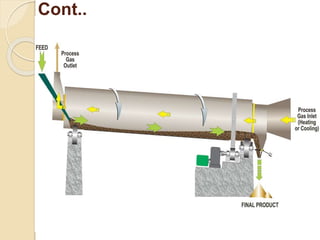
ROTARY DRYER
 It is a modified form of the tunnel dryer.
 In which the material pass through a rotating
cylinder, counter current to the stream of
heated air.
 It is a cylindrical shell which is mounted with
slight slope, so that the material fed in at one
end will move through it on slow rotation.
 Rotation speed near about 10 rpm.
 USE: powders, granules for continuous drying
purpose.
Cont..
FLUDISED BED DRYER
 It is a best dryer because, in that rapid
drying occurs.
 Theory: If a gas is allowed to flow
upward through a bed of solid particles at
a velocity greater than the velocity of the
particles, the particles are partially
suspended in the gas stream.
 The resultant mixture behaves like a
liquid, so solids is said to be fluidised.
Cont..
Cont..
 It have two types: Vertical & Horizontal fluidised
bed dryer.
 In that fan is mounted in the upper part of the
dryer.
 Air is heated by heaters & passed through the
wet material contained in a drying chamber.
 This chamber is fitted with a wire mesh support
at the bottom.
 The air flow rate is adjusted by re-circulation
control.
 Fabric filter bags are provided to prevent the
passage of fine particles.
 It is used for batch type dryer & the drying
chamber is removed from the unit for charging
Cont..
VACUUM DRYER
 This equipment is a good example of
conduction drier. The vacuum oven consists of
a jacketed vessel to withstand vacuum within
the oven.
 There are supports for the shelves giving a
larger area for conduction heat transfer. The
oven can be closed by a door.
 The oven is connected through a condenser
and liquid receiver to a vacuum pump.
 Operating pressure can be as low as 0.03-0.03
Cont..
Condenser
Connection to
Vacuum Pump
Condensat
e
Receiver
Steam or
Water
Jacket
FREEZE DRYER or LYOPHILIZATION
 It is also called as sublimation drying process
 In that process water is sublimed & removed from the
product after it is frozen at the reduced pressure.
 Theory:
 Material is frozen in a container connected to a high vacuum
system.
 Vapour pressure of material is reduced below the vapour
pressure at which it is dried i.e below the triple point.
 Under these conditions, heat transferred is used as latent
heat of sublimation to the product by means of radiant heat.
 Ice sublimes to vapours.
 Water vapours are removed by condensation.
Cont..
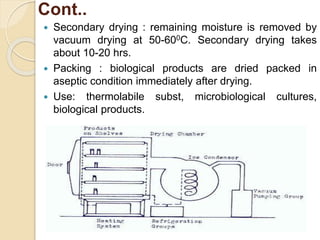
 Construction:
 Chamber for vacuum drying: having shelves
for keeping the material.
 Vacuum source: vacuum pump is connected
to the chamber.
 A heat source: heat is provided by
conduction or radiation or both.
 A vapour removal system: the condenser
consists of large cooled surface by solid
carbon dioxide mixed with acetone or ethanol.
Cont..
 Working:
 Pre-treatment : first solution is concentrated under
normal vacuum dryer before introducing in the
chamber.
 Pre-freezing : ampoules, vials & bottles having
aq.solution is packed & frozen in cold shelves at a
temperature below -500C.
 Primary drying :
 The material is spread.
 Temperature & pressure are kept below the triple point
of water.
 Heat is supplied.
 Ice sublimes into vapours.
 Vapours are removed from the chamber.
 98-99% moisture removes during primary drying.
Cont..
 Secondary drying : remaining moisture is removed by
vacuum drying at 50-600C. Secondary drying takes
about 10-20 hrs.
 Packing : biological products are dried packed in
aseptic condition immediately after drying.
 Use: thermolabile subst, microbiological cultures,
biological products.
Drum Dryer or Film Drying
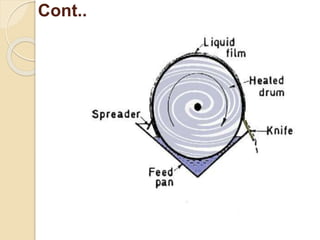
 It consists of a drum of about 0.75-1.5 m in
diameter and 2-4 m in length, heated
internally, usually by steam and rotated on
its longitudinal axis.
 Operation:
 The liquid is applied to the surface and
spread to a film, this may be done in various
ways, but the simplest method is that where
the drum dips into a feed pan. Drying rate is
controlled by using a suitable speed of
rotation and the drum temperature. The
product is scraped from the
surface of the drum by means of a doctor
Cont..
SPRAY DRYER
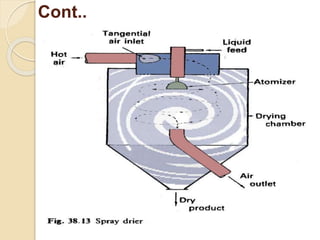
 The spray dryer provides a large surface area
for heat and mass transfer by atomizing the
liquid to small droplets.
 These are sprayed into a stream of hot air, so
that each droplet dries to a solid particle.
 The drying chamber resembles the cyclone
ensuring good circulation of air, to facilitate heat
and mass transfer, and that dried particles are
separated by the centrifugal action.
 Spray dryer can be operated efficiently at
various feed rates.
Cont..
drying-171229080826.pdf

drying-171229080826.pdf

  • 1.
    INTRODUCTION TO DRYING PROCESSES Mr.R. R. Patil Dr. Shivajirao Kadam College of Pharmacy, Kasabe digraj, Sangli
  • 2.
    Introduction  “ Dryingis defined as the final removal of liquid from solids by vaporisation with the aid of heat.”  The equipment used for drying is called dryer.
  • 3.
    Theory of drying Drying involves both heat & mass transfer operations.  To dry material, two steps are needed viz.. i. Heat must be supplied to provide latent heat of vaporisation. ii. The liberated vapour must be removed by moving an air steam.
  • 4.
    Cont..  Consider that,a film of liquid is formed at the surface of the material being dried. The rate of evaporation of this film is related to the rate of heat transfer, as per equation..  dw/dØ = q / λ ……. eq.1  Where, dw/dØ = the rate of evaporation pounds of water per hour q = overall rate of heat transfer (BTU per hr) λ = latent heat of vaporisation of water (BTU Per
  • 5.
    Cont..  The rateof diffusion of moisture into the air stream is expressed by the rate equations, similar to those for heat transfer. The driving force is a humidity differential, whereas, heat transfer is a temperature differential. Thus eq.1 can be written as.. dw/dØ = K’ A (Hs – Hg)……..eq.2 Where, dw/dØ = the rate of diffusion as pounds of water per hr. K’ = the coefficient of mass transfer. A = area of the evaporating surface in square feet. Hs = the absolute humidity at the evaporating surface. Hg = the absolute humidity in the passing air stream
  • 6.
    Cont…  K’ isnot a constant but it varies with the velocity of the air stream passing over the evaporating surface thus.. K’ = cGn where, c = a proportionality constant G = the rate of flow of air n = a fractional exponent usually about 0.82 After certain period, the rate of evaporation is equal to the rate of diffusion of vapour. The rate of heat transfer can be equated with the rate of mass transfer i.e eq.1 can be equated with eq.2 i.e
  • 7.
    Applications of drying Used in manufacturing of granules.  Used to reduce the bulk & weight of material.  It helps in the preservation of crude drugs or plant from mould growth.  It helps in the size reduction process.
  • 8.
    Equipments…  Tray dryer Tunnel dryer  Rotary dryer  Fluidised-bed dryer  Vacuum dryer  Freeze dryer
  • 9.
     It isthe simplest form of dryer, in this arrangement of heater at the bottom in cabinet e.g. laboratory oven.  In that the best type of tray dryer is directed circulation form, in which air is heated & is directed across the material in a controlled flow.  In modern tray dryers, a uniform temperature & air flow is maintained by the use of a well cabinet with strategically placed fans & heating coil.  In that heater is fixed in a such way that the air is reheated before passing over each shelf.  When the air passes over each shelf a certain amount of heat is given up to provide latent heat of vaporisation. TRAY DRYER
  • 10.
    Cont..  USE: forcrude drugs, powders, granules. etc.
  • 11.
    TUNNEL DRYER  Itis the same like tray dryer but only modification in which oven is replaced by a tunnel.  In which, receive the damp material at one end & discharge the dried product at the other end.  In that conveyor belt system can also be used to pass the material through the tunnel.
  • 12.
  • 13.
    ROTARY DRYER  Itis a modified form of the tunnel dryer.  In which the material pass through a rotating cylinder, counter current to the stream of heated air.  It is a cylindrical shell which is mounted with slight slope, so that the material fed in at one end will move through it on slow rotation.  Rotation speed near about 10 rpm.  USE: powders, granules for continuous drying purpose.
  • 14.
  • 15.
    FLUDISED BED DRYER It is a best dryer because, in that rapid drying occurs.  Theory: If a gas is allowed to flow upward through a bed of solid particles at a velocity greater than the velocity of the particles, the particles are partially suspended in the gas stream.  The resultant mixture behaves like a liquid, so solids is said to be fluidised.
  • 16.
  • 17.
    Cont..  It havetwo types: Vertical & Horizontal fluidised bed dryer.  In that fan is mounted in the upper part of the dryer.  Air is heated by heaters & passed through the wet material contained in a drying chamber.  This chamber is fitted with a wire mesh support at the bottom.  The air flow rate is adjusted by re-circulation control.  Fabric filter bags are provided to prevent the passage of fine particles.  It is used for batch type dryer & the drying chamber is removed from the unit for charging
  • 18.
  • 19.
    VACUUM DRYER  Thisequipment is a good example of conduction drier. The vacuum oven consists of a jacketed vessel to withstand vacuum within the oven.  There are supports for the shelves giving a larger area for conduction heat transfer. The oven can be closed by a door.  The oven is connected through a condenser and liquid receiver to a vacuum pump.  Operating pressure can be as low as 0.03-0.03
  • 20.
  • 21.
    FREEZE DRYER orLYOPHILIZATION  It is also called as sublimation drying process  In that process water is sublimed & removed from the product after it is frozen at the reduced pressure.  Theory:  Material is frozen in a container connected to a high vacuum system.  Vapour pressure of material is reduced below the vapour pressure at which it is dried i.e below the triple point.  Under these conditions, heat transferred is used as latent heat of sublimation to the product by means of radiant heat.  Ice sublimes to vapours.  Water vapours are removed by condensation.
  • 22.
    Cont..  Construction:  Chamberfor vacuum drying: having shelves for keeping the material.  Vacuum source: vacuum pump is connected to the chamber.  A heat source: heat is provided by conduction or radiation or both.  A vapour removal system: the condenser consists of large cooled surface by solid carbon dioxide mixed with acetone or ethanol.
  • 23.
    Cont..  Working:  Pre-treatment: first solution is concentrated under normal vacuum dryer before introducing in the chamber.  Pre-freezing : ampoules, vials & bottles having aq.solution is packed & frozen in cold shelves at a temperature below -500C.  Primary drying :  The material is spread.  Temperature & pressure are kept below the triple point of water.  Heat is supplied.  Ice sublimes into vapours.  Vapours are removed from the chamber.  98-99% moisture removes during primary drying.
  • 24.
    Cont..  Secondary drying: remaining moisture is removed by vacuum drying at 50-600C. Secondary drying takes about 10-20 hrs.  Packing : biological products are dried packed in aseptic condition immediately after drying.  Use: thermolabile subst, microbiological cultures, biological products.
  • 25.
    Drum Dryer orFilm Drying  It consists of a drum of about 0.75-1.5 m in diameter and 2-4 m in length, heated internally, usually by steam and rotated on its longitudinal axis.  Operation:  The liquid is applied to the surface and spread to a film, this may be done in various ways, but the simplest method is that where the drum dips into a feed pan. Drying rate is controlled by using a suitable speed of rotation and the drum temperature. The product is scraped from the surface of the drum by means of a doctor
  • 26.
  • 27.
    SPRAY DRYER  Thespray dryer provides a large surface area for heat and mass transfer by atomizing the liquid to small droplets.  These are sprayed into a stream of hot air, so that each droplet dries to a solid particle.  The drying chamber resembles the cyclone ensuring good circulation of air, to facilitate heat and mass transfer, and that dried particles are separated by the centrifugal action.  Spray dryer can be operated efficiently at various feed rates.
  • 28.