TERM ASSESSMENT -2
TOPIC : CONVENTIONAL
METHODS
OF
QUANTITATION
SUMMITED BY: HIMANSHU
(000FSM141513)
M.Sc. FORENSIC SCIENCE
SEMESTER-2
Analytical Chemistry
Analytical Chemistry deals with methods for
•Identification - of molecules / functional groups
•Structural Determination - determination of structure of a
molecule
•Quantification - Amount present in a sample/mixture
•Qualitative analysis – What is present/Identity of species
in a impure sample/mixture?
•Separation - Separation of mixtures – Chromatographic
Techniques.
Analytical chemistry has evolved from an art of court magicians to
alchemist’s into a science with applications throughout industry,
medicine, and all the sciences.
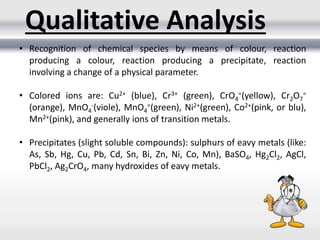
Qualitative Analysis
• Recognition of chemical species by means of colour, reaction
producing a colour, reaction producing a precipitate, reaction
involving a change of a physical parameter.
• Colored ions are: Cu2+ (blue), Cr3+ (green), CrO4
=(yellow), Cr2O7
=
(orange), MnO4
-(viole), MnO4
=(green), Ni2+(green), Co2+(pink, or blu),
Mn2+(pink), and generally ions of transition metals.
• Precipitates (slight soluble compounds): sulphurs of eavy metals (like:
As, Sb, Hg, Cu, Pb, Cd, Sn, Bi, Zn, Ni, Co, Mn), BaSO4, Hg2Cl2, AgCl,
PbCl2, Ag2CrO4, many hydroxides of eavy metals.
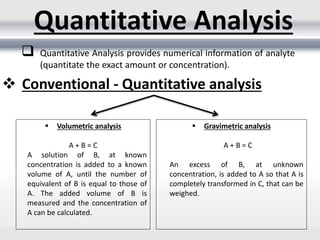
 Quantitative Analysis provides numerical information of analyte
(quantitate the exact amount or concentration).
Quantitative Analysis
 Conventional - Quantitative analysis
 Volumetric analysis
A + B = C
A solution of B, at known
concentration is added to a known
volume of A, until the number of
equivalent of B is equal to those of
A. The added volume of B is
measured and the concentration of
A can be calculated.
 Gravimetric analysis
A + B = C
An excess of B, at unknown
concentration, is added to A so that A is
completely transformed in C, that can be
weighed.
Volumetric Analysis
 It is a general term for a method in quantitative chemical
analysis in which the amount of a substance is determined by
the measurement of the volume that the substance occupies.
 It is commonly used to determine the unknown concentration of
a known reactant.
 Volumetric analysis is often referred to as titration, a laboratory
technique in which one substance of known concentration and
volume is used to react with another substance of
unknown concentration
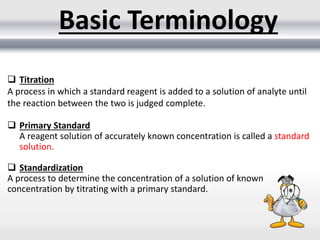
Basic Terminology
 Titration
A process in which a standard reagent is added to a solution of analyte until
the reaction between the two is judged complete.
 Primary Standard
A reagent solution of accurately known concentration is called a standard
solution.
 Standardization
A process to determine the concentration of a solution of known
concentration by titrating with a primary standard.
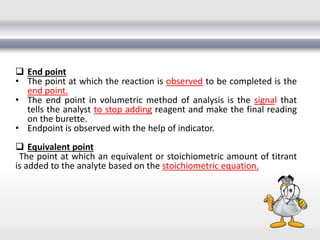
 End point
• The point at which the reaction is observed to be completed is the
end point.
• The end point in volumetric method of analysis is the signal that
tells the analyst to stop adding reagent and make the final reading
on the burette.
• Endpoint is observed with the help of indicator.
 Equivalent point
The point at which an equivalent or stoichiometric amount of titrant
is added to the analyte based on the stoichiometric equation.
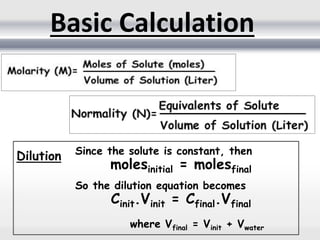
Since the solute is constant, then
molesinitial = molesfinal
So the dilution equation becomes
Cinit.Vinit = Cfinal.Vfinal
where Vfinal = Vinit + Vwater
Dilution
Basic Calculation
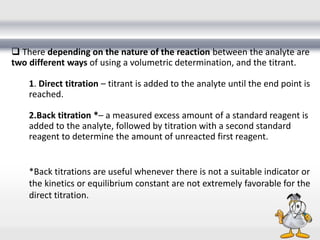
 There depending on the nature of the reaction between the analyte are
two different ways of using a volumetric determination, and the titrant.
1. Direct titration – titrant is added to the analyte until the end point is
reached.
2.Back titration *– a measured excess amount of a standard reagent is
added to the analyte, followed by titration with a second standard
reagent to determine the amount of unreacted first reagent.
*Back titrations are useful whenever there is not a suitable indicator or
the kinetics or equilibrium constant are not extremely favorable for the
direct titration.
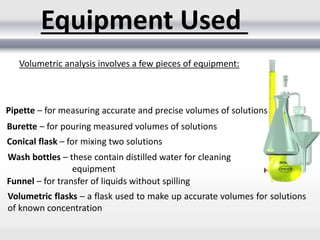
Equipment Used
Volumetric analysis involves a few pieces of equipment:
Pipette – for measuring accurate and precise volumes of solutions
Burette – for pouring measured volumes of solutions
Conical flask – for mixing two solutions
Wash bottles – these contain distilled water for cleaning
equipment
Funnel – for transfer of liquids without spilling
Volumetric flasks – a flask used to make up accurate volumes for solutions
of known concentration
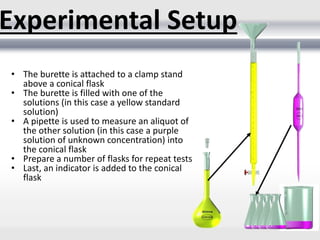
Experimental Setup
• The burette is attached to a clamp stand
above a conical flask
• The burette is filled with one of the
solutions (in this case a yellow standard
solution)
• A pipette is used to measure an aliquot of
the other solution (in this case a purple
solution of unknown concentration) into
the conical flask
• Prepare a number of flasks for repeat tests
• Last, an indicator is added to the conical
flask
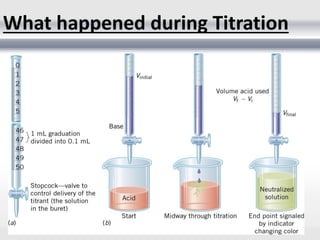
What happened during Titration
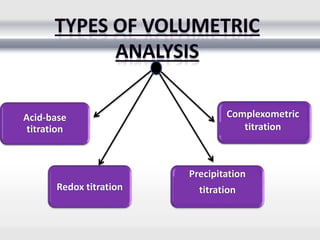
Complexometric
titration
Redox titration
Precipitation
titration
Acid-base
titration
Acid-base Titration
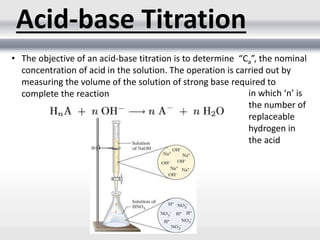
• The objective of an acid-base titration is to determine “Ca”, the nominal
concentration of acid in the solution. The operation is carried out by
measuring the volume of the solution of strong base required to
complete the reaction in which ‘n’ is
the number of
replaceable
hydrogen in
the acid
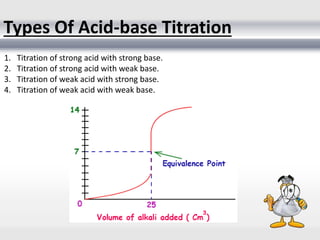
Types Of Acid-base Titration
1. Titration of strong acid with strong base.
2. Titration of strong acid with weak base.
3. Titration of weak acid with strong base.
4. Titration of weak acid with weak base.
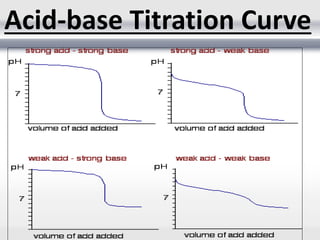
Acid-base Titration Curve
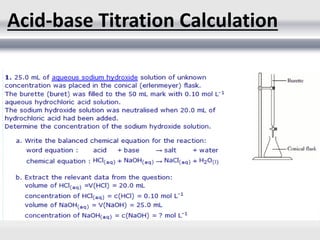
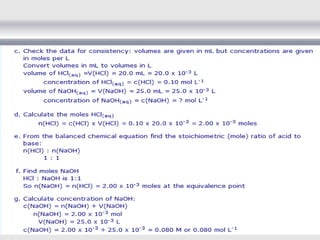
Acid-base Titration Calculation
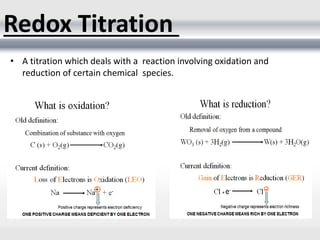
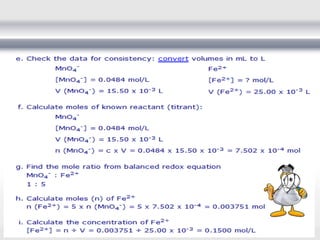
Redox Titration
• A titration which deals with a reaction involving oxidation and
reduction of certain chemical species.
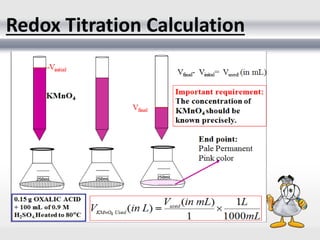
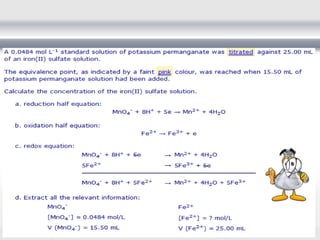
Redox Titration Calculation
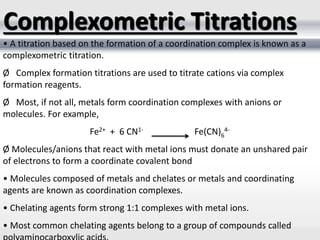
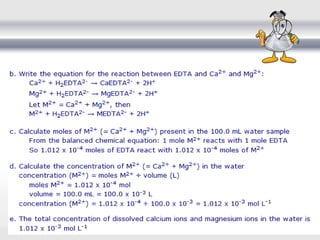
• A titration based on the formation of a coordination complex is known as a
complexometric titration.
Ø Complex formation titrations are used to titrate cations via complex
formation reagents.
Ø Most, if not all, metals form coordination complexes with anions or
molecules. For example,
Fe2+ + 6 CN1- Fe(CN)6
4-
Ø Molecules/anions that react with metal ions must donate an unshared pair
of electrons to form a coordinate covalent bond
• Molecules composed of metals and chelates or metals and coordinating
agents are known as coordination complexes.
• Chelating agents form strong 1:1 complexes with metal ions.
• Most common chelating agents belong to a group of compounds called
Complexometric Titrations
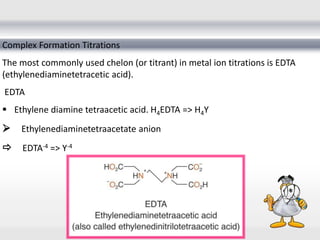
Complex Formation Titrations
The most commonly used chelon (or titrant) in metal ion titrations is EDTA
(ethylenediaminetetracetic acid).
EDTA
 Ethylene diamine tetraacetic acid. H4EDTA => H4Y
Ethylenediaminetetraacetate anion
 EDTA-4 => Y-4
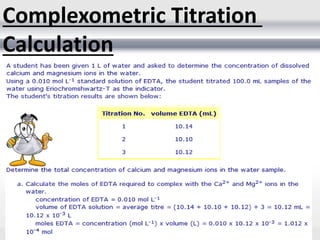
Complexometric Titration
Calculation
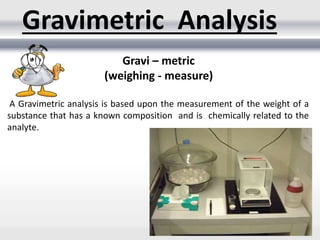
A Gravimetric analysis is based upon the measurement of the weight of a
substance that has a known composition and is chemically related to the
analyte.
Gravimetric Analysis
Gravi – metric
(weighing - measure)
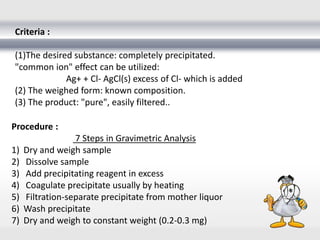
Criteria :
(1)The desired substance: completely precipitated.
"common ion" effect can be utilized:
Ag+ + Cl- AgCl(s) excess of Cl- which is added
(2) The weighed form: known composition.
(3) The product: "pure", easily filtered..
Procedure :
7 Steps in Gravimetric Analysis
1) Dry and weigh sample
2) Dissolve sample
3) Add precipitating reagent in excess
4) Coagulate precipitate usually by heating
5) Filtration-separate precipitate from mother liquor
6) Wash precipitate
7) Dry and weigh to constant weight (0.2-0.3 mg)
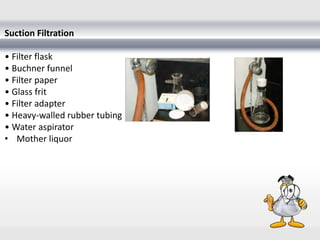
Suction Filtration
• Filter flask
• Buchner funnel
• Filter paper
• Glass frit
• Filter adapter
• Heavy-walled rubber tubing
• Water aspirator
• Mother liquor
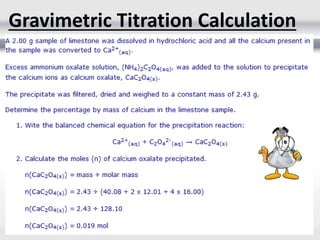
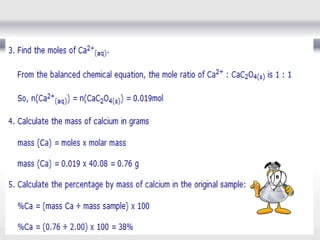
Gravimetric Titration Calculation
Conventional methods of quantitative analysis

Conventional methods of quantitative analysis

  • 1.
    TERM ASSESSMENT -2 TOPIC: CONVENTIONAL METHODS OF QUANTITATION SUMMITED BY: HIMANSHU (000FSM141513) M.Sc. FORENSIC SCIENCE SEMESTER-2
  • 2.
    Analytical Chemistry Analytical Chemistrydeals with methods for •Identification - of molecules / functional groups •Structural Determination - determination of structure of a molecule •Quantification - Amount present in a sample/mixture •Qualitative analysis – What is present/Identity of species in a impure sample/mixture? •Separation - Separation of mixtures – Chromatographic Techniques. Analytical chemistry has evolved from an art of court magicians to alchemist’s into a science with applications throughout industry, medicine, and all the sciences.
  • 4.
    Qualitative Analysis • Recognitionof chemical species by means of colour, reaction producing a colour, reaction producing a precipitate, reaction involving a change of a physical parameter. • Colored ions are: Cu2+ (blue), Cr3+ (green), CrO4 =(yellow), Cr2O7 = (orange), MnO4 -(viole), MnO4 =(green), Ni2+(green), Co2+(pink, or blu), Mn2+(pink), and generally ions of transition metals. • Precipitates (slight soluble compounds): sulphurs of eavy metals (like: As, Sb, Hg, Cu, Pb, Cd, Sn, Bi, Zn, Ni, Co, Mn), BaSO4, Hg2Cl2, AgCl, PbCl2, Ag2CrO4, many hydroxides of eavy metals.
  • 5.
     Quantitative Analysisprovides numerical information of analyte (quantitate the exact amount or concentration). Quantitative Analysis  Conventional - Quantitative analysis  Volumetric analysis A + B = C A solution of B, at known concentration is added to a known volume of A, until the number of equivalent of B is equal to those of A. The added volume of B is measured and the concentration of A can be calculated.  Gravimetric analysis A + B = C An excess of B, at unknown concentration, is added to A so that A is completely transformed in C, that can be weighed.
  • 7.
    Volumetric Analysis  Itis a general term for a method in quantitative chemical analysis in which the amount of a substance is determined by the measurement of the volume that the substance occupies.  It is commonly used to determine the unknown concentration of a known reactant.  Volumetric analysis is often referred to as titration, a laboratory technique in which one substance of known concentration and volume is used to react with another substance of unknown concentration
  • 8.
    Basic Terminology  Titration Aprocess in which a standard reagent is added to a solution of analyte until the reaction between the two is judged complete.  Primary Standard A reagent solution of accurately known concentration is called a standard solution.  Standardization A process to determine the concentration of a solution of known concentration by titrating with a primary standard.
  • 9.
     End point •The point at which the reaction is observed to be completed is the end point. • The end point in volumetric method of analysis is the signal that tells the analyst to stop adding reagent and make the final reading on the burette. • Endpoint is observed with the help of indicator.  Equivalent point The point at which an equivalent or stoichiometric amount of titrant is added to the analyte based on the stoichiometric equation.
  • 10.
    Since the soluteis constant, then molesinitial = molesfinal So the dilution equation becomes Cinit.Vinit = Cfinal.Vfinal where Vfinal = Vinit + Vwater Dilution Basic Calculation
  • 11.
     There dependingon the nature of the reaction between the analyte are two different ways of using a volumetric determination, and the titrant. 1. Direct titration – titrant is added to the analyte until the end point is reached. 2.Back titration *– a measured excess amount of a standard reagent is added to the analyte, followed by titration with a second standard reagent to determine the amount of unreacted first reagent. *Back titrations are useful whenever there is not a suitable indicator or the kinetics or equilibrium constant are not extremely favorable for the direct titration.
  • 12.
    Equipment Used Volumetric analysisinvolves a few pieces of equipment: Pipette – for measuring accurate and precise volumes of solutions Burette – for pouring measured volumes of solutions Conical flask – for mixing two solutions Wash bottles – these contain distilled water for cleaning equipment Funnel – for transfer of liquids without spilling Volumetric flasks – a flask used to make up accurate volumes for solutions of known concentration
  • 13.
    Experimental Setup • Theburette is attached to a clamp stand above a conical flask • The burette is filled with one of the solutions (in this case a yellow standard solution) • A pipette is used to measure an aliquot of the other solution (in this case a purple solution of unknown concentration) into the conical flask • Prepare a number of flasks for repeat tests • Last, an indicator is added to the conical flask
  • 14.
  • 15.
  • 16.
    Acid-base Titration • Theobjective of an acid-base titration is to determine “Ca”, the nominal concentration of acid in the solution. The operation is carried out by measuring the volume of the solution of strong base required to complete the reaction in which ‘n’ is the number of replaceable hydrogen in the acid
  • 17.
    Types Of Acid-baseTitration 1. Titration of strong acid with strong base. 2. Titration of strong acid with weak base. 3. Titration of weak acid with strong base. 4. Titration of weak acid with weak base.
  • 18.
  • 19.
  • 21.
    Redox Titration • Atitration which deals with a reaction involving oxidation and reduction of certain chemical species.
  • 22.
  • 25.
    • A titrationbased on the formation of a coordination complex is known as a complexometric titration. Ø Complex formation titrations are used to titrate cations via complex formation reagents. Ø Most, if not all, metals form coordination complexes with anions or molecules. For example, Fe2+ + 6 CN1- Fe(CN)6 4- Ø Molecules/anions that react with metal ions must donate an unshared pair of electrons to form a coordinate covalent bond • Molecules composed of metals and chelates or metals and coordinating agents are known as coordination complexes. • Chelating agents form strong 1:1 complexes with metal ions. • Most common chelating agents belong to a group of compounds called Complexometric Titrations
  • 26.
    Complex Formation Titrations Themost commonly used chelon (or titrant) in metal ion titrations is EDTA (ethylenediaminetetracetic acid). EDTA  Ethylene diamine tetraacetic acid. H4EDTA => H4Y Ethylenediaminetetraacetate anion  EDTA-4 => Y-4
  • 27.
  • 30.
    A Gravimetric analysisis based upon the measurement of the weight of a substance that has a known composition and is chemically related to the analyte. Gravimetric Analysis Gravi – metric (weighing - measure)
  • 31.
    Criteria : (1)The desiredsubstance: completely precipitated. "common ion" effect can be utilized: Ag+ + Cl- AgCl(s) excess of Cl- which is added (2) The weighed form: known composition. (3) The product: "pure", easily filtered.. Procedure : 7 Steps in Gravimetric Analysis 1) Dry and weigh sample 2) Dissolve sample 3) Add precipitating reagent in excess 4) Coagulate precipitate usually by heating 5) Filtration-separate precipitate from mother liquor 6) Wash precipitate 7) Dry and weigh to constant weight (0.2-0.3 mg)
  • 32.
    Suction Filtration • Filterflask • Buchner funnel • Filter paper • Glass frit • Filter adapter • Heavy-walled rubber tubing • Water aspirator • Mother liquor
  • 33.