Kevin Christian Dela Cruz, R.Ph.
sirRPh@yahoo.com
*
*
* Aka. Pharmaceutical Analysis
* Branch of chemistry which
provides information relative to
the composition of matter.
*
1. Qualitative
oAnswer the question:
•What is present in a given sample?
oDetermine the composition of the sample.
2. Quantitative
oAnswer the question:
•How much is present in the sample?
oDetermine the proportion of components in
a given sample?
*
1.Based on the sample size
2.Based on the extent of
determination
3.Based on nature of method
4.Based on materials used
*
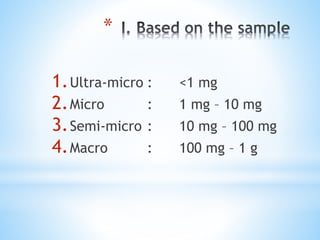
1.Ultra-micro : <1 mg
2.Micro : 1 mg – 10 mg
3.Semi-micro : 10 mg – 100 mg
4.Macro : 100 mg – 1 g
*
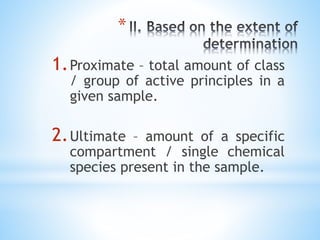
1.Proximate – total amount of class
/ group of active principles in a
given sample.
2.Ultimate – amount of a specific
compartment / single chemical
species present in the sample.
*
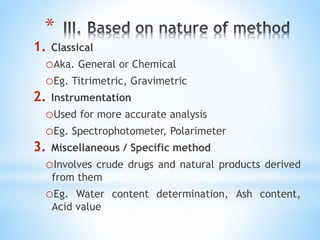
1. Classical
oAka. General or Chemical
oEg. Titrimetric, Gravimetric
2. Instrumentation
oUsed for more accurate analysis
oEg. Spectrophotometer, Polarimeter
3. Miscellaneous / Specific method
oInvolves crude drugs and natural products derived
from them
oEg. Water content determination, Ash content,
Acid value
*
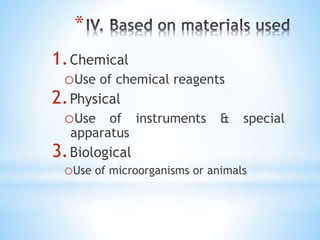
1.Chemical
oUse of chemical reagents
2.Physical
oUse of instruments & special
apparatus
3.Biological
oUse of microorganisms or animals
*
1.pH
2.Buffer Capacity
*
1.Negative logarithm of molar
concentration of Hydrogen ion;.
2.pH = -log[H+] or pH = log
1
[𝐻]
3.Henderson-Hasselbalch equation
opH = pka + log
[𝑠𝑎𝑙𝑡]
[𝑤𝑒𝑎𝑘 𝑎𝑐𝑖𝑑]
or
opH = pka + log
[𝑐𝑜𝑛𝑗𝑢𝑔𝑎𝑡𝑒 𝑏𝑎𝑠𝑒]
[𝑤𝑒𝑎𝑘 𝑎𝑐𝑖𝑑]
•pKa – acid dissociation constant
*
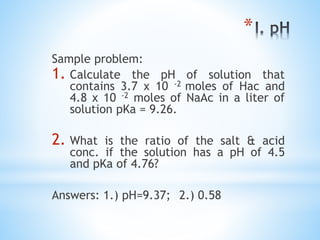
Sample problem:
1. Calculate the pH of solution that
contains 3.7 x 10 -2 moles of Hac and
4.8 x 10 -2 moles of NaAc in a liter of
solution pKa = 9.26.
2. What is the ratio of the salt & acid
conc. if the solution has a pH of 4.5
and pKa of 4.76?
Answers: 1.) pH=9.37; 2.) 0.58
*
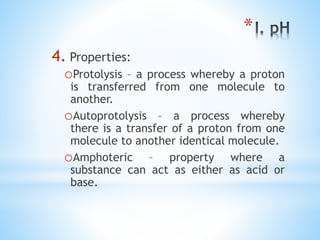
4. Properties:
oProtolysis – a process whereby a proton
is transferred from one molecule to
another.
oAutoprotolysis – a process whereby
there is a transfer of a proton from one
molecule to another identical molecule.
oAmphoteric – property where a
substance can act as either as acid or
base.
*
1. Ability of buffer solution to resist
change in pH upon addition to
acid/alkali.
2. BC equation =
[𝑠𝑡𝑟𝑜𝑛𝑔 𝑎𝑐𝑖𝑑 𝑜𝑟 𝑏𝑎𝑠𝑒]
Δ 𝑝𝐻
3. Van slyke:
Amount in g/L of strong acid or a strong
base required to be added to a solution to
change it’s pH by 1 unit.
*
1. Titrimetry**
2. Gravimetric **
3. Spectrometric method
4. Electrometric method
5. Chromatographic method
6. Miscellaneous method
*
An investigative (analytic) procedure in
laboratory medicine, pharmacology,
environmental biology and molecular
biology for qualitatively assessing or
quantitatively measuring the presence or
amount or the functional activity of a
target entity (the analyte).
*
1. Aka. Volumetric Analysis
oA process of determining volume of
standard solution (of known
concentration) required to react with a
known amount of substance being
assayed.
*
2. Definition of terms:
oAnalyte – aka. sample, active constituent, titrand
oStandard solution – aka. volumetric solution,
titrant
oIndicator – chemicals capable of changing color at
or near end point in w/c equivalent quantities of
analyte & std solution have reacted.
oEquivalent point – aka. Theoretical pt. or
Stoichiometric pt. is a point where the added
substance is chemically equivalent to the analyte or
sample.
oEnd point – experimental approximate of the Eq.Pt. which
could be observable.
*
3.Apparatus used:
a.Burets:
oMohr’s / base
oGeissler’s / acid
b.Cleaning solutions:
oNa2Cr2O7 in H2SO4
o(NH4)2S2O8 in H2SO4
oNa3PO4
oSynthetic detergents
*
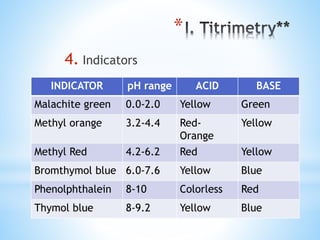
4. Indicators
INDICATOR pH range ACID BASE
Malachite green 0.0-2.0 Yellow Green
Methyl orange 3.2-4.4 Red-
Orange
Yellow
Methyl Red 4.2-6.2 Red Yellow
Bromthymol blue 6.0-7.6 Yellow Blue
Phenolphthalein 8-10 Colorless Red
Thymol blue 8-9.2 Yellow Blue
*
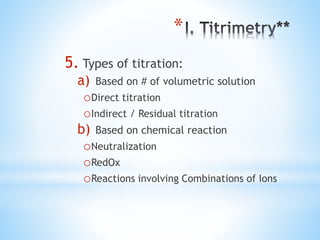
5. Types of titration:
a) Based on # of volumetric solution
oDirect titration
oIndirect / Residual titration
b) Based on chemical reaction
oNeutralization
oRedOx
oReactions involving Combinations of Ions
*
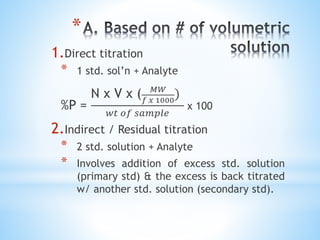
1.Direct titration
* 1 std. sol’n + Analyte
%P =
N x V x ( 𝑀𝑊
𝑓 𝑥 1000
)
𝑤𝑡 𝑜𝑓 𝑠𝑎𝑚𝑝𝑙𝑒
x 100
2.Indirect / Residual titration
* 2 std. solution + Analyte
* Involves addition of excess std. solution
(primary std) & the excess is back titrated
w/ another std. solution (secondary std).
*
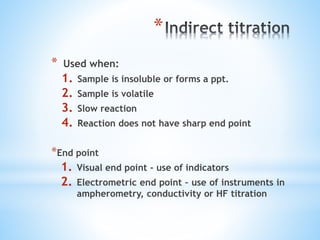
* Used when:
1. Sample is insoluble or forms a ppt.
2. Sample is volatile
3. Slow reaction
4. Reaction does not have sharp end point
*End point
1. Visual end point - use of indicators
2. Electrometric end point – use of instruments in
ampherometry, conductivity or HF titration
*
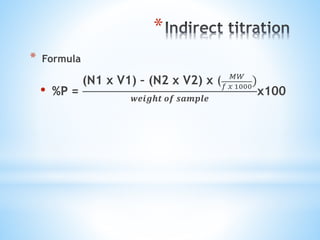
* Formula
• %P =
(N1 x V1) – (N2 x V2) x ( 𝑀𝑊
𝑓 𝑥 1000
)
𝒘𝒆𝒊𝒈𝒉𝒕 𝒐𝒇 𝒔𝒂𝒎𝒑𝒍𝒆
x100
*
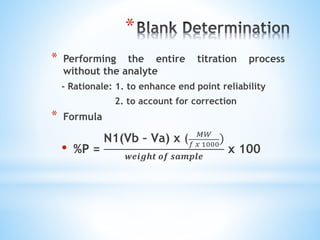
* Performing the entire titration process
without the analyte
- Rationale: 1. to enhance end point reliability
2. to account for correction
* Formula
• %P =
N1(Vb – Va) x ( 𝑀𝑊
𝑓 𝑥 1000
)
𝒘𝒆𝒊𝒈𝒉𝒕 𝒐𝒇 𝒔𝒂𝒎𝒑𝒍𝒆
x 100
*
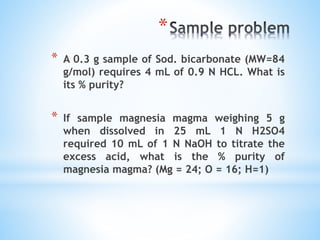
* A 0.3 g sample of Sod. bicarbonate (MW=84
g/mol) requires 4 mL of 0.9 N HCL. What is
its % purity?
* If sample magnesia magma weighing 5 g
when dissolved in 25 mL 1 N H2SO4
required 10 mL of 1 N NaOH to titrate the
excess acid, what is the % purity of
magnesia magma? (Mg = 24; O = 16; H=1)
*
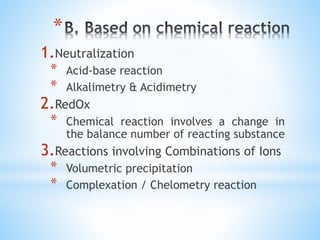
1.Neutralization
* Acid-base reaction
* Alkalimetry & Acidimetry
2.RedOx
* Chemical reaction involves a change in
the balance number of reacting substance
3.Reactions involving Combinations of Ions
* Volumetric precipitation
* Complexation / Chelometry reaction
*
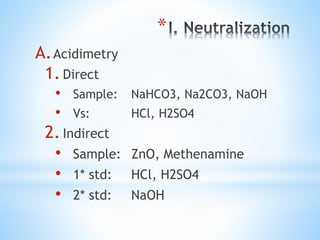
A.Acidimetry
1.Direct
• Sample: NaHCO3, Na2CO3, NaOH
• Vs: HCl, H2SO4
2.Indirect
• Sample: ZnO, Methenamine
• 1* std: HCl, H2SO4
• 2* std: NaOH
*
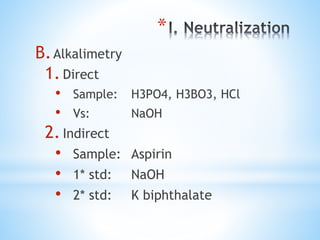
B.Alkalimetry
1.Direct
• Sample: H3PO4, H3BO3, HCl
• Vs: NaOH
2.Indirect
• Sample: Aspirin
• 1* std: NaOH
• 2* std: K biphthalate
*
1.Permanganometry
2.Iodimeetry
3.Iodometry
4.Cerimetry
*
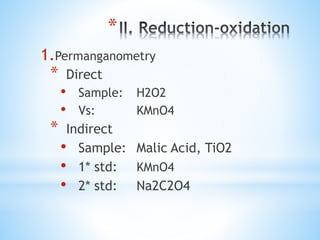
1.Permanganometry
* Direct
• Sample: H2O2
• Vs: KMnO4
* Indirect
• Sample: Malic Acid, TiO2
• 1* std: KMnO4
• 2* std: Na2C2O4
*
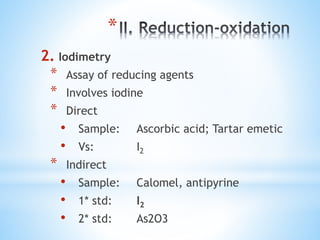
2. Iodimetry
* Assay of reducing agents
* Involves iodine
* Direct
• Sample: Ascorbic acid; Tartar emetic
• Vs: I2
* Indirect
• Sample: Calomel, antipyrine
• 1* std: I2
• 2* std: As2O3
*
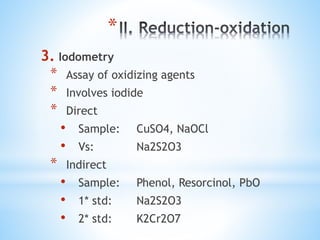
3. Iodometry
* Assay of oxidizing agents
* Involves iodide
* Direct
• Sample: CuSO4, NaOCl
• Vs: Na2S2O3
* Indirect
• Sample: Phenol, Resorcinol, PbO
• 1* std: Na2S2O3
• 2* std: K2Cr2O7
*
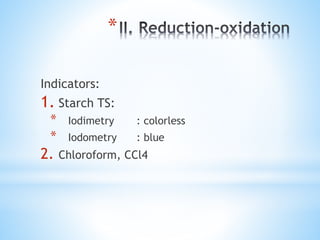
Indicators:
1. Starch TS:
* Iodimetry : colorless
* Iodometry : blue
2. Chloroform, CCl4
*
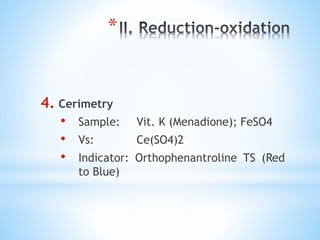
4. Cerimetry
• Sample: Vit. K (Menadione); FeSO4
• Vs: Ce(SO4)2
• Indicator: Orthophenantroline TS (Red
to Blue)
*
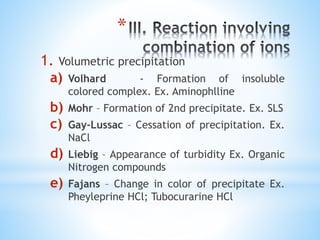
1. Volumetric precipitation
a) Volhard - Formation of insoluble
colored complex. Ex. Aminophlline
b) Mohr – Formation of 2nd precipitate. Ex. SLS
c) Gay-Lussac – Cessation of precipitation. Ex.
NaCl
d) Liebig – Appearance of turbidity Ex. Organic
Nitrogen compounds
e) Fajans – Change in color of precipitate Ex.
Pheyleprine HCl; Tubocurarine HCl
*
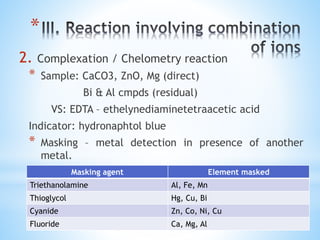
2. Complexation / Chelometry reaction
* Sample: CaCO3, ZnO, Mg (direct)
Bi & Al cmpds (residual)
VS: EDTA – ethelynediaminetetraacetic acid
Indicator: hydronaphtol blue
* Masking – metal detection in presence of another
metal.
Masking agent Element masked
Triethanolamine Al, Fe, Mn
Thioglycol Hg, Cu, Bi
Cyanide Zn, Co, Ni, Cu
Fluoride Ca, Mg, Al
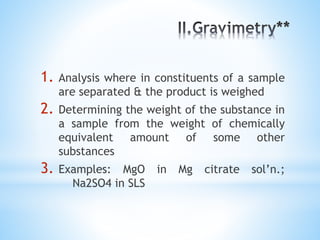
1. Analysis where in constituents of a sample
are separated & the product is weighed
2. Determining the weight of the substance in
a sample from the weight of chemically
equivalent amount of some other
substances
3. Examples: MgO in Mg citrate sol’n.;
Na2SO4 in SLS
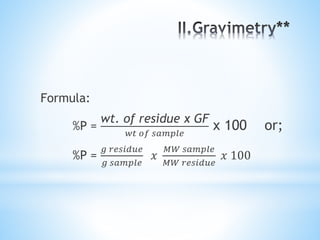
Formula:
%P =
wt. of residue x GF
𝑤𝑡 𝑜𝑓 𝑠𝑎𝑚𝑝𝑙𝑒
x 100 or;
%P =
𝑔 𝑟𝑒𝑠𝑖𝑑𝑢𝑒
𝑔 𝑠𝑎𝑚𝑝𝑙𝑒
𝑥
𝑀𝑊 𝑠𝑎𝑚𝑝𝑙𝑒
𝑀𝑊 𝑟𝑒𝑠𝑖𝑑𝑢𝑒
𝑥 100
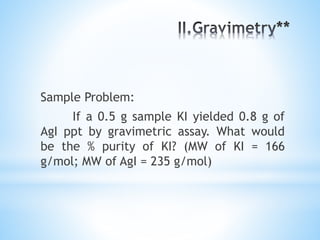
Sample Problem:
If a 0.5 g sample KI yielded 0.8 g of
AgI ppt by gravimetric assay. What would
be the % purity of KI? (MW of KI = 166
g/mol; MW of AgI = 235 g/mol)
Qc 1 review

Qc 1 review

  • 1.
    Kevin Christian DelaCruz, R.Ph. sirRPh@yahoo.com *
  • 2.
    * * Aka. PharmaceuticalAnalysis * Branch of chemistry which provides information relative to the composition of matter.
  • 3.
    * 1. Qualitative oAnswer thequestion: •What is present in a given sample? oDetermine the composition of the sample. 2. Quantitative oAnswer the question: •How much is present in the sample? oDetermine the proportion of components in a given sample?
  • 4.
    * 1.Based on thesample size 2.Based on the extent of determination 3.Based on nature of method 4.Based on materials used
  • 5.
    * 1.Ultra-micro : <1mg 2.Micro : 1 mg – 10 mg 3.Semi-micro : 10 mg – 100 mg 4.Macro : 100 mg – 1 g
  • 6.
    * 1.Proximate – totalamount of class / group of active principles in a given sample. 2.Ultimate – amount of a specific compartment / single chemical species present in the sample.
  • 7.
    * 1. Classical oAka. Generalor Chemical oEg. Titrimetric, Gravimetric 2. Instrumentation oUsed for more accurate analysis oEg. Spectrophotometer, Polarimeter 3. Miscellaneous / Specific method oInvolves crude drugs and natural products derived from them oEg. Water content determination, Ash content, Acid value
  • 8.
    * 1.Chemical oUse of chemicalreagents 2.Physical oUse of instruments & special apparatus 3.Biological oUse of microorganisms or animals
  • 9.
  • 10.
    * 1.Negative logarithm ofmolar concentration of Hydrogen ion;. 2.pH = -log[H+] or pH = log 1 [𝐻] 3.Henderson-Hasselbalch equation opH = pka + log [𝑠𝑎𝑙𝑡] [𝑤𝑒𝑎𝑘 𝑎𝑐𝑖𝑑] or opH = pka + log [𝑐𝑜𝑛𝑗𝑢𝑔𝑎𝑡𝑒 𝑏𝑎𝑠𝑒] [𝑤𝑒𝑎𝑘 𝑎𝑐𝑖𝑑] •pKa – acid dissociation constant
  • 11.
    * Sample problem: 1. Calculatethe pH of solution that contains 3.7 x 10 -2 moles of Hac and 4.8 x 10 -2 moles of NaAc in a liter of solution pKa = 9.26. 2. What is the ratio of the salt & acid conc. if the solution has a pH of 4.5 and pKa of 4.76? Answers: 1.) pH=9.37; 2.) 0.58
  • 12.
    * 4. Properties: oProtolysis –a process whereby a proton is transferred from one molecule to another. oAutoprotolysis – a process whereby there is a transfer of a proton from one molecule to another identical molecule. oAmphoteric – property where a substance can act as either as acid or base.
  • 13.
    * 1. Ability ofbuffer solution to resist change in pH upon addition to acid/alkali. 2. BC equation = [𝑠𝑡𝑟𝑜𝑛𝑔 𝑎𝑐𝑖𝑑 𝑜𝑟 𝑏𝑎𝑠𝑒] Δ 𝑝𝐻 3. Van slyke: Amount in g/L of strong acid or a strong base required to be added to a solution to change it’s pH by 1 unit.
  • 14.
    * 1. Titrimetry** 2. Gravimetric** 3. Spectrometric method 4. Electrometric method 5. Chromatographic method 6. Miscellaneous method
  • 15.
    * An investigative (analytic)procedure in laboratory medicine, pharmacology, environmental biology and molecular biology for qualitatively assessing or quantitatively measuring the presence or amount or the functional activity of a target entity (the analyte).
  • 16.
    * 1. Aka. VolumetricAnalysis oA process of determining volume of standard solution (of known concentration) required to react with a known amount of substance being assayed.
  • 17.
    * 2. Definition ofterms: oAnalyte – aka. sample, active constituent, titrand oStandard solution – aka. volumetric solution, titrant oIndicator – chemicals capable of changing color at or near end point in w/c equivalent quantities of analyte & std solution have reacted. oEquivalent point – aka. Theoretical pt. or Stoichiometric pt. is a point where the added substance is chemically equivalent to the analyte or sample. oEnd point – experimental approximate of the Eq.Pt. which could be observable.
  • 18.
    * 3.Apparatus used: a.Burets: oMohr’s /base oGeissler’s / acid b.Cleaning solutions: oNa2Cr2O7 in H2SO4 o(NH4)2S2O8 in H2SO4 oNa3PO4 oSynthetic detergents
  • 19.
    * 4. Indicators INDICATOR pHrange ACID BASE Malachite green 0.0-2.0 Yellow Green Methyl orange 3.2-4.4 Red- Orange Yellow Methyl Red 4.2-6.2 Red Yellow Bromthymol blue 6.0-7.6 Yellow Blue Phenolphthalein 8-10 Colorless Red Thymol blue 8-9.2 Yellow Blue
  • 20.
    * 5. Types oftitration: a) Based on # of volumetric solution oDirect titration oIndirect / Residual titration b) Based on chemical reaction oNeutralization oRedOx oReactions involving Combinations of Ions
  • 21.
    * 1.Direct titration * 1std. sol’n + Analyte %P = N x V x ( 𝑀𝑊 𝑓 𝑥 1000 ) 𝑤𝑡 𝑜𝑓 𝑠𝑎𝑚𝑝𝑙𝑒 x 100 2.Indirect / Residual titration * 2 std. solution + Analyte * Involves addition of excess std. solution (primary std) & the excess is back titrated w/ another std. solution (secondary std).
  • 22.
    * * Used when: 1.Sample is insoluble or forms a ppt. 2. Sample is volatile 3. Slow reaction 4. Reaction does not have sharp end point *End point 1. Visual end point - use of indicators 2. Electrometric end point – use of instruments in ampherometry, conductivity or HF titration
  • 23.
    * * Formula • %P= (N1 x V1) – (N2 x V2) x ( 𝑀𝑊 𝑓 𝑥 1000 ) 𝒘𝒆𝒊𝒈𝒉𝒕 𝒐𝒇 𝒔𝒂𝒎𝒑𝒍𝒆 x100
  • 24.
    * * Performing theentire titration process without the analyte - Rationale: 1. to enhance end point reliability 2. to account for correction * Formula • %P = N1(Vb – Va) x ( 𝑀𝑊 𝑓 𝑥 1000 ) 𝒘𝒆𝒊𝒈𝒉𝒕 𝒐𝒇 𝒔𝒂𝒎𝒑𝒍𝒆 x 100
  • 25.
    * * A 0.3g sample of Sod. bicarbonate (MW=84 g/mol) requires 4 mL of 0.9 N HCL. What is its % purity? * If sample magnesia magma weighing 5 g when dissolved in 25 mL 1 N H2SO4 required 10 mL of 1 N NaOH to titrate the excess acid, what is the % purity of magnesia magma? (Mg = 24; O = 16; H=1)
  • 26.
    * 1.Neutralization * Acid-base reaction *Alkalimetry & Acidimetry 2.RedOx * Chemical reaction involves a change in the balance number of reacting substance 3.Reactions involving Combinations of Ions * Volumetric precipitation * Complexation / Chelometry reaction
  • 27.
    * A.Acidimetry 1.Direct • Sample: NaHCO3,Na2CO3, NaOH • Vs: HCl, H2SO4 2.Indirect • Sample: ZnO, Methenamine • 1* std: HCl, H2SO4 • 2* std: NaOH
  • 28.
    * B.Alkalimetry 1.Direct • Sample: H3PO4,H3BO3, HCl • Vs: NaOH 2.Indirect • Sample: Aspirin • 1* std: NaOH • 2* std: K biphthalate
  • 29.
  • 30.
    * 1.Permanganometry * Direct • Sample:H2O2 • Vs: KMnO4 * Indirect • Sample: Malic Acid, TiO2 • 1* std: KMnO4 • 2* std: Na2C2O4
  • 31.
    * 2. Iodimetry * Assayof reducing agents * Involves iodine * Direct • Sample: Ascorbic acid; Tartar emetic • Vs: I2 * Indirect • Sample: Calomel, antipyrine • 1* std: I2 • 2* std: As2O3
  • 32.
    * 3. Iodometry * Assayof oxidizing agents * Involves iodide * Direct • Sample: CuSO4, NaOCl • Vs: Na2S2O3 * Indirect • Sample: Phenol, Resorcinol, PbO • 1* std: Na2S2O3 • 2* std: K2Cr2O7
  • 33.
    * Indicators: 1. Starch TS: *Iodimetry : colorless * Iodometry : blue 2. Chloroform, CCl4
  • 34.
    * 4. Cerimetry • Sample:Vit. K (Menadione); FeSO4 • Vs: Ce(SO4)2 • Indicator: Orthophenantroline TS (Red to Blue)
  • 35.
    * 1. Volumetric precipitation a)Volhard - Formation of insoluble colored complex. Ex. Aminophlline b) Mohr – Formation of 2nd precipitate. Ex. SLS c) Gay-Lussac – Cessation of precipitation. Ex. NaCl d) Liebig – Appearance of turbidity Ex. Organic Nitrogen compounds e) Fajans – Change in color of precipitate Ex. Pheyleprine HCl; Tubocurarine HCl
  • 36.
    * 2. Complexation /Chelometry reaction * Sample: CaCO3, ZnO, Mg (direct) Bi & Al cmpds (residual) VS: EDTA – ethelynediaminetetraacetic acid Indicator: hydronaphtol blue * Masking – metal detection in presence of another metal. Masking agent Element masked Triethanolamine Al, Fe, Mn Thioglycol Hg, Cu, Bi Cyanide Zn, Co, Ni, Cu Fluoride Ca, Mg, Al
  • 37.
    1. Analysis wherein constituents of a sample are separated & the product is weighed 2. Determining the weight of the substance in a sample from the weight of chemically equivalent amount of some other substances 3. Examples: MgO in Mg citrate sol’n.; Na2SO4 in SLS
  • 38.
    Formula: %P = wt. ofresidue x GF 𝑤𝑡 𝑜𝑓 𝑠𝑎𝑚𝑝𝑙𝑒 x 100 or; %P = 𝑔 𝑟𝑒𝑠𝑖𝑑𝑢𝑒 𝑔 𝑠𝑎𝑚𝑝𝑙𝑒 𝑥 𝑀𝑊 𝑠𝑎𝑚𝑝𝑙𝑒 𝑀𝑊 𝑟𝑒𝑠𝑖𝑑𝑢𝑒 𝑥 100
  • 39.
    Sample Problem: If a0.5 g sample KI yielded 0.8 g of AgI ppt by gravimetric assay. What would be the % purity of KI? (MW of KI = 166 g/mol; MW of AgI = 235 g/mol)