Boiler Efficiency
Calculations
Presenter:
Tahoor Alam Khan
Deputy Manager-Operations
RattanIndia Power Ltd., Amravati. (5x 270 MW)
CONTENTS
2
Methods of Boiler Efficiency Calculations
Pros and Cons of each Method
Improving Boiler Efficiency
3
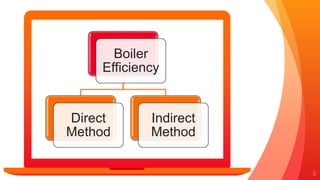
Boiler
Efficiency
Direct
Method
Indirect
Method
Direct Method
5
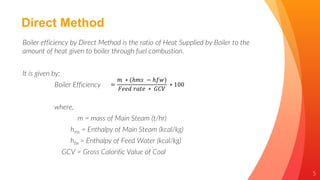
Direct Method
Boiler efficiency by Direct Method is the ratio of Heat Supplied by Boiler to the
amount of heat given to boiler through fuel combustion.
It is given by:
Boiler Efficiency
where,
m = mass of Main Steam (t/hr)
hms = Enthalpy of Main Steam (kcal/kg)
hfw = Enthalpy of Feed Water (kcal/kg)
GCV = Gross Calorific Value of Coal
=
𝑚 ∗ (ℎ𝑚𝑠 − ℎ𝑓𝑤)
𝐹𝑒𝑒𝑑 𝑟𝑎𝑡𝑒 ∗ 𝐺𝐶𝑉
∗ 100
6
Direct Method
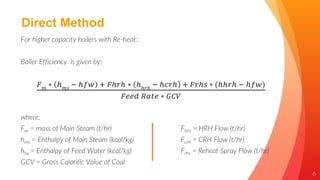
For higher capacity boilers with Re-heat:
Boiler Efficiency is given by:
𝐹𝑚
∗ ℎ𝑚𝑠
− ℎ𝑓𝑤 + 𝐹ℎ𝑟ℎ ∗ ℎℎ𝑟ℎ
− ℎ𝑐𝑟ℎ + 𝐹𝑟ℎ𝑠 ∗ (ℎℎ𝑟ℎ − ℎ𝑓𝑤)
𝐹𝑒𝑒𝑑 𝑅𝑎𝑡𝑒 ∗ 𝐺𝐶𝑉
where,
Fm = mass of Main Steam (t/hr) Fhrh = HRH Flow (t/hr)
hms = Enthalpy of Main Steam (kcal/kg) Fcrh = CRH Flow (t/hr)
hfw = Enthalpy of Feed Water (kcal/kg) Frhs = Reheat Spray Flow (t/hr)
GCV = Gross Calorific Value of Coal
7
Boiler
Efficiency
Direct
Method
Indirect
Method
Indirect Method
9
Indirect Method
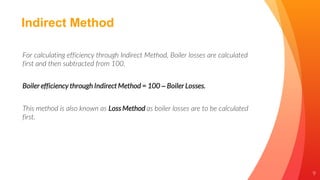
For calculating efficiency through Indirect Method, Boiler losses are calculated
first and then subtracted from 100.
Boiler efficiency through Indirect Method = 100 – Boiler Losses.
This method is also known as Loss Method as boiler losses are to be calculated
first.
10
Boiler
Losses
Dry Flue
Gas
H2 in
Fuel
Moisture
in Fuel
Unburnt
Carbon
Others
Moisture
in Air
11
Dry Flue Gas Loss
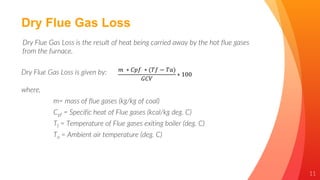
Dry Flue Gas Loss is the result of heat being carried away by the hot flue gases
from the furnace.
Dry Flue Gas Loss is given by: 𝑚 ∗ 𝐶𝑝𝑓 ∗ (𝑇𝑓 − 𝑇𝑎)
𝐺𝐶𝑉
∗ 100
where,
m= mass of flue gases (kg/kg of coal)
Cpf = Specific heat of Flue gases (kcal/kg deg. C)
Tf = Temperature of Flue gases exiting boiler (deg. C)
Ta = Ambient air temperature (deg. C)
12
Dry Flue Gas Loss
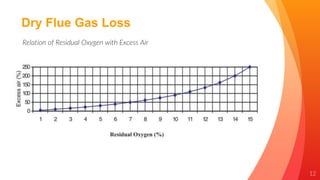
Relation of Residual Oxygen with Excess Air
13
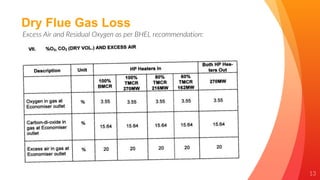
Excess Air and Residual Oxygen as per BHEL recommendation:
Dry Flue Gas Loss
14
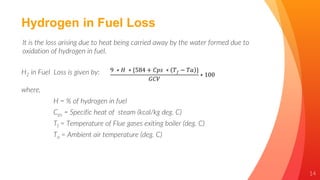
Hydrogen in Fuel Loss
It is the loss arising due to heat being carried away by the water formed due to
oxidation of hydrogen in fuel.
H2 in Fuel Loss is given by: 9 ∗ 𝐻 ∗ {584 + 𝐶𝑝𝑠 ∗ 𝑇𝑓 − 𝑇𝑎 }
𝐺𝐶𝑉
∗ 100
where,
H = % of hydrogen in fuel
Cps = Specific heat of steam (kcal/kg deg. C)
Tf = Temperature of Flue gases exiting boiler (deg. C)
Ta = Ambient air temperature (deg. C)
15
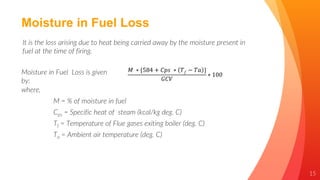
Moisture in Fuel Loss
It is the loss arising due to heat being carried away by the moisture present in
fuel at the time of firing.
Moisture in Fuel Loss is given
by:
𝑀 ∗ {584 + 𝐶𝑝𝑠 ∗ 𝑇𝑓 − 𝑇𝑎 }
𝐺𝐶𝑉
∗ 100
where,
M = % of moisture in fuel
Cps = Specific heat of steam (kcal/kg deg. C)
Tf = Temperature of Flue gases exiting boiler (deg. C)
Ta = Ambient air temperature (deg. C)
16
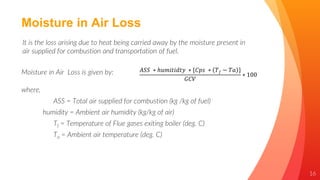
Moisture in Air Loss
It is the loss arising due to heat being carried away by the moisture present in
air supplied for combustion and transportation of fuel.
Moisture in Air Loss is given by: 𝐴𝑆𝑆 ∗ ℎ𝑢𝑚𝑖𝑡𝑖𝑑𝑡𝑦 ∗ {𝐶𝑝𝑠 ∗ 𝑇𝑓 − 𝑇𝑎 }
𝐺𝐶𝑉
∗ 100
where,
ASS = Total air supplied for combustion (kg /kg of fuel)
humidity = Ambient air humidity (kg/kg of air)
Tf = Temperature of Flue gases exiting boiler (deg. C)
Ta = Ambient air temperature (deg. C)
17
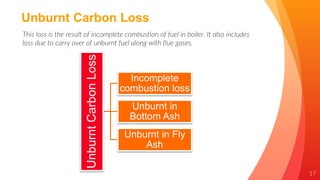
Unburnt Carbon Loss
This loss is the result of incomplete combustion of fuel in boiler. It also includes
loss due to carry over of unburnt fuel along with flue gases.
Unburnt
Carbon
Loss
Incomplete
combustion loss
Unburnt in
Bottom Ash
Unburnt in Fly
Ash
18
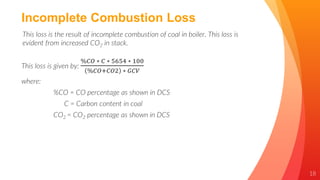
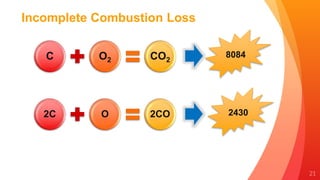
Incomplete Combustion Loss
This loss is the result of incomplete combustion of coal in boiler. This loss is
evident from increased CO2 in stack.
This loss is given by:
%𝐶𝑂 ∗ 𝐶 ∗ 5654 ∗ 100
%𝐶𝑂+𝐶𝑂2 ∗ 𝐺𝐶𝑉
where:
%CO = CO percentage as shown in DCS
C = Carbon content in coal
CO2 = CO2 percentage as shown in DCS
19
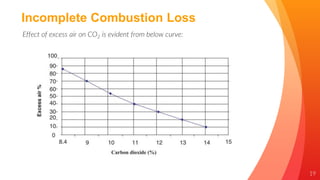
Incomplete Combustion Loss
Effect of excess air on CO2 is evident from below curve:
20
Incomplete Combustion Loss
How much heat do we
actually loose with
Incomplete
Combustion….
21
Incomplete Combustion Loss
C O2 CO2
8084
2C O 2CO 2430
22
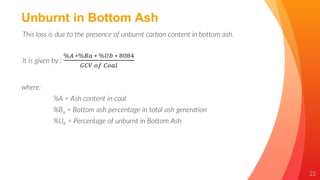
Unburnt in Bottom Ash
This loss is due to the presence of unburnt carbon content in bottom ash.
It is given by :
%𝐴 ∗%𝐵𝑎 ∗ %𝑈𝑏 ∗ 8084
𝐺𝐶𝑉 𝑜𝑓 𝐶𝑜𝑎𝑙
where:
%A = Ash content in coal
%Ba = Bottom ash percentage in total ash generation
%Ub = Percentage of unburnt in Bottom Ash
23
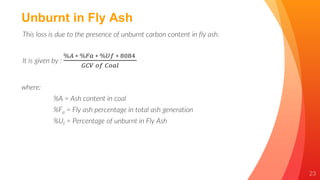
Unburnt in Fly Ash
This loss is due to the presence of unburnt carbon content in fly ash.
It is given by :
%𝐴 ∗ %𝐹𝑎 ∗ %𝑈𝑓 ∗ 8084
𝐺𝐶𝑉 𝑜𝑓 𝐶𝑜𝑎𝑙
where:
%A = Ash content in coal
%Fa = Fly ash percentage in total ash generation
%Uf = Percentage of unburnt in Fly Ash
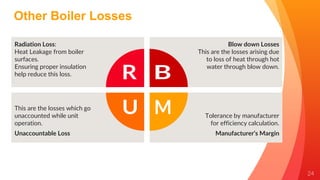
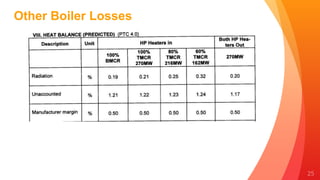
Other Boiler Losses
24
Radiation Loss:
Heat Leakage from boiler
surfaces.
Ensuring proper insulation
help reduce this loss.
Blow down Losses
This are the losses arising due
to loss of heat through hot
water through blow down.
This are the losses which go
unaccounted while unit
operation.
Unaccountable Loss
Tolerance by manufacturer
for efficiency calculation.
Manufacturer’s Margin
Other Boiler Losses
25
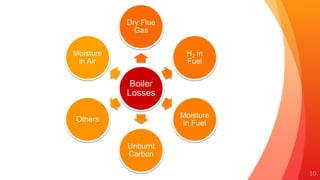
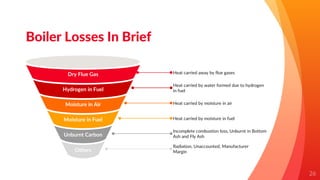
Boiler Losses In Brief
26
Unburnt Carbon
Others
Dry Flue Gas
Moisture in Air
Hydrogen in Fuel
Moisture in Fuel
Heat carried away by flue gases
Heat carried by water formed due to hydrogen
in fuel
Heat carried by moisture in fuel
Incomplete combustion loss, Unburnt in Bottom
Ash and Fly Ash
Radiation, Unaccounted, Manufacturer
Margin
Heat carried by moisture in air
27
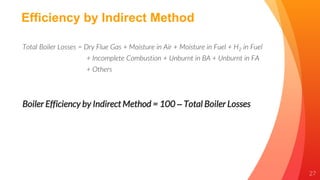
Efficiency by Indirect Method
Total Boiler Losses = Dry Flue Gas + Moisture in Air + Moisture in Fuel + H2 in Fuel
+ Incomplete Combustion + Unburnt in BA + Unburnt in FA
+ Others
Boiler Efficiency by Indirect Method = 100 – Total Boiler Losses
28
Methods of Boiler Efficiency Calculations
Pros and Cons of each Method
Improving Boiler Efficiency
CONTENTS
Optimization of
Boiler Losses
29
30
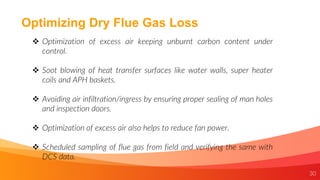
Optimizing Dry Flue Gas Loss
 Optimization of excess air keeping unburnt carbon content under
control.
 Soot blowing of heat transfer surfaces like water walls, super heater
coils and APH baskets.
 Avoiding air infiltration/ingress by ensuring proper sealing of man holes
and inspection doors.
 Optimization of excess air also helps to reduce fan power.
 Scheduled sampling of flue gas from field and verifying the same with
DCS data.
31
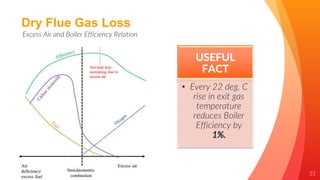
Excess Air and Boiler Efficiency Relation
Dry Flue Gas Loss
USEFUL
FACT
• Every 22 deg. C
rise in exit gas
temperature
reduces Boiler
Efficiency by
1%.
32
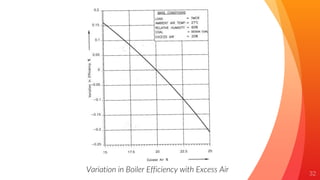
Variation in Boiler Efficiency with Excess Air
33
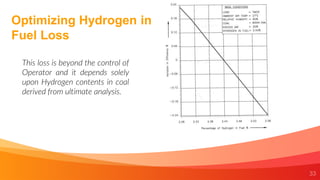
Optimizing Hydrogen in
Fuel Loss
This loss is beyond the control of
Operator and it depends solely
upon Hydrogen contents in coal
derived from ultimate analysis.
34
Optimizing Moisture in Fuel Loss
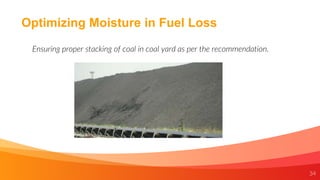
Ensuring proper stacking of coal in coal yard as per the recommendation.
35
Optimizing Moisture in Fuel Loss
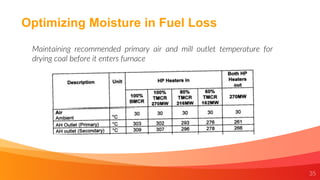
Maintaining recommended primary air and mill outlet temperature for
drying coal before it enters furnace
36
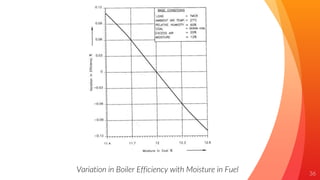
Variation in Boiler Efficiency with Moisture in Fuel
37
Optimizing Moisture in Air Loss
 Avoid air ingress in furnace through loose manholes and inspection
windows.
 Restricted use of cold air for tempering of mixed air for maintaining
mill outlet temperature.
 Maintaining recommended secondary air temperature at APH outlet
by APH soot blowing as per schedule.
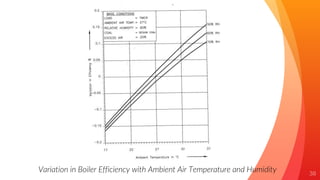
38
Variation in Boiler Efficiency with Ambient Air Temperature and Humidity
39
Optimizing Incomplete Combustion Loss
 Ensuring air rich mixture by supplying excess air for adequate
turbulence inside furnace.
 Coal to PA ratio too high or too low.
 Checking of SADC damper for their opening as per the command from
DCS.
 Ensuring equal burner tilt position at all corners.
 Ensuring equal velocity of coal in all four coal pipes.
40
Optimizing Unburnt in BA and FA
 Mill fineness to be checked at scheduled intervals. Classifier
adjustment, roller setting and roller replacement to be considered
when deterioration is observed in mill fineness.
 Restrict pulverized coal particle size of 50 mesh to <2% at mill outlet
and ensure more than 70% coal pass through 200mesh.
 AA dampers to be opened if unburnt in BA increases.
 Retention time of coal particles inside furnace to be ensured by
maintaining draught as per recommendation.
41
Methods of Boiler Efficiency Calculations
Pros and Cons of each Method
Improving Boiler Efficiency
CONTENTS
Pros
 Less parameters are
required.
 Less instrumentation
required.
 Rapid Calculations
 THR can be calculated
with minor changes
Pros and Cons of Direct Method
Cons
 Doesn’t furnish a
detailed report as to
why the efficiency is
lagging or leading.
 Cannot be used for
efficiency
improvement projects.
42
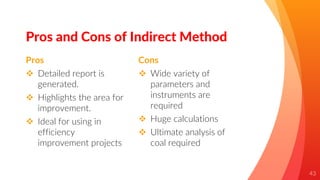
Pros
 Detailed report is
generated.
 Highlights the area for
improvement.
 Ideal for using in
efficiency
improvement projects
Pros and Cons of Indirect Method
Cons
 Wide variety of
parameters and
instruments are
required
 Huge calculations
 Ultimate analysis of
coal required
43
“
Great things are not done by
one person. They are done by
a team of people.
44
-Steve
Jobs
You can find me at:
tahoor.khan@rattanindia.com
www.linkedin.com/in/tahoorkhan

Boiler Efficiency Calculation by Direct & Indirect Method

  • 1.
    Boiler Efficiency Calculations Presenter: Tahoor AlamKhan Deputy Manager-Operations RattanIndia Power Ltd., Amravati. (5x 270 MW)
  • 2.
    CONTENTS 2 Methods of BoilerEfficiency Calculations Pros and Cons of each Method Improving Boiler Efficiency
  • 3.
  • 4.
  • 5.
    5 Direct Method Boiler efficiencyby Direct Method is the ratio of Heat Supplied by Boiler to the amount of heat given to boiler through fuel combustion. It is given by: Boiler Efficiency where, m = mass of Main Steam (t/hr) hms = Enthalpy of Main Steam (kcal/kg) hfw = Enthalpy of Feed Water (kcal/kg) GCV = Gross Calorific Value of Coal = 𝑚 ∗ (ℎ𝑚𝑠 − ℎ𝑓𝑤) 𝐹𝑒𝑒𝑑 𝑟𝑎𝑡𝑒 ∗ 𝐺𝐶𝑉 ∗ 100
  • 6.
    6 Direct Method For highercapacity boilers with Re-heat: Boiler Efficiency is given by: 𝐹𝑚 ∗ ℎ𝑚𝑠 − ℎ𝑓𝑤 + 𝐹ℎ𝑟ℎ ∗ ℎℎ𝑟ℎ − ℎ𝑐𝑟ℎ + 𝐹𝑟ℎ𝑠 ∗ (ℎℎ𝑟ℎ − ℎ𝑓𝑤) 𝐹𝑒𝑒𝑑 𝑅𝑎𝑡𝑒 ∗ 𝐺𝐶𝑉 where, Fm = mass of Main Steam (t/hr) Fhrh = HRH Flow (t/hr) hms = Enthalpy of Main Steam (kcal/kg) Fcrh = CRH Flow (t/hr) hfw = Enthalpy of Feed Water (kcal/kg) Frhs = Reheat Spray Flow (t/hr) GCV = Gross Calorific Value of Coal
  • 7.
  • 8.
  • 9.
    9 Indirect Method For calculatingefficiency through Indirect Method, Boiler losses are calculated first and then subtracted from 100. Boiler efficiency through Indirect Method = 100 – Boiler Losses. This method is also known as Loss Method as boiler losses are to be calculated first.
  • 10.
    10 Boiler Losses Dry Flue Gas H2 in Fuel Moisture inFuel Unburnt Carbon Others Moisture in Air
  • 11.
    11 Dry Flue GasLoss Dry Flue Gas Loss is the result of heat being carried away by the hot flue gases from the furnace. Dry Flue Gas Loss is given by: 𝑚 ∗ 𝐶𝑝𝑓 ∗ (𝑇𝑓 − 𝑇𝑎) 𝐺𝐶𝑉 ∗ 100 where, m= mass of flue gases (kg/kg of coal) Cpf = Specific heat of Flue gases (kcal/kg deg. C) Tf = Temperature of Flue gases exiting boiler (deg. C) Ta = Ambient air temperature (deg. C)
  • 12.
    12 Dry Flue GasLoss Relation of Residual Oxygen with Excess Air
  • 13.
    13 Excess Air andResidual Oxygen as per BHEL recommendation: Dry Flue Gas Loss
  • 14.
    14 Hydrogen in FuelLoss It is the loss arising due to heat being carried away by the water formed due to oxidation of hydrogen in fuel. H2 in Fuel Loss is given by: 9 ∗ 𝐻 ∗ {584 + 𝐶𝑝𝑠 ∗ 𝑇𝑓 − 𝑇𝑎 } 𝐺𝐶𝑉 ∗ 100 where, H = % of hydrogen in fuel Cps = Specific heat of steam (kcal/kg deg. C) Tf = Temperature of Flue gases exiting boiler (deg. C) Ta = Ambient air temperature (deg. C)
  • 15.
    15 Moisture in FuelLoss It is the loss arising due to heat being carried away by the moisture present in fuel at the time of firing. Moisture in Fuel Loss is given by: 𝑀 ∗ {584 + 𝐶𝑝𝑠 ∗ 𝑇𝑓 − 𝑇𝑎 } 𝐺𝐶𝑉 ∗ 100 where, M = % of moisture in fuel Cps = Specific heat of steam (kcal/kg deg. C) Tf = Temperature of Flue gases exiting boiler (deg. C) Ta = Ambient air temperature (deg. C)
  • 16.
    16 Moisture in AirLoss It is the loss arising due to heat being carried away by the moisture present in air supplied for combustion and transportation of fuel. Moisture in Air Loss is given by: 𝐴𝑆𝑆 ∗ ℎ𝑢𝑚𝑖𝑡𝑖𝑑𝑡𝑦 ∗ {𝐶𝑝𝑠 ∗ 𝑇𝑓 − 𝑇𝑎 } 𝐺𝐶𝑉 ∗ 100 where, ASS = Total air supplied for combustion (kg /kg of fuel) humidity = Ambient air humidity (kg/kg of air) Tf = Temperature of Flue gases exiting boiler (deg. C) Ta = Ambient air temperature (deg. C)
  • 17.
    17 Unburnt Carbon Loss Thisloss is the result of incomplete combustion of fuel in boiler. It also includes loss due to carry over of unburnt fuel along with flue gases. Unburnt Carbon Loss Incomplete combustion loss Unburnt in Bottom Ash Unburnt in Fly Ash
  • 18.
    18 Incomplete Combustion Loss Thisloss is the result of incomplete combustion of coal in boiler. This loss is evident from increased CO2 in stack. This loss is given by: %𝐶𝑂 ∗ 𝐶 ∗ 5654 ∗ 100 %𝐶𝑂+𝐶𝑂2 ∗ 𝐺𝐶𝑉 where: %CO = CO percentage as shown in DCS C = Carbon content in coal CO2 = CO2 percentage as shown in DCS
  • 19.
    19 Incomplete Combustion Loss Effectof excess air on CO2 is evident from below curve:
  • 20.
    20 Incomplete Combustion Loss Howmuch heat do we actually loose with Incomplete Combustion….
  • 21.
    21 Incomplete Combustion Loss CO2 CO2 8084 2C O 2CO 2430
  • 22.
    22 Unburnt in BottomAsh This loss is due to the presence of unburnt carbon content in bottom ash. It is given by : %𝐴 ∗%𝐵𝑎 ∗ %𝑈𝑏 ∗ 8084 𝐺𝐶𝑉 𝑜𝑓 𝐶𝑜𝑎𝑙 where: %A = Ash content in coal %Ba = Bottom ash percentage in total ash generation %Ub = Percentage of unburnt in Bottom Ash
  • 23.
    23 Unburnt in FlyAsh This loss is due to the presence of unburnt carbon content in fly ash. It is given by : %𝐴 ∗ %𝐹𝑎 ∗ %𝑈𝑓 ∗ 8084 𝐺𝐶𝑉 𝑜𝑓 𝐶𝑜𝑎𝑙 where: %A = Ash content in coal %Fa = Fly ash percentage in total ash generation %Uf = Percentage of unburnt in Fly Ash
  • 24.
    Other Boiler Losses 24 RadiationLoss: Heat Leakage from boiler surfaces. Ensuring proper insulation help reduce this loss. Blow down Losses This are the losses arising due to loss of heat through hot water through blow down. This are the losses which go unaccounted while unit operation. Unaccountable Loss Tolerance by manufacturer for efficiency calculation. Manufacturer’s Margin
  • 25.
  • 26.
    Boiler Losses InBrief 26 Unburnt Carbon Others Dry Flue Gas Moisture in Air Hydrogen in Fuel Moisture in Fuel Heat carried away by flue gases Heat carried by water formed due to hydrogen in fuel Heat carried by moisture in fuel Incomplete combustion loss, Unburnt in Bottom Ash and Fly Ash Radiation, Unaccounted, Manufacturer Margin Heat carried by moisture in air
  • 27.
    27 Efficiency by IndirectMethod Total Boiler Losses = Dry Flue Gas + Moisture in Air + Moisture in Fuel + H2 in Fuel + Incomplete Combustion + Unburnt in BA + Unburnt in FA + Others Boiler Efficiency by Indirect Method = 100 – Total Boiler Losses
  • 28.
    28 Methods of BoilerEfficiency Calculations Pros and Cons of each Method Improving Boiler Efficiency CONTENTS
  • 29.
  • 30.
    30 Optimizing Dry FlueGas Loss  Optimization of excess air keeping unburnt carbon content under control.  Soot blowing of heat transfer surfaces like water walls, super heater coils and APH baskets.  Avoiding air infiltration/ingress by ensuring proper sealing of man holes and inspection doors.  Optimization of excess air also helps to reduce fan power.  Scheduled sampling of flue gas from field and verifying the same with DCS data.
  • 31.
    31 Excess Air andBoiler Efficiency Relation Dry Flue Gas Loss USEFUL FACT • Every 22 deg. C rise in exit gas temperature reduces Boiler Efficiency by 1%.
  • 32.
    32 Variation in BoilerEfficiency with Excess Air
  • 33.
    33 Optimizing Hydrogen in FuelLoss This loss is beyond the control of Operator and it depends solely upon Hydrogen contents in coal derived from ultimate analysis.
  • 34.
    34 Optimizing Moisture inFuel Loss Ensuring proper stacking of coal in coal yard as per the recommendation.
  • 35.
    35 Optimizing Moisture inFuel Loss Maintaining recommended primary air and mill outlet temperature for drying coal before it enters furnace
  • 36.
    36 Variation in BoilerEfficiency with Moisture in Fuel
  • 37.
    37 Optimizing Moisture inAir Loss  Avoid air ingress in furnace through loose manholes and inspection windows.  Restricted use of cold air for tempering of mixed air for maintaining mill outlet temperature.  Maintaining recommended secondary air temperature at APH outlet by APH soot blowing as per schedule.
  • 38.
    38 Variation in BoilerEfficiency with Ambient Air Temperature and Humidity
  • 39.
    39 Optimizing Incomplete CombustionLoss  Ensuring air rich mixture by supplying excess air for adequate turbulence inside furnace.  Coal to PA ratio too high or too low.  Checking of SADC damper for their opening as per the command from DCS.  Ensuring equal burner tilt position at all corners.  Ensuring equal velocity of coal in all four coal pipes.
  • 40.
    40 Optimizing Unburnt inBA and FA  Mill fineness to be checked at scheduled intervals. Classifier adjustment, roller setting and roller replacement to be considered when deterioration is observed in mill fineness.  Restrict pulverized coal particle size of 50 mesh to <2% at mill outlet and ensure more than 70% coal pass through 200mesh.  AA dampers to be opened if unburnt in BA increases.  Retention time of coal particles inside furnace to be ensured by maintaining draught as per recommendation.
  • 41.
    41 Methods of BoilerEfficiency Calculations Pros and Cons of each Method Improving Boiler Efficiency CONTENTS
  • 42.
    Pros  Less parametersare required.  Less instrumentation required.  Rapid Calculations  THR can be calculated with minor changes Pros and Cons of Direct Method Cons  Doesn’t furnish a detailed report as to why the efficiency is lagging or leading.  Cannot be used for efficiency improvement projects. 42
  • 43.
    Pros  Detailed reportis generated.  Highlights the area for improvement.  Ideal for using in efficiency improvement projects Pros and Cons of Indirect Method Cons  Wide variety of parameters and instruments are required  Huge calculations  Ultimate analysis of coal required 43
  • 44.
    “ Great things arenot done by one person. They are done by a team of people. 44 -Steve Jobs You can find me at: tahoor.khan@rattanindia.com www.linkedin.com/in/tahoorkhan

Editor's Notes

  • #4 Enthalpy definition Gcv
  • #12 Why excess air is provided Cold end corosion Nitrogen
  • #13 EA calculation How much O2 in infinite air
  • #15 2H2 + O2 = 2H2O 4 + 32 = 36
  • #20 Percentage of CO2 is decreasing with increase in excess air
  • #35 This shape reduces surface area and hence less exposure to atm. Rainfall water do not accumulate
  • #40 1.5 to 1.9 PA to coal ratio