Design and Implementation of Ratio
controller in Two Conical Tank
Interacting Level System using PLC
and SCADA
Group members
Akhil K J
Jeinlal M V
Rajath P
Shelton Shibu
Guided by :Mr CLINT AUGUSTIN
Main Project
Problem Statement
• Conical shaped tank systems are used at
industry for easy drainage of products.
• The controlling of industrial equipment's are
done through the PLC.
• The main issue was level control of liquid in
a conical tank due to its change in cross-
section and non linearity of the tank
• Faced in most of the hydrometallurgical ,food,
chemical industries and waste treatment plants
Our Missions
• Design a non linear interacting system
• Create a ratio controller using ladder diagram in
PLC.
• Monitor the process parameters through SCADA
• Change the controller parameters through SCADA
• Designed and created two conical tank
interacting level system
• Designed and created ratio controller using PLC
and monitored through SCADA HMI
Missions Accomplished
Literature Survey
• Dynamic Matrix Control of a Two Conical Tank Interacting Level System- Science Direct
Procedia Engineering, Volume 38, 2012, Pages 2601-2610,V.R. Ravi, T. Thyagarajan, G.
Umaaheshwaran
• In this dynamic matrix control which meets the design specifications for MIMO systems
which is often complicated due to variation in process dynamics, that occur because of change
in operating point of nonlinear dynamic coupling are described.
• Centralized Neuro Controller for Two Conical Tank Interacting Level System.ieeexplore
Year: 2012, V. R. Ravi; T. Thyagarajan; B. Puviyarasi
• In this paper dynamic uncertainty associated with MIMO systems make existing model based
decoupling impractical for real time system. This work presents control of non linear Two
Conical Tank Interacting Level System (TCTILS) using centralised Neuro controller.
• Gain Scheduling Adaptive Model Predictive Controller for Two Conical Tank Interacting
Level System.-ieeexplore Year: 2012, V. R. Ravi; T. Thyagarajan; S. Yammuna Priyadharshni
• Gain scheduling adaptive (GSA) control strategy for MPC controller is investigated on Two
Conical Tank Interacting Level System (TCTILS) through computer simulation.
• Design and Implementation of Two Tank Conical Interacting System Using
Intelligent Technique (PSO).-ieeexplore Year: 2015, K. Malarvizhi;R. Kiruba
• This paper deals with the modeling and control of highly Nonlinear system using
intelligent technique namely Particle Swarm Optimization (PSO). Control of process
or process variable in process industries always employ a nonlinear system i.e., Two
Tank Interacting Conical tank System (TTICS)
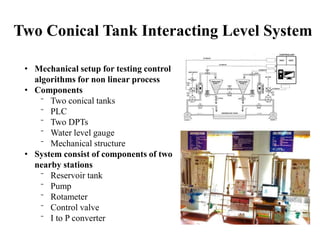
Two Conical Tank Interacting Level System
• Mechanical setup for testing control
algorithms for non linear process
• Components
⁻ Two conical tanks
⁻ PLC
⁻ Two DPTs
⁻ Water level gauge
⁻ Mechanical structure
• System consist of components of two
nearby stations
⁻ Reservoir tank
⁻ Pump
⁻ Rotameter
⁻ Control valve
⁻ I to P converter
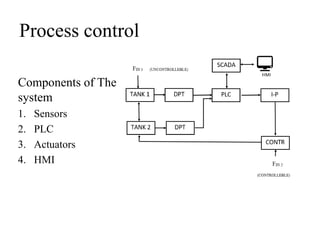
Process control
Components of The
system
1. Sensors
2. PLC
3. Actuators
4. HMI
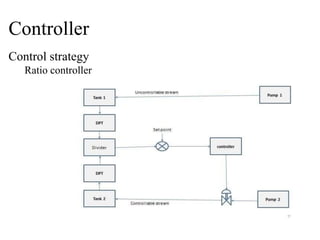
Controller
Control strategy
Ratio controller
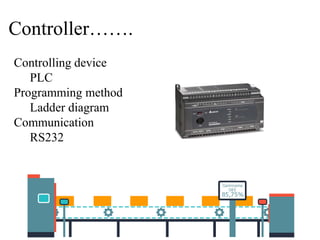
Controlling device
PLC
Programming method
Ladder diagram
Communication
RS232
Controller…….
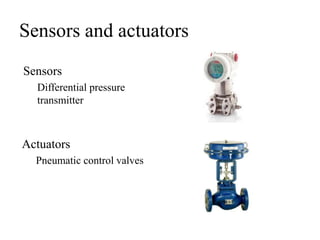
Sensors and actuators
Sensors
Differential pressure
transmitter
Actuators
Pneumatic control valves
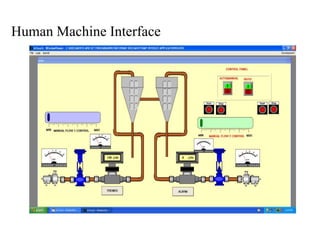
Human Machine Interface
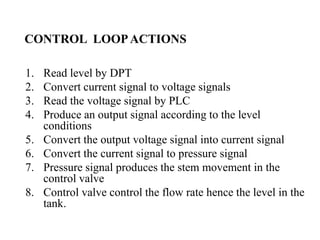
1. Read level by DPT
2. Convert current signal to voltage signals
3. Read the voltage signal by PLC
4. Produce an output signal according to the level
conditions
5. Convert the output voltage signal into current signal
6. Convert the current signal to pressure signal
7. Pressure signal produces the stem movement in the
control valve
8. Control valve control the flow rate hence the level in the
tank.
CONTROL LOOPACTIONS
SOFTWARE USED
WPLSoft
• For PLC programming
• Monitor the set value or temporarily saved
value in the timer(t),counter(c), and register
(D) and force on/off of output contacts
• Designed by DELTA ELECTRONICS
• Built in antivirus include.
SOFTWARE USED…….
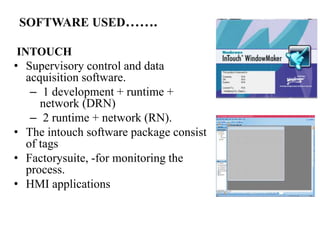
INTOUCH
• Supervisory control and data
acquisition software.
– 1 development + runtime +
network (DRN)
– 2 runtime + network (RN).
• The intouch software package consist
of tags
• Factorysuite, -for monitoring the
process.
• HMI applications
COMPONENTS USED
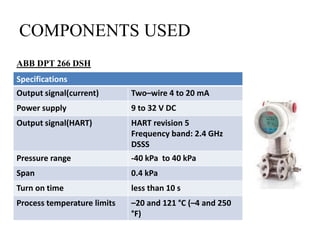
ABB DPT 266 DSH
Specifications
Output signal(current) Two–wire 4 to 20 mA
Power supply 9 to 32 V DC
Output signal(HART) HART revision 5
Frequency band: 2.4 GHz
DSSS
Pressure range -40 kPa to 40 kPa
Span 0.4 kPa
Turn on time less than 10 s
Process temperature limits –20 and 121 °C (–4 and 250
°F)
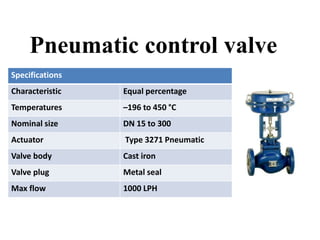
Pneumatic control valve
Specifications
Characteristic Equal percentage
Temperatures –196 to 450 °C
Nominal size DN 15 to 300
Actuator Type 3271 Pneumatic
Valve body Cast iron
Valve plug Metal seal
Max flow 1000 LPH
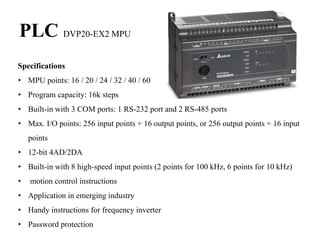
PLC DVP20-EX2 MPU
Specifications
• MPU points: 16 / 20 / 24 / 32 / 40 / 60
• Program capacity: 16k steps
• Built-in with 3 COM ports: 1 RS-232 port and 2 RS-485 ports
• Max. I/O points: 256 input points + 16 output points, or 256 output points + 16 input
points
• 12-bit 4AD/2DA
• Built-in with 8 high-speed input points (2 points for 100 kHz, 6 points for 10 kHz)
• motion control instructions
• Application in emerging industry
• Handy instructions for frequency inverter
• Password protection
Specifications
Make: watson smith
Input air: 20psi constant pressure
Signal input :( 4-20) ma
Output: pneumatic signal (3-15) psi
End connection: 1/2”BSP [F] thread
I to P converter
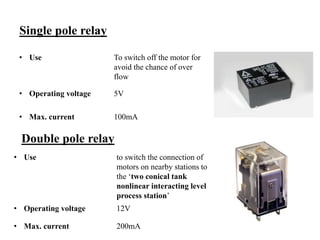
Single pole relay
• Use To switch off the motor for
avoid the chance of over
flow
• Operating voltage 5V
• Max. current 100mA
Double pole relay
• Use to switch the connection of
motors on nearby stations to
the ‘two conical tank
nonlinear interacting level
process station’
• Operating voltage 12V
• Max. current 200mA
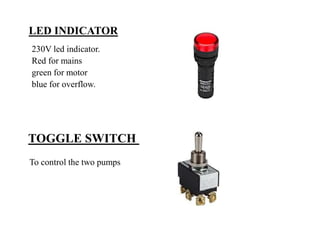
LED INDICATOR
230V led indicator.
Red for mains
green for motor
blue for overflow.
TOGGLE SWITCH
To control the two pumps
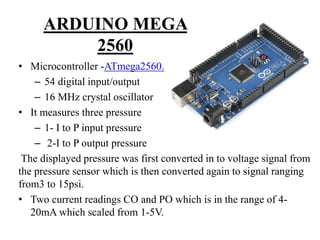
ARDUINO MEGA
2560
• Microcontroller -ATmega2560.
– 54 digital input/output
– 16 MHz crystal oscillator
• It measures three pressure
– 1- I to P input pressure
– 2-I to P output pressure
The displayed pressure was first converted in to voltage signal from
the pressure sensor which is then converted again to signal ranging
from3 to 15psi.
• Two current readings CO and PO which is in the range of 4-
20mA which scaled from 1-5V.
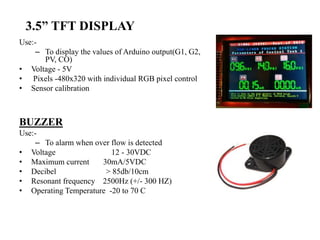
3.5” TFT DISPLAY
Use:-
– To display the values of Arduino output(G1, G2,
PV, CO)
• Voltage - 5V
• Pixels -480x320 with individual RGB pixel control
• Sensor calibration
BUZZER
Use:-
– To alarm when over flow is detected
• Voltage 12 - 30VDC
• Maximum current 30mA/5VDC
• Decibel > 85db/10cm
• Resonant frequency 2500Hz (+/- 300 HZ)
• Operating Temperature -20 to 70 C
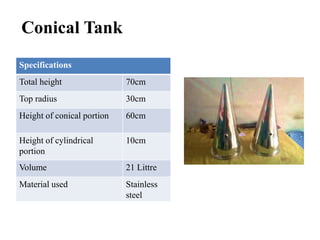
Conical Tank
Specifications
Total height 70cm
Top radius 30cm
Height of conical portion 60cm
Height of cylindrical
portion
10cm
Volume 21 Littre
Material used Stainless
steel
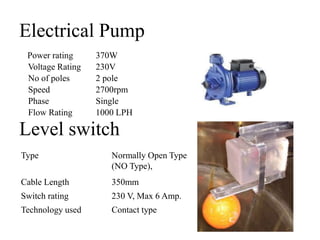
Electrical Pump
Power rating 370W
Voltage Rating 230V
No of poles 2 pole
Speed 2700rpm
Phase Single
Flow Rating 1000 LPH
Level switch
Type Normally Open Type
(NO Type),
Cable Length 350mm
Switch rating 230 V, Max 6 Amp.
Technology used Contact type
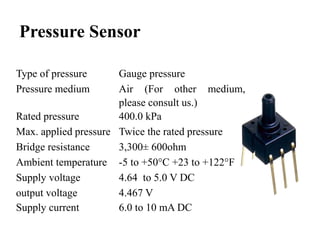
Pressure Sensor
Type of pressure Gauge pressure
Pressure medium Air (For other medium,
please consult us.)
Rated pressure 400.0 kPa
Max. applied pressure Twice the rated pressure
Bridge resistance 3,300± 600ohm
Ambient temperature -5 to +50°C +23 to +122°F
Supply voltage 4.64 to 5.0 V DC
output voltage 4.467 V
Supply current 6.0 to 10 mA DC
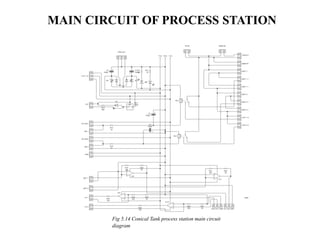
Fig 5.14 Conical Tank process station main circuit
diagram
MAIN CIRCUIT OF PROCESS STATION
Difficulties Faced
• Four of our op-amps got replaced due to short
circuiting.
• The level sensors showed different behavior.
• Purchasing components was very difficult due
to unavailability.
• Designing the frame and conical tanks was the
biggest challenge due to complex interfacing
from other station.
• Designing and manufacturing of the PCB is
challenging
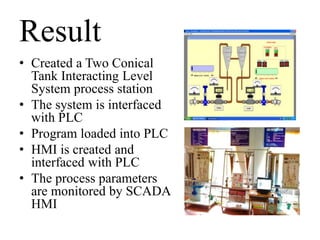
Result
• Created a Two Conical
Tank Interacting Level
System process station
• The system is interfaced
with PLC
• Program loaded into PLC
• HMI is created and
interfaced with PLC
• The process parameters
are monitored by SCADA
HMI
Conclusion & Future Scope
• Combination of two process station to create
this system greatly reduced the cost.
• This kind of setting up of system is an
example for other instrumentation labs in
various other institutions.
• This system is capable of been tried out with
various algorithms for further research.
References
• Marshiana.D , Thirusakthimurugan.P , “Design of
Deadbeat Algorithm for a Nonlinear Conical tank
system” , 21st October 1986 , Revised on 29th April 1987.
• V.R Ravi, T. Thyagarajan , S.Yammuna Priyadharshni ,”
Gain Scheduling Adaptive Model Predictive Controller
for Two Conical Tank Interacting Level System” , on
Computer Communication & Networking Technology,
IEEE, 2012 3rd International Confrence
• V.R Ravi, T. Thyagarajan, B. Puviyarasi , Centralised
Neuro Controller for Two Conical Tank Interacting
Level System, on Advanced Communication Control and
Computing Technology(ICACCT),IEEE , 2012
International Conference.
Ratio controller in two conical tank interacting level system

Ratio controller in two conical tank interacting level system

  • 1.
    Design and Implementationof Ratio controller in Two Conical Tank Interacting Level System using PLC and SCADA Group members Akhil K J Jeinlal M V Rajath P Shelton Shibu Guided by :Mr CLINT AUGUSTIN Main Project
  • 2.
    Problem Statement • Conicalshaped tank systems are used at industry for easy drainage of products. • The controlling of industrial equipment's are done through the PLC. • The main issue was level control of liquid in a conical tank due to its change in cross- section and non linearity of the tank • Faced in most of the hydrometallurgical ,food, chemical industries and waste treatment plants
  • 3.
    Our Missions • Designa non linear interacting system • Create a ratio controller using ladder diagram in PLC. • Monitor the process parameters through SCADA • Change the controller parameters through SCADA • Designed and created two conical tank interacting level system • Designed and created ratio controller using PLC and monitored through SCADA HMI Missions Accomplished
  • 4.
    Literature Survey • DynamicMatrix Control of a Two Conical Tank Interacting Level System- Science Direct Procedia Engineering, Volume 38, 2012, Pages 2601-2610,V.R. Ravi, T. Thyagarajan, G. Umaaheshwaran • In this dynamic matrix control which meets the design specifications for MIMO systems which is often complicated due to variation in process dynamics, that occur because of change in operating point of nonlinear dynamic coupling are described. • Centralized Neuro Controller for Two Conical Tank Interacting Level System.ieeexplore Year: 2012, V. R. Ravi; T. Thyagarajan; B. Puviyarasi • In this paper dynamic uncertainty associated with MIMO systems make existing model based decoupling impractical for real time system. This work presents control of non linear Two Conical Tank Interacting Level System (TCTILS) using centralised Neuro controller. • Gain Scheduling Adaptive Model Predictive Controller for Two Conical Tank Interacting Level System.-ieeexplore Year: 2012, V. R. Ravi; T. Thyagarajan; S. Yammuna Priyadharshni • Gain scheduling adaptive (GSA) control strategy for MPC controller is investigated on Two Conical Tank Interacting Level System (TCTILS) through computer simulation. • Design and Implementation of Two Tank Conical Interacting System Using Intelligent Technique (PSO).-ieeexplore Year: 2015, K. Malarvizhi;R. Kiruba • This paper deals with the modeling and control of highly Nonlinear system using intelligent technique namely Particle Swarm Optimization (PSO). Control of process or process variable in process industries always employ a nonlinear system i.e., Two Tank Interacting Conical tank System (TTICS)
  • 5.
    Two Conical TankInteracting Level System • Mechanical setup for testing control algorithms for non linear process • Components ⁻ Two conical tanks ⁻ PLC ⁻ Two DPTs ⁻ Water level gauge ⁻ Mechanical structure • System consist of components of two nearby stations ⁻ Reservoir tank ⁻ Pump ⁻ Rotameter ⁻ Control valve ⁻ I to P converter
  • 6.
    Process control Components ofThe system 1. Sensors 2. PLC 3. Actuators 4. HMI
  • 7.
  • 8.
    Controlling device PLC Programming method Ladderdiagram Communication RS232 Controller…….
  • 9.
    Sensors and actuators Sensors Differentialpressure transmitter Actuators Pneumatic control valves
  • 10.
  • 11.
    1. Read levelby DPT 2. Convert current signal to voltage signals 3. Read the voltage signal by PLC 4. Produce an output signal according to the level conditions 5. Convert the output voltage signal into current signal 6. Convert the current signal to pressure signal 7. Pressure signal produces the stem movement in the control valve 8. Control valve control the flow rate hence the level in the tank. CONTROL LOOPACTIONS
  • 12.
    SOFTWARE USED WPLSoft • ForPLC programming • Monitor the set value or temporarily saved value in the timer(t),counter(c), and register (D) and force on/off of output contacts • Designed by DELTA ELECTRONICS • Built in antivirus include.
  • 13.
    SOFTWARE USED……. INTOUCH • Supervisorycontrol and data acquisition software. – 1 development + runtime + network (DRN) – 2 runtime + network (RN). • The intouch software package consist of tags • Factorysuite, -for monitoring the process. • HMI applications
  • 14.
    COMPONENTS USED ABB DPT266 DSH Specifications Output signal(current) Two–wire 4 to 20 mA Power supply 9 to 32 V DC Output signal(HART) HART revision 5 Frequency band: 2.4 GHz DSSS Pressure range -40 kPa to 40 kPa Span 0.4 kPa Turn on time less than 10 s Process temperature limits –20 and 121 °C (–4 and 250 °F)
  • 15.
    Pneumatic control valve Specifications CharacteristicEqual percentage Temperatures –196 to 450 °C Nominal size DN 15 to 300 Actuator Type 3271 Pneumatic Valve body Cast iron Valve plug Metal seal Max flow 1000 LPH
  • 16.
    PLC DVP20-EX2 MPU Specifications •MPU points: 16 / 20 / 24 / 32 / 40 / 60 • Program capacity: 16k steps • Built-in with 3 COM ports: 1 RS-232 port and 2 RS-485 ports • Max. I/O points: 256 input points + 16 output points, or 256 output points + 16 input points • 12-bit 4AD/2DA • Built-in with 8 high-speed input points (2 points for 100 kHz, 6 points for 10 kHz) • motion control instructions • Application in emerging industry • Handy instructions for frequency inverter • Password protection
  • 17.
    Specifications Make: watson smith Inputair: 20psi constant pressure Signal input :( 4-20) ma Output: pneumatic signal (3-15) psi End connection: 1/2”BSP [F] thread I to P converter
  • 18.
    Single pole relay •Use To switch off the motor for avoid the chance of over flow • Operating voltage 5V • Max. current 100mA Double pole relay • Use to switch the connection of motors on nearby stations to the ‘two conical tank nonlinear interacting level process station’ • Operating voltage 12V • Max. current 200mA
  • 19.
    LED INDICATOR 230V ledindicator. Red for mains green for motor blue for overflow. TOGGLE SWITCH To control the two pumps
  • 20.
    ARDUINO MEGA 2560 • Microcontroller-ATmega2560. – 54 digital input/output – 16 MHz crystal oscillator • It measures three pressure – 1- I to P input pressure – 2-I to P output pressure The displayed pressure was first converted in to voltage signal from the pressure sensor which is then converted again to signal ranging from3 to 15psi. • Two current readings CO and PO which is in the range of 4- 20mA which scaled from 1-5V.
  • 21.
    3.5” TFT DISPLAY Use:- –To display the values of Arduino output(G1, G2, PV, CO) • Voltage - 5V • Pixels -480x320 with individual RGB pixel control • Sensor calibration BUZZER Use:- – To alarm when over flow is detected • Voltage 12 - 30VDC • Maximum current 30mA/5VDC • Decibel > 85db/10cm • Resonant frequency 2500Hz (+/- 300 HZ) • Operating Temperature -20 to 70 C
  • 22.
    Conical Tank Specifications Total height70cm Top radius 30cm Height of conical portion 60cm Height of cylindrical portion 10cm Volume 21 Littre Material used Stainless steel
  • 23.
    Electrical Pump Power rating370W Voltage Rating 230V No of poles 2 pole Speed 2700rpm Phase Single Flow Rating 1000 LPH Level switch Type Normally Open Type (NO Type), Cable Length 350mm Switch rating 230 V, Max 6 Amp. Technology used Contact type
  • 24.
    Pressure Sensor Type ofpressure Gauge pressure Pressure medium Air (For other medium, please consult us.) Rated pressure 400.0 kPa Max. applied pressure Twice the rated pressure Bridge resistance 3,300± 600ohm Ambient temperature -5 to +50°C +23 to +122°F Supply voltage 4.64 to 5.0 V DC output voltage 4.467 V Supply current 6.0 to 10 mA DC
  • 25.
    Fig 5.14 ConicalTank process station main circuit diagram MAIN CIRCUIT OF PROCESS STATION
  • 26.
    Difficulties Faced • Fourof our op-amps got replaced due to short circuiting. • The level sensors showed different behavior. • Purchasing components was very difficult due to unavailability. • Designing the frame and conical tanks was the biggest challenge due to complex interfacing from other station. • Designing and manufacturing of the PCB is challenging
  • 27.
    Result • Created aTwo Conical Tank Interacting Level System process station • The system is interfaced with PLC • Program loaded into PLC • HMI is created and interfaced with PLC • The process parameters are monitored by SCADA HMI
  • 28.
    Conclusion & FutureScope • Combination of two process station to create this system greatly reduced the cost. • This kind of setting up of system is an example for other instrumentation labs in various other institutions. • This system is capable of been tried out with various algorithms for further research.
  • 29.
    References • Marshiana.D ,Thirusakthimurugan.P , “Design of Deadbeat Algorithm for a Nonlinear Conical tank system” , 21st October 1986 , Revised on 29th April 1987. • V.R Ravi, T. Thyagarajan , S.Yammuna Priyadharshni ,” Gain Scheduling Adaptive Model Predictive Controller for Two Conical Tank Interacting Level System” , on Computer Communication & Networking Technology, IEEE, 2012 3rd International Confrence • V.R Ravi, T. Thyagarajan, B. Puviyarasi , Centralised Neuro Controller for Two Conical Tank Interacting Level System, on Advanced Communication Control and Computing Technology(ICACCT),IEEE , 2012 International Conference.